tow HUMMER H3 2010 Repair Manual
[x] Cancel search | Manufacturer: HUMMER, Model Year: 2010, Model line: H3, Model: HUMMER H3 2010Pages: 410, PDF Size: 2.24 MB
Page 350 of 410
10-84 Vehicle Care
Secondary Latch System
This vehicle has an underbody
mounted tire hoist assembly that
has a secondary latch system. It is
designed to stop the spare tire from
suddenly falling off the vehicle if
the cable holding the spare tire is
damaged. For the secondary latch
to work, the tire must be stowed
with the valve stem pointing down.
SeeTire Changing (H3T)
on
page 10‑66or Tire Changing (H3)on page 10‑75for instructions on
storing the spare tire correctly.
{WARNING
Before beginning this procedure
read all the instructions. Failure to
read and follow the instructions
could damage the hoist assembly
and you and others could get
hurt. Read and follow the
instructions listed next. To release the spare tire from the
secondary latch:
{WARNING
Someone standing too close
during the procedure could be
injured by the jack. If the spare
tire does not slide off the jack
completely, make sure no one is
behind you or on either side of
you as you pull the jack out from
under the spare.
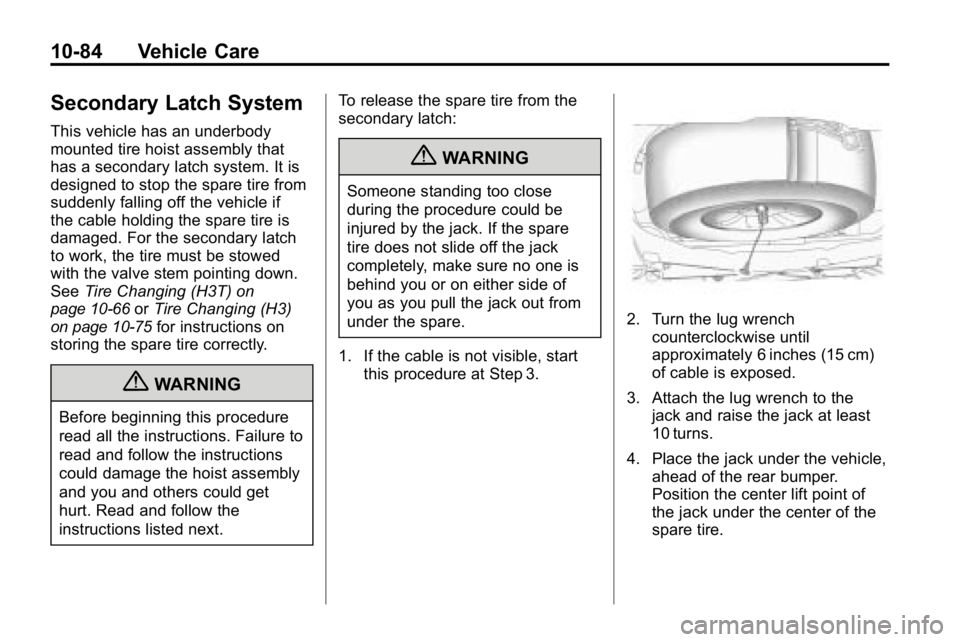
1. If the cable is not visible, start this procedure at Step 3.
2. Turn the lug wrench
counterclockwise until
approximately 6 inches (15 cm)
of cable is exposed.
3. Attach the lug wrench to the jack and raise the jack at least
10 turns.
4. Place the jack under the vehicle, ahead of the rear bumper.
Position the center lift point of
the jack under the center of the
spare tire.
Page 356 of 410
10-90 Vehicle Care
Towing
Towing the Vehicle
To avoid damage, the disabled
vehicle should be towed with all
four wheels off the ground. Consult
your dealer or a professional towing
service if the disabled vehicle must
be towed. SeeRoadside Service
on
page 13‑5.
To tow the vehicle behind
another vehicle for recreational
purposes —such as behind a
motorhome, see “Recreational
Vehicle Towing” following.
Recreational Vehicle
Towing
Recreational vehicle towing
means towing the vehicle behind
another vehicle–such as behind
a motorhome. The two most
common types of recreational
vehicle towing are known as “dinghy
towing” — towing the vehicle with
all four wheels on the ground, and “dolly towing” —
towing the vehicle
with two wheels on the ground and
two wheels up on a device known
as a “dolly”.
Here are some important things to
consider before recreational vehicle
towing:
.What is the towing capacity of
the tow vehicle? Be sure to read
the tow vehicle manufacturer's
recommendations.
.What is the distance that will be
travelled? Some vehicles have
restrictions on how far and how
long they can tow.
.Is the proper towing equipment
going to be used? See your
dealer or trailering professional
for additional advice and
equipment recommendations.
.Is the vehicle ready to be
towed? Just as preparing the
vehicle for a long trip, make sure
the vehicle is prepared to be
towed.
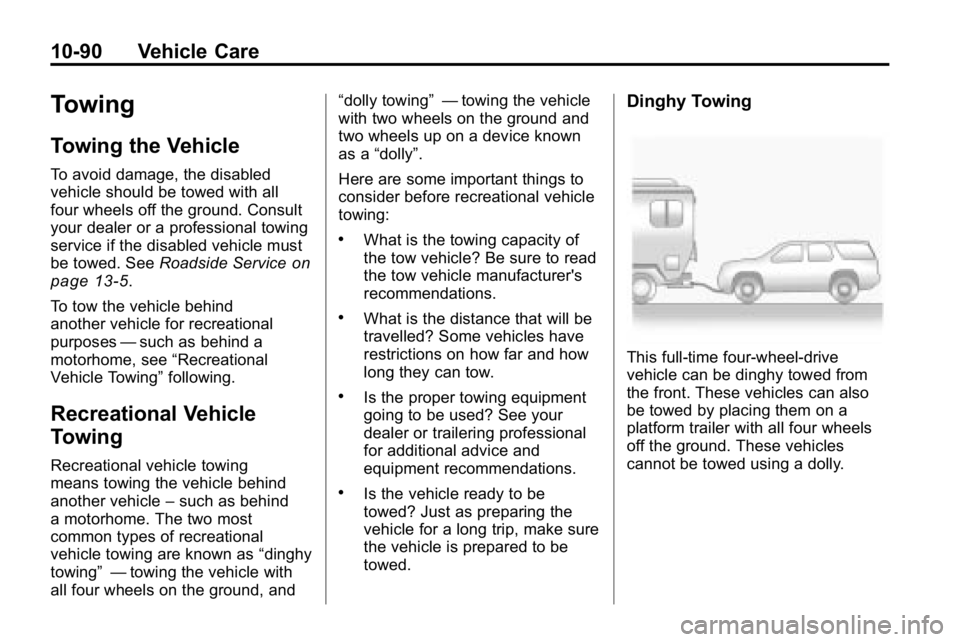
Dinghy Towing
This full‐time four‐wheel‐drive
vehicle can be dinghy towed from
the front. These vehicles can also
be towed by placing them on a
platform trailer with all four wheels
off the ground. These vehicles
cannot be towed using a dolly.
Page 357 of 410
Vehicle Care 10-91
Use the following procedure to tow
the vehicle:
1. Put the transmission in P (Park)for an automatic transmission
or in 1 (First) for a manual
transmission.
2. Turn the engine off, but leave the ignition in ACC/
ACCESSORY.
3. Firmly set the parking brake.
4. Securely attach the vehicle being towed to the tow vehicle.
{WARNING
Shifting a full‐time four‐wheel‐
drive vehicle's transfer case into
N (Neutral) can cause the vehicle
to roll even if the automatic
transmission is in P (Park) or the
manual transmission is in any
gear. You or others could be
injured. Make sure the parking
brake is firmly set before the
transfer case is shifted to
N (Neutral). 5. Shift the transfer case to
N (Neutral). See Four-Wheel
Drive
on page 9‑46for the
proper procedure to select the
N (Neutral) position for the
vehicle.
6. Release the parking brake only after the vehicle being towed
is firmly attached to the tow
vehicle.
7. Make sure the ignition is in ACC/ACCESSORY.
When towing the vehicle for
extended periods of time, start the
vehicle as often as possible to
prevent battery drain. This should
only be done when the tow vehicle
is parked.
After towing, see “Shifting Out of
NEUTRAL” underFour-Wheel Drive
on page 9‑46.
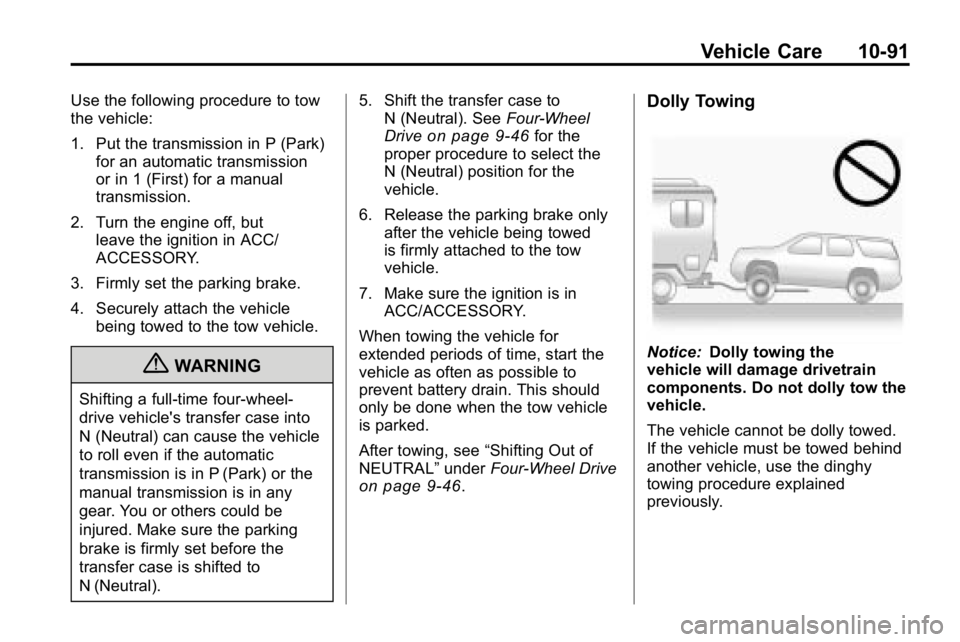
Dolly Towing
Notice: Dolly towing the
vehicle will damage drivetrain
components. Do not dolly tow the
vehicle.
The vehicle cannot be dolly towed.
If the vehicle must be towed behind
another vehicle, use the dinghy
towing procedure explained
previously.
Page 359 of 410
Vehicle Care 10-93
Washing the Vehicle
To preserve the vehicle's finish,
keep it clean by washing it often.
Do not wash the vehicle in direct
sunlight and use a car
washing soap.
Notice:Certain cleaners contain
chemicals that can damage the
emblems or nameplates on the
vehicle. Check the cleaning
product label. If it states that it
should not be used on plastic
parts, do not use it on the vehicle
or damage may occur and it
would not be covered by the
warranty.
Do not use cleaning agents that are
petroleum based or that contain
acid or abrasives, as they can
damage the paint, metal or plastic
on the vehicle. Approved cleaning
products can be obtained from your
dealer. Follow all manufacturer
directions regarding correct product
usage, necessary safety precautions and appropriate
disposal of any vehicle care
product.
Rinse the vehicle well, before
washing and after to remove all
cleaning agents completely. If they
are allowed to dry on the surface,
they could stain.
Dry the finish with a soft, clean
chamois or an all-cotton towel to
avoid surface scratches and water
spotting.
High pressure car washes could
cause water to enter the vehicle.
Avoid using high pressure washes
closer than 30 cm (12 inches) to the
surface of the vehicle. Use of power
washers exceeding 8,274 kPa
(1,200 psi) can result in damage or
removal of paint and decals.
Notice:
Conveyor systems on
some automatic car washes could
damage the vehicle. There may
not be enough clearance for the
undercarriage. Check with the car
wash manager before using the
automatic car wash.
Weatherstrips
Silicone grease on weatherstrips will
make them last longer, seal better,
and not stick or squeak. Apply
silicone grease with a clean cloth.
During very cold, damp weather
frequent application may be
required. See “Fluids and
Lubricants” in the Index of the
“Maintenance and Warranty and
Owner assistance Information”
manual.
Page 360 of 410
10-94 Vehicle Care
Wheels and Trim—Aluminum
or Chrome
The vehicle may have either
aluminum or chrome-plated wheels.
Keep the wheels clean using a soft
clean cloth with mild soap and
water. Rinse with clean water. After
rinsing thoroughly, dry with a soft
clean towel. A wax may then be
applied.
Notice: Chrome wheels and other
chrome trim may be damaged if
the vehicle is not washed after
driving on roads that have been
sprayed with magnesium, calcium
or sodium chloride. These
chlorides are used on roads
for conditions such as ice and
dust. Always wash the vehicle's
chrome with soap and water after
exposure. Notice:
Using strong soaps,
chemicals, abrasive polishes,
cleaners, brushes, or cleaners
that contain acid on aluminum
or chrome-plated wheels, could
damage the surface of the
wheel(s). The repairs would not
be covered by the vehicle
warranty. Use only approved
cleaners on aluminum or
chrome-plated wheels.
The surface of these wheels is
similar to the painted surface of the
vehicle. Do not use strong soaps,
chemicals, abrasive polishes,
abrasive cleaners, cleaners with
acid, or abrasive cleaning brushes
on them because the surface could
be damaged. Do not use chrome
polish on aluminum wheels. Notice:
Using chrome polish on
aluminum wheels could damage
the wheels. The repairs would
not be covered by the vehicle
warranty. Use chrome polish on
chrome wheels only.
Use chrome polish only on
chrome-plated wheels, but avoid
any painted surface of the wheel,
and buff off immediately after
application.
Notice: Driving the vehicle
through an automatic car wash
that has silicone carbide tire
cleaning brushes, could damage
the aluminum or chrome-plated
wheels. The repairs would not be
covered by the vehicle warranty.
Never drive a vehicle that has
aluminum or chrome-plated
wheels through an automatic car
wash that uses silicone carbide
tire cleaning brushes.
Page 361 of 410
Vehicle Care 10-95
Windshield, Backglass, and
Wiper Blades
Clean the outside of the windshield
and backglass with glass cleaner.
Clean the rubber blades using a lint
free cloth or paper towel soaked
with windshield washer fluid or a
mild detergent. Wash the windshield
thoroughly when cleaning the
blades. Bugs, road grime, sap, and
a buildup of vehicle wash/wax
treatments may cause wiper
streaking. Replace the wiper blades
if they are worn or damaged.
Wipers can be damaged by:
.Extreme dusty conditions
.Sand and salt
.Heat and sun
.Snow and ice, without proper
removal
Tires
Use a stiff brush with tire cleaner to
clean the tires.
Notice:Using petroleum-based
tire dressing products on the
vehicle may damage the paint
finish and/or tires. When applying
a tire dressing, always wipe off
any overspray from all painted
surfaces on the vehicle.
Sheet Metal Damage
If the vehicle is damaged and
requires sheet metal repair or
replacement, make sure the body
repair shop applies anti-corrosion
material to parts repaired or
replaced to restore corrosion
protection.
Original manufacturer replacement
parts will provide the corrosion
protection while maintaining the
vehicle warranty.
Finish Damage
Any stone chips, fractures or deep
scratches in the finish should be
repaired right away. Bare metal will
corrode quickly and may develop
into major repair expense.
Minor chips and scratches can be
repaired with touch-up materials
available from your dealer. Larger
areas of finish damage can be
corrected in your dealer's/retailer's
body and paint shop.
Underbody Maintenance
Chemicals used for ice and snow
removal and dust control can collect
on the underbody. If these are not
removed, corrosion and rust can
develop on the underbody parts
such as fuel lines, frame, floor pan,
and exhaust system even though
they have corrosion protection.
Page 363 of 410
Vehicle Care 10-97
Do not clean the interior using the
following cleaners or techniques:
.Never use a knife or any other
sharp object to remove a soil
from any interior surface.
.Never use a stiff brush. It can
cause damage to the vehicle's
interior surfaces.
.Never apply heavy pressure or
rub aggressively with a cleaning
cloth. Use of heavy pressure can
damage the interior and does
not improve the effectiveness of
soil removal.
.Use only mild, neutral-pH soaps.
Avoid laundry detergents or
dishwashing soaps with
degreasers. Using too much
soap will leave a residue that
leaves streaks and attracts dirt.
For liquid cleaners, about
20 drops per 3.78 L (1 gal) of
water is a good guide.
.Do not heavily saturate the
upholstery while cleaning.
.Damage to the vehicle's interior
may result from the use of many
organic solvents such as naptha,
alcohol, etc.
Fabric/Carpet
Use a vacuum cleaner with a soft
brush attachment to remove dust
and loose dirt. A canister vacuum
with a beater bar in the nozzle may
only be used on floor carpet and
carpeted floor mats. For soils,
always try to remove them first with
plain water or club soda. Before
cleaning, gently remove as much of
the soil as possible using one of the
following techniques:
.For liquids: gently blot the
remaining soil with a paper
towel. Allow the soil to absorb
into the paper towel until no
more can be removed.
.For solid dry soils: remove as
much as possible and then
vacuum.To clean:
1. Saturate a lint-free, clean white
cloth with water or club soda.
2. Remove excess moisture.
3. Start on the outside edge of the soil and gently rub toward the
center. Continue cleaning, using
a clean area of the cloth each
time it becomes soiled.
4. Continue to gently rub the soiled area.
5. If the soil is not completely removed, use a mild soap
solution and repeat the cleaning
process with plain water.
If any of the soil remains, a
commercial fabric cleaner or spot
lifter may be necessary. Test a small
hidden area for colorfastness before
using a commercial upholstery
cleaner or spot lifter. If the locally
cleaned area gives any impression
that a ring formation may result,
clean the entire surface.
Page 364 of 410
10-98 Vehicle Care
A paper towel can be used to blot
excess moisture from the fabric or
carpet after the cleaning process.
Leather
To remove dust, a soft cloth
dampened with water can be used.
If a more thorough cleaning is
necessary, a soft cloth dampened
with a mild soap solution can be
used. Allow the leather to dry
naturally. Do not use heat, steam,
or spot lifters or spot removers,
or shoe polish on leather. Many
commercial leather cleaners
and coatings that are sold to
preserve and protect leather
may permanently change the
appearance and feel of the leather
and are not recommended. Do
not use silicone or wax-based
products, or those containing
organic solvents to clean the
vehicle's interior because they can
alter the appearance by increasing
the gloss in a non-uniform manner.
Instrument Panel, Vinyl, and
Other Plastic Surfaces
To remove dust, a soft cloth
dampened with water can be used.
If a more thorough cleaning is
necessary, a clean soft cloth
dampened with a mild soap solution
can be used to gently remove dust
and dirt. Never use spot lifters or
removers on plastic surfaces.
Many commercial cleaners and
coatings that are sold to preserve
and protect soft plastic surfaces
may permanently change the
appearance and feel of the interior
and are not recommended. Do
not use silicone or wax-based
products, or those containing
organic solvents to clean the
vehicle's interior because they can
alter the appearance by increasing
the gloss in a non-uniform manner.Some commercial products may
increase gloss on the instrument
panel. The increase in gloss may
cause annoying reflections in the
windshield and even make it difficult
to see through the windshield under
certain conditions.
Care of Safety Belts
Keep belts clean and dry.
{WARNING
Do not bleach or dye safety belts.
It may severely weaken them. In
a crash, they might not be able
to provide adequate protection.
Clean safety belts only with mild
soap and lukewarm water.
Page 369 of 410

Service and Maintenance 11-5
.Exhaust system and nearby heat
shields inspection for loose or
damaged components.
.Accelerator pedal check for
damage, high effort, or binding.
Replace if needed.
First Engine Oil Change After
Every 40 000 km/25,000 Miles
.Fuel system inspection for
damage or leaks.
First Engine Oil Change After
Every 80 000 km/50,000 Miles
.Engine air cleaner filter
replacement. See Engine Air
Cleaner/Filter on page 10‑17.
.Automatic transmission fluid
change (severe service) for
vehicles mainly driven in heavy
city traffic in hot weather, in
hilly or mountainous terrain,
when frequently towing a
trailer, or used for taxi, police,
or delivery service. See
Automatic Transmission Fluid
on
page 10‑12.
.Four‐wheel drive only: Transfer
case fluid change. Check vent
hose at transfer case for kinks
and proper installation. Check
to be sure vent hose is
unobstructed, clear, and free of
debris. During any maintenance,
if a power washer is used to
clean mud and dirt from the
underbody, care should be taken
to not directly spray the transfer
case output seals. High pressure
water can overcome the seals
and contaminate the transfer
case fluid. Contaminated fluid
will decrease the life of the
transfer case and should be
replaced.
First Engine Oil Change After
Every 160 000 km/100,000 Miles
.Automatic transmission fluid
change (normal service).
See Automatic Transmission
Fluid on page 10‑12.
.Rear axle fluid change (normal
service). See Rear Axleon
page 10‑29.
.Spark plug replacement and
spark plug wires inspection.
An Emission Control Service.
First Engine Oil Change After
Every 240 000 km/150,000 Miles
.Engine cooling system drain,
flush, and refill, cooling system
and cap pressure check, and
cleaning of outside of radiator
and air conditioning condenser
(or every 5 years, whichever
occurs first). See Cooling
System
on page 10‑18. An
Emission Control Service.
.Engine accessory drive belt
inspection for fraying, excessive
cracks, or obvious damage
and replacement, if needed.
An Emission Control Service.
Page 388 of 410
13-6 Customer Information
Services Provided
.Emergency Fuel Delivery:
Delivery of enough fuel for the
vehicle to get to the nearest
service station.
.Lock‐Out Service:Service is
provided to unlock the vehicle if
you are locked out. A remote
unlock may be available if you
have OnStar
®. For security
reasons, the driver must present
identification before this service
is given.
.Emergency Tow From a Public
Road or Highway: Tow to the
nearest HUMMER dealer for
warranty service, or if the vehicle
was in a crash and cannot be
driven.
.Flat Tire Change: Service is
provided to change a flat tire
with spare tire. The spare tire,
if equipped, must be in good
condition and properly inflated.
It is your responsibility for the
repair or replacement of the
tire if it is not covered by the
warranty.
.Battery Jump Start: Service is
provided to jump start a dead
battery.
.Trip Routing Service: Detailed
maps of North America are
provided when requested either
with the most direct route or the
most scenic route. Additional
travel information is also
available. Allow three weeks
for delivery.
.Trip Interruption Benefits and
Assistance: If your trip is
interrupted due to a warranty
failure, incidental expenses
may be reimbursed during
the 5 year/100,000 miles
(160 000 km) Powertrain
warranty period. Items
considered are hotel, meals,
and rental car.
HUMMER Technician Roadside
Service (U.S. only)
HUMMER's exceptional Roadside
Service is more than an auto
club or towing service. It provides
every HUMMER owner in the
United States with the advantage of
contacting a HUMMER advisor and,
where available, a HUMMER trained
dealer technician who can provide
on-site service.