transmission HUMMER H3 2010 Repair Manual
[x] Cancel search | Manufacturer: HUMMER, Model Year: 2010, Model line: H3, Model: HUMMER H3 2010Pages: 410, PDF Size: 2.24 MB
Page 314 of 410
10-48 Vehicle Care
(E) Rim Diameter:Diameter of
the wheel in inches.
(F) Load Range
:Load Range.
(G) Service Description
:The
service description indicates the
load index and speed rating of a
tire. If two numbers are given as
in the example, 120/116, then
this represents the load index for
single versus dual wheel usage
(single/dual). The speed rating is
the maximum speed a tire is
certified to carry a load.
Tire Terminology and
Definitions
Air Pressure:The amount
of air inside the tire pressing
outward on each square inch
of the tire. Air pressure is
expressed in psi (pounds per
square inch) or kPa (kilopascal). Accessory Weight
:This
means the combined weight
of optional accessories.
Some examples of optional
accessories are, automatic
transmission, power steering,
power brakes, power windows,
power seats, and air
conditioning.
Aspect Ratio
:The relationship
of a tire's height to its width.
Belt
:A rubber coated layer of
cords that is located between
the plies and the tread. Cords
may be made from steel or other
reinforcing materials.
Bead
:The tire bead contains
steel wires wrapped by steel
cords that hold the tire onto
the rim. Bias Ply Tire
:A pneumatic tire
in which the plies are laid at
alternate angles less than
90 degrees to the centerline of
the tread.
Cold Tire Pressure
:The
amount of air pressure in a tire,
measured in psi (pounds per
square inch) or kPa (kilopascal)
before a tire has built up heat
from driving. See Tire Pressure
on page 10‑51.
Curb Weight
:The weight of a
motor vehicle with standard and
optional equipment including
the maximum capacity of fuel,
oil, and coolant, but without
passengers and cargo.
Page 353 of 410
Vehicle Care 10-87
You would not be able to start
your vehicle, and the bad
grounding could damage the
electrical systems.
To avoid the possibility of the
vehicles rolling, set the parking
brake firmly on both vehicles
involved in the jump start
procedure. Put an automatic
transmission in P (Park) or a
manual transmission in Neutral
before setting the parking brake.
If you have a four-wheel-drive
vehicle, be sure the transfer
case is not in Neutral.
Notice: If you leave the radio or
other accessories on during the
jump starting procedure, they
could be damaged. The repairs
would not be covered by the
warranty. Always turn off the
radio and other accessories
when jump starting the vehicle. 3. Turn off the ignition on both
vehicles. Unplug unnecessary
accessories plugged into the
cigarette lighter or the accessory
power outlets. Turn off the radio
and all lamps that are not
needed. This will avoid sparks
and help save both batteries.
And it could save the radio!
4. Open the hoods and locate the batteries on both vehicles. You
will use the positive (+) battery
terminal and the remote
negative (−) jump starting
terminal to jump start your
vehicle. To access the
positive (+) battery terminal,
open the terminal cover. See
Engine Compartment Overview
on page 10‑6for more
information on the terminal
locations.
{WARNING
Using a match near a battery can
cause battery gas to explode.
People have been hurt doing this,
and some have been blinded.
Use a flashlight if you need more
light.
Be sure the batteries have
enough water. You do not need
to add water to the ACDelco
®
battery (or batteries) installed in
your new vehicle. But if a battery
has filler caps, be sure the right
amount of fluid is there. If it is low,
add water to take care of that
first. If you do not, explosive gas
could be present.
Battery fluid contains acid that
can burn you. Do not get it on
you. If you accidentally get it in
your eyes or on your skin, flush
the place with water and get
medical help immediately.
Page 357 of 410
Vehicle Care 10-91
Use the following procedure to tow
the vehicle:
1. Put the transmission in P (Park)for an automatic transmission
or in 1 (First) for a manual
transmission.
2. Turn the engine off, but leave the ignition in ACC/
ACCESSORY.
3. Firmly set the parking brake.
4. Securely attach the vehicle being towed to the tow vehicle.
{WARNING
Shifting a full‐time four‐wheel‐
drive vehicle's transfer case into
N (Neutral) can cause the vehicle
to roll even if the automatic
transmission is in P (Park) or the
manual transmission is in any
gear. You or others could be
injured. Make sure the parking
brake is firmly set before the
transfer case is shifted to
N (Neutral). 5. Shift the transfer case to
N (Neutral). See Four-Wheel
Drive
on page 9‑46for the
proper procedure to select the
N (Neutral) position for the
vehicle.
6. Release the parking brake only after the vehicle being towed
is firmly attached to the tow
vehicle.
7. Make sure the ignition is in ACC/ACCESSORY.
When towing the vehicle for
extended periods of time, start the
vehicle as often as possible to
prevent battery drain. This should
only be done when the tow vehicle
is parked.
After towing, see “Shifting Out of
NEUTRAL” underFour-Wheel Drive
on page 9‑46.
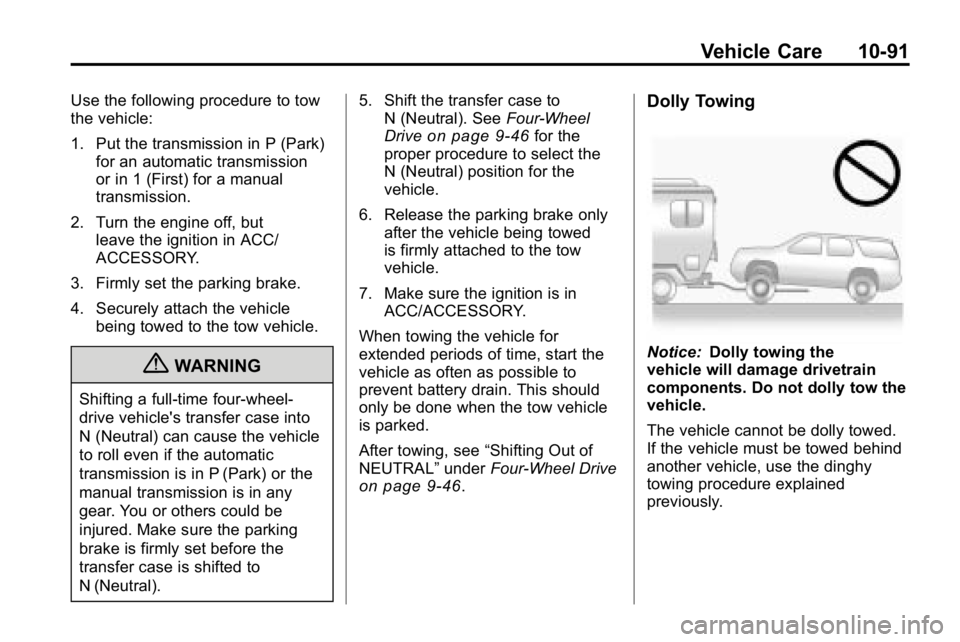
Dolly Towing
Notice: Dolly towing the
vehicle will damage drivetrain
components. Do not dolly tow the
vehicle.
The vehicle cannot be dolly towed.
If the vehicle must be towed behind
another vehicle, use the dinghy
towing procedure explained
previously.
Page 368 of 410

11-4 Service and Maintenance
.Windshield wiper blade
inspection for wear, cracking,
or contamination and windshield
and wiper blade cleaning,
if contaminated. SeeExterior
Care
on page 10‑92. Worn
or damaged wiper blade
replacement. See Wiper Blade
Replacement on page 10‑32.
.Body hinges and latches, key
lock cylinders, folding seat
hardware, and rear compartment
hinges, linkage, and handle
pivot points lubrication. See
Recommended Fluids and
Lubricants
on page 11‑8.
More frequent lubrication may
be required when vehicle
is exposed to a corrosive
environment. Applying silicone
grease on weatherstrips with a
clean cloth makes them last
longer, seal better, and not stick
or squeak.
.Restraint system component
check. See Safety System
Check on page 3‑26.
.Automatic transmission fluid
level check and adding fluid,
if needed. See Automatic
Transmission Fluid
on
page 10‑12.
.Four‐wheel drive vehicles:
Transfer case fluid level check
and adding fluid, if needed.
.Engine air cleaner filter
inspection. See Engine Air
Cleaner/Filter on page 10‑17.
Additional Required Services
At Each Fuel Stop
.Engine oil level check. See
Engine Oil on page 10‑9.
.Engine coolant level check. See
Engine Coolant on page 10‑19.
.Windshield washer fluid level
check. See Washer Fluidon
page 10‑25. Once a Month
.Tire inflation check. See
Tire
Pressure on page 10‑51.
.Tire wear inspection. See Tire
Inspection on page 10‑57.
Once a Year
.See Starter Switch Checkon
page 10‑30.
.See Automatic Transmission
Shift Lock Control System
Check on page 10‑30.
.See Ignition Transmission Lock
Check on page 10‑31.
.See Park Brake and P (Park)
Mechanism Checkon
page 10‑31.
.Engine cooling system and
pressure cap pressure check.
Radiator and air conditioning
condenser outside cleaning. See
Cooling System on page 10‑18.
Page 369 of 410

Service and Maintenance 11-5
.Exhaust system and nearby heat
shields inspection for loose or
damaged components.
.Accelerator pedal check for
damage, high effort, or binding.
Replace if needed.
First Engine Oil Change After
Every 40 000 km/25,000 Miles
.Fuel system inspection for
damage or leaks.
First Engine Oil Change After
Every 80 000 km/50,000 Miles
.Engine air cleaner filter
replacement. See Engine Air
Cleaner/Filter on page 10‑17.
.Automatic transmission fluid
change (severe service) for
vehicles mainly driven in heavy
city traffic in hot weather, in
hilly or mountainous terrain,
when frequently towing a
trailer, or used for taxi, police,
or delivery service. See
Automatic Transmission Fluid
on
page 10‑12.
.Four‐wheel drive only: Transfer
case fluid change. Check vent
hose at transfer case for kinks
and proper installation. Check
to be sure vent hose is
unobstructed, clear, and free of
debris. During any maintenance,
if a power washer is used to
clean mud and dirt from the
underbody, care should be taken
to not directly spray the transfer
case output seals. High pressure
water can overcome the seals
and contaminate the transfer
case fluid. Contaminated fluid
will decrease the life of the
transfer case and should be
replaced.
First Engine Oil Change After
Every 160 000 km/100,000 Miles
.Automatic transmission fluid
change (normal service).
See Automatic Transmission
Fluid on page 10‑12.
.Rear axle fluid change (normal
service). See Rear Axleon
page 10‑29.
.Spark plug replacement and
spark plug wires inspection.
An Emission Control Service.
First Engine Oil Change After
Every 240 000 km/150,000 Miles
.Engine cooling system drain,
flush, and refill, cooling system
and cap pressure check, and
cleaning of outside of radiator
and air conditioning condenser
(or every 5 years, whichever
occurs first). See Cooling
System
on page 10‑18. An
Emission Control Service.
.Engine accessory drive belt
inspection for fraying, excessive
cracks, or obvious damage
and replacement, if needed.
An Emission Control Service.
Page 371 of 410

Service and Maintenance 11-7
ServiceMaintenanceIMaintenance
II
Chassis components lubrication. •
Engine cooling system inspection. •
Windshield wiper blades inspection. •
Body components lubrication. •
Restraint system components check. •
Automatic transmission fluid level check. •
Four‐wheel drive only: Transfer case fluid level check. •
Engine air cleaner filter inspection (vehicles not driven in dusty conditions). •
Page 372 of 410
11-8 Service and Maintenance
Recommended Fluids, Lubricants, and Parts
Recommended Fluids and Lubricants
UsageFluid/Lubricant
Engine Oil Engine oil which meets GM Standard GM6094M and displays the
American Petroleum Institute Certified for Gasoline Engines starburst
symbol. To determine the proper viscosity for your vehicle's engine,
see
Engine Oil on page 10‑9.
Engine Coolant 50/50 mixture of clean, drinkable water and use only DEX-COOL
®Coolant.
See Engine Coolant on page 10‑19
Hydraulic Brake System DOT 3 Hydraulic Brake Fluid (GM Part No. U.S. 12377967,
in Canada 89021320).
Windshield Washer Optikleen
®Washer Solvent.
Hydraulic Power Steering System GM Power Steering Fluid (GM Part No. U.S. 89021184,
in Canada 89021186).
Automatic Transmission DEXRON
®‐VI Automatic Transmission Fluid.
Manual Transmission Manual Transmission Fluid (GM Part No. U.S. 89021806,
in Canada 89021807).
Hydraulic Clutch System Hydraulic Clutch Fluid (GM Part No. U.S. 12345347, in Canada 10953517)
or equivalent DOT-3 brake fluid.
Page 373 of 410
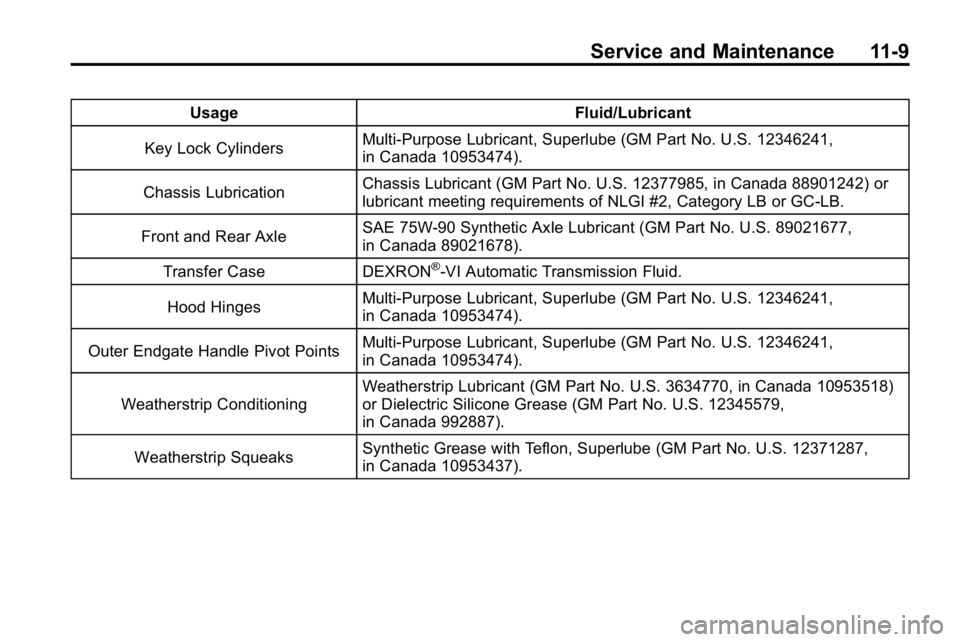
Service and Maintenance 11-9
UsageFluid/Lubricant
Key Lock Cylinders Multi-Purpose Lubricant, Superlube (GM Part No. U.S. 12346241,
in Canada 10953474).
Chassis Lubrication Chassis Lubricant (GM Part No. U.S. 12377985, in Canada 88901242) or
lubricant meeting requirements of NLGI #2, Category LB or GC-LB.
Front and Rear Axle SAE 75W-90 Synthetic Axle Lubricant (GM Part No. U.S. 89021677,
in Canada 89021678).
Transfer Case DEXRON
®‐VI Automatic Transmission Fluid.
Hood Hinges Multi-Purpose Lubricant, Superlube (GM Part No. U.S. 12346241,
in Canada 10953474).
Outer Endgate Handle Pivot Points Multi-Purpose Lubricant, Superlube (GM Part No. U.S. 12346241,
in Canada 10953474).
Weatherstrip Conditioning Weatherstrip Lubricant (GM Part No. U.S. 3634770, in Canada 10953518)
or Dielectric Silicone Grease (GM Part No. U.S. 12345579,
in Canada 992887).
Weatherstrip Squeaks Synthetic Grease with Teflon, Superlube (GM Part No. U.S. 12371287,
in Canada 10953437).
Page 381 of 410

Technical Data 12-3
Capacities and Specifications (cont'd)
ApplicationCapacities
Metric English
Transfer Case 1.5 L 1.6 qt
Transmission 3.7L L5 and 5.3L V8, Automatic Transmission
(Pan Removal and Filter Replacement) 4.7 L 5.0 qt
3.7L L5, Manual Transmission (Drain and Refill) 2.4 L 2.5 qt
Wheel Nut Torque 140 Y100 lb ft
All capacities are approximate. When adding, be sure to fill to the approximate level, as recommended in this
manual.
Engine Specifications
Engine VIN CodeTransmission Spark Plug Gap
3.7L L5 EAutomatic
Manual 1.01 mm (0.040 in)
5.3L V8 PAutomatic 1.01 mm (0.040 in)
Page 394 of 410
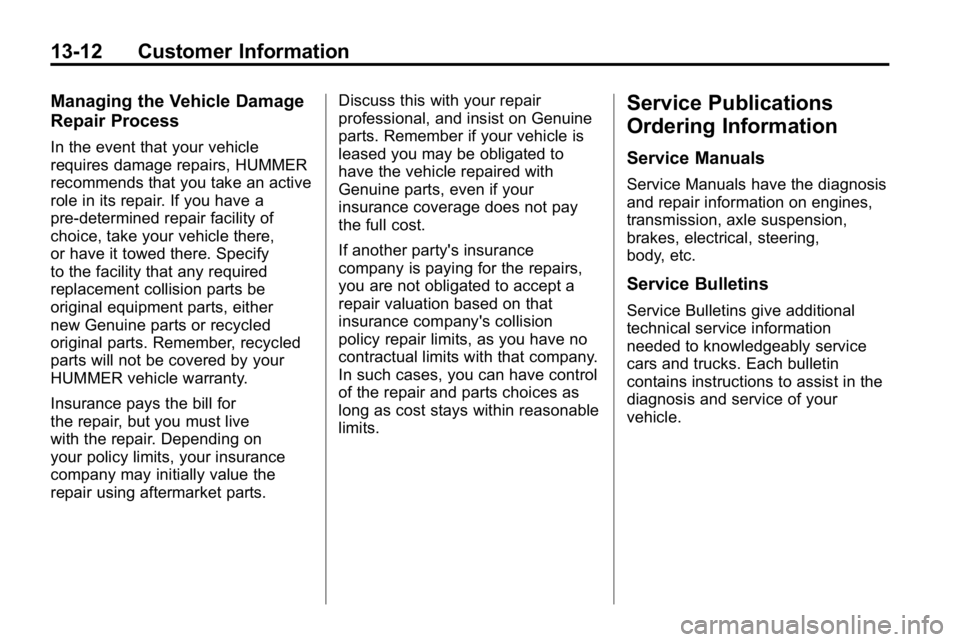
13-12 Customer Information
Managing the Vehicle Damage
Repair Process
In the event that your vehicle
requires damage repairs, HUMMER
recommends that you take an active
role in its repair. If you have a
pre-determined repair facility of
choice, take your vehicle there,
or have it towed there. Specify
to the facility that any required
replacement collision parts be
original equipment parts, either
new Genuine parts or recycled
original parts. Remember, recycled
parts will not be covered by your
HUMMER vehicle warranty.
Insurance pays the bill for
the repair, but you must live
with the repair. Depending on
your policy limits, your insurance
company may initially value the
repair using aftermarket parts.Discuss this with your repair
professional, and insist on Genuine
parts. Remember if your vehicle is
leased you may be obligated to
have the vehicle repaired with
Genuine parts, even if your
insurance coverage does not pay
the full cost.
If another party's insurance
company is paying for the repairs,
you are not obligated to accept a
repair valuation based on that
insurance company's collision
policy repair limits, as you have no
contractual limits with that company.
In such cases, you can have control
of the repair and parts choices as
long as cost stays within reasonable
limits.
Service Publications
Ordering Information
Service Manuals
Service Manuals have the diagnosis
and repair information on engines,
transmission, axle suspension,
brakes, electrical, steering,
body, etc.
Service Bulletins
Service Bulletins give additional
technical service information
needed to knowledgeably service
cars and trucks. Each bulletin
contains instructions to assist in the
diagnosis and service of your
vehicle.