Fluid Hyundai Accent 2003 User Guide
[x] Cancel search | Manufacturer: HYUNDAI, Model Year: 2003, Model line: Accent, Model: Hyundai Accent 2003Pages: 186, PDF Size: 11.36 MB
Page 121 of 186
WHAT TO DO IN AN EMERGENCY 3- 11
NOTE:Before towing, check the level of the tran-
saxle fluid. If it is below the "HOT" range on
the dipstick, add fluid. If you cannot add
fluid, a towing dolly must be used as de-
scribed above.
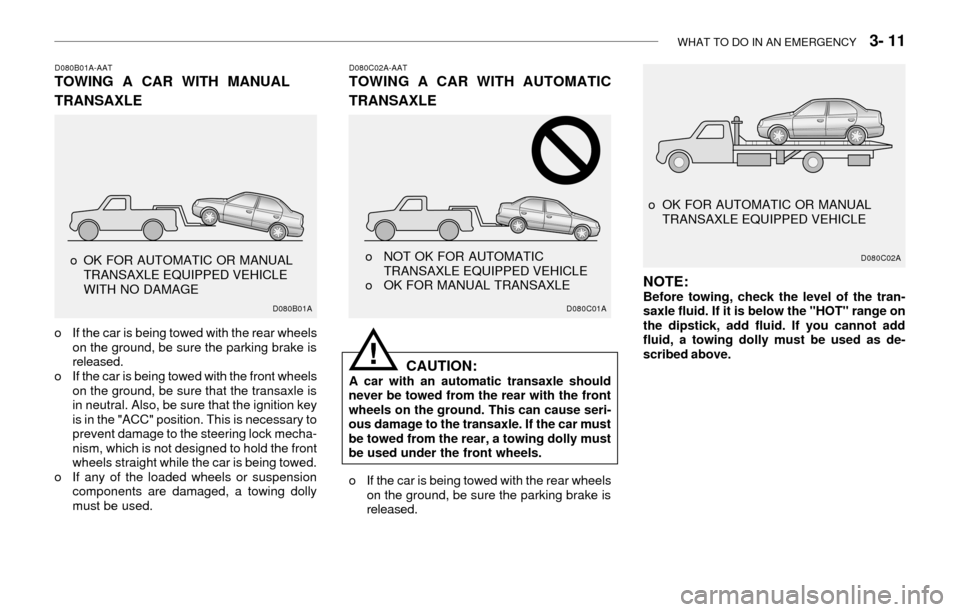
D080B01A-AATTOWING A CAR WITH MANUAL
TRANSAXLE
o If the car is being towed with the rear wheels
on the ground, be sure the parking brake is
released.
o If the car is being towed with the front wheels
on the ground, be sure that the transaxle is
in neutral. Also, be sure that the ignition key
is in the "ACC" position. This is necessary to
prevent damage to the steering lock mecha-
nism, which is not designed to hold the front
wheels straight while the car is being towed.
o If any of the loaded wheels or suspension
components are damaged, a towing dolly
must be used.
D080C02A-AATTOWING A CAR WITH AUTOMATIC
TRANSAXLE
CAUTION:
A car with an automatic transaxle should
never be towed from the rear with the front
wheels on the ground. This can cause seri-
ous damage to the transaxle. If the car must
be towed from the rear, a towing dolly must
be used under the front wheels.
D080B01A
o OK FOR AUTOMATIC OR MANUAL
TRANSAXLE EQUIPPED VEHICLE
WITH NO DAMAGE o NOT OK FOR AUTOMATIC
TRANSAXLE EQUIPPED VEHICLE
o OK FOR MANUAL TRANSAXLE
D080C01A
o If the car is being towed with the rear wheels
on the ground, be sure the parking brake is
released.
!
D080C02A
o OK FOR AUTOMATIC OR MANUAL
TRANSAXLE EQUIPPED VEHICLE
Page 126 of 186
4- 4 CORROSION PREVENTION AND APPEARANCE CARE
to the removal of salt, mud and other substanc-
es on the underside of the splashboards of the
car. Make sure that the outlets and the under-
side of the doors are open. Paint damage can be
caused by small accumulation of tar, industrial
precipitation, tree resin, insects and bird drop-
pings, when not removed immediately.
If water alone is not strong enough to remove
the accumulated dirt, use a mild car washing
solution. Be sure to rinse the surface after
washing to remove the solution. Never allow the
solution to dry on the painted surfaces.
E030B01A-AAT
Spot Cleaning
Don't use gasoline, strong solvents or corrosive
cleaning agents. These can damage the finish
of the car. To remove road tar, use turpentine on
a clean, soft cloth. Be gentle.
To remove dead insects or tree sap, use warm
water and mild soap or car-washing solution.
Soak the spot and rub gently. If the paint has
lost its luster, use a commercial car-cleaning
polish.
E030C01A-AATPolishing and Waxing
Always wash and dry the car before polishing or
waxing or using a combination cleaner and wax.
Use a good quality commercial product and
follow the manufacturer's directions on the con-
tainer. Polish and wax the bright trim pieces as
well as the paint.
E030D01A-AAT
When to Wax Again
You should polish and wax the car again when
water no longer beads on a clean surface but
spreads out over a larger area.
E030E01A-AAT
Maintaining Bumpers
Special precautions must be observed to pre-
serve the appearance of the bumpers on your
Hyundai. They are:
o Be careful not to spill battery electrolyte or
hydraulic brake fluid on the bumpers. If you
do, wash it off immediately with clean water.
o Be gentle when cleaning the bumper sur-
faces. They are made of soft plastic and the
surface can be damaged if mistreated. Do
not use abrasive cleaners. Use warm water
and mild soap or car-washing solution.o Do not expose the bumpers to high tem-
peratures. For example, if you have your
car repainted, do not leave the bumpers on
the car if the car is going to be placed in a
high-temperature paint booth.
E040A01A-AATCLEANING THE INTERIOR
To Clean the Vinyl Upholstery
To clean the vinyl upholstery, first remove loose
dirt and dust with a vacuum cleaner. Then apply
a solution of mild soap or detergent and water
using a clean sponge or soft cloth. Allow this to
stay on the surface to loosen the dirt, then wipe
with a clean damp sponge or cloth. If all the dirt
stains are not removed, repeat this procedure
until the upholstery is clean. Do not use gaso-
line, solvent, paint thinner or other strong clean-
ers.
E040C01A-AAT
Cleaning the Carpets
Use a foam-type carpet cleaner. Cleaners of
this type are available in aerosol cans in liquid
form or powder. Read the instructions and follow
them exactly. Using a vacuum cleaner with the
appropriate attachment, remove as much dirt
from the carpets as possible. Apply the foam
following the manufacturer's directions, then
rub in overlapping circles. Do not add water.
These cleaners work best when the carpet is
kept as dry as possible.
Page 129 of 186
5- 2 VEHICLE MAINTENANCE REQUIREMENTS
F010B01A-AATMaintenance Requirements
The maintenance required for your Hyundai can
be divided into three main areas:
o Specified scheduled procedures
o General checks
o Do-it-yourself maintenance
F010A01A-AATMAINTENANCE INTERVALS
Service Requirements
To ensure that you receive the greatest number
of miles of satisfying operation from your
Hyundai, certain maintenance procedures must
be performed. Although careful design and engi-
neering have reduced these to a minimum,
those that are required are of the utmost impor-
tance.
It is your responsibility to have these mainte-
nance procedures performed to comply with the
terms of the warranties covering your new
Hyundai. The Owner's Handbook supplied with
your new vehicle provides further information
about these warranties.
F010D01A-AAT
General Checks
These are the regular checks you should per-
form when you drive your Hyundai or you fill the
fuel tank. A list of these items will be found on
page 6-3.
F010C01A-AATSpecified Scheduled Procedures
These are the procedures such as inspections,
adjustments and replacements that are listed in
the maintenance charts starting on page 5-4.
These procedures must be performed at the
intervals shown in the maintenance schedule to
assure that your warranty remains in effect.
Although it is strongly recommended that they
be performed by the factory-trained or distribu-
tor-trained technicians at your Hyundai dealer,
these procedures may be performed at any
qualified service facility.
It is suggested that genuine Hyundai service
parts be used for any required repairs or re-
placements. Other parts of equivalent quality
such as engine oil, engine coolant, manual or
auto transaxle oil, brake fluid and so on which
are not supplied by Hyundai Motor Company or
its distributor may be used without affecting your
warranty coverage but you should always be
sure these are equivalent to the quality of the
original Hyundai parts. Your Service Passport
provides further information about your warranty
coverage.
F010F01A-AATA Few Tips
o Whenever you have your Hyundai serviced,
keep copies of the service records in your
glove box. This will help ensure that you can
document that the required procedures have
been performed to keep your warranties in
effect. This is especially important when ser-
vice is not performed by an authorized
Hyundai dealer.
o If you choose to do your own maintenance
and repairs, you may find it helpful to have
an official Hyundai Shop Manual. A copy of
this publication may be purchased at your
Hyundai dealer's parts department.
F010E01A-AATDo-It-Yourself Maintenance
If you are mechanically inclined, own a few tools
that are required and want to take the time to do
so, you can inspect and service a number of
items. For more information about doing it your-
self, see Section 6.
Page 132 of 186
VEHICLE MAINTENANCE REQUIREMENTS 5- 5
GENERAL ITEMS
DRIVE BELT (WATER PUMP, ALTERNATOR AND A/CON)
COOLANT
TIMING BELT
MANUAL TRANSAXLE OIL
AUTOMATIC TRANSAXLE FLUID
BRAKE FLUID
BRAKE HOSES AND LINES
REAR BRAKE DRUMS/LININGS, PARKING BRAKE
BRAKE PADS, CALIPERS AND ROTORS
EXHAUST PIPE AND MUFFLER
SUSPENSION MOUNTING BOLTS
STEERING GEAR BOX, LINKAGE & BOOTS/LOWER ARM
BALL JOINT
POWER STEERING PUMP, BELT AND HOSES
DRIVESHAFTS AND BOOTS
AIR CONDITIONING REFRIGERANT
AIR FILTER (For Evaporator and Blower unit) 1
2
3
4
5
6
7
8
9
10
11
12
13
14
15
16 No.DESCRIPTIONMILES X 1000
KILOMETERS X 1000
MONTHS7.5
12
615
24
12
I
I
I
I
I
I
I
I22.5
36
1830
48
24
I
I
I
I
I
I
I
I
I
I
I
I
I
I37.5
60
3045
72
36
I
I
I
I
I
I
I
I52.5
84
4260
96
48
I
R*
2
I
I
I
I
I
I
I
I
I
I
I
I67.5
108
5475
120
60
I
I
I
I
I
I
I
I82.5
132
6690
144
72
I
I
I
I
I
I
I
I
I
I
I
I
I
I97.5
156
78105
168
84
R
I
I
I
I
I
I
I112.5
180
90120
192
96
I
R*
2
I
I
I
I
I
I
I
I
I
I
I
I127.5
204
102135
216
108
I
I
I
I
I
I
I
I142.5
228
114150
240
120
I
I
I
I
I
I
I
I
I
I
I
I
I
I
See Note *
3
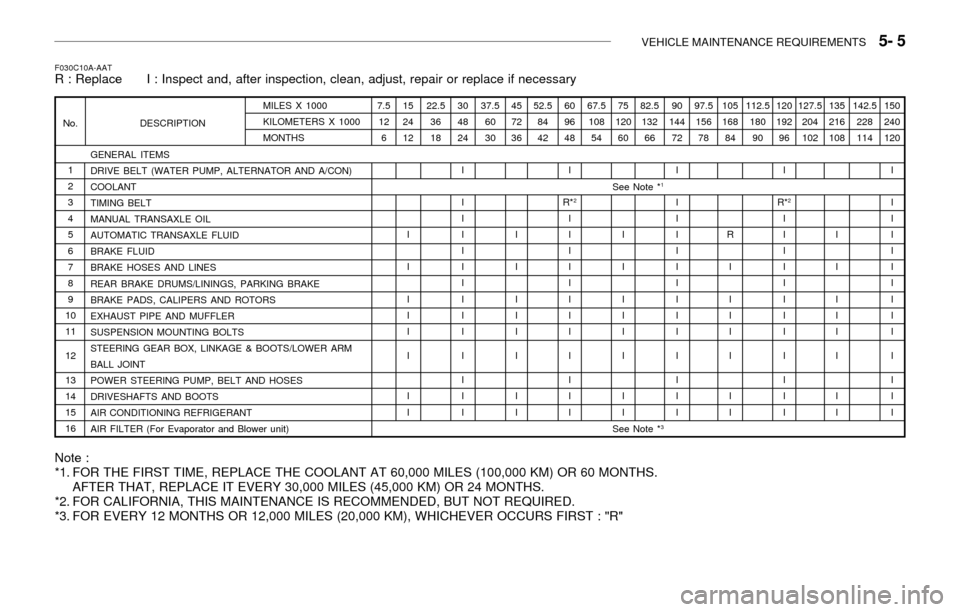
Note :
*1. FOR THE FIRST TIME, REPLACE THE COOLANT AT 60,000 MILES (100,000 KM) OR 60 MONTHS.
AFTER THAT, REPLACE IT EVERY 30,000 MILES (45,000 KM) OR 24 MONTHS.
*2. FOR CALIFORNIA, THIS MAINTENANCE IS RECOMMENDED, BUT NOT REQUIRED.
*3. FOR EVERY 12 MONTHS OR 12,000 MILES (20,000 KM), WHICHEVER OCCURS FIRST : "R"
F030C10A-AATR : Replace I : Inspect and, after inspection, clean, adjust, repair or replace if necessary
See Note *1
Page 133 of 186
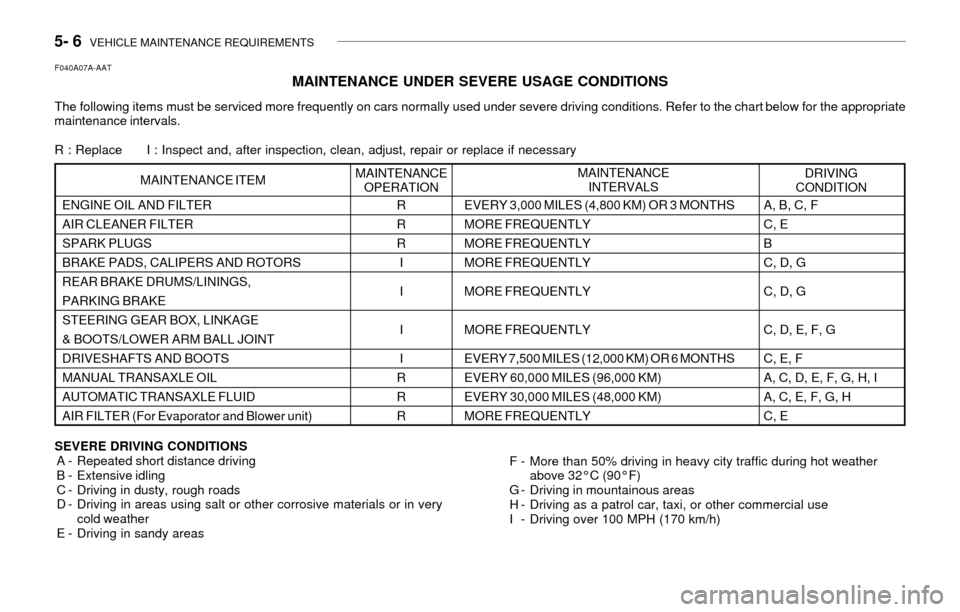
5- 6 VEHICLE MAINTENANCE REQUIREMENTS
DRIVING
CONDITION MAINTENANCE
INTERVALS
ENGINE OIL AND FILTER
AIR CLEANER FILTER
SPARK PLUGS
BRAKE PADS, CALIPERS AND ROTORS
REAR BRAKE DRUMS/LININGS,
PARKING BRAKE
STEERING GEAR BOX, LINKAGE
& BOOTS/LOWER ARM BALL JOINT
DRIVESHAFTS AND BOOTS
MANUAL TRANSAXLE OIL
AUTOMATIC TRANSAXLE FLUID
AIR FILTER (For Evaporator and Blower unit)R
R
R
I
I
I
I
R
R
R MAINTENANCE
OPERATION MAINTENANCE ITEM
EVERY 3,000 MILES (4,800 KM) OR 3 MONTHS
MORE FREQUENTLY
MORE FREQUENTLY
MORE FREQUENTLY
MORE FREQUENTLY
MORE FREQUENTLY
EVERY 7,500 MILES (12,000 KM) OR 6 MONTHS
EVERY 60,000 MILES (96,000 KM)
EVERY 30,000 MILES (48,000 KM)
MORE FREQUENTLY
SEVERE DRIVING CONDITIONS
A - Repeated short distance driving
B - Extensive idling
C - Driving in dusty, rough roads
D - Driving in areas using salt or other corrosive materials or in very
cold weather
E - Driving in sandy areasF - More than 50% driving in heavy city traffic during hot weather
above 32°C (90°F)
G - Driving in mountainous areas
H - Driving as a patrol car, taxi, or other commercial use
I - Driving over 100 MPH (170 km/h)
F040A07A-AATMAINTENANCE UNDER SEVERE USAGE CONDITIONS
The following items must be serviced more frequently on cars normally used under severe driving conditions. Refer to the chart below for the appropriate
maintenance intervals.
R : Replace I : Inspect and, after inspection, clean, adjust, repair or replace if necessary
A, B, C, F
C, E
B
C, D, G
C, D, G
C, D, E, F, G
C, E, F
A, C, D, E, F, G, H, I
A, C, E, F, G, H
C, E
Page 135 of 186
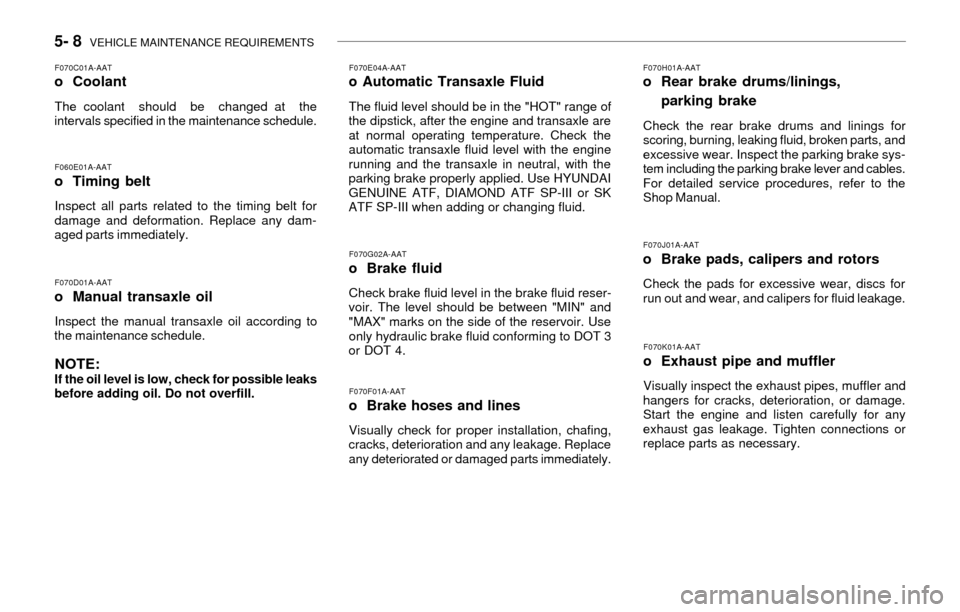
5- 8 VEHICLE MAINTENANCE REQUIREMENTS
F070H01A-AATo Rear brake drums/linings,
parking brake
Check the rear brake drums and linings for
scoring, burning, leaking fluid, broken parts, and
excessive wear. Inspect the parking brake sys-
tem including the parking brake lever and cables.
For detailed service procedures, refer to the
Shop Manual.
F070F01A-AAT
o Brake hoses and lines
Visually check for proper installation, chafing,
cracks, deterioration and any leakage. Replace
any deteriorated or damaged parts immediately.
F070G02A-AATo Brake fluid
Check brake fluid level in the brake fluid reser-
voir. The level should be between "MIN" and
"MAX" marks on the side of the reservoir. Use
only hydraulic brake fluid conforming to DOT 3
or DOT 4.
F070E04A-AATo Automatic Transaxle Fluid
The fluid level should be in the "HOT" range of
the dipstick, after the engine and transaxle are
at normal operating temperature. Check the
automatic transaxle fluid level with the engine
running and the transaxle in neutral, with the
parking brake properly applied. Use HYUNDAI
GENUINE ATF, DIAMOND ATF SP-III or SK
ATF SP-III when adding or changing fluid.
F070K01A-AAT
o Exhaust pipe and muffler
Visually inspect the exhaust pipes, muffler and
hangers for cracks, deterioration, or damage.
Start the engine and listen carefully for any
exhaust gas leakage. Tighten connections or
replace parts as necessary.
F070J01A-AAT
o Brake pads, calipers and rotors
Check the pads for excessive wear, discs for
run out and wear, and calipers for fluid leakage.F070D01A-AAT
o Manual transaxle oil
Inspect the manual transaxle oil according to
the maintenance schedule.
NOTE:If the oil level is low, check for possible leaks
before adding oil. Do not overfill.
F060E01A-AAT
o Timing belt
Inspect all parts related to the timing belt for
damage and deformation. Replace any dam-
aged parts immediately.
F070C01A-AATo Coolant
The coolant should be changed at the
intervals specified in the maintenance schedule.
Page 137 of 186
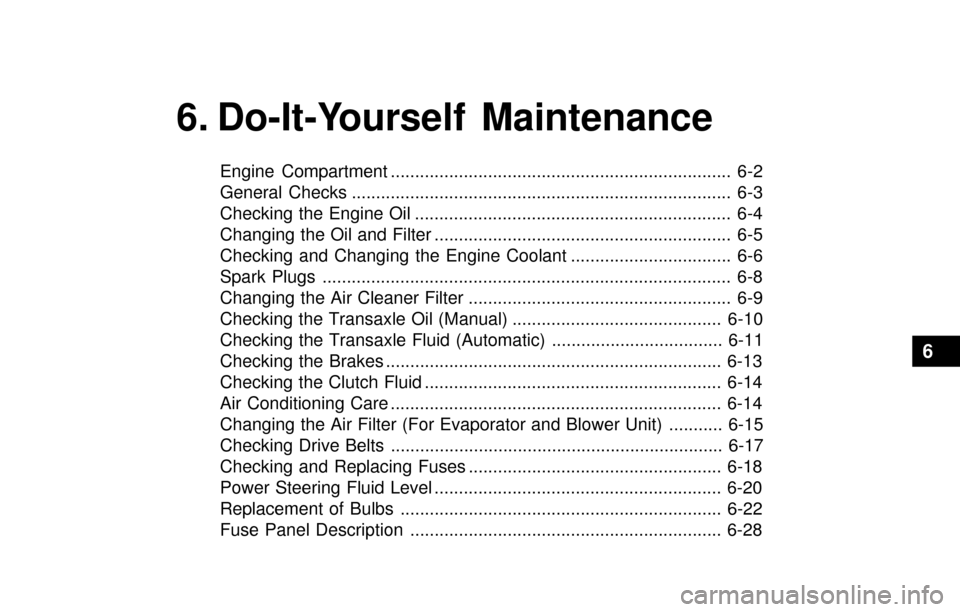
6. Do-It-Yourself Maintenance
Engine Compartment ...................................................................... 6-2
General Checks .............................................................................. 6-3
Checking the Engine Oil ................................................................. 6-4
Changing the Oil and Filter ............................................................. 6-5
Checking and Changing the Engine Coolant ................................. 6-6
Spark Plugs .................................................................................... 6-8
Changing the Air Cleaner Filter ...................................................... 6-9
Checking the Transaxle Oil (Manual) ...........................................6-10
Checking the Transaxle Fluid (Automatic) ................................... 6-11
Checking the Brakes ..................................................................... 6-13
Checking the Clutch Fluid ............................................................. 6-14
Air Conditioning Care .................................................................... 6-14
Changing the Air Filter (For Evaporator and Blower Unit) ........... 6-15
Checking Drive Belts .................................................................... 6-17
Checking and Replacing Fuses .................................................... 6-18
Power Steering Fluid Level ........................................................... 6-20
Replacement of Bulbs .................................................................. 6-22
Fuse Panel Description ................................................................ 6-28
6
Page 138 of 186
6- 2 DO-IT-YOURSELF MAINTENANCE
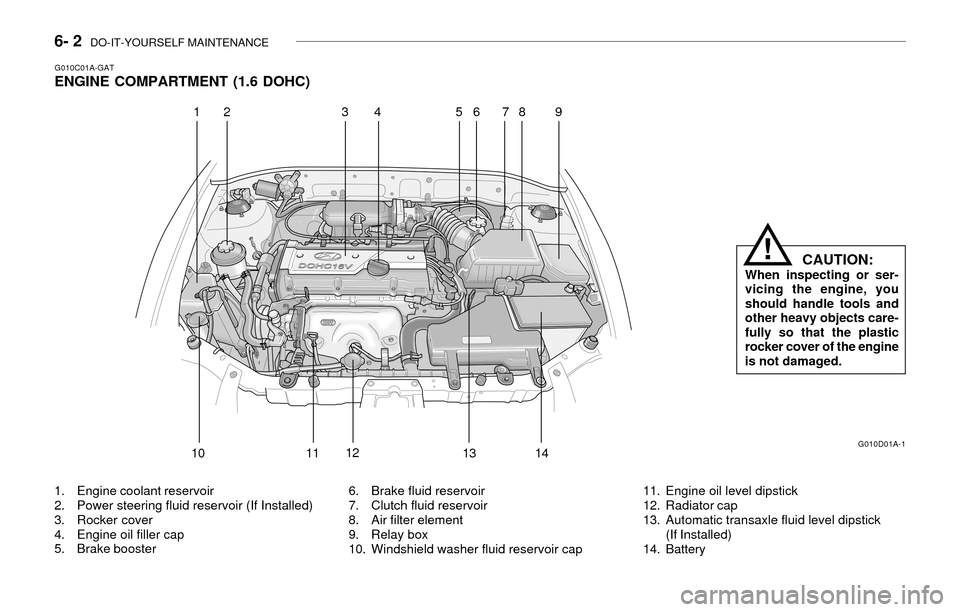
G010C01A-GATENGINE COMPARTMENT (1.6 DOHC)
G010D01A-1
1. Engine coolant reservoir
2. Power steering fluid reservoir (If Installed)
3. Rocker cover
4. Engine oil filler cap
5. Brake booster6. Brake fluid reservoir
7. Clutch fluid reservoir
8. Air filter element
9. Relay box
10. Windshield washer fluid reservoir cap11. Engine oil level dipstick
12. Radiator cap
13. Automatic transaxle fluid level dipstick
(If Installed)
14. Battery 1
CAUTION:When inspecting or ser-
vicing the engine, you
should handle tools and
other heavy objects care-
fully so that the plastic
rocker cover of the engine
is not damaged.
!
23456789
10 1112
13 14
Page 139 of 186
DO-IT-YOURSELF MAINTENANCE 6- 3
G020C01A-AATVehicle Interior
The following should be checked each time
when the vehicle is driven:
o Light operation
o Windshield wiper operation
o Horn operation
o Defroster, heater system operation (and air
conditioning, if installed)
o Steering operation and condition
o Mirror condition and operation
o Turn signal operation
o Accelerator pedal operation
o Brake operation, including parking brake
o Manual transaxle operation, including clutch
operation
o Automatic transaxle operation, including
"Park" mechanism operation
o Seat control condition and operation
o Seat belt condition and operation
o Sun visor operation
If you notice anything that does not operate
correctly or appear to be functioning correctly,
inspect it carefully and seek assistance from
your Hyundai dealer if service is needed.
G020A01A-AATGENERAL CHECKS
Engine Compartment
The following should be checked regularly:
o Engine oil level and condition
o Transaxle fluid level and condition
o Brake fluid level
o Clutch fluid level
o Engine coolant level
o Windshield washer fluid level
o Accessory drive belt condition
o Engine coolant hose condition
o Fluid leaks (on or below components)
o Power steering fluid level and condition
o Battery Condition
o Air filter condition
G020B01A-AATVehicle Exterior
The following should be checked monthly:
o Overall appearance and condition
o Wheel condition and wheel nut tightness
o Exhaust system condition
o Light condition and operation
o Windshield glass condition
o Wiper blade condition
o Paint condition and body corrosion
o Fluid leaks
o Door and hood lock condition
o Tire pressure and condition
(including spare tire)
Page 142 of 186
6- 6 DO-IT-YOURSELF MAINTENANCE
G050A01A-AATCHECKING AND CHANGING THE EN-
GINE COOLANTG050B01A-AATRecommended Engine Coolant
Use a high quality ethylene-glycol coolant in a
50/50 mix with water. The engine coolant should
be compatible with aluminum engine parts. Ad-
ditional corrosion inhibitors or additives should
not be used. The cooling system must be main-
tained with the correct concentration and type of
engine coolant to prevent freezing and corro-
sion.
Never allow the concentration of antifreeze to
exceed the 60% level or go below the 35% level
or damage to the coolant system may result. For
proper concentration when adding or replacing
the coolant, refer to the following table.
WARNING:Do not remove the radiator cap when the
engine is hot. When the engine is hot, the
engine coolant is under pressure and may
erupt through the opening if the cap is re-
moved. You could be seriously burned if you
do not observe this precaution. Do not re-
move the radiator cap until the radiator is
cool to the touch.
!
Water
65%
60%
50%
40% Antifreeze
solution
35%
40%
50%
60% Ambient
temperature
°F (°C)
5 (-15)
-13 (-25)
-31 (-35)
-49 (-45)Engine coolant
concentration
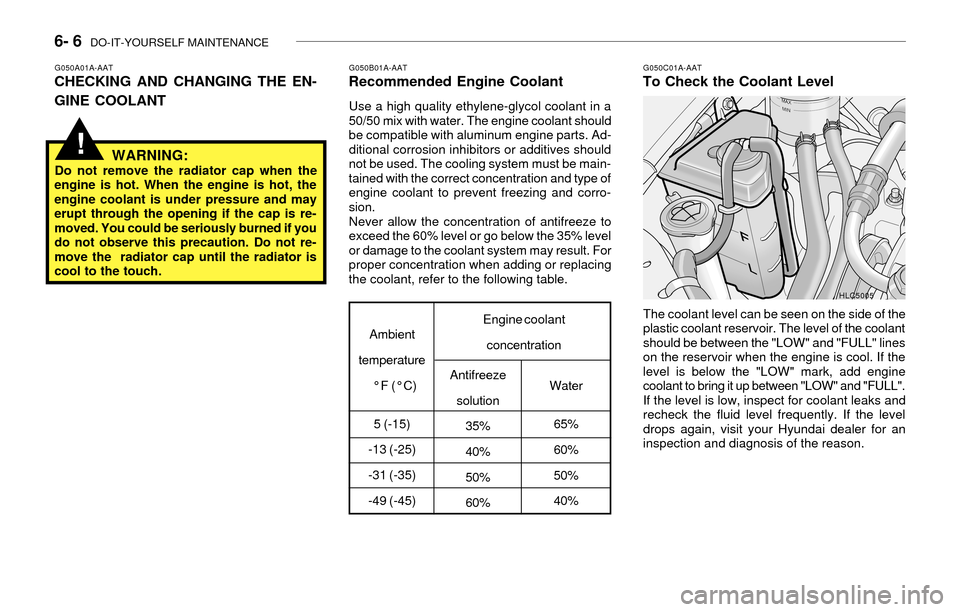
G050C01A-AATTo Check the Coolant Level
The coolant level can be seen on the side of the
plastic coolant reservoir. The level of the coolant
should be between the "LOW" and "FULL" lines
on the reservoir when the engine is cool. If the
level is below the "LOW" mark, add engine
coolant to bring it up between "LOW" and "FULL".
If the level is low, inspect for coolant leaks and
recheck the fluid level frequently. If the level
drops again, visit your Hyundai dealer for an
inspection and diagnosis of the reason.
HLC5005