radio Hyundai Accent 2003 User Guide
[x] Cancel search | Manufacturer: HYUNDAI, Model Year: 2003, Model line: Accent, Model: Hyundai Accent 2003Pages: 186, PDF Size: 11.36 MB
Page 92 of 186
FEATURES OF YOUR HYUNDAI 1- 79
B260D01O-AAT
1. Playing CD
o Insert the CD with the label facing upward.
o Insert the CD to start CD playback, during
radio operation.
o When a disc is in the CD deck, if you press
the CD button, the CD player will begin
playing even if the radio is being used.
o The CD player can be used when the ignition
switch is in either the "ON" or "ACC" posi-
tion.
2. FF/REW ( / )
If you want to fast forward or reverse through
the compact disc track, push and hold the FF
( ) or REW ( ) button.
When you release the button, the compact disc
player will resume playing.
3 . TRACK UP/DOWN
o The desired track on the disc currently being
played can be selected using the track num-
ber.
o Press once to skip forward to the beginn-
ing of the next track. Press once to skip
back to the beginning of the track.
4 . SCAN Button
o Press the SCAN button to playback the first
10 seconds of each track.
o Press the SCAN button again within 10 sec.
when you have reached the disired track.
5 . REPEAT Button
o To repeat the track you are currently listen-
ing to, press the RPT button. To cancel,
press again.
o If you do not release RPT operation when
the track ends, it will automatically be re-
played.
This process will be continued until you push
the button again.
6 . EJECT Button
When the EJECT button is pressed with a
CD loaded, the CD will eject.
NOTE:o To assure proper operation of the unit,
keep the vehicle interior temperature
within a normal range by using the
vehicle's air conditioning or heating sys-
tem.
o When replacing the fuse, replace it with a
fuse having the correct capacity.
o The preset station frequencies are all
erased when the car battery is discon-
nected. Therefore, all data will have to be
set again if this should occur.o Do not add any oil to the rotating parts.
Keep magnets, screwdrivers and other
metallic objects away from the tape
mechanism and head.
o This equipment is designed to be used
only in a 12 volt DC battery system with
negative ground.
o This unit is made of precision parts. Do
not attempt to disassemble or adjust any
parts.
o When driving your vehicle, be sure to
keep the volume of the unit set low enough
to allow you to hear sounds coming from
the outside.
o Do not expose this equipment (including
the speakers) to water or excessive mois-
ture.
Page 96 of 186
FEATURES OF YOUR HYUNDAI 1- 83
B870A01A-AAT
ANTENNA
Fixed Rod Antenna
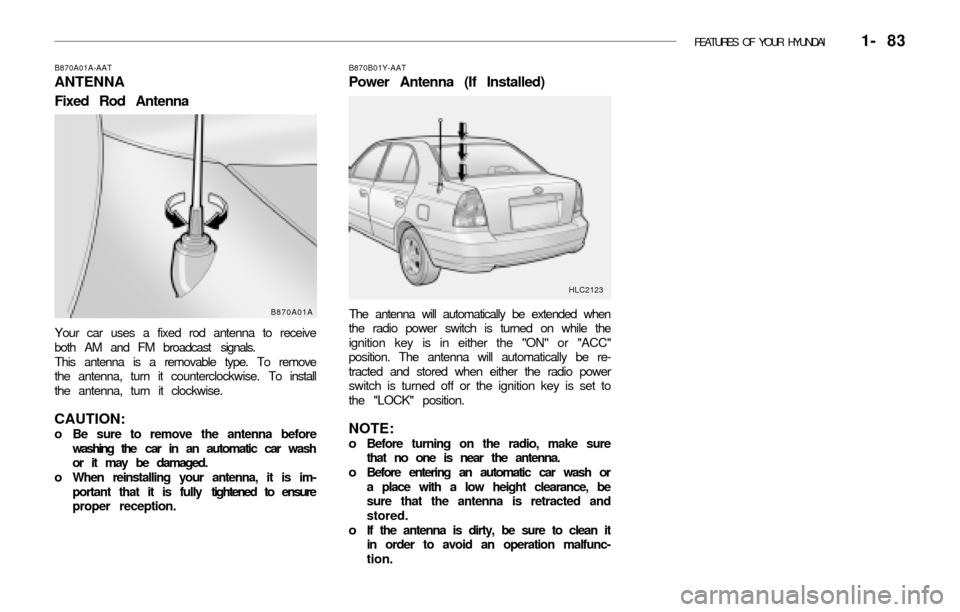
Your car uses a fixed rod antenna to receive
both AM and FM broadcast signals.
This antenna is a removable type. To remove
the antenna, turn it counterclockwise. To install
the antenna, turn it clockwise.
CAUTION:o Be sure to remove the antenna before
washing the car in an automatic car wash
or it may be damaged.
o When reinstalling your antenna, it is im-
portant that it is fully tightened to ensure
proper reception.
B870B01Y-AAT
Power Antenna (If Installed)
The antenna will automatically be extended when
the radio power switch is turned on while the
ignition key is in either the "ON" or "ACC"
position. The antenna will automatically be re-
tracted and stored when either the radio power
switch is turned off or the ignition key is set to
the "LOCK" position.
NOTE:o Before turning on the radio, make sure
that no one is near the antenna.
o Before entering an automatic car wash or
a place with a low height clearance, be
sure that the antenna is retracted and
stored.
o If the antenna is dirty, be sure to clean it
in order to avoid an operation malfunc-
tion.
HLC2123
B870A01A
Page 100 of 186
2- 4 DRIVING YOUR HYUNDAI
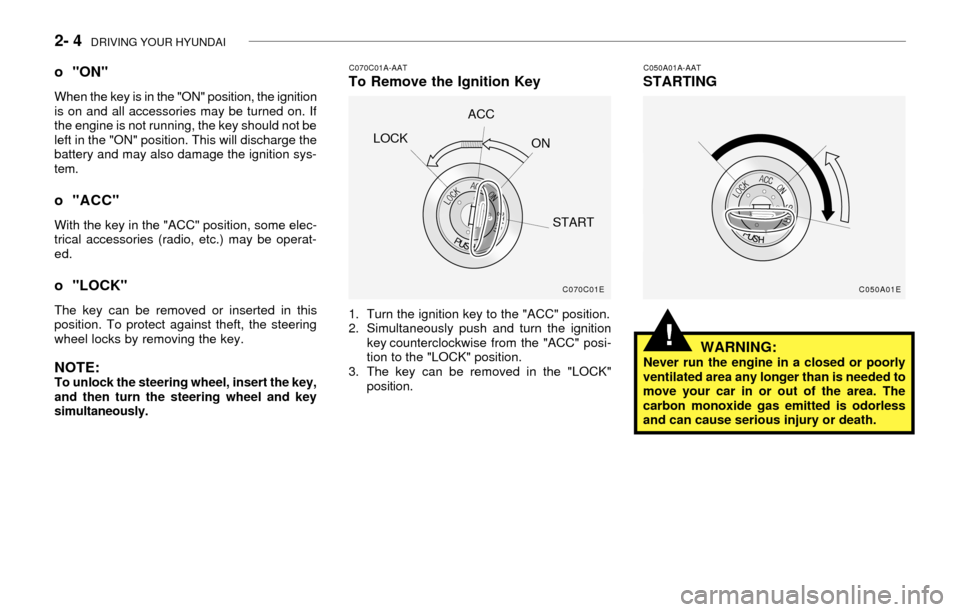
C070C01A-AATTo Remove the Ignition Key
1. Turn the ignition key to the "ACC" position.
2. Simultaneously push and turn the ignition
key counterclockwise from the "ACC" posi-
tion to the "LOCK" position.
3. The key can be removed in the "LOCK"
position.
C050A01A-AATSTARTING
WARNING:
Never run the engine in a closed or poorly
ventilated area any longer than is needed to
move your car in or out of the area. The
carbon monoxide gas emitted is odorless
and can cause serious injury or death.
o "ON"
When the key is in the "ON" position, the ignition
is on and all accessories may be turned on. If
the engine is not running, the key should not be
left in the "ON" position. This will discharge the
battery and may also damage the ignition sys-
tem.
o "ACC"
With the key in the "ACC" position, some elec-
trical accessories (radio, etc.) may be operat-
ed.
o "LOCK"
The key can be removed or inserted in this
position. To protect against theft, the steering
wheel locks by removing the key.
NOTE:To unlock the steering wheel, insert the key,
and then turn the steering wheel and key
simultaneously.
C070C01E
LOCKACC
ON
START
C050A01E
!
Page 144 of 186
6- 8 DO-IT-YOURSELF MAINTENANCE
G060B01A-AATREPLACING THE SPARK PLUGS
G060A01L
0.039 ~ 0.043 in.
(1.0 ~ 1.1 mm )
The spark plugs should be changed at the
intervals specified in the vehicle maintenance
schedule in section 5, or whenever engine per-
formance indicates they should be changed.
Symptoms that suggest poor spark plug perfor-
mance include engine misfiring under load, loss
of fuel economy, poor acceleration, etc. When
spark plugs are replaced, always use spark
plugs recommended by Hyundai. The use of
other spark plugs can result in loss of perfor-
mance, radio interference or engine damage.
NOTE:When replacing the spark plugs, genuine
Hyundai replacement parts are recom-
mended.
G060C01S-GAT
Changing the Spark PlugsYou will find it easier to change spark plugs if the
engine is cold. Always change one spark plug at
a time. This helps avoid getting the wires mixed
up.
G060C01A-D
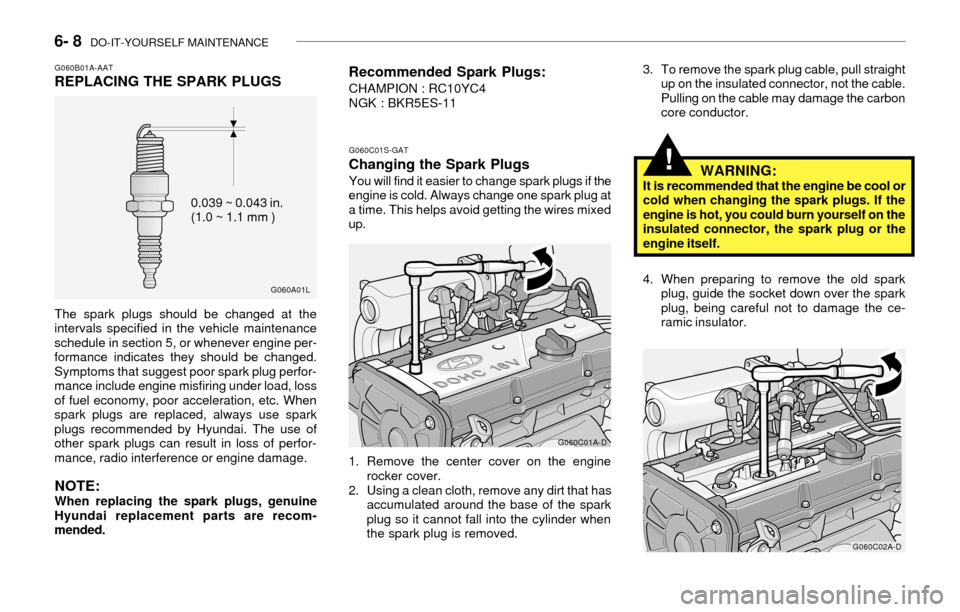
1. Remove the center cover on the engine
rocker cover.
2. Using a clean cloth, remove any dirt that has
accumulated around the base of the spark
plug so it cannot fall into the cylinder when
the spark plug is removed.
Recommended Spark Plugs:
CHAMPION : RC10YC4
NGK : BKR5ES-113. To remove the spark plug cable, pull straight
up on the insulated connector, not the cable.
Pulling on the cable may damage the carbon
core conductor.
WARNING:It is recommended that the engine be cool or
cold when changing the spark plugs. If the
engine is hot, you could burn yourself on the
insulated connector, the spark plug or the
engine itself.
G060C02A-D
!
4. When preparing to remove the old spark
plug, guide the socket down over the spark
plug, being careful not to damage the ce-
ramic insulator.
Page 155 of 186
DO-IT-YOURSELF MAINTENANCE 6- 19
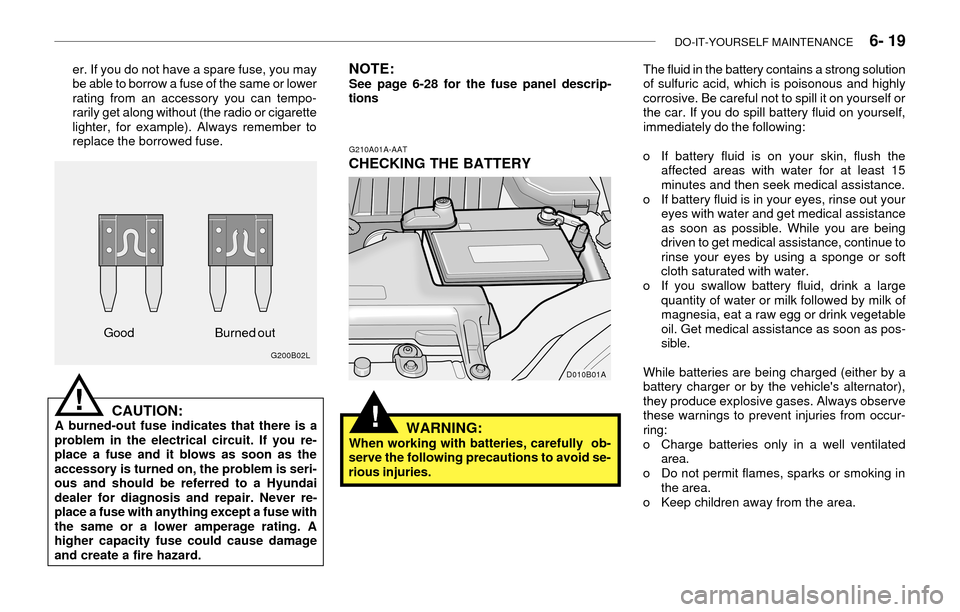
er. If you do not have a spare fuse, you may
be able to borrow a fuse of the same or lower
rating from an accessory you can tempo-
rarily get along without (the radio or cigarette
lighter, for example). Always remember to
replace the borrowed fuse.
CAUTION:A burned-out fuse indicates that there is a
problem in the electrical circuit. If you re-
place a fuse and it blows as soon as the
accessory is turned on, the problem is seri-
ous and should be referred to a Hyundai
dealer for diagnosis and repair. Never re-
place a fuse with anything except a fuse with
the same or a lower amperage rating. A
higher capacity fuse could cause damage
and create a fire hazard.
G200B02L
!
GoodBurned out
G210A01A-AAT
CHECKING THE BATTERY
WARNING:
When working with batteries, carefully ob-
serve the following precautions to avoid se-
rious injuries.
!
The fluid in the battery contains a strong solution
of sulfuric acid, which is poisonous and highly
corrosive. Be careful not to spill it on yourself or
the car. If you do spill battery fluid on yourself,
immediately do the following:
o If battery fluid is on your skin, flush the
affected areas with water for at least 15
minutes and then seek medical assistance.
o If battery fluid is in your eyes, rinse out your
eyes with water and get medical assistance
as soon as possible. While you are being
driven to get medical assistance, continue to
rinse your eyes by using a sponge or soft
cloth saturated with water.
o If you swallow battery fluid, drink a large
quantity of water or milk followed by milk of
magnesia, eat a raw egg or drink vegetable
oil. Get medical assistance as soon as pos-
sible.
While batteries are being charged (either by a
battery charger or by the vehicle's alternator),
they produce explosive gases. Always observe
these warnings to prevent injuries from occur-
ring:
o Charge batteries only in a well ventilated
area.
o Do not permit flames, sparks or smoking in
the area.
o Keep children away from the area.NOTE:See page 6-28 for the fuse panel descrip-
tions
D010B01A
Page 182 of 186
10- 2 INDEX
Cargo Area Cover .............................................................................1-55
Catalytic Converter ............................................................................. 7-2
Changing a flat tire .............................................................................. 3-6
Child-Protector Rear Door Look ......................................................... 1-5
Child Restraint System .....................................................................1-19
Installing a child restraint seat with the
"Tether Anchorage" system ......................................................1-21
Securing the child restraint seat with the "ISOFIX" system ........1-22
Cigarette Lighter ................................................................................1-45
Clock ................................................................................................1-44
Clutch
Checking fluid ..............................................................................6-14
Pedal free-play .............................................................................6-16
Combination Light
Headlight flasher ..........................................................................1-41
Headlight switch ...........................................................................1-41
High-beam switch ........................................................................1-41
Lane change signal ......................................................................1-40
Turn signal operation ...................................................................1-40
Cooling Fans .....................................................................................6-20
Corrosion Protection
Cleaning the interior ....................................................................... 4-4
Protecting your Hyundai from corrosion ........................................ 4-2
Washing and waxing ...................................................................... 4-3
D
Defrosting/Defogging .........................................................................1-65
Door
Central door lock ........................................................................... 1-6
Door locks ...................................................................................... 1-4
Locking, unlocking front door with a key ....................................... 1-4 A
Airbag................................................................................................1-26
Air Conditioner
Care .............................................................................................6-14
Operation.....................................................................................1-63
Air Filter (For Evaporator and Blower Unit) .....................................1-64
Antenna.............................................................................................1-83
Ashtray ..............................................................................................1-45
Audio Fault Code ..............................................................................1-80
Audio System
Cassette tape player operation (H245) ........................................1-73
Compact disk player operation (H265) ........................................1-78
Stereo radio operation (H215, H245, H265) .............. 1-68, 1-70, 1-75
Automatic Transaxle ........................................................................... 2-7
Overdrive switch ............................................................................ 2-8
Shift lock release ........................................................................... 2-9
B
Battery ...............................................................................................6-19
Bi-Level Heating ................................................................................1-61
Brake
Anti-lock system ..........................................................................2-10
Checking the brakes ....................................................................6-13
Fluid.............................................................................................6-13
Pedal clearance ...........................................................................6-17
Pedal free-play .............................................................................6-17
Practices ......................................................................................2-10
Breaking-In your new Hyundai ........................................................... 1-3
C
Care of Cassette tapes .....................................................................1-81
Care of Disk ......................................................................................1-81