tow Hyundai Accent 2003 User Guide
[x] Cancel search | Manufacturer: HYUNDAI, Model Year: 2003, Model line: Accent, Model: Hyundai Accent 2003Pages: 186, PDF Size: 11.36 MB
Page 63 of 186
1- 50 FEATURES OF YOUR HYUNDAI
B510D01HP-GAT
OUTSIDE REAR VIEW MIRROR HEAT-
ER (If Installed)
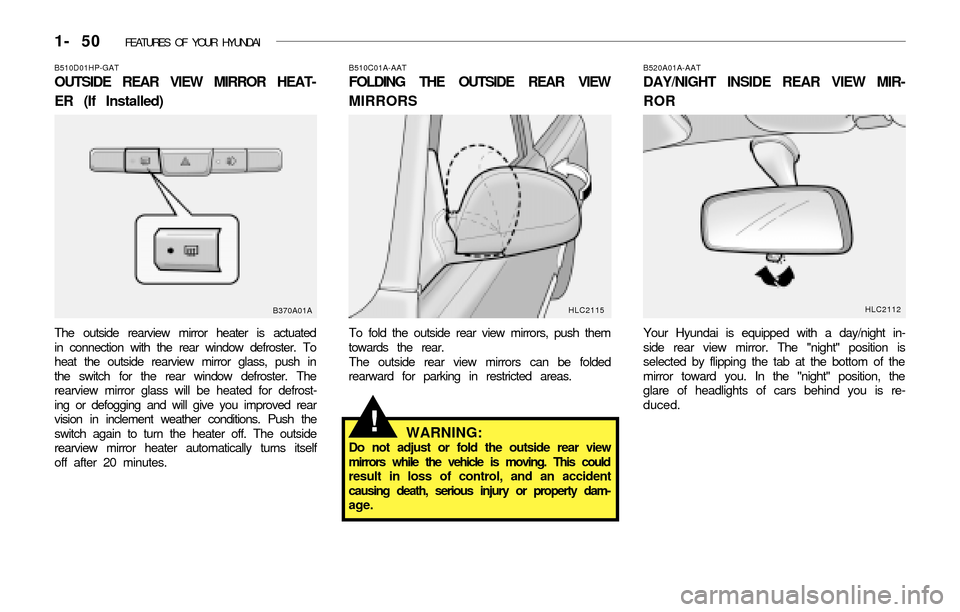
The outside rearview mirror heater is actuated
in connection with the rear window defroster. To
heat the outside rearview mirror glass, push in
the switch for the rear window defroster. The
rearview mirror glass will be heated for defrost-
ing or defogging and will give you improved rear
vision in inclement weather conditions. Push the
switch again to turn the heater off. The outside
rearview mirror heater automatically turns itself
off after 20 minutes.
B370A01AB510C01A-AAT
FOLDING THE OUTSIDE REAR VIEW
MIRRORS
To fold the outside rear view mirrors, push them
towards the rear.
The outside rear view mirrors can be folded
rearward for parking in restricted areas.
B520A01A-AAT
DAY/NIGHT INSIDE REAR VIEW MIR-
ROR
Your Hyundai is equipped with a day/night in-
side rear view mirror. The "night" position is
selected by flipping the tab at the bottom of the
mirror toward you. In the "night" position, the
glare of headlights of cars behind you is re-
duced.
HLC2115
WARNING:Do not adjust or fold the outside rear view
mirrors while the vehicle is moving. This could
result in loss of control, and an accident
causing death, serious injury or property dam-
age.
!
HLC2112
Page 67 of 186
1- 54 FEATURES OF YOUR HYUNDAI
B540C01A-AAT
To Unlock Using the Key.
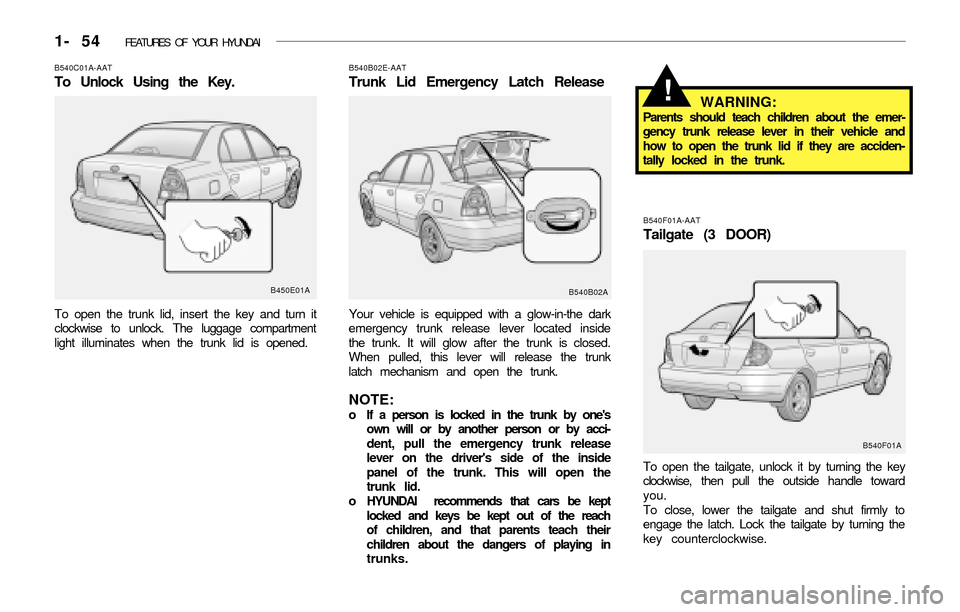
To open the trunk lid, insert the key and turn it
clockwise to unlock. The luggage compartment
light illuminates when the trunk lid is opened.
B450E01AB540F01A-AAT
Tailgate (3 DOOR)
To open the tailgate, unlock it by turning the key
clockwise, then pull the outside handle toward
you.
To close, lower the tailgate and shut firmly to
engage the latch. Lock the tailgate by turning the
key counterclockwise.
B540B02E-AAT
Trunk Lid Emergency Latch Release
Your vehicle is equipped with a glow-in-the dark
emergency trunk release lever located inside
the trunk. It will glow after the trunk is closed.
When pulled, this lever will release the trunk
latch mechanism and open the trunk.
NOTE:o If a person is locked in the trunk by one's
own will or by another person or by acci-
dent, pull the emergency trunk release
lever on the driver's side of the inside
panel of the trunk. This will open the
trunk lid.
o HYUNDAI recommends that cars be kept
locked and keys be kept out of the reach
of children, and that parents teach their
children about the dangers of playing in
trunks.
WARNING:Parents should teach children about the emer-
gency trunk release lever in their vehicle and
how to open the trunk lid if they are acciden-
tally locked in the trunk.
B540B02A
!
B540F01A
Page 68 of 186
FEATURES OF YOUR HYUNDAI 1- 55
If the vehicle is equipped with central door
locking, the tailgate can be locked without a key.
Push the central door lock switch toward the
front of the vehicle after closing the tailgate.
If the tailgate is open when the switch is pushed,
the tailgate will be locked when it is fully closed.
WARNING:The tailgate should always be kept completely
closed while the vehicle is in motion. If it is left
open or ajar, poisonous exhaust gases may
enter the car which could result in serious
injury or death to the occupants. See addi-
tional warnings concerning exhaust gases on
page 2-2.
!
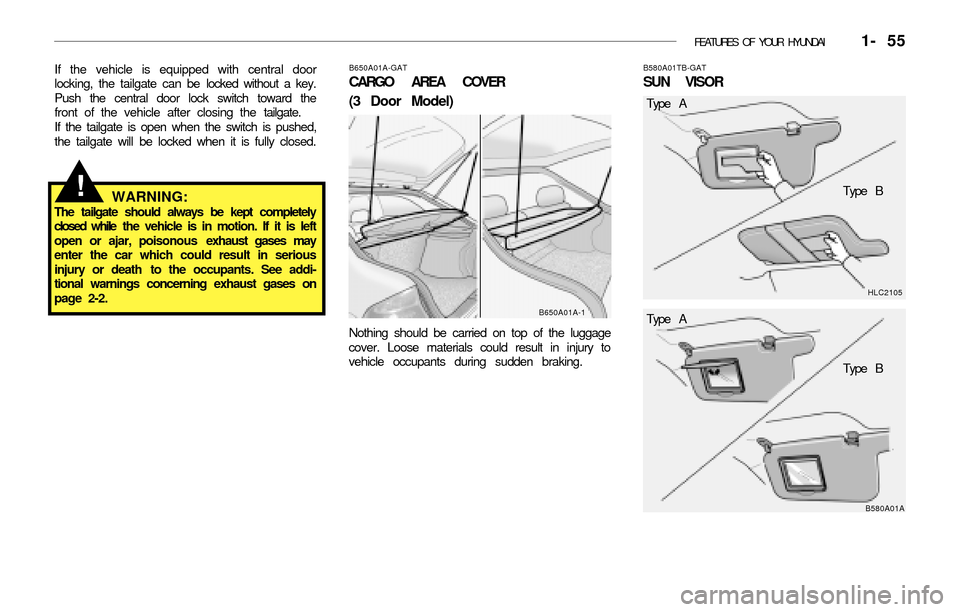
HLC2105 B580A01TB-GAT
SUN VISOR
B580A01A
Type A
Type B
B650A01A-GAT
CARGO AREA COVER
(3 Door Model)
Nothing should be carried on top of the luggage
cover. Loose materials could result in injury to
vehicle occupants during sudden braking.
B650A01A-1Type A
Type B
Page 76 of 186
FEATURES OF YOUR HYUNDAI 1- 63
B740B02A-AAT
AIR CONDITIONING OPERATION
(If Installed)
Cooling
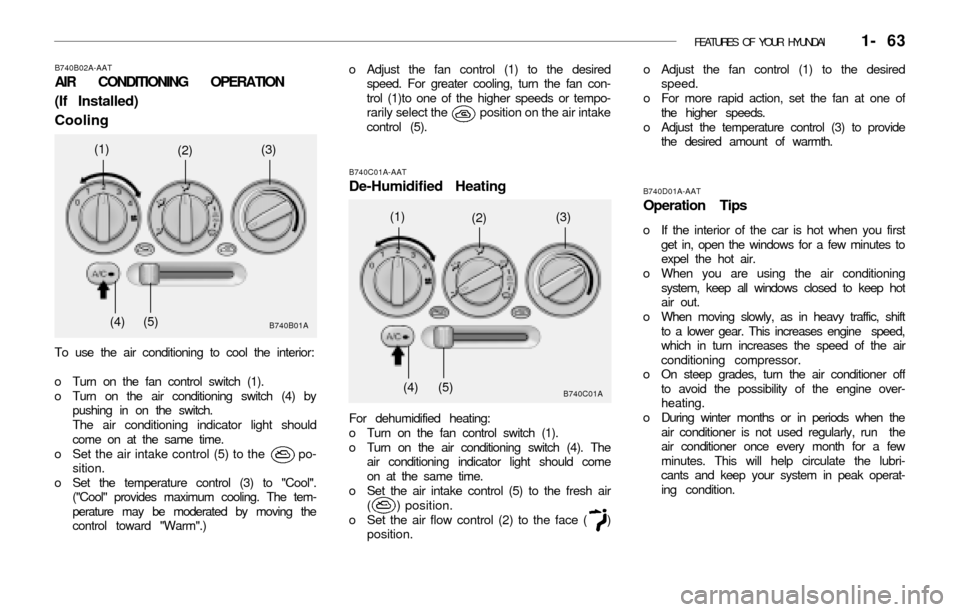
To use the air conditioning to cool the interior:
o Turn on the fan control switch (1).
o Turn on the air conditioning switch (4) by
pushing in on the switch.
The air conditioning indicator light should
come on at the same time.
o Set the air intake control (5) to the po-
sition.
o Set the temperature control (3) to "Cool".
("Cool" provides maximum cooling. The tem-
perature may be moderated by moving the
control toward "Warm".)
B740B01A
(1)(2)(3)
(4) (5)
B740D01A-AAT
Operation Tips
o If the interior of the car is hot when you first
get in, open the windows for a few minutes to
expel the hot air.
o When you are using the air conditioning
system, keep all windows closed to keep hot
air out.
o When moving slowly, as in heavy traffic, shift
to a lower gear. This increases engine speed,
which in turn increases the speed of the air
conditioning compressor.
o On steep grades, turn the air conditioner off
to avoid the possibility of the engine over-
heating.
o During winter months or in periods when the
air conditioner is not used regularly, run the
air conditioner once every month for a few
minutes. This will help circulate the lubri-
cants and keep your system in peak operat-
ing condition.
B740C01A-AAT
De-Humidified Heating
For dehumidified heating:
o Turn on the fan control switch (1).
o Turn on the air conditioning switch (4). The
air conditioning indicator light should come
on at the same time.
o Set the air intake control (5) to the fresh air
( ) position.
o Set the air flow control (2) to the face ( )
position.
B740C01A
(1)(2)(3)
(4) (5)
o Adjust the fan control (1) to the desired
speed. For greater cooling, turn the fan con-
trol (1)to one of the higher speeds or tempo-
rarily select the position on the air intake
control (5).o Adjust the fan control (1) to the desired
speed.
o For more rapid action, set the fan at one of
the higher speeds.
o Adjust the temperature control (3) to provide
the desired amount of warmth.
Page 79 of 186
1- 66 FEATURES OF YOUR HYUNDAI
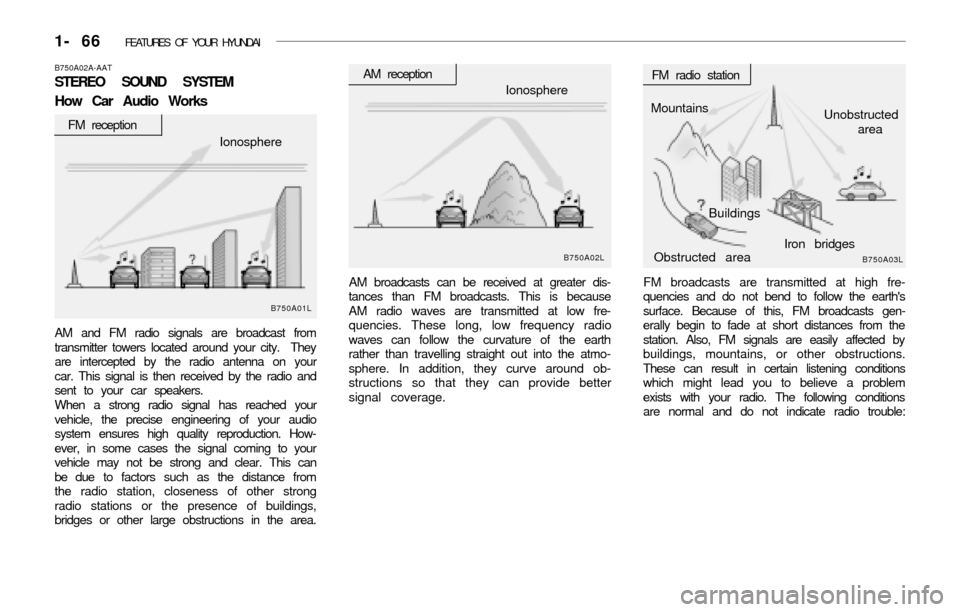
FM broadcasts are transmitted at high fre-
quencies and do not bend to follow the earth's
surface. Because of this, FM broadcasts gen-
erally begin to fade at short distances from the
station. Also, FM signals are easily affected by
buildings, mountains, or other obstructions.
These can result in certain listening conditions
which might lead you to believe a problem
exists with your radio. The following conditions
are normal and do not indicate radio trouble: AM broadcasts can be received at greater dis-
tances than FM broadcasts. This is because
AM radio waves are transmitted at low fre-
quencies. These long, low frequency radio
waves can follow the curvature of the earth
rather than travelling straight out into the atmo-
sphere. In addition, they curve around ob-
structions so that they can provide better
signal coverage.
B750A02A-AAT
STEREO SOUND SYSTEM
How Car Audio Works
AM and FM radio signals are broadcast from
transmitter towers located around your city. They
are intercepted by the radio antenna on your
car. This signal is then received by the radio and
sent to your car speakers.
When a strong radio signal has reached your
vehicle, the precise engineering of your audio
system ensures high quality reproduction. How-
ever, in some cases the signal coming to your
vehicle may not be strong and clear. This can
be due to factors such as the distance from
the radio station, closeness of other strong
radio stations or the presence of buildings,
bridges or other large obstructions in the area.Ionosphere
B750A02L
Mountains
Buildings
Obstructed areaUnobstructed
area FM radio station
B750A03L
Ionosphere FM reception
B750A01L
Iron bridges
AM reception
Page 97 of 186
2. DRIVING YOUR HYUNDAI
Before Starting the Engine ............................................................. 2-3
Key Positions .................................................................................. 2-3
Starting ............................................................................................ 2-4
Operating the Manual Transaxle .................................................... 2-5
Automatic Transaxle ....................................................................... 2-7
Good Braking Practices ................................................................ 2-10
Anti-Lock Brake System ............................................................... 2-10
Driving for Economy ..................................................................... 2-11
Winter Driving ............................................................................... 2-12
Trailer Towing ............................................................................... 2-14
2
Page 109 of 186
DRIVING YOUR HYUNDAI 2- 13
C160H01A-AAT
Use Approved Anti-Freeze in Window
Washer System
To keep the water in the window washer system
from freezing, add an approved anti-freeze so-
lution in accordance with instructions on the
container. Window washer anti-freeze is avail-
able from Hyundai dealers and most auto parts
outlets. Do not use engine coolant or other types
of anti-freeze as these may damage the finish.
C160F01A-AATCheck Spark Plugs and Ignition
System
Inspect your spark plugs as described in Sec-
tion 6 and replace them if necessary. Also
check all ignition wiring and components to be
sure they are not cracked, worn or damaged in
any way.
C160G01A-AAT
To Keep Locks from Freezing
To keep the locks from freezing, squirt an ap-
proved de-icer fluid or glycerine into the key
opening. If a lock is covered with ice, squirt it
with an approved de-icing fluid to remove the
ice. If the lock is frozen internally, you may be
able to thaw it out by using a heated key. Handle
the heated key with care to avoid burning the
fingers.
C160I01A-AATDon't Let Your Parking Brake Freeze
Under some conditions your parking brake can
freeze in the engaged position. This is most
likely to happen when there is an accumulation
of snow or ice around or near the rear brakes or
if the brakes are wet. If you think the parking
brake may freeze, apply it only temporarily while
you put the gear selector lever in "P" (automatic)
or in first or reverse gear (manual transaxle) and
block the rear wheels so the car cannot roll.
Then release the parking brake.
C160K01A-AATCarry Emergency Equipment
Depending on the severity of the weather where
you drive your car, you should carry appropriate
emergency equipment. Some of the items you
may want to carry include tire chains, tow straps
or chains, flashlight, emergency flares, sand, a
shovel, jumper cables, a window scraper, gloves,
ground cloth, coveralls, a blanket, etc.
C160J01A-AAT
Don't Let Ice and Snow Accumulate
Underneath
Under some conditions, snow and ice can build
up under the fenders and interfere with the
steering. When driving in severe winter condi-
tions where this may happen, you should peri-
odically check underneath the car to be sure the
movement of the front wheels and the steering
components is not obstructed.
C170A01A-AAT
HIGHER SPEED MOTORING
Pre-Trip Inspections
1. Tires:
Adjust the tire inflation pressures for highway
driving. Low tire inflation pressures will result in
overheating and possible failure of the tires.
Avoid using worn or damaged tires which may
result in reduced traction or tire failure.
NOTE:Never exceed the maximum tire inflation pres-
sure shown on the tires.
2. Fuel, engine coolant and engine oil:
High speed travel consumes 1.5 times more fuel
than urban motoring. Do not forget to check both
engine coolant and engine oil.
3. Drive belt:
A loose or damaged drive belt may result in
overheating of the engine.
Page 110 of 186
2- 14 DRIVING YOUR HYUNDAI
C190A01A-AAT
TRAILER TOWING
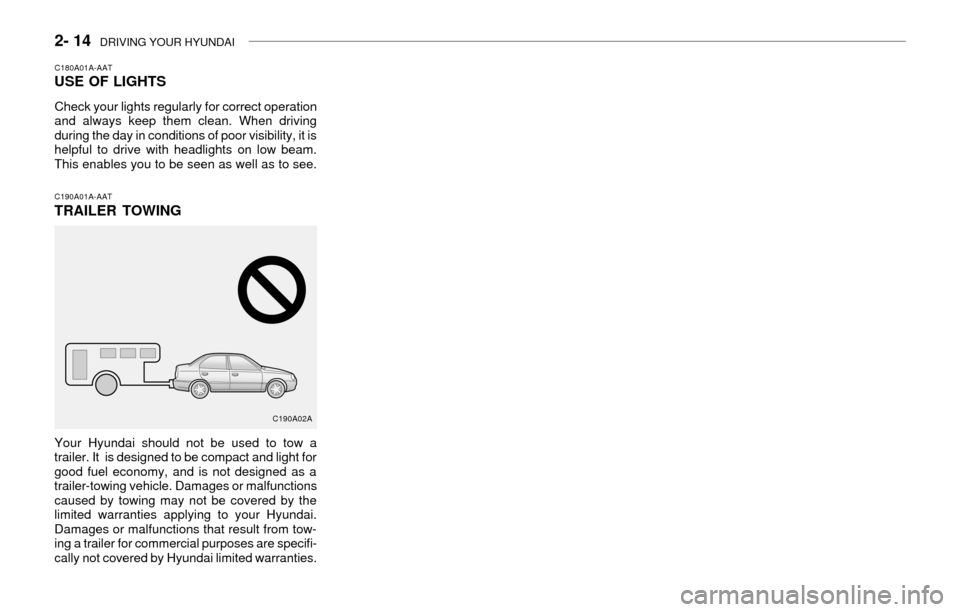
Your Hyundai should not be used to tow a
trailer. It is designed to be compact and light for
good fuel economy, and is not designed as a
trailer-towing vehicle. Damages or malfunctions
caused by towing may not be covered by the
limited warranties applying to your Hyundai.
Damages or malfunctions that result from tow-
ing a trailer for commercial purposes are specifi-
cally not covered by Hyundai limited warranties.
C180A01A-AATUSE OF LIGHTS
Check your lights regularly for correct operation
and always keep them clean. When driving
during the day in conditions of poor visibility, it is
helpful to drive with headlights on low beam.
This enables you to be seen as well as to see.
C190A02A
Page 111 of 186
3. WHAT TO DO IN AN EMERGENCY
If the Engine Will Not Start ............................................................ 3-2
Jump Starting ................................................................................. 3-3
If the Engine Overheats ................................................................. 3-4
Spare Tire ....................................................................................... 3-4
If You Have a Flat Tire .................................................................. 3-5
If Your Car Must Be Towed ......................................................... 3-10
Emergency Towing ....................................................................... 3-12
If You Lose Your Keys ................................................................ 3-12
3
Page 120 of 186
3- 10 WHAT TO DO IN AN EMERGENCY
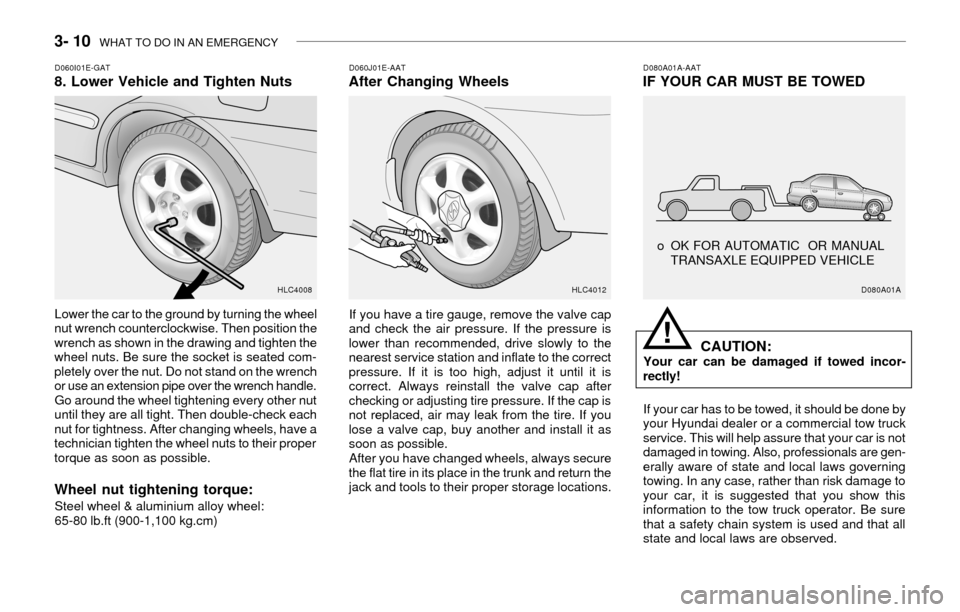
D060I01E-GAT8. Lower Vehicle and Tighten Nuts
Lower the car to the ground by turning the wheel
nut wrench counterclockwise. Then position the
wrench as shown in the drawing and tighten the
wheel nuts. Be sure the socket is seated com-
pletely over the nut. Do not stand on the wrench
or use an extension pipe over the wrench handle.
Go around the wheel tightening every other nut
until they are all tight. Then double-check each
nut for tightness. After changing wheels, have a
technician tighten the wheel nuts to their proper
torque as soon as possible.
Wheel nut tightening torque:
Steel wheel & aluminium alloy wheel:
65-80 lb.ft (900-1,100 kg.cm)
D060J01E-AATAfter Changing Wheels
If you have a tire gauge, remove the valve cap
and check the air pressure. If the pressure is
lower than recommended, drive slowly to the
nearest service station and inflate to the correct
pressure. If it is too high, adjust it until it is
correct. Always reinstall the valve cap after
checking or adjusting tire pressure. If the cap is
not replaced, air may leak from the tire. If you
lose a valve cap, buy another and install it as
soon as possible.
After you have changed wheels, always secure
the flat tire in its place in the trunk and return the
jack and tools to their proper storage locations.
D080A01A-AATIF YOUR CAR MUST BE TOWED
CAUTION:
Your car can be damaged if towed incor-
rectly!
HLC4008HLC4012
If your car has to be towed, it should be done by
your Hyundai dealer or a commercial tow truck
service. This will help assure that your car is not
damaged in towing. Also, professionals are gen-
erally aware of state and local laws governing
towing. In any case, rather than risk damage to
your car, it is suggested that you show this
information to the tow truck operator. Be sure
that a safety chain system is used and that all
state and local laws are observed.
D080A01A
o OK FOR AUTOMATIC OR MANUAL
TRANSAXLE EQUIPPED VEHICLE
!