air condition Hyundai Accent 2003 Owner's Manual
[x] Cancel search | Manufacturer: HYUNDAI, Model Year: 2003, Model line: Accent, Model: Hyundai Accent 2003Pages: 186, PDF Size: 11.36 MB
Page 10 of 186
YOUR VEHICLE AT A GLANCE
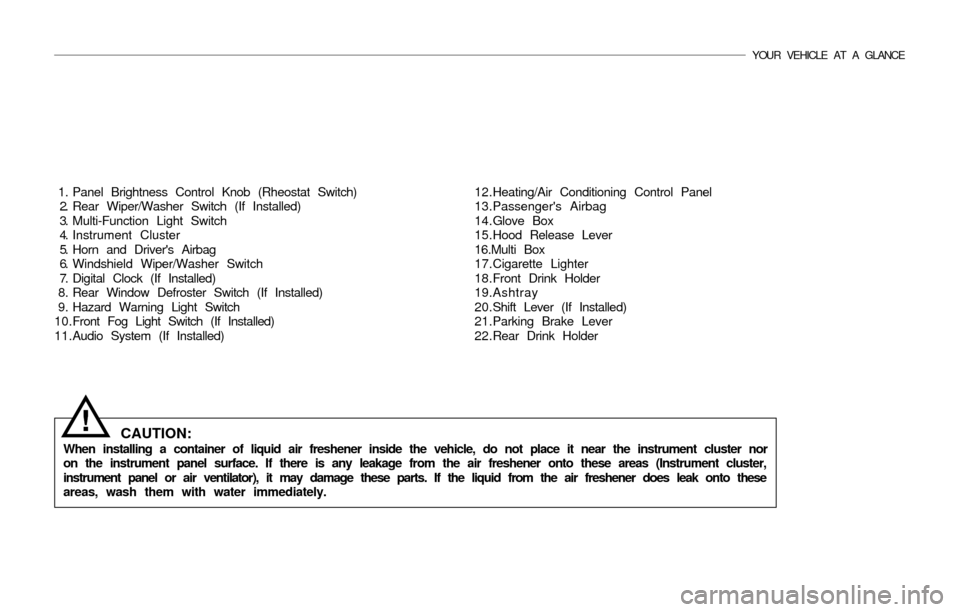
1. Panel Brightness Control Knob (Rheostat Switch)
2. Rear Wiper/Washer Switch (If Installed)
3. Multi-Function Light Switch
4. Instrument Cluster
5. Horn and Driver's Airbag
6. Windshield Wiper/Washer Switch
7. Digital Clock (If Installed)
8. Rear Window Defroster Switch (If Installed)
9. Hazard Warning Light Switch
1 0 . Front Fog Light Switch (If Installed)
11.Audio System (If Installed)12.Heating/Air Conditioning Control Panel
13.Passenger's Airbag
14.Glove Box
15.Hood Release Lever
16.Multi Box
17.Cigarette Lighter
18.Front Drink Holder
19.Ashtray
20. Shift Lever (If Installed)
21.Parking Brake Lever
22.Rear Drink Holder
CAUTION:When installing a container of liquid air freshener inside the vehicle, do not place it near the instrument cluster nor
on the instrument panel surface. If there is any leakage from the air freshener onto these areas (Instrument cluster,
instrument panel or air ventilator), it may damage these parts. If the liquid from the air freshener does leak onto these
areas, wash them with water immediately.
!
Page 37 of 186
1- 24 FEATURES OF YOUR HYUNDAI
After installation of the child restraint system, try
to move it in all directions to be sure the child
restraint system is securely installed. If you
need to tighten the belt, pull more webbing
toward the retractor. When you unbuckle the
seat belt and allow it to retract, the retractor will
automatically revert back to its normal seated
passenger emergency locking usage condition.
NOTE:o Before installing the child restraint sys-
tem, read the instructions supplied by the
child restraint system manufacturer.
o If the seat belt does not operate as de-
scribed, have the system checked imme-
diately by your authorized Hyundai dealer.
WARNING:o If the retractor is not in the Automatic
Locking mode, the child restraint system
can move when your vehicle turns or
stops abruptly.
o Do not install any child restraint system
in the front passenger seat. Should an
accident occur and cause the passenger
side airbag to deploy, it could severely
injure or kill an infant or child seated in an
infant or child seat. Therefore, only use a
child restraint system in the rear seat of
your vehicle.
!
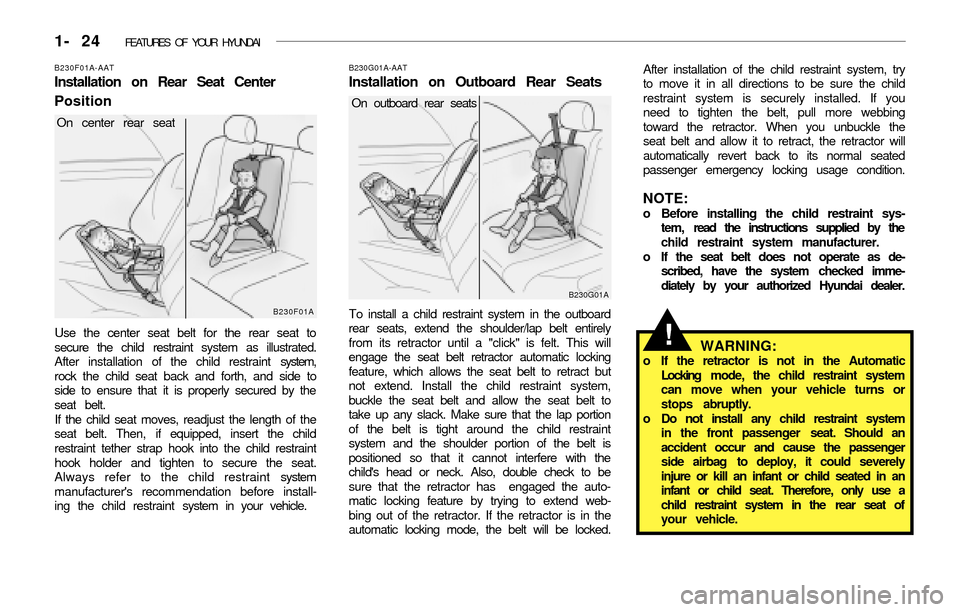
To install a child restraint system in the outboard
rear seats, extend the shoulder/lap belt entirely
from its retractor until a "click" is felt. This will
engage the seat belt retractor automatic locking
feature, which allows the seat belt to retract but
not extend. Install the child restraint system,
buckle the seat belt and allow the seat belt to
take up any slack. Make sure that the lap portion
of the belt is tight around the child restraint
system and the shoulder portion of the belt is
positioned so that it cannot interfere with the
child's head or neck. Also, double check to be
sure that the retractor has engaged the auto-
matic locking feature by trying to extend web-
bing out of the retractor. If the retractor is in the
automatic locking mode, the belt will be locked.
B230G01A-AAT
Installation on Outboard Rear Seats
On outboard rear seats
B230G01A B230F01A-AAT
Installation on Rear Seat Center
Position
Use the center seat belt for the rear seat to
secure the child restraint system as illustrated.
After installation of the child restraint system,
rock the child seat back and forth, and side to
side to ensure that it is properly secured by the
seat belt.
If the child seat moves, readjust the length of the
seat belt. Then, if equipped, insert the child
restraint tether strap hook into the child restraint
hook holder and tighten to secure the seat.
Always refer to the child restraint system
manufacturer's recommendation before install-
ing the child restraint system in your vehicle.
B230F01A
On center rear seat
Page 40 of 186
FEATURES OF YOUR HYUNDAI 1- 27
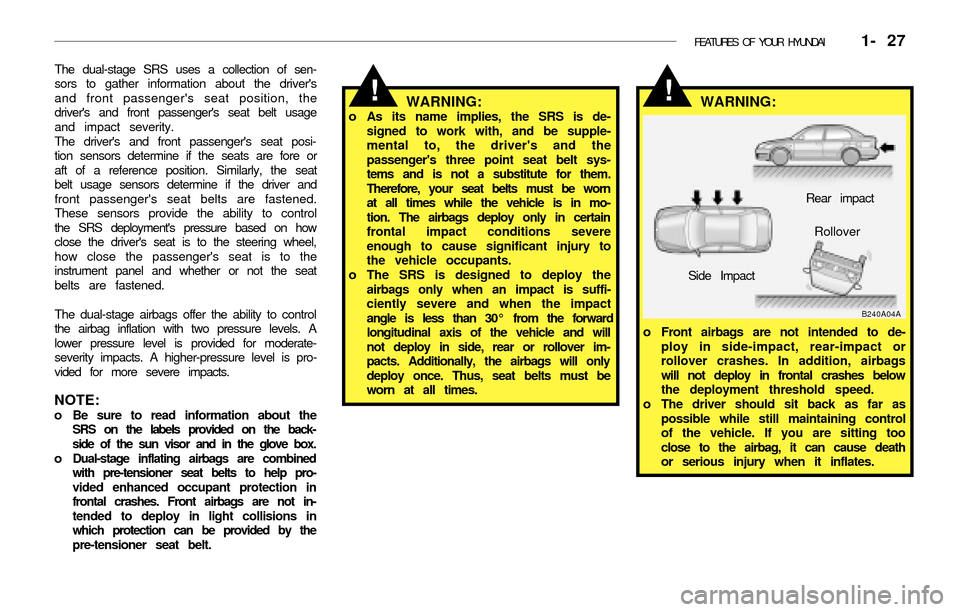
o Front airbags are not intended to de-
ploy in side-impact, rear-impact or
rollover crashes. In addition, airbags
will not deploy in frontal crashes below
the deployment threshold speed.
o The driver should sit back as far as
possible while still maintaining control
of the vehicle. If you are sitting too
close to the airbag, it can cause death
or serious injury when it inflates.
B240A04A
Rear impact
Side ImpactRollover
!
The dual-stage SRS uses a collection of sen-
sors to gather information about the driver's
and front passenger's seat position, the
driver's and front passenger's seat belt usage
and impact severity.
The driver's and front passenger's seat posi-
tion sensors determine if the seats are fore or
aft of a reference position. Similarly, the seat
belt usage sensors determine if the driver and
front passenger's seat belts are fastened.
These sensors provide the ability to control
the SRS deployment's pressure based on how
close the driver's seat is to the steering wheel,
how close the passenger's seat is to the
instrument panel and whether or not the seat
belts are fastened.
The dual-stage airbags offer the ability to control
the airbag inflation with two pressure levels. A
lower pressure level is provided for moderate-
severity impacts. A higher-pressure level is pro-
vided for more severe impacts.
NOTE:o Be sure to read information about the
SRS on the labels provided on the back-
side of the sun visor and in the glove box.
o Dual-stage inflating airbags are combined
with pre-tensioner seat belts to help pro-
vided enhanced occupant protection in
frontal crashes. Front airbags are not in-
tended to deploy in light collisions in
which protection can be provided by the
pre-tensioner seat belt.
WARNING:o As its name implies, the SRS is de-
signed to work with, and be supple-
mental to, the driver's and the
passenger's three point seat belt sys-
tems and is not a substitute for them.
Therefore, your seat belts must be worn
at all times while the vehicle is in mo-
tion. The airbags deploy only in certain
frontal impact conditions severe
enough to cause significant injury to
the vehicle occupants.
o The SRS is designed to deploy the
airbags only when an impact is suffi-
ciently severe and when the impact
angle is less than 30° from the forward
longitudinal axis of the vehicle and will
not deploy in side, rear or rollover im-
pacts. Additionally, the airbags will only
deploy once. Thus, seat belts must be
worn at all times.
!WARNING:
Page 43 of 186
1- 30 FEATURES OF YOUR HYUNDAI
!
B990B04Y-GAT
Side Impact Airbag (If Installed)
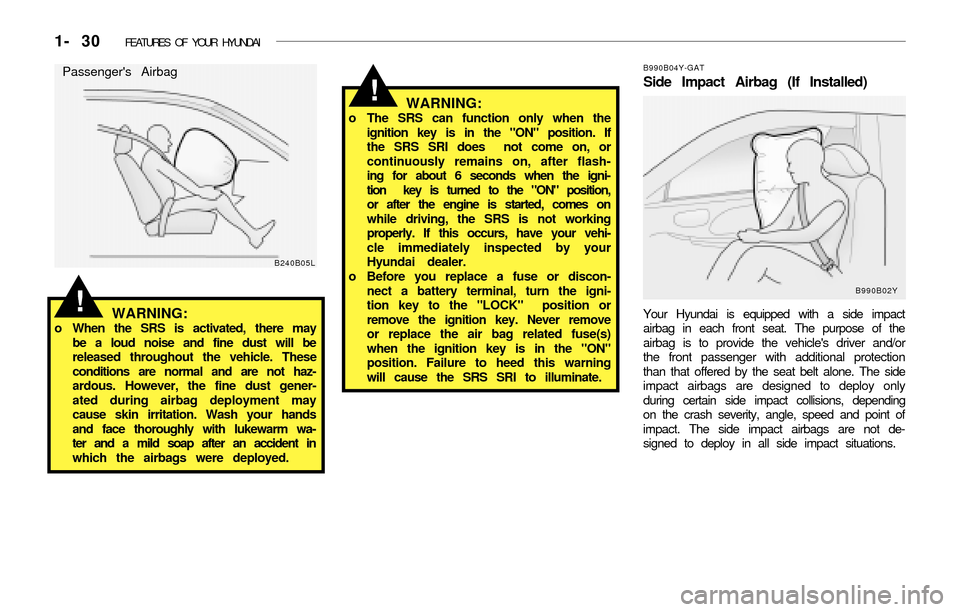
Your Hyundai is equipped with a side impact
airbag in each front seat. The purpose of the
airbag is to provide the vehicle's driver and/or
the front passenger with additional protection
than that offered by the seat belt alone. The side
impact airbags are designed to deploy only
during certain side impact collisions, depending
on the crash severity, angle, speed and point of
impact. The side impact airbags are not de-
signed to deploy in all side impact situations.
B990B02Y
WARNING:o When the SRS is activated, there may
be a loud noise and fine dust will be
released throughout the vehicle. These
conditions are normal and are not haz-
ardous. However, the fine dust gener-
ated during airbag deployment may
cause skin irritation. Wash your hands
and face thoroughly with lukewarm wa-
ter and a mild soap after an accident in
which the airbags were deployed.
!
Passenger's Airbag
B240B05L
WARNING:o The SRS can function only when the
ignition key is in the "ON" position. If
the SRS SRI does not come on, or
continuously remains on, after flash-
ing for about 6 seconds when the igni-
tion key is turned to the "ON" position,
or after the engine is started, comes on
while driving, the SRS is not working
properly. If this occurs, have your vehi-
cle immediately inspected by your
Hyundai dealer.
o Before you replace a fuse or discon-
nect a battery terminal, turn the igni-
tion key to the "LOCK" position or
remove the ignition key. Never remove
or replace the air bag related fuse(s)
when the ignition key is in the "ON"
position. Failure to heed this warning
will cause the SRS SRI to illuminate.
Page 44 of 186
FEATURES OF YOUR HYUNDAI 1- 31
!WARNING:o For best protection from the side im-
pact airbag system and to avoid being
injured by the deploying side impact
airbag, both front seat occupants
should sit in an upright position with
the seat belt properly fastened. The
driver's hands should be placed on the
steering wheel at the 9:00 and 3:00
o'clock positions.
The passenger's arms and hands should
be placed in their laps.
o Do not use any accessory seat covers.
o Use of seat covers could reduce or pre-
vent the effectiveness of the system.
o Do not install any accessories on the side
or near the side impact airbag.
o Do not use excessive force on the side of
the seat.
o Do not place any objects over the airbag
or between the airbag and yourself.
o Do not place any objects (an umbrella,
bag, etc.) between the front door and the
front seat. Such objects may become dan-
gerous projectiles and cause injury if the
supplemental side impact airbag inflates.
o To prevent unexpected deployment of the
side impact air bag that may result in
personal injury, avoid impact to the side
impact airbag sensor when the ignition
key is on.
HLC2036
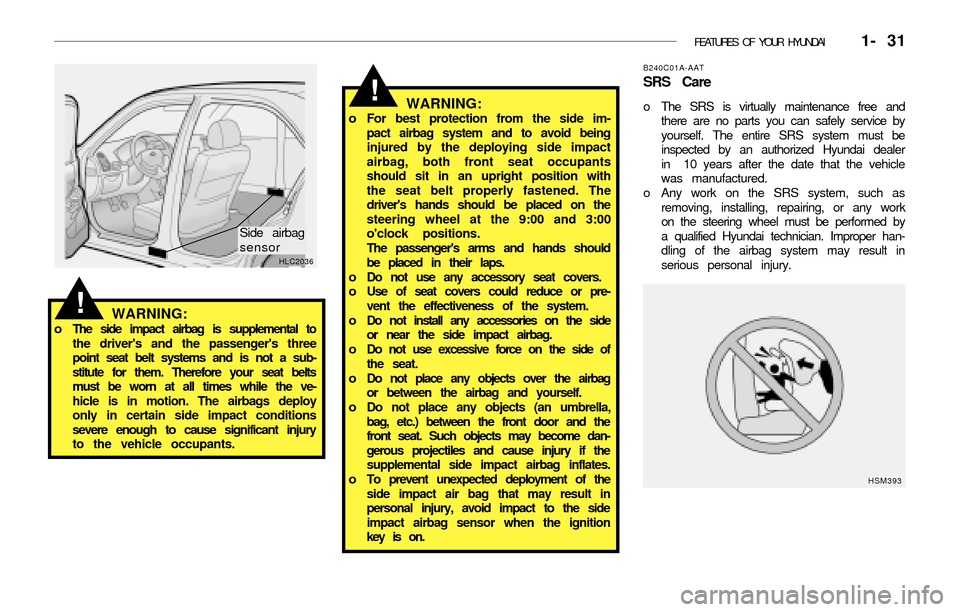
Side airbag
sensor
WARNING:o The side impact airbag is supplemental to
the driver's and the passenger's three
point seat belt systems and is not a sub-
stitute for them. Therefore your seat belts
must be worn at all times while the ve-
hicle is in motion. The airbags deploy
only in certain side impact conditions
severe enough to cause significant injury
to the vehicle occupants.
!
B240C01A-AAT
SRS Care
o The SRS is virtually maintenance free and
there are no parts you can safely service by
yourself. The entire SRS system must be
inspected by an authorized Hyundai dealer
in 10 years after the date that the vehicle
was manufactured.
o Any work on the SRS system, such as
removing, installing, repairing, or any work
on the steering wheel must be performed by
a qualified Hyundai technician. Improper han-
dling of the airbag system may result in
serious personal injury.
HSM393
Page 71 of 186
1- 58 FEATURES OF YOUR HYUNDAI
This is used to select fresh outside air or
recirculating inside air.
Fresh
Recirculation
With the mode selected, air enters the
vehicle from outside and is heated or cooled
according to the other functions selected.
With the mode selected, air from within
the passenger compartment is drawn through
the heating system and heated or cooled ac-
cording to the other functions selected.
B670C01A-AAT
AIR INTAKE CONTROL
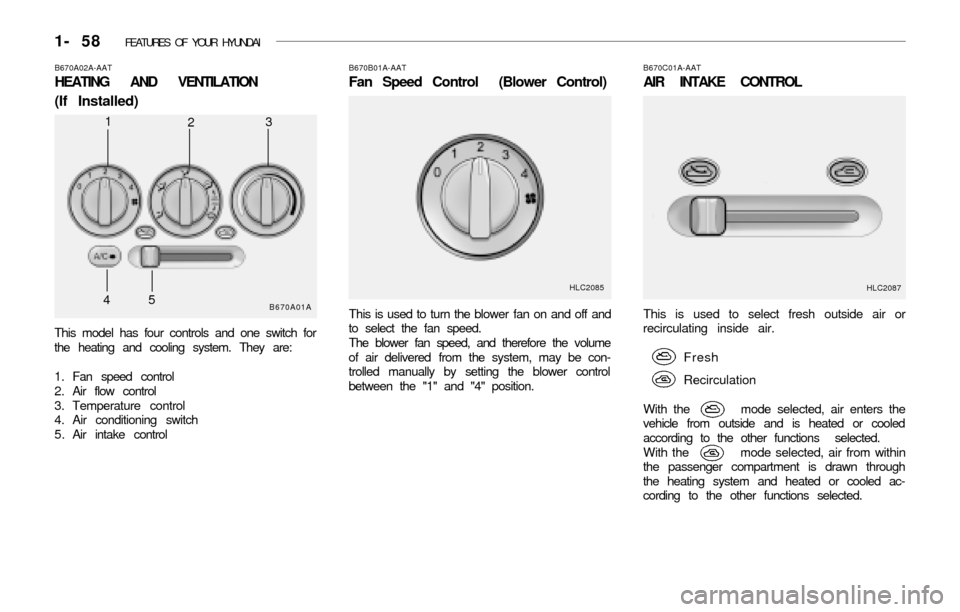
This model has four controls and one switch for
the heating and cooling system. They are:
1. Fan speed control
2. Air flow control
3. Temperature control
4. Air conditioning switch
5 . Air intake control
B670B01A-AAT
Fan Speed Control (Blower Control)
This is used to turn the blower fan on and off and
to select the fan speed.
The blower fan speed, and therefore the volume
of air delivered from the system, may be con-
trolled manually by setting the blower control
between the "1" and "4" position.
B670A02A-AAT
HEATING AND VENTILATION
(If Installed)
B670A01A
1
23
4
HLC2085HLC20875
Page 72 of 186
FEATURES OF YOUR HYUNDAI 1- 59
NOTE:It should be noted that prolonged opera-
tion of the heating system in mode will
give rise to misting of the windshield and
side windows and the air within the passen-
ger compartment will become stale. In ad-
dition prolonged use of the air condition-
ing with the mode selected may result
in the air within the passenger compart-
ment becoming excessively dry.
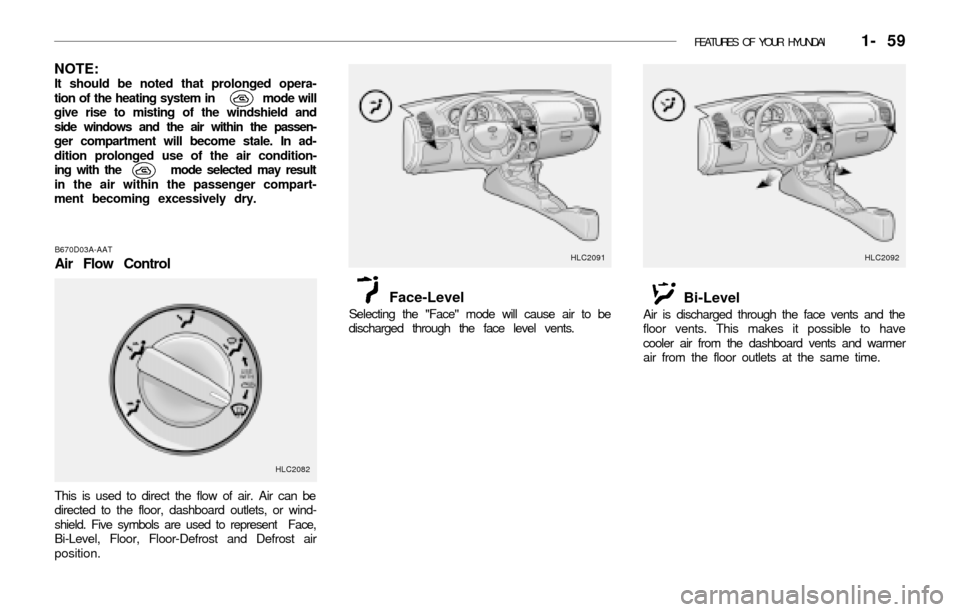
Bi-Level
Air is discharged through the face vents and the
floor vents. This makes it possible to have
cooler air from the dashboard vents and warmer
air from the floor outlets at the same time.
HLC2092HLC2091
Face-Level
Selecting the "Face" mode will cause air to be
discharged through the face level vents.
B670D03A-AAT
Air Flow Control
This is used to direct the flow of air. Air can be
directed to the floor, dashboard outlets, or wind-
shield. Five symbols are used to represent Face,
Bi-Level, Floor, Floor-Defrost and Defrost air
position.
HLC2082
Page 73 of 186
1- 60 FEATURES OF YOUR HYUNDAI
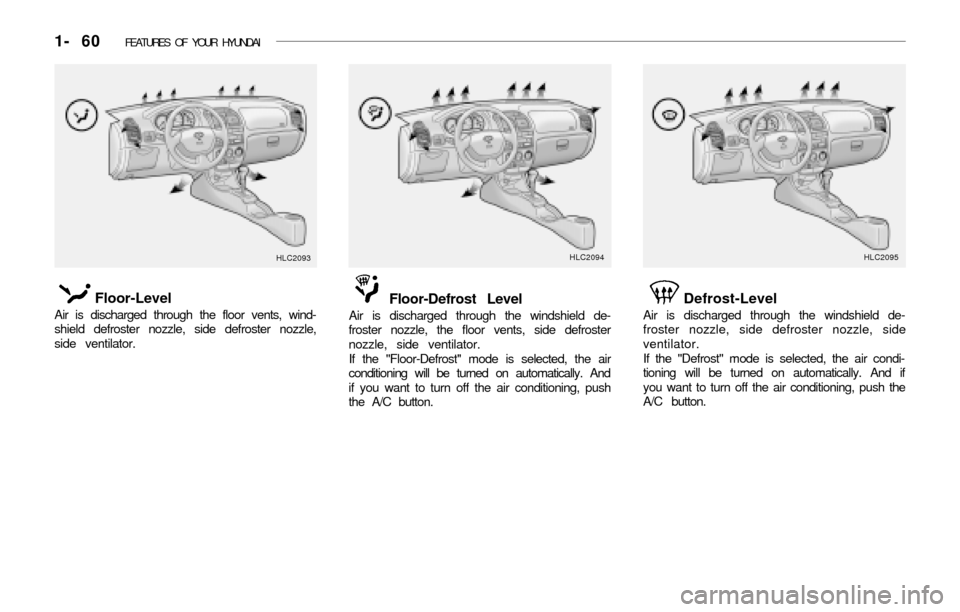
Defrost-Level
Air is discharged through the windshield de-
froster nozzle, side defroster nozzle, side
ventilator.
If the "Defrost" mode is selected, the air condi-
tioning will be turned on automatically. And if
you want to turn off the air conditioning, push the
A/C button.
HLC2095
Floor-Level
Air is discharged through the floor vents, wind-
shield defroster nozzle, side defroster nozzle,
side ventilator.
HLC2093
Floor-Defrost Level
Air is discharged through the windshield de-
froster nozzle, the floor vents, side defroster
nozzle, side ventilator.
If the "Floor-Defrost" mode is selected, the air
conditioning will be turned on automatically. And
if you want to turn off the air conditioning, push
the A/C button.
HLC2094
Page 74 of 186
FEATURES OF YOUR HYUNDAI 1- 61
B690A02A-AAT
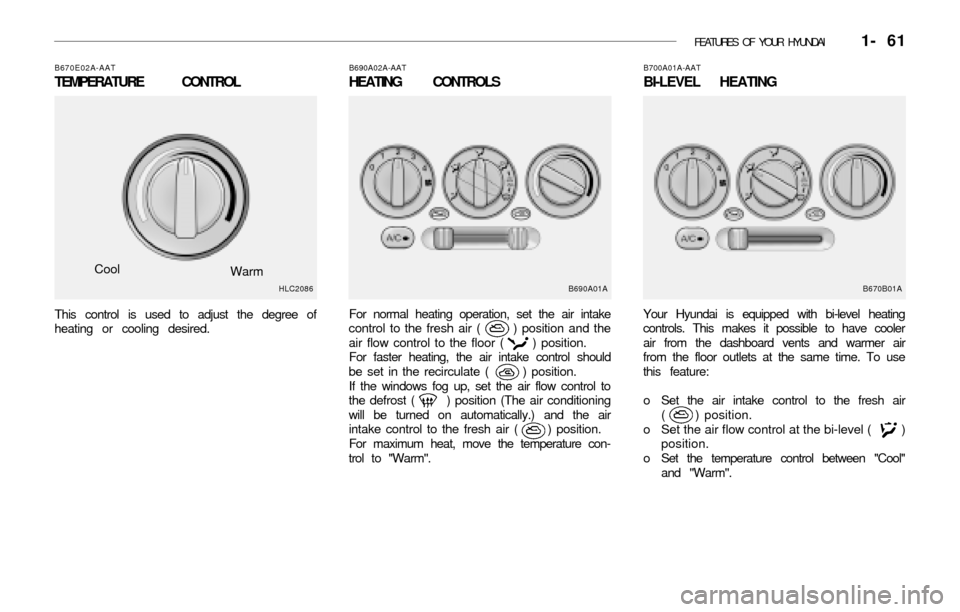
HEATING CONTROLS
B670E02A-AAT
TEMPERATURE CONTROL
Cool
Warm
This control is used to adjust the degree of
heating or cooling desired.
HLC2086
For normal heating operation, set the air intake
control to the fresh air ( ) position and the
air flow control to the floor ( ) position.
For faster heating, the air intake control should
be set in the recirculate ( ) position.
If the windows fog up, set the air flow control to
the defrost ( ) position (The air conditioning
will be turned on automatically.) and the air
intake control to the fresh air ( ) position.
For maximum heat, move the temperature con-
trol to "Warm".
B700A01A-AAT
BI-LEVEL HEATING
Your Hyundai is equipped with bi-level heating
controls. This makes it possible to have cooler
air from the dashboard vents and warmer air
from the floor outlets at the same time. To use
this feature:
o Set the air intake control to the fresh air
( ) position.
o Set the air flow control at the bi-level ( )
position.
o Set the temperature control between "Cool"
and "Warm".
B690A01AB670B01A
Page 75 of 186
1- 62 FEATURES OF YOUR HYUNDAI
B730A01FC-GAT
OPERATION TIPS
o To keep dust or unpleasant fumes from en-
tering the car through the ventilation system,
temporarily set the air intake control to
the position.
Be sure to return the control to the po-
sition when the irritation has passed to keep
fresh air in the vehicle. This will help keep the
driver alert and comfortable.
o Air for the heating/cooling system is drawn in
through the grilles just ahead of the wind-
shield. Care should be taken that these are
not blocked by leaves, snow, ice or other
obstructions.
o To prevent interior fog on the windshield, set
the air intake control to the fresh air ( )
position and fan speed to the desired posi-
tion.
B740A01A-AAT
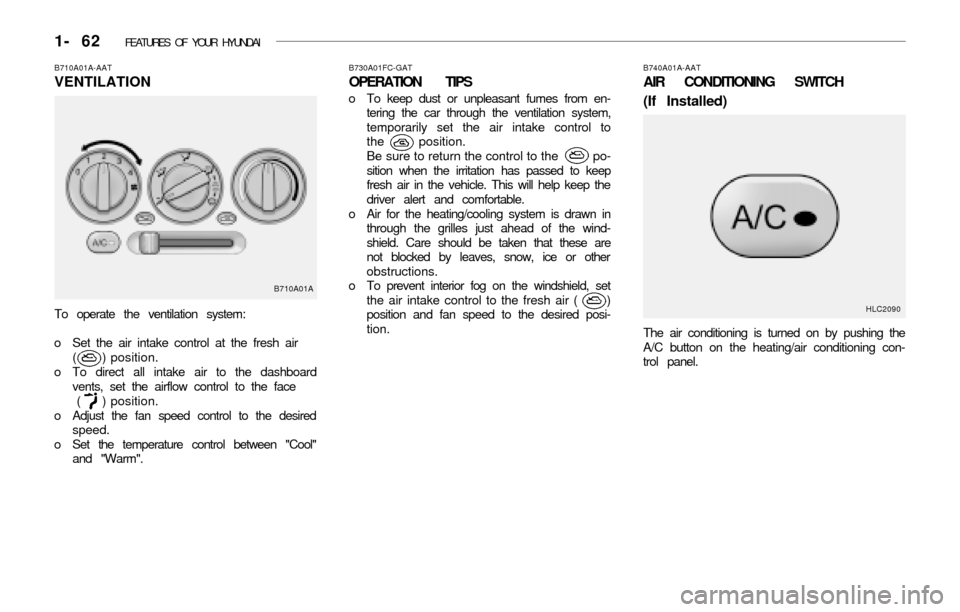
AIR CONDITIONING SWITCH
(If Installed)
The air conditioning is turned on by pushing the
A/C button on the heating/air conditioning con-
trol panel.
B710A01A-AAT
VENTILATION
To operate the ventilation system:
o Set the air intake control at the fresh air
( ) position.
o To direct all intake air to the dashboard
vents, set the airflow control to the face
( ) position.
o Adjust the fan speed control to the desired
speed.
o Set the temperature control between "Cool"
and "Warm".
B710A01A
HLC2090