Battery Hyundai Accent 2004 User Guide
[x] Cancel search | Manufacturer: HYUNDAI, Model Year: 2004, Model line: Accent, Model: Hyundai Accent 2004Pages: 205, PDF Size: 3.2 MB
Page 125 of 205
3
4
WHAT TO DO IN AN EMERGENCY
IF THE ENGINE OVERHEATS
!
!WARNING:While the engine is running, keep hands,
long hair and clothing away from moving
parts such as the fan and drive belts to
prevent injury.
D030A02A-AAT
If your temperature gauge indicates overheat-
ing, you experience a loss of power, or hear loud
pinging or knocking, the engine is probably too
hot. If this happens, you should:
1. Pull off the road and stop as soon as it is safe
to do so.
2. Place the gear selector lever in "P" (auto-
matic), or neutral (manual transaxle) and set
the parking brake. If the air conditioner is on,
turn it off.
3. If coolant is running out under the car or
steam is coming out from the hood, stop the
engine. Do not open the hood until the cool-
ant has stopped running or the steaming has
stopped. If there is no visible loss of coolant
and no steam, leave the engine running and
check to be sure the engine cooling fan is
operating. If the fan is not running, turn the
engine off.
4. Check to see if the water pump drive belt is
missing. If it is not missing, check to see that
it is tight. If the drive belt seems to be
satisfactory, check for coolant leaking from
the radiator, hoses or under the car. (If the air
conditioner had been in use, it is normal for
cold water to be draining from it when you
stop).5. If the water pump drive belt is broken or
coolant is leaking out, stop the engine im-
mediately and call the nearest Hyundai deal-
er for assistance.
WARNING:Do not remove the radiator cap when the
engine is hot. This may allow coolant to be
blown out of the opening and cause serious
burns.
6. If you cannot find the cause of the overheat-
ing, wait until the engine temperature has
returned to normal. Then, if coolant has been
lost, carefully add water to the reservoir
(Page 6-7) to bring the fluid level in the
reservoir up to the halfway mark.
7. Proceed with caution, keeping alert for fur-
ther signs of overheating. If overheating hap-
pens again, call a Hyundai dealer for assis-
tance. Then attach the other end of that cable to a
solid metal part of the engine away from the
battery. Do not connect the cable to any
moving part.
4. Start the engine in the car with the booster
battery and let it run for a few minutes. This
will help to assure that the booster battery is
fully charged. During the jumping operation,
run the engine in this vehicle at about 2000
rpm.
5. Start the engine in the car with the dis-
charged battery using the normal starting
procedure. After the engine starts, leave the
jumper cables connected and let the engine
run at fast idle or about 2000 rpm for several
minutes.
6. Carefully remove the jumper cables in the
reverse order of attachment.
If you do not know why your battery became
discharged (because the lights were left on,
etc.), have the charging system checked by
your Hyundai dealer.
Page 139 of 205
4CORROSION PREVENTION AND APPEARANCE CARE4CORROSION PREVENTION AND APPEARANCE CARE
5
E030D01A-AAT
When to Wax Again
You should polish and wax the car again when
water no longer beads on a clean surface but
spreads out over a larger area.
E030E01A-AAT
Maintaining Bumpers
Special precautions must be observed to pre-
serve the appearance of the bumpers on your
Hyundai. They are:
o Be careful not to spill battery electrolyte or
hydraulic brake fluid on the bumpers. If you
do, wash it off immediately with clean water.
o Be gentle when cleaning the bumper sur-
faces. They are made of soft plastic and the
surface can be damaged if mistreated. Do
not use abrasive cleaners. Use warm water
and mild soap or car-washing solution.
o Do not expose the bumpers to high tem-
peratures. For example, if you have your
car repainted, do not leave the bumpers on
the car if the car is going to be placed in a
high-temperature paint booth.
E040D01A-AAT
Cleaning the Seat Belts
To clean the seat belts, use a cloth or sponge
with mild soap or detergent and warm water. Do
not use strong detergents, dye, bleach or abra-
sive materials on the seat belts as this may
weaken the fabric.
While cleaning the belts, inspect them for ex-
cessive wear, cuts, fraying or other signs of
damage and replace them if necessary.
E040E01A-AATCleaning the Windows
You may use any household window cleaner on
the windows. However, when cleaning the in-
side of the rear window be careful not to damage
the rear window defroster wiring.
E040A01A-AAT
To Clean the Vinyl Upholstery
To clean the vinyl upholstery, first remove loose
dirt and dust with a vacuum cleaner. Then apply
a solution of mild soap or detergent and water
using a clean sponge or soft cloth. Allow this to
stay on the surface to loosen the dirt, then wipe
with a clean damp sponge or cloth. If all the dirt
stains are not removed, repeat this procedure
until the upholstery is clean. Do not use gaso-
line, solvent, paint thinner or other strong clean-
ers.
E040C01A-AAT
Cleaning the Carpets
Use a foam-type carpet cleaner. Cleaners of
this type are available in aerosol cans in liquid
form or powder. Read the instructions and follow
them exactly. Using a vacuum cleaner with the
appropriate attachment, remove as much dirt
from the carpets as possible. Apply the foam
following the manufacturer's directions, then
rub in overlapping circles. Do not add water.
These cleaners work best when the carpet is
kept as dry as possible.
CLEANING THE INTERIOR
Page 151 of 205
6DO-IT-YOURSELF MAINTENANCE
2
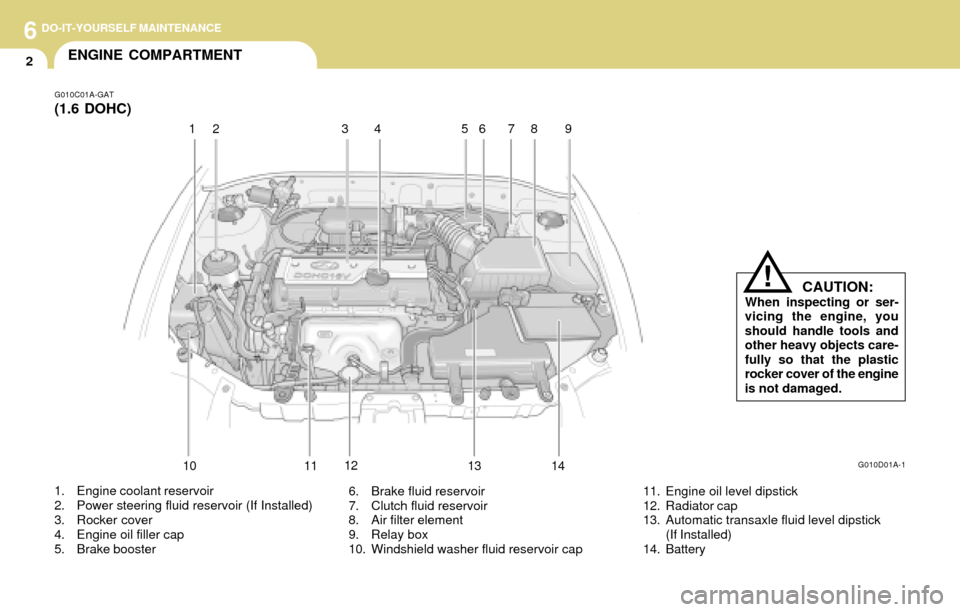
6. Brake fluid reservoir
7. Clutch fluid reservoir
8. Air filter element
9. Relay box
10. Windshield washer fluid reservoir cap
ENGINE COMPARTMENT
G010C01A-GAT
(1.6 DOHC)
G010D01A-1
1. Engine coolant reservoir
2. Power steering fluid reservoir (If Installed)
3. Rocker cover
4. Engine oil filler cap
5. Brake booster11. Engine oil level dipstick
12. Radiator cap
13. Automatic transaxle fluid level dipstick
(If Installed)
14. Battery 1
CAUTION:When inspecting or ser-
vicing the engine, you
should handle tools and
other heavy objects care-
fully so that the plastic
rocker cover of the engine
is not damaged.
!
23456789
10 1112
13
14
Page 152 of 205
6DO-IT-YOURSELF MAINTENANCE
3GENERAL CHECKS
G020C01A-AAT
Vehicle Interior
The following should be checked each time
when the vehicle is driven:
o Light operation
o Windshield wiper operation
o Horn operation
o Defroster, heater system operation (and air
conditioning, if installed)
o Steering operation and condition
o Mirror condition and operation
o Turn signal operation
o Accelerator pedal operation
o Brake operation, including parking brake
o Manual transaxle operation, including clutch
operation
o Automatic transaxle operation, including
"Park" mechanism operation
o Seat control condition and operation
o Seat belt condition and operation
o Sun visor operation
If you notice anything that does not operate
correctly or appear to be functioning correctly,
inspect it carefully and seek assistance from
your Hyundai dealer if service is needed.
G020A01A-AATEngine Compartment
The following should be checked regularly:
o Engine oil level and condition
o Transaxle fluid level and condition
o Brake fluid level
o Clutch fluid level
o Engine coolant level
o Windshield washer fluid level
o Accessory drive belt condition
o Engine coolant hose condition
o Fluid leaks (on or below components)
o Power steering fluid level and condition
o Battery Condition
o Air filter conditionG020B01A-AAT
Vehicle Exterior
The following should be checked monthly:
o Overall appearance and condition
o Wheel condition and wheel nut tightness
o Exhaust system condition
o Light condition and operation
o Windshield glass condition
o Wiper blade condition
o Paint condition and body corrosion
o Fluid leaks
o Door and hood lock condition
o Tire pressure and condition
(including spare tire)
Page 168 of 205
6DO-IT-YOURSELF MAINTENANCE
19CHECKING AND REPLACING
FUSESCHECKING DRIVE BELTS
G190A01A-AAT
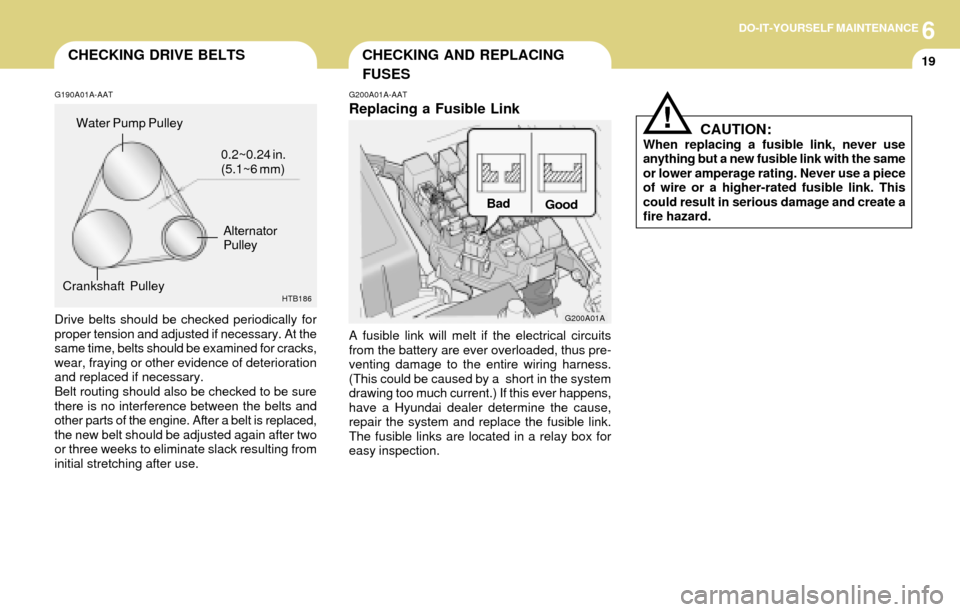
Drive belts should be checked periodically for
proper tension and adjusted if necessary. At the
same time, belts should be examined for cracks,
wear, fraying or other evidence of deterioration
and replaced if necessary.
Belt routing should also be checked to be sure
there is no interference between the belts and
other parts of the engine. After a belt is replaced,
the new belt should be adjusted again after two
or three weeks to eliminate slack resulting from
initial stretching after use.
Water Pump Pulley
Alternator
Pulley
Crankshaft Pulley0.2~0.24 in.
(5.1~6 mm)
HTB186
G200A01A-AAT
Replacing a Fusible Link
A fusible link will melt if the electrical circuits
from the battery are ever overloaded, thus pre-
venting damage to the entire wiring harness.
(This could be caused by a short in the system
drawing too much current.) If this ever happens,
have a Hyundai dealer determine the cause,
repair the system and replace the fusible link.
The fusible links are located in a relay box for
easy inspection.
G200A01A
Bad
Good
CAUTION:When replacing a fusible link, never use
anything but a new fusible link with the same
or lower amperage rating. Never use a piece
of wire or a higher-rated fusible link. This
could result in serious damage and create a
fire hazard.
!
Page 170 of 205
6DO-IT-YOURSELF MAINTENANCE
21CHECKING THE BATTERY
!
G210A01A-AAT
WARNING:When working with batteries, carefully ob-
serve the following precautions to avoid se-
rious injuries.o If battery fluid is on your skin, flush the
affected areas with water for at least 15
minutes and then seek medical assistance.
o If battery fluid is in your eyes, rinse out your
eyes with water and get medical assistance
as soon as possible. While you are being
driven to get medical assistance, continue to
rinse your eyes by using a sponge or soft
cloth saturated with water.
o If you swallow battery fluid, drink a large
quantity of water or milk followed by milk of
magnesia, eat a raw egg or drink vegetable
oil. Get medical assistance as soon as pos-
sible.
While batteries are being charged (either by a
battery charger or by the vehicle's alternator),
they produce explosive gases. Always observe
these warnings to prevent injuries from occur-
ring:
o Charge batteries only in a well ventilated
area.
o Do not permit flames, sparks or smoking in
the area.
o Keep children away from the area.
D010B01A
The fluid in the battery contains a strong solution
of sulfuric acid, which is poisonous and highly
corrosive. Be careful not to spill it on yourself or
the car. If you do spill battery fluid on yourself,
immediately do the following:
!
G210B02A-AAT
Checking the Battery
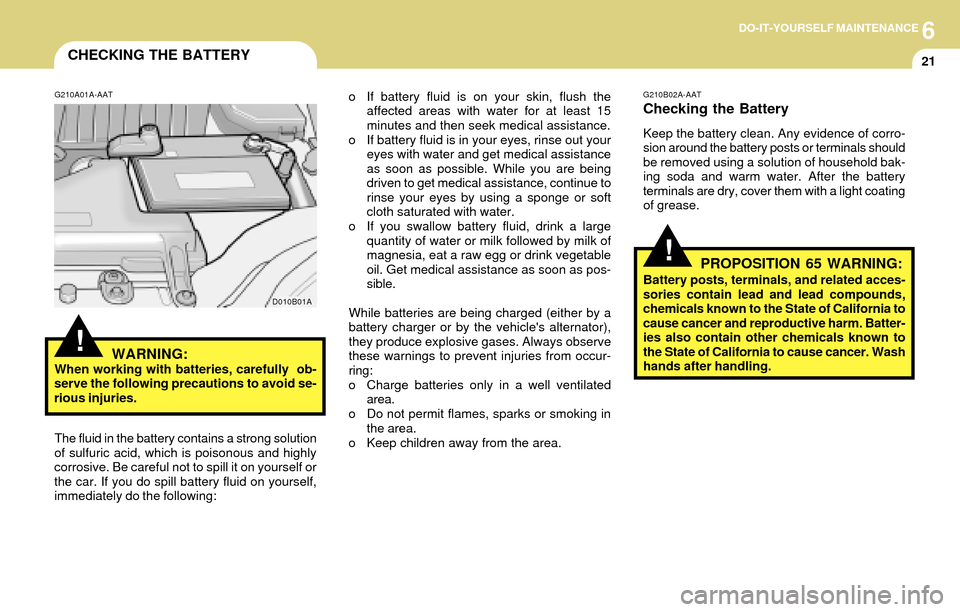
Keep the battery clean. Any evidence of corro-
sion around the battery posts or terminals should
be removed using a solution of household bak-
ing soda and warm water. After the battery
terminals are dry, cover them with a light coating
of grease.
PROPOSITION 65 WARNING:Battery posts, terminals, and related acces-
sories contain lead and lead compounds,
chemicals known to the State of California to
cause cancer and reproductive harm. Batter-
ies also contain other chemicals known to
the State of California to cause cancer. Wash
hands after handling.
Page 181 of 205
6DO-IT-YOURSELF MAINTENANCE
32FUSE PANEL DESCRIPTION
G200C02A-GAT
Engine Compartment
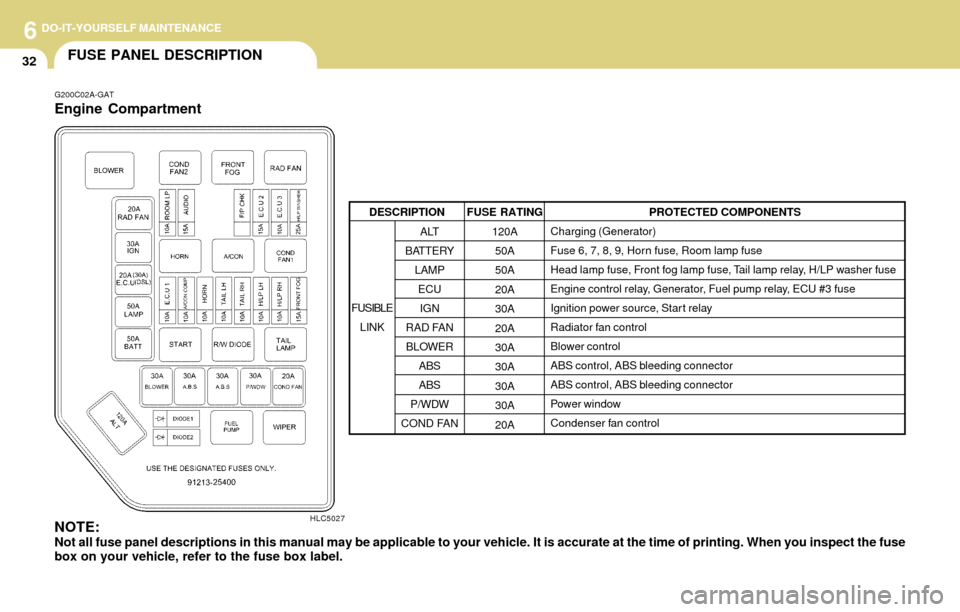
HLC5027NOTE:Not all fuse panel descriptions in this manual may be applicable to your vehicle. It is accurate at the time of printing. When you inspect the fuse
box on your vehicle, refer to the fuse box label.
FUSE RATING
120A
50A
50A
20A
30A
20A
30A
30A
30A
30A
20APROTECTED COMPONENTS
Charging (Generator)
Fuse 6, 7, 8, 9, Horn fuse, Room lamp fuse
Head lamp fuse, Front fog lamp fuse, Tail lamp relay, H/LP washer fuse
Engine control relay, Generator, Fuel pump relay, ECU #3 fuse
Ignition power source, Star t relay
Radiator fan control
Blower control
ABS control, ABS bleeding connector
ABS control, ABS bleeding connector
Power window
Condenser fan control
ALT
BATTERY
LAMP
ECU
IGN
RAD FAN
BLOWER
ABS
ABS
P/WDW
COND FAN FUSIBLE
LINK
DESCRIPTION
Page 197 of 205
9VEHICLE SPECIFICATIONS
2
Tire Size
P175/70 R13
P185/60 R14
T105/70 D(R)14 in. (mm)
Liter
45Automatic Transaxle
Manual Transaxle
MF12V, 55AH
13.5V 90A
Dual hydraulic with brake booster
Ventilated disc
Drum
Cable operated on rear wheel
Standard
Option
Spare
US. gal
11.9 Fuel tank
capacityImp.gal
9.9Battery
Alternator
Starter0.9 KW
0.7 KW
Type
Front brake type
Rear brake type
Parking brake
Inflation Pressure
30PSI (207 kPa)
60PSI (414 kPa)
J010A01A-AAT
MEASUREMENT
J020A01A-AATPOWER STEERING
J060A01A-AATFUEL SYSTEM
J040A01A-AATELECTRICAL
J050A01A-AAT
BRAKE
J030A03A-AAT
TIRE
4 DOOR
167.7 (4260)
66.1 (1680)
54.9 (1395)
96.1 (2440)
56.5 (1435)
56.1 (1425) Item
Overall length
Overall width
Overall height (unladen)
Wheel base
Wheel tread
Front
Rear
3 DOOR
165.9 (4215)
Type
Wheel free play
Rack stroke
Oil pump typeRack and pinion
0 ~ 1.18 in (0 ~ 30 mm)
5.3 in. (134 mm)
Vane type
Page 201 of 205
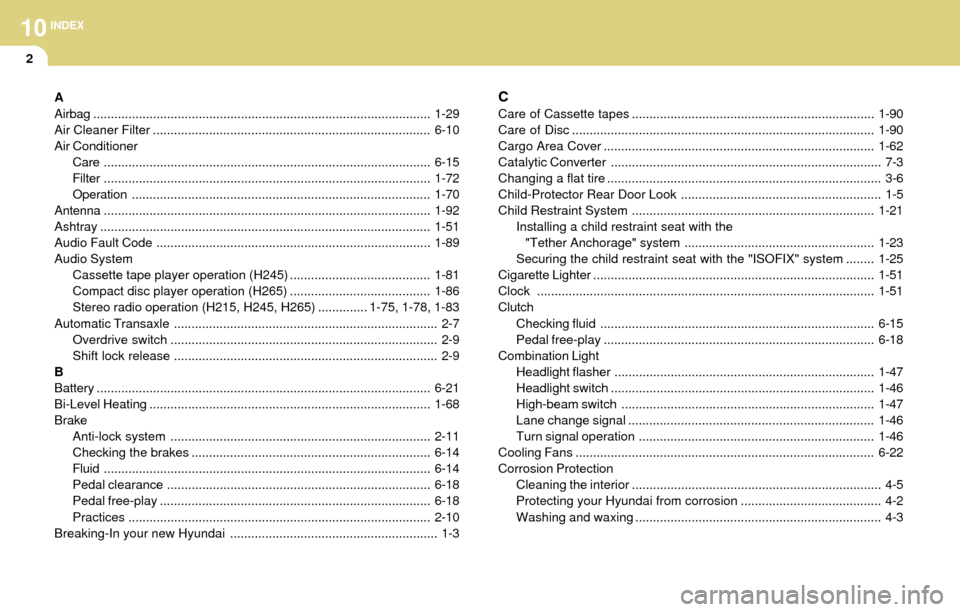
10INDEX
2
C
Care of Cassette tapes .....................................................................1-90
Care of Disc ......................................................................................1-90
Cargo Area Cover .............................................................................1-62
Catalytic Converter............................................................................. 7-3
Changing a flat tire .............................................................................. 3-6
Child-Protector Rear Door Look ......................................................... 1-5
Child Restraint System.....................................................................1-21
Installing a child restraint seat with the
"Tether Anchorage" system ......................................................1-23
Securing the child restraint seat with the "ISOFIX" system ........1-25
Cigarette Lighter................................................................................1-51
Clock ................................................................................................1-51
Clutch
Checking fluid..............................................................................6-15
Pedal free-play .............................................................................6-18
Combination Light
Headlight flasher ..........................................................................1-47
Headlight switch...........................................................................1-46
High-beam switch........................................................................1-47
Lane change signal ......................................................................1-46
Turn signal operation ...................................................................1-46
Cooling Fans.....................................................................................6-22
Corrosion Protection
Cleaning the interior....................................................................... 4-5
Protecting your Hyundai from corrosion........................................ 4-2
Washing and waxing...................................................................... 4-3 A
Airbag................................................................................................1-29
Air Cleaner Filter...............................................................................6-10
Air Conditioner
Care.............................................................................................6-15
Filter.............................................................................................1-72
Operation.....................................................................................1-70
Antenna.............................................................................................1-92
Ashtray ..............................................................................................1-51
Audio Fault Code ..............................................................................1-89
Audio System
Cassette tape player operation (H245)........................................1-81
Compact disc player operation (H265)........................................1-86
Stereo radio operation (H215, H245, H265) .............. 1-75, 1-78, 1-83
Automatic Transaxle ........................................................................... 2-7
Overdrive switch............................................................................ 2-9
Shift lock release........................................................................... 2-9
B
Battery...............................................................................................6-21
Bi-Level Heating ................................................................................1-68
Brake
Anti-lock system..........................................................................2-11
Checking the brakes ....................................................................6-14
Fluid .............................................................................................6-14
Pedal clearance...........................................................................6-18
Pedal free-play .............................................................................6-18
Practices ......................................................................................2-10
Breaking-In your new Hyundai ........................................................... 1-3