service Hyundai Accent 2004 Owner's Guide
[x] Cancel search | Manufacturer: HYUNDAI, Model Year: 2004, Model line: Accent, Model: Hyundai Accent 2004Pages: 205, PDF Size: 3.2 MB
Page 164 of 205
6DO-IT-YOURSELF MAINTENANCE
15CHECKING THE CLUTCH FLUID
!
G130B02A-AAT
To Replace the Fluid
Recommended brake fluid conforming to DOT 3
or DOT 4 specification should be used. The
reservoir cap must be fully tightened to avoid
contamination from foreign matter or moisture.
NOTE:Do not allow any other liquids to contami-
nate the brake fluid. Seal damage will result.
WARNING:Use caution when handling brake fluid. It
can damage your vision if you get it in your
eyes. It will also damage your vehicles paint
if spilled on it and not removed immediately.
G130A01A-AAT
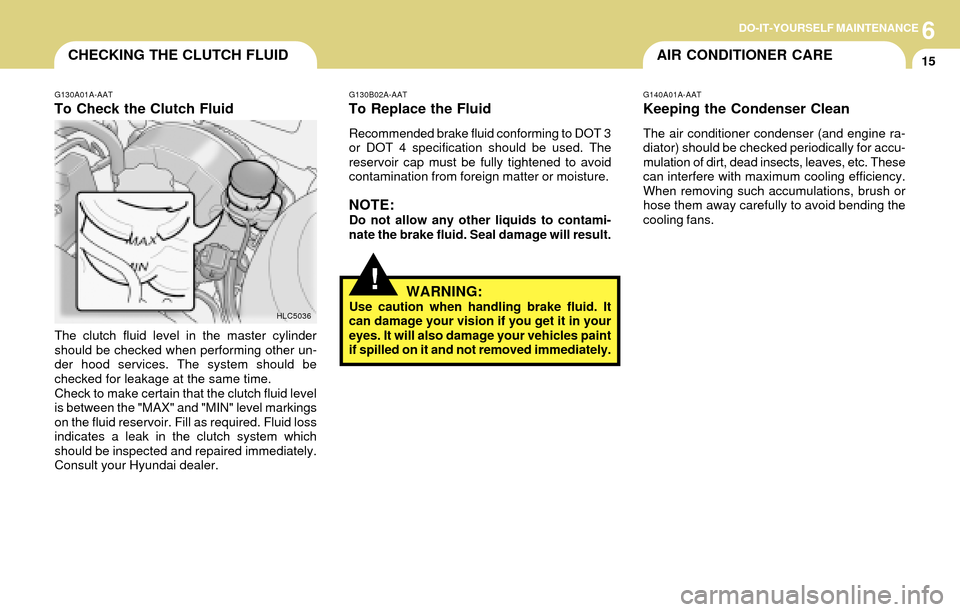
To Check the Clutch Fluid
The clutch fluid level in the master cylinder
should be checked when performing other un-
der hood services. The system should be
checked for leakage at the same time.
Check to make certain that the clutch fluid level
is between the "MAX" and "MIN" level markings
on the fluid reservoir. Fill as required. Fluid loss
indicates a leak in the clutch system which
should be inspected and repaired immediately.
Consult your Hyundai dealer.
HLC5036
AIR CONDITIONER CARE
G140A01A-AAT
Keeping the Condenser Clean
The air conditioner condenser (and engine ra-
diator) should be checked periodically for accu-
mulation of dirt, dead insects, leaves, etc. These
can interfere with maximum cooling efficiency.
When removing such accumulations, brush or
hose them away carefully to avoid bending the
cooling fans.
Page 193 of 205
8CONSUMER INFORMATION & REPORTING SAFETY DEFECTS
7CONSUMER INFORMATION
!
I130A01A-AAT
This consumer information has been prepared
in accordance with regulations issued by the
National Highway Traffic Safety Administration
of the U.S. Department of Transportation. It
provides the purchasers and/or prospective
purchasers of Hyundai automobiles with infor-
mation on uniform tire quality grading. Your
Hyundai dealer will help answer any questions
you may have as you read this information.
I130B03A-AAT
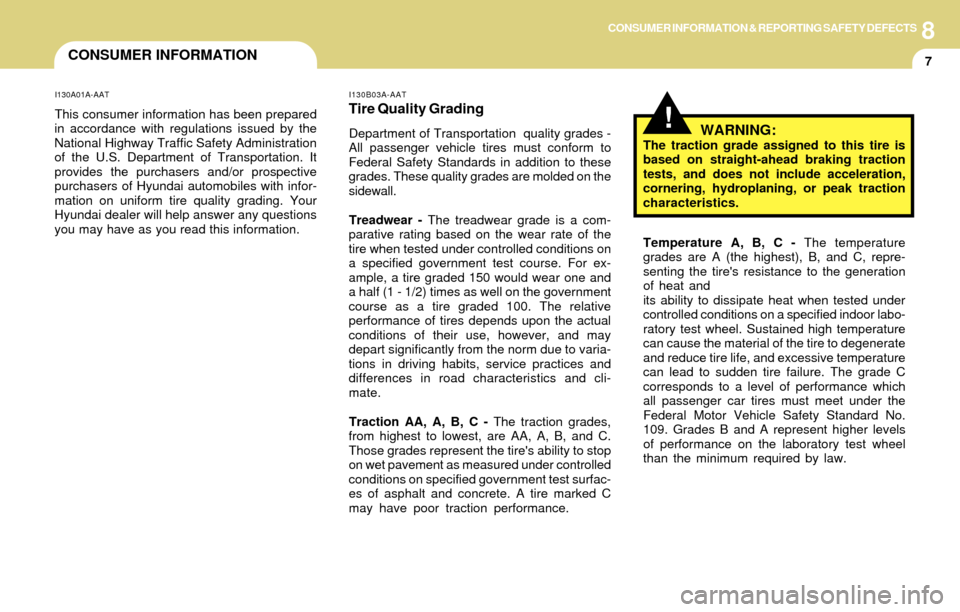
Tire Quality Grading
Department of Transportation quality grades -
All passenger vehicle tires must conform to
Federal Safety Standards in addition to these
grades. These quality grades are molded on the
sidewall.
Treadwear - The treadwear grade is a com-
parative rating based on the wear rate of the
tire when tested under controlled conditions on
a specified government test course. For ex-
ample, a tire graded 150 would wear one and
a half (1 - 1/2) times as well on the government
course as a tire graded 100. The relative
performance of tires depends upon the actual
conditions of their use, however, and may
depart significantly from the norm due to varia-
tions in driving habits, service practices and
differences in road characteristics and cli-
mate.
Traction AA, A, B, C - The traction grades,
from highest to lowest, are AA, A, B, and C.
Those grades represent the tire's ability to stop
on wet pavement as measured under controlled
conditions on specified government test surfac-
es of asphalt and concrete. A tire marked C
may have poor traction performance.WARNING:The traction grade assigned to this tire is
based on straight-ahead braking traction
tests, and does not include acceleration,
cornering, hydroplaning, or peak traction
characteristics.
Temperature A, B, C - The temperature
grades are A (the highest), B, and C, repre-
senting the tire's resistance to the generation
of heat and
its ability to dissipate heat when tested under
controlled conditions on a specified indoor labo-
ratory test wheel. Sustained high temperature
can cause the material of the tire to degenerate
and reduce tire life, and excessive temperature
can lead to sudden tire failure. The grade C
corresponds to a level of performance which
all passenger car tires must meet under the
Federal Motor Vehicle Safety Standard No.
109. Grades B and A represent higher levels
of performance on the laboratory test wheel
than the minimum required by law.
Page 203 of 205
10INDEX
4
Scheduled maintenance................................................................. 5-4
Service requirements ..................................................................... 5-2
Mirrors
Day/night inside rearview.............................................................1-57
Outside rear view ........................................................................1-55
O
Odometer/Trip Odometer..................................................................1-43
P
Parking Brake...................................................................................1-57
Power Steering Fluid Level ...............................................................6-22
Pretensioner Seat Belt ......................................................................1-27
R
Rear Seats
Folding seatbacks........................................................................1-14
Rear seat entry ............................................................................1-12
Rear Window Defroster Switch .........................................................1-50
Rear Window Wiper and Washer.....................................................1-48
Replacement of Bulbs .......................................................................6-24
S
Seat Belts
2-Point static type ........................................................................1-20
3-Point type..................................................................................1-18
Adjusting your seat belt ...............................................................1-19
Adjutable height...........................................................................1-17
Care of seat belts ........................................................................1-17
Precautions..................................................................................1-15 Heating and Ventilation
Air flow control.............................................................................1-66
Air intake control..........................................................................1-65
Bi-level heating ............................................................................1-68
Defrosting/Defogging....................................................................1-71
Fan seed control (Blower control)...............................................1-65
Temperature control.....................................................................1-68
High-Mounted Rear Stop Light .........................................................1-57
Hood Release...................................................................................1-58
Horn................................................................................................1-63
I
Ignition Switch..................................................................................... 2-3
Instrument Cluster and Indicator Lights............................................1-38
Instrument Panel Light Control (Rheostat).......................................1-49
Interior Light ......................................................................................1-53
J
Jump Starting...................................................................................... 3-3
K
Keys .................................................................................................. 1-3
If you lose your keys...................................................................3-13
Positions........................................................................................ 2-3
M
Maintenance Intervals
Explanation of scheduled maintenance items .............................. 5-7
Maintenance under severe usage conditions ................................ 5-6
Page 205 of 205
Seoul KoreaPrinting: MAR. 04, 2004
Publication No.: A25O-EU43G
Printed in Korea
SERVICE STATION INFORMATION SERVICE STATION INFORMATIONSERVICE STATION INFORMATION SERVICE STATION INFORMATION
SERVICE STATION INFORMATION
FUEL: FUEL:FUEL: FUEL:
FUEL:
UNLEADED gasoline only
Pump Octane Rating of 87 (Research Octane Number 91) or higher.
FUEL TANK CAPACITY FUEL TANK CAPACITYFUEL TANK CAPACITY FUEL TANK CAPACITY
FUEL TANK CAPACITY
Original, US.gal (Imp.gal., liter) 11.9 (9.9, 45)
TIRE PRESSURE: TIRE PRESSURE:TIRE PRESSURE: TIRE PRESSURE:
TIRE PRESSURE:
See the label in the glove box.
OTHER TIRE INFORMATION: OTHER TIRE INFORMATION:OTHER TIRE INFORMATION: OTHER TIRE INFORMATION:
OTHER TIRE INFORMATION:
See pages 8-1 through 8-6
HOOD RELEASE: HOOD RELEASE:HOOD RELEASE: HOOD RELEASE:
HOOD RELEASE:
Pull handle under left side of dash.
ENGINE OIL: ENGINE OIL:ENGINE OIL: ENGINE OIL:
ENGINE OIL:
SH, SG or SG/CD multigrade and fuel efficient oil. Use SAE 10W-
30, 10W-40 or 10W-50 if normal temperatures are above -10°F (-
23°C). For other viscosity recommendations, see page 6-4.MANUAL TRANSAXLE: MANUAL TRANSAXLE:MANUAL TRANSAXLE: MANUAL TRANSAXLE:
MANUAL TRANSAXLE:
HYUNDAI GENUINE PARTS MTF 75W/90 (API GL-4) Oil level
should be up to filler-bolt hole in housing beside differential.
AUTOMATIC TRANSAXLE: AUTOMATIC TRANSAXLE:AUTOMATIC TRANSAXLE: AUTOMATIC TRANSAXLE:
AUTOMATIC TRANSAXLE:
Apply the parking brake, with the engine running, shift the selector
lever through all ranges and return to "N" (Neutral) position. Then
check the level of fluid on the dipstick. Use only HYUNDAI GENU-
INE ATF available at your dealer, DIAMOND ATF SP-III or SK ATF
SP-III.
QUICK INDEX QUICK INDEXQUICK INDEX QUICK INDEX
QUICK INDEX
o Car will not start .................................................................... 3-2
o Flat tire ................................................................................. 3-6
o Warning light/chime comes on .................................... 1-38 ~ 1-41
o Engine overheats ................................................................... 3-4
o Towing of your vehicle ......................................................... 3-11
o Starting the engine ................................................................. 2-5
o Driving tips for first 1,200 miles (2,000 km) .......................... 1-3
o Scheduled maintenance ......................................................... 5-4
o Reporting safety defects ......................................................... 8-9