wheel Hyundai Accent 2004 Owner's Guide
[x] Cancel search | Manufacturer: HYUNDAI, Model Year: 2004, Model line: Accent, Model: Hyundai Accent 2004Pages: 205, PDF Size: 3.2 MB
Page 131 of 205
3
10
WHAT TO DO IN AN EMERGENCY
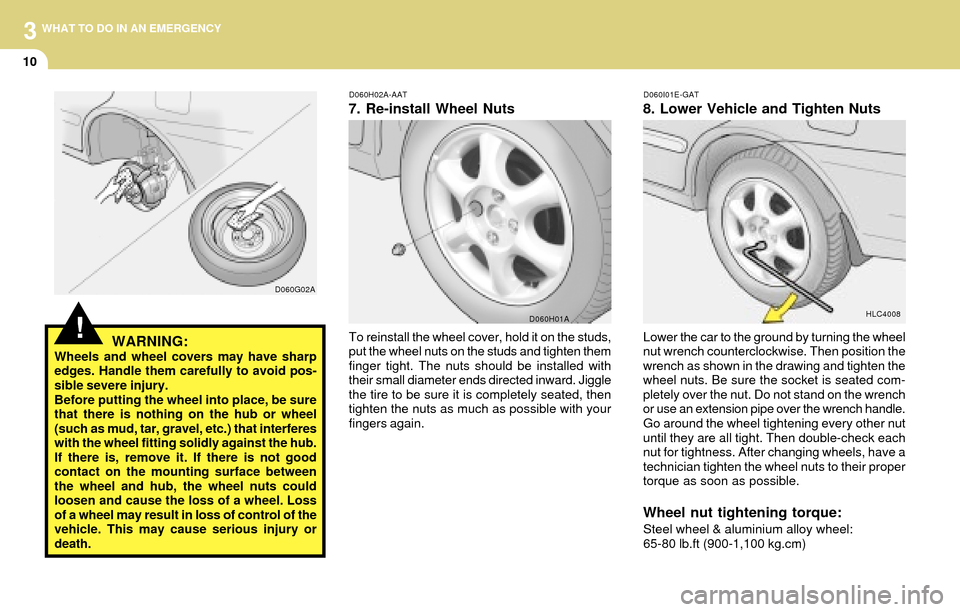
D060I01E-GAT
8. Lower Vehicle and Tighten Nuts
Lower the car to the ground by turning the wheel
nut wrench counterclockwise. Then position the
wrench as shown in the drawing and tighten the
wheel nuts. Be sure the socket is seated com-
pletely over the nut. Do not stand on the wrench
or use an extension pipe over the wrench handle.
Go around the wheel tightening every other nut
until they are all tight. Then double-check each
nut for tightness. After changing wheels, have a
technician tighten the wheel nuts to their proper
torque as soon as possible.
Wheel nut tightening torque:
Steel wheel & aluminium alloy wheel:
65-80 lb.ft (900-1,100 kg.cm)
HLC4008
!WARNING:Wheels and wheel covers may have sharp
edges. Handle them carefully to avoid pos-
sible severe injury.
Before putting the wheel into place, be sure
that there is nothing on the hub or wheel
(such as mud, tar, gravel, etc.) that interferes
with the wheel fitting solidly against the hub.
If there is, remove it. If there is not good
contact on the mounting surface between
the wheel and hub, the wheel nuts could
loosen and cause the loss of a wheel. Loss
of a wheel may result in loss of control of the
vehicle. This may cause serious injury or
death.
D060H02A-AAT
7. Re-install Wheel Nuts
To reinstall the wheel cover, hold it on the studs,
put the wheel nuts on the studs and tighten them
finger tight. The nuts should be installed with
their small diameter ends directed inward. Jiggle
the tire to be sure it is completely seated, then
tighten the nuts as much as possible with your
fingers again.
D060G02A
D060H01A
Page 132 of 205
3WHAT TO DO IN AN EMERGENCY
11IF YOUR CAR MUST BE TOWED
D060J01E-AAT
After Changing Wheels
If you have a tire gauge, remove the valve cap
and check the air pressure. If the pressure is
lower than recommended, drive slowly to the
nearest service station and inflate to the correct
pressure. If it is too high, adjust it until it is
correct. Always reinstall the valve cap after
checking or adjusting tire pressure. If the cap is
not replaced, air may leak from the tire. If you
lose a valve cap, buy another and install it as
soon as possible.
After you have changed wheels, always secure
the flat tire in its place in the trunk and return the
jack and tools to their proper storage locations.
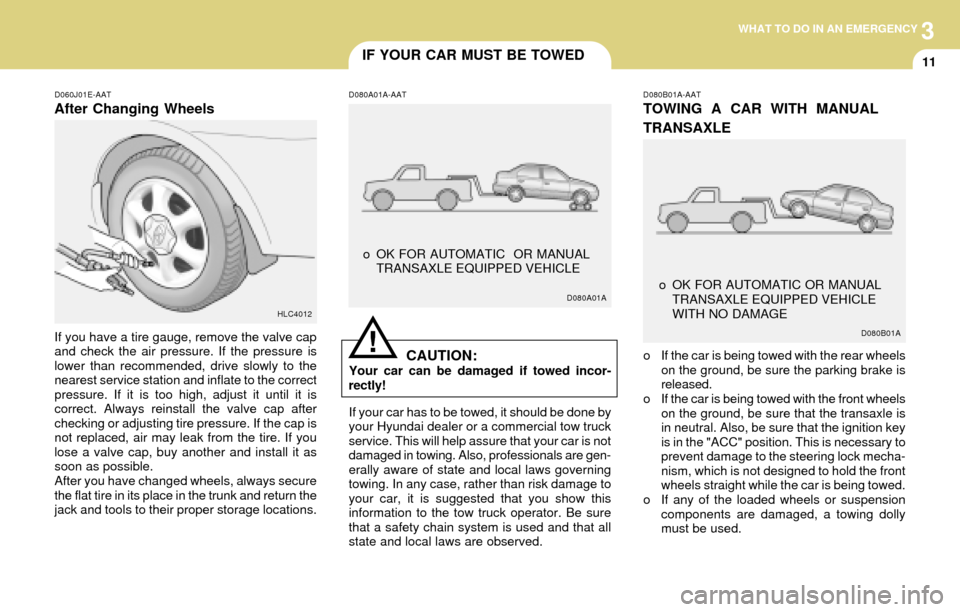
D080A01A-AAT
CAUTION:Your car can be damaged if towed incor-
rectly!
HLC4012
If your car has to be towed, it should be done by
your Hyundai dealer or a commercial tow truck
service. This will help assure that your car is not
damaged in towing. Also, professionals are gen-
erally aware of state and local laws governing
towing. In any case, rather than risk damage to
your car, it is suggested that you show this
information to the tow truck operator. Be sure
that a safety chain system is used and that all
state and local laws are observed.
D080A01A
o OK FOR AUTOMATIC OR MANUAL
TRANSAXLE EQUIPPED VEHICLE
!
D080B01A-AAT
TOWING A CAR WITH MANUAL
TRANSAXLE
o If the car is being towed with the rear wheels
on the ground, be sure the parking brake is
released.
o If the car is being towed with the front wheels
on the ground, be sure that the transaxle is
in neutral. Also, be sure that the ignition key
is in the "ACC" position. This is necessary to
prevent damage to the steering lock mecha-
nism, which is not designed to hold the front
wheels straight while the car is being towed.
o If any of the loaded wheels or suspension
components are damaged, a towing dolly
must be used.
D080B01A
o OK FOR AUTOMATIC OR MANUAL
TRANSAXLE EQUIPPED VEHICLE
WITH NO DAMAGE
Page 133 of 205
3
12
WHAT TO DO IN AN EMERGENCY
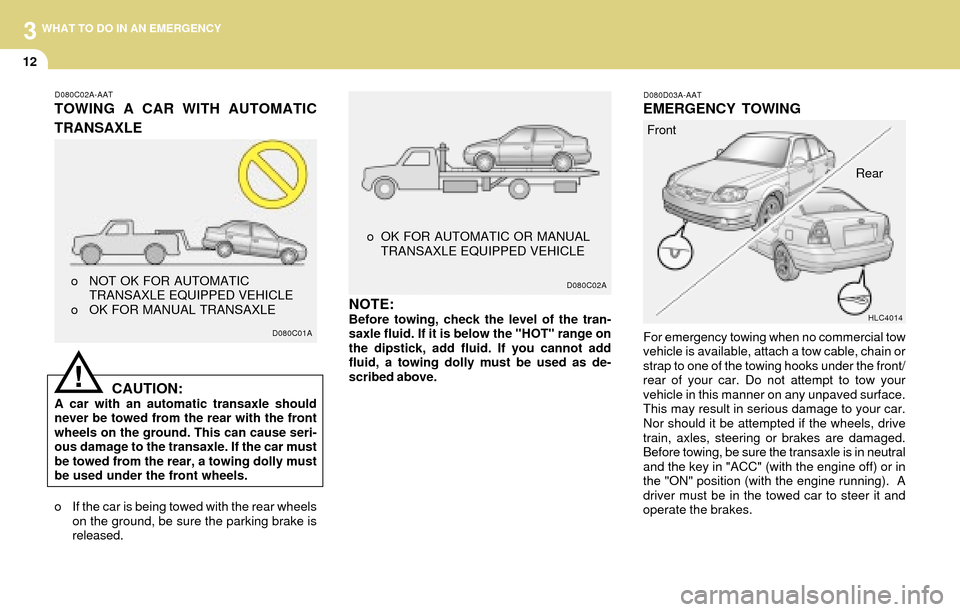
D080D03A-AATEMERGENCY TOWING
For emergency towing when no commercial tow
vehicle is available, attach a tow cable, chain or
strap to one of the towing hooks under the front/
rear of your car. Do not attempt to tow your
vehicle in this manner on any unpaved surface.
This may result in serious damage to your car.
Nor should it be attempted if the wheels, drive
train, axles, steering or brakes are damaged.
Before towing, be sure the transaxle is in neutral
and the key in "ACC" (with the engine off) or in
the "ON" position (with the engine running). A
driver must be in the towed car to steer it and
operate the brakes.
HLC4014NOTE:Before towing, check the level of the tran-
saxle fluid. If it is below the "HOT" range on
the dipstick, add fluid. If you cannot add
fluid, a towing dolly must be used as de-
scribed above.
D080C02A
o OK FOR AUTOMATIC OR MANUAL
TRANSAXLE EQUIPPED VEHICLE
D080C02A-AAT
TOWING A CAR WITH AUTOMATIC
TRANSAXLE
CAUTION:
A car with an automatic transaxle should
never be towed from the rear with the front
wheels on the ground. This can cause seri-
ous damage to the transaxle. If the car must
be towed from the rear, a towing dolly must
be used under the front wheels. o NOT OK FOR AUTOMATIC
TRANSAXLE EQUIPPED VEHICLE
o OK FOR MANUAL TRANSAXLE
D080C01A
o If the car is being towed with the rear wheels
on the ground, be sure the parking brake is
released.
!
Front
Rear
Page 134 of 205
3WHAT TO DO IN AN EMERGENCY
13IF YOU LOSE YOUR KEYS
D120A01A-AAT
If you lose your keys, many Hyundai dealers
can make you a new key if you have your key
number.
If you lock the keys inside your car and you
cannot obtain a new key, many Hyundai dealers
can use special tools to open the door for you.
CAUTION:If the car is being towed with all four wheels
on the ground, it can be towed only from the
front. Be sure that the transaxle is in neutral.
Do not tow at speeds greater than 30 mph
(50 km/h) and for more than 15 miles (25 km).
Be sure the steering is unlocked by placing
the key in the "ACC" position. A driver must
be in the towed vehicle to operate the steer-
ing and brakes.
!
Page 138 of 205
44CORROSION PREVENTION AND APPEARANCE CARE
4
Use a clean sponge or cloth, rinse it frequently
and don't damage the finish by rubbing too hard.
For stubborn spots, dampen them frequently
and remove them a little at a time.
To clean whitewall tires, use a stiff brush or
soap-impregnated steel-wool scouring pad.
To clean plastic wheel covers, use a clean
sponge or soft cloth and water.
To clean cast aluminum alloy wheels, use a mild
soap or neutral detergent. Do not use abrasive
cleaners. Protect the bare-metal surfaces by
cleaning, polishing and waxing. Because alumi-
num is subject to corrosion, be sure to give
aluminum alloy wheels special attention in win-
ter. If you drive on salted roads, clean the
wheels thoroughly afterwards.
After washing, be sure to rinse thoroughly. If
soapy water dries on the finish, streaking will
result.
When the weather is warm and the humidity low,
you may find it necessary to rinse each section
immediately after washing to avoid streaking.After rinsing, dry the car using a damp chamois
or soft, absorbent cloth. The reason for drying
the car is to remove water from the car so it will
dry without water spots. Don't rub, this can
damage the finish.
If you find any nicks or scratches in the paint,
use touch-up paint to cover them to prevent
corrosion. To protect the paintwork of the car
against corrosion, you must clean your Hyundai
(at least once a month). Give special attention
to the removal of salt, mud and other substanc-
es on the underside of the splashboards of the
car. Make sure that the outlets and the under-
side of the doors are open. Paint damage can be
caused by small accumulation of tar, industrial
precipitation, tree resin, insects and bird drop-
pings, when not removed immediately.
If water alone is not strong enough to remove
the accumulated dirt, use a mild car washing
solution. Be sure to rinse the surface after
washing to remove the solution. Never allow the
solution to dry on the painted surfaces.
E030B01A-AAT
Spot Cleaning
Don't use gasoline, strong solvents or corrosive
cleaning agents. These can damage the finish
of the car. To remove road tar, use turpentine on
a clean, soft cloth. Be gentle.
To remove dead insects or tree sap, use warm
water and mild soap or car-washing solution.
Soak the spot and rub gently. If the paint has
lost its luster, use a commercial car-cleaning
polish.
E030C01A-AATPolishing and Waxing
Always wash and dry the car before polishing or
waxing or using a combination cleaner and wax.
Use a good quality commercial product and
follow the manufacturer's directions on the con-
tainer. Polish and wax the bright trim pieces as
well as the paint.
Page 149 of 205
5VEHICLE MAINTENANCE REQUIREMENTS
9
F070M01A-AAT
o Steering Gear Box, Linkage &
Boots/Lower Arm Ball Joint
With the vehicle stopped and engine off, check
for excessive free-play in the steering wheel.
Check the linkage for bends or damage. Check
the dust boots and ball joints for deterioration,
cracks, or damage. Replace any damaged parts.
F070L01A-AAT
o Suspension Mounting Bolts
Check the suspension connections for loose-
ness or damage. Retighten to the specified
torque.
F070Q01A-AAT
o Air Conditioning Refrigerant
Check the air conditioning lines and connec-
tions for leakage and damage. Check air condi-
tioning performance according to the relevant
shop manual if necessary.
F070P01A-AAT
o Driveshafts and Boots
Check the drive shafts, boots and clamps for
cracks, deterioration, or damage. Replace any
damaged parts and, if necessary, repack the
grease.
F070N01A-AAT
o Power Steering Pump, Belt and
Hoses
Check the power steering pump and hoses for
leakage and damage. Replace any damaged or
leaking parts immediately. Inspect the power
steering belt for evidence of cuts, cracks, ex-
cessive wear, oiliness and proper tension. Re-
place or adjust it if necessary.
Page 152 of 205
6DO-IT-YOURSELF MAINTENANCE
3GENERAL CHECKS
G020C01A-AAT
Vehicle Interior
The following should be checked each time
when the vehicle is driven:
o Light operation
o Windshield wiper operation
o Horn operation
o Defroster, heater system operation (and air
conditioning, if installed)
o Steering operation and condition
o Mirror condition and operation
o Turn signal operation
o Accelerator pedal operation
o Brake operation, including parking brake
o Manual transaxle operation, including clutch
operation
o Automatic transaxle operation, including
"Park" mechanism operation
o Seat control condition and operation
o Seat belt condition and operation
o Sun visor operation
If you notice anything that does not operate
correctly or appear to be functioning correctly,
inspect it carefully and seek assistance from
your Hyundai dealer if service is needed.
G020A01A-AATEngine Compartment
The following should be checked regularly:
o Engine oil level and condition
o Transaxle fluid level and condition
o Brake fluid level
o Clutch fluid level
o Engine coolant level
o Windshield washer fluid level
o Accessory drive belt condition
o Engine coolant hose condition
o Fluid leaks (on or below components)
o Power steering fluid level and condition
o Battery Condition
o Air filter conditionG020B01A-AAT
Vehicle Exterior
The following should be checked monthly:
o Overall appearance and condition
o Wheel condition and wheel nut tightness
o Exhaust system condition
o Light condition and operation
o Windshield glass condition
o Wiper blade condition
o Paint condition and body corrosion
o Fluid leaks
o Door and hood lock condition
o Tire pressure and condition
(including spare tire)
Page 166 of 205
6DO-IT-YOURSELF MAINTENANCE
17
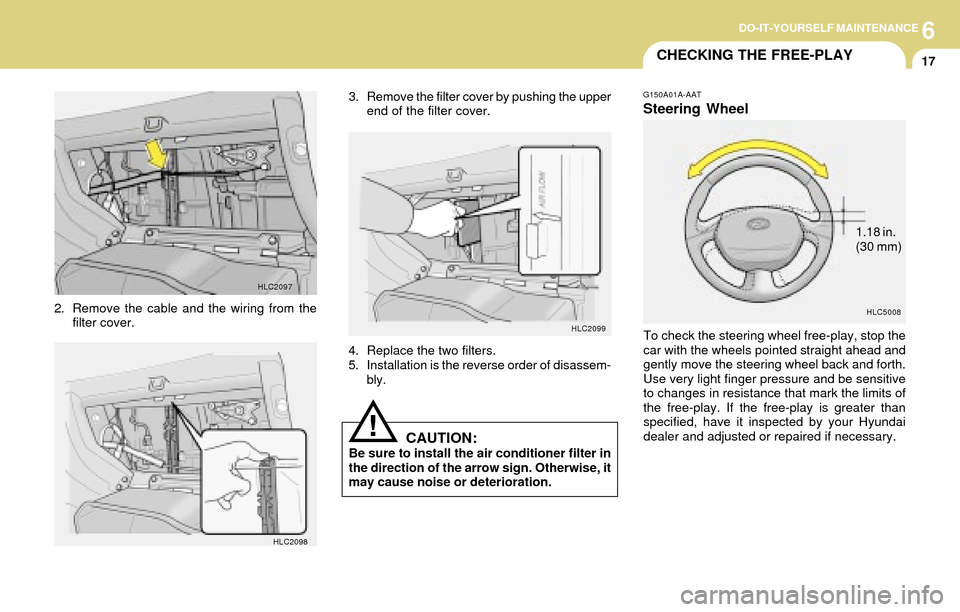
HLC2097
2. Remove the cable and the wiring from the
filter cover.
HLC2098
3. Remove the filter cover by pushing the upper
end of the filter cover.
HLC2099
4. Replace the two filters.
5. Installation is the reverse order of disassem-
bly.
CAUTION:Be sure to install the air conditioner filter in
the direction of the arrow sign. Otherwise, it
may cause noise or deterioration.
!
CHECKING THE FREE-PLAY
G150A01A-AAT
Steering Wheel
To check the steering wheel free-play, stop the
car with the wheels pointed straight ahead and
gently move the steering wheel back and forth.
Use very light finger pressure and be sensitive
to changes in resistance that mark the limits of
the free-play. If the free-play is greater than
specified, have it inspected by your Hyundai
dealer and adjusted or repaired if necessary.
HLC5008
1.18 in.
(30 mm)
Page 189 of 205
8CONSUMER INFORMATION & REPORTING SAFETY DEFECTS
3
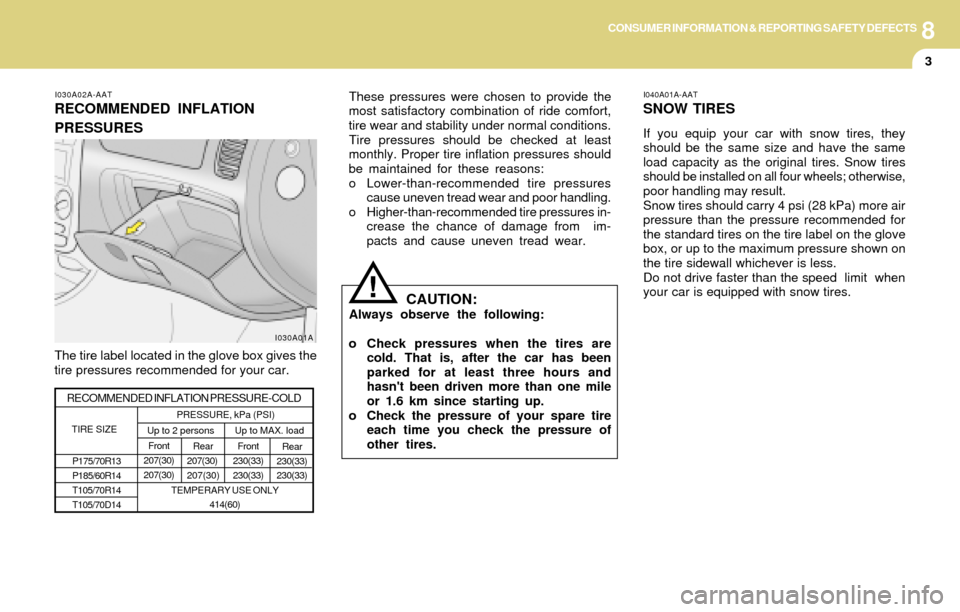
Up to 2 persons TIRE SIZE
RECOMMENDED INFLATION PRESSURE-COLD
P175/70R13
P185/60R14
T105/70R14
T105/70D14Rear
207(30)
207(30)Front
230(33)
230(33)Up to MAX. load
Rear
230(33)
230(33) Front
207(30)
207(30)
PRESSURE, kPa (PSI)
TEMPERARY USE ONLY
414(60)
I030A02A-AAT
RECOMMENDED INFLATION
PRESSURES
The tire label located in the glove box gives the
tire pressures recommended for your car.
I030A01A
!CAUTION:Always observe the following:
o Check pressures when the tires are
cold. That is, after the car has been
parked for at least three hours and
hasn't been driven more than one mile
or 1.6 km since starting up.
o Check the pressure of your spare tire
each time you check the pressure of
other tires.
I040A01A-AAT
SNOW TIRES
If you equip your car with snow tires, they
should be the same size and have the same
load capacity as the original tires. Snow tires
should be installed on all four wheels; otherwise,
poor handling may result.
Snow tires should carry 4 psi (28 kPa) more air
pressure than the pressure recommended for
the standard tires on the tire label on the glove
box, or up to the maximum pressure shown on
the tire sidewall whichever is less.
Do not drive faster than the speed limit when
your car is equipped with snow tires. These pressures were chosen to provide the
most satisfactory combination of ride comfort,
tire wear and stability under normal conditions.
Tire pressures should be checked at least
monthly. Proper tire inflation pressures should
be maintained for these reasons:
o Lower-than-recommended tire pressures
cause uneven tread wear and poor handling.
o Higher-than-recommended tire pressures in-
crease the chance of damage from im-
pacts and cause uneven tread wear.
Page 190 of 205
8CONSUMER INFORMATION & REPORTING SAFETY DEFECTS
4
I060A02A-AAT
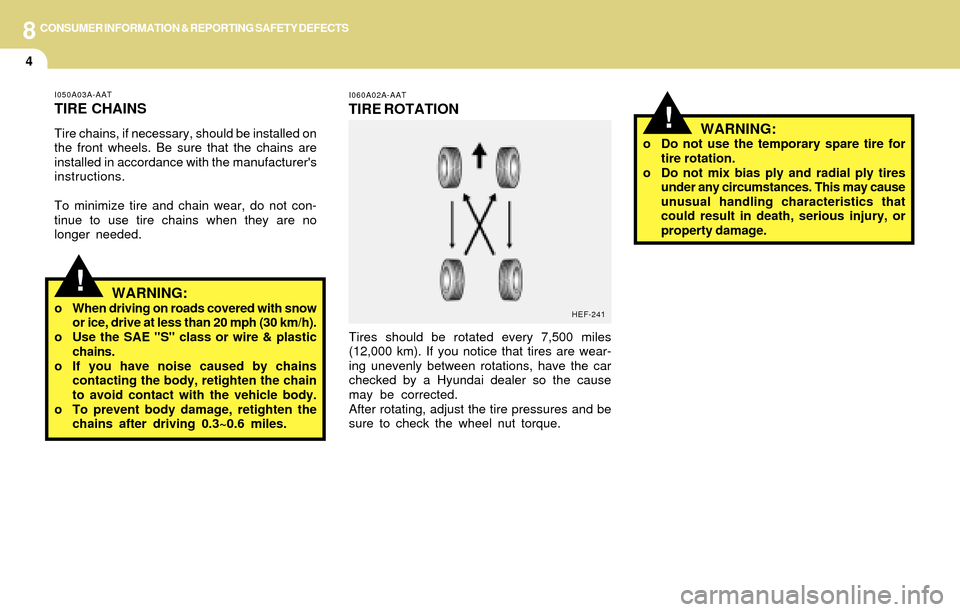
TIRE ROTATION
Tires should be rotated every 7,500 miles
(12,000 km). If you notice that tires are wear-
ing unevenly between rotations, have the car
checked by a Hyundai dealer so the cause
may be corrected.
After rotating, adjust the tire pressures and be
sure to check the wheel nut torque.
HEF-241
!
I050A03A-AAT
TIRE CHAINS
Tire chains, if necessary, should be installed on
the front wheels. Be sure that the chains are
installed in accordance with the manufacturer's
instructions.
To minimize tire and chain wear, do not con-
tinue to use tire chains when they are no
longer needed.
WARNING:o When driving on roads covered with snow
or ice, drive at less than 20 mph (30 km/h).
o Use the SAE "S" class or wire & plastic
chains.
o If you have noise caused by chains
contacting the body, retighten the chain
to avoid contact with the vehicle body.
o To prevent body damage, retighten the
chains after driving 0.3~0.6 miles.
!WARNING:o Do not use the temporary spare tire for
tire rotation.
o Do not mix bias ply and radial ply tires
under any circumstances. This may cause
unusual handling characteristics that
could result in death, serious injury, or
property damage.