seats Hyundai Accent 2005 User Guide
[x] Cancel search | Manufacturer: HYUNDAI, Model Year: 2005, Model line: Accent, Model: Hyundai Accent 2005Pages: 219, PDF Size: 7.07 MB
Page 48 of 219
1FEATURES OF YOUR HYUNDAI36
!
!
oEach seat belt is designed to restrain
one occupant. If more than one person
uses the same seat belt, they could be
seriously injured or killed in a collision.
oDo not use any accessories on seat
belts. Devices claiming to improve occu-
pant comfort or reposition the seat belt can
reduce the protection provided by the seat
belt and increase the chance of serious
injury in a crash.
oPassengers should not place hard or
sharp objects between themselves and
the airbags. Carrying hard or sharp ob-
jects on your lap or in your mouth can result
in injuries if an airbag inflates.
oKeep occupants away from the airbag
covers. All occupants should sit upright,
fully back in their seats with their seat belts
on and their feet on the floor. If occupants
are too close to the airbag covers, they
could be injured if the airbags inflate.
oDo not attach or place objects on or
near the airbag covers. Any object at-
tached to or placed on the front or side
impact airbag covers could interfere with
the proper operation of the airbags.
oDo not modify the front seats. Modifica-
tion of the front seats could interfere with
the operation of the supplemental restraint
system sensing components or side im-
pact airbags.
B240D01JM-AATAdditional Safety PrecautionsoNever let passengers ride in the cargo
area (trunk) or on top of a folded-down
back seat. All occupants should sit upright,
fully back in their seats with their seat belts
on and their feet on the floor.
oPassengers should not move out of or
change seats while the vehicle is mov-
ing. A passenger who is not wearing a seat
belt during a crash or emergency stop can
be thrown against the inside of the vehicle,
against other occupants, or out of the
vehicle. o If you sell your vehicle, be sure to
inform the new owner of these impor-
tant points and make certain that this
manual is transferred to the new owner.
o If your car was flooded and has soaked
carpeting or water on the floor, you
shouldn't try to start the engine; have
the car towed to an authorized Hyundai
dealer.oDo not place items under the front
seats. Placing items under the front seats
could interfere with the operation of the
supplemental restraint system sensing
components and wiring harnesses.
oNever hold an infant or child on your
lap. The infant or child could be seriously
injured or killed in the event of a crash. All
infants and children should be properly
restrained in appropriate child safety seats
or seat belts in the rear seat.
WARNING:
o Sitting improperly or out of position
can result in serious injury or death in
a crash.
o Always sit upright, fully back in the
seat, with your seat belt on, and your
feet on the floor.Adding Equipment to or Modifying Your
Airbag-Equipped Vehicle.If you modify your vehicle by changing your
vehicle's frame, bumper system, front end or
side sheet metal or ride height, this may affect
the operation of your vehicle's airbag system.
WARNING:
Page 67 of 219
1
FEATURES OF YOUR HYUNDAI
55
SEAT POCKET
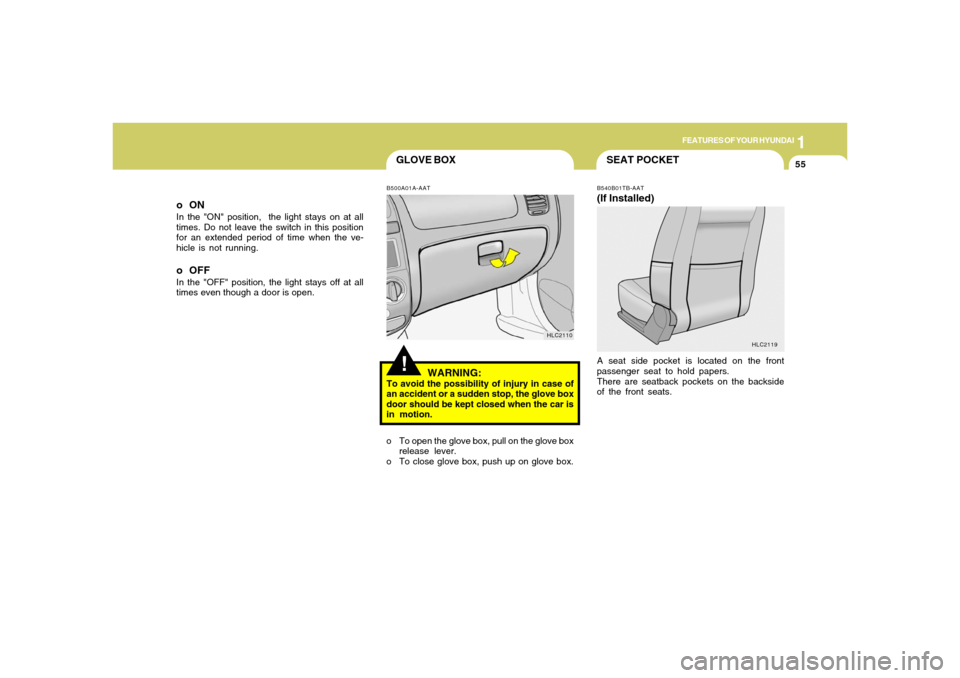
GLOVE BOXo To open the glove box, pull on the glove box
release lever.
o To close glove box, push up on glove box.
B540B01TB-AAT(If Installed)A seat side pocket is located on the front
passenger seat to hold papers.
There are seatback pockets on the backside
of the front seats.
HLC2119
!
oONIn the "ON" position, the light stays on at all
times. Do not leave the switch in this position
for an extended period of time when the ve-
hicle is not running.oOFFIn the "OFF" position, the light stays off at all
times even though a door is open.
HLC2110 B500A01A-AAT
WARNING:
To avoid the possibility of injury in case of
an accident or a sudden stop, the glove box
door should be kept closed when the car is
in motion.
Page 126 of 219
2
DRIVING YOUR HYUNDAI
20
!
!
WARNING:
Items you carry inside your vehicle
can strike and injure people in a
sudden stop or turn, or in a crash.
o Put things in the cargo area of
your vehicle. Try to spread the
weight evenly.
o Never stack items, like suitcases,
inside the vehicle above the tops
of the seats.
o Do not leave an unsecured child
restraint in your vehicle.
o When you carry something in-
side the vehicle, secure it.
o Do not drive with a seat folded
down unless necessary. WARNING:
o Overloading your vehicle can
cause heat buildup in your
vehicle's tires and possible tire
failure that could lead to a crash.
o Overloading your vehicle can
cause increased stopping dis-
tances that could lead to a crash.
o A crash resulting from poor han-
dling vehicle damage, tire failure,
or increased stopping dis-
tances could result in serious
injury or death.The label will help you decide how
much cargo and installed equipment
your vehicle can carry.
If you carry items inside your vehicle
– like suitcases, tools, packages, or
anything else – they more as fast as
the vehicle goes. If you have to stop or
turn quickly, or if there is a crash, the
items will keep going and can cause
an injury if they strikes the driver or a
passenger.
Page 199 of 219

8
CONSUMER INFORMATION, REPORTING SAFETY DEFECTS & BINDING ARBITRATION OF WARRANTY CLAIMS
7
6. Maximum load rating
This number indicates the maxi-
mum load in kilograms and pounds
that can be carried by the tire. When
replacing the tires on the vehicle,
always use a tire that has the same
load rating as the factory installed
tire.
7. Uniform Tire Quality Grading
(UTQG):
Tire manufacturers are required to
grade tires based on three perfor-
mance factors: treadwear, traction
and temperature resistance. For
more information, see Uniform Tire
Quality Grading on page 8-13.
I030D01JM-AATTIRE TERMINOLOGY AND DEFINI-
TIONS
Air Pressure: The amount of air inside
the tire pressing outward on the tire.
Air pressure is expressed in pounds
per square inch (psi) or kilopascal
(kPa).
Accessory Weight: This means the
combined weight of optional accesso-
ries. Some examples of optional ac-
cessories are, automatic transmission,
power seats, and air conditioning.
Aspect Ratio: The relationship of a
tire's height to its width.
Belt: A rubber coated layer of cords
that is located between the plies and
the tread. Cords may be made from
steel or other reinforcing materials.
Bead: The tire bead contains steel
wires wrapped by steel cords that hold
the tire onto the rim.
Bias Ply Tire: A pneumatic tire in
which the plies are laid at alternate
angles less than 90 degrees to the
centerline of the tread.Cold Tire Pressure: The amount of
air pressure in a tire, measured in
pounds per square inch (psi) or
kilopascals (kPa) before a tire has
built up heat from driving.
Curb Weight: This means the weight
of a motor vehicle with standard and
optional equipment including the maxi-
mum capacity of fuel, oil and coolant,
but without passengers and cargo.
DOT Markings: A code molded into
the sidewall of a tire signifying that the
tire is in compliance with the U.S.
Department of Transportation motor
vehicle safety standards. The DOT
code includes the Tire Identification
Number (TIN), an alphanumeric desig-
nator which can also identify the tire
manufacturer, production plant, brand
and date of production.
GVWR: Gross Vehicle Weight Rating
GAWR FRT: Gross Axle Weight Rat-
ing for the front Axle.
GAWR RR: Gross Axle Weight Rating
for the rear axle.
Page 215 of 219

10
INDEX
3
D
Defrosting/Defogging.......................................................................1-72
Door
Central door lock .......................................................................... 1-6
Door locks.................................................................................... 1-4
Locking, unlocking front door with a key ................................... 1-4
Drink Holder.....................................................................................1-53
Drive Belts........................................................................................6-19
Driving
Economical driving......................................................................2-12
Smooth cornering.......................................................................2-13
Winter driving..............................................................................2-13
Dual-Stage Supplemental Restraint (AIRBAG) System ................1-30
E
Emission Control Systems................................................................ 7-1
Engine
Before starting the engine ............................................................ 2-3
Compartment (For 1.6 DOHC) ................................................... 6-2
Coolant.......................................................................................... 6-6
Coolant temperature gauge .......................................................1-42
If the engine overheats ................................................................ 3-4
Number.......................................................................................... 8-2
Oil .................................................................................................. 6-4
Starting.......................................................................................... 2-4
Engine Exhaust Can Be Dangerous ................................................ 2-2F
Fan Speed Control (Blower Control)..............................................1-66
Fog Light
Front............................................................................................1-51
Front Seats
Adjustable front seats ................................................................1-11
Adjustable headrests..................................................................1-12
Adjusting seatback angle ...........................................................1-11
Adjusting seatback forward and rearward...............................1-11
Lumbar support control ..............................................................1-13
Seat cushion height adjustment................................................1-13
Seat pocket.................................................................................1-55
Fuel
Capacity........................................................................................ 9-2
Gauge..........................................................................................1-42
Recommendations........................................................................ 1-2
Fuel Filler Lid
Remote release..........................................................................1-60
Fuses ......................................................................................................
6-19
G
General Checks................................................................................ 6-3
Glove box.........................................................................................1-55
H
Hazard Warning System .................................................................1-50
Page 216 of 219

10
INDEX
4
Maintenance under severe usage conditions ................................ 5-6
Scheduled maintenance................................................................. 5-4
Service requirements ..................................................................... 5-2
Mirrors
Day/night inside rearview.............................................................1-58
Outside rear view ........................................................................1-56
O
Odometer/Trip Odometer..................................................................1-44
P
Parking Brake...................................................................................1-58
Power Steering Fluid Level ...............................................................6-22
Pretensioner Seat Belt ......................................................................1-28
R
Rear Seats
Folding seatbacks........................................................................1-15
Rear seat entry ............................................................................1-13
Rear Window Defroster Switch .........................................................1-51
Rear Window Wiper and Washer.....................................................1-49
Replacement of Bulbs .......................................................................6-24
S
Seat Belts
2-Point static type ........................................................................1-21
3-Point type..................................................................................1-19
Adjusting your seat belt ...............................................................1-20
Adjutable height...........................................................................1-18
Care of seat belts ........................................................................1-18 Headlight Bulb..................................................................................6-25
Heating and Ventilation
Air flow control ............................................................................1-67
Air intake control.........................................................................1-66
Bi-level heating............................................................................1-69
Defrosting/Defogging ..................................................................1-72
Fan seed control (Blower control)............................................1-66
Temperature control...................................................................1-69
High-Mounted Rear Stop Light .......................................................1-58
Hood Release..................................................................................1-59
Horn................................................................................................1-64
I
Ignition Switch..................................................................................... 2-3
Instrument Cluster and Indicator Lights............................................
1-39
Instrument Panel Light Control (Rheostat).......................................1-50
Interior Light ......................................................................................1-54
J
Jump Starting...................................................................................... 3-3
K
Keys .................................................................................................. 1-3
If you lose your keys...................................................................3-14
Positions........................................................................................ 2-3
M
Maintenance Intervals
Explanation of scheduled maintenance items .............................. 5-7