tow Hyundai Accent 2005 User Guide
[x] Cancel search | Manufacturer: HYUNDAI, Model Year: 2005, Model line: Accent, Model: Hyundai Accent 2005Pages: 219, PDF Size: 7.07 MB
Page 70 of 219
1FEATURES OF YOUR HYUNDAI58
PARKING BRAKE
DAY/NIGHT INSIDE REARVIEW
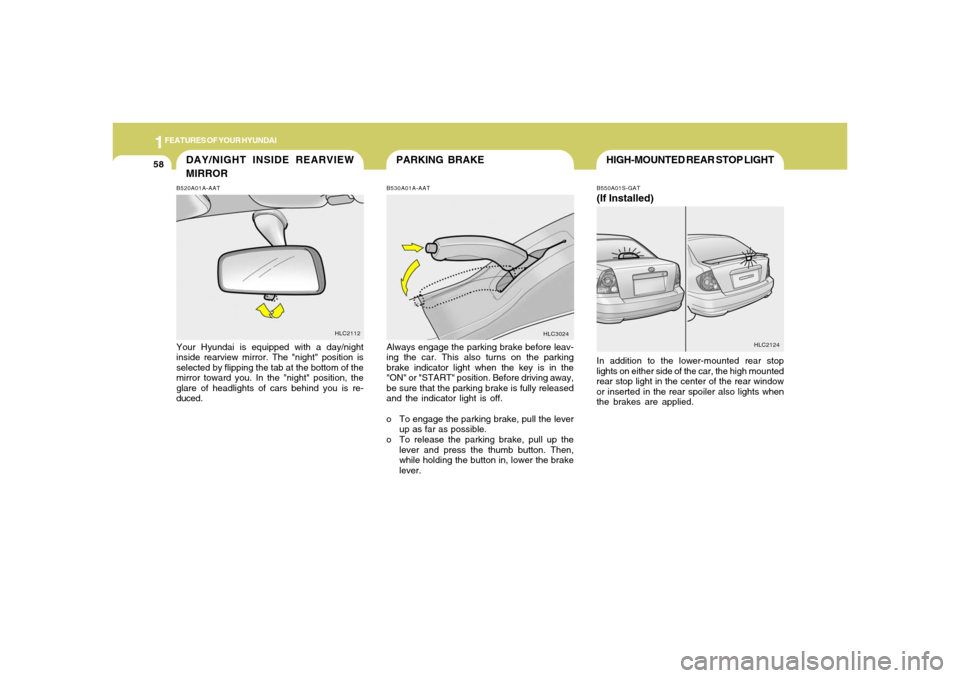
MIRRORB520A01A-AATYour Hyundai is equipped with a day/night
inside rearview mirror. The "night" position is
selected by flipping the tab at the bottom of the
mirror toward you. In the "night" position, the
glare of headlights of cars behind you is re-
duced.
HLC2112
B530A01A-AATAlways engage the parking brake before leav-
ing the car. This also turns on the parking
brake indicator light when the key is in the
"ON" or "START" position. Before driving away,
be sure that the parking brake is fully released
and the indicator light is off.
o To engage the parking brake, pull the lever
up as far as possible.
o To release the parking brake, pull up the
lever and press the thumb button. Then,
while holding the button in, lower the brake
lever.
HLC3024
HIGH-MOUNTED REAR STOP LIGHTB550A01S-GAT(If Installed)In addition to the lower-mounted rear stop
lights on either side of the car, the high mounted
rear stop light in the center of the rear window
or inserted in the rear spoiler also lights when
the brakes are applied.
HLC2124
Page 74 of 219
1FEATURES OF YOUR HYUNDAI62
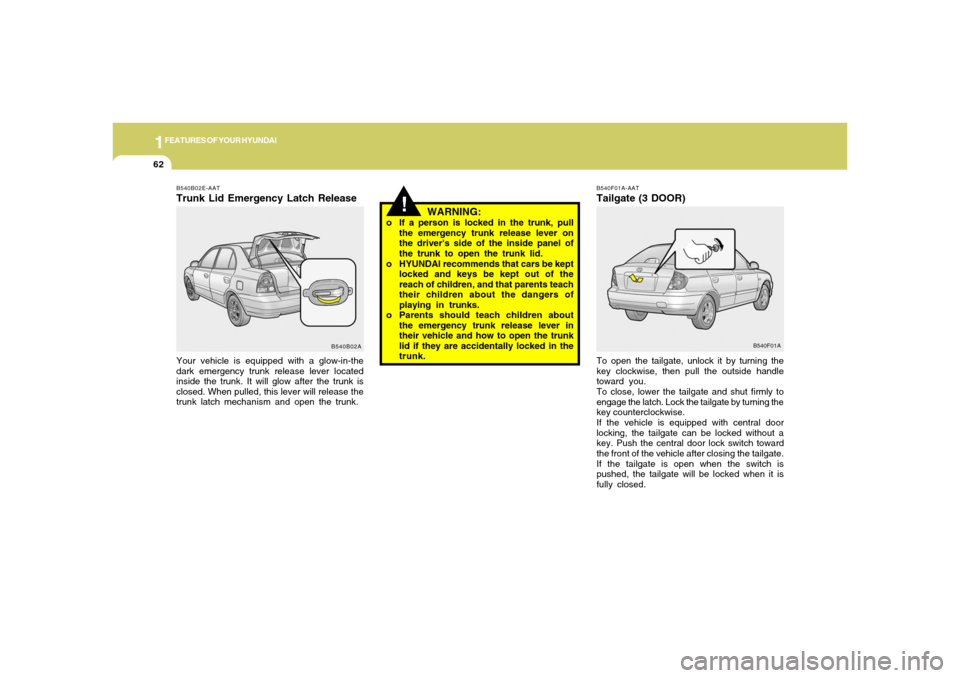
B540F01A-AATTailgate (3 DOOR)To open the tailgate, unlock it by turning the
key clockwise, then pull the outside handle
toward you.
To close, lower the tailgate and shut firmly to
engage the latch. Lock the tailgate by turning the
key counterclockwise.
If the vehicle is equipped with central door
locking, the tailgate can be locked without a
key. Push the central door lock switch toward
the front of the vehicle after closing the tailgate.
If the tailgate is open when the switch is
pushed, the tailgate will be locked when it is
fully closed.
B540B02E-AATTrunk Lid Emergency Latch ReleaseYour vehicle is equipped with a glow-in-the
dark emergency trunk release lever located
inside the trunk. It will glow after the trunk is
closed. When pulled, this lever will release the
trunk latch mechanism and open the trunk.
B540B02AB540F01A
WARNING:
o If a person is locked in the trunk, pull
the emergency trunk release lever on
the driver's side of the inside panel of
the trunk to open the trunk lid.
o HYUNDAI recommends that cars be kept
locked and keys be kept out of the
reach of children, and that parents teach
their children about the dangers of
playing in trunks.
o Parents should teach children about
the emergency trunk release lever in
their vehicle and how to open the trunk
lid if they are accidentally locked in the
trunk.
!
Page 83 of 219
1
FEATURES OF YOUR HYUNDAI
71
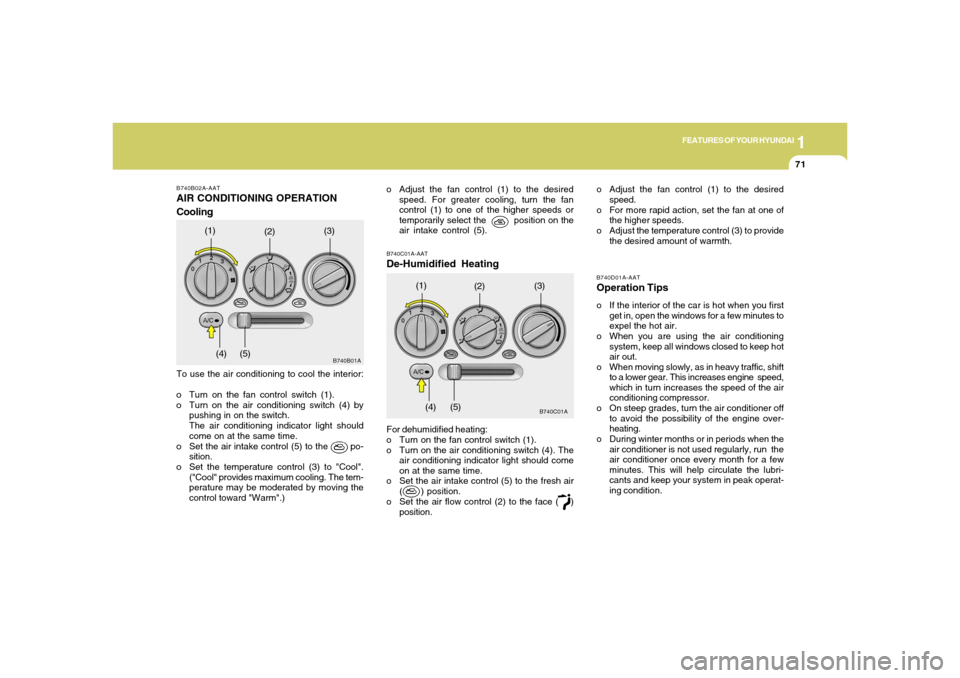
B740B02A-AATAIR CONDITIONING OPERATION
CoolingTo use the air conditioning to cool the interior:
o Turn on the fan control switch (1).
o Turn on the air conditioning switch (4) by
pushing in on the switch.
The air conditioning indicator light should
come on at the same time.
o Set the air intake control (5) to the po-
sition.
o Set the temperature control (3) to "Cool".
("Cool" provides maximum cooling. The tem-
perature may be moderated by moving the
control toward "Warm".)
(1)
(2)(3)
(4) (5)
B740D01A-AATOperation Tipso If the interior of the car is hot when you first
get in, open the windows for a few minutes to
expel the hot air.
o When you are using the air conditioning
system, keep all windows closed to keep hot
air out.
o When moving slowly, as in heavy traffic, shift
to a lower gear. This increases engine speed,
which in turn increases the speed of the air
conditioning compressor.
o On steep grades, turn the air conditioner off
to avoid the possibility of the engine over-
heating.
o During winter months or in periods when the
air conditioner is not used regularly, run the
air conditioner once every month for a few
minutes. This will help circulate the lubri-
cants and keep your system in peak operat-
ing condition.
B740C01A-AATDe-Humidified HeatingFor dehumidified heating:
o Turn on the fan control switch (1).
o Turn on the air conditioning switch (4). The
air conditioning indicator light should come
on at the same time.
o Set the air intake control (5) to the fresh air
( ) position.
o Set the air flow control (2) to the face ( )
position.
B740C01A
(1)
(2)(3)
(4) (5)
o Adjust the fan control (1) to the desired
speed. For greater cooling, turn the fan
control (1) to one of the higher speeds or
temporarily select the position on the
air intake control (5).o Adjust the fan control (1) to the desired
speed.
o For more rapid action, set the fan at one of
the higher speeds.
o Adjust the temperature control (3) to provide
the desired amount of warmth.
B740B01A
Page 86 of 219

1FEATURES OF YOUR HYUNDAI74
STEREO SOUND SYSTEM
FM broadcasts are transmitted at high fre-
quencies and do not bend to follow the earth's
surface. Because of this, FM broadcasts gen-
erally begin to fade at short distances from the
station. Also, FM signals are easily affected by
buildings, mountains, or other obstructions.
These can result in certain listening conditions
which might lead you to believe a problem
exists with your radio. The following conditions
are normal and do not indicate radio trouble: AM broadcasts can be received at greater dis-
tances than FM broadcasts. This is because
AM radio waves are transmitted at low fre-
quencies. These long, low frequency radio
waves can follow the curvature of the earth
rather than travelling straight out into the atmo-
sphere. In addition, they curve around ob-
structions so that they can provide better
signal coverage.
B750A02A-AATHow Car Audio WorksAM and FM radio signals are broadcast from
transmitter towers located around your city.
They are intercepted by the radio antenna on
your car. This signal is then received by the
radio and sent to your car speakers.
When a strong radio signal has reached your
vehicle, the precise engineering of your audio
system ensures the best possible quality re-
production. However, in some cases the sig-
nal coming to your vehicle may not be strong
and clear. This can be due to factors such as
the distance from the radio station, closeness
of other strong radio stations or the presence
of buildings, bridges or other large obstruc-
tions in the area.Ionosphere
B750A02L
Mountains
Buildings
Obstructed areaUnobstructed
area FM radio station
B750A03L
Ionosphere FM reception
B750A01L
Iron bridges
AM reception
Page 107 of 219
Before Starting the Engine ............................................ 2-3
Key Positions ................................................................ 2-3
Starting ..........................................................................2-4
Operating the Manual Transaxle ................................... 2-5
Automatic Transaxle ..................................................... 2-7
Good Braking Practices..............................................2-10
Anti-Lock Brake System.............................................2-11
Driving for Economy...................................................2-12
Winter Driving.............................................................2-13
Trailer Towing .............................................................2-16
Vehicle Load Limit.......................................................2-16
DRIVING YOUR HYUNDAI
2
2
Page 121 of 219
DRIVING YOUR HYUNDAI
152
HIGHER SPEED MOTORING
C160I01A-AATDon't Let Your Parking Brake FreezeUnder some conditions your parking brake can
freeze in the engaged position. This is most
likely to happen when there is an accumulation
of snow or ice around or near the rear brakes or
if the brakes are wet. If you think the parking
brake may freeze, apply it only temporarily while
you put the gear selector lever in "P" (automatic)
or in first or reverse gear (manual transaxle) and
block the rear wheels so the car cannot roll.
Then release the parking brake.
C160K01A-AATCarry Emergency EquipmentDepending on the severity of the weather where
you drive your car, you should carry appropriate
emergency equipment. Some of the items you
may want to carry include tire chains, tow straps
or chains, flashlight, emergency flares, sand, a
shovel, jumper cables, a window scraper, gloves,
ground cloth, coveralls, a blanket, etc.
C160J01A-AATDon't Let Ice and Snow Accumulate
UnderneathUnder some conditions, snow and ice can build
up under the fenders and interfere with the
steering. When driving in severe winter condi-
tions where this may happen, you should peri-
odically check underneath the car to be sure the
movement of the front wheels and the steering
components is not obstructed.
C170A01A-AATPre-Trip Inspections1. Tires:
Adjust the tire inflation pressures for highway
driving. Low tire inflation pressures will result in
overheating and possible failure of the tires.
Avoid using worn or damaged tires which may
result in reduced traction or tire failure.NOTE:Never exceed the maximum tire inflation pres-
sure shown on the tires.
2. Fuel, engine coolant and engine oil:
High speed travel consumes more fuel than
urban motoring. Do not forget to check both
engine coolant and engine oil.
3. Drive belt:
A loose or damaged drive belt may result in
overheating of the engine.
Page 122 of 219
2
DRIVING YOUR HYUNDAI
16
TRAILER TOWING
USE OF LIGHTS
C190A01A-AATYour Hyundai should not be used to tow a
trailer. It is designed to be compact and light
for good fuel economy, and is not designed as
a trailer-towing vehicle. Damages or malfunc-
tions caused by towing may not be covered by
the limited warranties applying to your Hyundai.
Damages or malfunctions that result from tow-
ing a trailer for commercial purposes are specifi-
cally not covered by Hyundai limited warranties.
C180A01A-AATCheck your lights regularly for correct opera-
tion and always keep them clean. When driv-
ing during the day in conditions of poor visibil-
ity, it is helpful to drive with headlights on low
beam. This enables you to be seen as well as
to see.
C190A02A
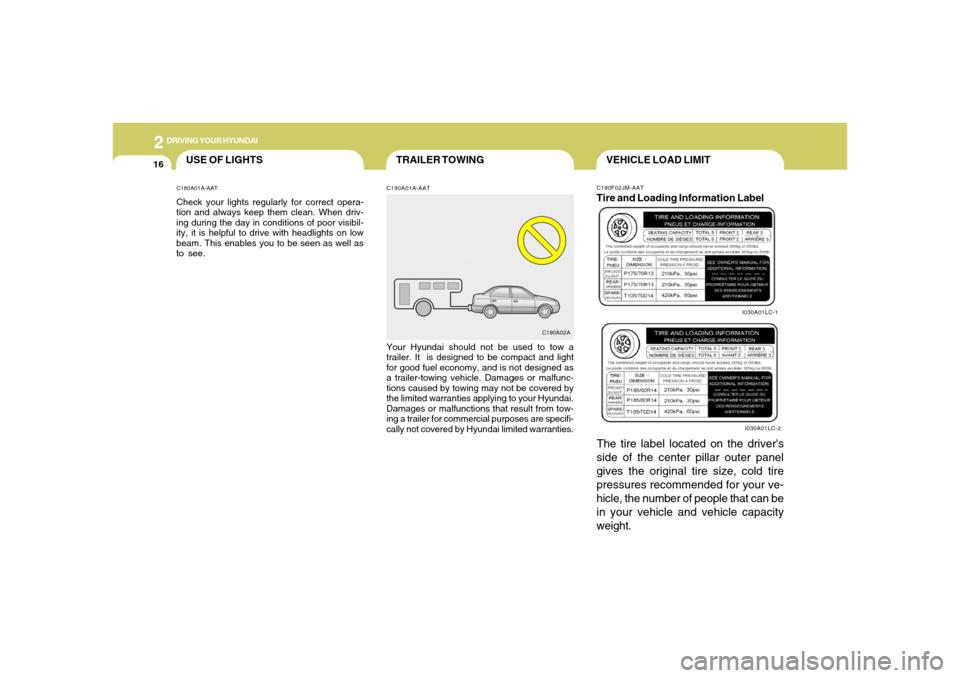
VEHICLE LOAD LIMITC190F02JM-AATTire and Loading Information LabelThe tire label located on the driver's
side of the center pillar outer panel
gives the original tire size, cold tire
pressures recommended for your ve-
hicle, the number of people that can be
in your vehicle and vehicle capacity
weight.
I030A01LC-1I030A01LC-2
Page 123 of 219

DRIVING YOUR HYUNDAI
172
Vehicle capacity weight:
880 lbs (400 kg)
Vehicle capacity weight is the maxi-
mum combined weight of occupants
and cargo. If your vehicle is equipped
with a trailer, the combined weight
includes the tongue load.
Seating capacity:
Total: 5 persons
(Front seat: 2 persons,
Rear seat: 3 persons)
Seating capacity is the maximum num-
ber of occupants including a driver,
your vehicle may carry.
However the seating capacity may be
reduced based upon the weight of all
of the occupants, and the weight of the
cargo being carried or towed. Do not
overload the vehicle as there is a limit
to the total weight, or load limit includ-
ing occupants and cargo, the vehicle
can carry.Towing capacity:
Towing capacity is the maximum trailer
weight including its cargo weight, your
vehicle can tow. See the section
"Trailer or Vehicle Towing" for specifi-
cations about the trailer weight.
Cargo capacity:
The cargo capacity of your vehicle will
increase or decrease depending on the
weight and the number of occupants
and the tongue load, if your vehicle is
equipped with a trailer.
Steps for Determining Correct Load
Limit
(1)Locate the statement "The com-
bined weight of occupants and cargo
should never exceed XXX pounds''
on your vehicle's placard.
(2)Determine the combined weight of
the driver and passengers that will
be riding in your vehicle.(3)Subtract the combined weight of the
driver and passengers from XXX
kilograms or XXX pounds.
(4)The resulting figure equals the avail-
able amount of cargo and luggage
load capacity. For example, if the
"XXX" amount equals 1400 lbs, and
there will be five 150 lb. passengers
in your vehicle, the amount of avail-
able cargo and luggage load capac-
ity is 650 lbs. (1400-750 (5 x 150) =
650 lbs.)
(5)Determine the combined weight of
luggage and cargo being loaded on
the vehicle. That weight may not
safely exceed the available cargo
and luggage load capacity calcu-
lated in Step 4.
(6)If your vehicle will be towing a trailer,
load from your trailer will be trans-
ferred to your vehicle. Consult this
manual to determine how this re-
duces the available cargo and lug-
gage load capacity of your vehicle.
Page 127 of 219
If the Engine Will Not Start .......................................... 3-2
Jump Starting ............................................................... 3-3
If the Engine Overheats ............................................... 3-4
Spare Tire ..................................................................... 3-5
If You Have a Flat Tire ................................................ 3-6
Changing a Flat Tire .................................................... 3-7
If Your Car Must Be Towed ......................................3-12
Emergency Towing .....................................................3-14
If You Lose Your Keys ..............................................3-14
WHAT TO DO IN AN EMERGENCY
3
3
Page 132 of 219
36WHAT TO DO IN AN EMERGENCY
IF YOU HAVE A FLAT TIRE
D040B01A-AATHandling the Spare Tire
Remove the installation bolt to re-
move the spare tire. To replace the
spare tire in its storage compartment,
tighten the bolt firmly with your fin-
gers until there is no more play in the
spare tire.
HLC4011D050A01A-AAT
If a tire goes flat while you are driving:
1. Take your foot off the accelerator
pedal and let the car slow down
while driving straight ahead. Do not
apply the brakes immediately or
attempt to pull off the road as this
may cause a loss of control. When
the car has slowed to such a speed
that it is safe to do so, brake care-
fully and pull off the road. Drive off
the road as far as possible and
park on firm, level ground. If you
are on a divided highway, do not
park in the median area between
the two traffic lanes.
2. When the car is stopped, turn on
your emergency hazard flashers,
set the parking brake and put the
transaxle in "P" (automatic) or re-
verse (manual transaxle). CAUTION:
o Do not use snow chains with
your temporary spare tire.
o Do not use more than one tem-
porary spare tire at a time.
o Do not tow a trailer while the
temporary spare tire is installed.
!