fuel Hyundai Accent 2005 Owner's Guide
[x] Cancel search | Manufacturer: HYUNDAI, Model Year: 2005, Model line: Accent, Model: Hyundai Accent 2005Pages: 219, PDF Size: 7.07 MB
Page 121 of 219
DRIVING YOUR HYUNDAI
152
HIGHER SPEED MOTORING
C160I01A-AATDon't Let Your Parking Brake FreezeUnder some conditions your parking brake can
freeze in the engaged position. This is most
likely to happen when there is an accumulation
of snow or ice around or near the rear brakes or
if the brakes are wet. If you think the parking
brake may freeze, apply it only temporarily while
you put the gear selector lever in "P" (automatic)
or in first or reverse gear (manual transaxle) and
block the rear wheels so the car cannot roll.
Then release the parking brake.
C160K01A-AATCarry Emergency EquipmentDepending on the severity of the weather where
you drive your car, you should carry appropriate
emergency equipment. Some of the items you
may want to carry include tire chains, tow straps
or chains, flashlight, emergency flares, sand, a
shovel, jumper cables, a window scraper, gloves,
ground cloth, coveralls, a blanket, etc.
C160J01A-AATDon't Let Ice and Snow Accumulate
UnderneathUnder some conditions, snow and ice can build
up under the fenders and interfere with the
steering. When driving in severe winter condi-
tions where this may happen, you should peri-
odically check underneath the car to be sure the
movement of the front wheels and the steering
components is not obstructed.
C170A01A-AATPre-Trip Inspections1. Tires:
Adjust the tire inflation pressures for highway
driving. Low tire inflation pressures will result in
overheating and possible failure of the tires.
Avoid using worn or damaged tires which may
result in reduced traction or tire failure.NOTE:Never exceed the maximum tire inflation pres-
sure shown on the tires.
2. Fuel, engine coolant and engine oil:
High speed travel consumes more fuel than
urban motoring. Do not forget to check both
engine coolant and engine oil.
3. Drive belt:
A loose or damaged drive belt may result in
overheating of the engine.
Page 122 of 219
2
DRIVING YOUR HYUNDAI
16
TRAILER TOWING
USE OF LIGHTS
C190A01A-AATYour Hyundai should not be used to tow a
trailer. It is designed to be compact and light
for good fuel economy, and is not designed as
a trailer-towing vehicle. Damages or malfunc-
tions caused by towing may not be covered by
the limited warranties applying to your Hyundai.
Damages or malfunctions that result from tow-
ing a trailer for commercial purposes are specifi-
cally not covered by Hyundai limited warranties.
C180A01A-AATCheck your lights regularly for correct opera-
tion and always keep them clean. When driv-
ing during the day in conditions of poor visibil-
ity, it is helpful to drive with headlights on low
beam. This enables you to be seen as well as
to see.
C190A02A
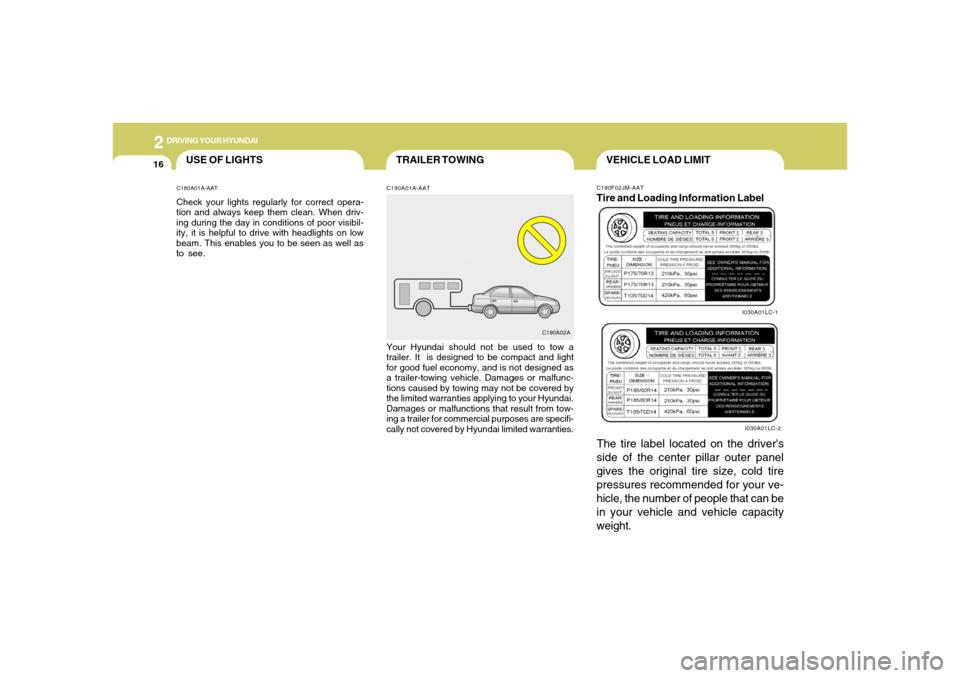
VEHICLE LOAD LIMITC190F02JM-AATTire and Loading Information LabelThe tire label located on the driver's
side of the center pillar outer panel
gives the original tire size, cold tire
pressures recommended for your ve-
hicle, the number of people that can be
in your vehicle and vehicle capacity
weight.
I030A01LC-1I030A01LC-2
Page 125 of 219
DRIVING YOUR HYUNDAI
192
Refer to your vehicle’s tire and loading
information label for specific informa-
tion about your vehicle’s capacity
weight and seating positions. The com-
bined weight of the driver, passengers
and cargo should never exceed your
vehicle’s capacity weight.
!
The label shows the maximum allow-
able weight of the fully loaded vehicle.
This is called the GVWR (Gross Ve-
hicle Weight Rating). The GVWR in-
cludes the weight of the vehicle, all
occupants, fuel and cargo.
This label also tells you the maximum
weights that can be supported by the
front and rear axles, called Gross Axle
Weight Rating (GAWR). To find out the
actual loads on your front and rear
axles, you need to go to a weigh
station and weigh your vehicle. Your
dealer can help you with this. Be sure
to spread out your load equally on both
sides of the centerline.WARNING:
o Never exceed the GVWR for your
vehicle, the GAWR for either the
front or rear axle and vehicle ca-
pacity weight. Exceeding these
ratings can cause an accident or
vehicle damage. You can calcu-
late the weight of your load by
weighing the items (or people)
before putting them in the ve-
hicle. Be careful not to overload
your vehicle.
o Do not load your vehicle any
heavier than the GVWR, either the
maximum front or rear GAWR and
vehicle capacity weight. If you
do, parts, including tires on your
vehicle can break, and it can
change the way your vehicle
handles and braking ability. This
could cause you to lose control
and crash. Also, overloading can
shorten the life of your vehicle.
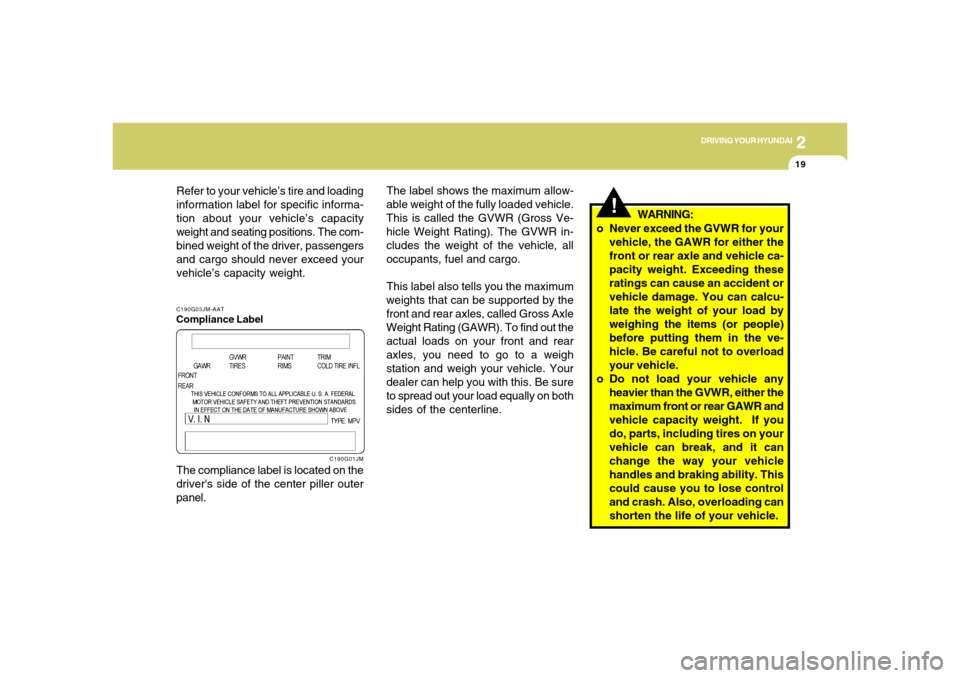
C190G03JM-AATCompliance LabelThe compliance label is located on the
driver's side of the center piller outer
panel.
C190G01JM
Page 128 of 219
32WHAT TO DO IN AN EMERGENCY
IF THE ENGINE WILL NOT START!
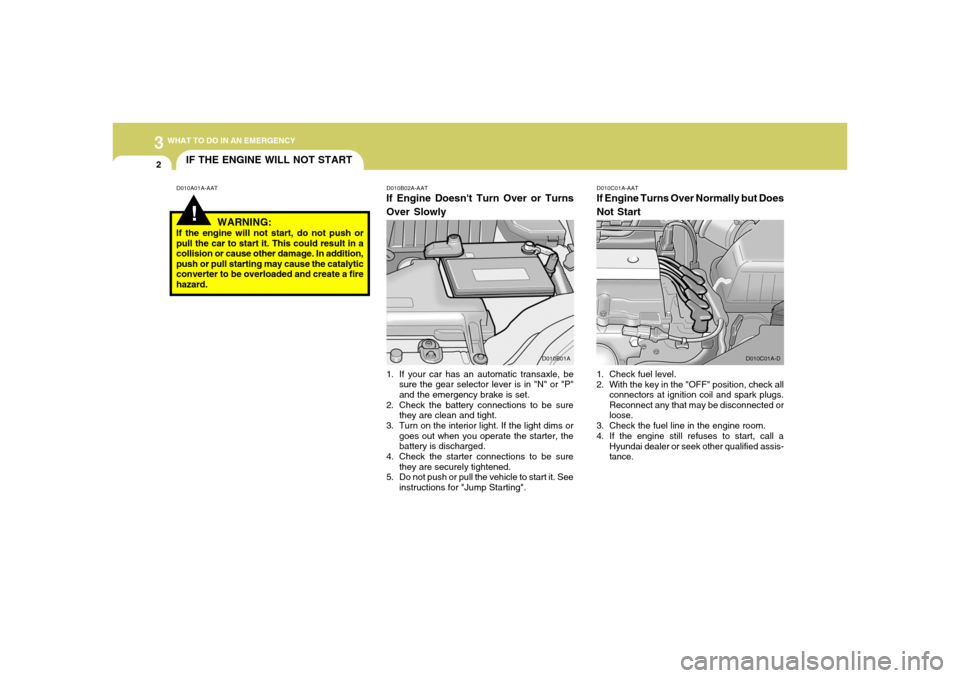
D010B02A-AATIf Engine Doesn't Turn Over or Turns
Over Slowly
D010A01A-AATD010C01A-AAT
If Engine Turns Over Normally but Does
Not Start1. Check fuel level.
2. With the key in the "OFF" position, check all
connectors at ignition coil and spark plugs.
Reconnect any that may be disconnected or
loose.
3. Check the fuel line in the engine room.
4. If the engine still refuses to start, call a
Hyundai dealer or seek other qualified assis-
tance.
WARNING:
If the engine will not start, do not push or
pull the car to start it. This could result in a
collision or cause other damage. In addition,
push or pull starting may cause the catalytic
converter to be overloaded and create a fire
hazard.
D010B01AD010C01A-D
1. If your car has an automatic transaxle, be
sure the gear selector lever is in "N" or "P"
and the emergency brake is set.
2. Check the battery connections to be sure
they are clean and tight.
3. Turn on the interior light. If the light dims or
goes out when you operate the starter, the
battery is discharged.
4. Check the starter connections to be sure
they are securely tightened.
5. Do not push or pull the vehicle to start it. See
instructions for "Jump Starting".
Page 148 of 219

5
VEHICLE MAINTENANCE REQUIREMENTS2
MAINTENANCE INTERVALSF010B01A-AATMaintenance RequirementsThe maintenance required for your Hyundai can
be divided into three main areas:
o Specified scheduled procedures
o General checks
o Do-it-yourself maintenanceF010A01A-AATService RequirementsTo ensure that you receive the greatest number
of miles of satisfying operation from your
Hyundai, certain maintenance procedures must
be performed. Although careful design and engi-
neering have reduced these to a minimum,
those that are required are of the utmost impor-
tance.
It is your responsibility to have these mainte-
nance procedures performed to comply with the
terms of the warranties covering your new
Hyundai. The Owner's Handbook supplied with
your new vehicle provides further information
about these warranties.
F010D01A-AATGeneral ChecksThese are the regular checks you should per-
form when you drive your Hyundai or you fill the
fuel tank. A list of these items will be found on
page 6-3.
F010C01A-AATSpecified Scheduled ProceduresThese are the procedures such as inspections,
adjustments and replacements that are listed in
the maintenance charts starting on page 5-4.
These procedures must be performed at the
intervals shown in the maintenance schedule to
assure that your warranty remains in effect.
Although it is strongly recommended that they
be performed by the factory-trained or distribu-
tor-trained technicians at your Hyundai dealer,
these procedures may be performed at any
qualified service facility.
It is suggested that genuine Hyundai service
parts be used for any required repairs or re-
placements. Other parts of equivalent quality
such as engine oil, engine coolant, manual or
auto transaxle oil, brake fluid and so on which
are not supplied by Hyundai Motor Company or
its distributor may be used without affecting your
warranty coverage but you should always be
sure these are equivalent to the quality of the
original Hyundai parts. Your Owner's Handbook
provides further information about your warranty
coverage.
F010E01A-AATDo-It-Yourself MaintenanceIf you are mechanically inclined, own a few tools
that are required and want to take the time to do
so, you can inspect and service a number of
items. For more information about doing it your-
self, see Section 6.
Page 150 of 219
5
VEHICLE MAINTENANCE REQUIREMENTS4
SCHEDULED MAINTENANCE
150
240
120
R
I
I
R
R
R MILES X 1000
KILOMETERS X 1000
MONTHS
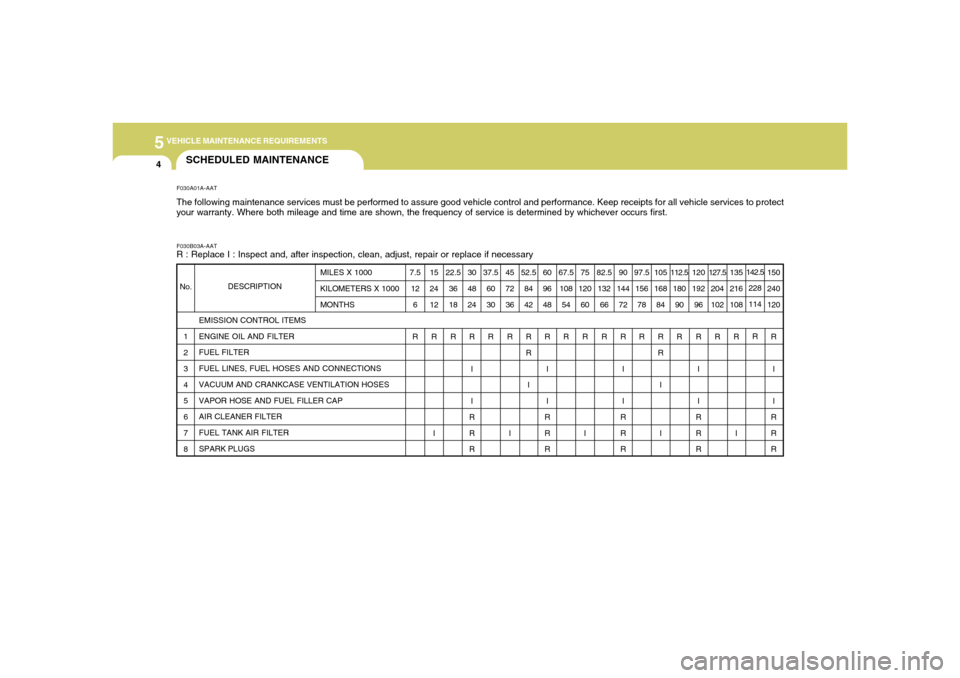
EMISSION CONTROL ITEMS
ENGINE OIL AND FILTER
FUEL FILTER
FUEL LINES, FUEL HOSES AND CONNECTIONS
VACUUM AND CRANKCASE VENTILATION HOSES
VAPOR HOSE AND FUEL FILLER CAP
AIR CLEANER FILTER
FUEL TANK AIR FILTER
SPARK PLUGS No.DESCRIPTION
1
2
3
4
5
6
7
87.5
12
6
R15
24
12
R
I22.5
36
18
R30
48
24
R
I
I
R
R
R37.5
60
30
R45
72
36
R
I52.5
84
42
R
R
I60
96
48
R
I
I
R
R
R67.5
108
54
R75
120
60
R
I82.5
132
66
R90
144
72
R
I
I
R
R
R97.5
156
78
R105
168
84
R
R
I
I112.5
180
90
R120
192
96
R
I
I
R
R
R127.5
204
102
R135
216
108
R
I142.5
228
114
R
F030B03A-AATR : Replace I : Inspect and, after inspection, clean, adjust, repair or replace if necessaryF030A01A-AATThe following maintenance services must be performed to assure good vehicle control and performance. Keep receipts for all vehicle services to protect
your warranty. Where both mileage and time are shown, the frequency of service is determined by whichever occurs first.
Page 153 of 219
5
VEHICLE MAINTENANCE REQUIREMENTS
7
EXPLANATION OF SCHEDULED
MAINTENANCE ITEMS
F060D01A-AATo Fuel Lines, Fuel Hoses and
ConnectionsCheck the fuel lines, fuel hoses and connec-
tions for leakage and damage. Have a trained
techincian, replace any damaged or leaking
parts immediately.
F060C01A-AATo Fuel FilterA clogged filter can limit the speed at which the
vehicle may be driven, damage the emission
system and cause hard starting. If an excessive
amount of foreign matter accumulates in the fuel
tank, the filter may require replacement more
frequently.
After installing a new filter, run the engine for
several minutes, and check for leaks at the
connections.
Fuel filters should be installed by trained techni-
cians.F060M01A-AATo Engine Oil and FilterThe engine oil and filter should be changed at
the intervals specified in the maintenance sched-
ule. If the car is being driven in severe condi-
tions, more frequent oil and filter changes are
required.
F060H01A-AATo Air Cleaner FilterA Genuine Hyundai air cleaner filter is recom-
mended when the filter is replaced.F060G01A-AATo Vapor Hose and Fuel Filler CapThe vapor hose and fuel filler cap should be
inspected at those intervals specified in the
maintenance schedule. Make sure that a new
vapor hose or fuel filler cap is correctly re-
placed.
F060F01A-AATo Vacuum, Crankcase Ventilation
HosesInspect the surface of hoses for evidence of
heat and/or mechanical damage. Hard and brittle
rubber, cracking, tears, cuts, abrasions, and
excessive swelling indicate deterioration. Par-
ticular attention should be paid to examine those
hose surfaces nearest to high heat sources,
such as the exhaust manifold.
Inspect the hose routing to assure that the
hoses do not come in contact with any heat
source, sharp edges or moving component which
might cause heat damage or mechanical wear.
Inspect all hose connections, such as clamps
and couplings, to make sure they are secure,
and that no leaks are present. Hoses should be
replaced immediately if there is any evidence of
deterioration or damage.
F060B01A-AATo Drive BeltsInspect all drive belts for evidence of cuts,
cracks, excessive wear or oil saturation and
replace if necessary. Drive belts should be
checked periodically for proper tension and ad-
justed as necessary.F060J01A-AATo Spark PlugsMake sure to install new spark plugs of the
correct heat range.
Page 159 of 219
6
DO-IT-YOURSELF MAINTENANCE4
CHECKING THE ENGINE OILG030A01A-AATEngine oil is essential to the performance and
service of the engine. It is suggested that you
check the oil level at least once a week in
normal use and more often if you are on a trip or
driving in severe conditions.
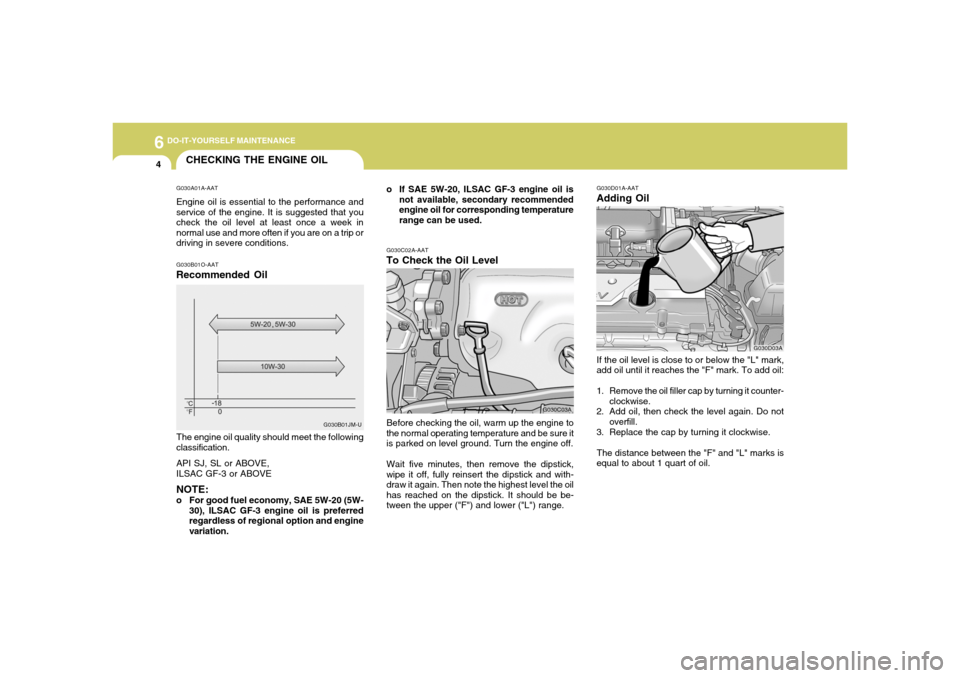
G030C02A-AATTo Check the Oil LevelBefore checking the oil, warm up the engine to
the normal operating temperature and be sure it
is parked on level ground. Turn the engine off.
Wait five minutes, then remove the dipstick,
wipe it off, fully reinsert the dipstick and with-
draw it again. Then note the highest level the oil
has reached on the dipstick. It should be be-
tween the upper ("F") and lower ("L") range.
G030D01A-AATAdding OilIf the oil level is close to or below the "L" mark,
add oil until it reaches the "F" mark. To add oil:
1. Remove the oil filler cap by turning it counter-
clockwise.
2. Add oil, then check the level again. Do not
overfill.
3. Replace the cap by turning it clockwise.
The distance between the "F" and "L" marks is
equal to about 1 quart of oil.
G030C03A
G030D03A G030B01O-AAT
Recommended OilThe engine oil quality should meet the following
classification.
API SJ, SL or ABOVE,
ILSAC GF-3 or ABOVENOTE:o For good fuel economy, SAE 5W-20 (5W-
30), ILSAC GF-3 engine oil is preferred
regardless of regional option and engine
variation.
G030B01JM-U
o If SAE 5W-20, ILSAC GF-3 engine oil is
not available, secondary recommended
engine oil for corresponding temperature
range can be used.
Page 163 of 219
6
DO-IT-YOURSELF MAINTENANCE8
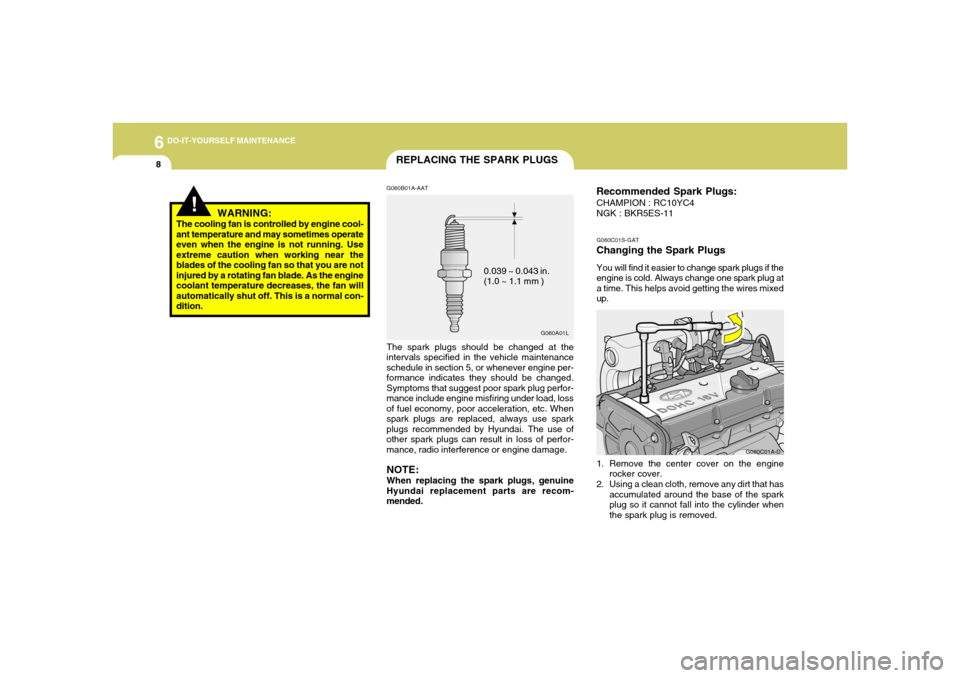
REPLACING THE SPARK PLUGSG060B01A-AAT
G060A01L
0.039 ~ 0.043 in.
(1.0 ~ 1.1 mm )
The spark plugs should be changed at the
intervals specified in the vehicle maintenance
schedule in section 5, or whenever engine per-
formance indicates they should be changed.
Symptoms that suggest poor spark plug perfor-
mance include engine misfiring under load, loss
of fuel economy, poor acceleration, etc. When
spark plugs are replaced, always use spark
plugs recommended by Hyundai. The use of
other spark plugs can result in loss of perfor-
mance, radio interference or engine damage.
NOTE:When replacing the spark plugs, genuine
Hyundai replacement parts are recom-
mended.
G060C01S-GATChanging the Spark PlugsYou will find it easier to change spark plugs if the
engine is cold. Always change one spark plug at
a time. This helps avoid getting the wires mixed
up.
G060C01A-D
1. Remove the center cover on the engine
rocker cover.
2. Using a clean cloth, remove any dirt that has
accumulated around the base of the spark
plug so it cannot fall into the cylinder when
the spark plug is removed.Recommended Spark Plugs:CHAMPION : RC10YC4
NGK : BKR5ES-11
!
WARNING:
The cooling fan is controlled by engine cool-
ant temperature and may sometimes operate
even when the engine is not running. Use
extreme caution when working near the
blades of the cooling fan so that you are not
injured by a rotating fan blade. As the engine
coolant temperature decreases, the fan will
automatically shut off. This is a normal con-
dition.
Page 178 of 219
6
DO-IT-YOURSELF MAINTENANCE
23
G240A01A-AATPOWER STEERING HOSESIt is suggested that you check the power steer-
ing hose connections for fluid leakage at those
intervals specified in the vehicle maintenance
schedule in Section 5.
The power steering hoses should be replaced if
there is severe surface cracking, pulling, scuff-
ing or worn spots. Deterioration of the hose
could cause premature failure.Recommended FluidUse PSF-3 type fluidNOTE:Do not start the engine when the power
steering oil reservoir is empty.
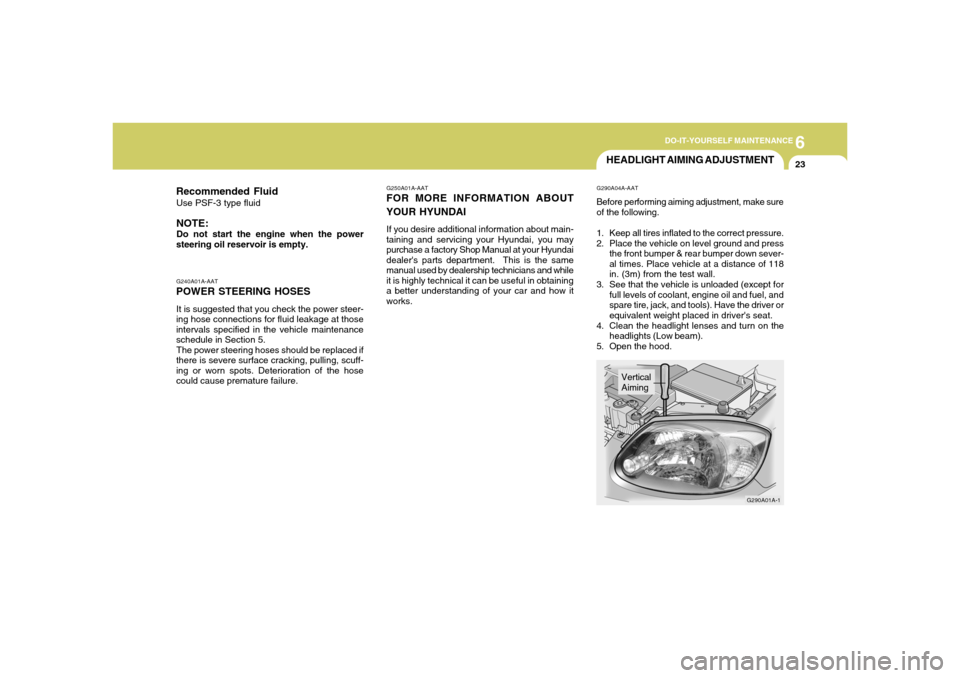
HEADLIGHT AIMING ADJUSTMENT
G250A01A-AATFOR MORE INFORMATION ABOUT
YOUR HYUNDAIIf you desire additional information about main-
taining and servicing your Hyundai, you may
purchase a factory Shop Manual at your Hyundai
dealer's parts department. This is the same
manual used by dealership technicians and while
it is highly technical it can be useful in obtaining
a better understanding of your car and how it
works.
G290A04A-AATBefore performing aiming adjustment, make sure
of the following.
1. Keep all tires inflated to the correct pressure.
2. Place the vehicle on level ground and press
the front bumper & rear bumper down sever-
al times. Place vehicle at a distance of 118
in. (3m) from the test wall.
3. See that the vehicle is unloaded (except for
full levels of coolant, engine oil and fuel, and
spare tire, jack, and tools). Have the driver or
equivalent weight placed in driver's seat.
4. Clean the headlight lenses and turn on the
headlights (Low beam).
5. Open the hood.
G290A01A-1
Vertical
Aiming