ignition Hyundai Accent 2005 Owner's Guide
[x] Cancel search | Manufacturer: HYUNDAI, Model Year: 2005, Model line: Accent, Model: Hyundai Accent 2005Pages: 219, PDF Size: 7.07 MB
Page 111 of 219
DRIVING YOUR HYUNDAI
52
OPERATING THE MANUAL
TRANSAXLE
4. Turn the ignition key to the "Start" position
and release it when the engine starts.
After the engine has started, allow the engine
to run for 10 to 20 seconds prior to placing
the vehicle in gear.
The starter should not be operated for more
than 15 seconds at a time. Wait 15-30 sec-
onds between starting attempts to protect
the starter from overheating.
C050B01A-AATNormal Conditions:The Starting Procedure:
1. Insert key, and fasten the seat belt.
2. Depress the clutch pedal fully and place the
gearshift lever (manual transaxle) in neutral
or the selector lever (automatic transaxle) in
"P" (park) position.
3. After turning the ignition key to the "ON"
position, make certain all warning lights and
gauges are functioning properly before start-
ing the engine.
WARNING:
Be sure that the clutch is fully depressed
when starting a manual transaxle vehicle.
Your manual transaxle equipped vehicle will
not start unless the clutch pedal is fully
depressed. On a manual transaxle equipped
vehicle that can be started without depress-
ing the clutch, there is the potential to cause
damage to the vehicle or injury to someone
inside or outside the vehicle as a result of
the forward or backward movement of the
vehicle that will occur if the clutch is not
depressed when the vehicle is started.
!
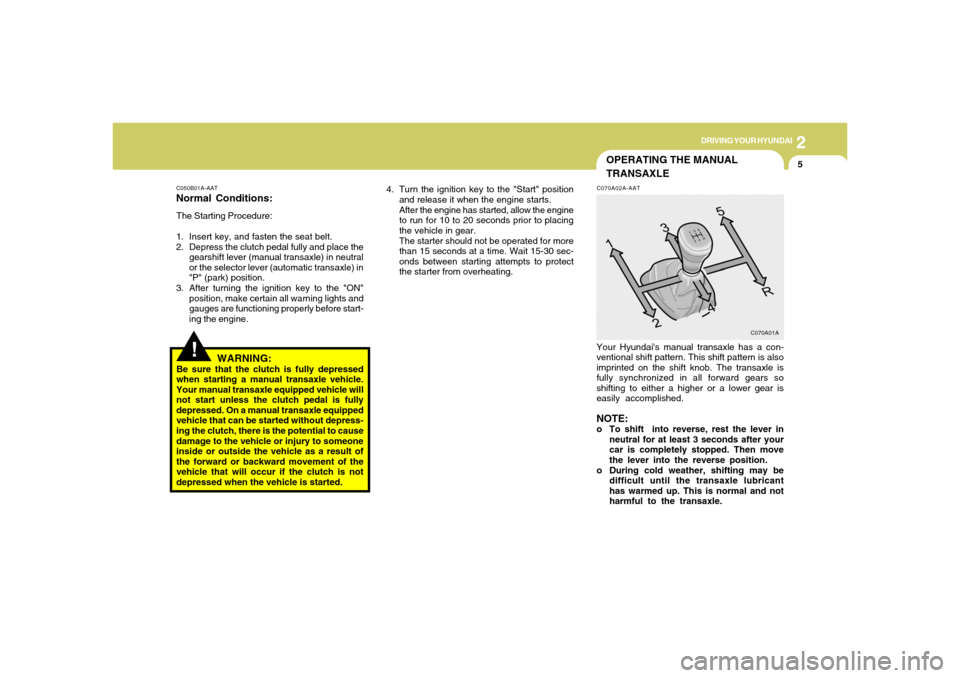
C070A02A-AATYour Hyundai's manual transaxle has a con-
ventional shift pattern. This shift pattern is also
imprinted on the shift knob. The transaxle is
fully synchronized in all forward gears so
shifting to either a higher or a lower gear is
easily accomplished.NOTE:o To shift into reverse, rest the lever in
neutral for at least 3 seconds after your
car is completely stopped. Then move
the lever into the reverse position.
o During cold weather, shifting may be
difficult until the transaxle lubricant
has warmed up. This is normal and not
harmful to the transaxle.
C070A01A
Page 114 of 219

2
DRIVING YOUR HYUNDAI8
C090G01A-AATo L (Low gear):Use for driving up a very steep grade or for
engine braking when descending steep hills.
When downshifting to "L", the transaxle will
temporarily remain in second gear until the ve-
hicle has slowed enough for low gear to engage.
Do not exceed 31 mph (50 km/h) in low gear.C090F01A-AATo 2 (Second gear):Use for driving on a slippery road, hill climbing
or engine braking downhill. "2" automatically
shifts between first and second gears.
This means that no shift-up to 3rd gear is per-
formed. However, the shift-up to third gear is
done when the car speed exceeds a certain
value to prevent the engine from over-revving.
Manually move the selector to "D" returning to
normal driving condition.
C090H01A-AATNOTE:o For smooth and safe operation, de-
press the brake pedal when shifting
from "Neutral" position or "Park" posi-
tion to a forward or reverse gear.
o The ignition key must be in the "ON"
position and the brake pedal fully de-
pressed in order to move the shift lever
from the "P" (Park) position to any of the
other positions.
o It is always possible to shift from "R",
"N", "D", "2", "L" position to "P" posi-
tion.
C090C01A-AATo R(Reverse):Use for backing up the vehicle. Bring the car to
a complete stop before shifting the selector
lever to "R" position.C090D02A-AATo N (Neutral):In the "N" position, the transaxle is in neutral
position, which means that no gears are en-
gaged. The engine can be started with the shift
lever in "N" position, although this is not recom-
mended except if the engine stalls while the car
is moving.C090E01A-AATo D (Drive):Use for normal driving. The transaxle will auto-
matically shift through a four-gear sequence.
Never downshift manually to "2" position or "L"
position when vehicle speed is more than 60
mph (96 km/h).
Page 115 of 219
DRIVING YOUR HYUNDAI
92
C090I01A-AAT
CAUTION:
o Shift into "R" and "P" position only
when the vehicle has completely
stopped.
o Do not accelerate the engine in reverse
or any of the forward positions with the
brakes applied.
o Always apply the footbrake when shifting
from "P" or "N", to "R", "D", "2" or "L"
position.
o Do not use the "P" (Park) position in
place of the parking brake. Always set
the parking brake, shift the transaxle into
"P" (Park) position and turn off the igni-
tion when you leave the vehicle, even
momentarily. Never leave the vehicle un-
attended while the engine is running.
o Check the automatic transaxle fluid level
regularly, and add fluid as necessary.
!
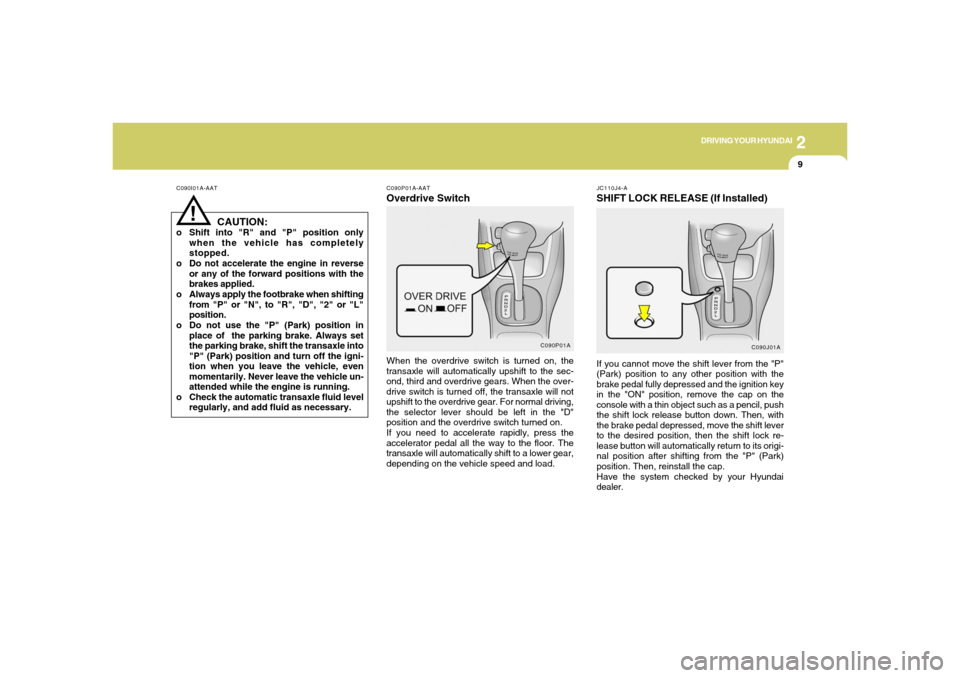
If you cannot move the shift lever from the "P"
(Park) position to any other position with the
brake pedal fully depressed and the ignition key
in the "ON" position, remove the cap on the
console with a thin object such as a pencil, push
the shift lock release button down. Then, with
the brake pedal depressed, move the shift lever
to the desired position, then the shift lock re-
lease button will automatically return to its origi-
nal position after shifting from the "P" (Park)
position. Then, reinstall the cap.
Have the system checked by your Hyundai
dealer.JC110J4-ASHIFT LOCK RELEASE (If Installed)
C090J01A
C090P01A-AATOverdrive SwitchWhen the overdrive switch is turned on, the
transaxle will automatically upshift to the sec-
ond, third and overdrive gears. When the over-
drive switch is turned off, the transaxle will not
upshift to the overdrive gear. For normal driving,
the selector lever should be left in the "D"
position and the overdrive switch turned on.
If you need to accelerate rapidly, press the
accelerator pedal all the way to the floor. The
transaxle will automatically shift to a lower gear,
depending on the vehicle speed and load.
C090P01A
Page 120 of 219

2
DRIVING YOUR HYUNDAI
14
C160D01A-AATCheck Battery and CablesWinter puts additional burdens on the battery
system. Visually inspect the battery and cables
as described in Section 6. The level of charge in
your battery can be checked by your Hyundai
dealer or a service station.
C160E01A-AATChange to "Winter Weight" Oil if
NecessaryIn some climates it is recommended that a lower
viscosity "winter weight" oil be used during cold
weather. See Section 9 for recommendations. If
you aren't sure what weight oil you should use,
consult your Hyundai dealer.
C160C01A-AATUse High Quality Ethylene Glycol
CoolantYour Hyundai is delivered with high quality eth-
ylene glycol coolant in the cooling system. It is
the only type of coolant that should be used
because it helps prevent corrosion in the cooling
system, lubricates the water pump and prevents
freezing. Be sure to replace or replenish your
coolant in accordance with the maintenance
schedule in Section 5. Before winter, have your
coolant tested to assure that its freezing point is
sufficient for the temperatures anticipated dur-
ing the winter.
C160H01A-AATUse Approved Anti-Freeze in Window
Washer SystemTo keep the water in the window washer system
from freezing, add an approved anti-freeze so-
lution in accordance with instructions on the
container. Window washer anti-freeze is avail-
able from Hyundai dealers and most auto parts
outlets. Do not use engine coolant or other types
of anti-freeze as these may damage the finish.
C160F01A-AATCheck Spark Plugs and Ignition
SystemInspect your spark plugs as described in Sec-
tion 6 and replace them if necessary. Also
check all ignition wiring and components to be
sure they are not cracked, worn or damaged in
any way.
C160G01A-AATTo Keep Locks from FreezingTo keep the locks from freezing, squirt an ap-
proved de-icer fluid or glycerine into the key
opening. If a lock is covered with ice, squirt it
with an approved de-icing fluid to remove the
ice. If the lock is frozen internally, you may be
able to thaw it out by using a heated key. Handle
the heated key with care to avoid injury.
Page 128 of 219
32WHAT TO DO IN AN EMERGENCY
IF THE ENGINE WILL NOT START!
D010B02A-AATIf Engine Doesn't Turn Over or Turns
Over Slowly
D010A01A-AATD010C01A-AAT
If Engine Turns Over Normally but Does
Not Start1. Check fuel level.
2. With the key in the "OFF" position, check all
connectors at ignition coil and spark plugs.
Reconnect any that may be disconnected or
loose.
3. Check the fuel line in the engine room.
4. If the engine still refuses to start, call a
Hyundai dealer or seek other qualified assis-
tance.
WARNING:
If the engine will not start, do not push or
pull the car to start it. This could result in a
collision or cause other damage. In addition,
push or pull starting may cause the catalytic
converter to be overloaded and create a fire
hazard.
D010B01AD010C01A-D
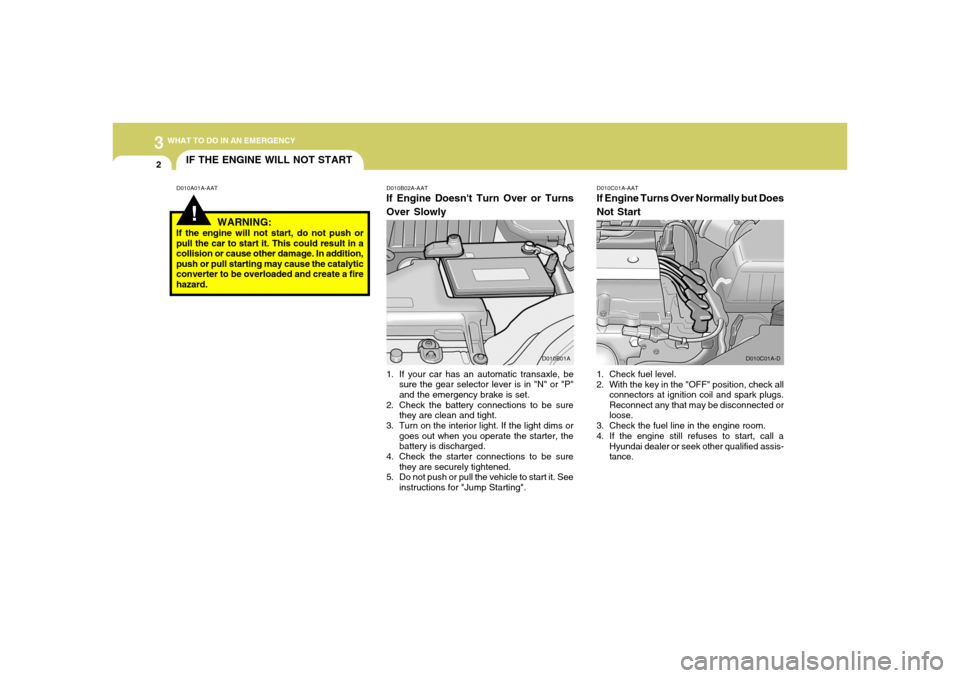
1. If your car has an automatic transaxle, be
sure the gear selector lever is in "N" or "P"
and the emergency brake is set.
2. Check the battery connections to be sure
they are clean and tight.
3. Turn on the interior light. If the light dims or
goes out when you operate the starter, the
battery is discharged.
4. Check the starter connections to be sure
they are securely tightened.
5. Do not push or pull the vehicle to start it. See
instructions for "Jump Starting".
Page 139 of 219
3
WHAT TO DO IN AN EMERGENCY
13
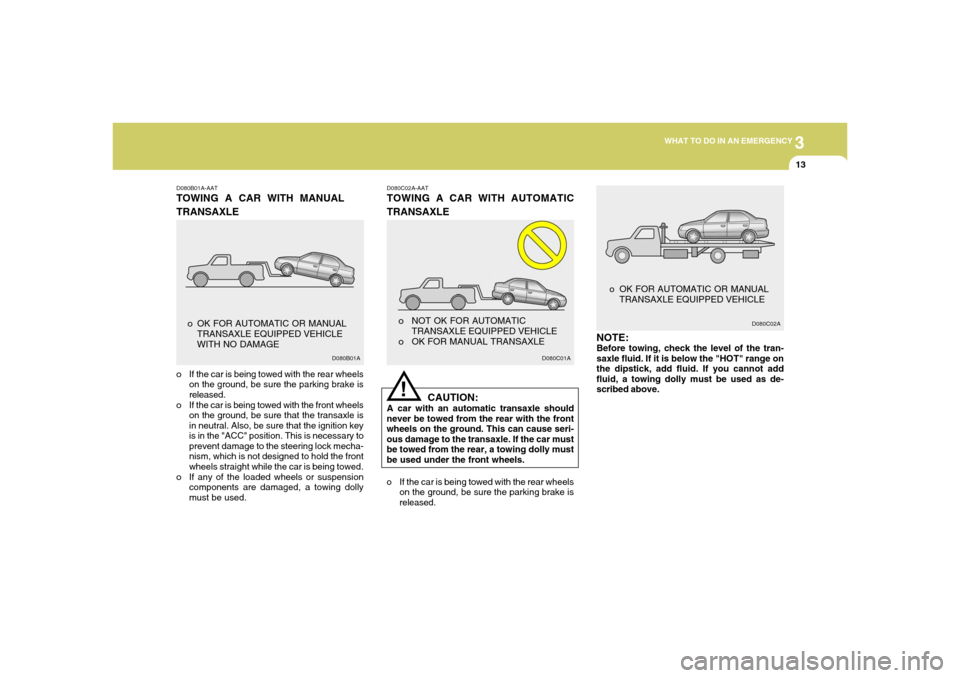
D080B01A-AATTOWING A CAR WITH MANUAL
TRANSAXLEo If the car is being towed with the rear wheels
on the ground, be sure the parking brake is
released.
o If the car is being towed with the front wheels
on the ground, be sure that the transaxle is
in neutral. Also, be sure that the ignition key
is in the "ACC" position. This is necessary to
prevent damage to the steering lock mecha-
nism, which is not designed to hold the front
wheels straight while the car is being towed.
o If any of the loaded wheels or suspension
components are damaged, a towing dolly
must be used.
D080B01A
o OK FOR AUTOMATIC OR MANUAL
TRANSAXLE EQUIPPED VEHICLE
WITH NO DAMAGE
D080C02A-AATTOWING A CAR WITH AUTOMATIC
TRANSAXLE
CAUTION:A car with an automatic transaxle should
never be towed from the rear with the front
wheels on the ground. This can cause seri-
ous damage to the transaxle. If the car must
be towed from the rear, a towing dolly must
be used under the front wheels. o NOT OK FOR AUTOMATIC
TRANSAXLE EQUIPPED VEHICLE
o OK FOR MANUAL TRANSAXLE
D080C01A
o If the car is being towed with the rear wheels
on the ground, be sure the parking brake is
released.
!
NOTE:Before towing, check the level of the tran-
saxle fluid. If it is below the "HOT" range on
the dipstick, add fluid. If you cannot add
fluid, a towing dolly must be used as de-
scribed above.
D080C02A
o OK FOR AUTOMATIC OR MANUAL
TRANSAXLE EQUIPPED VEHICLE
Page 175 of 219
6
DO-IT-YOURSELF MAINTENANCE
20
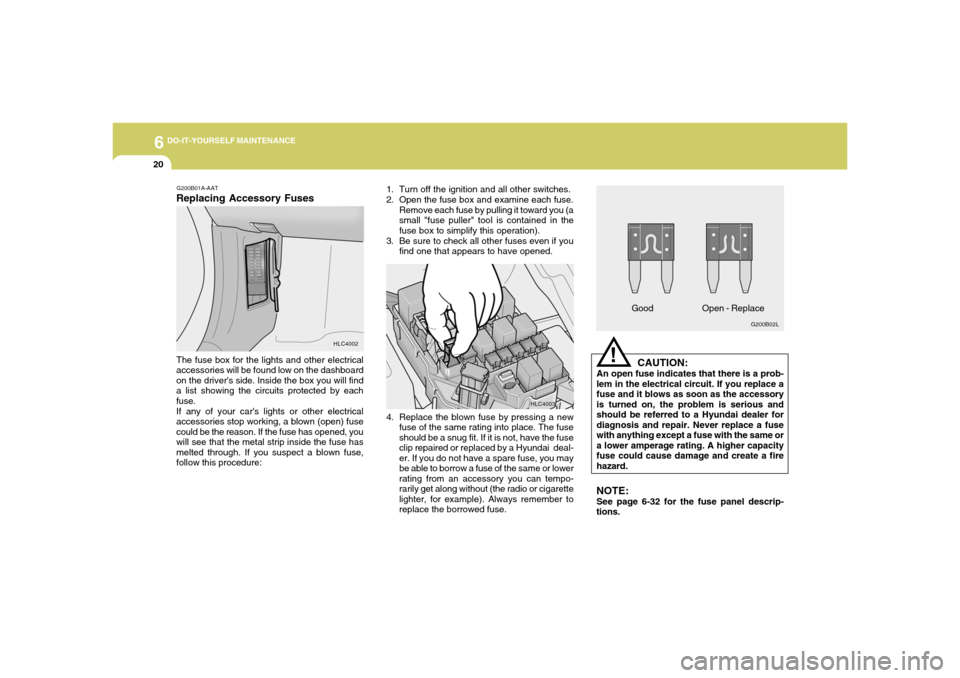
CAUTION:
An open fuse indicates that there is a prob-
lem in the electrical circuit. If you replace a
fuse and it blows as soon as the accessory
is turned on, the problem is serious and
should be referred to a Hyundai dealer for
diagnosis and repair. Never replace a fuse
with anything except a fuse with the same or
a lower amperage rating. A higher capacity
fuse could cause damage and create a fire
hazard.
G200B02L
!
GoodOpen - Replace
G200B01A-AATReplacing Accessory FusesThe fuse box for the lights and other electrical
accessories will be found low on the dashboard
on the driver's side. Inside the box you will find
a list showing the circuits protected by each
fuse.
If any of your car's lights or other electrical
accessories stop working, a blown (open) fuse
could be the reason. If the fuse has opened, you
will see that the metal strip inside the fuse has
melted through. If you suspect a blown fuse,
follow this procedure:
HLC4002
1. Turn off the ignition and all other switches.
2. Open the fuse box and examine each fuse.
Remove each fuse by pulling it toward you (a
small "fuse puller" tool is contained in the
fuse box to simplify this operation).
3. Be sure to check all other fuses even if you
find one that appears to have opened.
HLC4003
4. Replace the blown fuse by pressing a new
fuse of the same rating into place. The fuse
should be a snug fit. If it is not, have the fuse
clip repaired or replaced by a Hyundai deal-
er. If you do not have a spare fuse, you may
be able to borrow a fuse of the same or lower
rating from an accessory you can tempo-
rarily get along without (the radio or cigarette
lighter, for example). Always remember to
replace the borrowed fuse.
NOTE:See page 6-32 for the fuse panel descrip-
tions.
Page 177 of 219
6
DO-IT-YOURSELF MAINTENANCE
22
POWER STEERING FLUID LEVEL
CHECKING ELECTRIC COOLING
FANS!
G220A01A-AAT G230A03A-AAT
G220B01A-AATChecking Engine Cooling FanThe engine cooling fan should come on auto-
matically if the engine coolant temperature is
high.
WARNING:
The radiator fan is controlled by engine cool-
ant temperature and may sometimes operate
even when the engine is not running. Use
extreme caution when working near the
blades of the cooling fan, so that you are not
injured by a rotating fan blade. As the cool-
ant temperature decreases the fan will auto-
matically shut off. This is a normal condition.G220C01A-AATChecking Condenser Cooling FanThe condenser cooling fan should come on
automatically whenever the air conditioner is in
operation.
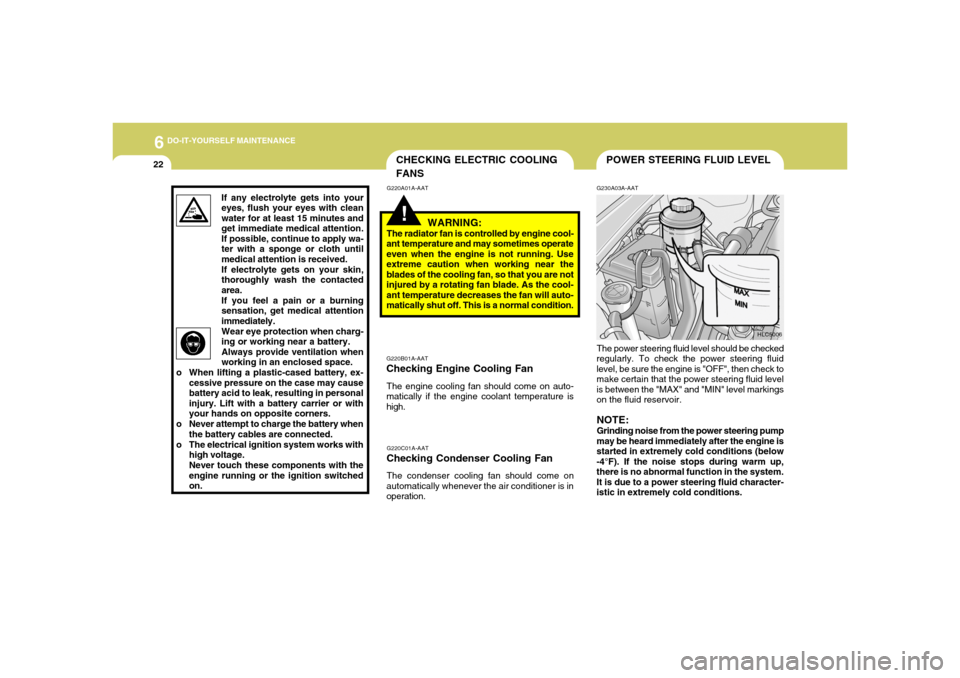
HLC5006
The power steering fluid level should be checked
regularly. To check the power steering fluid
level, be sure the engine is "OFF", then check to
make certain that the power steering fluid level
is between the "MAX" and "MIN" level markings
on the fluid reservoir.NOTE:Grinding noise from the power steering pump
may be heard immediately after the engine is
started in extremely cold conditions (below
-4°F). If the noise stops during warm up,
there is no abnormal function in the system.
It is due to a power steering fluid character-
istic in extremely cold conditions.
If any electrolyte gets into your
eyes, flush your eyes with clean
water for at least 15 minutes and
get immediate medical attention.
If possible, continue to apply wa-
ter with a sponge or cloth until
medical attention is received.
If electrolyte gets on your skin,
thoroughly wash the contacted
area.
If you feel a pain or a burning
sensation, get medical attention
immediately.
Wear eye protection when charg-
ing or working near a battery.
Always provide ventilation when
working in an enclosed space.
o When lifting a plastic-cased battery, ex-
cessive pressure on the case may cause
battery acid to leak, resulting in personal
injury. Lift with a battery carrier or with
your hands on opposite corners.
o Never attempt to charge the battery when
the battery cables are connected.
o The electrical ignition system works with
high voltage.
Never touch these components with the
engine running or the ignition switched
on.
Page 187 of 219
6
DO-IT-YOURSELF MAINTENANCE
32
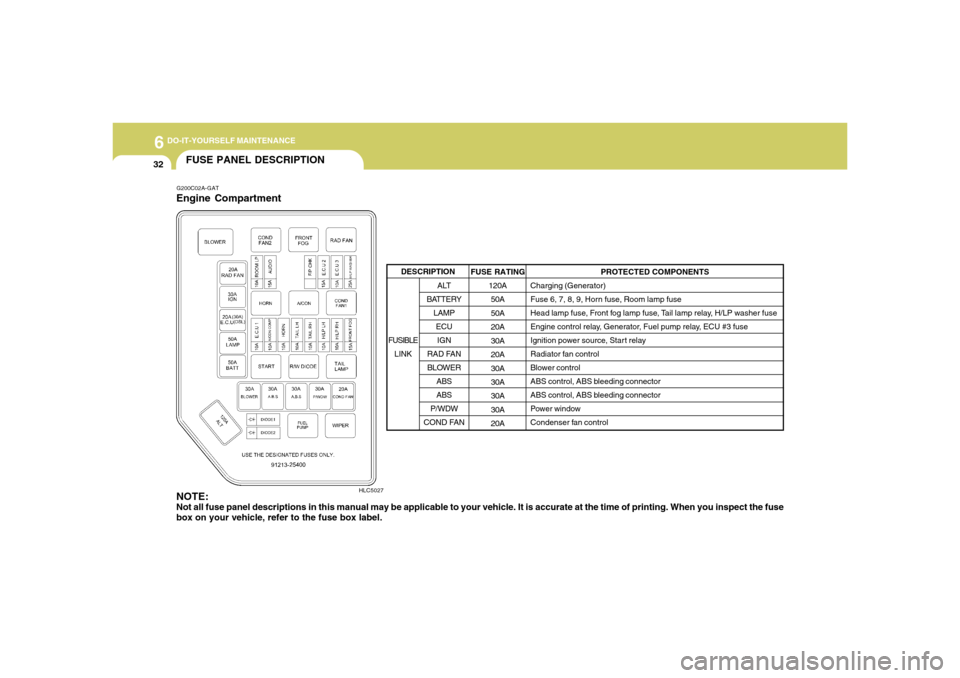
FUSE PANEL DESCRIPTIONG200C02A-GATEngine Compartment
HLC5027
NOTE:Not all fuse panel descriptions in this manual may be applicable to your vehicle. It is accurate at the time of printing. When you inspect the fuse
box on your vehicle, refer to the fuse box label.
FUSE RATING
120A
50A
50A
20A
30A
20A
30A
30A
30A
30A
20APROTECTED COMPONENTS
Charging (Generator)
Fuse 6, 7, 8, 9, Horn fuse, Room lamp fuse
Head lamp fuse, Front fog lamp fuse, Tail lamp relay, H/LP washer fuse
Engine control relay, Generator, Fuel pump relay, ECU #3 fuse
Ignition power source, Star t relay
Radiator fan control
Blower control
ABS control, ABS bleeding connector
ABS control, ABS bleeding connector
Power window
Condenser fan control
ALT
BATTERY
LAMP
ECU
IGN
RAD FAN
BLOWER
ABS
ABS
P/WDW
COND FAN FUSIBLE
LINK
DESCRIPTION
Page 211 of 219
9
VEHICLE SPECIFICATIONS
3
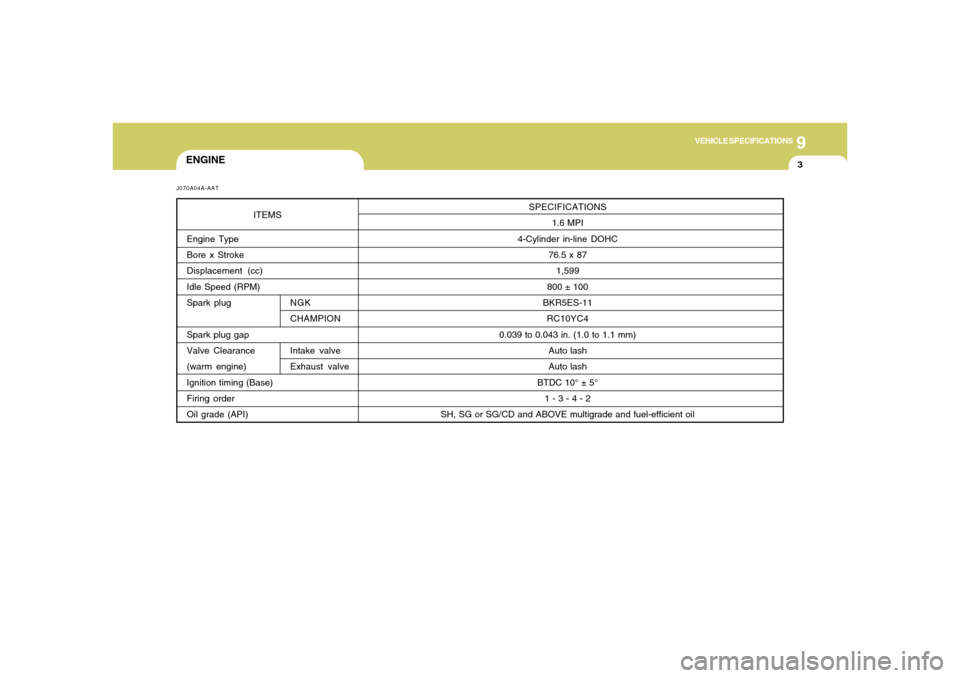
ENGINE
SPECIFICATIONS
1.6 MPI
4-Cylinder in-line DOHC
76.5 x 87
1,599
800 ± 100
BKR5ES-11
RC10YC4
0.039 to 0.043 in. (1.0 to 1.1 mm)
Auto lash
Auto lash
BTDC 10° ± 5°
1 - 3 - 4 - 2
SH, SG or SG/CD and ABOVE multigrade and fuel-efficient oil
J070A04A-AAT
ITEMS
Engine Type
Bore x Stroke
Displacement (cc)
Idle Speed (RPM)
Spark plug
Spark plug gap
Valve Clearance
(warm engine)
Ignition timing (Base)
Firing order
Oil grade (API)
NGK
CHAMPION
Intake valve
Exhaust valve