warning Hyundai Accent 2005 Owner's Guide
[x] Cancel search | Manufacturer: HYUNDAI, Model Year: 2005, Model line: Accent, Model: Hyundai Accent 2005Pages: 219, PDF Size: 7.07 MB
Page 37 of 219
1
FEATURES OF YOUR HYUNDAI
25
!
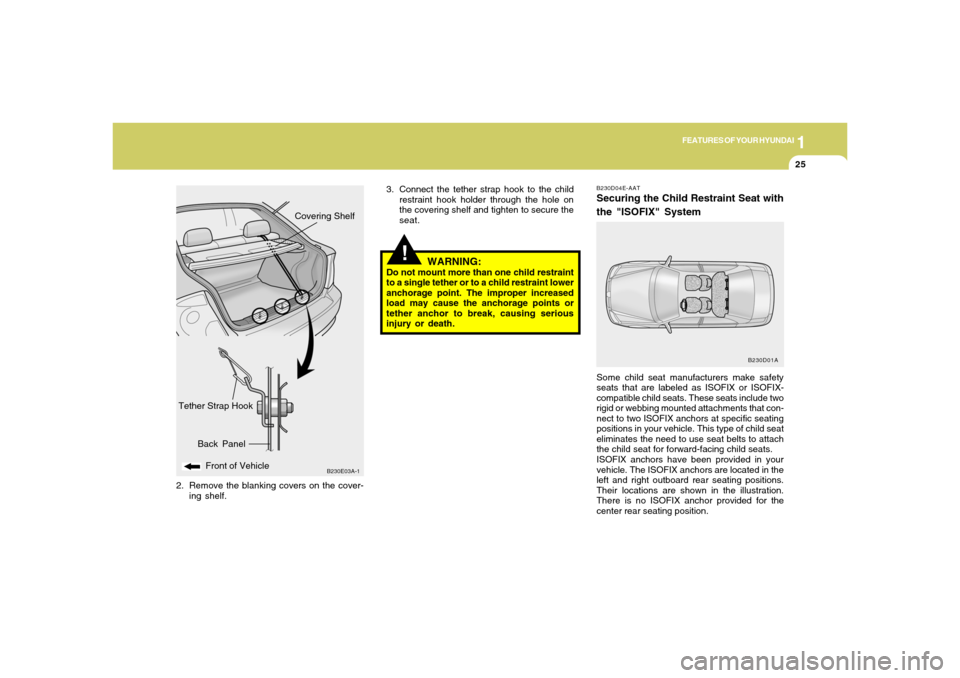
Tether Strap Hook
B230E03A-1
Front of VehicleBack PanelCovering Shelf
3. Connect the tether strap hook to the child
restraint hook holder through the hole on
the covering shelf and tighten to secure the
seat.
WARNING:
Do not mount more than one child restraint
to a single tether or to a child restraint lower
anchorage point. The improper increased
load may cause the anchorage points or
tether anchor to break, causing serious
injury or death.
2. Remove the blanking covers on the cover-
ing shelf.
B230D04E-AATSecuring the Child Restraint Seat with
the "ISOFIX" SystemSome child seat manufacturers make safety
seats that are labeled as ISOFIX or ISOFIX-
compatible child seats. These seats include two
rigid or webbing mounted attachments that con-
nect to two ISOFIX anchors at specific seating
positions in your vehicle. This type of child seat
eliminates the need to use seat belts to attach
the child seat for forward-facing child seats.
ISOFIX anchors have been provided in your
vehicle. The ISOFIX anchors are located in the
left and right outboard rear seating positions.
Their locations are shown in the illustration.
There is no ISOFIX anchor provided for the
center rear seating position.
B230D01A
Page 38 of 219
1FEATURES OF YOUR HYUNDAI26
!
WARNING:
o Do not install a child restraint seat at
the center of the rear seat using the
vehicle's ISOFIX anchors. The ISOFIX
anchors are only provided for the left
and right outboard rear seating posi-
tions. Do not misuse the ISOFIX an-
chors by attempting to attach a child
restraint seat improperly in the middle
of the reat seat position to the ISOFIX
anchors. In a crash, the child seat ISOFIX
attachments may not be strong enough
to secure the child restraint seat prop-
erly in the center of the rear seat and
may break, causing serious injury or
death.
o When using the vehicle’s “ISOFIX” sys-
tem to install a child restraint system in
the rear seat, all unused vehicle rear
seat belt metal latch plates or tabs must
be latched securely in their seat belt
buckles and the seat belt webbing must
be retracted behind the child restraint
to prevent the child from reaching and
taking hold of unretracted seat belts.
Unlatched metal latch plates or tabs
may allow the child to reach the
unretracted seat belts which may result
in strangulation and a serious injury or
death to the child in the child restraint.
!
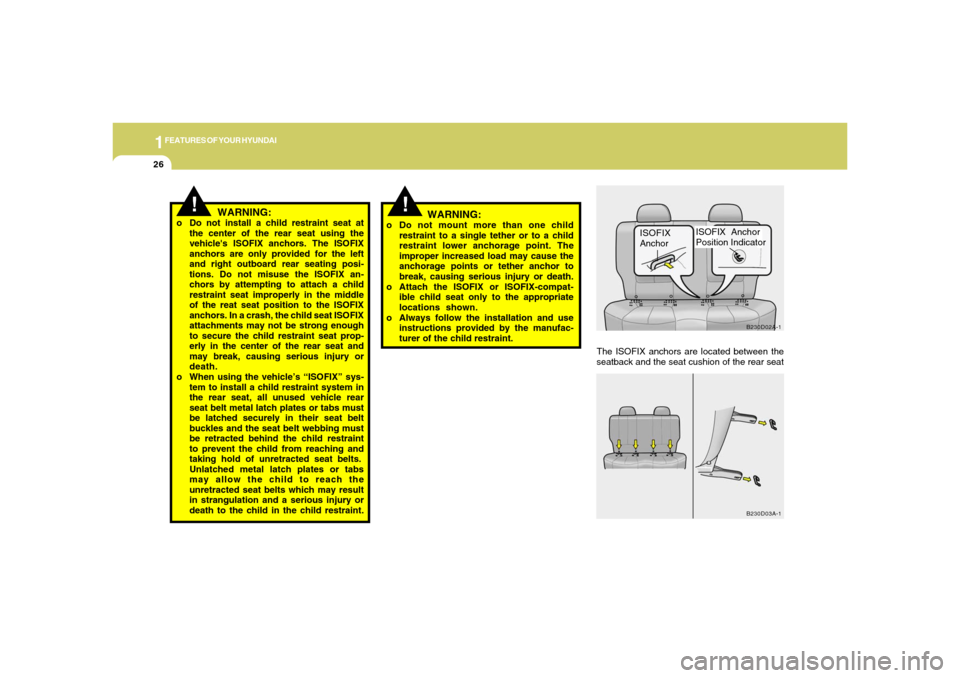
The ISOFIX anchors are located between the
seatback and the seat cushion of the rear seat
B230D02A-1
ISOFIX
Anchor
ISOFIX Anchor
Position Indicator
B230D03A-1
WARNING:
o Do not mount more than one child
restraint to a single tether or to a child
restraint lower anchorage point. The
improper increased load may cause the
anchorage points or tether anchor to
break, causing serious injury or death.
o Attach the ISOFIX or ISOFIX-compat-
ible child seat only to the appropriate
locations shown.
o Always follow the installation and use
instructions provided by the manufac-
turer of the child restraint.
Page 39 of 219
1
FEATURES OF YOUR HYUNDAI
27
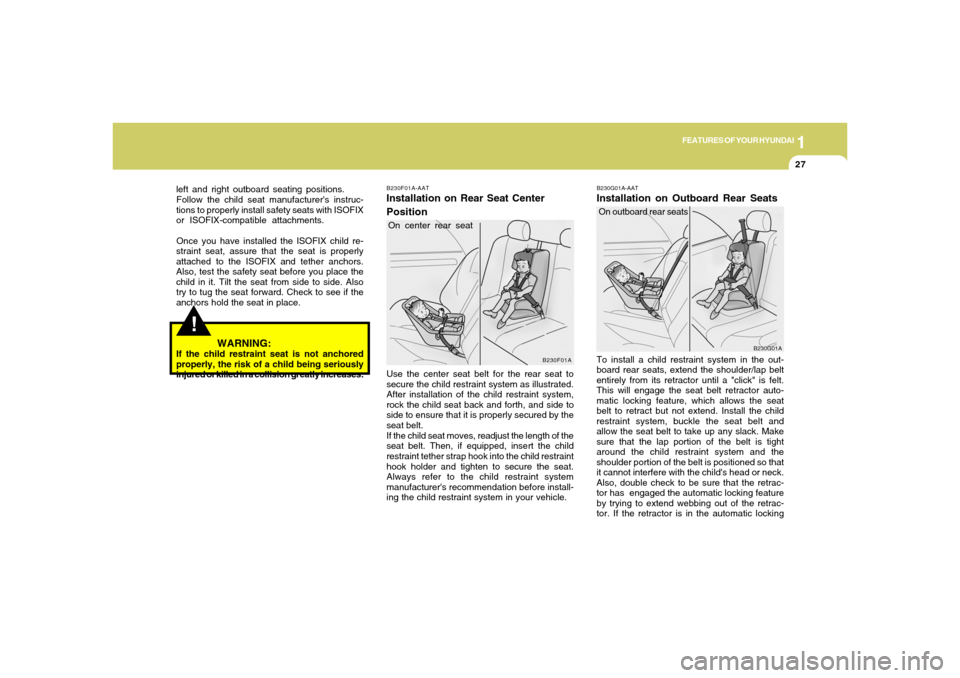
To install a child restraint system in the out-
board rear seats, extend the shoulder/lap belt
entirely from its retractor until a "click" is felt.
This will engage the seat belt retractor auto-
matic locking feature, which allows the seat
belt to retract but not extend. Install the child
restraint system, buckle the seat belt and
allow the seat belt to take up any slack. Make
sure that the lap portion of the belt is tight
around the child restraint system and the
shoulder portion of the belt is positioned so that
it cannot interfere with the child's head or neck.
Also, double check to be sure that the retrac-
tor has engaged the automatic locking feature
by trying to extend webbing out of the retrac-
tor. If the retractor is in the automatic lockingB230G01A-AATInstallation on Outboard Rear SeatsOn outboard rear seats
B230G01A B230F01A-AAT
Installation on Rear Seat Center
PositionUse the center seat belt for the rear seat to
secure the child restraint system as illustrated.
After installation of the child restraint system,
rock the child seat back and forth, and side to
side to ensure that it is properly secured by the
seat belt.
If the child seat moves, readjust the length of the
seat belt. Then, if equipped, insert the child
restraint tether strap hook into the child restraint
hook holder and tighten to secure the seat.
Always refer to the child restraint system
manufacturer's recommendation before install-
ing the child restraint system in your vehicle.
B230F01A
On center rear seat
left and right outboard seating positions.
Follow the child seat manufacturer's instruc-
tions to properly install safety seats with ISOFIX
or ISOFIX-compatible attachments.
Once you have installed the ISOFIX child re-
straint seat, assure that the seat is properly
attached to the ISOFIX and tether anchors.
Also, test the safety seat before you place the
child in it. Tilt the seat from side to side. Also
try to tug the seat forward. Check to see if the
anchors hold the seat in place.
WARNING:
If the child restraint seat is not anchored
properly, the risk of a child being seriously
injured or killed in a collision greatly increases.
!
Page 40 of 219
1FEATURES OF YOUR HYUNDAI28
!
!
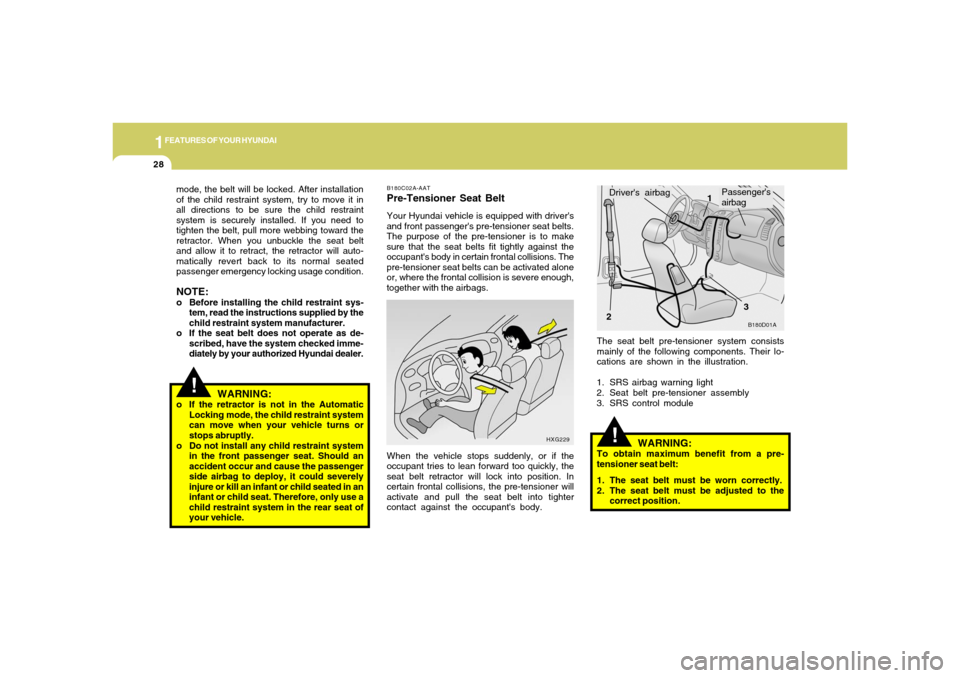
The seat belt pre-tensioner system consists
mainly of the following components. Their lo-
cations are shown in the illustration.
1. SRS airbag warning light
2. Seat belt pre-tensioner assembly
3. SRS control module
B180C02A-AATPre-Tensioner Seat BeltYour Hyundai vehicle is equipped with driver's
and front passenger's pre-tensioner seat belts.
The purpose of the pre-tensioner is to make
sure that the seat belts fit tightly against the
occupant's body in certain frontal collisions. The
pre-tensioner seat belts can be activated alone
or, where the frontal collision is severe enough,
together with the airbags.
When the vehicle stops suddenly, or if the
occupant tries to lean forward too quickly, the
seat belt retractor will lock into position. In
certain frontal collisions, the pre-tensioner will
activate and pull the seat belt into tighter
contact against the occupant's body.
Passenger's
airbag
HXG229B180D01A
Driver's airbag
1
23
WARNING:
To obtain maximum benefit from a pre-
tensioner seat belt:
1. The seat belt must be worn correctly.
2. The seat belt must be adjusted to the
correct position. mode, the belt will be locked. After installation
of the child restraint system, try to move it in
all directions to be sure the child restraint
system is securely installed. If you need to
tighten the belt, pull more webbing toward the
retractor. When you unbuckle the seat belt
and allow it to retract, the retractor will auto-
matically revert back to its normal seated
passenger emergency locking usage condition.
NOTE:o Before installing the child restraint sys-
tem, read the instructions supplied by the
child restraint system manufacturer.
o If the seat belt does not operate as de-
scribed, have the system checked imme-
diately by your authorized Hyundai dealer.
WARNING:
o If the retractor is not in the Automatic
Locking mode, the child restraint system
can move when your vehicle turns or
stops abruptly.
o Do not install any child restraint system
in the front passenger seat. Should an
accident occur and cause the passenger
side airbag to deploy, it could severely
injure or kill an infant or child seated in an
infant or child seat. Therefore, only use a
child restraint system in the rear seat of
your vehicle.
Page 41 of 219
1
FEATURES OF YOUR HYUNDAI
29
!
WARNING:
o Pre-tensioners are designed to operate
only one time. After activation, pre-
tensioner seat belts must be replaced. All
seat belts, of any type, should always be
replaced after they have been worn dur-
ing a collision.
o The pre-tensioner seat belt assembly
mechanisms become hot during activa-
tion. Do not touch the pre-tensioner seat
belt assemblies for several minutes after
they have been activated.
o Do not attempt to inspect or replace the
pre-tensioner seat belts yourself. This
must be done by an authorized Hyundai
dealer.
o Do not strike the pre-tensioner seat belt
assemblies.
o Do not attempt to service or repair the
pre-tensioner seat belt system in any
manner.
o Improper handling of the pre-tensioner
seat belt assemblies, and failure to heed
the warnings to not strike, modify, in-
spect, replace, service or repair the pre-
tensioner seat belt assemblies may lead
to improper operation or inadvertent acti-
vation and serious injury.
o Always wear the seat belts when driving
or riding in a motor vehicle.
CAUTION:
o Because the sensor that activates the
SRS airbag is connected with the pre-
tensioner seat belt, the SRS airbag warn-
ing light on the instrument panel will
blink for approximately 6 seconds after
the ignition key has been turned to the
"ON" position, and then it should turn
off.
o If the pre-tensioner seat belt is not
working properly, this warning light
will illuminate even if there is no mal-
function of the SRS airbag system.
If the SRS airbag warning light does not
illuminate when the ignition key is turned
to "ON", or if it remains illuminated after
blinking for approximately 6 seconds, or
if it illuminates while the vehicle is being
driven, please have an authorized Hyundai
dealer inspect the pre-tensioner seat
belts and SRS airbag system as soon as
possible.
!
NOTE:o Both the driver's and front passenger's
pre-tensioner seat belts will be activated
in certain frontal collisions. The pre-
tensioner seat belts can be activated
alone or, where the frontal collision is
severe enough, together with the
airbags.
The pre-tensioners will not be acti-
vated if the seat belts are not being
worn at the time of the collision.
o When the pre-tensioner seat belts are
activated, a loud noise may be heard and
fine dust, which may appear to be smoke,
may be visible in the passenger compart-
ment. These are normal operating condi-
tions and are not hazardous.
o Although it is harmless, the fine dust may
cause skin irritation and should not be
breathed for prolonged periods. Wash
your hands and face thoroughly after an
accident in which the pre-tensioner seat
belts were activated.
Page 42 of 219
1FEATURES OF YOUR HYUNDAI30
DUAL-STAGE SUPPLEMENTAL
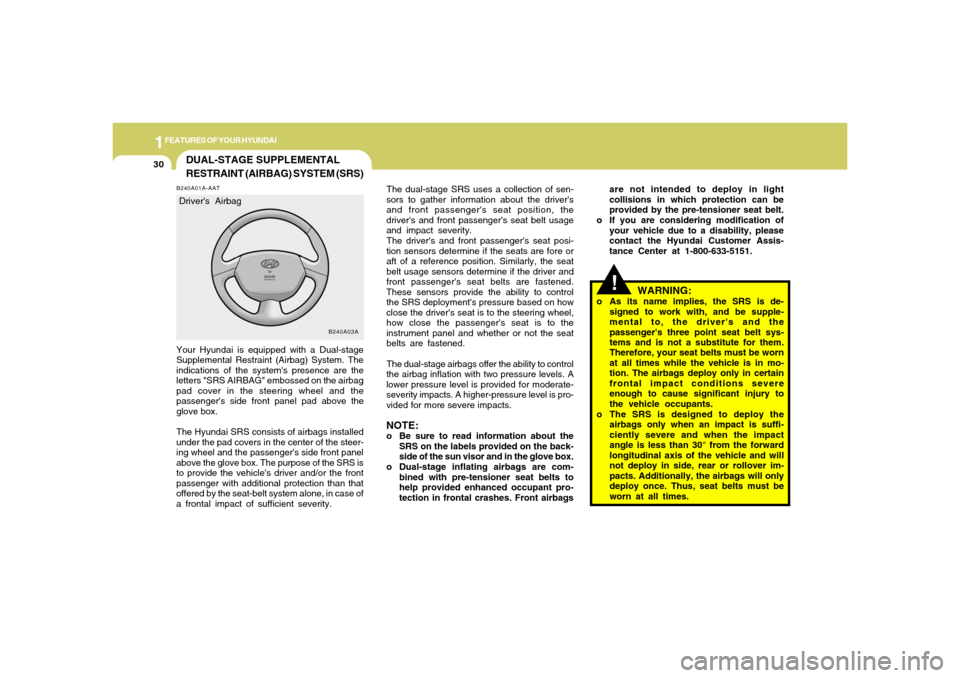
RESTRAINT (AIRBAG) SYSTEM (SRS)B240A01A-AATYour Hyundai is equipped with a Dual-stage
Supplemental Restraint (Airbag) System. The
indications of the system's presence are the
letters "SRS AIRBAG" embossed on the airbag
pad cover in the steering wheel and the
passenger's side front panel pad above the
glove box.
The Hyundai SRS consists of airbags installed
under the pad covers in the center of the steer-
ing wheel and the passenger's side front panel
above the glove box. The purpose of the SRS is
to provide the vehicle's driver and/or the front
passenger with additional protection than that
offered by the seat-belt system alone, in case of
a frontal impact of sufficient severity.
B240A03A
Driver's AirbagThe dual-stage SRS uses a collection of sen-
sors to gather information about the driver's
and front passenger's seat position, the
driver's and front passenger's seat belt usage
and impact severity.
The driver's and front passenger's seat posi-
tion sensors determine if the seats are fore or
aft of a reference position. Similarly, the seat
belt usage sensors determine if the driver and
front passenger's seat belts are fastened.
These sensors provide the ability to control
the SRS deployment's pressure based on how
close the driver's seat is to the steering wheel,
how close the passenger's seat is to the
instrument panel and whether or not the seat
belts are fastened.
The dual-stage airbags offer the ability to control
the airbag inflation with two pressure levels. A
lower pressure level is provided for moderate-
severity impacts. A higher-pressure level is pro-
vided for more severe impacts.
NOTE:o Be sure to read information about the
SRS on the labels provided on the back-
side of the sun visor and in the glove box.
o Dual-stage inflating airbags are com-
bined with pre-tensioner seat belts to
help provided enhanced occupant pro-
tection in frontal crashes. Front airbags
WARNING:
o As its name implies, the SRS is de-
signed to work with, and be supple-
mental to, the driver's and the
passenger's three point seat belt sys-
tems and is not a substitute for them.
Therefore, your seat belts must be worn
at all times while the vehicle is in mo-
tion. The airbags deploy only in certain
frontal impact conditions severe
enough to cause significant injury to
the vehicle occupants.
o The SRS is designed to deploy the
airbags only when an impact is suffi-
ciently severe and when the impact
angle is less than 30° from the forward
longitudinal axis of the vehicle and will
not deploy in side, rear or rollover im-
pacts. Additionally, the airbags will only
deploy once. Thus, seat belts must be
worn at all times.
!are not intended to deploy in light
collisions in which protection can be
provided by the pre-tensioner seat belt.
o If you are considering modification of
your vehicle due to a disability, please
contact the Hyundai Customer Assis-
tance Center at 1-800-633-5151.
Page 43 of 219
1
FEATURES OF YOUR HYUNDAI
31
WARNING:
o No objects should be placed over or
near the airbag modules on the steer-
ing wheel, instrument panel, and the
front passenger's panel above the glove
box, because any such object could
cause harm if the vehicle is in a crash
severe enough to cause the airbags to
deploy.
o If the airbags deploy, they must be
replaced by an authorized Hyundai
dealer.
o Do not tamper with or disconnect SRS
wiring, or other components of the SRS
system. Doing so could result in injury,
due to accidental firing of the airbags
or by rendering the SRS inoperative.
o Do not install a child restraint system in
the front passenger seat position. A
child restraint system must never be
placed in the front seat. The infant or
child could be severely injured or killed
by an airbag deployment in case of an
accident.
o Do not allow children to ride in the front
passenger seat. If older children (teen-
agers and older) must ride in the front
seat, make sure they are always prop-
erly belted and that the seat is moved
back as far as possible.
WARNING:
o For maximum safety protection in all
types of crashes, all occupants includ-
ing the driver should always wear their
seat belts whether or not an airbag is
also provided at their seating position
to minimize the risk of severe injury or
death in the event of a crash. Do not sit
or lean unnecessarily close to the airbag
while the vehicle is in motion.
o Sitting improperly or out of position
can result in serious or fatal injury in a
crash. All occupants should sit upright
in their seats with their feet on the floor
until the vehicle is parked and the igni-
tion key is removed.
o The SRS airbag system must deploy
very rapidly to provide protection in a
crash. If an occupant is out of position
because of not wearing a seat belt, the
airbag may forcefully contact the occu-
pant causing serious or fatal injuries.
!
!
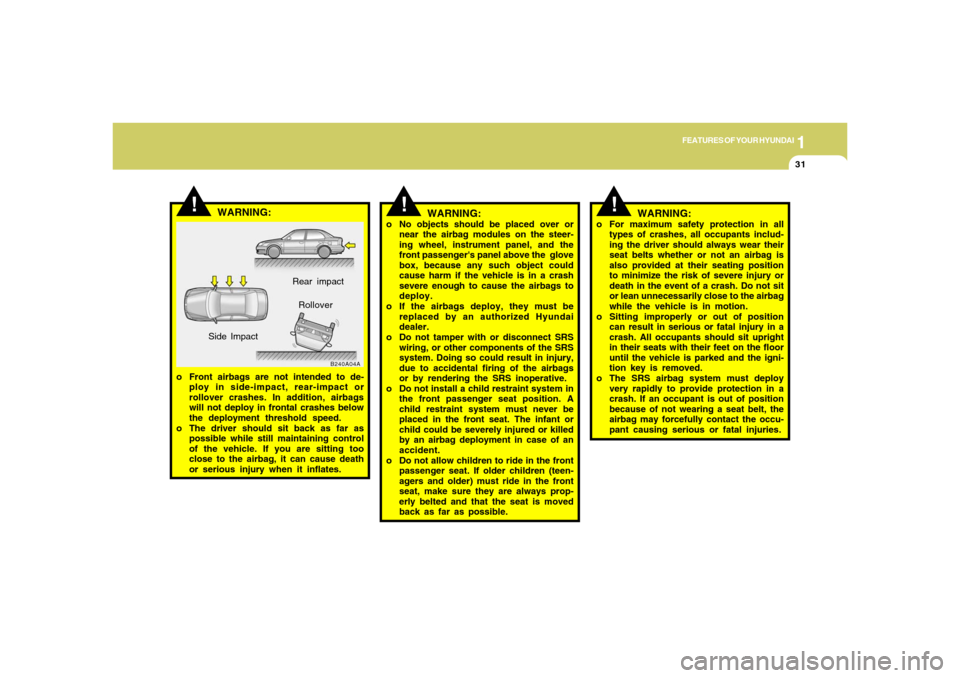
o Front airbags are not intended to de-
ploy in side-impact, rear-impact or
rollover crashes. In addition, airbags
will not deploy in frontal crashes below
the deployment threshold speed.
o The driver should sit back as far as
possible while still maintaining control
of the vehicle. If you are sitting too
close to the airbag, it can cause death
or serious injury when it inflates.
B240A04A
Rear impact
Side ImpactRollover
WARNING:
!
Page 45 of 219
1
FEATURES OF YOUR HYUNDAI
33
!
!
WARNING:
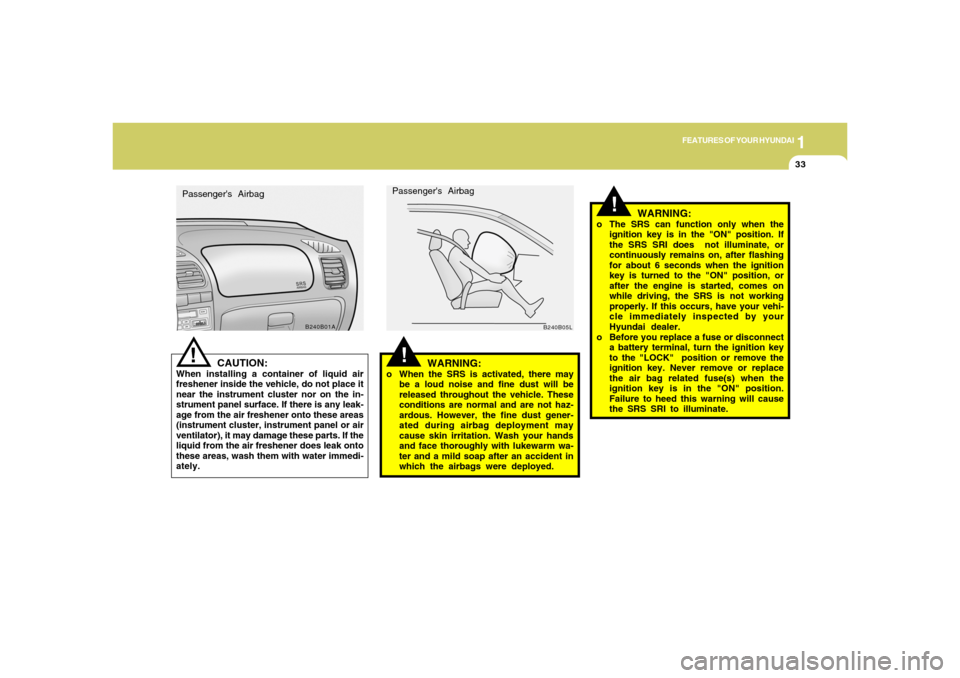
o When the SRS is activated, there may
be a loud noise and fine dust will be
released throughout the vehicle. These
conditions are normal and are not haz-
ardous. However, the fine dust gener-
ated during airbag deployment may
cause skin irritation. Wash your hands
and face thoroughly with lukewarm wa-
ter and a mild soap after an accident in
which the airbags were deployed. Passenger's Airbag
B240B05L
WARNING:
o The SRS can function only when the
ignition key is in the "ON" position. If
the SRS SRI does not illuminate, or
continuously remains on, after flashing
for about 6 seconds when the ignition
key is turned to the "ON" position, or
after the engine is started, comes on
while driving, the SRS is not working
properly. If this occurs, have your vehi-
cle immediately inspected by your
Hyundai dealer.
o Before you replace a fuse or disconnect
a battery terminal, turn the ignition key
to the "LOCK" position or remove the
ignition key. Never remove or replace
the air bag related fuse(s) when the
ignition key is in the "ON" position.
Failure to heed this warning will cause
the SRS SRI to illuminate.
CAUTION:
When installing a container of liquid air
freshener inside the vehicle, do not place it
near the instrument cluster nor on the in-
strument panel surface. If there is any leak-
age from the air freshener onto these areas
(instrument cluster, instrument panel or air
ventilator), it may damage these parts. If the
liquid from the air freshener does leak onto
these areas, wash them with water immedi-
ately.
!
B240B01A
Passenger's Airbag
Page 46 of 219
1FEATURES OF YOUR HYUNDAI34
!
!
WARNING:
o For best protection from the side im-
pact airbag system and to avoid being
injured by the deploying side impact
airbag, both front seat occupants
should sit in an upright position with
the seat belt properly fastened. The
driver's hands should be placed on the
steering wheel at the 9:00 and 3:00
o'clock positions.
The passenger's arms and hands should
be placed on their laps.
o Do not use any accessory seat covers.
o Use of seat covers could reduce or pre-
vent the effectiveness of the system.
o Do not install any accessories on the side
or near the side impact airbag.
o Do not use excessive force on the side of
the seat.
o Do not place any objects over the airbag
or between the airbag and yourself.
o Do not place any objects (an umbrella,
bag, etc.) between the front door and the
front seat. Such objects may become dan-
gerous projectiles and cause injury if the
supplemental side impact airbag inflates.
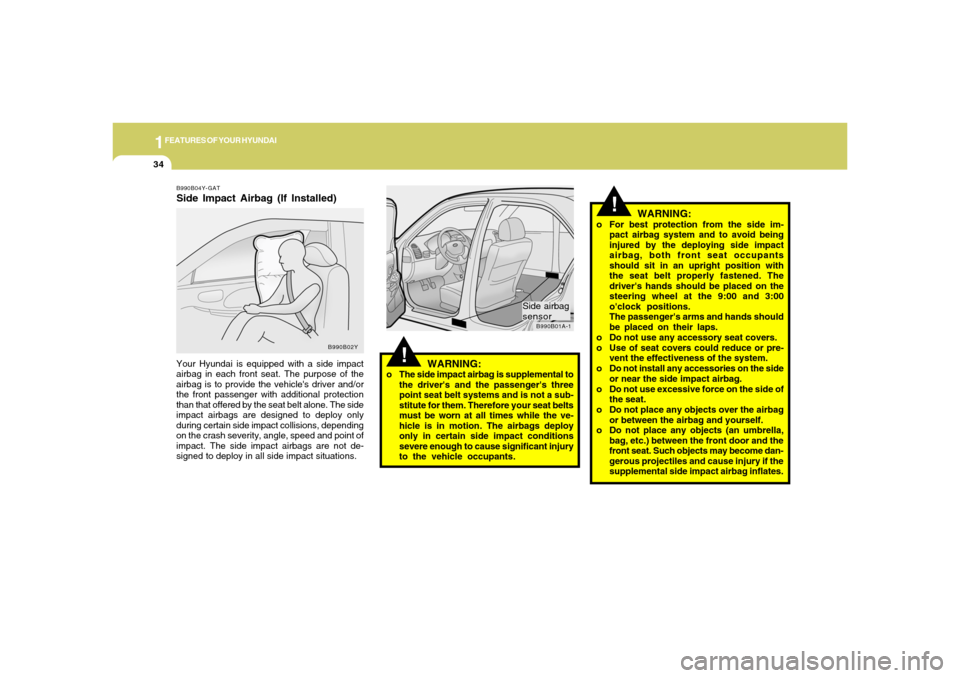
B990B01A-1
Side airbag
sensor
WARNING:
o The side impact airbag is supplemental to
the driver's and the passenger's three
point seat belt systems and is not a sub-
stitute for them. Therefore your seat belts
must be worn at all times while the ve-
hicle is in motion. The airbags deploy
only in certain side impact conditions
severe enough to cause significant injury
to the vehicle occupants.
B990B04Y-GATSide Impact Airbag (If Installed)Your Hyundai is equipped with a side impact
airbag in each front seat. The purpose of the
airbag is to provide the vehicle's driver and/or
the front passenger with additional protection
than that offered by the seat belt alone. The side
impact airbags are designed to deploy only
during certain side impact collisions, depending
on the crash severity, angle, speed and point of
impact. The side impact airbags are not de-
signed to deploy in all side impact situations.
B990B02Y
Page 47 of 219
1
FEATURES OF YOUR HYUNDAI
35
!
!
WARNING:
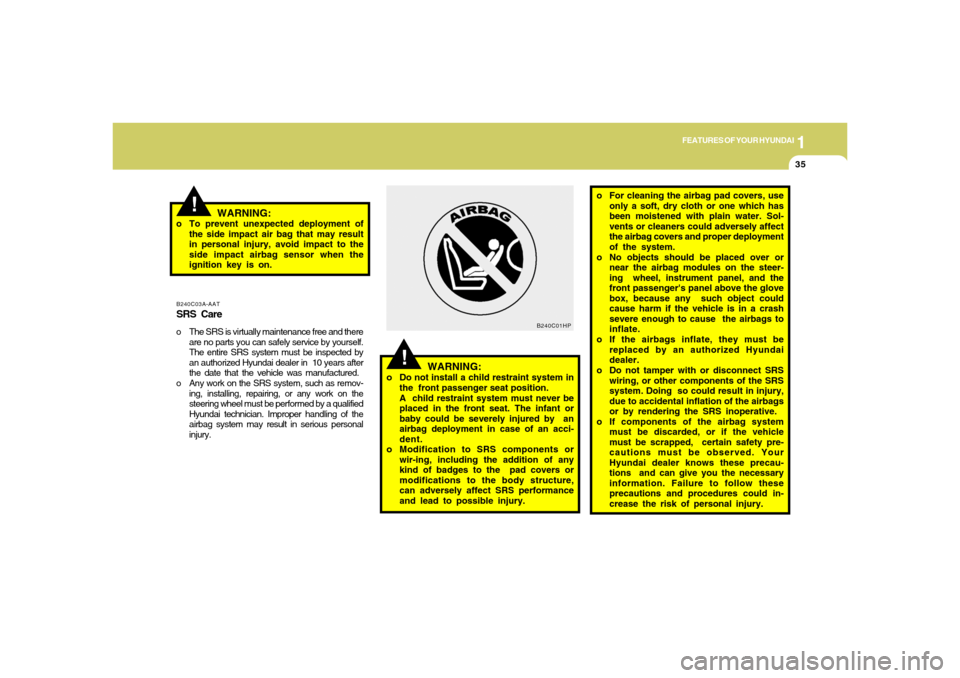
o Do not install a child restraint system in
the front passenger seat position.
A child restraint system must never be
placed in the front seat. The infant or
baby could be severely injured by an
airbag deployment in case of an acci-
dent.
o Modification to SRS components or
wir-ing, including the addition of any
kind of badges to the pad covers or
modifications to the body structure,
can adversely affect SRS performance
and lead to possible injury.
B240C03A-AATSRS Careo The SRS is virtually maintenance free and there
are no parts you can safely service by yourself.
The entire SRS system must be inspected by
an authorized Hyundai dealer in 10 years after
the date that the vehicle was manufactured.
o Any work on the SRS system, such as remov-
ing, installing, repairing, or any work on the
steering wheel must be performed by a qualified
Hyundai technician. Improper handling of the
airbag system may result in serious personal
injury.
B240C01HP
o To prevent unexpected deployment of
the side impact air bag that may result
in personal injury, avoid impact to the
side impact airbag sensor when the
ignition key is on.
WARNING:
o For cleaning the airbag pad covers, use
only a soft, dry cloth or one which has
been moistened with plain water. Sol-
vents or cleaners could adversely affect
the airbag covers and proper deployment
of the system.
o No objects should be placed over or
near the airbag modules on the steer-
ing wheel, instrument panel, and the
front passenger's panel above the glove
box, because any such object could
cause harm if the vehicle is in a crash
severe enough to cause the airbags to
inflate.
o If the airbags inflate, they must be
replaced by an authorized Hyundai
dealer.
o Do not tamper with or disconnect SRS
wiring, or other components of the SRS
system. Doing so could result in injury,
due to accidental inflation of the airbags
or by rendering the SRS inoperative.
o If components of the airbag system
must be discarded, or if the vehicle
must be scrapped, certain safety pre-
cautions must be observed. Your
Hyundai dealer knows these precau-
tions and can give you the necessary
information. Failure to follow these
precautions and procedures could in-
crease the risk of personal injury.