ECU Hyundai Accent 2005 Owner's Manual
[x] Cancel search | Manufacturer: HYUNDAI, Model Year: 2005, Model line: Accent, Model: Hyundai Accent 2005Pages: 219, PDF Size: 7.07 MB
Page 16 of 219
1FEATURES OF YOUR HYUNDAI4
DOOR LOCKS!
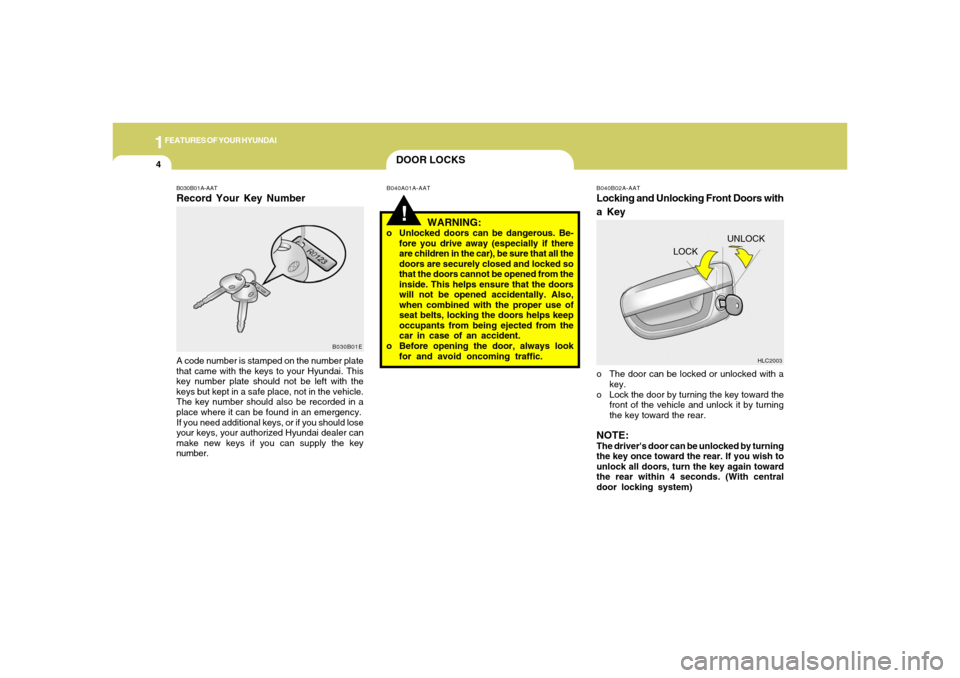
B030B01A-AATRecord Your Key NumberA code number is stamped on the number plate
that came with the keys to your Hyundai. This
key number plate should not be left with the
keys but kept in a safe place, not in the vehicle.
The key number should also be recorded in a
place where it can be found in an emergency.
If you need additional keys, or if you should lose
your keys, your authorized Hyundai dealer can
make new keys if you can supply the key
number.
B030B01EB040A01A-AAT B040B02A-AAT
Locking and Unlocking Front Doors with
a Keyo The door can be locked or unlocked with a
key.
o Lock the door by turning the key toward the
front of the vehicle and unlock it by turning
the key toward the rear.NOTE:The driver's door can be unlocked by turning
the key once toward the rear. If you wish to
unlock all doors, turn the key again toward
the rear within 4 seconds. (With central
door locking system)
WARNING:
o Unlocked doors can be dangerous. Be-
fore you drive away (especially if there
are children in the car), be sure that all the
doors are securely closed and locked so
that the doors cannot be opened from the
inside. This helps ensure that the doors
will not be opened accidentally. Also,
when combined with the proper use of
seat belts, locking the doors helps keep
occupants from being ejected from the
car in case of an accident.
o Before opening the door, always look
for and avoid oncoming traffic.UNLOCK
HLC2003
LOCK
Page 23 of 219

1
FEATURES OF YOUR HYUNDAI
11
ADJUSTABLE FRONT SEATS!
B080C01A-AATAdjusting Seatback AngleTo recline the seatback, lean forward to take
your weight off it, then pull up on the recliner
control lever at the outside edge of the seat.
Now lean back until the desired seatback angle
is achieved. To lock the seatback into position,
release the recliner control lever.
B080A01A-AAT
To move the seat toward the front or rear, pull
the lock release lever upward. This will release
the seat on its track so you can move it forward
or rearward to the desired position.
When you find the position you want, release
the lever and slide the seat forward or rear-
ward on its track until it locks into the desired
position and cannot be moved further.B080B02A-AATAdjusting Seat Forward and Rearward
WARNING:
Never attempt to adjust the seat while the
vehicle is moving. This could result in loss
of control, or an accident which may cause
death, serious injury, or property damage.
HLC2026HLC2027
!
WARNING:
To ensure the seat is locked securely, at-
tempt to move the seat forward or rearward
without using the lock release lever.
Page 29 of 219
1
FEATURES OF YOUR HYUNDAI
17
!
B150E01A-AATInjured PersonA seat belt should be used when an injured
person is being transported. When this is nec-
essary, you should consult a physician for rec-
ommendations.B150F01A-AATOne Person Per BeltTwo people (including children) should never
attempt to use a single seat belt. This could
increase the severity of injuries in case of an
accident.B150G01A-AATDo Not Lie DownTo reduce the chance of injuries in the event
of an accident and to achieve maximum effec-
tiveness of the restraint system, all passen-
gers should be sitting up and the front seats
should be in an upright position when the car
is moving. A seat belt cannot provide proper
protection if the person is lying down in the rear
seat or if the front seat is in a reclined position.
WARNING:
Sitting in a reclined position or lying down
when your vehicle is in motion can be danger-
ous. Even if you buckle up, your seat belts
can't do their job when you're reclined. The
shoulder belt can't do its job because it won't
be against your body. Instead, it will be in
front of you. In a crash you could go into it
with great force, receiving serious neck or
other injuries. The lap belt can't do its job
either. In a crash the belt could go up over
your abdomen. The belt forces would be there,
not at your strong pelvic bones. This could
cause serious internal injuries.
For proper protection when the vehicle is in
motion, have the seatback upright. Then sit
back in the seat and wear your seat belt
properly. See Page 1-19.
B150D01A-AATPregnant WomenThe use of a seat belt is recommended for
pregnant women to lessen the chance of injury
in an accident. When a seat belt is used, the lap
belt portion should be placed as low and snugly
as possible on the hips, not across the abdo-
men. For specific recommendations, consult a
physician.B150C02A-AATLarger ChildrenChildren who are too large for child restraint
systems should always occupy the rear seat
and use the available lap/shoulder belts. The
lap portion should be fastened snug on the
hips and as low as possible. Check belt fit
periodically. A child's squirming could put the
belt out of position. Children are afforded the
most safety in the event of an accident when
they are restrained by a proper restraint sys-
tem in the rear seat. If a larger child (over age
13) must be seated in the front seat, the child
should be securely restrained by the available
lap/shoulder belt and the seat should be placed
in the rearmost position. Children under the
age of 13 should be restrained securely in the
rear seat. NEVER place a child under the age
of 13 in the front seat. NEVER place a rear
facing child seat in the front seat of a vehicle.
Page 31 of 219
1
FEATURES OF YOUR HYUNDAI
19
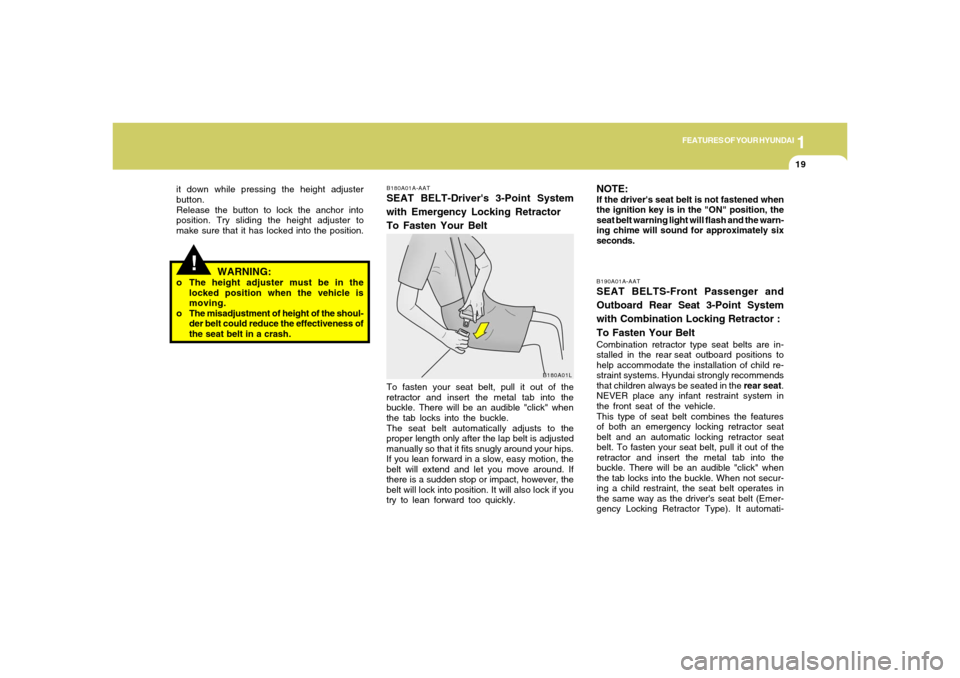
To fasten your seat belt, pull it out of the
retractor and insert the metal tab into the
buckle. There will be an audible "click" when
the tab locks into the buckle.
The seat belt automatically adjusts to the
proper length only after the lap belt is adjusted
manually so that it fits snugly around your hips.
If you lean forward in a slow, easy motion, the
belt will extend and let you move around. If
there is a sudden stop or impact, however, the
belt will lock into position. It will also lock if you
try to lean forward too quickly.
B190A01A-AATSEAT BELTS-Front Passenger and
Outboard Rear Seat 3-Point System
with Combination Locking Retractor :
To Fasten Your BeltCombination retractor type seat belts are in-
stalled in the rear seat outboard positions to
help accommodate the installation of child re-
straint systems. Hyundai strongly recommends
that children always be seated in the rear seat.
NEVER place any infant restraint system in
the front seat of the vehicle.
This type of seat belt combines the features
of both an emergency locking retractor seat
belt and an automatic locking retractor seat
belt. To fasten your seat belt, pull it out of the
retractor and insert the metal tab into the
buckle. There will be an audible "click" when
the tab locks into the buckle. When not secur-
ing a child restraint, the seat belt operates in
the same way as the driver's seat belt (Emer-
gency Locking Retractor Type). It automati-
!
B180A01A-AATSEAT BELT-Driver's 3-Point System
with Emergency Locking Retractor
To Fasten Your Belt
WARNING:
o The height adjuster must be in the
locked position when the vehicle is
moving.
o The misadjustment of height of the shoul-
der belt could reduce the effectiveness of
the seat belt in a crash.
B180A01L
it down while pressing the height adjuster
button.
Release the button to lock the anchor into
position. Try sliding the height adjuster to
make sure that it has locked into the position.
NOTE:If the driver's seat belt is not fastened when
the ignition key is in the "ON" position, the
seat belt warning light will flash and the warn-
ing chime will sound for approximately six
seconds.
Page 34 of 219
1FEATURES OF YOUR HYUNDAI22
CHILD RESTRAINT SYSTEM
!
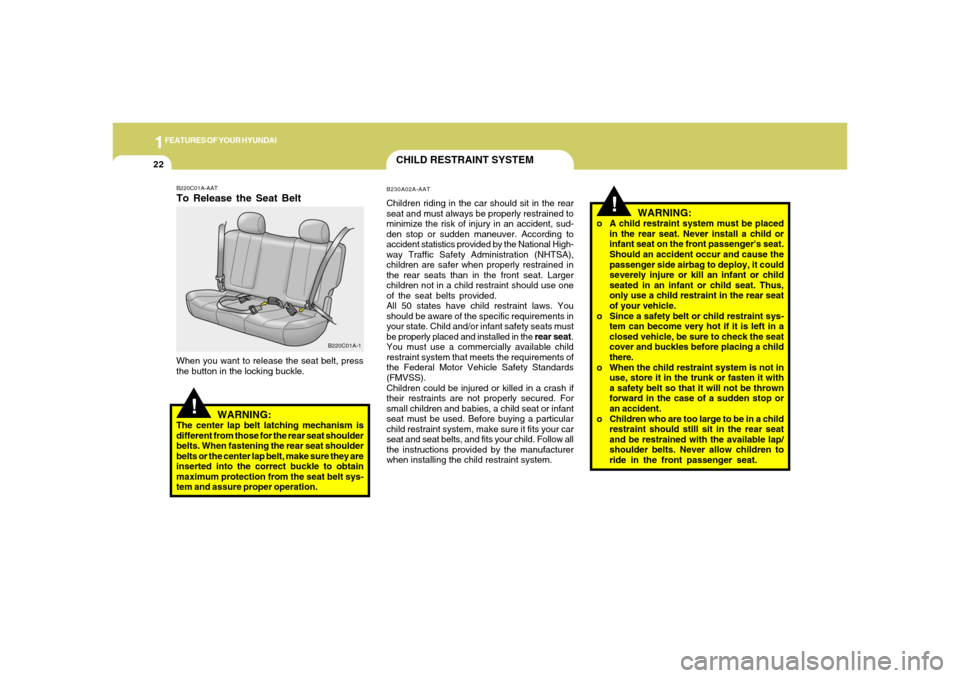
B220C01A-AATTo Release the Seat BeltWhen you want to release the seat belt, press
the button in the locking buckle.
B220C01A-1
WARNING:
The center lap belt latching mechanism is
different from those for the rear seat shoulder
belts. When fastening the rear seat shoulder
belts or the center lap belt, make sure they are
inserted into the correct buckle to obtain
maximum protection from the seat belt sys-
tem and assure proper operation.
B230A02A-AATChildren riding in the car should sit in the rear
seat and must always be properly restrained to
minimize the risk of injury in an accident, sud-
den stop or sudden maneuver. According to
accident statistics provided by the National High-
way Traffic Safety Administration (NHTSA),
children are safer when properly restrained in
the rear seats than in the front seat. Larger
children not in a child restraint should use one
of the seat belts provided.
All 50 states have child restraint laws. You
should be aware of the specific requirements in
your state. Child and/or infant safety seats must
be properly placed and installed in the rear seat.
You must use a commercially available child
restraint system that meets the requirements of
the Federal Motor Vehicle Safety Standards
(FMVSS).
Children could be injured or killed in a crash if
their restraints are not properly secured. For
small children and babies, a child seat or infant
seat must be used. Before buying a particular
child restraint system, make sure it fits your car
seat and seat belts, and fits your child. Follow all
the instructions provided by the manufacturer
when installing the child restraint system.
WARNING:
o A child restraint system must be placed
in the rear seat. Never install a child or
infant seat on the front passenger's seat.
Should an accident occur and cause the
passenger side airbag to deploy, it could
severely injure or kill an infant or child
seated in an infant or child seat. Thus,
only use a child restraint in the rear seat
of your vehicle.
o Since a safety belt or child restraint sys-
tem can become very hot if it is left in a
closed vehicle, be sure to check the seat
cover and buckles before placing a child
there.
o When the child restraint system is not in
use, store it in the trunk or fasten it with
a safety belt so that it will not be thrown
forward in the case of a sudden stop or
an accident.
o Children who are too large to be in a child
restraint should still sit in the rear seat
and be restrained with the available lap/
shoulder belts. Never allow children to
ride in the front passenger seat.
!
Page 35 of 219
1
FEATURES OF YOUR HYUNDAI
23
B230B01E-AATUsing a Child Restraint System with
the "Tether Anchorage" SystemFor small children and babies, the use of a
child seat or infant seat is required. This child
seat or infant seat should be of appropriate
size for the child and should be installed in
accordance with the manufacturer's instruc-
tions. It is further required that the seat be
placed in the vehicle's rear seat since this can
make an important contribution to safety. Your
vehicle is provided with three child restraint
hook holders for installing the child seat or
infant seat.
!
WARNING:
o Always make sure that the shoulder
belt portion of the outboard lap/shoul-
der belt is positioned midway over the
shoulder, never across the neck or be-
hind the back. Moving the child closer
to the center of the vehicle may help
provide a good shoulder belt fit. The
lap belt portion of the lap/shoulder belt
or the center seat lap belt must always
be positioned as low as possible on the
child's hips and as snug as possible.
o If the seat belt will not properly fit the
child, Hyundai recommends the use of
an approved booster seat in the rear
seat in order to raise the child's seating
height so that the seat belt will properly
fit the child. Before purchasing a
booster seat, make sure that it meets
applicable Federal Motor Vehicle Safety
Standards (FMVSS) and that it is satis-
factory for use with this vehicle.
o Never allow a child to stand up or kneel
on the seat.
o Never use an infant carrier or child safety
seat that "hooks" over a seatback; it may
not provide adequate security in an acci-
dent.
WARNING:
o Never allow a child to be held in a
person's arms while they are in a mov-
ing vehicle, as this could result in seri-
ous injury to the child in the event of an
accident or a sudden stop. Holding a
child in a moving vehicle does not pro-
vide the child with any means of protec-
tion during an accident, even if the per-
son holding the child is wearing a seat
belt.
!
B230C04A-AATInstalling a Child Restraint Seat with
the "Tether Anchorage" System
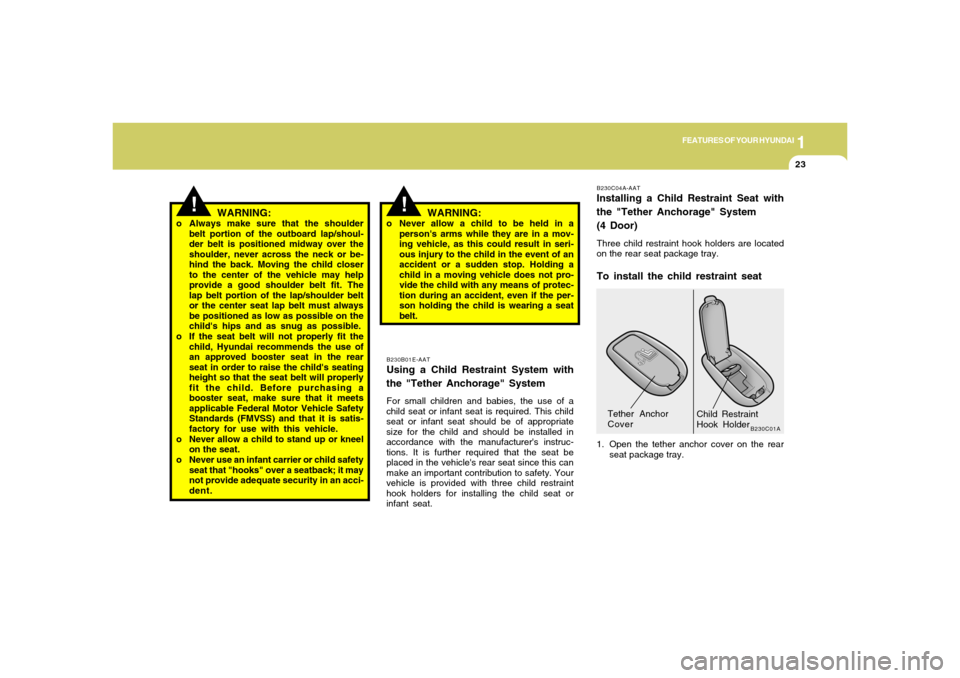
(4 Door)Three child restraint hook holders are located
on the rear seat package tray.To install the child restraint seat
B230C01A
1. Open the tether anchor cover on the rear
seat package tray.Tether Anchor
CoverChild Restraint
Hook Holder
Page 36 of 219
1FEATURES OF YOUR HYUNDAI24
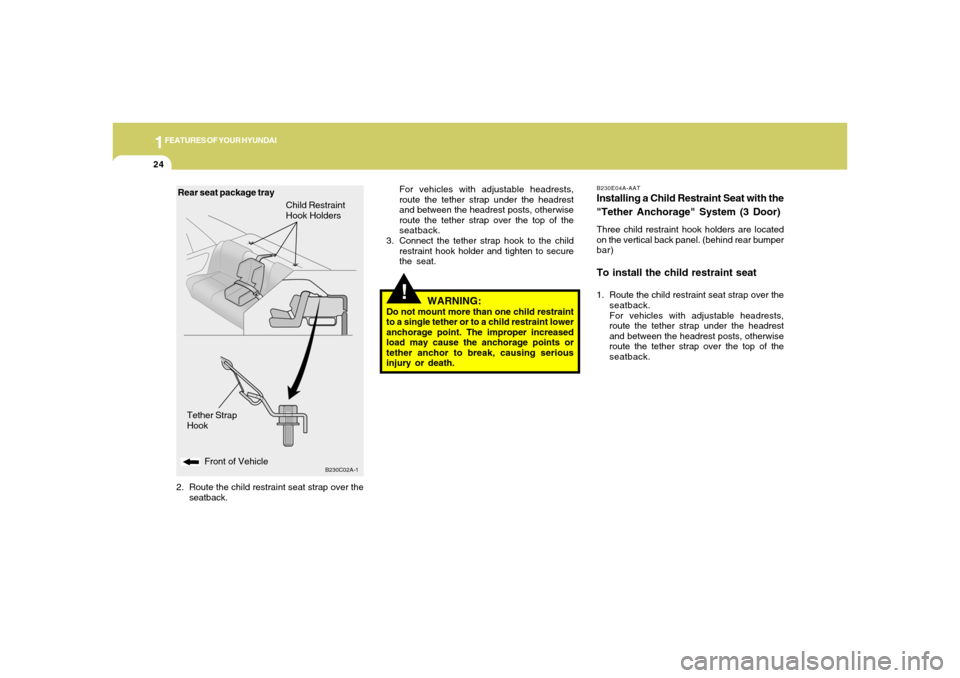
B230E04A-AATInstalling a Child Restraint Seat with the
"Tether Anchorage" System (3 Door)Three child restraint hook holders are located
on the vertical back panel. (behind rear bumper
bar)To install the child restraint seat1. Route the child restraint seat strap over the
seatback.
For vehicles with adjustable headrests,
route the tether strap under the headrest
and between the headrest posts, otherwise
route the tether strap over the top of the
seatback.
2. Route the child restraint seat strap over the
seatback.
B230C02A-1
Front of Vehicle
Tether Strap
HookChild Restraint
Hook HoldersRear seat package tray
!For vehicles with adjustable headrests,
route the tether strap under the headrest
and between the headrest posts, otherwise
route the tether strap over the top of the
seatback.
3. Connect the tether strap hook to the child
restraint hook holder and tighten to secure
the seat.
WARNING:
Do not mount more than one child restraint
to a single tether or to a child restraint lower
anchorage point. The improper increased
load may cause the anchorage points or
tether anchor to break, causing serious
injury or death.
Page 37 of 219
1
FEATURES OF YOUR HYUNDAI
25
!
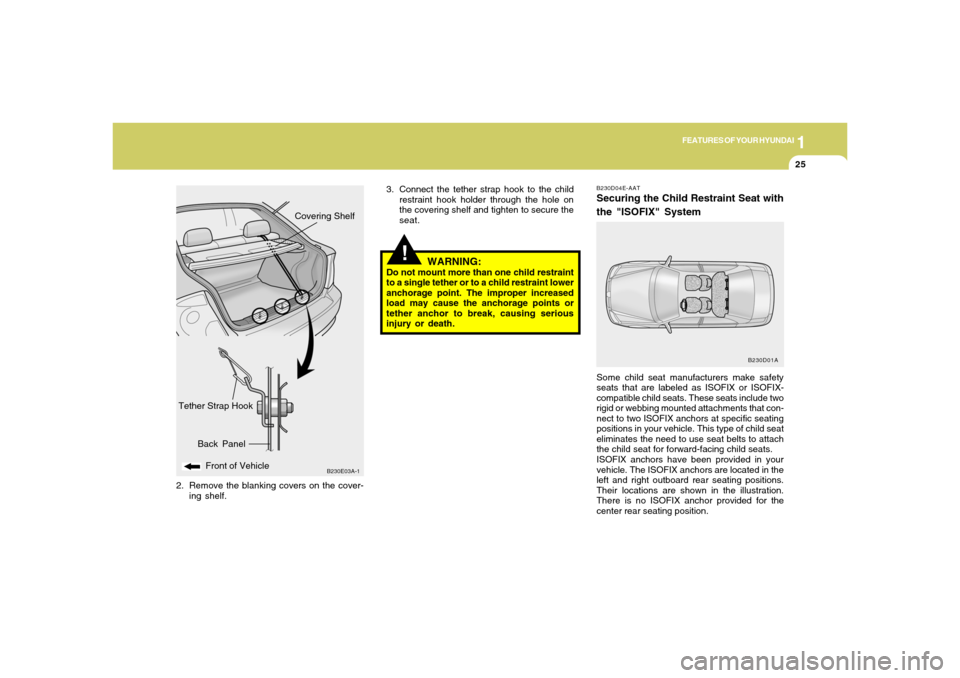
Tether Strap Hook
B230E03A-1
Front of VehicleBack PanelCovering Shelf
3. Connect the tether strap hook to the child
restraint hook holder through the hole on
the covering shelf and tighten to secure the
seat.
WARNING:
Do not mount more than one child restraint
to a single tether or to a child restraint lower
anchorage point. The improper increased
load may cause the anchorage points or
tether anchor to break, causing serious
injury or death.
2. Remove the blanking covers on the cover-
ing shelf.
B230D04E-AATSecuring the Child Restraint Seat with
the "ISOFIX" SystemSome child seat manufacturers make safety
seats that are labeled as ISOFIX or ISOFIX-
compatible child seats. These seats include two
rigid or webbing mounted attachments that con-
nect to two ISOFIX anchors at specific seating
positions in your vehicle. This type of child seat
eliminates the need to use seat belts to attach
the child seat for forward-facing child seats.
ISOFIX anchors have been provided in your
vehicle. The ISOFIX anchors are located in the
left and right outboard rear seating positions.
Their locations are shown in the illustration.
There is no ISOFIX anchor provided for the
center rear seating position.
B230D01A
Page 38 of 219
1FEATURES OF YOUR HYUNDAI26
!
WARNING:
o Do not install a child restraint seat at
the center of the rear seat using the
vehicle's ISOFIX anchors. The ISOFIX
anchors are only provided for the left
and right outboard rear seating posi-
tions. Do not misuse the ISOFIX an-
chors by attempting to attach a child
restraint seat improperly in the middle
of the reat seat position to the ISOFIX
anchors. In a crash, the child seat ISOFIX
attachments may not be strong enough
to secure the child restraint seat prop-
erly in the center of the rear seat and
may break, causing serious injury or
death.
o When using the vehicle’s “ISOFIX” sys-
tem to install a child restraint system in
the rear seat, all unused vehicle rear
seat belt metal latch plates or tabs must
be latched securely in their seat belt
buckles and the seat belt webbing must
be retracted behind the child restraint
to prevent the child from reaching and
taking hold of unretracted seat belts.
Unlatched metal latch plates or tabs
may allow the child to reach the
unretracted seat belts which may result
in strangulation and a serious injury or
death to the child in the child restraint.
!
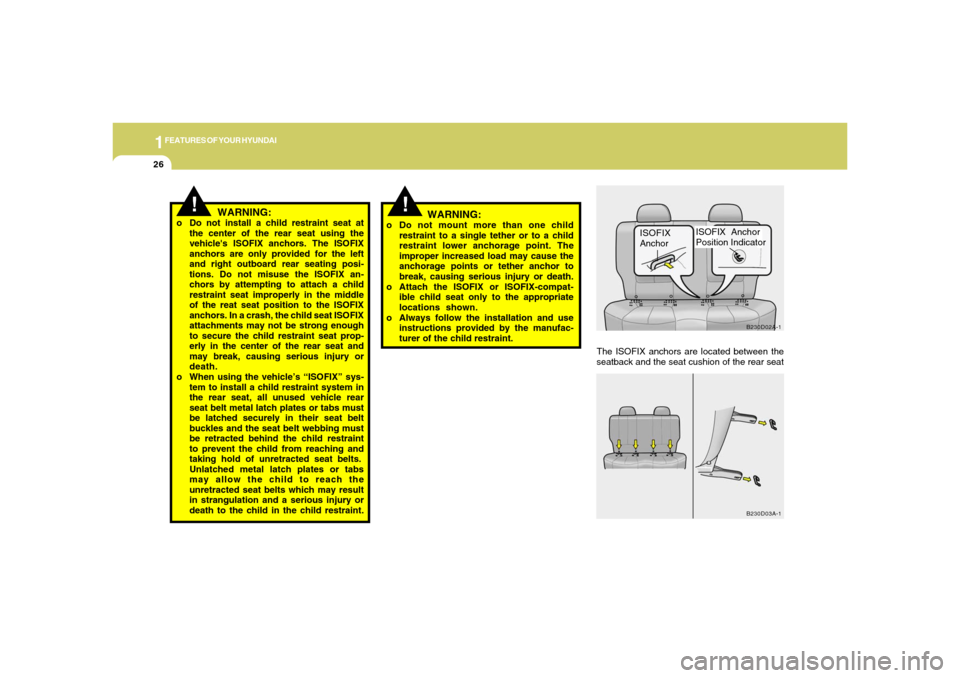
The ISOFIX anchors are located between the
seatback and the seat cushion of the rear seat
B230D02A-1
ISOFIX
Anchor
ISOFIX Anchor
Position Indicator
B230D03A-1
WARNING:
o Do not mount more than one child
restraint to a single tether or to a child
restraint lower anchorage point. The
improper increased load may cause the
anchorage points or tether anchor to
break, causing serious injury or death.
o Attach the ISOFIX or ISOFIX-compat-
ible child seat only to the appropriate
locations shown.
o Always follow the installation and use
instructions provided by the manufac-
turer of the child restraint.
Page 39 of 219
1
FEATURES OF YOUR HYUNDAI
27
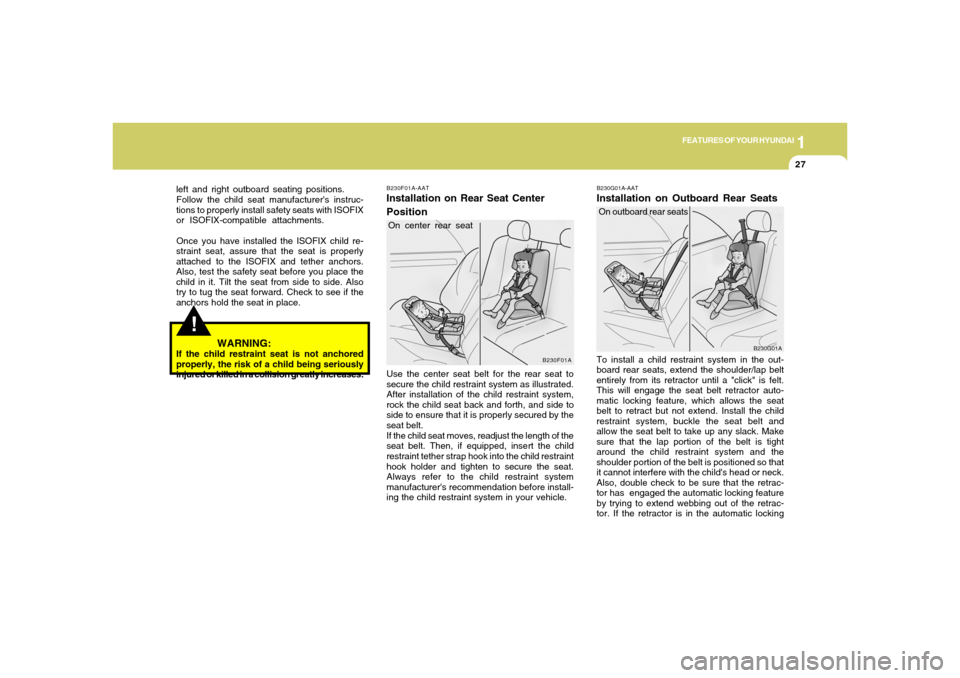
To install a child restraint system in the out-
board rear seats, extend the shoulder/lap belt
entirely from its retractor until a "click" is felt.
This will engage the seat belt retractor auto-
matic locking feature, which allows the seat
belt to retract but not extend. Install the child
restraint system, buckle the seat belt and
allow the seat belt to take up any slack. Make
sure that the lap portion of the belt is tight
around the child restraint system and the
shoulder portion of the belt is positioned so that
it cannot interfere with the child's head or neck.
Also, double check to be sure that the retrac-
tor has engaged the automatic locking feature
by trying to extend webbing out of the retrac-
tor. If the retractor is in the automatic lockingB230G01A-AATInstallation on Outboard Rear SeatsOn outboard rear seats
B230G01A B230F01A-AAT
Installation on Rear Seat Center
PositionUse the center seat belt for the rear seat to
secure the child restraint system as illustrated.
After installation of the child restraint system,
rock the child seat back and forth, and side to
side to ensure that it is properly secured by the
seat belt.
If the child seat moves, readjust the length of the
seat belt. Then, if equipped, insert the child
restraint tether strap hook into the child restraint
hook holder and tighten to secure the seat.
Always refer to the child restraint system
manufacturer's recommendation before install-
ing the child restraint system in your vehicle.
B230F01A
On center rear seat
left and right outboard seating positions.
Follow the child seat manufacturer's instruc-
tions to properly install safety seats with ISOFIX
or ISOFIX-compatible attachments.
Once you have installed the ISOFIX child re-
straint seat, assure that the seat is properly
attached to the ISOFIX and tether anchors.
Also, test the safety seat before you place the
child in it. Tilt the seat from side to side. Also
try to tug the seat forward. Check to see if the
anchors hold the seat in place.
WARNING:
If the child restraint seat is not anchored
properly, the risk of a child being seriously
injured or killed in a collision greatly increases.
!