Jack Hyundai Accent 2005 Owner's Manual
[x] Cancel search | Manufacturer: HYUNDAI, Model Year: 2005, Model line: Accent, Model: Hyundai Accent 2005Pages: 219, PDF Size: 7.07 MB
Page 118 of 219
2
DRIVING YOUR HYUNDAI
12
DRIVING FOR ECONOMY
!
WARNING:
ABS will not prevent accidents due to
improper or dangerous driving maneu-
vers. Even though vehicle control is im-
proved during emergency braking, always
maintain a safe distance between you and
objects ahead. Vehicle speeds should al-
ways be reduced during extreme road
conditions.
The braking distance for cars equipped
with an anti-lock braking system may be
longer than for those without it in the
following road conditions.
During these conditions the veicle should
be driven at reduced speeds.
o Rough, gravel or snow-covered roads.
o With tire chains installed.
o On roads where the road surface is
pitted or has different surface height.
These roads should be driven at reduced
speeds. The safety features of an ABS
equipped vehicle should not be tested by
high speed driving or cornering. This could
endanger the safety of yourself or others.
C140A01A-AATYou can save fuel and get more miles from
your car if you follow these suggestions:
o Drive smoothly. Accelerate at a moderate
rate. Don't make "jack-rabbit" starts or full-
throttle shifts and maintain a steady cruising
speed. Don't race between stoplights. Try to
adjust your speed to that of the other traffic
so you don't have to change speeds unnec-
essarily. Avoid heavy traffic whenever possi-
ble. Always maintain a safe distance from
other vehicles so you can avoid unneces-
sary braking. This also reduces brake wear.
o Drive at a moderate speed. The faster you
drive, the more fuel your car uses. Driving at
a moderate speed, especially on the high-
way, is one of the most effective ways to
reduce fuel consumption.
o Don't "ride" the brake or clutch pedal. This
can increase fuel consumption and also in-
crease wear on these components. In addi-
tion, driving with your foot resting on the
brake pedal may cause the brakes to over-
heat, which reduces their effectiveness and
may lead to more serious consequences.
o Take care of your tires. Keep them inflated to
the recommended pressure. Incorrect infla-
tion, either too much or too little, results in
unnecessary tire wear. Check the tire pres-
sures at least once a month.o Be sure that the wheels are aligned cor-
rectly. Improper alignment can result from
hitting curbs or driving too fast over irreg-
ular surfaces. Poor alignment causes faster
tire wear and may also result in other
problems as well as greater fuel consump-
tion.
o Keep your car in good condition. For better
fuel economy and reduced maintenance
costs, maintain your car in accordance with
the maintenance schedule in Section 5. If
you drive your car in severe conditions, more
frequent maintenance is required (see Sec-
tion 5 for details).
o Keep your car clean. For maximum service,
your Hyundai should be kept clean and free
of corrosive materials. It is especially impor-
tant that mud, dirt, ice, etc. not be allowed to
accumulate on the underside of the car. This
extra weight can result in increased fuel
consumption and also contribute to corro-
sion.
o Travel lightly. Don't carry unnecessary weight
in your car. Weight reduces fuel economy.
o Don't let the engine idle longer than neces-
sary. If you are waiting (and not in traffic),
turn off your engine and restart only when
you're ready to go.
Page 134 of 219
38WHAT TO DO IN AN EMERGENCY
HTB156
Flat tire
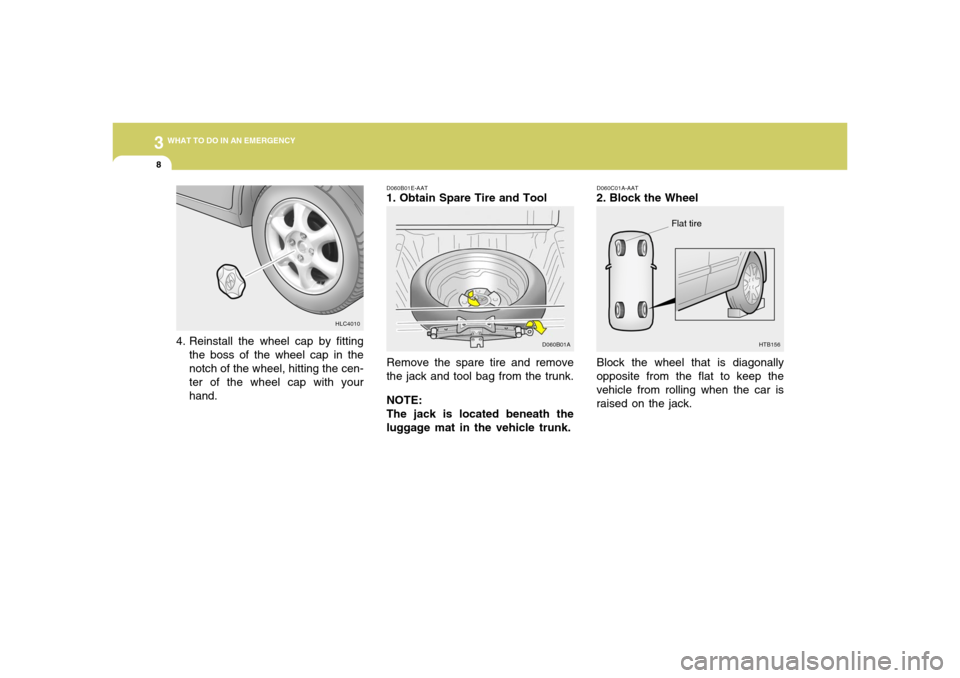
Block the wheel that is diagonally
opposite from the flat to keep the
vehicle from rolling when the car is
raised on the jack.D060C01A-AAT2. Block the Wheel
4. Reinstall the wheel cap by fitting
the boss of the wheel cap in the
notch of the wheel, hitting the cen-
ter of the wheel cap with your
hand.
HLC4010
Remove the spare tire and remove
the jack and tool bag from the trunk.
NOTE:
The jack is located beneath the
luggage mat in the vehicle trunk.D060B01E-AAT1. Obtain Spare Tire and Tool
D060B01A
Page 135 of 219
3
WHAT TO DO IN AN EMERGENCY
9
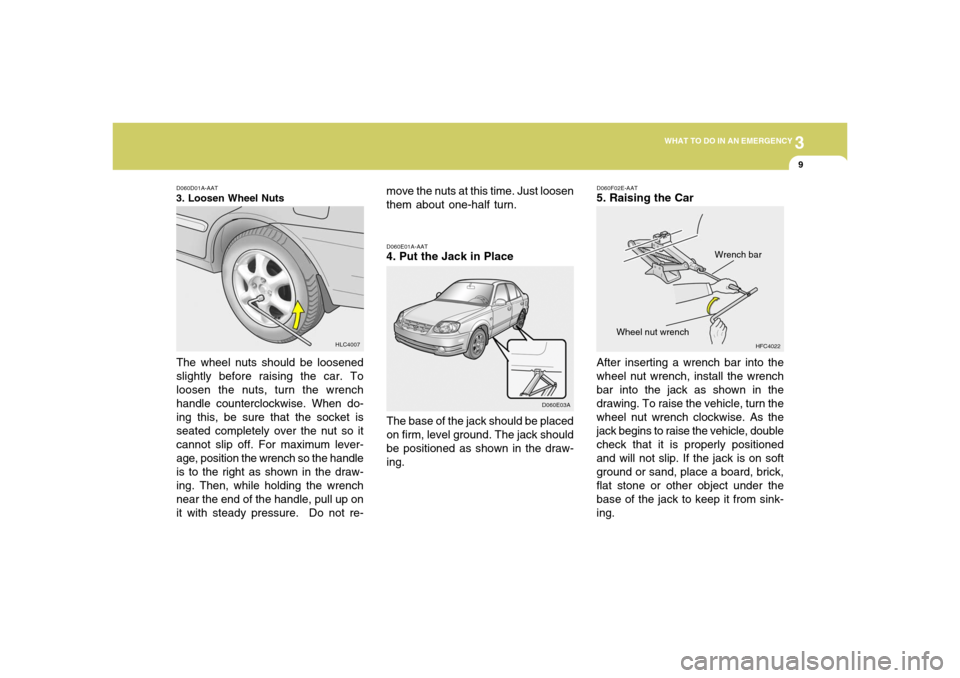
D060E01A-AAT4. Put the Jack in Place
The base of the jack should be placed
on firm, level ground. The jack should
be positioned as shown in the draw-
ing.
D060E03A
D060D01A-AAT3. Loosen Wheel NutsThe wheel nuts should be loosened
slightly before raising the car. To
loosen the nuts, turn the wrench
handle counterclockwise. When do-
ing this, be sure that the socket is
seated completely over the nut so it
cannot slip off. For maximum lever-
age, position the wrench so the handle
is to the right as shown in the draw-
ing. Then, while holding the wrench
near the end of the handle, pull up on
it with steady pressure. Do not re-
HLC4007
move the nuts at this time. Just loosen
them about one-half turn.
D060F02E-AAT5. Raising the Car
After inserting a wrench bar into the
wheel nut wrench, install the wrench
bar into the jack as shown in the
drawing. To raise the vehicle, turn the
wheel nut wrench clockwise. As the
jack begins to raise the vehicle, double
check that it is properly positioned
and will not slip. If the jack is on soft
ground or sand, place a board, brick,
flat stone or other object under the
base of the jack to keep it from sink-
ing.
Wrench bar
Wheel nut wrench
HFC4022
Page 136 of 219
310
WHAT TO DO IN AN EMERGENCY
!
Raise the car high enough so that the
fully inflated spare tire can be in-
stalled. To do this, you will need more
ground clearance than is required to
remove the flat tire.
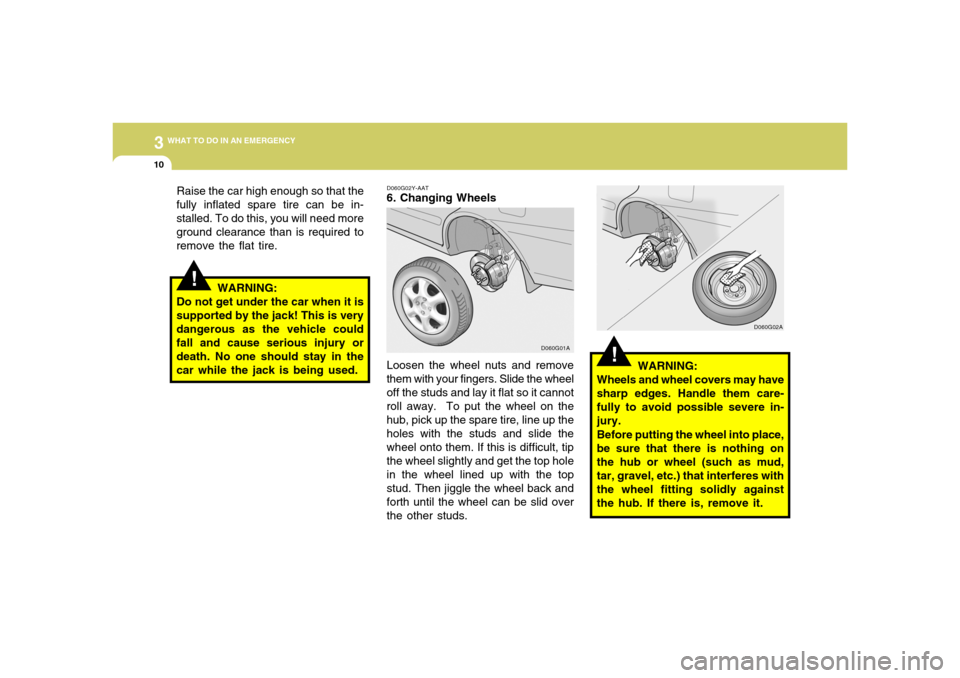
D060G02Y-AAT6. Changing Wheels
Loosen the wheel nuts and remove
them with your fingers. Slide the wheel
off the studs and lay it flat so it cannot
roll away. To put the wheel on the
hub, pick up the spare tire, line up the
holes with the studs and slide the
wheel onto them. If this is difficult, tip
the wheel slightly and get the top hole
in the wheel lined up with the top
stud. Then jiggle the wheel back and
forth until the wheel can be slid over
the other studs.
D060G01A
WARNING:
Do not get under the car when it is
supported by the jack! This is very
dangerous as the vehicle could
fall and cause serious injury or
death. No one should stay in the
car while the jack is being used.
!
WARNING:
Wheels and wheel covers may have
sharp edges. Handle them care-
fully to avoid possible severe in-
jury.
Before putting the wheel into place,
be sure that there is nothing on
the hub or wheel (such as mud,
tar, gravel, etc.) that interferes with
the wheel fitting solidly against
the hub. If there is, remove it.
D060G02A
Page 138 of 219
312
WHAT TO DO IN AN EMERGENCY
IF YOUR CAR MUST BE TOWED
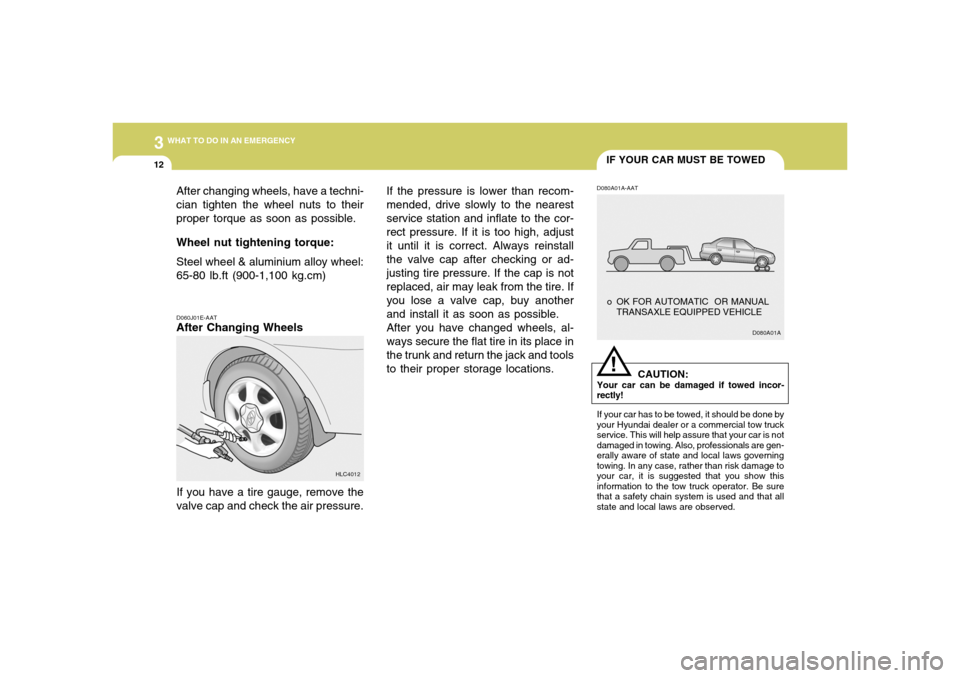
D060J01E-AATAfter Changing Wheels
If you have a tire gauge, remove the
valve cap and check the air pressure.
D080A01A-AAT
CAUTION:
Your car can be damaged if towed incor-
rectly!
HLC4012
If your car has to be towed, it should be done by
your Hyundai dealer or a commercial tow truck
service. This will help assure that your car is not
damaged in towing. Also, professionals are gen-
erally aware of state and local laws governing
towing. In any case, rather than risk damage to
your car, it is suggested that you show this
information to the tow truck operator. Be sure
that a safety chain system is used and that all
state and local laws are observed.
D080A01A
o OK FOR AUTOMATIC OR MANUAL
TRANSAXLE EQUIPPED VEHICLE!
After changing wheels, have a techni-
cian tighten the wheel nuts to their
proper torque as soon as possible.
Wheel nut tightening torque:
Steel wheel & aluminium alloy wheel:
65-80 lb.ft (900-1,100 kg.cm)If the pressure is lower than recom-
mended, drive slowly to the nearest
service station and inflate to the cor-
rect pressure. If it is too high, adjust
it until it is correct. Always reinstall
the valve cap after checking or ad-
justing tire pressure. If the cap is not
replaced, air may leak from the tire. If
you lose a valve cap, buy another
and install it as soon as possible.
After you have changed wheels, al-
ways secure the flat tire in its place in
the trunk and return the jack and tools
to their proper storage locations.
Page 178 of 219
6
DO-IT-YOURSELF MAINTENANCE
23
G240A01A-AATPOWER STEERING HOSESIt is suggested that you check the power steer-
ing hose connections for fluid leakage at those
intervals specified in the vehicle maintenance
schedule in Section 5.
The power steering hoses should be replaced if
there is severe surface cracking, pulling, scuff-
ing or worn spots. Deterioration of the hose
could cause premature failure.Recommended FluidUse PSF-3 type fluidNOTE:Do not start the engine when the power
steering oil reservoir is empty.
HEADLIGHT AIMING ADJUSTMENT
G250A01A-AATFOR MORE INFORMATION ABOUT
YOUR HYUNDAIIf you desire additional information about main-
taining and servicing your Hyundai, you may
purchase a factory Shop Manual at your Hyundai
dealer's parts department. This is the same
manual used by dealership technicians and while
it is highly technical it can be useful in obtaining
a better understanding of your car and how it
works.
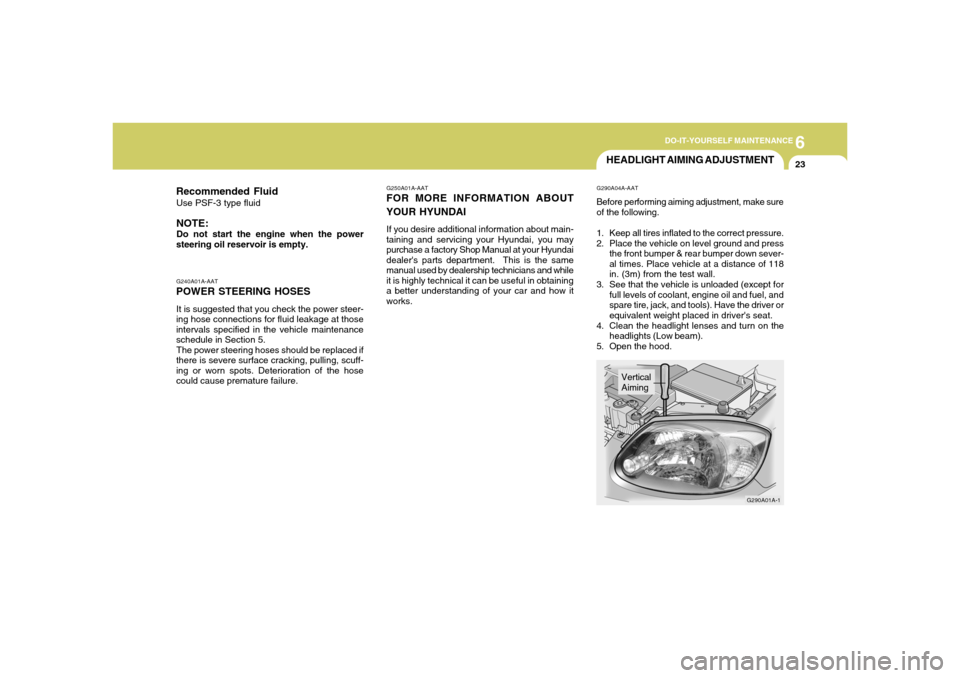
G290A04A-AATBefore performing aiming adjustment, make sure
of the following.
1. Keep all tires inflated to the correct pressure.
2. Place the vehicle on level ground and press
the front bumper & rear bumper down sever-
al times. Place vehicle at a distance of 118
in. (3m) from the test wall.
3. See that the vehicle is unloaded (except for
full levels of coolant, engine oil and fuel, and
spare tire, jack, and tools). Have the driver or
equivalent weight placed in driver's seat.
4. Clean the headlight lenses and turn on the
headlights (Low beam).
5. Open the hood.
G290A01A-1
Vertical
Aiming
Page 204 of 219
8
CONSUMER INFORMATION, REPORTING SAFETY DEFECTS & BINDING ARBITRATION OF WARRANTY CLAIMS
12
WARRANTIES FOR YOUR HYUNDAI
VEHICLE
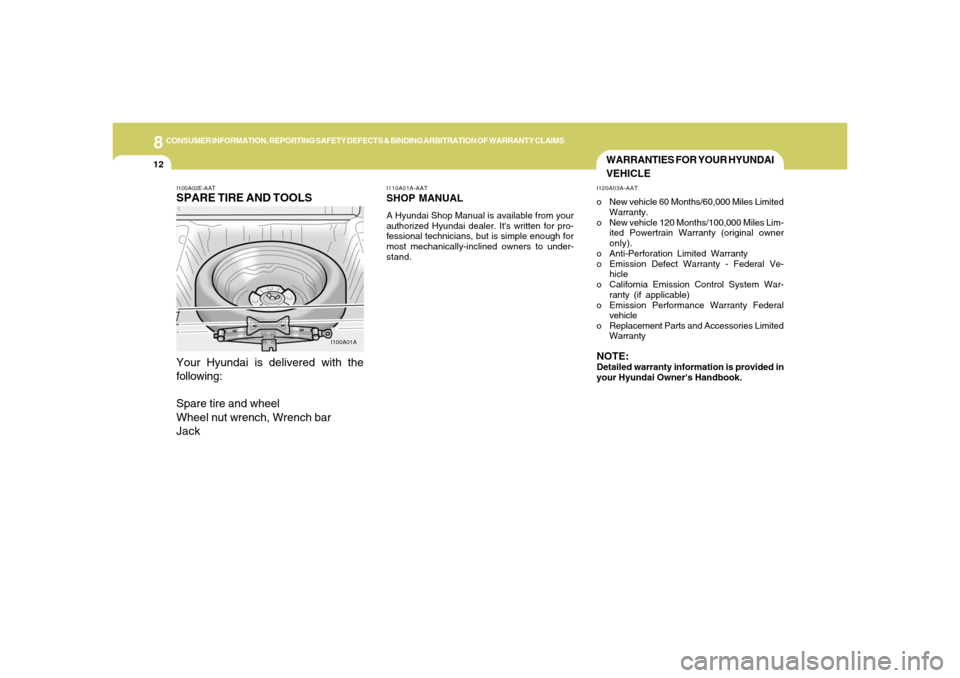
I100A02E-AATSPARE TIRE AND TOOLS
Your Hyundai is delivered with the
following:
Spare tire and wheel
Wheel nut wrench, Wrench bar
Jack
I100A01AI110A01A-AAT
SHOP MANUALA Hyundai Shop Manual is available from your
authorized Hyundai dealer. It's written for pro-
fessional technicians, but is simple enough for
most mechanically-inclined owners to under-
stand.
I120A03A-AATo New vehicle 60 Months/60,000 Miles Limited
Warranty.
o New vehicle 120 Months/100,000 Miles Lim-
ited Powertrain Warranty (original owner
only).
o Anti-Perforation Limited Warranty
o Emission Defect Warranty - Federal Ve-
hicle
o California Emission Control System War-
ranty (if applicable)
o Emission Performance Warranty Federal
vehicle
o Replacement Parts and Accessories Limited
WarrantyNOTE:Detailed warranty information is provided in
your Hyundai Owner's Handbook.