tire type Hyundai Accent 2005 Owner's Manual
[x] Cancel search | Manufacturer: HYUNDAI, Model Year: 2005, Model line: Accent, Model: Hyundai Accent 2005Pages: 219, PDF Size: 7.07 MB
Page 119 of 219
DRIVING YOUR HYUNDAI
132
o Remember, your Hyundai does not require
extended warm-up. As soon as the engine
is running smoothly, you can drive away. In
very cold weather, however, give your en-
gine a slightly longer warm-up period.
o Don't "lug" or "over-rev" the engine. Lug-
ging is driving too slowly in too high a gear
resulting in the engine bucking. If this hap-
pens, shift to a lower gear. Over-revving is
racing the engine beyond its safe limit. This
can be avoided by shifting at the recom-
mended speeds.
o Use your air conditioning sparingly. The air
conditioning system is operated by engine
power so your fuel economy is reduced
when you use it.
WINTER DRIVING
SMOOTH CORNERING
C160A01A-AATThe more severe weather conditions of winter
result in greater wear and other problems. To
minimize the problems of winter driving, you
should follow these suggestions:C160B01A-AATSnowy or Icy ConditionsTo drive your vehicle in deep snow, it may be
necessary to use snow tires or to install tire
chains on your tires. If snow tires are needed, it
is necessary to select tires equivalent in size
and type to the original equipment tires. Failure
to do so may adversely affect the safety and
handling of your car. Furthermore, speeding,
rapid acceleration, sudden brake applications,
and sharp turns are potentially very hazardous
practices.
During deceleration, use engine braking to the
fullest extent. Sudden brake applications on
snowy or icy roads may cause skids to occur.
You need to keep sufficient distance between
the vehicle in operation in front and your vehicle.
Also, apply the brake gently. It should be noted
that installing tire chains on the tire will provide
a greater driving force, but will not prevent side
skids.NOTE:Tire chains are not legal in all states. Check
state laws before fitting tire chains.
C150A01A-AATAvoid braking or gear changing in corners,
especially when roads are wet. Ideally, cor-
ners should always be taken under gentle
acceleration. If you follow these suggestions,
tire wear will be held to a minimum.
Page 178 of 219
6
DO-IT-YOURSELF MAINTENANCE
23
G240A01A-AATPOWER STEERING HOSESIt is suggested that you check the power steer-
ing hose connections for fluid leakage at those
intervals specified in the vehicle maintenance
schedule in Section 5.
The power steering hoses should be replaced if
there is severe surface cracking, pulling, scuff-
ing or worn spots. Deterioration of the hose
could cause premature failure.Recommended FluidUse PSF-3 type fluidNOTE:Do not start the engine when the power
steering oil reservoir is empty.
HEADLIGHT AIMING ADJUSTMENT
G250A01A-AATFOR MORE INFORMATION ABOUT
YOUR HYUNDAIIf you desire additional information about main-
taining and servicing your Hyundai, you may
purchase a factory Shop Manual at your Hyundai
dealer's parts department. This is the same
manual used by dealership technicians and while
it is highly technical it can be useful in obtaining
a better understanding of your car and how it
works.
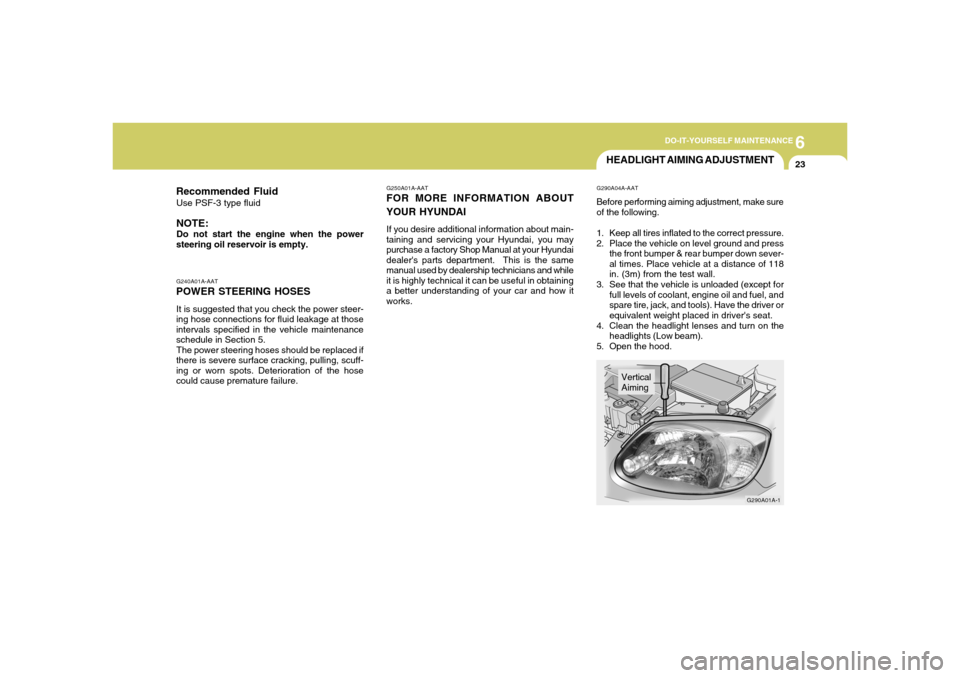
G290A04A-AATBefore performing aiming adjustment, make sure
of the following.
1. Keep all tires inflated to the correct pressure.
2. Place the vehicle on level ground and press
the front bumper & rear bumper down sever-
al times. Place vehicle at a distance of 118
in. (3m) from the test wall.
3. See that the vehicle is unloaded (except for
full levels of coolant, engine oil and fuel, and
spare tire, jack, and tools). Have the driver or
equivalent weight placed in driver's seat.
4. Clean the headlight lenses and turn on the
headlights (Low beam).
5. Open the hood.
G290A01A-1
Vertical
Aiming
Page 198 of 219

8
CONSUMER INFORMATION, REPORTING SAFETY DEFECTS & BINDING ARBITRATION OF WARRANTY CLAIMS6
1. Manufacturer or Brand name
o Manufacturer or Brand name is
shown.
2. Tire size (example: P175/70R13)
o The "P" indicates the tire is de-
signed for passenger vehicles. A
"T" is the designation for a tempo-
rary spare tire.
o Three-digit number (175): This
number gives the width in millime-
ters of the tire from sidewall edge
to sidewall edge.
o Two-digit number (70): This num-
ber, known as the aspect ratio,
gives the tire's ratio of height to
width.
o R: The "R" stands for radial.
o Two-digit number (13): This num-
ber is the wheel or rim diameter in
inches.
o Two (or three) digit number (82):
This number is the tire's load in-
dex. It is a measurement of how
much weight each tire can sup-
port.o T: Speed Rating. The speed rat-
ing denotes the speed at which a
tire is designed to be driven for
extended periods of time. The
ratings range from "A" to "Z" (98
to 186 MPH).
3. TIN (Tire Identification Number) for
new tire (example: DOT XX XX
XXX XXXX)
o DOT: Abbreviation for the "De-
partment of Transportation". The
symbol can be placed above, be-
low or to the left or right of the Tire
Iden tification Number. In-
dicates tire is in compliance with
the U.S. Department of
Transportation Motor Vehicle
Safety Standards.
o 1st two-digit code: Manufacturer's
identification mark
o 2nd two-digit code: Tire size
o 3rd three-digit code: Tire type code
(Optional)
o 4th four-digit code: Date of Manu-
factureo Four numbers represent the week
and year the tire was built. For
example, the numbers 3104
means the 31st week of 2004.
4. Tire ply composition and mate-
rial
The number of layers or plies of
rubbercoated fabric in the tire. Tire
manufacturers also must indicate
the materials in the tire, which in-
clude steel, nylon, polyester, and
others. The letter "R" means radial
ply construction; the letter "D" means
diagonal or bias ply construction;
and the letter "B" means belted-bias
ply construction.
5. Maximum permissible inflation
pressure
This number is the greatest amount
of air pressure that should be put in
the tire. Do not exceed the maxi-
mum permissible inflation pressure.
Refer to the Tire and Loading Infor-
mation label for recommended infla-
tion pressure.
Page 210 of 219
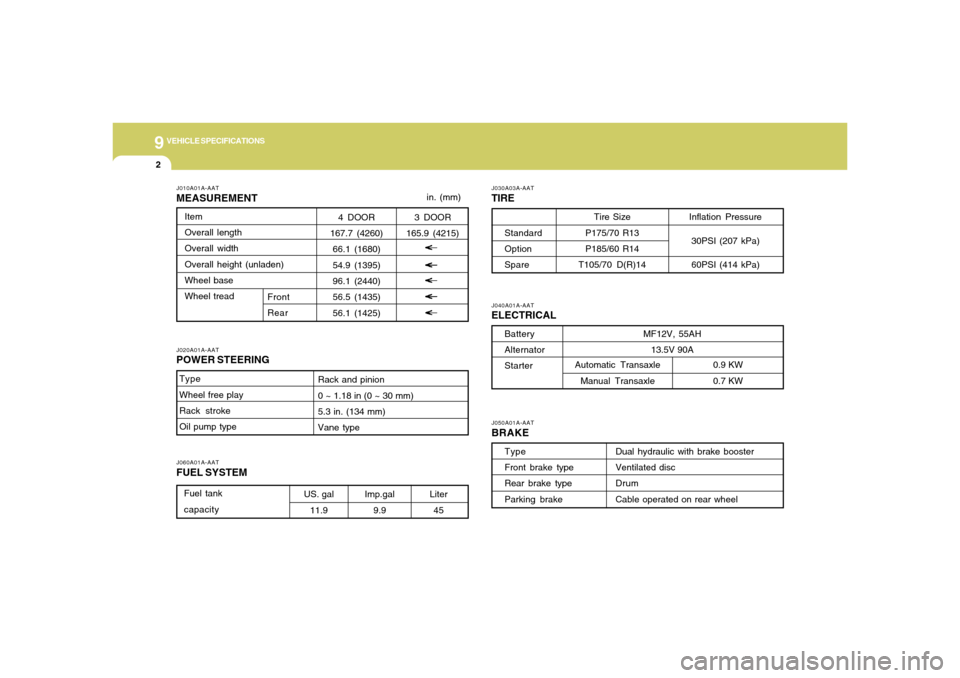
9
VEHICLE SPECIFICATIONS2
Tire Size
P175/70 R13
P185/60 R14
T105/70 D(R)14 in. (mm)
Liter
45Automatic Transaxle
Manual Transaxle
MF12V, 55AH
13.5V 90A
Dual hydraulic with brake booster
Ventilated disc
Drum
Cable operated on rear wheel
Standard
Option
Spare
US. gal
11.9 Fuel tank
capacityImp.gal
9.9Battery
Alternator
Starter0.9 KW
0.7 KW
Type
Front brake type
Rear brake type
Parking brake
Inflation Pressure
30PSI (207 kPa)
60PSI (414 kPa)
J010A01A-AATMEASUREMENTJ020A01A-AATPOWER STEERINGJ060A01A-AATFUEL SYSTEM
J040A01A-AATELECTRICALJ050A01A-AATBRAKEJ030A03A-AATTIRE
4 DOOR
167.7 (4260)
66.1 (1680)
54.9 (1395)
96.1 (2440)
56.5 (1435)
56.1 (1425) Item
Overall length
Overall width
Overall height (unladen)
Wheel base
Wheel tread
Front
Rear
3 DOOR
165.9 (4215)
Type
Wheel free play
Rack stroke
Oil pump type
Rack and pinion
0 ~ 1.18 in (0 ~ 30 mm)
5.3 in. (134 mm)
Vane type