engine Hyundai Accent 2007 Owners Manual
[x] Cancel search | Manufacturer: HYUNDAI, Model Year: 2007, Model line: Accent, Model: Hyundai Accent 2007Pages: 282, PDF Size: 10.55 MB
Page 253 of 282
6 DO-IT-YOURSELF MAINTENANCE
30
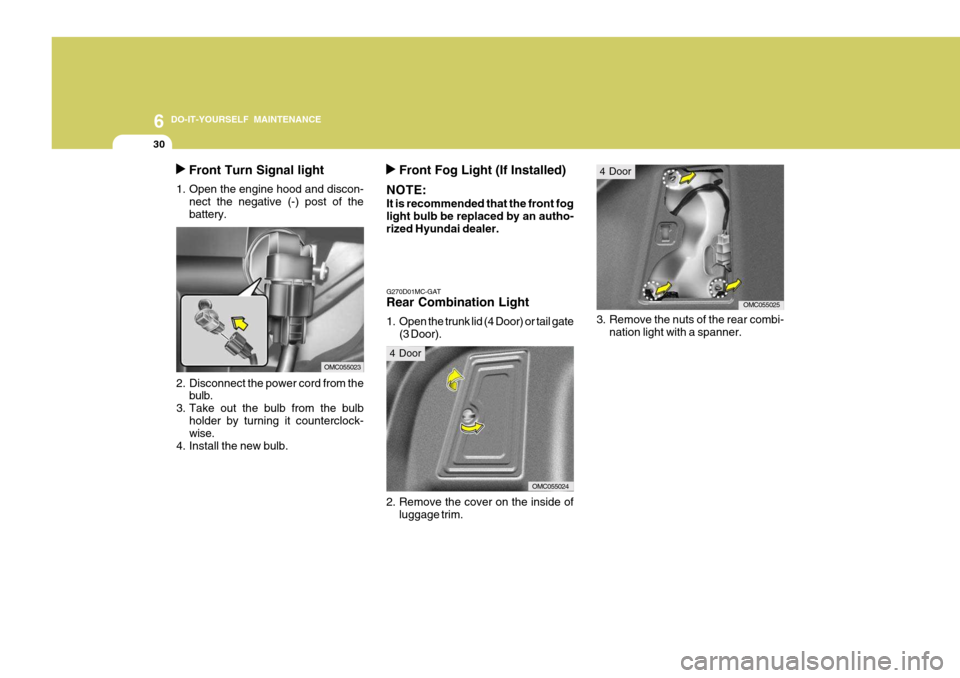
Front Turn Signal light
1. Open the engine hood and discon- nect the negative (-) post of the battery.
2. Disconnect the power cord from the bulb.
3. Take out the bulb from the bulb holder by turning it counterclock- wise.
4. Install the new bulb.
OMC055023
Front Fog Light (If Installed)
NOTE: It is recommended that the front fog light bulb be replaced by an autho- rized Hyundai dealer.
3. Remove the nuts of the rear combi- nation light with a spanner.
G270D01MC-GAT Rear Combination Light
1. Open the trunk lid (4 Door) or tail gate(3 Door).
OMC055024
OMC055025
2. Remove the cover on the inside of luggage trim.
4 Door
4 Door
Page 258 of 282
6
DO-IT-YOURSELF MAINTENANCE
35
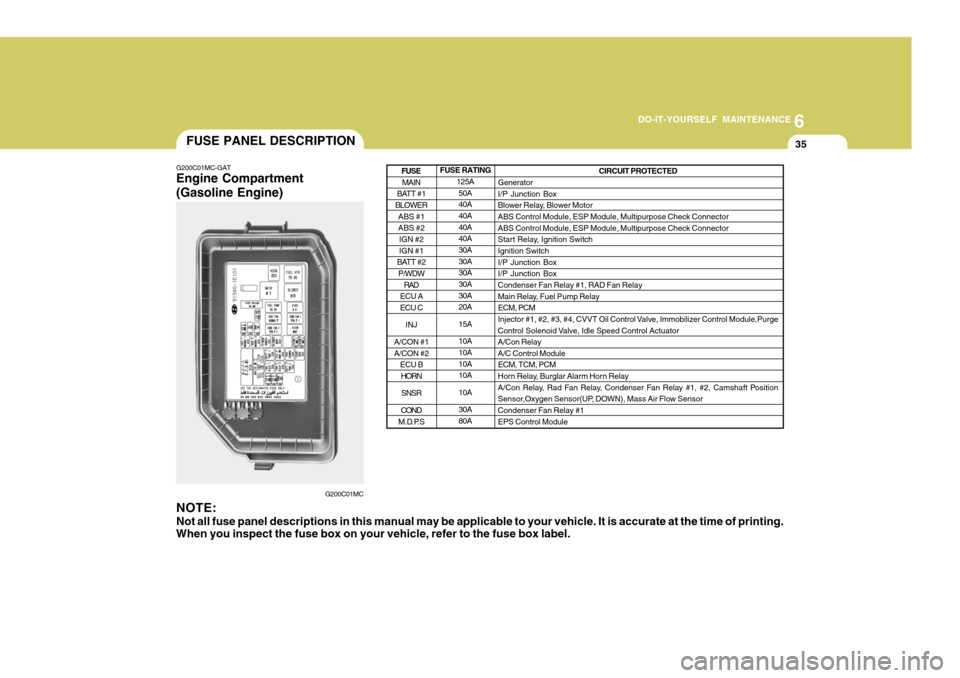
FUSE RATING 125A50A 40A 40A 40A40A 30A 30A30A 30A 30A20A 15A10A 10A 10A10A 10A30A 80A
G200C01MC-GAT Engine Compartment (Gasoline Engine)
G200C01MC
NOTE:
Not all fuse panel descriptions in this manual may be applicable to your vehicle. It is accurate at the time of printing.
When you inspect the fuse box on your vehicle, refer to the fuse box label. CIRCUIT PROTECTED
Generator I/P Junction Box
Blower Relay, Blower MotorABS Control Module, ESP Module, Multipurpose Check Connector ABS Control Module, ESP Module, Multipurpose Check Connector
Start Relay, Ignition SwitchIgnition Switch I/P Junction Box I/P Junction BoxCondenser Fan Relay #1, RAD Fan Relay
Main Relay, Fuel Pump Relay ECM, PCM
Injector #1, #2, #3, #4, CVVT Oil Control Valve, Immobilizer Control Module,Purge
Control Solenoid Valve, Idle Speed Control Actuator A/Con RelayA/C Control ModuleECM, TCM, PCM
Horn Relay, Burglar Alarm Horn Relay
A/Con Relay, Rad Fan Relay, Condenser Fan Relay #1, #2, Camshaft Position
Sensor,Oxygen Sensor(UP, DOWN), Mass Air Flow Sensor Condenser Fan Relay #1 EPS Control Module
MAIN
BATT #1
BLOWER
ABS #1 ABS #2IGN #2 IGN #1
BATT #2 P/WDW
RAD
ECU A ECU C
INJ
A/CON #1 A/CON #2 ECU BHORN
SNSR
COND
M.D.P.S
FUSE
FUSE PANEL DESCRIPTION
Page 259 of 282
6 DO-IT-YOURSELF MAINTENANCE
36
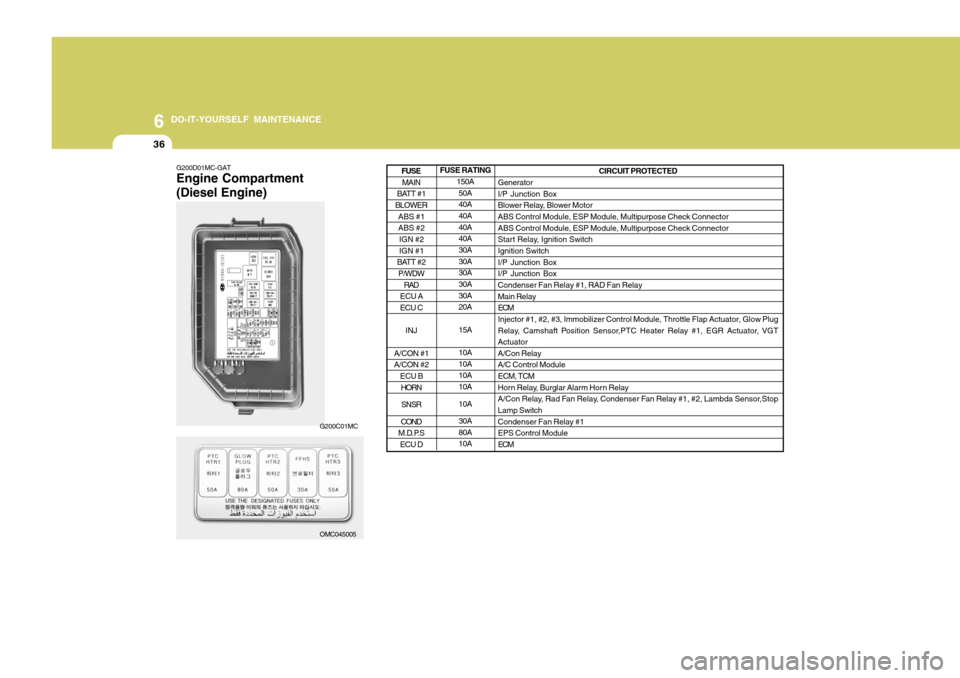
G200D01MC-GAT Engine Compartment (Diesel Engine) FUSE RATING
150A50A 40A 40A 40A40A 30A 30A30A 30A 30A20A 15A10A 10A10A 10A 10A30A 80A10A CIRCUIT PROTECTED
Generator I/P Junction Box
Blower Relay, Blower MotorABS Control Module, ESP Module, Multipurpose Check Connector ABS Control Module, ESP Module, Multipurpose Check Connector
Start Relay, Ignition SwitchIgnition Switch I/P Junction Box I/P Junction BoxCondenser Fan Relay #1, RAD Fan Relay Main Relay ECMInjector #1, #2, #3, Immobilizer Control Module, Throttle Flap Actuator, Glow Plug
Relay, Camshaft Position Sensor,PTC Heater Relay #1, EGR Actuator, VGT ActuatorA/Con RelayA/C Control Module ECM, TCM
Horn Relay, Burglar Alarm Horn Relay
A/Con Relay, Rad Fan Relay, Condenser Fan Relay #1, #2, Lambda Sensor,Stop Lamp Switch Condenser Fan Relay #1EPS Control Module ECM
MAIN
BATT #1
BLOWER
ABS #1 ABS #2IGN #2 IGN #1
BATT #2 P/WDW
RAD
ECU A ECU C
INJ
A/CON #1A/CON #2 ECU B
HORN
SNSR
COND
M.D.P.S ECU D
FUSE
OMC045005
G200C01MC
Page 263 of 282
7EMISSION CONTROL SYSTEMS
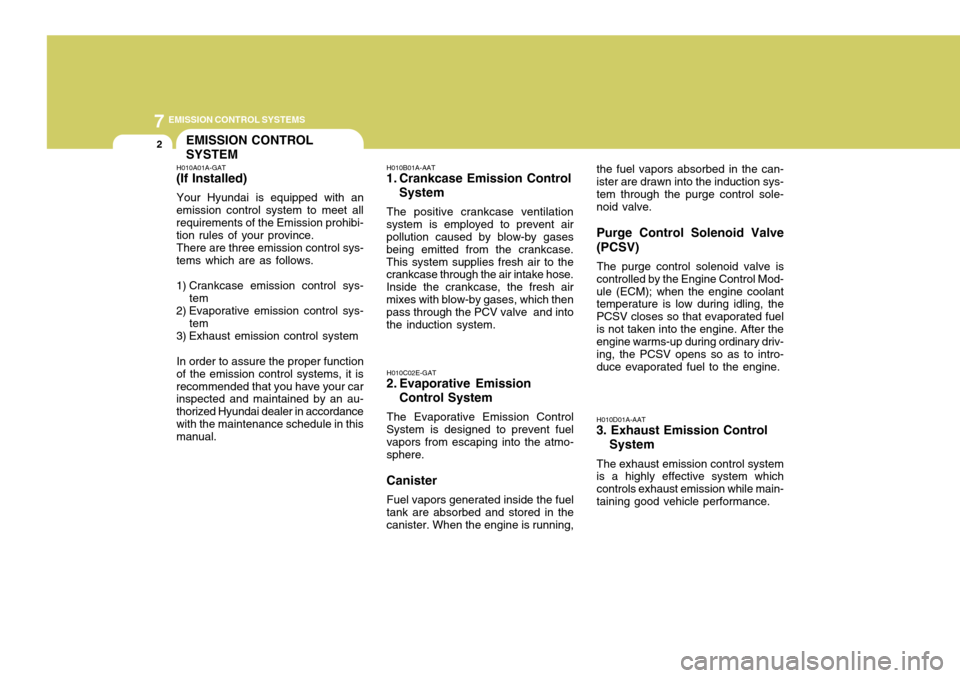
2EMISSION CONTROL SYSTEM
H010A01A-GAT
(If Installed)
Your Hyundai is equipped with an
emission control system to meet all requirements of the Emission prohibi- tion rules of your province. There are three emission control sys-
tems which are as follows.
1) Crankcase emission control sys- tem
2) Evaporative emission control sys-
tem
3) Exhaust emission control system
In order to assure the proper function
of the emission control systems, it is recommended that you have your car inspected and maintained by an au- thorized Hyundai dealer in accordancewith the maintenance schedule in this manual. H010B01A-AAT
1. Crankcase Emission Control
System
The positive crankcase ventilation
system is employed to prevent airpollution caused by blow-by gases being emitted from the crankcase.This system supplies fresh air to the crankcase through the air intake hose. Inside the crankcase, the fresh airmixes with blow-by gases, which then pass through the PCV valve and into the induction system.
H010C02E-GAT
2. Evaporative Emission
Control System
The Evaporative Emission Control
System is designed to prevent fuelvapors from escaping into the atmo-sphere. Canister
Fuel vapors generated inside the fuel
tank are absorbed and stored in the canister. When the engine is running, the fuel vapors absorbed in the can-ister are drawn into the induction sys-tem through the purge control sole- noid valve. Purge Control Solenoid Valve (PCSV)
The purge control solenoid valve is
controlled by the Engine Control Mod- ule (ECM); when the engine coolant temperature is low during idling, the PCSV closes so that evaporated fuelis not taken into the engine. After the engine warms-up during ordinary driv- ing, the PCSV opens so as to intro-duce evaporated fuel to the engine. H010D01A-AAT
3. Exhaust Emission Control
System
The exhaust emission control system is a highly effective system which controls exhaust emission while main-taining good vehicle performance.
Page 264 of 282
7
EMISSION CONTROL SYSTEMS
3
!
CATALYTIC CONVERTER
H020A01A-GAT
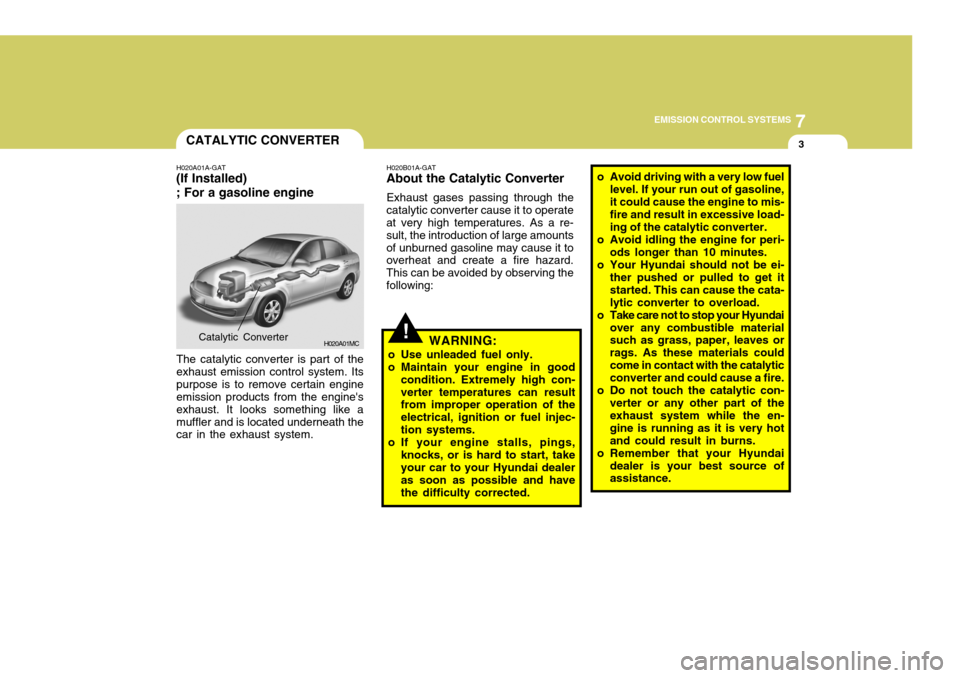
(If Installed) ; For a gasoline engine
H020A01MC
The catalytic converter is part of the exhaust emission control system. Itspurpose is to remove certain engine emission products from the engine's exhaust. It looks something like amuffler and is located underneath the car in the exhaust system.
Catalytic Converter H020B01A-GAT
About the Catalytic Converter
Exhaust gases passing through the
catalytic converter cause it to operate at very high temperatures. As a re- sult, the introduction of large amountsof unburned gasoline may cause it to overheat and create a fire hazard. This can be avoided by observing thefollowing:
WARNING:
o Use unleaded fuel only.
o Maintain your engine in good condition. Extremely high con-verter temperatures can result from improper operation of the electrical, ignition or fuel injec-tion systems.
o If your engine stalls, pings, knocks, or is hard to start, takeyour car to your Hyundai dealer as soon as possible and have the difficulty corrected.
o Avoid driving with a very low fuel
level. If your run out of gasoline, it could cause the engine to mis- fire and result in excessive load- ing of the catalytic converter.
o Avoid idling the engine for peri-
ods longer than 10 minutes.
o Your Hyundai should not be ei- ther pushed or pulled to get itstarted. This can cause the cata-lytic converter to overload.
o Take care not to stop your Hyundai over any combustible material such as grass, paper, leaves or rags. As these materials couldcome in contact with the catalytic converter and could cause a fire.
o Do not touch the catalytic con- verter or any other part of theexhaust system while the en- gine is running as it is very hotand could result in burns.
o Remember that your Hyundai dealer is your best source of assistance.
Page 265 of 282
7EMISSION CONTROL SYSTEMS
4EGR SYSTEM
H020C01S-GAT
; For a diesel engine
This system helps control oxides of nitrogen by recirculating a part of the exhaust gas into the engine.
H020D01S-GAT
CATALYTIC CONVERTER ; For a diesel engine
All Hyundai vehicles are equipped
with oxidation type catalytic converter to reduce the carbon monoxide, hy- drocarbons and particulate containedin the exhaust gas.
Page 266 of 282
Vehicle Identification Number (VIN) .............................. 8-2
Engine Number ............................................................. 8-3
Recommended Inflation Pressures .............................. 8-3
Snow Tires ................................................................... 8-4
Tire Chains ................................................................... 8-5
Tire Rotation ................................................................. 8-5
Tire Balancing ............................................................... 8-6
Tire Traction ................................................................. 8-6
When to Replace Tires ................................................. 8-6
Spare Tire and Tools .................................................... 8-7
8
CONSUMER INFORMATION
8
Page 268 of 282
8
CONSUMER INFORMATION
3ENGINE NUMBERTIRE
I010B01A-GAT
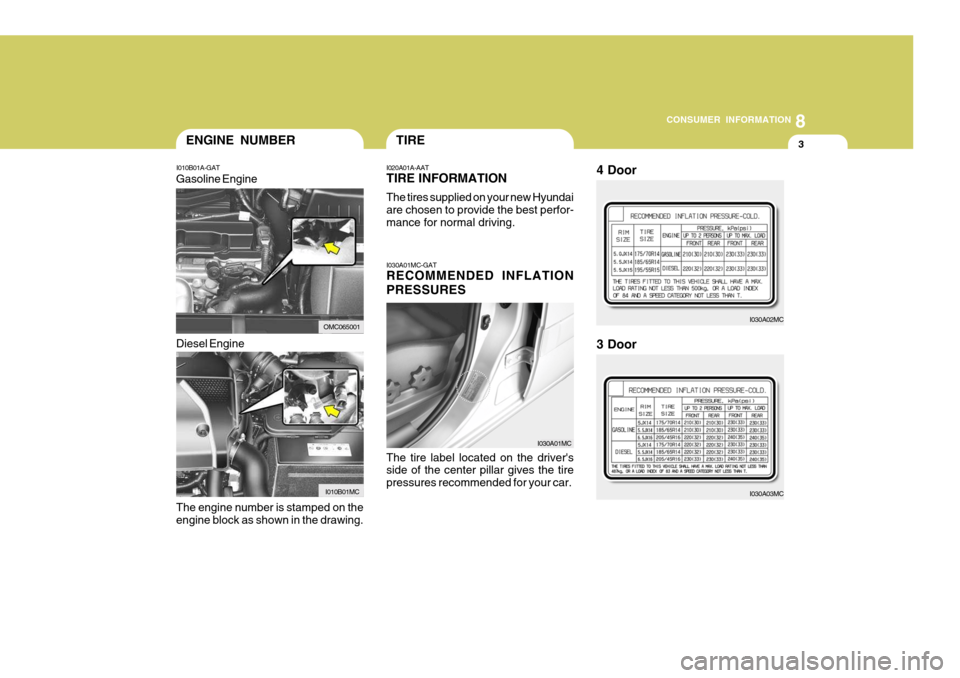
The engine number is stamped on the engine block as shown in the drawing. I020A01A-AAT TIRE INFORMATION The tires supplied on your new Hyundai are chosen to provide the best perfor-mance for normal driving. I030A01MC-GAT RECOMMENDED INFLATION PRESSURES The tire label located on the driver's side of the center pillar gives the tire pressures recommended for your car.
I030A01MC
Gasoline Engine Diesel Engine
OMC065001
I010B01MC
I030A01MC
I030A02MC
4 Door
I030A03MC
3 Door
Page 273 of 282
MEASUREMENT......................................................... 9-2
ENGINE ....................................................................... 9-3
LUBRICATION CHART ............................................... 9-4
9
VEHICLE SPECIFICATIONS
9
Page 275 of 282

9
VEHICLE SPECIFICATIONS
3ENGINE
Engine Type Bore x Stroke (mm) Displacement (cc) Firing orderIdle speed (RPM) Ignition timing
J070A02MC-GAT
ITEMS
N,P
D
GASOLINE
720 ± 100 660 ± 100
BTDC 5° ± 5°
1.4L
75.5 x 78.1 1,399 1.6L
76.5 x 87 1,599 DIESEL
1.5L
75 x 84.5 1,493
820 ± 100
Auto control
4-Cylinder in-line DOHC
1 - 3 - 4 - 2