cooling system Hyundai Accent 2007 User Guide
[x] Cancel search | Manufacturer: HYUNDAI, Model Year: 2007, Model line: Accent, Model: Hyundai Accent 2007Pages: 282, PDF Size: 10.55 MB
Page 194 of 282
3
WHAT TO DO IN AN EMERGENCY
5
!!
SPARE TIRE
WARNING (Diesel Only):
Never work on injection system with engine running or within 30 sec- onds after shutting off engine. High pressure pump, rail, injectors andhigh pressure pipes are subject to high pressure even after the engine stopped. The fuel jet produced byfuel leaks may cause serious in- jury, if it touch the body. People using pacemakers should not movethan 30cm closer to the ECU or wiring harness within the engine room while engine is running, sincethe high currents in the Common Rail system produce considerable magnetic fields. WARNING:
Do not remove the radiator cap whenthe engine is hot. This can allowcoolant to be blown out of the open- ing and cause serious burns.
6. If you cannot find the cause of the overheating, wait until the engine temperature has returned to nor-mal. Then, if the engine coolant has been lost, carefully add coolant to the reservoir (Page 6-11) to bring thefluid level in the reservoir up to the halfway mark.
7. Proceed with caution, keeping alert
for further signs of overheating. Ifoverheating happens again, call a Hyundai dealer for assistance.
!
5. If the water pump drive belt is broken
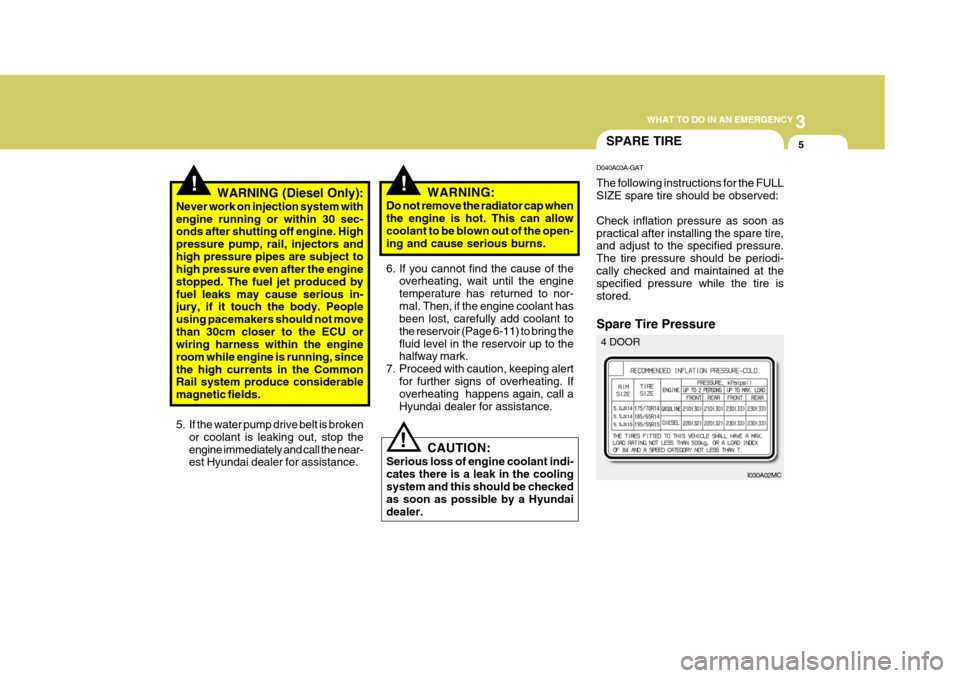
or coolant is leaking out, stop the engine immediately and call the near- est Hyundai dealer for assistance. D040A03A-GAT The following instructions for the FULL SIZE spare tire should be observed: Check inflation pressure as soon as practical after installing the spare tire, and adjust to the specified pressure. The tire pressure should be periodi-cally checked and maintained at the specified pressure while the tire is stored.
CAUTION:
Serious loss of engine coolant indi-cates there is a leak in the coolingsystem and this should be checked as soon as possible by a Hyundai dealer. Spare Tire Pressure
I030A02MC
4 DOOR
Page 218 of 282

5VEHICLE MAINTENANCE REQUIREMENTS
6
F030C02MC-GAT R : Replace I : Inspect and, after inspection, clean, adjust, repair or replace if necessary
Note : (1) FOR THE FIRST TIME, REPLACE THE COOLANT AT 90,000 KM OR 60 MONTHS. AFTER THAT, REPLACE IT EVERY 45,000 KM OR 24 MONTHS.
(2) FOR EVERY 45,000 KM OR 24 MONTHS, WHICHEVER OCCURS FIRST : "R"
NO.
1 23 4 5 678 9
10 11121314 15 DESCRIPTION
GENERAL MAINTENANCE COOLING SYSTEM COOLANT MANUAL TRANSAXLE OILAUTOMATIC TRANSAXLE FLUID BRAKE HOSES AND LINES BRAKE FLUIDREAR BRAKE DRUMS/LININGS, PARKING BRAKEBRAKE PADS, CALIPERS AND ROTORS EXHAUST PIPE AND MUFFLER SUSPENSION MOUNTING BOLTSSTEERING GEAR BOX, LINKAGE & BOOTS/LOWER ARM BALL JOINTPOWER STEERING PUMP, BELT AND HOSESDRIVE SHAFTS AND BOOTSAIR CONDITIONING REFRIGERANT CLIMATE CONTROL AIR FILTER
120 96
I I IIII I IIII I II
R
105
84
I I III I III I I
R
90 72
I I
R I II I IIII I II
R
7560
I I III I III I I
R
60 48
I I IIII I IIII I II
R
4536
I I III I III I I
R
30 24
I I IIII I IIII I II
R
1512
I I III I III I I
R
KILOMETERS X 1000 MONTHS
See Note (1) See Note (2)
European Community Only Except European Community
European Community Only Except European Community
Page 221 of 282

5
VEHICLE MAINTENANCE REQUIREMENTS
9
F060H01A-AAT
o Air Cleaner Filter A Genuine Hyundai air cleaner filter is
recommended when the filter is re- placed. F060J01A-AAT
o Spark Plugs (For Gasoline Engine)
Make sure to install new spark plugs of the correct heat range. F070C01A-AAT o Coolant The coolant should be changed at the intervals specified in the mainte- nance schedule.
F060E01MC-AAT
o Timing Belt (Gasoline)
Inspect all parts related to the timing
belt for damage and deformation.Replace any damaged parts immedi- ately.
F060G01A-AAT
o Vapor Hose and Fuel Filler Cap
The vapor hose and fuel filler cap
should be inspected at those intervalsspecified in the maintenance sched-ule. Make sure that a new vapor hose or fuel filler cap is correctly replaced. F060F01A-AAT
o Vacuum, Crankcase Ventila-
tion Hoses
Inspect the surface of hoses for evi-
dence of heat and/or mechanical dam-age. Hard and brittle rubber, cracking, tears, cuts, abrasions, and excessiveswelling indicate deterioration. Partic- ular attention should be paid to exam- ine those hose surfaces nearest tohigh heat sources, such as the ex- haust manifold.
Inspect the hose routing to assure
that the hoses do not come in contactwith any heat source, sharp edges or moving component which might causeheat damage or mechanical wear. Inspect all hose connections, such as clamps and couplings, to make surethey are secure, and that no leaks are present. Hoses should be replaced immediately if there is any evidenceof deterioration or damage. F070B01A-GAT o Cooling System Check the cooling system part, such as radiator, coolant reservoir, hoses and connections for leakage and dam- age. Replace any damaged parts.
Page 233 of 282
6 DO-IT-YOURSELF MAINTENANCE
10
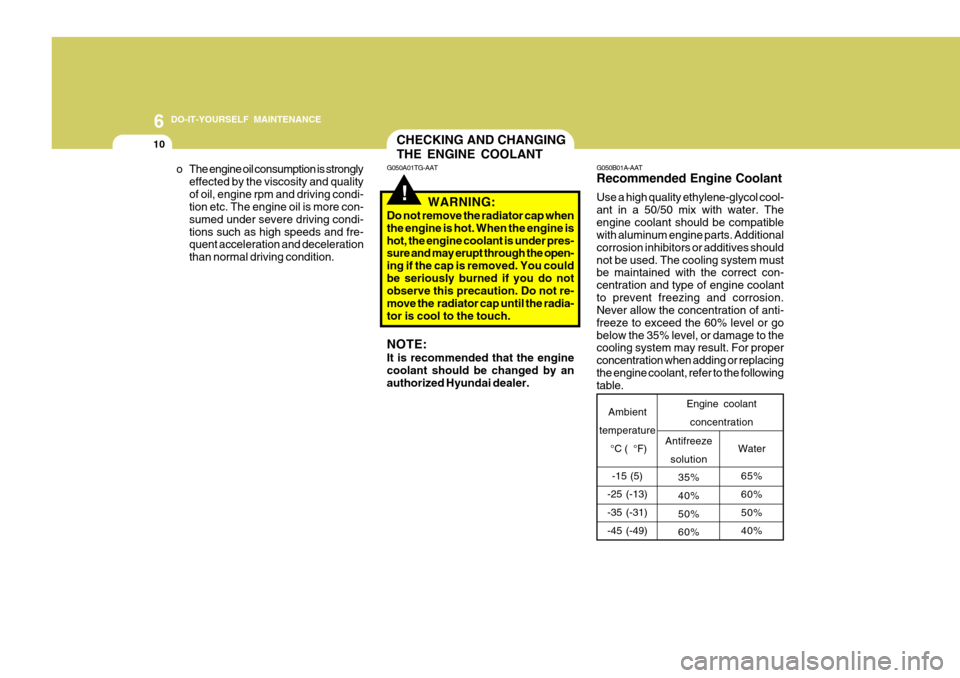
G050B01A-AAT Recommended Engine Coolant Use a high quality ethylene-glycol cool- ant in a 50/50 mix with water. Theengine coolant should be compatible with aluminum engine parts. Additional corrosion inhibitors or additives shouldnot be used. The cooling system must be maintained with the correct con- centration and type of engine coolantto prevent freezing and corrosion. Never allow the concentration of anti- freeze to exceed the 60% level or gobelow the 35% level, or damage to the cooling system may result. For proper concentration when adding or replacingthe engine coolant, refer to the following table.
Water
65% 60% 50% 40%
Antifreeze
solution 35% 40% 50%60%
Ambient
temperature
°C ( °F)
-15 (5)
-25 (-13)-35 (-31) -45 (-49) Engine coolant
concentration
!
CHECKING AND CHANGING THE ENGINE COOLANT
G050A01TG-AAT
WARNING:
Do not remove the radiator cap when the engine is hot. When the engine ishot, the engine coolant is under pres- sure and may erupt through the open- ing if the cap is removed. You couldbe seriously burned if you do not observe this precaution. Do not re- move the radiator cap until the radia-tor is cool to the touch. NOTE: It is recommended that the engine coolant should be changed by an authorized Hyundai dealer.
o The engine oil consumption is strongly
effected by the viscosity and qualityof oil, engine rpm and driving condi- tion etc. The engine oil is more con- sumed under severe driving condi-tions such as high speeds and fre- quent acceleration and deceleration than normal driving condition.
Page 239 of 282
6 DO-IT-YOURSELF MAINTENANCE
16
!
!
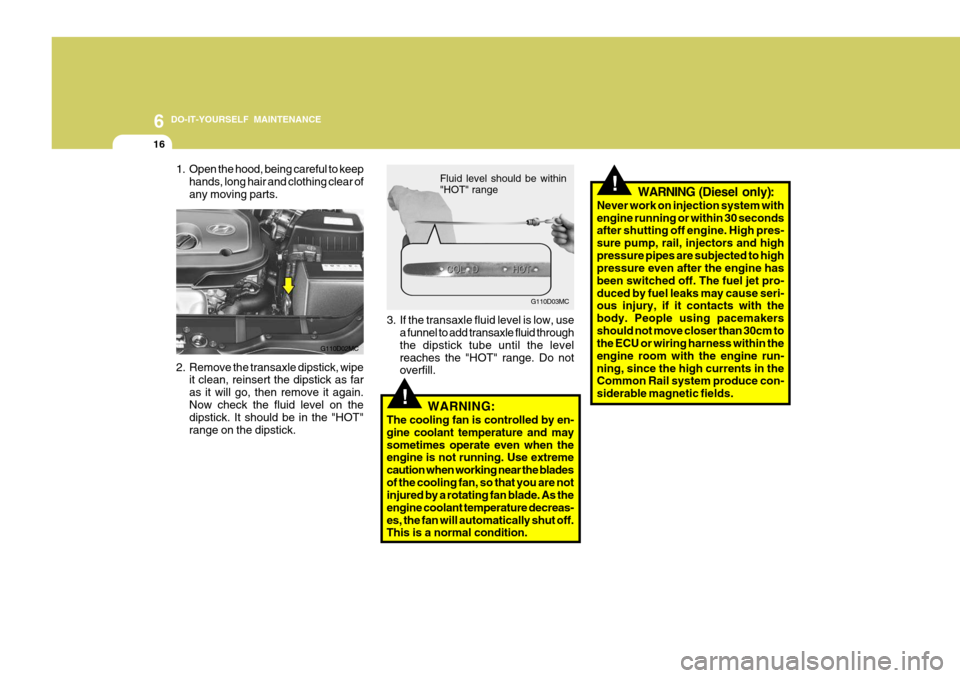
3. If the transaxle fluid level is low, use
a funnel to add transaxle fluid through the dipstick tube until the levelreaches the "HOT" range. Do not overfill.
WARNING:
The cooling fan is controlled by en- gine coolant temperature and maysometimes operate even when the engine is not running. Use extreme caution when working near the bladesof the cooling fan, so that you are not injured by a rotating fan blade. As the engine coolant temperature decreas-es, the fan will automatically shut off. This is a normal condition. WARNING (
Diesel only):
Never work on injection system with engine running or within 30 seconds after shutting off engine. High pres- sure pump, rail, injectors and highpressure pipes are subjected to high pressure even after the engine has been switched off. The fuel jet pro-duced by fuel leaks may cause seri- ous injury, if it contacts with the body. People using pacemakersshould not move closer than 30cm to the ECU or wiring harness within the engine room with the engine run-ning, since the high currents in the Common Rail system produce con- siderable magnetic fields.
G110D03MC
Fluid level should be within "HOT" range
1. Open the hood, being careful to keep
hands, long hair and clothing clear of any moving parts.
2. Remove the transaxle dipstick, wipe it clean, reinsert the dipstick as faras it will go, then remove it again.Now check the fluid level on the dipstick. It should be in the "HOT" range on the dipstick. G110D02MC
Page 241 of 282
6 DO-IT-YOURSELF MAINTENANCE
18
G140B01A-AAT Checking the Air Conditioning Operation
1. Start the engine and let it run at afast idle for several minutes with the air conditioning set at the maximum cold setting.
2. If the air coming out of the in-dash vents is not cold, have the air condi-tioning system inspected by yourHyundai dealer.
G140C01A-AAT Lubrication To lubricate the compressor and the seals in the system, the air conditioning should be run for at least 10 minuteseach week. This is particularly important during cool weather when the air condi- tioning system is not otherwise in use.
! CAUTION:
Running the air conditioning sys- tem for extended periods of time with a low refrigerant level may damage the compressor.
AIR CONDITIONING CARE
G140A01A-AAT Keeping the Condenser Clean The air conditioning condenser (and engine radiator) should be checkedperiodically for accumulation of dirt, dead insects, leaves, etc. These can interfere with maximum cooling effi-ciency. When removing such accumu- lations, brush or hose them away care- fully to avoid bending the cooling fans.CHECKING THE CLUTCH FLUID
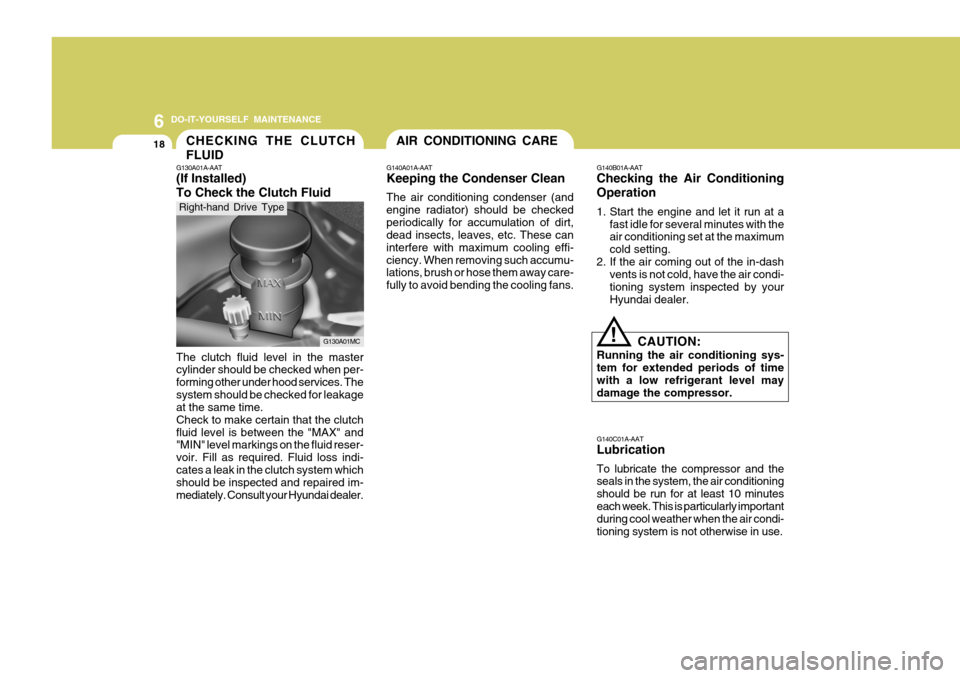
G130A01A-AAT (If Installed) To Check the Clutch Fluid The clutch fluid level in the master cylinder should be checked when per- forming other under hood services. Thesystem should be checked for leakage at the same time. Check to make certain that the clutchfluid level is between the "MAX" and "MIN" level markings on the fluid reser- voir. Fill as required. Fluid loss indi-cates a leak in the clutch system which should be inspected and repaired im- mediately. Consult your Hyundai dealer.
G130A01MC
Right-hand Drive Type
Page 245 of 282
6 DO-IT-YOURSELF MAINTENANCE
22
!
CHECKING THE BATTERY
G210A01A-AAT
WARNING:
Batteries can be dangerous! When working with batteries, carefully ob-serve the following precautions to avoid serious injuries. The fluid in the battery contains a strong solution of sulfuric acid, which is poi- sonous and highly corrosive. Be careful not to spill it on yourself or the car. If youdo spill battery fluid on yourself, imme- diately do the following:
OMC055018
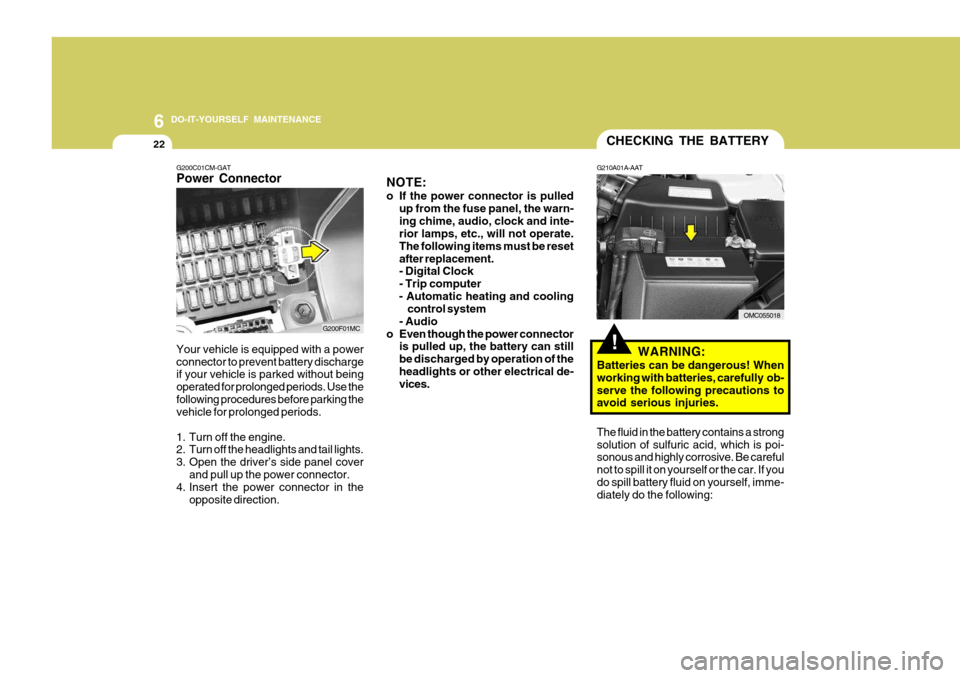
G200C01CM-GAT Power Connector
NOTE:
o If the power connector is pulled
up from the fuse panel, the warn- ing chime, audio, clock and inte- rior lamps, etc., will not operate. The following items must be resetafter replacement. - Digital Clock - Trip computer
- Automatic heating and cooling control system
- Audio
o Even though the power connector is pulled up, the battery can stillbe discharged by operation of theheadlights or other electrical de- vices.
Your vehicle is equipped with a power connector to prevent battery discharge if your vehicle is parked without being operated for prolonged periods. Use thefollowing procedures before parking the vehicle for prolonged periods.
1. Turn off the engine.
2. Turn off the headlights and tail lights.
3. Open the driver’s side panel cover
and pull up the power connector.
4. Insert the power connector in the
opposite direction.
G200F01MC
Page 247 of 282
6 DO-IT-YOURSELF MAINTENANCE
24
o When lifting a plastic-cased bat-
tery, excessive pressure on the case may cause battery acid to leak, resulting in personal injury.Lift with a battery carrier or with your hands on opposite corners.
o Never attempt to charge the bat-
tery when the battery cables areconnected.
o The electrical ignition system
works with high voltage.Never touch these components with the engine running or the ignition switched on.
CHECKING ELECTRIC COOLING FANS
!
G220B01A-AAT Checking Engine Cooling Fan The engine cooling fan should come on automatically if the engine coolant tem-perature is high. G220C01TB-GAT Checking Condenser Cooling Fan When the air conditioning is in opera- tion, the condenser cooling fan comeson automatically to be controlled by ECU.G220A01A-AAT
WARNING:
The cooling fan is controlled by en- gine coolant temperature and may sometimes operate even when the engine is not running. Use extremecaution when working near the blades of the cooling fan, so that you are not injured by a rotating fanblade. As the engine coolant temper- ature decreases the fan will automat- ically shut off. This is a normal con-dition.
POWER STEERING FLUID LEVEL
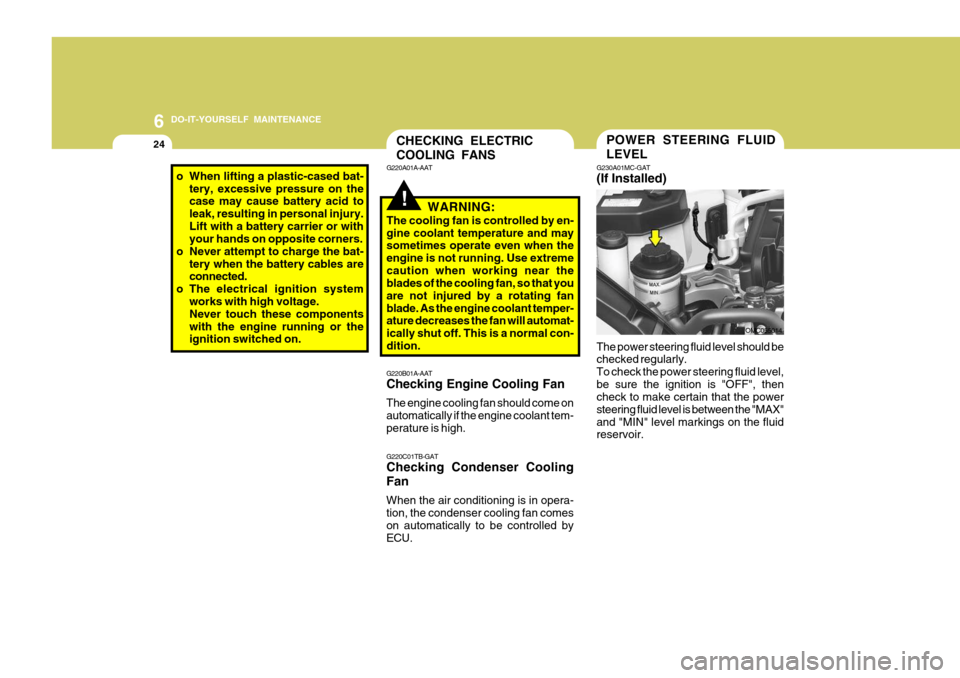
G230A01MC-GAT (If Installed) The power steering fluid level should be checked regularly. To check the power steering fluid level,be sure the ignition is "OFF", then check to make certain that the power steering fluid level is between the "MAX"and "MIN" level markings on the fluid reservoir. OMC055014
Page 278 of 282

10INDEX
2
A Airbag ........................................................................ 1-43
Curtain airbag ......................................................... 1-51
Driver's and passenger's front airbag ...................... 1-44
Passenger’s front airbag on/off switch ................... 1-47
Side impact airbag .................................................. 1-49
Air Cleaner Filter ........................................................ 6-12
Air Conditioning Care ........................................................................ 6-18
Operation .............................................................. 1-107
Switch ................................................................... 1-106
Antenna ................................................................... 1-151
Ashtray ...................................................................... 1-80
Audio System Cassette tape player operation (M420) .................1-121
Cassette tape player operation (M455) .................1-132
Cassette tape player operation (M465) .................1-142
Compact disc player operation (M445) .................1-126
Compact disc player operation (M455) .................1-135
Compact disc player operation (M465) .................1-144
Stereo radio player operation (M420) ....................1-118
Stereo radio player operation (M445) ....................1-123
Stereo radio player operation (M455) ....................1-129
Stereo radio player operation (M465) ....................1-139
Automatic Heating and Cooling Control System ...... 1-109
Air flow control ...................................................... 1-112
Air intake control switch ....................................... 1-111
Fan speed control ................................................. 1-111
Operation .............................................................. 1-110BBack Warning
System ............................................... 2-15
Battery ....................................................................... 6-22
Brake Anti-lock system ..................................................... 2-13
Checking the brakes ............................................... 6-17
Fluid ........................................................................ 6-17
Pad wear warning sound .................. .......................1-64
Practices ................................................................ 2-17
Breaking-In your New Hyundai .................................... 1-3
Bulbs Replacem ent .................................................... 6-27
Bulbs Wa ttage ........................................................... 6-34
C
Care of Cassette Tapes .......................................... 1-149
Care of Discs .......................................................... 1-149
Cargo Area Cover ...................................................... 1-96
Catalytic Converter ...................................................... 7-3
Child-Protector Rear Door Lock ................................... 1-8
Child Restraint System .............................................. 1-32
Cigarette Lighter ........................................................ 1-78
Climate Control Air Filter ................................ 1-115, 6-19
Clock ......................................................................... 1-78
Clutch Checking the cluch fluid ......................................... 6-18
Cooling Fans ............................................................. 6-24
Corrosion protection
Cleaning the interior .................................................. 4-6
Protecting your Hyundai from corrosion ................... 4-2
Washing and waxing ................................................. 4-4
Page 279 of 282

10
INDEX
3
D Door Central door locks .................................................... 1-9
Door locks ................................................................ 1-7 Locking, unlocking front doors with a key ................ 1-7
Drink Holder ............................................................... 1-80
Driving
Economical driving ................................................. 2-18
Smooth corneri ng .................................................... 2-20
Winter driving .......................................................... 2-20
EElectronic Stability Program ...................................... 2-14
Emission Contro l System ............................................ 7-2
Engine
Before starting the engine ....................................... 2-3
Compartment ........................................................... 6-2
Coolant ................................................................... 6-10
Coolant temperature gauge .....................................1-66
If the engine overheats ............................................. 3-4
Number ..................................................................... 8-3
Oil ............................................................................. 6-6Starting ..................................................................... 2-5
Emergency Commodity ............................................. 3-11
Engine Exhaust Can Be Dangerous ............................ 2-2 F Fog Light
Front ....................................................................... 1-77
Rear ........................................................................ 1-78
Front Seats
Adjustable front seats ............................................. 1-15
Adjustable headrests .............................................. 1-16
Adjusting seat forward and rearward .......................1-15
Adjusting seatback angle ....................................... 1-15
Seat warmer ........................................................... 1-17
Fuel
Capacity ................................................................... 9-2
Gauge ..................................................................... 1-66
Recommendations .................................................... 1-2
Fuel Filler Lid
Remote release ...................................................... 1-92
Fuses ........................................................................ 6-20
Fuse Panel description .............................................. 6-35
G General Checks ........................................................... 6-5
Glove Box ................................................................. 1-86
H Hazard Warning System ............................................ 1-76
Headlight Aiming Adjustment..................................... 6-26
Headlight Leveling Device S ystem ............................1-76
Heating and Cooling Control ......................................1-99