fuel Hyundai Accent 2007 User Guide
[x] Cancel search | Manufacturer: HYUNDAI, Model Year: 2007, Model line: Accent, Model: Hyundai Accent 2007Pages: 282, PDF Size: 10.55 MB
Page 73 of 282

1
FEATURES OF YOUR HYUNDAI
61
B260J01S-GAT Charging System Warning Light
The charging system warning light should come on when the ignition isturned on, then go out when the engine is running. If the light stays on while the engine is running, there is a malfunctionin the electrical charging system. If the light comes on while you are driving, stop, turn off the engine and checkunder the hood. First, make certain the generator drive belt is in place. If it is, check the tension of the belt.And then, have the system checked by your Hyundai dealer.
CAUTION:
If the drive belt (generator belt) is loosen, broken, or mission while the vehicle is driving, there may be a serious malfunction, engine couldoverheat because this belt also drives the water pump.! B260M01A-AAT
Low Fuel Level Warning Light
The low fuel level warning light comes on when the fuel tank is approachingempty. When it comes on, you should add fuel as soon as possible. Driving with the fuel level warning light on orwith the fuel level below "E" can cause the engine to misfire and damage the catalytic converter.
B260L01A-GAT Door Ajar Warning Light
The door ajar warning light warns you that a door is not completely closed.B260K01MC-AAT Trunk Lid/Tail Gate
Open Warning Light
This light remains on unless the trunk lid/tail gate is completely closed andlatched.
B260L02HP-GAT Door Ajar Warning Light and Chime (Mideast only)
The door ajar warning light warns you that a door is not completely closed and the chime warns you that the key is inthe ignition switch. NOTE : The warning chime only sounds whenever the key is in the ignition switch and the driver's side frontdoor is open simultaneously. The chime sounds until the key is re- moved from the ignition switch orthe driver's side front door is closed.
Page 74 of 282
1FEATURES OF YOUR HYUNDAI
62
B290A01MC-GAT
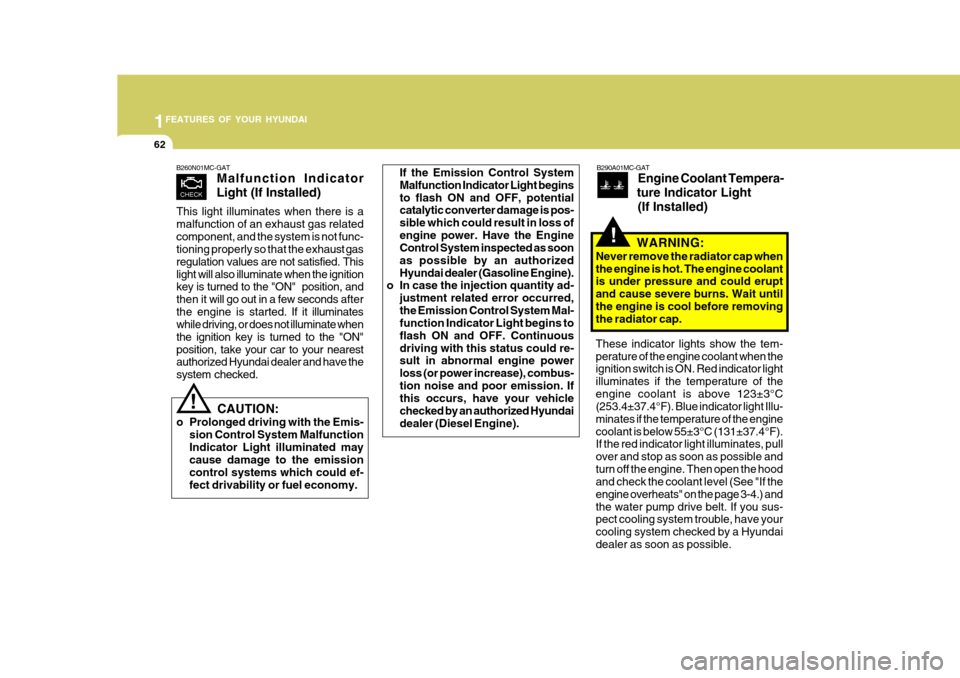
Engine Coolant Tempera-
ture Indicator Light
(If Installed)
WARNING:
Never remove the radiator cap when the engine is hot. The engine coolant is under pressure and could erupt and cause severe burns. Wait untilthe engine is cool before removing the radiator cap.
!
These indicator lights show the tem- perature of the engine coolant when the ignition switch is ON. Red indicator light illuminates if the temperature of theengine coolant is above 123±3°C (253.4±37.4°F). Blue indicator light Illu- minates if the temperature of the enginecoolant is below 55±3°C (131±37.4°F). If the red indicator light illuminates, pull over and stop as soon as possible andturn off the engine. Then open the hood and check the coolant level (See "If the engine overheats" on the page 3-4.) andthe water pump drive belt. If you sus- pect cooling system trouble, have your cooling system checked by a Hyundaidealer as soon as possible.
If the Emission Control SystemMalfunction Indicator Light beginsto flash ON and OFF, potential catalytic converter damage is pos- sible which could result in loss ofengine power. Have the Engine Control System inspected as soon as possible by an authorizedHyundai dealer (Gasoline Engine).
o In case the injection quantity ad-
justment related error occurred,the Emission Control System Mal- function Indicator Light begins to flash ON and OFF. Continuousdriving with this status could re- sult in abnormal engine power loss (or power increase), combus-tion noise and poor emission. If this occurs, have your vehicle checked by an authorized Hyundaidealer (Diesel Engine).
B260N01MC-GAT Malfunction Indicator Light (If Installed)
This light illuminates when there is a malfunction of an exhaust gas relatedcomponent, and the system is not func- tioning properly so that the exha ust gas
regulation values are not satisfied. This light will also illuminate when the ignition
key is turned to the "ON" position, and then it will go out in a few seconds after
the engine is started. If it illuminates
while driving, or does not illuminate whenthe ignition key is turned to the "ON"position, take your car to your nearest authorized Hyundai dealer and have the system checked.
CAUTION:
o Prolonged driving with the Emis- sion Control System Malfunction Indicator Light illuminated may cause damage to the emission control systems which could ef-fect drivability or fuel economy.!
Page 77 of 282
1
FEATURES OF YOUR HYUNDAI
65
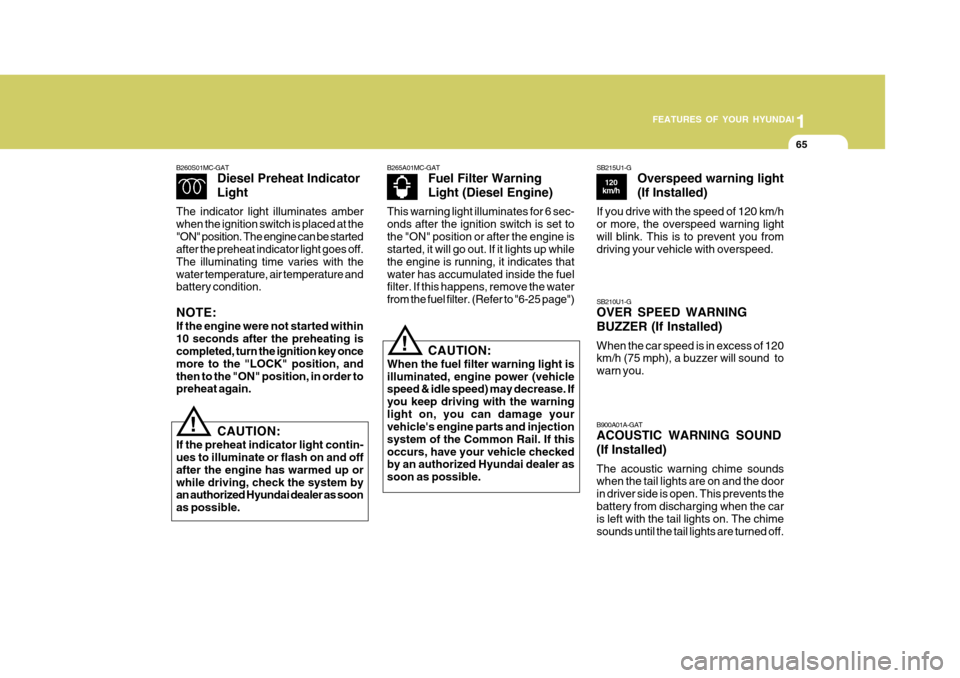
B265A01MC-GAT Fuel Filter Warning Light (Diesel Engine)
This warning light illuminates for 6 sec- onds after the ignition switch is set tothe "ON" position or after the engine is started, it will go out. If it lights up while the engine is running, it indicates thatwater has accumulated inside the fuel filter. If this happens, remove the water from the fuel filter. (Refer to "6-25 page")
B260S01MC-GAT
Diesel Preheat Indicator Light
The indicator light illuminates amber when the ignition switch is placed at the"ON" position. The engine can be started after the preheat indicator light goes off. The illuminating time varies with thewater temperature, air temperature and battery condition. NOTE: If the engine were not started within 10 seconds after the preheating is completed, turn the ignition key once more to the "LOCK" position, andthen to the "ON" position, in order to preheat again.
! CAUTION:
If the preheat indicator light contin- ues to illuminate or flash on and off after the engine has warmed up orwhile driving, check the system by an authorized Hyundai dealer as soon as possible.
! CAUTION:
When the fuel filter warning light is illuminated, engine power (vehicle speed & idle speed) may decrease. If you keep driving with the warninglight on, you can damage your vehicle's engine parts and injection system of the Common Rail. If thisoccurs, have your vehicle checked by an authorized Hyundai dealer as soon as possible. B900A01A-GAT ACOUSTIC WARNING SOUND (If Installed) The acoustic warning chime sounds when the tail lights are on and the door in driver side is open. This prevents thebattery from discharging when the car is left with the tail lights on. The chime sounds until the tail lights are turned off.
SB210U1-G OVER SPEED WARNING BUZZER (If Installed) When the car speed is in excess of 120 km/h (75 mph), a buzzer will sound to warn you.
SB215U1-G
Overspeed warning light (If Installed)
If you drive with the speed of 120 km/h or more, the overspeed warning lightwill blink. This is to prevent you from driving your vehicle with overspeed.
120
km/h
Page 78 of 282
1FEATURES OF YOUR HYUNDAI
66
B270A01A-AAT BRAKE PAD WEAR WARNING SOUND The front disc brake pads have wear indicators that should make a high- pitched squealing or scraping noisewhen new pads are needed. The sound may come and go or be heard all the time when the vehicle is moving. It mayalso be heard when the brake pedal is pushed down firmly. Excessive rotor damage will result if the worn pads arenot replaced. See your Hyundai dealer immediately.
!
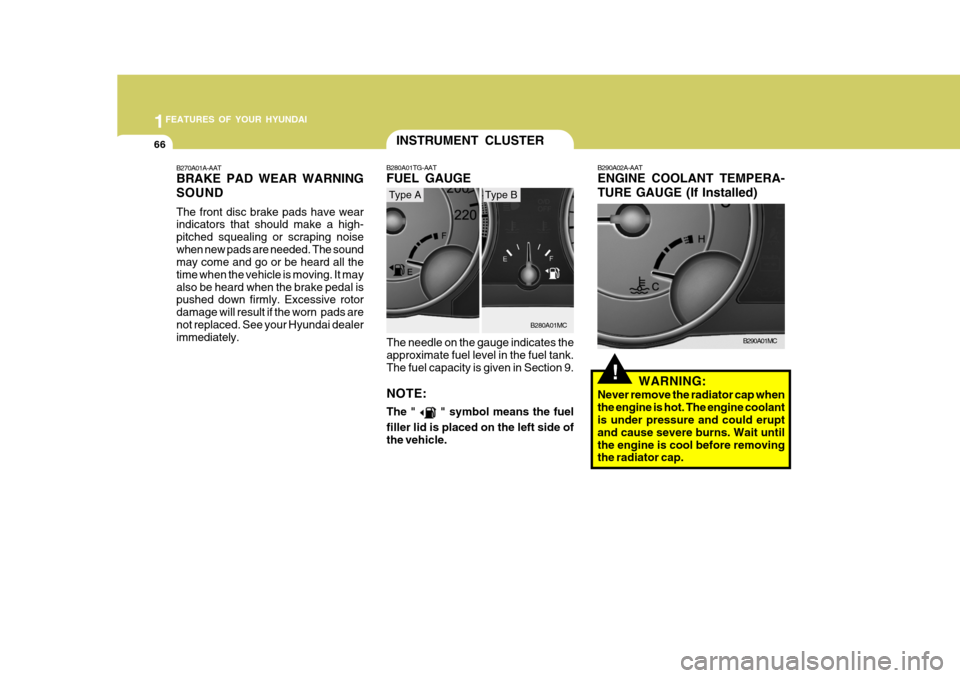
B290A02A-AAT ENGINE COOLANT TEMPERA- TURE GAUGE (If Installed)
WARNING:
Never remove the radiator cap when the engine is hot. The engine coolant is under pressure and could erupt and cause severe burns. Wait untilthe engine is cool before removing the radiator cap.
B290A01MC
INSTRUMENT CLUSTER
The needle on the gauge indicates the approximate fuel level in the fuel tank. The fuel capacity is given in Section 9. NOTE: The "
" symbol means the fuel
filler lid is placed on the left side of the vehicle.
B280A01TG-AAT FUEL GAUGE
B280A01MC
Type AType B
Page 81 of 282
1
FEATURES OF YOUR HYUNDAI
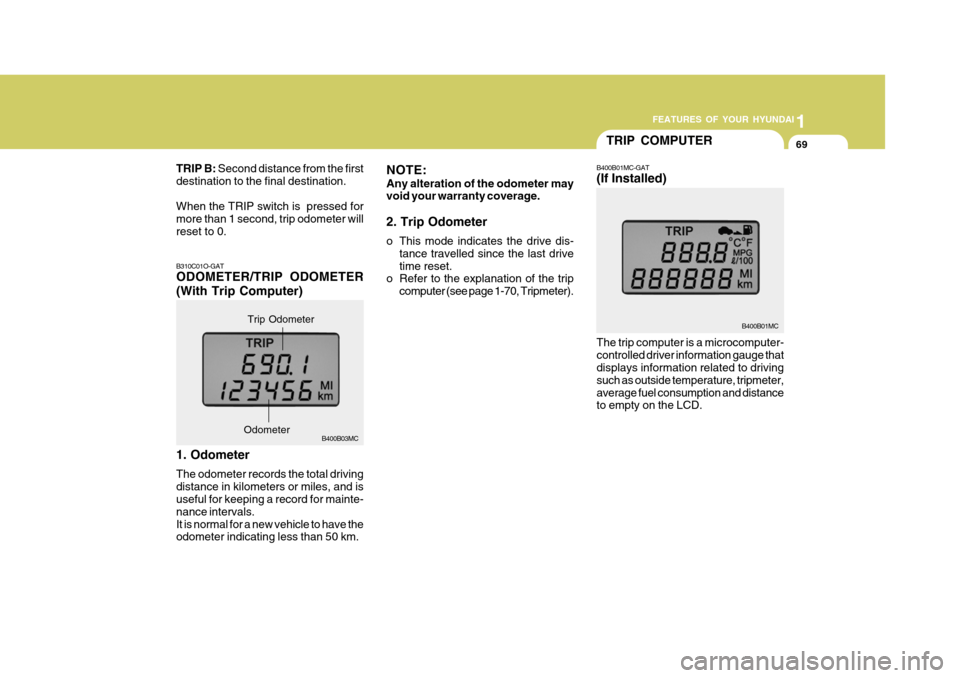
69TRIP COMPUTER
B400B01MC
The trip computer is a microcomputer- controlled driver information gauge that displays information related to driving such as outside temperature, tripmeter,average fuel consumption and distance to empty on the LCD.
B400B01MC-GAT (If Installed)
TRIP B:
Second distance from the first
destination to the final destination. When the TRIP switch is pressed for more than 1 second, trip odometer willreset to 0. NOTE: Any alteration of the odometer may void your warranty coverage. 2. Trip Odometer
o This mode indicates the drive dis-
tance travelled since the last drive time reset.
o Refer to the explanation of the trip
computer (see page 1-70, Tripmeter).
B310C01O-GAT ODOMETER/TRIP ODOMETER (With Trip Computer) 1. Odometer The odometer records the total driving distance in kilometers or miles, and is useful for keeping a record for mainte- nance intervals.It is normal for a new vehicle to have the odometer indicating less than 50 km. B400B03MC
Trip Odometer
Odometer
Page 82 of 282
1FEATURES OF YOUR HYUNDAI
70
OUTSIDE TEMPERATURETRIPMETER
AVERAGE FUEL CONSUMPTION DISTANCE TO EMPTY
TRIP Switch
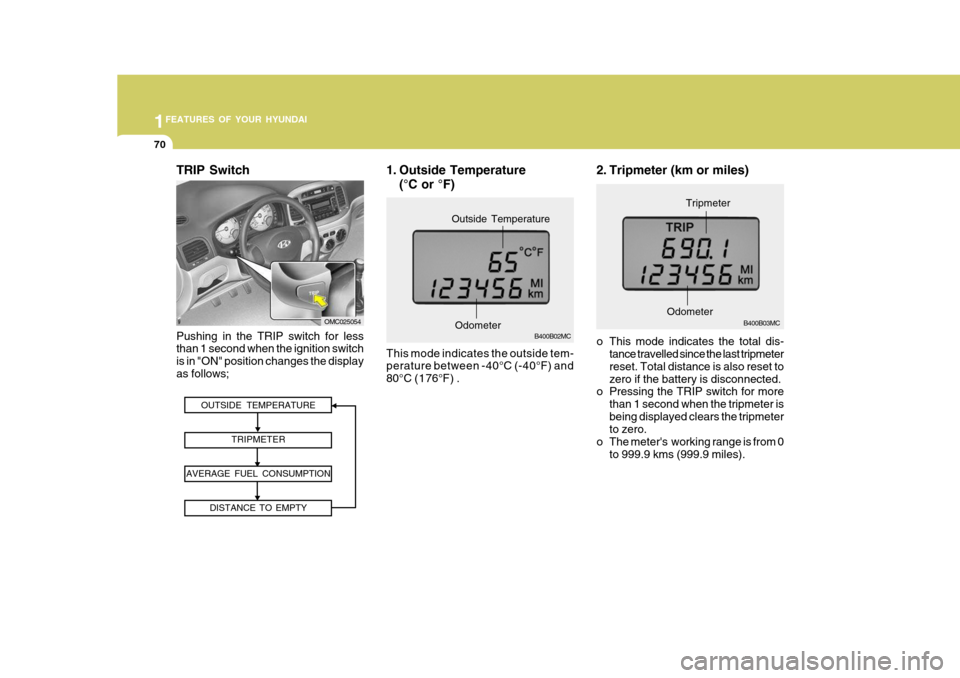
Pushing in the TRIP switch for less than 1 second when the ignition switch is in "ON" position changes the displayas follows;
1. Outside Temperature(°C or °F)
This mode indicates the outside tem-
perature between -40°C (-40°F) and
80°C (176°F) . B400B02MC
Odometer
Outside Temperature
2. Tripmeter (km or miles)
o This mode indicates the total dis-
tance travelled since the last tripmeter reset. Total distance is also reset tozero if the battery is disconnected.
o Pressing the TRIP switch for more
than 1 second when the tripmeter isbeing displayed clears the tripmeter to zero.
o The meter's working range is from 0 to 999.9 kms (999.9 miles). B400B03MC
Odometer Tripmeter
OMC025054
Page 83 of 282
1
FEATURES OF YOUR HYUNDAI
71
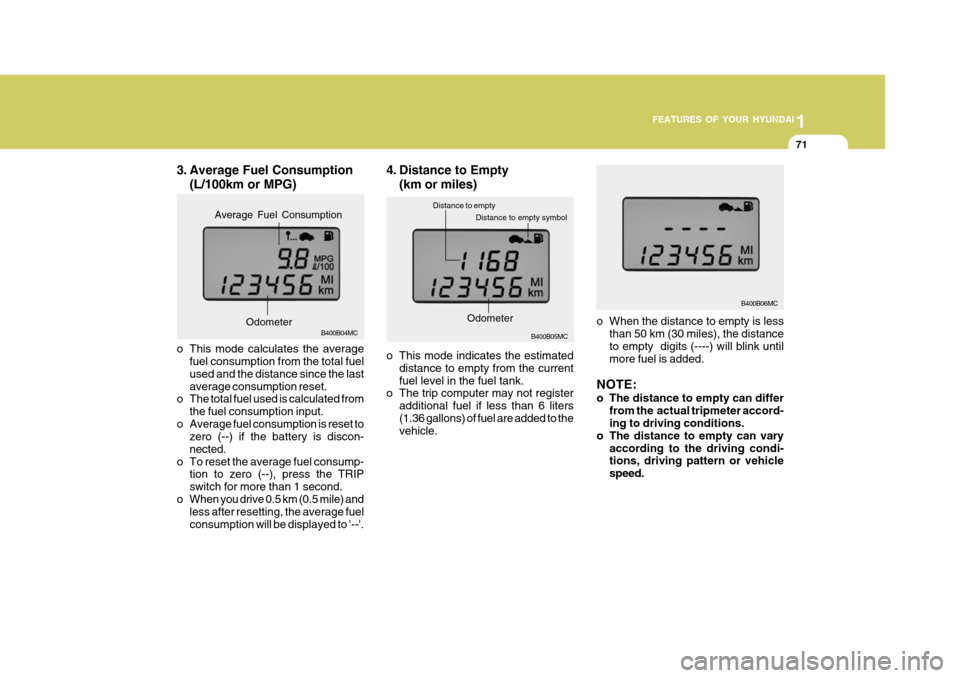
3. Average Fuel Consumption
(L/100km or MPG)
B400B04MC
o This mode calculates the average fuel consumption from the total fuel used and the distance since the lastaverage consumption reset.
o The total fuel used is calculated from
the fuel consumption input.
o Average fuel consumption is reset to zero (--) if the battery is discon-nected.
o To reset the average fuel consump- tion to zero (--), press the TRIPswitch for more than 1 second.
o When you drive 0.5 km (0.5 mile) and less after resetting, the average fuelconsumption will be displayed to '--'.
Odometer
Average Fuel Consumption
o When the distance to empty is less
than 50 km (30 miles), the distance to empty digits (----) will blink untilmore fuel is added.
NOTE:
o The distance to empty can differ from the actual tripmeter accord- ing to driving conditions.
o The distance to empty can vary according to the driving condi-tions, driving pattern or vehicle speed.
4. Distance to Empty
(km or miles)
o This mode indicates the estimated distance to empty from the currentfuel level in the fuel tank.
o The trip computer may not register
additional fuel if less than 6 liters(1.36 gallons) of fuel are added to the vehicle. B400B05MC
Distance to empty symbol
Distance to empty
B400B06MC
Odometer
Page 104 of 282
1FEATURES OF YOUR HYUNDAI
92
WARNING:
o Fuel vapors are dangerous. Be- fore refueling, always stop the en- gine and never allow sparks or open flames near the filler area. If you need to replace the filler cap,use a genuine Hyundai replace- ment part. If you open the fuel filler cap dur-ing high ambient temperatures, a slight "pressure sound" may be heard. This is normal and not acause for concern. Whenever you open the fuel filler cap, turn it slowly.!
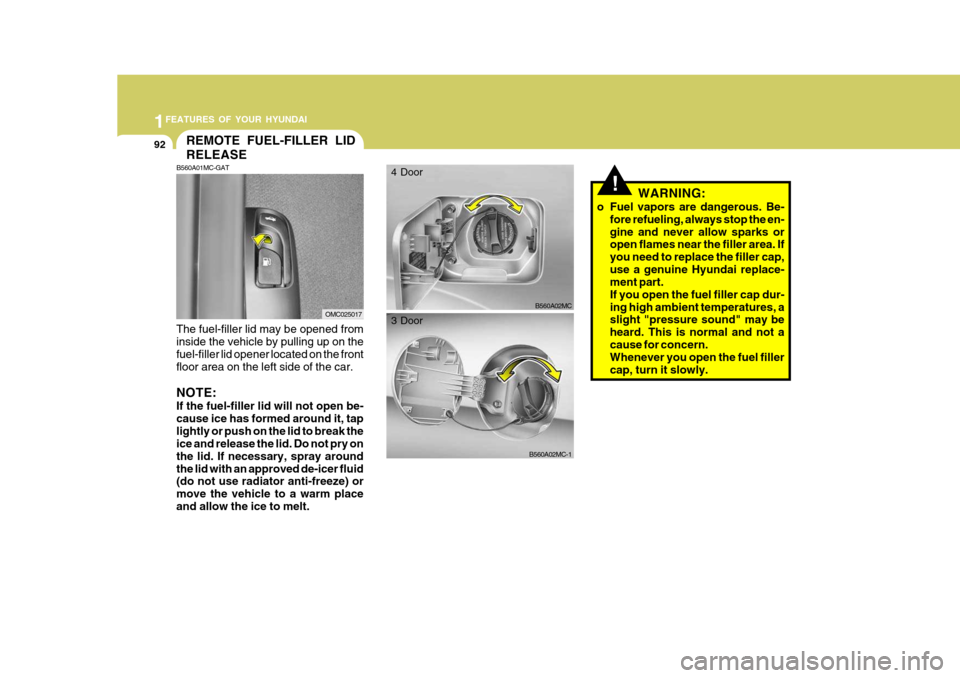
REMOTE FUEL-FILLER LID RELEASE
B560A01MC-GAT
The fuel-filler lid may be opened from inside the vehicle by pulling up on the fuel-filler lid opener located on the front floor area on the left side of the car. NOTE: If the fuel-filler lid will not open be- cause ice has formed around it, taplightly or push on the lid to break the ice and release the lid. Do not pry on the lid. If necessary, spray aroundthe lid with an approved de-icer fluid (do not use radiator anti-freeze) or move the vehicle to a warm placeand allow the ice to melt.
OMC025017B560A02MC
4 Door
B560A02MC-1
3 Door
Page 105 of 282
1
FEATURES OF YOUR HYUNDAI
93
If you must re-enter the vehicle, you should once again elimi- nate potentially dangerous staticelectricity discharge by touch- ing a metal part of the vehicle, away from the fuel filler neck,nozzle or other gasoline source.
- When using a portable fuel con-
tainer be sure to place the con-tainer on the ground prior to refueling. Static electricity dis- charge from the container canignite fuel vapors causing a fire. Once refueling has begun, con- tact with the vehicle should bemaintained until the filling is complete. Use only portable fuel containers designed to carry andstore gasoline.
- Do not use cellular phones
around a gas station or whilerefueling any vehicle. Electric current and/or electronic inter- ference from cellular phones canpotentially ignite fuel vapors causing a fire. If you must use your cellular phone use it in aplace away from the gas station.o Automotive fuels are flammable/ explosive materials. When refuel- ing, please note the followingguidelines carefully. Failure to follow these guidelines may re- sult in severe personal injury, se-vere burns or death by fire or explosion.
- Before refueling always note the
location of the Emergency Gaso- line Shut-Off, if available, at the gas station facility.
- Before touching the fuel nozzle or fuel filler cap, you shouldeliminate potentially dangerousstatic electricity discharge by touching another metal part of the front of the vehicle, a safedistance away from the fuel filler neck, nozzle, or other gas source.
- Do not get back into a vehicle once you have begun refueling.Do not touch, rub or slide againstany item or fabric (polyester, satin, nylon, etc.) capable of pro- ducing static electricity. Staticelectricity discharge can ignite fuel vapors resulting in explo- sion.- When refueling always shut theengine off. Sparks produced by electrical components related tothe engine can ignite fuel va- pors causing a fire. Always in- sure that the engine is OFF be-fore and during refueling. Once refueling is complete, check to make sure the fuel filler cap anddoor are securely closed, before starting the engine.
- Do not light any fire around a gas station. DO NOT use matchesor a lighter and DO NOT SMOKE or leave a lit cigarette in yourvehicle while at a gas station especially during refueling. Au- tomotive fuel is highly flammableand can, when ignited, result in explosion by flames.
- If a fire breaks out during refuel- ing, leave the vicinity of the ve-hicle, and immediately contact the manager of the gas stationor contact the police and local fire department. Follow any safety instructions they provide.
Page 166 of 282
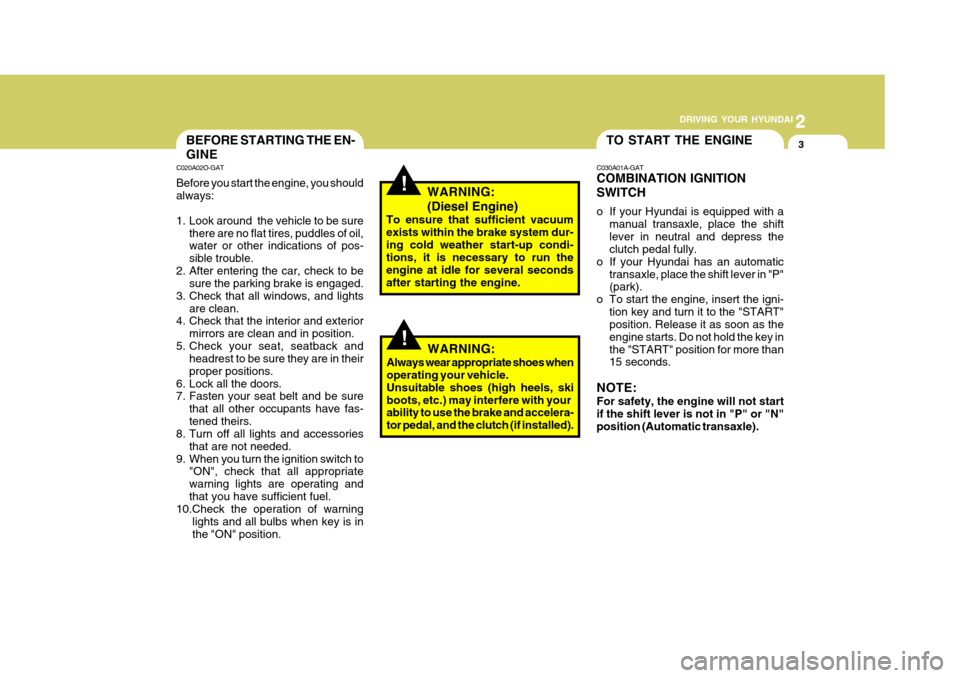
2
DRIVING YOUR HYUNDAI
3
2
DRIVING YOUR HYUNDAI
3
!
BEFORE STARTING THE EN- GINE
C020A02O-GAT Before you start the engine, you should always:
1. Look around the vehicle to be sure
there are no flat tires, puddles of oil, water or other indications of pos- sible trouble.
2. After entering the car, check to be sure the parking brake is engaged.
3. Check that all windows, and lights are clean.
4. Check that the interior and exterior
mirrors are clean and in position.
5. Check your seat, seatback and headrest to be sure they are in theirproper positions.
6. Lock all the doors.
7. Fasten your seat belt and be sure
that all other occupants have fas- tened theirs.
8. Turn off all lights and accessories
that are not needed.
9. When you turn the ignition switch to "ON", check that all appropriatewarning lights are operating andthat you have sufficient fuel.
10.Check the operation of warning
lights and all bulbs when key is inthe "ON" position. WARNING:
(Diesel Engine)
To ensure that sufficient vacuum exists within the brake system dur-ing cold weather start-up condi- tions, it is necessary to run the engine at idle for several secondsafter starting the engine.TO START THE ENGINE
C030A01A-GAT COMBINATION IGNITION SWITCH
o If your Hyundai is equipped with a manual transaxle, place the shift lever in neutral and depress the clutch pedal fully.
o If your Hyundai has an automatic
transaxle, place the shift lever in "P"(park).
o To start the engine, insert the igni- tion key and turn it to the "START"position. Release it as soon as the engine starts. Do not hold the key inthe "START" position for more than 15 seconds.
NOTE: For safety, the engine will not start if the shift lever is not in "P" or "N" position (Automatic transaxle).
!WARNING:
Always wear appropriate shoes when operating your vehicle. Unsuitable shoes (high heels, skiboots, etc.) may interfere with your ability to use the brake and accelera- tor pedal, and the clutch (if installed).