battery Hyundai Accent 2007 Owner's Guide
[x] Cancel search | Manufacturer: HYUNDAI, Model Year: 2007, Model line: Accent, Model: Hyundai Accent 2007Pages: 282, PDF Size: 10.55 MB
Page 210 of 282

4
CORROSION PREVENTION AND APPEARANCE CARE
5
4
CORROSION PREVENTION AND APPEARANCE CARE
5
E030D01A-AAT When to Wax Again You should polish and wax the car again when water no longer beads on a clean surface but spreads out over alarger area. E030E01A-AAT Maintaining Bumpers Special precautions must be observed to preserve the appearance of thebumpers on your Hyundai. They are:
o Be careful not to spill battery elec-
trolyte or hydraulic brake fluid on the bumpers. If you do, wash it off im- mediately with clear water.
o Be gentle when cleaning the bumper surfaces. They are made of softplastic and the surface can be dam-aged if mistreated. Do not use abra- sive cleaners. Use warm water and mild soap or car-washing solution.
o Do not expose the bumpers to high temperatures. For example, if youhave your car repainted, do notleave the bumpers on the car if the car is going to be placed in a high- temperature paint booth.
E030B01A-AAT Spot Cleaning Don't use gasoline, strong solvents or corrosive cleaning agents. These can damage the finish of the car. To re-move road tar, use turpentine on a clean, soft cloth or commercially avail- able bug and tar remover. Be gentle.To remove dead insects or tree sap, use warm water and mild soap or car- washing solution. Soak the spot andrub gently. If the paint has lost its luster, use a commercial car-cleaning polish. E030C01A-AAT Polishing and Waxing Always wash and dry the car before polishing or waxing or using a combi-nation cleaner and wax. Use a good quality commercial product and follow the manufacturer's directions on thecontainer. Polish and wax the bright trim pieces as well as the paint.
mulated dirt, use a mild car washing solution. Be sure to rinse the surfaceafter washing to remove the solution. Never allow the solution to dry on the painted surfaces.
Page 224 of 282
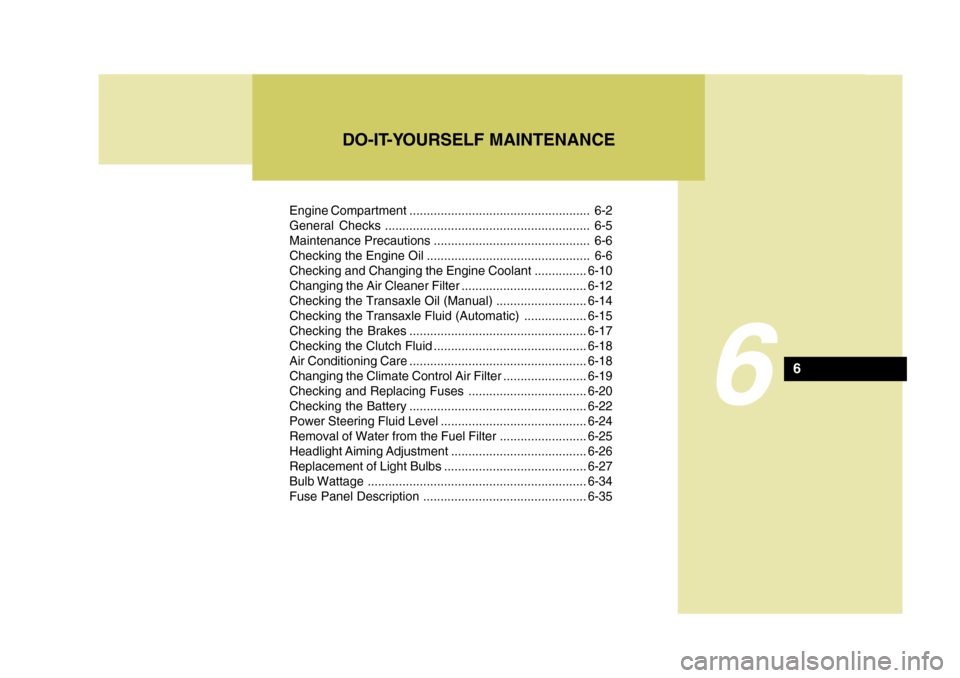
Engine Compartment .................................................... 6-2
General Checks ........................................................... 6-5
Maintenance Precautions ............................................. 6-6
Checking the Engine Oil ............................................... 6-6
Checking and Changing the Engine Coolant ...............6-10
Changing the Air Cleaner Filte r ....................................6-12
Checking the Transaxle Oil (Manual ) ..........................6-14
Checking the Transaxle Fluid (Automatic)..................6-15
Checking the B rakes ................................................... 6-17
Checking the Clutch Fluid ............................................ 6-18
Air Conditioning Care ................................................... 6-18
Changing the Climate Control Air Filter........................ 6-19
Checking and Replacing Fuses .................................. 6-20
Checking the Battery ................................................... 6-22
Power Steering Fluid Level .......................................... 6-24
Removal of Water from the Fuel Filter .........................6-25
Headlight Aiming Adjustment ....................................... 6-26
Replacement of Light Bulbs ......................................... 6-27
Bulb Wattage ............................................................... 6-34
Fuse Panel Description ............................................... 6-35
DO-IT-YOURSELF MAINTENANCE
6
6
Page 225 of 282
6 DO-IT-YOURSELF MAINTENANCE
2ENGINE COMPARTMENT
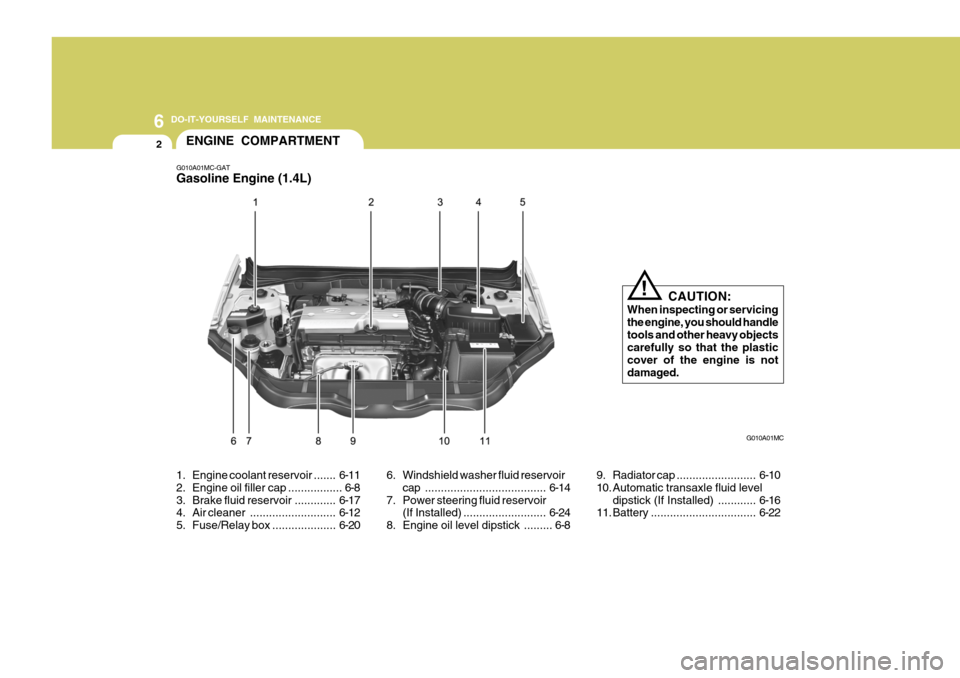
G010A01MC-GAT Gasoline Engine (1.4L)
1. Engine coolant reservoir ....... 6-11
2. Engine oil filler cap ................. 6-8
3. Brake fluid reservoir ............. 6-17
4. Air cleaner ........................... 6-12
5. Fuse/Relay box .................... 6-206. Windshield washer fluid reservoir
cap ...................................... 6-14
7. Power steering fluid reservoir (If Installed) .......................... 6-24
8. Engine oil level dipstick ......... 6-8 9. Radiator
cap ......................... 6-10
10. Automatic transaxle fluid level dipstick (If Installed) ............ 6-16
11. Battery ................................. 6-22
G010A01MC
CAUTION:
When inspecting or servicing the engine, you should handletools and other heavy objects carefully so that the plastic cover of the engine is notdamaged.
!
Page 226 of 282
6
DO-IT-YOURSELF MAINTENANCE
3
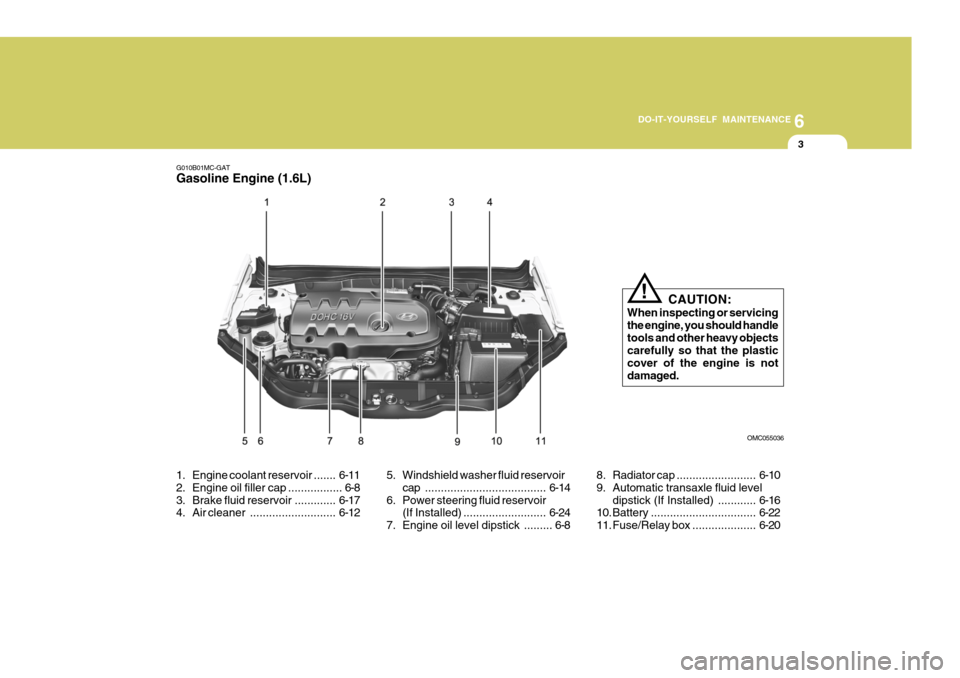
G010B01MC-GAT Gasoline Engine (1.6L)
1. Engine coolant reservoir .......
6-11
2. Engine oil filler cap ................. 6-8
3. Brake fluid reservoir ............. 6-17
4. Air cleaner ........................... 6-125. Windshield washer fluid reservoir
cap ...................................... 6-14
6. Power steering fluid reservoir (If Installed) .......................... 6-24
7. Engine oil level dipstick ......... 6-8 8. Radiator
cap ......................... 6-10
9. Automatic transaxle fluid level dipstick (If Installed) ............ 6-16
10. Battery ................................. 6-22
11. Fuse/Relay box .................... 6-20
OMC055036
CAUTION:
When inspecting or servicing the engine, you should handletools and other heavy objects carefully so that the plastic cover of the engine is notdamaged.
!
Page 227 of 282
6 DO-IT-YOURSELF MAINTENANCE
4
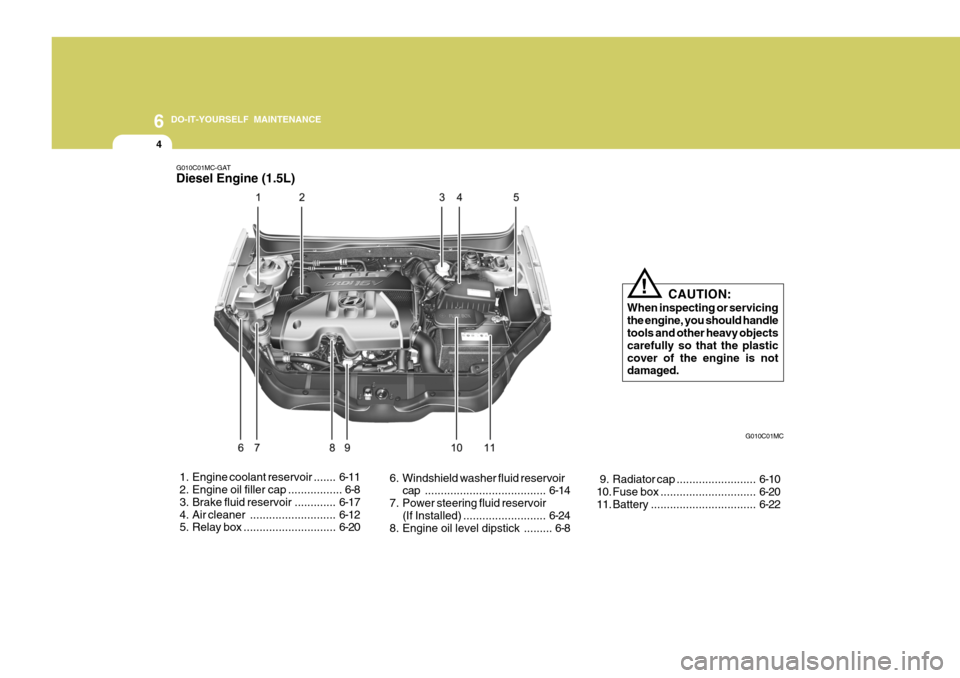
G010C01MC-GAT Diesel Engine (1.5L)
G010C01MC
1. Engine coolant reservoir ....... 6-11
2. Engine oil filler cap................. 6-8
3. Brake fluid reservoir ............. 6-17
4. Air cleaner ........................... 6-12
5. Relay box ............................. 6-20 6. Windshield washer fluid reservoir
cap ...................................... 6-14
7. Power steering fluid reservoir
(If Installed) .......................... 6-24
8. Engine oil level dipstick ......... 6-8 9. Radiator
cap ......................... 6-10
10. Fuse box .............................. 6-20
11. Battery ................................. 6-22
CAUTION:
When inspecting or servicing the engine, you should handletools and other heavy objects carefully so that the plastic cover of the engine is not damaged.
!
Page 228 of 282
6
DO-IT-YOURSELF MAINTENANCE
5
G020A01A-AAT Engine Compartment The following should be checked regu- larly:
o Engine oil level and condition
o Transaxle fluid level and condition
o Brake fluid level
o Clutch fluid level
o Engine coolant level
o Windshield washer fluid level
o Accessory drive belt condition
o Engine coolant hose condition
o Fluid leaks (on or below compo-
nents)
o Power steering fluid level
o Battery condition
o Air cleaner filter condition G020C01A-AAT Vehicle Interior The following should be checked each time when the vehicle is driven:
o Lights operation
o Windshield wiper operation
o Horn operation
o Defroster, heater system operation
(and air conditioning, if installed)
o Steering operation and condition
o Mirror condition and operation
o Turn signal operation
o Accelerator pedal operation
o Brake operation, including parking
brake
o Manual transaxle operation, includ- ing clutch operation
o Automatic transaxle operation, in- cluding "Park" mechanism opera-tion
o Seat control condition and opera- tion
o Seat belt condition and operation
o Sun visor operation If you notice anything that does not operate correctly or appears to befunctioning incorrectly, inspect it care- fully and seek assistance from your Hyundai dealer if service is needed.
G020B01A-AAT Vehicle Exterior The following should be checked monthly:
o Overall appearance and condition
o Wheel condition and wheel nut torque
o Exhaust system condition
o Light condition and operation
o Windshield glass condition
o Wiper blade condition
o Paint condition and body corrosion
o Fluid leaks
o Door and hood lock condition
o Tire pressure and condition
(including spare tire)
GENERAL CHECKS
Page 243 of 282
6 DO-IT-YOURSELF MAINTENANCE
20
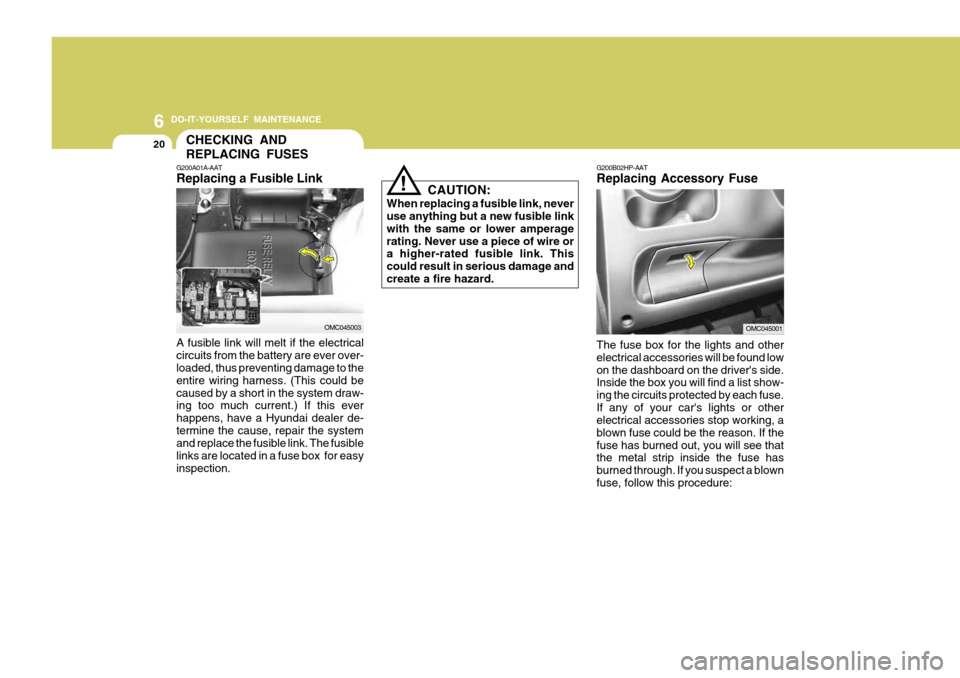
G200B02HP-AAT Replacing Accessory Fuse The fuse box for the lights and other electrical accessories will be found lowon the dashboard on the driver's side. Inside the box you will find a list show- ing the circuits protected by each fuse.If any of your car's lights or other electrical accessories stop working, a blown fuse could be the reason. If thefuse has burned out, you will see that the metal strip inside the fuse has burned through. If you suspect a blownfuse, follow this procedure:
OMC045001
CAUTION:
When replacing a fusible link, never use anything but a new fusible link with the same or lower amperagerating. Never use a piece of wire or a higher-rated fusible link. This could result in serious damage andcreate a fire hazard.
!
CHECKING AND REPLACING FUSES
G200A01A-AAT Replacing a Fusible Link
OMC045003
A fusible link will melt if the electrical circuits from the battery are ever over- loaded, thus preventing damage to the entire wiring harness. (This could becaused by a short in the system draw- ing too much current.) If this ever happens, have a Hyundai dealer de-termine the cause, repair the system and replace the fusible link. The fusible links are located in a fuse box for easyinspection.
Page 245 of 282
6 DO-IT-YOURSELF MAINTENANCE
22
!
CHECKING THE BATTERY
G210A01A-AAT
WARNING:
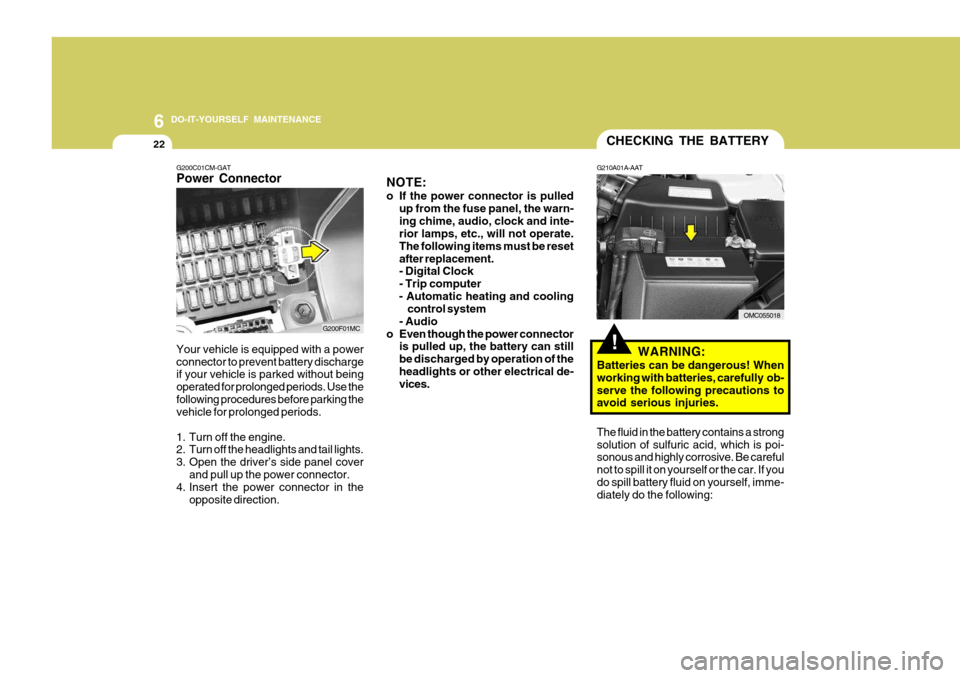
Batteries can be dangerous! When working with batteries, carefully ob-serve the following precautions to avoid serious injuries. The fluid in the battery contains a strong solution of sulfuric acid, which is poi- sonous and highly corrosive. Be careful not to spill it on yourself or the car. If youdo spill battery fluid on yourself, imme- diately do the following:
OMC055018
G200C01CM-GAT Power Connector
NOTE:
o If the power connector is pulled
up from the fuse panel, the warn- ing chime, audio, clock and inte- rior lamps, etc., will not operate. The following items must be resetafter replacement. - Digital Clock - Trip computer
- Automatic heating and cooling control system
- Audio
o Even though the power connector is pulled up, the battery can stillbe discharged by operation of theheadlights or other electrical de- vices.
Your vehicle is equipped with a power connector to prevent battery discharge if your vehicle is parked without being operated for prolonged periods. Use thefollowing procedures before parking the vehicle for prolonged periods.
1. Turn off the engine.
2. Turn off the headlights and tail lights.
3. Open the driver’s side panel cover
and pull up the power connector.
4. Insert the power connector in the
opposite direction.
G200F01MC
Page 246 of 282
6
DO-IT-YOURSELF MAINTENANCE
23
G210B01Y-GAT Checking the Battery Keep the battery clean. Any evidence of corrosion around the battery postsor terminals should be removed using a solution of household baking soda and warm water. After the battery ter-minals are dry, cover them with a light coating of grease.
Keep batteries out of the reach of children because batteries contain highly cor- rosive SULFURIC ACID. Donot allow battery acid to con- tact your skin, eyes, cloth- ing or paint finish.If any electrolyte gets into your eyes, flush your eyes with clean water for at least15 minutes and get immedi- ate medical attention. If pos- sible, continue to applywater with a sponge or cloth until medical attention is re- ceived.If electrolyte gets on your skin, thoroughly wash the contacted area.If you feel a pain or a burn- ing sensation, get medical attention immediately.Wear eye protection when charging or working near a battery.Always provide ventilation when working in an en- closed space.
WARNING: Always read the following instructions carefully when handling a battery.Keep lighted cigarettes and all other flames or sparks away from the battery.Hydrogen, which is a highly combustible gas, is always present in battery cells andmay explode if ignited.!
o If battery fluid is on your skin, flush the affected areas with water for at least 15 minutes and then seek medi- cal assistance.
o If battery fluid is in your eyes, rinse
out your eyes with water and getmedical assistance as soon as pos- sible. While you are being driven toget medical assistance, continue to rinse your eyes by using a sponge or soft cloth saturated with water.
o If you swallow battery fluid, drink a large quantity of water or milk fol-lowed by milk of magnesia, eat araw egg or drink vegetable oil. Get medical assistance as soon as pos- sible.
While batteries are being charged (ei-ther by a battery charger or by thevehicle's alternator), they produce ex- plosive gases. Always observe these warnings to prevent injuries from oc-curring:
o Charge batteries only in a well ven- tilated area.
o Do not permit flames, sparks or
smoking in the area.
o Keep children away from the area.
Page 247 of 282
6 DO-IT-YOURSELF MAINTENANCE
24
o When lifting a plastic-cased bat-
tery, excessive pressure on the case may cause battery acid to leak, resulting in personal injury.Lift with a battery carrier or with your hands on opposite corners.
o Never attempt to charge the bat-
tery when the battery cables areconnected.
o The electrical ignition system
works with high voltage.Never touch these components with the engine running or the ignition switched on.
CHECKING ELECTRIC COOLING FANS
!
G220B01A-AAT Checking Engine Cooling Fan The engine cooling fan should come on automatically if the engine coolant tem-perature is high. G220C01TB-GAT Checking Condenser Cooling Fan When the air conditioning is in opera- tion, the condenser cooling fan comeson automatically to be controlled by ECU.G220A01A-AAT
WARNING:
The cooling fan is controlled by en- gine coolant temperature and may sometimes operate even when the engine is not running. Use extremecaution when working near the blades of the cooling fan, so that you are not injured by a rotating fanblade. As the engine coolant temper- ature decreases the fan will automat- ically shut off. This is a normal con-dition.
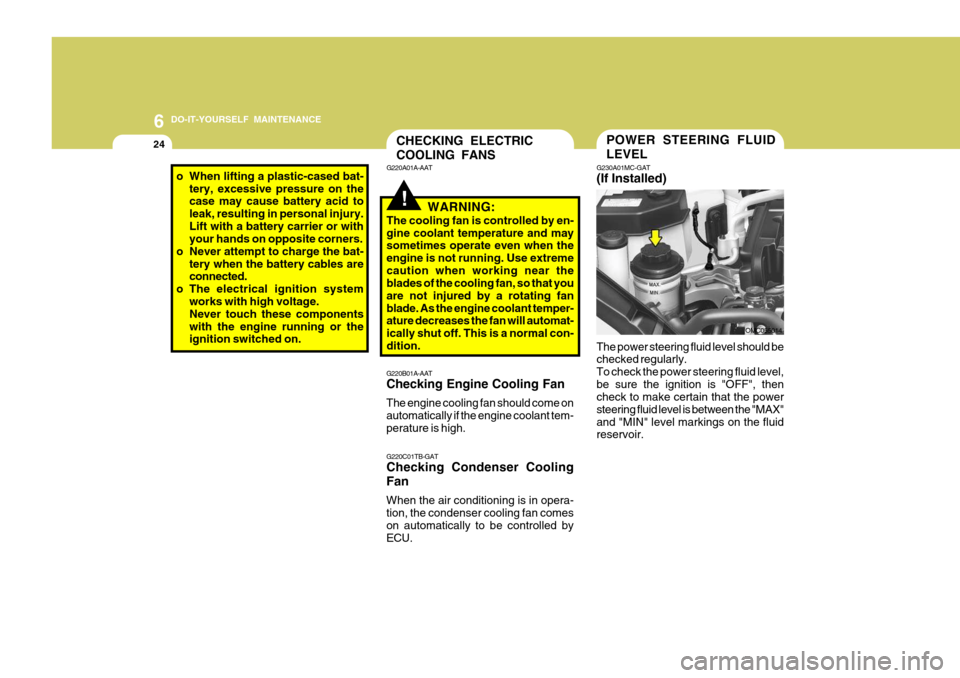
POWER STEERING FLUID LEVEL
G230A01MC-GAT (If Installed) The power steering fluid level should be checked regularly. To check the power steering fluid level,be sure the ignition is "OFF", then check to make certain that the power steering fluid level is between the "MAX"and "MIN" level markings on the fluid reservoir. OMC055014