Spare Hyundai Accent 2007 Owner's Manual
[x] Cancel search | Manufacturer: HYUNDAI, Model Year: 2007, Model line: Accent, Model: Hyundai Accent 2007Pages: 282, PDF Size: 10.55 MB
Page 16 of 282
1FEATURES OF YOUR HYUNDAI
4KEYS
B020B01FC-GAT During the First 1,000 Km (600 Miles) (Diesel Engine) No formal "break-in" procedure is re- quired with your new Hyundai. How- ever, you can contribute to the eco- nomical operation and durability of your Hyundai by observing the following rec- ommendations during the first 1,000km (600 miles).
o While driving, keep your engine speed (rpm, or revolutions per minute) within 3,000 rpm.
o While driving, keep under three quar- ters of maximum speed.
o Use moderate acceleration. Don't
start, depress the accelerator pedal fully.
o For the first 300 km (200 miles), try
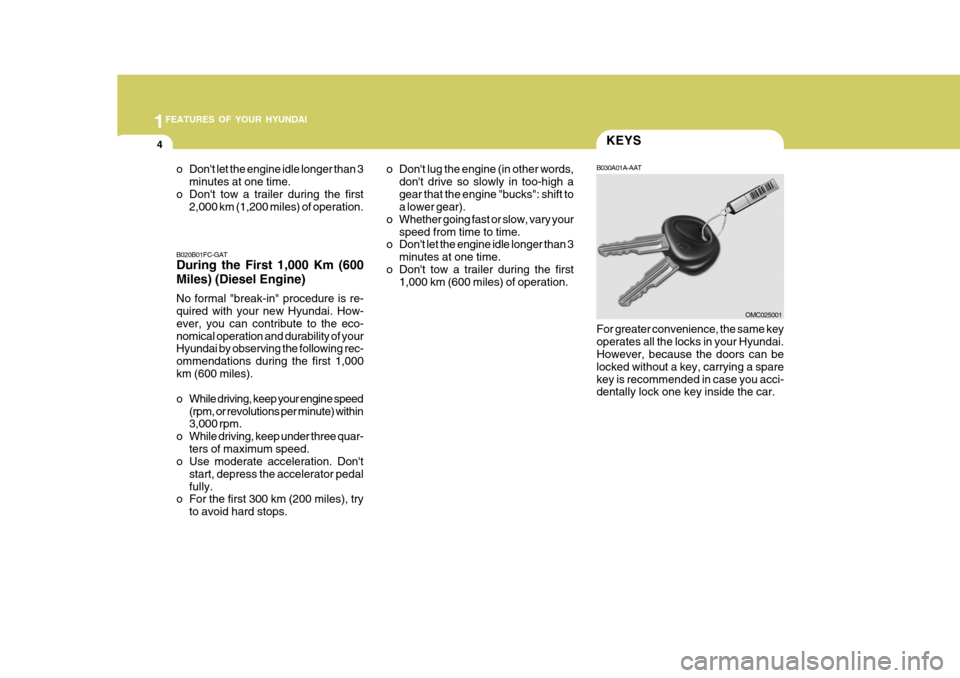
to avoid hard stops. B030A01A-AAT For greater convenience, the same key operates all the locks in your Hyundai. However, because the doors can be locked without a key, carrying a sparekey is recommended in case you acci- dentally lock one key inside the car.
o Don't lug the engine (in other words,
don't drive so slowly in too-high a gear that the engine "bucks": shift to a lower gear).
o Whether going fast or slow, vary your speed from time to time.
o Don't let the engine idle longer than 3
minutes at one time.
o Don't tow a trailer during the first 1,000 km (600 miles) of operation.
OMC025001
o Don't let the engine idle longer than 3
minutes at one time.
o Don't tow a trailer during the first 2,000 km (1,200 miles) of operation.
Page 188 of 282
2
DRIVING YOUR HYUNDAI
25
2
DRIVING YOUR HYUNDAI
25
C190F02A-GAT Trailer or Vehicle Towing Tips
1. Before towing, check hitch and safety chain connections as well as proper operation of the trailer running lights, brake lights, and turn signals.
2. Always drive your vehicle at a mod- erate speed (Less than 100 km/h).
3. Trailer towing requires more fuel than normal conditions.
4. To maintain engine braking effi-
ciency, do not tow a trailer withtransaxle in fifth gear (manual transaxle) or an overdrive gear (au- tomatic transaxle).
5. Always secure items in the trailer to prevent load shift while driving.
6. Check the condition and air pres- sure of all tires on the trailer and your car. Low tire pressure can seriously affect the handling. Alsocheck the spare tire.
7. The vehicle/trailer combination is
more affected by crosswind andbuffeting.
GAWR. Improper trailer loading and/or too much luggage in thetrunk can overload the rear axle. Redistribute the load and check the axle weight again.
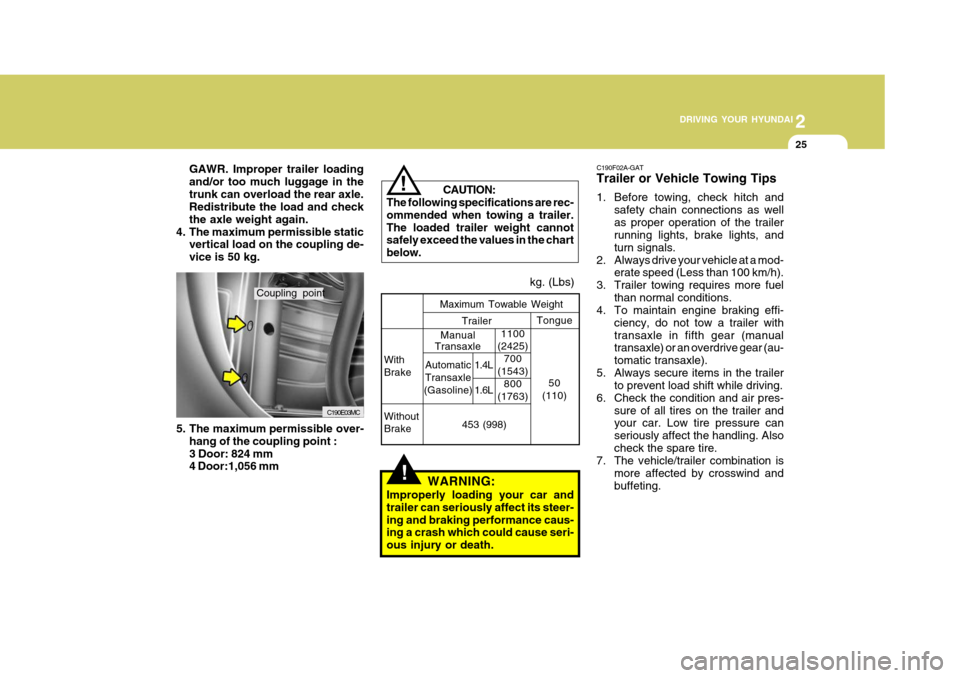
4. The maximum permissible static vertical load on the coupling de-vice is 50 kg.
5. The maximum permissible over- hang of the coupling point :3 Door: 824 mm 4 Door:1,056 mm
Maximum Towable Weight kg. (Lbs)
Coupling point CAUTION:
The following specifications are rec- ommended when towing a trailer.The loaded trailer weight cannot safely exceed the values in the chart below.
!
Manual
Transaxle 1100
(2425)
700
(1543) 800
(1763)
453 (998)
Trailer
Tongue
50
(110)
With Brake Without Brake
Automatic Transaxle
(Gasoline) 1.4L 1.6L
!WARNING:
Improperly loading your car and trailer can seriously affect its steer-ing and braking performance caus- ing a crash which could cause seri- ous injury or death.
C190E03MC
Page 190 of 282
3
If the Engine Will not Start ............................................ 3-2
Jump Starting ............................................................... 3-3
If the Engine Overheats ............................................... 3-4
Spare Tire .................................................................... 3-5
If You Have a Flat Tire ................................................. 3-6
Changing a Flat Tire .................................................... 3-7Emergency Commodity.............................................. 3-11
If Your Vehicle Must Be Towed .................................. 3-13
Emergency Towing ..................................................... 3-14
If You Lose Your K eys ................................................ 3-16
WHAT TO DO IN AN EMERGENCY
3
Page 194 of 282
3
WHAT TO DO IN AN EMERGENCY
5
!!
SPARE TIRE
WARNING (Diesel Only):
Never work on injection system with engine running or within 30 sec- onds after shutting off engine. High pressure pump, rail, injectors andhigh pressure pipes are subject to high pressure even after the engine stopped. The fuel jet produced byfuel leaks may cause serious in- jury, if it touch the body. People using pacemakers should not movethan 30cm closer to the ECU or wiring harness within the engine room while engine is running, sincethe high currents in the Common Rail system produce considerable magnetic fields. WARNING:
Do not remove the radiator cap whenthe engine is hot. This can allowcoolant to be blown out of the open- ing and cause serious burns.
6. If you cannot find the cause of the overheating, wait until the engine temperature has returned to nor-mal. Then, if the engine coolant has been lost, carefully add coolant to the reservoir (Page 6-11) to bring thefluid level in the reservoir up to the halfway mark.
7. Proceed with caution, keeping alert
for further signs of overheating. Ifoverheating happens again, call a Hyundai dealer for assistance.
!
5. If the water pump drive belt is broken
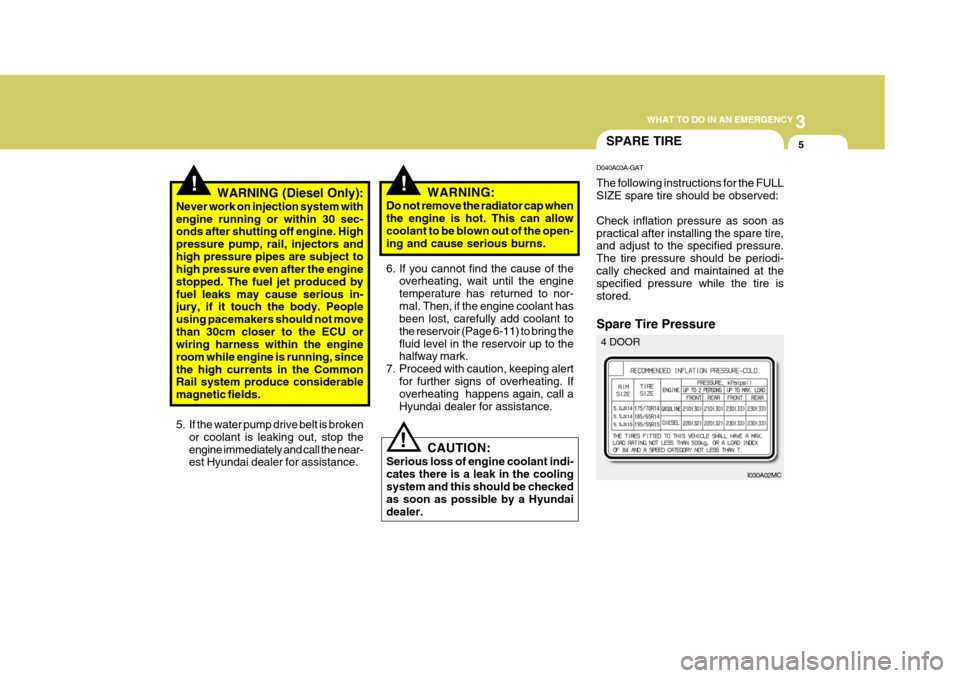
or coolant is leaking out, stop the engine immediately and call the near- est Hyundai dealer for assistance. D040A03A-GAT The following instructions for the FULL SIZE spare tire should be observed: Check inflation pressure as soon as practical after installing the spare tire, and adjust to the specified pressure. The tire pressure should be periodi-cally checked and maintained at the specified pressure while the tire is stored.
CAUTION:
Serious loss of engine coolant indi-cates there is a leak in the coolingsystem and this should be checked as soon as possible by a Hyundai dealer. Spare Tire Pressure
I030A02MC
4 DOOR
Page 195 of 282
3 WHAT TO DO IN AN EMERGENCY
6IF YOU HAVE A FLAT TIRE
D050A01A-AAT If a tire goes flat while you are driving:
1. Take your foot off the accelerator pedal and let the car slow down while driving straight ahead. Do not apply the brakes immediately or at- tempt to pull off the road as this maycause a loss of control. When the car has slowed to such a speed that it is safe to do so, brake carefullyand pull off the road. Drive off the road as far as possible and park on firm, level ground. If you are on adivided highway, do not park in the median area between the two traffic lanes.
2. When the car is stopped, turn on your emergency hazard flashers,set the parking brake and put thetransaxle in "P" (automatic) or re- verse (manual transaxle).
3. Have all passengers get out of the car. Be sure they all get out on theside of the car that is away from traffic.
4. Change the tire following instruc- tions provided on the following pages.
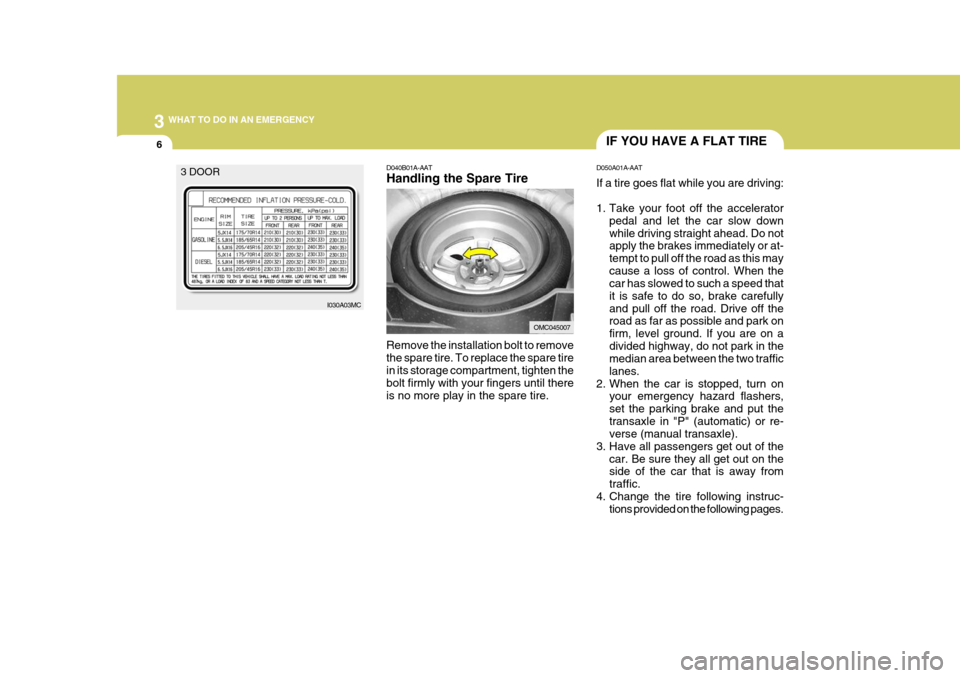
D040B01A-AAT Handling the Spare Tire Remove the installation bolt to remove the spare tire. To replace the spare tire in its storage compartment, tighten the bolt firmly with your fingers until thereis no more play in the spare tire.
OMC045007
I030A03MC
3 DOOR
Page 196 of 282
3
WHAT TO DO IN AN EMERGENCY
7
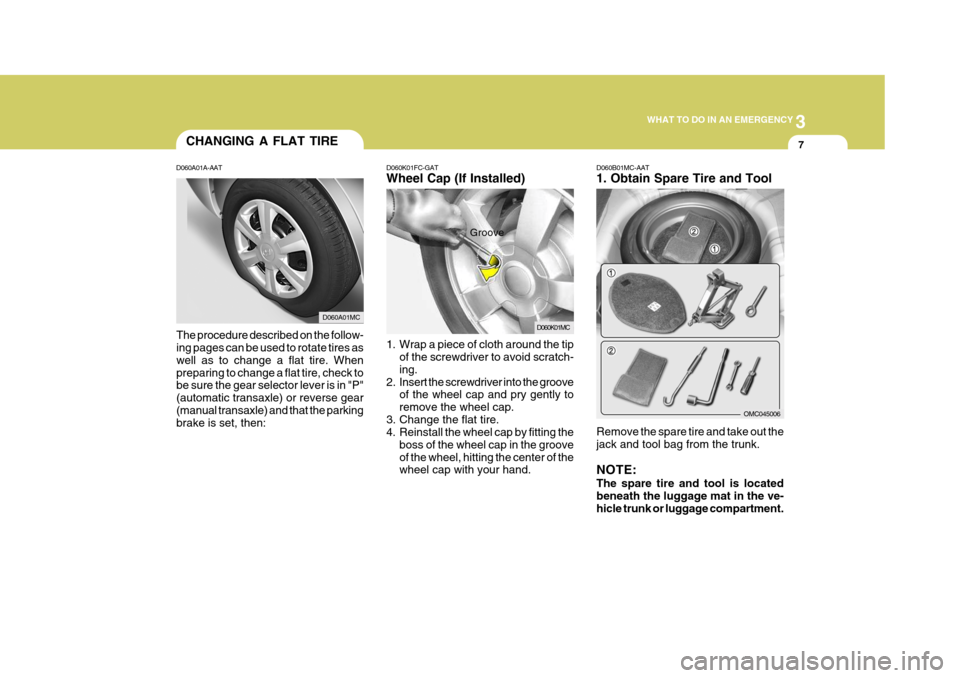
D060K01FC-GAT Wheel Cap (If Installed)
1. Wrap a piece of cloth around the tip
of the screwdriver to avoid scratch- ing.
2. Insert the screwdriver into the groove of the wheel cap and pry gently toremove the wheel cap.
3. Change the flat tire.
4. Reinstall the wheel cap by fitting the boss of the wheel cap in the groove of the wheel, hitting the center of the wheel cap with your hand.
D060A01A-AAT
The procedure described on the follow-ing pages can be used to rotate tires as well as to change a flat tire. Whenpreparing to change a flat tire, check to be sure the gear selector lever is in "P" (automatic transaxle) or reverse gear(manual transaxle) and that the parking brake is set, then: Groove
D060B01MC-AAT 1. Obtain Spare Tire and Tool Remove the spare tire and take out the jack and tool bag from the trunk. NOTE: The spare tire and tool is located beneath the luggage mat in the ve-hicle trunk or luggage compartment.
CHANGING A FLAT TIRE
D060K01MCD060A01MC
OMC045006
Page 198 of 282
3
WHAT TO DO IN AN EMERGENCY
9
!
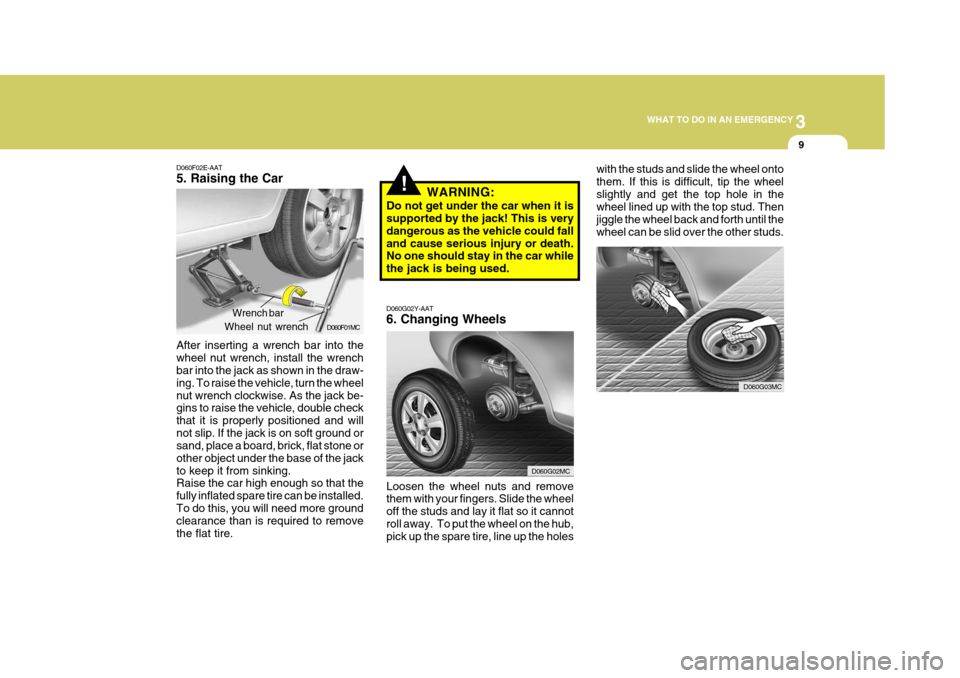
D060G02Y-AAT 6. Changing Wheels Loosen the wheel nuts and remove them with your fingers. Slide the wheel off the studs and lay it flat so it cannotroll away. To put the wheel on the hub, pick up the spare tire, line up the holes
D060F02E-AAT 5. Raising the Car After inserting a wrench bar into the wheel nut wrench, install the wrench bar into the jack as shown in the draw- ing. To raise the vehicle, turn the wheelnut wrench clockwise. As the jack be- gins to raise the vehicle, double check that it is properly positioned and willnot slip. If the jack is on soft ground or sand, place a board, brick, flat stone or other object under the base of the jackto keep it from sinking. Raise the car high enough so that the fully inflated spare tire can be installed.To do this, you will need more ground clearance than is required to remove the flat tire.
Wrench bar
Wheel nut wrench WARNING:
Do not get under the car when it is supported by the jack! This is very dangerous as the vehicle could falland cause serious injury or death. No one should stay in the car while the jack is being used.
D060F01MC with the studs and slide the wheel ontothem. If this is difficult, tip the wheelslightly and get the top hole in the wheel lined up with the top stud. Then jiggle the wheel back and forth until thewheel can be slid over the other studs.
D060G02MC
D060G03MC
Page 204 of 282
3
WHAT TO DO IN AN EMERGENCY
15
CAUTION
It should be tightened firmly with your fingers until there is no more play in the towing hole. Towing hookis located in the jack case on the spare tire.
!
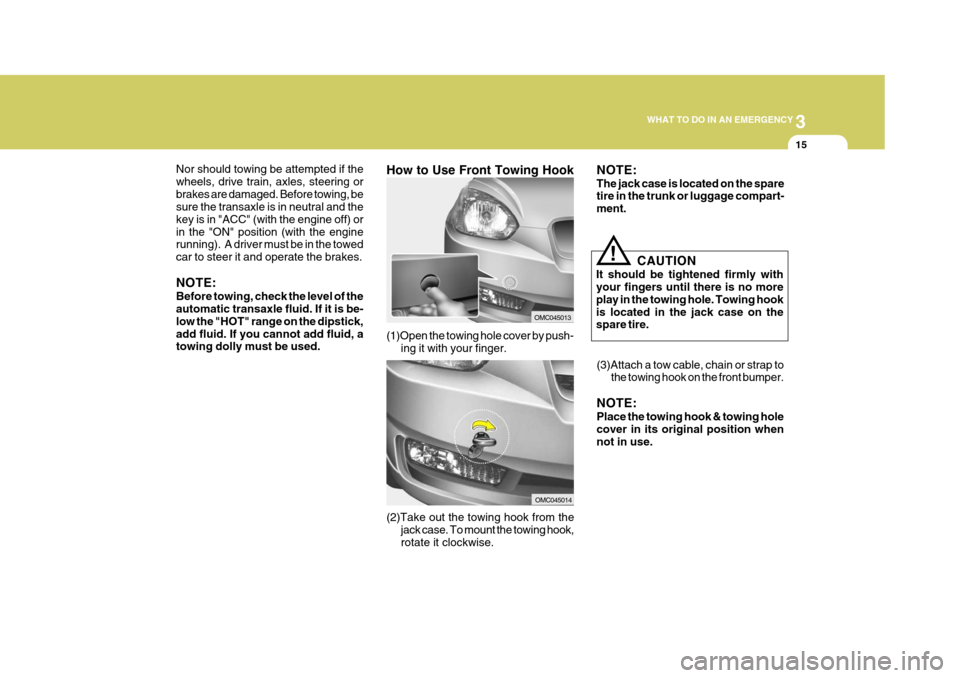
(3)Attach a tow cable, chain or strap to the towing hook on the front bumper.
NOTE: Place the towing hook & towing hole cover in its original position when not in use.
(2)Take out the towing hook from the jack case. To mount the towing hook, rotate it clockwise.
OMC045014
Nor should towing be attempted if the wheels, drive train, axles, steering orbrakes are damaged. Before towing, be sure the transaxle is in neutral and the key is in "ACC" (with the engine off) orin the "ON" position (with the engine running). A driver must be in the towed car to steer it and operate the brakes. NOTE: Before towing, check the level of the automatic transaxle fluid. If it is be- low the "HOT" range on the dipstick,add fluid. If you cannot add fluid, a towing dolly must be used.
(1)Open the towing hole cover by push-
ing it with your finger.
OMC045013
How to Use Front Towing Hook
NOTE: The jack case is located on the spare tire in the trunk or luggage compart- ment.
Page 228 of 282
6
DO-IT-YOURSELF MAINTENANCE
5
G020A01A-AAT Engine Compartment The following should be checked regu- larly:
o Engine oil level and condition
o Transaxle fluid level and condition
o Brake fluid level
o Clutch fluid level
o Engine coolant level
o Windshield washer fluid level
o Accessory drive belt condition
o Engine coolant hose condition
o Fluid leaks (on or below compo-
nents)
o Power steering fluid level
o Battery condition
o Air cleaner filter condition G020C01A-AAT Vehicle Interior The following should be checked each time when the vehicle is driven:
o Lights operation
o Windshield wiper operation
o Horn operation
o Defroster, heater system operation
(and air conditioning, if installed)
o Steering operation and condition
o Mirror condition and operation
o Turn signal operation
o Accelerator pedal operation
o Brake operation, including parking
brake
o Manual transaxle operation, includ- ing clutch operation
o Automatic transaxle operation, in- cluding "Park" mechanism opera-tion
o Seat control condition and opera- tion
o Seat belt condition and operation
o Sun visor operation If you notice anything that does not operate correctly or appears to befunctioning incorrectly, inspect it care- fully and seek assistance from your Hyundai dealer if service is needed.
G020B01A-AAT Vehicle Exterior The following should be checked monthly:
o Overall appearance and condition
o Wheel condition and wheel nut torque
o Exhaust system condition
o Light condition and operation
o Windshield glass condition
o Wiper blade condition
o Paint condition and body corrosion
o Fluid leaks
o Door and hood lock condition
o Tire pressure and condition
(including spare tire)
GENERAL CHECKS
Page 244 of 282
6
DO-IT-YOURSELF MAINTENANCE
21
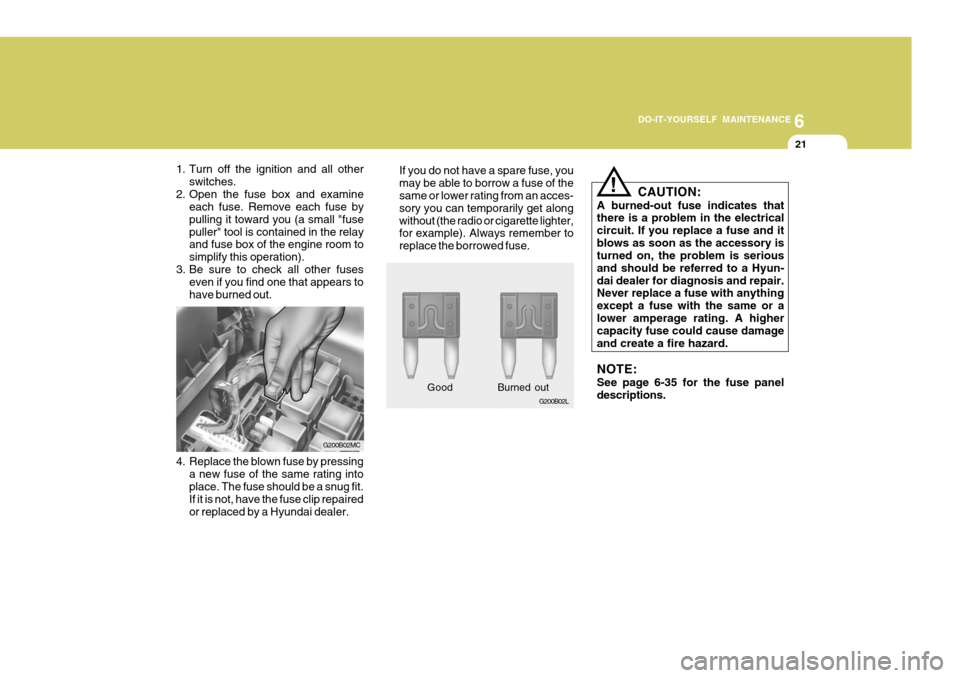
4. Replace the blown fuse by pressing
a new fuse of the same rating into place. The fuse should be a snug fit. If it is not, have the fuse clip repaired or replaced by a Hyundai dealer.
1. Turn off the ignition and all other
switches.
2. Open the fuse box and examine each fuse. Remove each fuse bypulling it toward you (a small "fusepuller" tool is contained in the relay and fuse box of the engine room to simplify this operation).
3. Be sure to check all other fuses even if you find one that appears tohave burned out.
G200B02MC
If you do not have a spare fuse, you may be able to borrow a fuse of the same or lower rating from an acces- sory you can temporarily get alongwithout (the radio or cigarette lighter, for example). Always remember to replace the borrowed fuse.
G200B02L
Good B
urned out CAUTION:
A burned-out fuse indicates that there is a problem in the electrical circuit. If you replace a fuse and itblows as soon as the accessory is turned on, the problem is serious and should be referred to a Hyun-dai dealer for diagnosis and repair. Never replace a fuse with anything except a fuse with the same or alower amperage rating. A higher capacity fuse could cause damage and create a fire hazard. NOTE: See page 6-35 for the fuse panel descriptions.
!