wheel size Hyundai Accent 2007 Owner's Manual
[x] Cancel search | Manufacturer: HYUNDAI, Model Year: 2007, Model line: Accent, Model: Hyundai Accent 2007Pages: 282, PDF Size: 10.55 MB
Page 177 of 282
2 DRIVING YOUR HYUNDAI
14
!
CAUTION:
Driving with varying tire or wheel size may cause the ESP system to malfunction. When replacing tires,make sure they are the same size as your original tires.!
ELECTRONIC STABILITY PROGRAM (ESP)
C310A01JM-AAT (If Installed) It is not a substitute for safe driving practices. Factors including speed, roadconditions and driver steering input can all affect whether ESP will be effective in preventing a loss of control. It is stillyour responsibility to drive and corner at reasonable speeds and to leave a sufficient margin of safety.
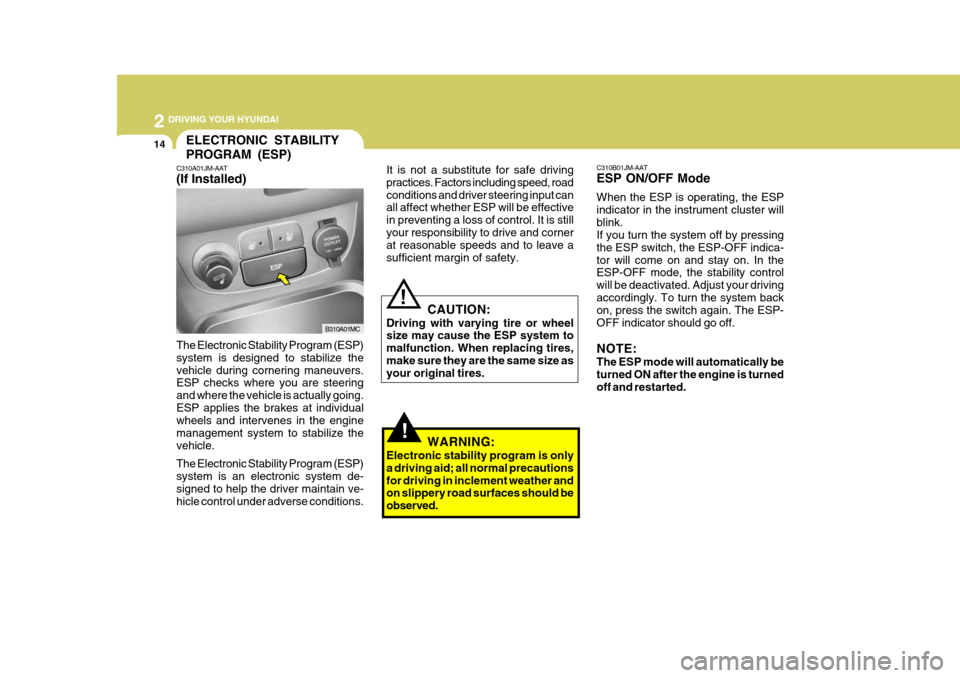
B310A01MC C310B01JM-AAT ESP ON/OFF Mode When the ESP is operating, the ESP indicator in the instrument cluster willblink. If you turn the system off by pressing the ESP switch, the ESP-OFF indica-tor will come on and stay on. In the ESP-OFF mode, the stability control will be deactivated. Adjust your drivingaccordingly. To turn the system back on, press the switch again. The ESP- OFF indicator should go off. NOTE: The ESP mode will automatically be turned ON after the engine is turnedoff and restarted.
The Electronic Stability Program (ESP)system is designed to stabilize thevehicle during cornering maneuvers. ESP checks where you are steering and where the vehicle is actually going.ESP applies the brakes at individual wheels and intervenes in the engine management system to stabilize thevehicle. The Electronic Stability Program (ESP) system is an electronic system de- signed to help the driver maintain ve- hicle control under adverse conditions. WARNING:
Electronic stability program is onlya driving aid; all normal precautionsfor driving in inclement weather and on slippery road surfaces should be observed.
Page 269 of 282

8CONSUMER INFORMATION
4
I040A02S-GAT SNOW TIRES If you equip your car with snow tires, they should be the same size and havethe same load capacity as the original tires. Snow tires should be installed on all four wheels; otherwise, poor han-dling may result. Snow tires should carry 28 kPa (4 psi) more air pressure than the pressurerecommended for the standard tires on the tire label on the driver's door edge, or up to the maximum pressure shownon the tire sidewall whichever is less. Do not drive faster than 120 km/h (75 mph) when your car is equipped withsnow tires.
These pressures were chosen to pro-vide the most satisfactory combinationof ride comfort, tire wear and stability under normal conditions. Tire pres- sures should be checked at leastmonthly. Proper tire inflation pressures should be maintained for these rea- sons:
o Lower-than-recommended tire pres-
sures cause uneven tread wear and poor handling.
o Higher-than-recommended tire
pressures increase the chance ofdamage from impacts and cause uneven tread wear. CAUTION:
Always observe the following:
o Check pressures when the tires are cold. That is, after the car has been parked for at least threehours and hasn't been driven more than 1.6 km or one mile since starting up.
o Check the pressure of your spare tire each time you check the pres-sure of other tires.
o Worn, old tires can cause acci-
dents. If your tread is badly worn, or if your tires have been dam-aged, replace them.
!
Page 270 of 282
8
CONSUMER INFORMATION
5
!
!
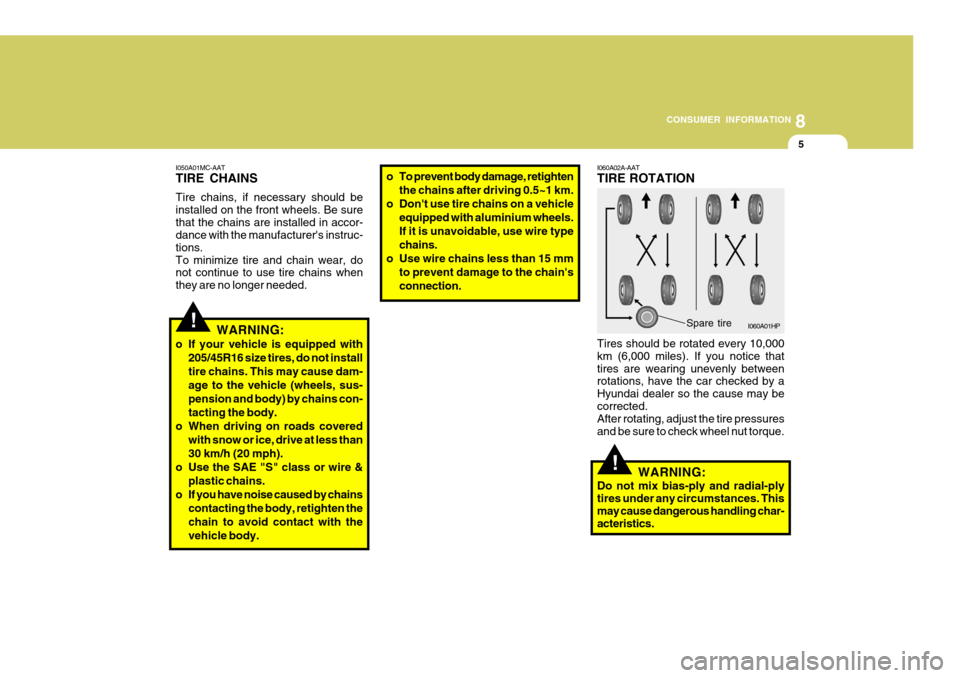
I050A01MC-AAT TIRE CHAINS Tire chains, if necessary should be installed on the front wheels. Be surethat the chains are installed in accor- dance with the manufacturer's instruc- tions.To minimize tire and chain wear, do not continue to use tire chains when they are no longer needed. I060A02A-AAT TIRE ROTATION Tires should be rotated every 10,000 km (6,000 miles). If you notice thattires are wearing unevenly between rotations, have the car checked by a Hyundai dealer so the cause may becorrected. After rotating, adjust the tire pressures and be sure to check wheel nut torque.
WARNING:
o If your vehicle is equipped with 205/45R16 size tires, do not install tire chains. This may cause dam-age to the vehicle (wheels, sus-pension and body) by chains con-tacting the body.
o When driving on roads covered with snow or ice, drive at less than30 km/h (20 mph).
o Use the SAE "S" class or wire & plastic chains.
o If you have noise caused by chains contacting the body, retighten thechain to avoid contact with thevehicle body. I060A01HP
Spare tire
WARNING:
Do not mix bias-ply and radial-ply tires under any circumstances. Thismay cause dangerous handling char- acteristics.
o To prevent body damage, retighten
the chains after driving 0.5~1 km.
o Don't use tire chains on a vehicle equipped with aluminium wheels. If it is unavoidable, use wire typechains.
o Use wire chains less than 15 mm to prevent damage to the chain'sconnection.
Page 271 of 282
8CONSUMER INFORMATION
6
I090A01MC-GAT WHEN TO REPLACE TIRES
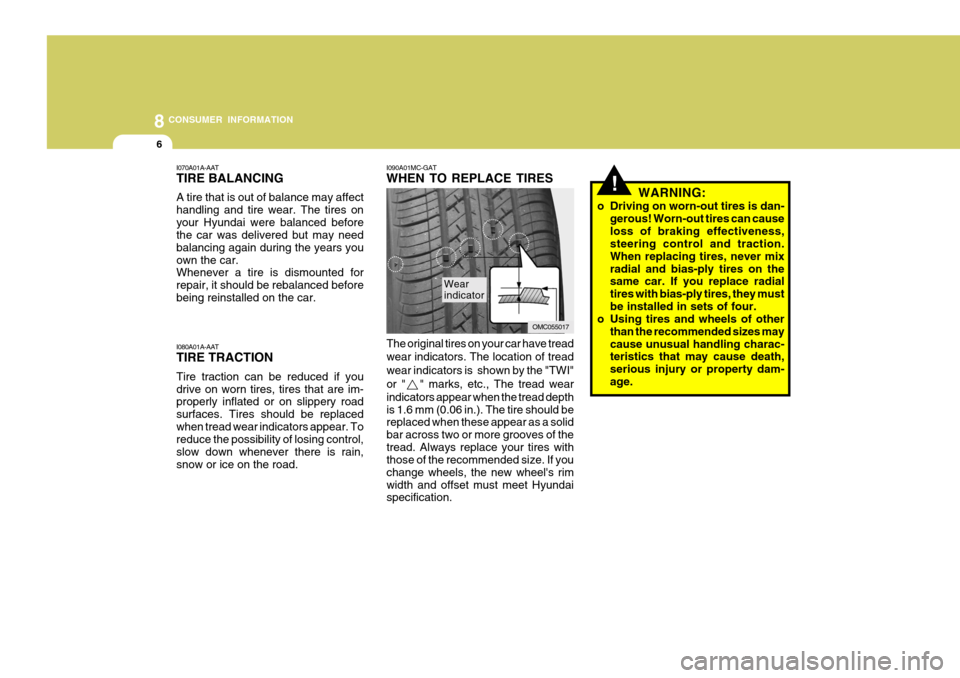
The original tires on your car have tread wear indicators. The location of tread wear indicators is shown by the "TWI"or " " marks, etc., The tread wear indicators appear when the tread depth is 1.6 mm (0.06 in.). The tire should be replaced when these appear as a solid bar across two or more grooves of thetread. Always replace your tires with those of the recommended size. If you change wheels, the new wheel's rimwidth and offset must meet Hyundai specification.
!WARNING:
o Driving on worn-out tires is dan- gerous! Worn-out tires can cause
loss of braking effectiveness, steering control and traction. When replacing tires, never mixradial and bias-ply tires on the same car. If you replace radial tires with bias-ply tires, they mustbe installed in sets of four.
o Using tires and wheels of other
than the recommended sizes maycause unusual handling charac- teristics that may cause death, serious injury or property dam-age.
OMC055017
Wear indicator
I070A01A-AAT TIRE BALANCING A tire that is out of balance may affect handling and tire wear. The tires onyour Hyundai were balanced before the car was delivered but may need balancing again during the years youown the car. Whenever a tire is dismounted for repair, it should be rebalanced beforebeing reinstalled on the car. I080A01A-AAT TIRE TRACTION Tire traction can be reduced if you drive on worn tires, tires that are im- properly inflated or on slippery road surfaces. Tires should be replacedwhen tread wear indicators appear. To reduce the possibility of losing control, slow down whenever there is rain,snow or ice on the road.
Page 274 of 282

9 VEHICLE SPECIFICATIONS
2
Type Wheel free playRack stroke Oil pump type 4 Door
4280 (168.5)
1695 (66.7)1470 (57.9) 2500 (98.4) 1470 (57.9)1460 (57.5)
ItemOverall length Overall width Overall heightWheel base Wheel tread J030A01MC-GAT TIRE
GASOLINE
MF45AH, MF55AH 90A (13.5V)
0.9 KW
Dual hydraulic with brake booster Ventilated disc Drum (without ABS)Disc (with ABS) Cable operated on rear wheel
J010A01MC-GAT MEASUREMENT
J060A01A-GAT FUEL SYSTEM
Rack and pinion 0 ~ 30 mm (0 ~ 1.18 in.) 142 mm (5.59 in.) 138 mm (5.43 in.)Vane type
175/70 R14, 185/65 R14, 195/55 R15 175/70 R14, 185/65 R14, 205/45 R16 Full size
4 Door3 Door Spare
Front Rear
mm (in.)
J020A01MC-GAT POWER STEERING Fuel tank Capacity Liter
45 Imp.gal
9.9
J040A01MC-GAT ELECTRICAL
Item Battery Alternator Starter
J050A01MC-GAT BRAKE Type Front brake type Rear brake typeParking brake
3 Door
4045 (159.3)
DIESEL
MF68AH
120A(12V) 1.7 KW
175 Tire only Except 175 Tire