brakes Hyundai Accent 2008 User Guide
[x] Cancel search | Manufacturer: HYUNDAI, Model Year: 2008, Model line: Accent, Model: Hyundai Accent 2008Pages: 273, PDF Size: 9.36 MB
Page 181 of 273
3
WHAT TO DO IN AN EMERGENCY
9
!
!
!
CAUTION:
o Do not use any tire sealant if your
vehicle is equipped with a Tire
Pressure Monitoring System. The
liquid sealant can damage the
tire pressure sensors.
o In order for the system to cor-
rectly monitor tires for under-in-
flation, there should be a total of
exactly 4 sensors fitted to each of
the four driven wheel positions.
There should be no other sen-
sors in the vehicle including spare
tire since this could cause the
system to monitor the wrong sen-
sors.
WARNING:
Tampering with, modifying, or dis-
abling the Tire Pressure Monitoring
System (TPMS) components may
interfere with the system's ability to
warn the driver of low tire pressure
conditions and/or TPMS malfunc-
tions. Tampering with, modifying,
or disabling the Tire Pressure Moni-
toring System (TPMS) components
may void the warranty for that por-
tion of the vehicle.
!
WARNING - TPMS
o The TPMS cannot alert you to
severe and sudden tire damage
caused by external factors such
as nails or road debris.
o If you feel any vehicle instability,
immediately take your foot off the
accelerator, apply the brakes
gradually and with light force,
and slowly move to a safe posi-
tion off the road.This device complies with Part 15
of the FCC rules.
Operation is subject to the following
two conditions:
1. This device may not cause harmful
interference, and
2. This device must accept any inter-
ference received, including interfer-
ence that may cause undesired op-
eration.
WARNING:
Changes or modifications not ex-
pressly approved by the party re-
sponsible for compliance could void
the user’s authority to operate the
equipment.
Page 183 of 273
3
WHAT TO DO IN AN EMERGENCY
11
IF YOU HAVE A FLAT TIRED050A01A-AATIf a tire goes flat while you are driving:
1. Take your foot off the accelerator
pedal and let the car slow down while
driving straight ahead. Do not apply
the brakes immediately or attempt to
pull off the road as this may cause a
loss of control. When the car has
slowed to such a speed that it is safe
to do so, brake carefully and pull off
the road. Drive off the road as far as
possible and park on firm, level
ground. If you are on a divided high-
way, do not park in the median area
between the two traffic lanes.
2. When the car is stopped, turn on
your emergency hazard flashers,
set the parking brake and put the
transaxle in "P" (automatic) or re-
verse (manual transaxle).
3.
Have all passengers get out of the car.
Be sure they all get out on the side of
the car that is away from traffic.
4. When changing a flat tire, follow the
instructions provided on the next
description.
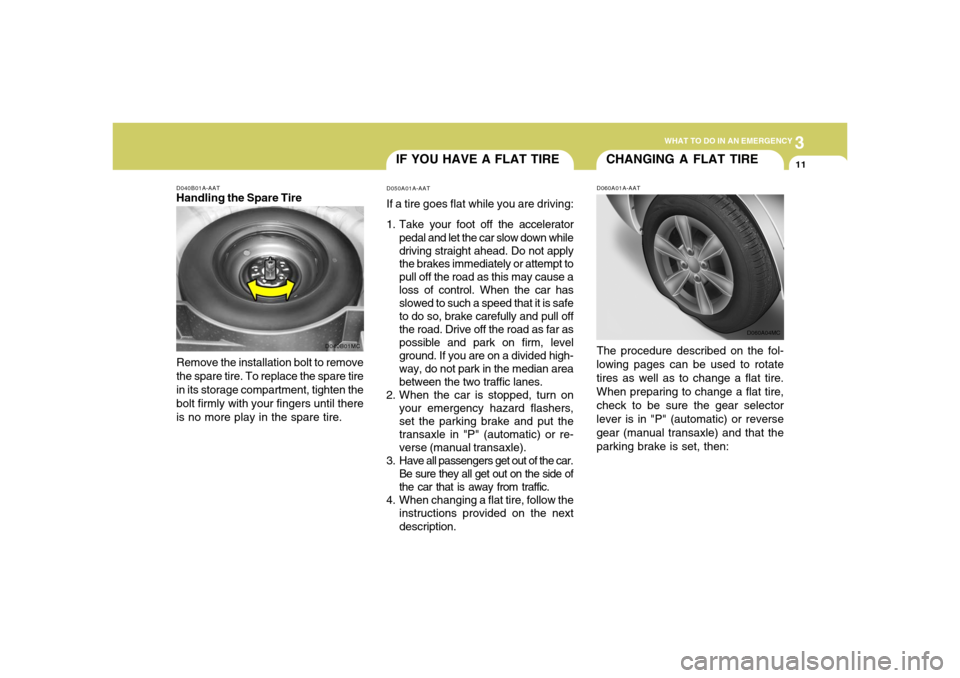
D040B01A-AATHandling the Spare Tire
Remove the installation bolt to remove
the spare tire. To replace the spare tire
in its storage compartment, tighten the
bolt firmly with your fingers until there
is no more play in the spare tire.
D040B01MC
CHANGING A FLAT TIRED060A01A-AATThe procedure described on the fol-
lowing pages can be used to rotate
tires as well as to change a flat tire.
When preparing to change a flat tire,
check to be sure the gear selector
lever is in "P" (automatic) or reverse
gear (manual transaxle) and that the
parking brake is set, then:
D060A04MC
Page 190 of 273
318
WHAT TO DO IN AN EMERGENCY
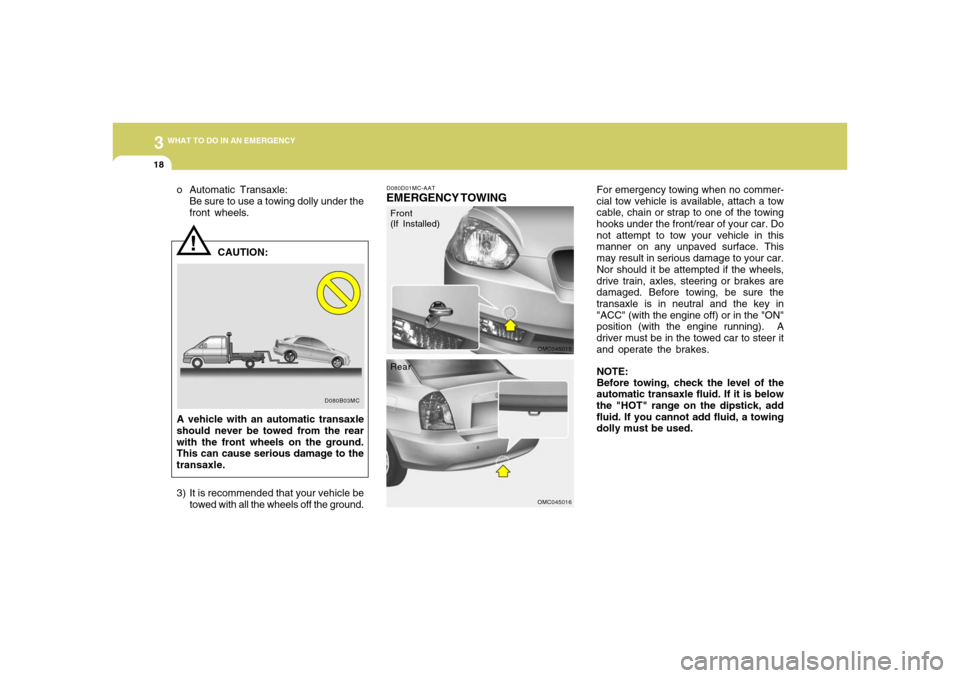
D080D01MC-AATEMERGENCY TOWING
For emergency towing when no commer-
cial tow vehicle is available, attach a tow
cable, chain or strap to one of the towing
hooks under the front/rear of your car. Do
not attempt to tow your vehicle in this
manner on any unpaved surface. This
may result in serious damage to your car.
Nor should it be attempted if the wheels,
drive train, axles, steering or brakes are
damaged. Before towing, be sure the
transaxle is in neutral and the key in
"ACC" (with the engine off) or in the "ON"
position (with the engine running). A
driver must be in the towed car to steer it
and operate the brakes.
NOTE:
Before towing, check the level of the
automatic transaxle fluid. If it is below
the "HOT" range on the dipstick, add
fluid. If you cannot add fluid, a towing
dolly must be used.
OMC045015OMC045016
!
D080B03MC
CAUTION: o Automatic Transaxle:
Be sure to use a towing dolly under the
front wheels.
A vehicle with an automatic transaxle
should never be towed from the rear
with the front wheels on the ground.
This can cause serious damage to the
transaxle.
3) It is recommended that your vehicle be
towed with all the wheels off the ground.
Front
(If Installed)
Rear
Page 191 of 273
3
WHAT TO DO IN AN EMERGENCY
19
CAUTION:
If the car is being towed with all four
wheels on the ground, it can be towed
only from the front. Be sure that the
transaxle is in neutral. Do not tow at
speeds greater than 30 mph (50 km/h)
and for more than 15 miles (25 km). Be
sure the steering is unlocked by plac-
ing the key in the "ACC" position. A
driver must be in the towed vehicle to
operate the steering and brakes.
!
OMC045013
OMC045014
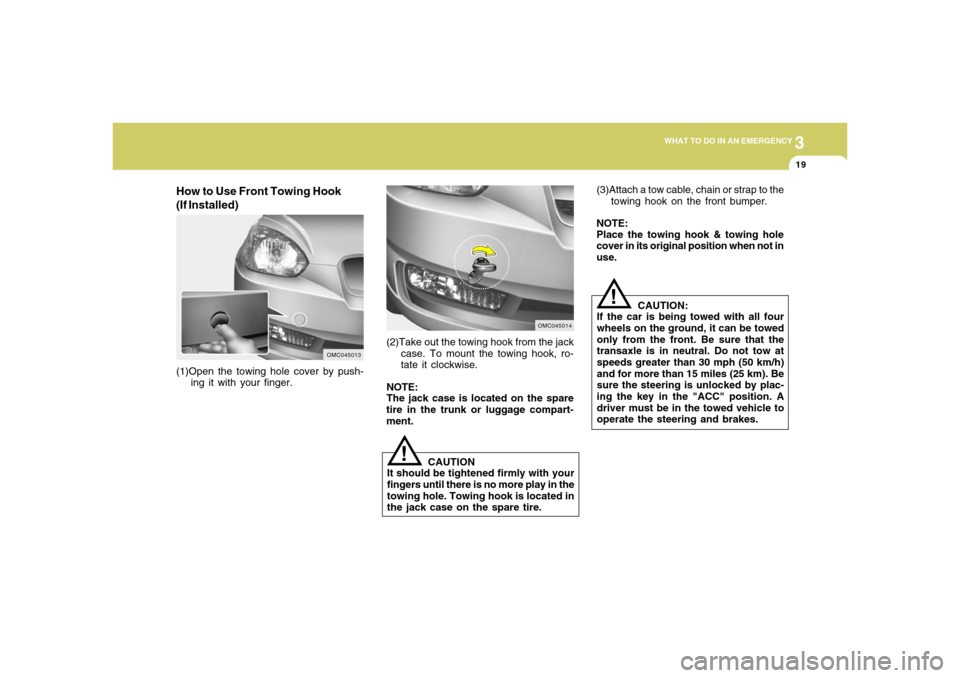
(1)Open the towing hole cover by push-
ing it with your finger.(2)Take out the towing hook from the jack
case. To mount the towing hook, ro-
tate it clockwise.
NOTE:
The jack case is located on the spare
tire in the trunk or luggage compart-
ment.
!
CAUTION
It should be tightened firmly with your
fingers until there is no more play in the
towing hole. Towing hook is located in
the jack case on the spare tire.
How to Use Front Towing Hook
(If Installed)
(3)Attach a tow cable, chain or strap to the
towing hook on the front bumper.
NOTE:
Place the towing hook & towing hole
cover in its original position when not in
use.
Page 210 of 273
Engine Compartment .................................................... 6-2
General Checks ............................................................ 6-3
Maintenance Precautions ............................................. 6-4
Checking the Engine Oil ............................................... 6-4
Checking and Changing the Engine Coolant ................ 6-7
Changing the Air Cleaner Filter ..................................... 6-8
Checking the Transaxle Oil (Manual) .........................6-11
Checking the Transaxle Fluid (Automatic)..................6-11
Checking the Brakes ..................................................6-13
Air Conditioning Care..................................................6-14
Changing the Climate Control Air Filter .......................6-15
Checking and Replacing Fuses..................................6-16
Checking the Battery..................................................6-19
Power Steering Fluid Level .........................................6-21
Replacement of Light Bulbs ........................................6-22
Bulb Wattages.............................................................6-28
Fuse Panel Description...............................................6-29
DO-IT-YOURSELF MAINTENANCE
6
6
Page 222 of 273
6
DO-IT-YOURSELF MAINTENANCE
13
CHECKING THE BRAKES!
G120A01A-AAT
G120B01A-AATChecking the Brake Fluid Level
CAUTION:
Because brakes are essential to the
safe operation of the car, it is sug-
gested that they be checked and in-
spected by your Hyundai dealer. The
brakes should be checked and in-
spected for wear at those intervals
specified in the vehicle maintenance
schedule in Section 5.
!
WARNING:
Use caution when handling brake fluid.
It can damage your vision if it gets into
your eyes. It will also damage your
vehicle's paint if spilled on it and not
removed immediately.
!
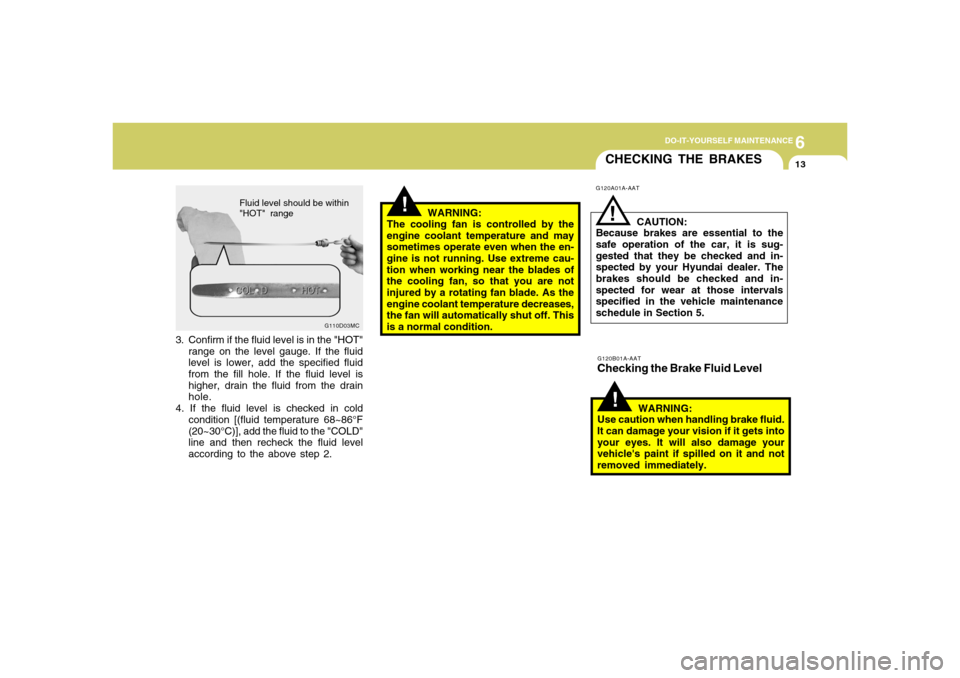
3. Confirm if the fluid level is in the "HOT"
range on the level gauge. If the fluid
level is lower, add the specified fluid
from the fill hole. If the fluid level is
higher, drain the fluid from the drain
hole.
4. If the fluid level is checked in cold
condition [(fluid temperature 68~86°F
(20~30°C)], add the fluid to the "COLD"
line and then recheck the fluid level
according to the above step 2.
G110D03MC
Fluid level should be within
"HOT" range
WARNING:
The cooling fan is controlled by the
engine coolant temperature and may
sometimes operate even when the en-
gine is not running. Use extreme cau-
tion when working near the blades of
the cooling fan, so that you are not
injured by a rotating fan blade. As the
engine coolant temperature decreases,
the fan will automatically shut off. This
is a normal condition.
Page 267 of 273

10
INDEX
2
A
Advanced Supplemental Restraint (AIRBAG)
System (SRS) ....................................................................1-41
Curtain airbag .................................................................1-56
Driver's and passenger's front airbag ............................1-42
Occupant classification system ......................................1-49
Side impact airbag .........................................................1-54
Air Cleaner Filter .................................................................. 6-9
Air Conditioning
Care.................................................................................6-14
Operation............................................................ 1-113, 6-15
Switch............................................................................1-113
Antenna ............................................................................1-121
Ashtray................................................................................1-83
Audio System ...................................................................1-122
B
Battery .................................................................................6-19
Binding Arbitration .............................................................8-18
Brake
Anti-lock brake system (ABS) .........................................2-13
Checking the brakes ......................................................6-13
Fluid.................................................................................6-13
Practices..........................................................................2-14
Breaking-In your New Hyundai ........................................... 1-3C
Care of Cassette Tapes ...................................................1-119
Care of Discs ....................................................................1-119
Cargo Area Cover ............................................................1-102
Catalytic Converter ............................................................... 7-3
Child Restraint System ......................................................1-31
Installing a child restraint system with
"Tether Anchorage" system ...........................................1-33
Securing a child restraint system with "ISOFIX" system1-35
Child-Protector Rear Door Lock .......................................... 1-6
Cigarette Lighter ................................................................1-83
Climate Control Air Filter ....................................... 1-116, 6-15
Clock...................................................................................1-83
Combination Light
Headlight flasher ............................................................1-77
Headlight switch .............................................................1-76
High-beam switch ...........................................................1-77
Lane change signal ........................................................1-76
Parking light auto off ......................................................1-77
Turn signal operation .....................................................1-76
Consumer Information .......................................................8-15
Cooling Fans ......................................................................6-20
Corrosion Protection
Cleaning the interior ......................................................... 4-6
Protecting your Hyundai from corrosion .......................... 4-2
Washing and waxing ........................................................ 4-4