tow Hyundai Accent 2008 User Guide
[x] Cancel search | Manufacturer: HYUNDAI, Model Year: 2008, Model line: Accent, Model: Hyundai Accent 2008Pages: 273, PDF Size: 9.36 MB
Page 91 of 273
1
FEATURES OF YOUR HYUNDAI
791
FEATURES OF YOUR HYUNDAI
79
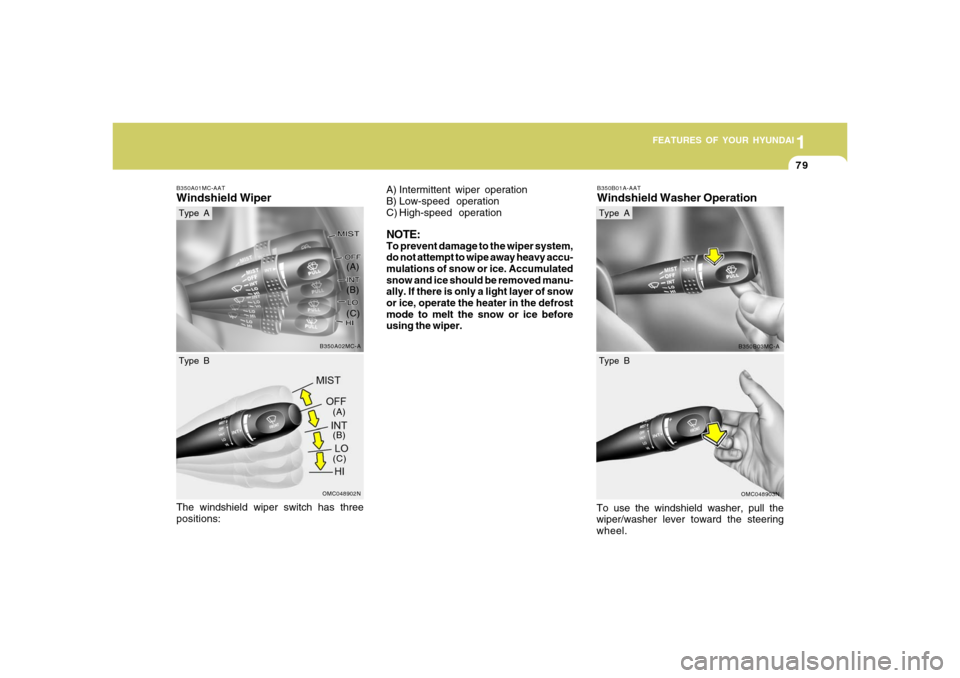
B350A01MC-AATWindshield Wiper
A) Intermittent wiper operation
B) Low-speed operation
C) High-speed operationNOTE:To prevent damage to the wiper system,
do not attempt to wipe away heavy accu-
mulations of snow or ice. Accumulated
snow and ice should be removed manu-
ally. If there is only a light layer of snow
or ice, operate the heater in the defrost
mode to melt the snow or ice before
using the wiper.
B350A02MC-A
B350B01A-AATWindshield Washer OperationTo use the windshield washer, pull the
wiper/washer lever toward the steering
wheel.
B350B03MC-A
(A)
(B)
(C)
OMC048902N(A)
(B)
(C)
The windshield wiper switch has three
positions:
OMC048903N
Type B
Type A
Type B
Type A
Page 105 of 273
1
FEATURES OF YOUR HYUNDAI
931
FEATURES OF YOUR HYUNDAI
93
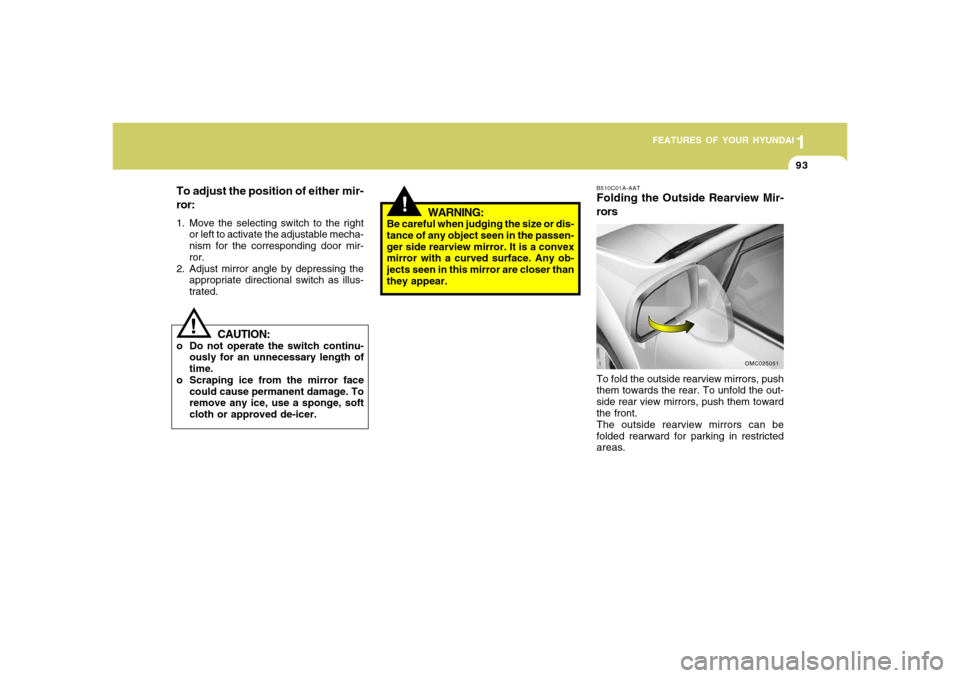
B510C01A-AATFolding the Outside Rearview Mir-
rorsTo fold the outside rearview mirrors, push
them towards the rear. To unfold the out-
side rear view mirrors, push them toward
the front.
The outside rearview mirrors can be
folded rearward for parking in restricted
areas.
OMC025051
!
WARNING:
Be careful when judging the size or dis-
tance of any object seen in the passen-
ger side rearview mirror. It is a convex
mirror with a curved surface. Any ob-
jects seen in this mirror are closer than
they appear.
CAUTION:
o Do not operate the switch continu-
ously for an unnecessary length of
time.
o Scraping ice from the mirror face
could cause permanent damage. To
remove any ice, use a sponge, soft
cloth or approved de-icer.
!
To adjust the position of either mir-
ror:1. Move the selecting switch to the right
or left to activate the adjustable mecha-
nism for the corresponding door mir-
ror.
2. Adjust mirror angle by depressing the
appropriate directional switch as illus-
trated.
Page 106 of 273
1FEATURES OF YOUR HYUNDAI94
PARKING BRAKE
DAY/NIGHT INSIDE REAR-
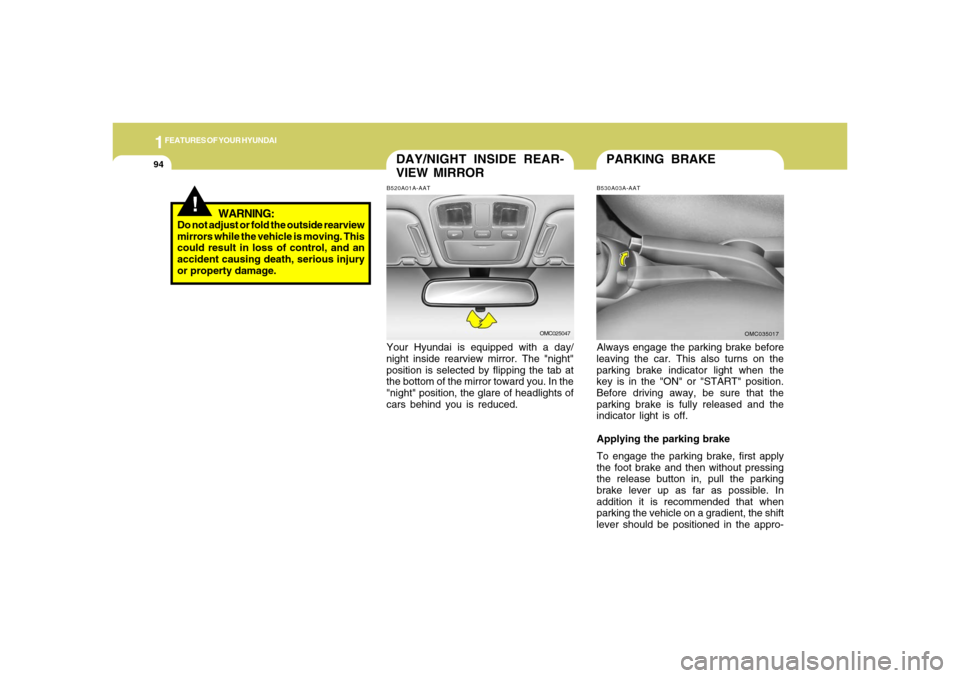
VIEW MIRRORB520A01A-AATYour Hyundai is equipped with a day/
night inside rearview mirror. The "night"
position is selected by flipping the tab at
the bottom of the mirror toward you. In the
"night" position, the glare of headlights of
cars behind you is reduced.
OMC025047
B530A03A-AATAlways engage the parking brake before
leaving the car. This also turns on the
parking brake indicator light when the
key is in the "ON" or "START" position.
Before driving away, be sure that the
parking brake is fully released and the
indicator light is off.
Applying the parking brake
To engage the parking brake, first apply
the foot brake and then without pressing
the release button in, pull the parking
brake lever up as far as possible. In
addition it is recommended that when
parking the vehicle on a gradient, the shift
lever should be positioned in the appro-
OMC035017
!
WARNING:
Do not adjust or fold the outside rearview
mirrors while the vehicle is moving. This
could result in loss of control, and an
accident causing death, serious injury
or property damage.
Page 111 of 273
1
FEATURES OF YOUR HYUNDAI
991
FEATURES OF YOUR HYUNDAI
99
!
WARNING:
- When refueling always shut the
engine off. Sparks produced by
electrical components related to
the engine can ignite fuel vapors
causing a fire. Always insure that
the engine is OFF before and dur-
ing refueling. Once refueling is
complete, check to make sure the
fuel filler cap and door are se-
curely closed, before starting the
engine.
- Do not light any fire around a gas
station. DO NOT use matches or a
lighter and DO NOT SMOKE or
leave a lit cigarette in your vehicle
while at a gas station especially
during refueling. Automotive fuel
is highly flammable and can, when
ignited, result in explosion by
flames.
- If a fire breaks out during refueling,
leave the vicinity of the vehicle,
and immediately contact the man-
ager of the gas station or contact
the police and local fire depart-
ment. Follow any safety instruc-
tions they provide.
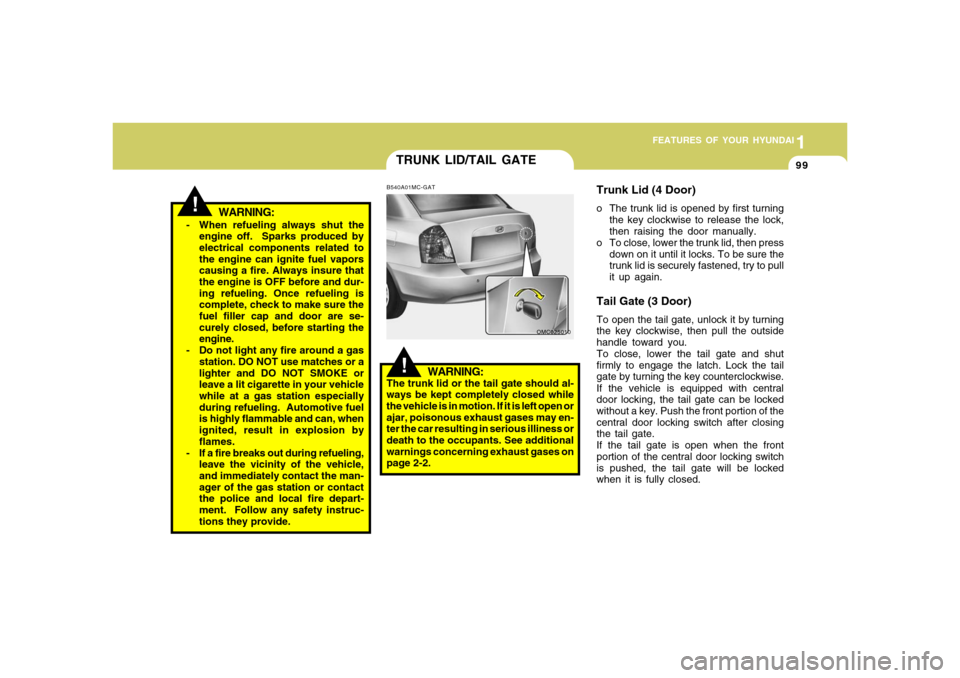
!TRUNK LID/TAIL GATEB540A01MC-GAT
WARNING:
The trunk lid or the tail gate should al-
ways be kept completely closed while
the vehicle is in motion. If it is left open or
ajar, poisonous exhaust gases may en-
ter the car resulting in serious illiness or
death to the occupants. See additional
warnings concerning exhaust gases on
page 2-2.
Trunk Lid (4 Door)o The trunk lid is opened by first turning
the key clockwise to release the lock,
then raising the door manually.
o To close, lower the trunk lid, then press
down on it until it locks. To be sure the
trunk lid is securely fastened, try to pull
it up again.Tail Gate (3 Door)To open the tail gate, unlock it by turning
the key clockwise, then pull the outside
handle toward you.
To close, lower the tail gate and shut
firmly to engage the latch. Lock the tail
gate by turning the key counterclockwise.
If the vehicle is equipped with central
door locking, the tail gate can be locked
without a key. Push the front portion of the
central door locking switch after closing
the tail gate.
If the tail gate is open when the front
portion of the central door locking switch
is pushed, the tail gate will be locked
when it is fully closed.
OMC025010
Page 126 of 273
1FEATURES OF YOUR HYUNDAI
114
B740D01A-AATOperation Tipso If the interior of the car is hot when you
first get in, open the windows for a few
minutes to expel the hot air.
o When you are using the air condition-
ing system, keep all windows closed to
keep hot air out.
o When moving slowly, as in heavy traf-
fic, shift to a lower gear.
This increases engine speed, which in
turn increases the speed of the air
conditioning compressor.
o On steep grades, turn the air condi-
tioning off to avoid the possibility of the
engine overheating.
o During winter months or in periods
when the air conditioning is not used
regularly, run the air conditioning once
every month for a few minutes.
This will help circulate the lubricants
and keep your system in peak operat-
ing condition.
o Set the temperature control to "Cool".
("Cool" provides maximum cooling. The
temperature may be moderated by
moving the control toward "Warm".)
o Adjust the fan control to the desired
speed. For greater cooling, turn the fan
control to one of the higher speeds or
temporarily select the (
)position
on the air intake control.
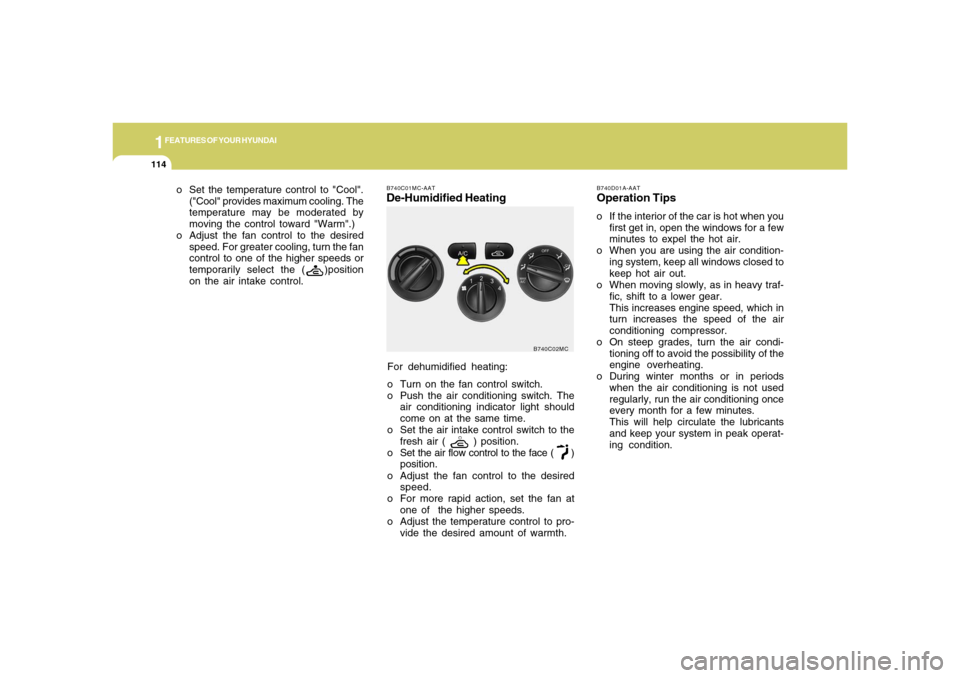
For dehumidified heating:
o Turn on the fan control switch.
o Push the air conditioning switch. The
air conditioning indicator light should
come on at the same time.
o Set the air intake control switch to the
fresh air (
) position.
o Set the air flow control to the face (
)
position.
o Adjust the fan control to the desired
speed.
o For more rapid action, set the fan at
one of the higher speeds.
o Adjust the temperature control to pro-
vide the desired amount of warmth.
B740C01MC-AATDe-Humidified Heating
B740C02MC
Page 129 of 273
1
FEATURES OF YOUR HYUNDAI
1171
FEATURES OF YOUR HYUNDAI
117
STEREO SOUND SYSTEM
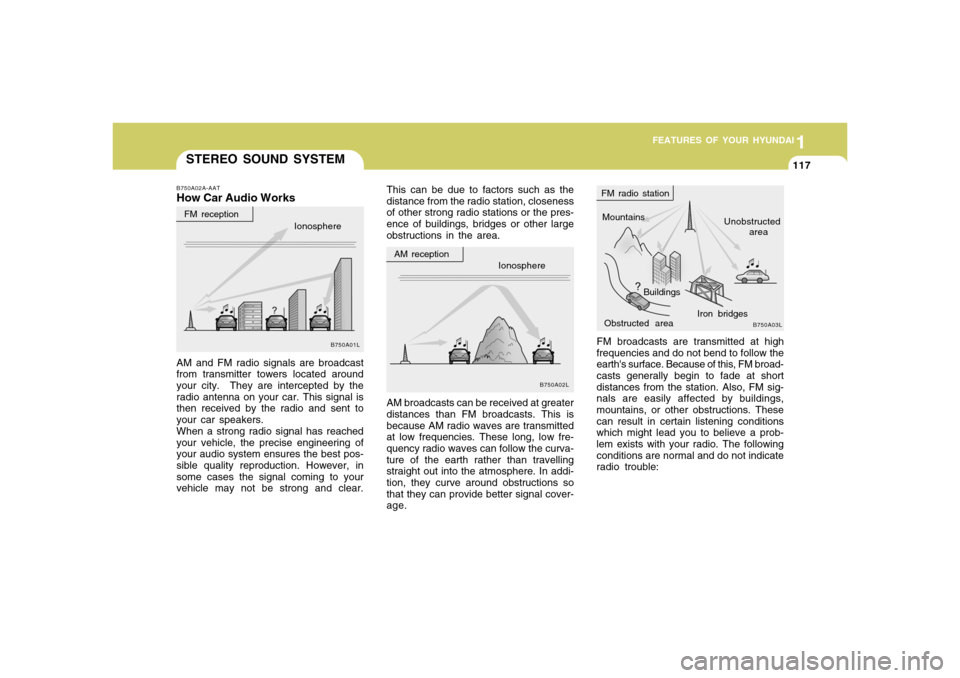
FM broadcasts are transmitted at high
frequencies and do not bend to follow the
earth's surface. Because of this, FM broad-
casts generally begin to fade at short
distances from the station. Also, FM sig-
nals are easily affected by buildings,
mountains, or other obstructions. These
can result in certain listening conditions
which might lead you to believe a prob-
lem exists with your radio. The following
conditions are normal and do not indicate
radio trouble: AM broadcasts can be received at greater
distances than FM broadcasts. This is
because AM radio waves are transmitted
at low frequencies. These long, low fre-
quency radio waves can follow the curva-
ture of the earth rather than travelling
straight out into the atmosphere. In addi-
tion, they curve around obstructions so
that they can provide better signal cover-
age.
B750A02A-AATHow Car Audio WorksAM and FM radio signals are broadcast
from transmitter towers located around
your city. They are intercepted by the
radio antenna on your car. This signal is
then received by the radio and sent to
your car speakers.
When a strong radio signal has reached
your vehicle, the precise engineering of
your audio system ensures the best pos-
sible quality reproduction. However, in
some cases the signal coming to your
vehicle may not be strong and clear.
Ionosphere
B750A02L
Mountains
Buildings
Obstructed areaUnobstructed
area FM radio station
B750A03L
Ionosphere FM reception
B750A01L
Iron bridges
AM receptionThis can be due to factors such as the
distance from the radio station, closeness
of other strong radio stations or the pres-
ence of buildings, bridges or other large
obstructions in the area.
Page 148 of 273
Engine Exhaust can be Dangerous! ............................. 2-2
Before Starting the Engine ............................................ 2-3
Key Positions ................................................................ 2-4
Starting ..........................................................................2-5
Operating the Manual Transaxle ................................... 2-6
Automatic Transaxle ..................................................... 2-9
Anti-Lock Brake System.............................................2-13
Good Braking Practices..............................................2-14
Driving for Economy...................................................2-15
Winter Driving.............................................................2-16
Trailer Towing .............................................................2-20
Vehicle Load Limit.......................................................2-20
DRIVING YOUR HYUNDAI
2
2
Page 165 of 273

2
DRIVING YOUR HYUNDAI
18
C160K01A-AATCarry Emergency EquipmentDepending on the severity of the weather
where you drive your car, you should
carry appropriate emergency equipment.
Some of the items you may want to carry
include tire chains, tow straps or chains,
flashlight, emergency flares, sand, a
shovel, jumper cables, a window scraper,
gloves, ground cloth, coveralls, a blanket,
etc.
C160H01A-AATUse Approved Anti-Freeze in Win-
dow Washer SystemTo keep the water in the window washer
system from freezing, add an approved
anti-freeze solution in accordance with
instructions on the container. Window
washer anti-freeze is available from
Hyundai dealers and most auto parts
outlets. Do not use engine coolant or
other types of anti-freeze as these may
damage the finish.C160G01A-AATTo Keep Locks from FreezingTo keep the locks from freezing, squirt an
approved de-icer fluid or glycerine into
the key opening. If a lock is covered with
ice, squirt it with an approved de-icing
fluid to remove the ice. If the lock is frozen
internally, you may be able to thaw it out
by using a heated key. Handle the heated
key with care to avoid injury.
C160I01A-AATDon't Let Your Parking Brake FreezeUnder some conditions your parking brake
can freeze in the engaged position. This
is most likely to happen when there is an
accumulation of snow or ice around or
near the rear brakes or if the brakes are
wet. If you think the parking brake may
freeze, apply it only temporarily while
you put the gear selector lever in "P"
(automatic) or in first or reverse gear
(manual transaxle) and block the rear
wheels so the car cannot roll. Then re-
lease the parking brake.C160J01A-AATDon't Let Ice and Snow Accumulate
UnderneathUnder some conditions, snow and ice
can build up under the fenders and inter-
fere with the steering. When driving in
severe winter conditions where this may
happen, you should periodically check
underneath the car to be sure the move-
ment of the front wheels and the steering
components is not obstructed.
Page 167 of 273
2
DRIVING YOUR HYUNDAI
20
TRAILER TOWINGC190A01A-AATYour Hyundai should not be used to tow
a trailer. It is designed to be compact and
light for good fuel economy, and is not
designed as a trailer-towing vehicle.
Damages or malfunctions caused by tow-
ing may not be covered by the limited
warranties applying to your Hyundai.
Damages or malfunctions that result from
towing a trailer for commercial purposes
are specifically not covered by Hyundai
limited warranties.
C190A01MC
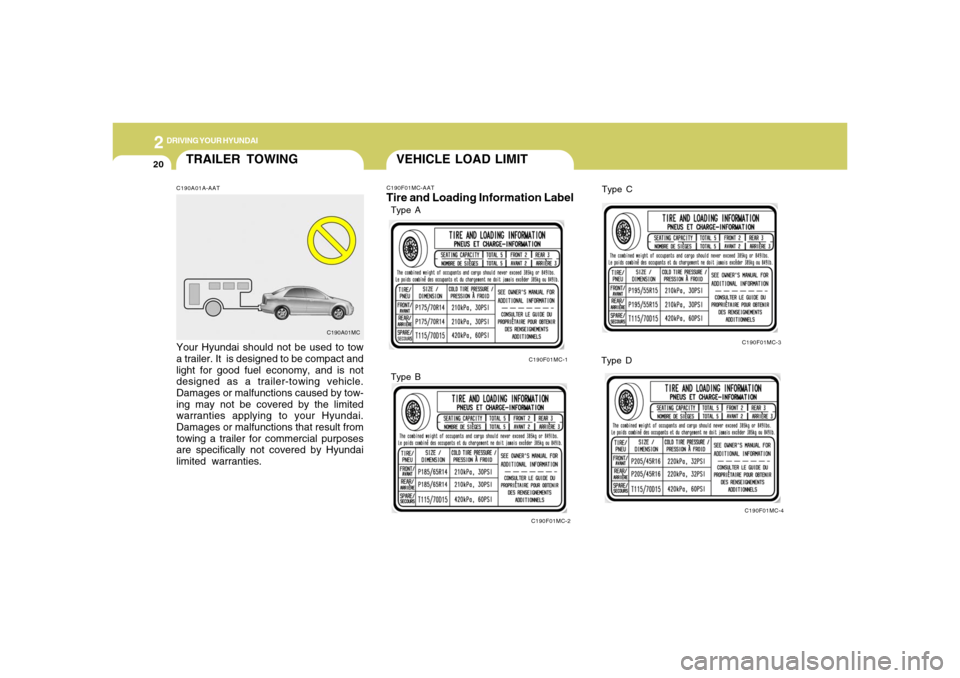
VEHICLE LOAD LIMITC190F01MC-AATTire and Loading Information Label
C190F01MC-1
C190F01MC-2
Type A
Type B
C190F01MC-3
C190F01MC-4
Type C
Type D
Page 168 of 273

DRIVING YOUR HYUNDAI
212
Steps for Determining Correct Load
Limit
(1)Locate the statement "The com-
bined weight of occupants and cargo
should never exceed XXX pounds''
on your vehicle's placard.
(2)Determine the combined weight of
the driver and passengers that will
be riding in your vehicle.
(3)Subtract the combined weight of the
driver and passengers from XXX
kilograms or XXX pounds.
(4)The resulting figure equals the avail-
able amount of cargo and luggage
load capacity. For example, if the
"XXX" amount equals 1400 lbs, and
there will be five 150 lb. passengers
in your vehicle, the amount of avail-
able cargo and luggage load capac-
ity is 650 lbs. (1400-750 (5 x 150) =
650 lbs.) The tire label located on the driver's
side of the center pillar outer panel
gives the original tire size, cold tire
pressures recommended for your ve-
hicle, the number of people that can be
in your vehicle and vehicle capacity
weight.
Vehicle capacity weight:
849 lbs (385 kg)
Vehicle capacity weight is the maxi-
mum combined weight of occupants
and cargo. If your vehicle is equipped
with a trailer, the combined weight
includes the tongue load.
Seating capacity:
Total: 5 persons
(Front seat: 2 persons,
Rear seat: 3 persons)
Seating capacity is the maximum num-
ber of occupants including a driver,
your vehicle may carry.However the seating capacity may be
reduced based upon the weight of all
of the occupants, and the weight of the
cargo being carried or towed. Do not
overload the vehicle as there is a limit
to the total weight, or load limit includ-
ing occupants and cargo, the vehicle
can carry.
Towing capacity:
We do not recommend using this ve-
hicle for trailer towing.
Cargo capacity:
The cargo capacity of your vehicle will
increase or decrease depending on the
weight and the number of occupants
and the tongue load, if your vehicle is
equipped with a trailer.