warning Hyundai Accent 2009 Owner's Manual
[x] Cancel search | Manufacturer: HYUNDAI, Model Year: 2009, Model line: Accent, Model: Hyundai Accent 2009Pages: 266, PDF Size: 8.77 MB
Page 225 of 266
6
DO-IT-YOURSELF MAINTENANCE
20
!
G220A01A-AAT
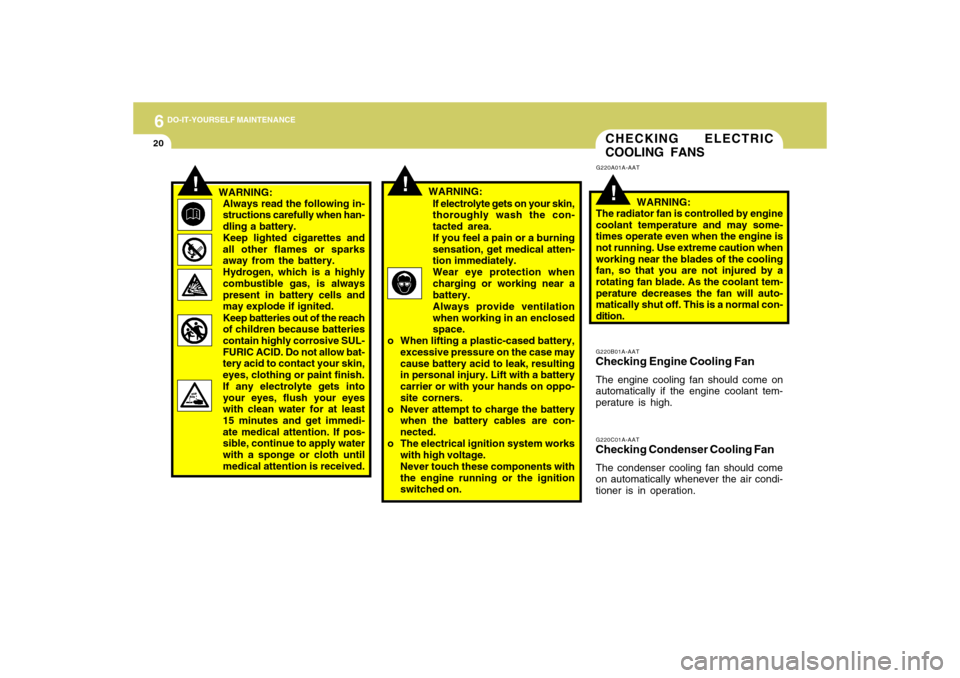
G220B01A-AATChecking Engine Cooling FanThe engine cooling fan should come on
automatically if the engine coolant tem-
perature is high.WARNING:
The radiator fan is controlled by engine
coolant temperature and may some-
times operate even when the engine is
not running. Use extreme caution when
working near the blades of the cooling
fan, so that you are not injured by a
rotating fan blade. As the coolant tem-
perature decreases the fan will auto-
matically shut off. This is a normal con-
dition.G220C01A-AATChecking Condenser Cooling FanThe condenser cooling fan should come
on automatically whenever the air condi-
tioner is in operation.CHECKING ELECTRIC
COOLING FANS
!
If electrolyte gets on your skin,
thoroughly wash the con-
tacted area.
If you feel a pain or a burning
sensation, get medical atten-
tion immediately.
Wear eye protection when
charging or working near a
battery.
Always provide ventilation
when working in an enclosed
space.
o When lifting a plastic-cased battery,
excessive pressure on the case may
cause battery acid to leak, resulting
in personal injury. Lift with a battery
carrier or with your hands on oppo-
site corners.
o Never attempt to charge the battery
when the battery cables are con-
nected.
o The electrical ignition system works
with high voltage.
Never touch these components with
the engine running or the ignition
switched on.
WARNING:
Always read the following in-
structions carefully when han-
dling a battery.
Keep lighted cigarettes and
all other flames or sparks
away from the battery.
Hydrogen, which is a highly
combustible gas, is always
present in battery cells and
may explode if ignited.
Keep batteries out of the reach
of children because batteries
contain highly corrosive SUL-
FURIC ACID. Do not allow bat-
tery acid to contact your skin,
eyes, clothing or paint finish.
If any electrolyte gets into
your eyes, flush your eyes
with clean water for at least
15 minutes and get immedi-
ate medical attention. If pos-
sible, continue to apply water
with a sponge or cloth until
medical attention is received.
!
WARNING:
Page 228 of 266
6
DO-IT-YOURSELF MAINTENANCE
23
G270A03O
!
WARNING:
o When removing/replacing halogen
bulbs, always handle the metal body
of the bulb, not the glass.
o The halogen bulb contains gas under
pressure and if impacted could shat-
ter, resulting in flying fragments. Al-
ways wear eye protection when ser-
vicing the bulb. Protect the bulb
against abrasions or scratches and
against liquids when lighted. Turn
the bulb on only when installed in a
headlight. Replace the headlight if
damaged or cracked. Keep the bulb
out of the reach of children and dis-
pose of the used bulb with care.
5. Remove the socket cover.
6. Push the bulb spring to remove the
headlight bulb.
7. Remove the protective cap from the
replacement bulb and install the new
bulb by matching the plastic base with
the headlight hole. Reattach the bulb
spring and install the socket cover.
Reconnect the power cord.
8. Use the protective cap and carton to
dispose of the old bulb.
9.Check for proper headlight aim.
OMC055022
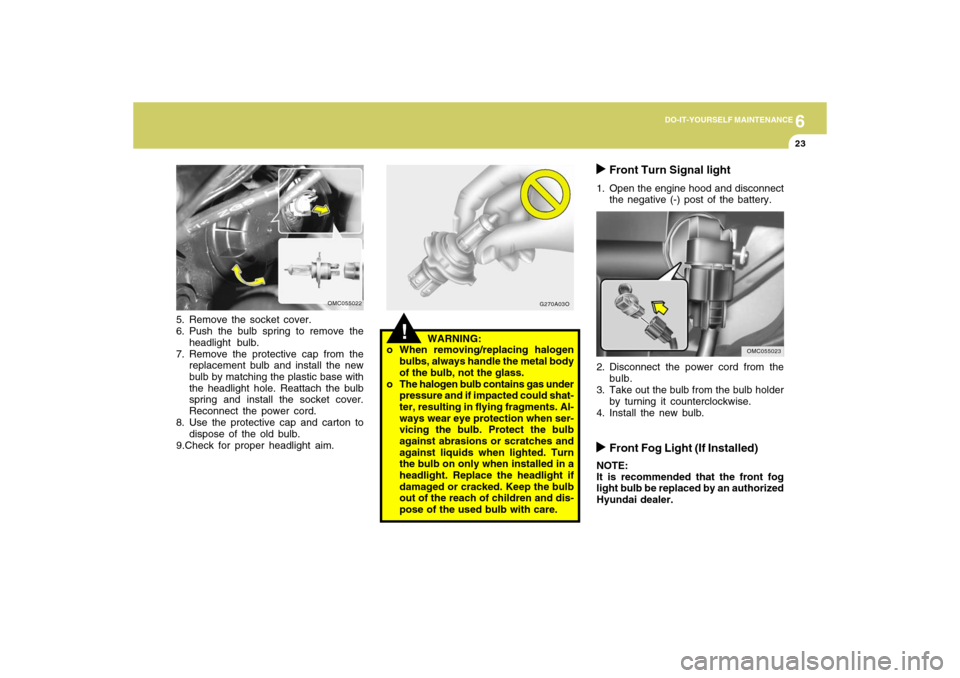
Front Turn Signal light
1. Open the engine hood and disconnect
the negative (-) post of the battery.
2. Disconnect the power cord from the
bulb.
3. Take out the bulb from the bulb holder
by turning it counterclockwise.
4. Install the new bulb.
OMC055023
Front Fog Light (If Installed)
NOTE:
It is recommended that the front fog
light bulb be replaced by an authorized
Hyundai dealer.
Page 235 of 266
6
DO-IT-YOURSELF MAINTENANCE
30
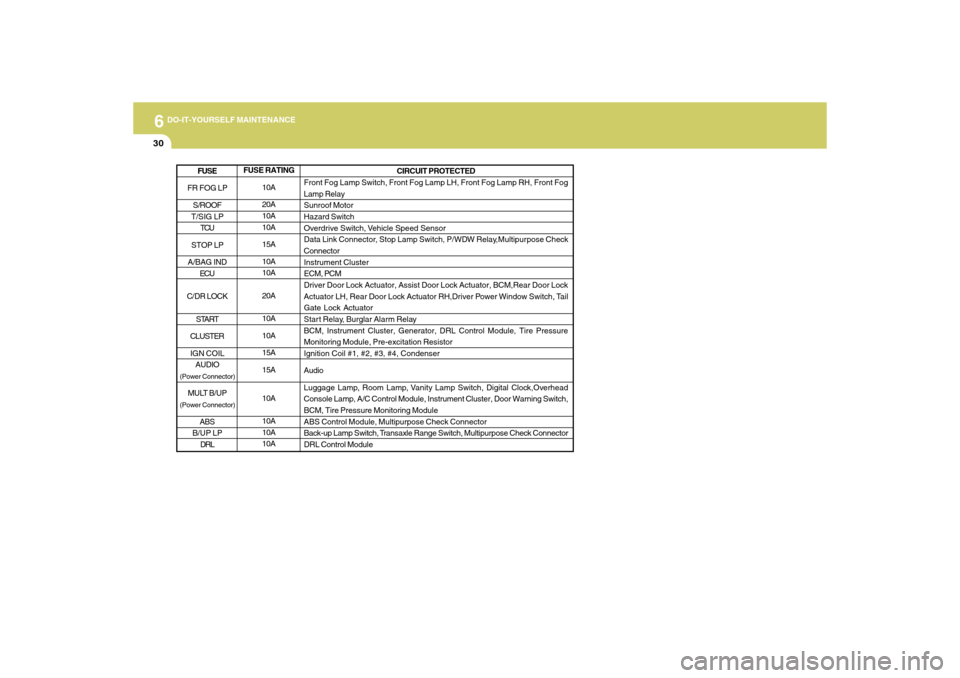
FUSE RATING
10A
20A
10A
10A
15A
10A
10A
20A
10A
10A
15A
15A
10A
10A
10A
10ACIRCUIT PROTECTED
Front Fog Lamp Switch, Front Fog Lamp LH, Front Fog Lamp RH, Front Fog
Lamp Relay
Sunroof Motor
Hazard Switch
Overdrive Switch, Vehicle Speed Sensor
Data Link Connector, Stop Lamp Switch, P/WDW Relay,Multipurpose Check
Connector
Instrument Cluster
ECM, PCM
Driver Door Lock Actuator, Assist Door Lock Actuator, BCM,Rear Door Lock
Actuator LH, Rear Door Lock Actuator RH,Driver Power Window Switch, Tail
Gate Lock Actuator
Star t Relay, Burglar Alarm Relay
BCM, Instrument Cluster, Generator, DRL Control Module, Tire Pressure
Monitoring Module, Pre-excitation Resistor
Ignition Coil #1, #2, #3, #4, Condenser
Audio
Luggage Lamp, Room Lamp, Vanity Lamp Switch, Digital Clock,Overhead
Console Lamp, A/C Control Module, Instrument Cluster, Door Warning Switch,
BCM, Tire Pressure Monitoring Module
ABS Control Module, Multipurpose Check Connector
Back-up Lamp Switch, Transaxle Range Switch, Multipurpose Check Connector
DRL Control Module
FR FOG LP
S/ROOF
T/SIG LP
TCU
STOP LP
A/BAG IND
ECU
C/DR LOCK
START
CLUSTER
IGN COIL
AUDIO(Power Connector)MULT B/UP(Power Connector)
ABS
B/UP LP
DRLFUSE
Page 238 of 266
7
EMISSION CONTROL SYSTEMS
3
CATALYTIC CONVERTER
!
!
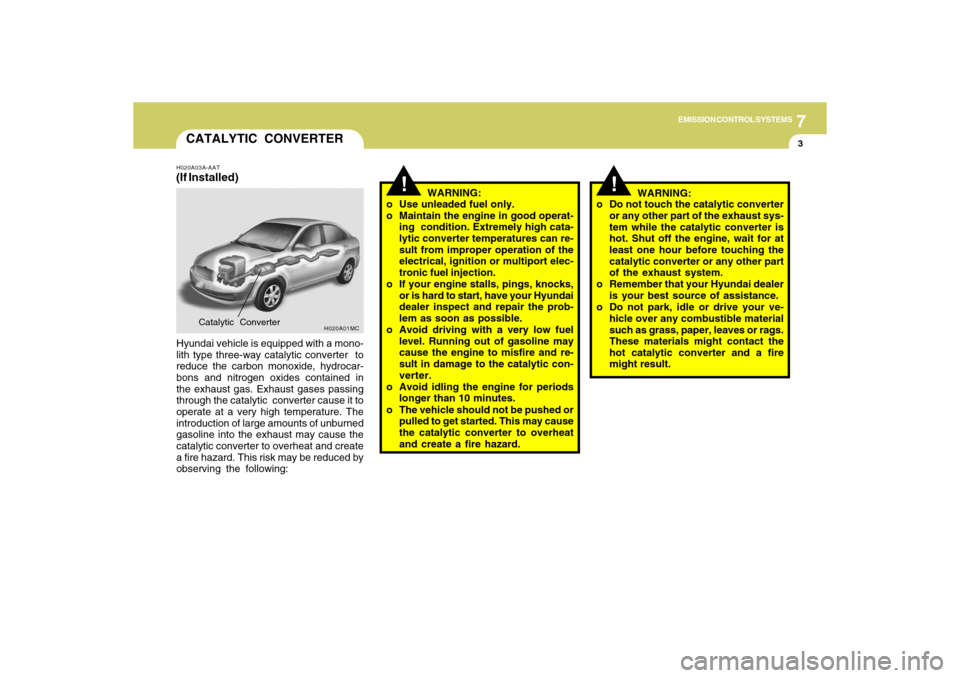
H020A03A-AAT(If Installed)Hyundai vehicle is equipped with a mono-
lith type three-way catalytic converter to
reduce the carbon monoxide, hydrocar-
bons and nitrogen oxides contained in
the exhaust gas. Exhaust gases passing
through the catalytic converter cause it to
operate at a very high temperature. The
introduction of large amounts of unburned
gasoline into the exhaust may cause the
catalytic converter to overheat and create
a fire hazard. This risk may be reduced by
observing the following:WARNING:
o Do not touch the catalytic converter
or any other part of the exhaust sys-
tem while the catalytic converter is
hot. Shut off the engine, wait for at
least one hour before touching the
catalytic converter or any other part
of the exhaust system.
o Remember that your Hyundai dealer
is your best source of assistance.
o Do not park, idle or drive your ve-
hicle over any combustible material
such as grass, paper, leaves or rags.
These materials might contact the
hot catalytic converter and a fire
might result.
H020A01MC
Catalytic Converter
WARNING:
o Use unleaded fuel only.
o Maintain the engine in good operat-
ing condition. Extremely high cata-
lytic converter temperatures can re-
sult from improper operation of the
electrical, ignition or multiport elec-
tronic fuel injection.
o If your engine stalls, pings, knocks,
or is hard to start, have your Hyundai
dealer inspect and repair the prob-
lem as soon as possible.
o Avoid driving with a very low fuel
level. Running out of gasoline may
cause the engine to misfire and re-
sult in damage to the catalytic con-
verter.
o Avoid idling the engine for periods
longer than 10 minutes.
o The vehicle should not be pushed or
pulled to get started. This may cause
the catalytic converter to overheat
and create a fire hazard.
Page 242 of 266
8
CONSUMER INFORMATION, REPORTING SAFETY DEFECTS & BINDING ARBITRATION OF WARRANTY CLAIMS4
!
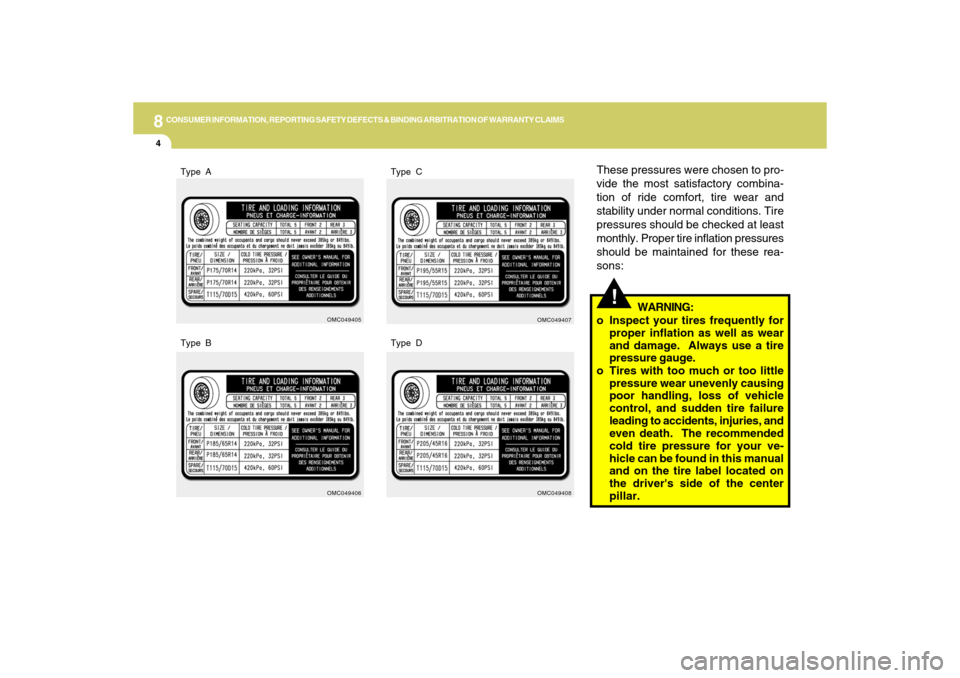
These pressures were chosen to pro-
vide the most satisfactory combina-
tion of ride comfort, tire wear and
stability under normal conditions. Tire
pressures should be checked at least
monthly. Proper tire inflation pressures
should be maintained for these rea-
sons:
WARNING:
o Inspect your tires frequently for
proper inflation as well as wear
and damage. Always use a tire
pressure gauge.
o Tires with too much or too little
pressure wear unevenly causing
poor handling, loss of vehicle
control, and sudden tire failure
leading to accidents, injuries, and
even death. The recommended
cold tire pressure for your ve-
hicle can be found in this manual
and on the tire label located on
the driver's side of the center
pillar.
OMC049405OMC049406
OMC049407OMC049408
Type A
Type BType C
Type D
Page 243 of 266
8
CONSUMER INFORMATION, REPORTING SAFETY DEFECTS & BINDING ARBITRATION OF WARRANTY CLAIMS
5
!
!
o Worn tires can cause accidents.
Replace tires that are worn, show
uneven wear, or are damaged.
See page 8-12.
o Remember to check the pressure
of your spare tire. Hyundai rec-
ommends that you check the
spare every time you check the
pressure of the other tires on
your vehicle.
WARNING:
Overinflation or underinflation can
reduce the tire life, adversely affect
vehicle handling, and lead to sud-
den tire failure. This could rusult in
loss of vehicle control and potential
injury.CAUTION:
Always observe the following:
o Check pressures when the tires
are cold. (After the vehicle has
been parked for at least three
hours or hasn't been driven more
than one mile (1.6 km) since start-
ing up.)
o Check the pressure of your spare
tire each time you check the pres-
sure of other tires.
o Never overload your vehicle. Be
especially careful about overload-
ing if you equip your vehicle with
a luggage rack.
o Worn, old tires can cause acci-
dents. If your tread is badly worn,
or if your tires have been dam-
aged, replace them.
!
WARNING:NOTE:
o Underinflation also results in ex-
cessive wear, poor handling and
reduced fuel economy. Wheel de-
formation also is possible. Keep
your tire pressures at the proper
levels. If a tire frequently needs
refilling, have it checked by your
Hyundai Dealer.
o Overinflation produces a harsh
ride, excessive wear at the center
of the tire tread, and a greater
possibility of damage from road
hazards.
Page 249 of 266
8
CONSUMER INFORMATION, REPORTING SAFETY DEFECTS & BINDING ARBITRATION OF WARRANTY CLAIMS
11
!
!
I050A01MC-AATTIRE CHAINS
Tire chains, if necessary, should be
installed on the front wheels. Be sure
that the chains are installed in accor-
dance with the manufacturer's instruc-
tions.
To minimize tire and chain wear, do
not continue to use tire chains when
they are no longer needed.
WARNING:
o If your vehicle is equipped with
P205/45R16 size tires, do not in-
stall tire chains. This may cause
damage to the vehicle (wheels,
suspension and body) by chains
contacting the body.
o When driving on roads covered
with snow or ice, drive at less
than 20 mph (30 km/h).
o Use the SAE "S" class or wire &
plastic chains.o If you have noise caused by
chains contacting the body, re-
tighten the chain to avoid contact
with the vehicle body.
o To prevent body damage, re-
tighten the chains after driving
0.3~0.6 miles.
o Don't use tire chains on a vehicle
equipped with aluminium wheels.
If it is unavoidable, use wire type
chains.
o Use wire chains less than 15 mm
to prevent damage to the chain's
connection.WARNING:
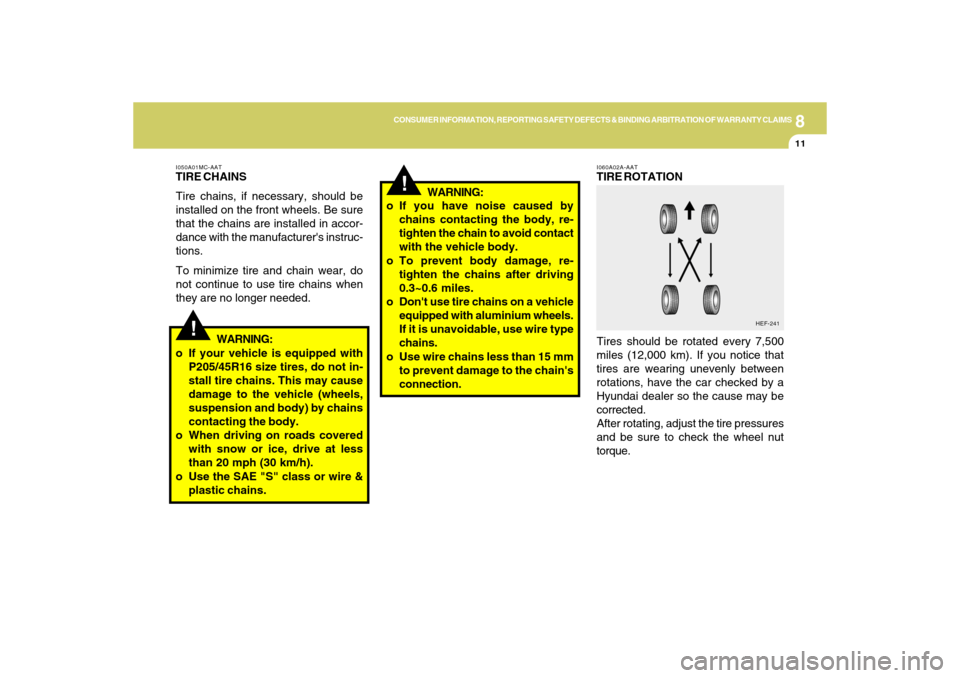
I060A02A-AATTIRE ROTATION
Tires should be rotated every 7,500
miles (12,000 km). If you notice that
tires are wearing unevenly between
rotations, have the car checked by a
Hyundai dealer so the cause may be
corrected.
After rotating, adjust the tire pressures
and be sure to check the wheel nut
torque.
HEF-241
Page 250 of 266
8
CONSUMER INFORMATION, REPORTING SAFETY DEFECTS & BINDING ARBITRATION OF WARRANTY CLAIMS
12
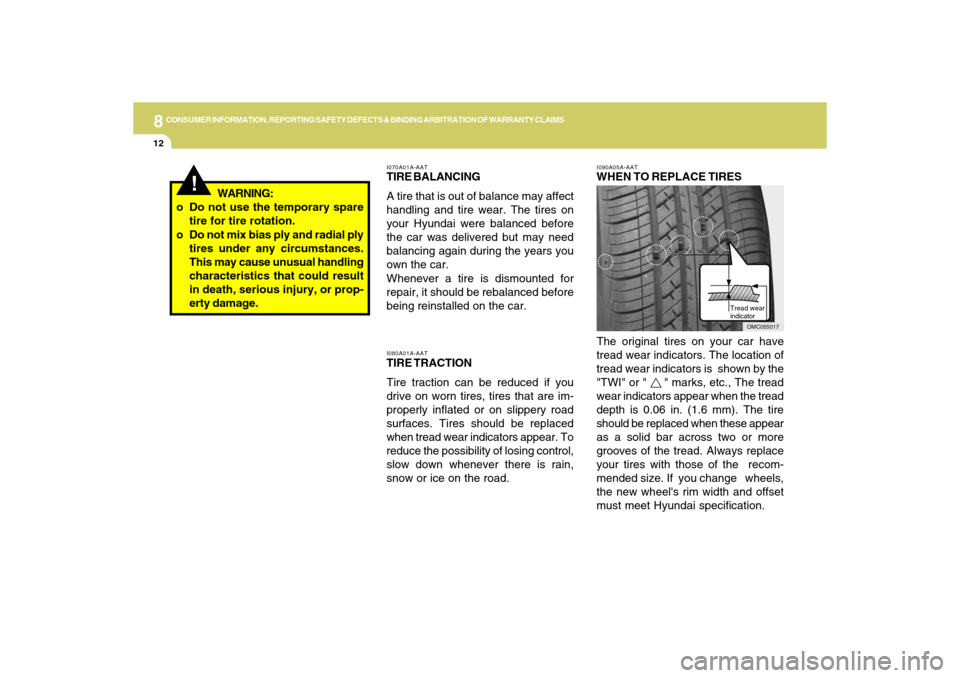
I090A05A-AATWHEN TO REPLACE TIRES
Tread wear
indicator
The original tires on your car have
tread wear indicators. The location of
tread wear indicators is shown by the
"TWI" or " " marks, etc., The tread
wear indicators appear when the tread
depth is 0.06 in. (1.6 mm). The tire
should be replaced when these appear
as a solid bar across two or more
grooves of the tread. Always replace
your tires with those of the recom-
mended size. If you change wheels,
the new wheel's rim width and offset
must meet Hyundai specification.
OMC055017
!
WARNING:
o Do not use the temporary spare
tire for tire rotation.
o Do not mix bias ply and radial ply
tires under any circumstances.
This may cause unusual handling
characteristics that could result
in death, serious injury, or prop-
erty damage.
I070A01A-AATTIRE BALANCING
A tire that is out of balance may affect
handling and tire wear. The tires on
your Hyundai were balanced before
the car was delivered but may need
balancing again during the years you
own the car.
Whenever a tire is dismounted for
repair, it should be rebalanced before
being reinstalled on the car.I080A01A-AATTIRE TRACTION
Tire traction can be reduced if you
drive on worn tires, tires that are im-
properly inflated or on slippery road
surfaces. Tires should be replaced
when tread wear indicators appear. To
reduce the possibility of losing control,
slow down whenever there is rain,
snow or ice on the road.
Page 251 of 266
8
CONSUMER INFORMATION, REPORTING SAFETY DEFECTS & BINDING ARBITRATION OF WARRANTY CLAIMS
13
!
!
!
WARNING:
To reduce the chance or serious or
fatal injuries from an accident
caused by tire failure or loss of
vehicle control:
o Replace tires that are worn, show
uneven wear, or are damaged.
Worn tires can cause loss of brak-
ing effectiveness, steering con-
trol, and traction.
o Do not drive your vehicle with too
little or too much pressure in
your tires. This can lead to un-
even wear and tire failure.
o When replacing tires, never mix
radial and bias-ply tires on the
same car. You must replace all
tires (including the spare) if mov-
ing from radial to bias-ply tires.
o Using tires and wheel other than
the recommended sizes could
cause unusual handling charac-
teristics and poor vehicle con-
trol, resulting in a serious acci-
dent.
I090B02JM-AATTIRE MAINTENANCE
In addition to proper inflation, correct
wheel alignment helps to decrease tire
wear. If you find a tire is worn un-
evenly, have your dealer check the
wheel alignment.
When you have new tires installed,
make sure they are balanced. This will
increase vehicle ride comfort and tire
life. Additionally, a tire shoud always
be rebalanced if it is removed from the
wheel. o Wheels that do not meet Hyundai's
specifications may fit poorly and
result in damage to the vehicle or
unusual handling and poor ve-
hicle control.
o Tires degrade over time, even when
they are not being used. Regard-
less of the remaining tread, it is
recommended that tires tread, It is
recommended that tires generally
be replaced after 6 years of normal
service. Heat caused by not to hot
climates or frequent high loading
Conditions can accelerate the ag-
ing process. Failure to follow this
Warning can result in sudden tire
failure, which could lead to a loss
of control and an accident involv-
ing serious injury or death.
o The ABS works by comparing the
speed of the wheels. Tire size can
affect wheel speed. When replac-
ing tires, all 4 tires must use the
same size originally supplied with
the vehicle. Using tires of a differ-
ent size can cause the ABS (Anti-
lock Brake System) (If Installed)
to work irregularly.WARNING:
WARNING:
o Underinflated or overinflated tires
can cause poor handling, loss of
vehicle control, and sudden tire
failure leading to accidents, inju-
ries, and even death. Always
check tires are properly inflated
before driving. Refer to pages 2-
20 and 8-3 for proper tire pres-
sures and further information.
Page 252 of 266
8
CONSUMER INFORMATION, REPORTING SAFETY DEFECTS & BINDING ARBITRATION OF WARRANTY CLAIMS
14
!
WARNING:
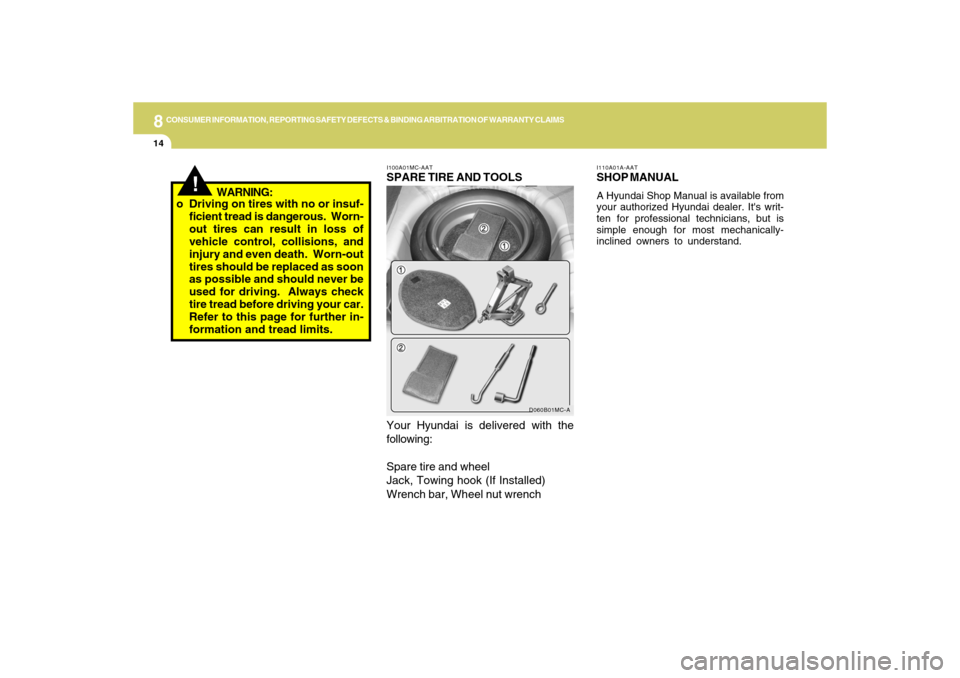
I100A01MC-AATSPARE TIRE AND TOOLS
Your Hyundai is delivered with the
following:
Spare tire and wheel
Jack, Towing hook (If Installed)
Wrench bar, Wheel nut wrench
I110A01A-AATSHOP MANUALA Hyundai Shop Manual is available from
your authorized Hyundai dealer. It's writ-
ten for professional technicians, but is
simple enough for most mechanically-
inclined owners to understand.
D060B01MC-A
o Driving on tires with no or insuf-
ficient tread is dangerous. Worn-
out tires can result in loss of
vehicle control, collisions, and
injury and even death. Worn-out
tires should be replaced as soon
as possible and should never be
used for driving. Always check
tire tread before driving your car.
Refer to this page for further in-
formation and tread limits.