Battery Hyundai Accent 2009 User Guide
[x] Cancel search | Manufacturer: HYUNDAI, Model Year: 2009, Model line: Accent, Model: Hyundai Accent 2009Pages: 266, PDF Size: 8.77 MB
Page 143 of 266
1
FEATURES OF YOUR HYUNDAI
133133
o This equipment is designed to be
used only in a 12 volt DC battery
system with negative ground.
o This unit is made of precision parts.
Do not attempt to disassemble or
adjust any parts.
o When driving your vehicle, be sure to
keep the volume of the unit set low
enough to allow you to hear sounds
coming from the outside.
o Do not expose this equipment (in-
cluding the speakers and CD) to water
or excessive moisture.
!
CAUTION:
o Do not insert warped or poor quality
discs into the CD player as damage
to the unit may occur.
o Do not insert anything like coins into
the player slot as damage to the unit
may occur.
o Do not place beverages close to the
audio system. The playback mecha-
nism may be damaged if you spill
them.
o Do not strike or allow anything to
impact the audio system, damage to
the system mechanisms could oc-
cur.
o Off-road or rough surface driving may
cause the compact disc to skip. Do
not use the compact disc when driv-
ing in such conditions as damage to
the compact disc face could occur.
o Do not attempt to grab or pull the
compact disc out while the disc is
being pulled into the audio unit by the
self-loading mechanism. Damage to
the audio unit and compact disc could
occur.
Page 147 of 266
2
DRIVING YOUR HYUNDAI4
C040A02A-AAT
WARNING:
The engine should not be turned off or
the key removed from the ignition key
cylinder while the vehicle is in motion.
The steering wheel is locked by remov-
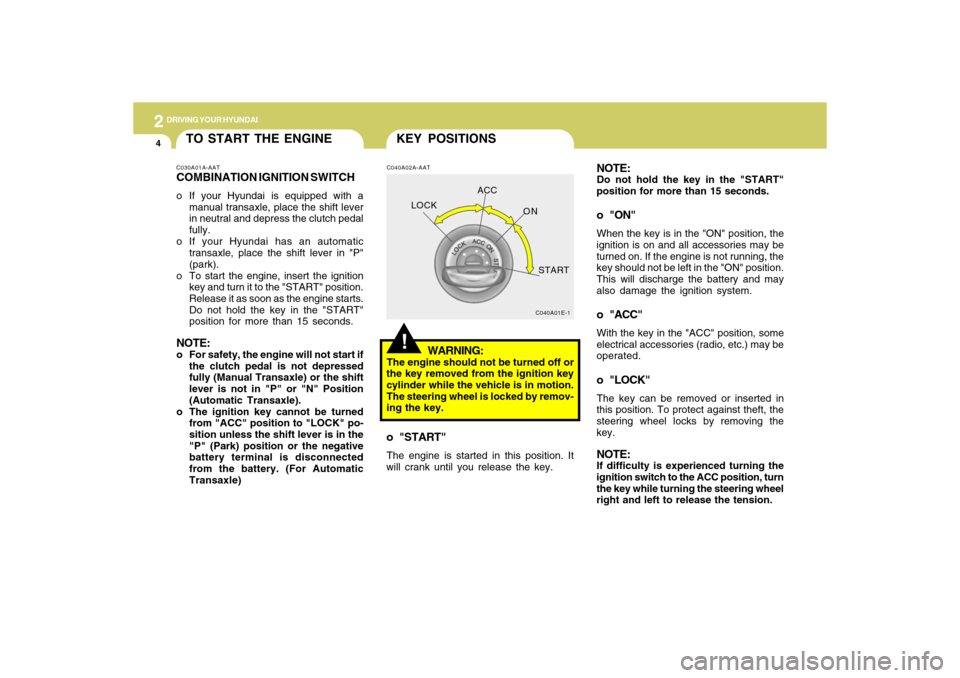
ing the key.o "START"The engine is started in this position. It
will crank until you release the key.
!KEY POSITIONS
C040A01E-1
LOCKACC
ON
START
NOTE:Do not hold the key in the "START"
position for more than 15 seconds.o "ON"When the key is in the "ON" position, the
ignition is on and all accessories may be
turned on. If the engine is not running, the
key should not be left in the "ON" position.
This will discharge the battery and may
also damage the ignition system.o "ACC"With the key in the "ACC" position, some
electrical accessories (radio, etc.) may be
operated.o "LOCK"The key can be removed or inserted in
this position. To protect against theft, the
steering wheel locks by removing the
key.NOTE:If difficulty is experienced turning the
ignition switch to the ACC position, turn
the key while turning the steering wheel
right and left to release the tension.
TO START THE ENGINEC030A01A-AATCOMBINATION IGNITION SWITCHo If your Hyundai is equipped with a
manual transaxle, place the shift lever
in neutral and depress the clutch pedal
fully.
o If your Hyundai has an automatic
transaxle, place the shift lever in "P"
(park).
o To start the engine, insert the ignition
key and turn it to the "START" position.
Release it as soon as the engine starts.
Do not hold the key in the "START"
position for more than 15 seconds.NOTE:o For safety, the engine will not start if
the clutch pedal is not depressed
fully (Manual Transaxle) or the shift
lever is not in "P" or "N" Position
(Automatic Transaxle).
o The ignition key cannot be turned
from "ACC" position to "LOCK" po-
sition unless the shift lever is in the
"P" (Park) position or the negative
battery terminal is disconnected
from the battery. (For Automatic
Transaxle)
Page 160 of 266

DRIVING YOUR HYUNDAI
172
C160D01A-AATCheck Battery and CablesWinter puts additional burdens on the
battery system. Visually inspect the bat-
tery and cables as described in Section
6. The level of charge in your battery can
be checked by your Hyundai dealer or a
service station.C160C01A-AATUse High Quality Ethylene Glycol
CoolantYour Hyundai is delivered with high qual-
ity ethylene glycol coolant in the cooling
system. It is the only type of coolant that
should be used because it helps prevent
corrosion in the cooling system, lubri-
cates the water pump and prevents freez-
ing. Be sure to replace or replenish your
coolant in accordance with the mainte-
nance schedule in Section 5. Before win-
ter, have your coolant tested to assure
that its freezing point is sufficient for the
temperatures anticipated during the win-
ter.
C160B01A-AATSnowy or Icy ConditionsTo drive your vehicle in deep snow, it may
be necessary to use snow tires or to
install tire chains on your tires. If snow
tires are needed, it is necessary to select
tires equivalent in size and type to the
original equipment tires. Failure to do so
may adversely affect the safety and han-
dling of your car. Furthermore, speeding,
rapid acceleration, sudden brake appli-
cations, and sharp turns are potentially
very hazardous practices.
During deceleration, use engine braking
to the fullest extent. Sudden brake appli-
cations on snowy or icy roads may cause
skids to occur. You need to keep suffi-
cient distance between the vehicle in
operation in front and your vehicle. Also,
apply the brake gently. It should be noted
that installing tire chains on the tire will
provide a greater driving force, but will
not prevent side skids.NOTE:Tire chains are not legal in all states.
Check state laws before fitting tire
chains.
C160E01A-AATChange to "Winter Weight" Oil if
NecessaryIn some climates it is recommended that
a lower viscosity "winter weight" oil be
used during cold weather. See Section 9
for recommendations. If you aren't sure
what weight oil you should use, consult
your Hyundai dealer.C160F02A-AATCheck Spark Plugs and Ignition
SystemInspect your spark plugs and replace
them if necessary. Also check all ignition
wiring and components to be sure they
are not cracked, worn or damaged in any
way.
Page 170 of 266
32WHAT TO DO IN AN EMERGENCY
IF THE ENGINE WILL NOT
START!
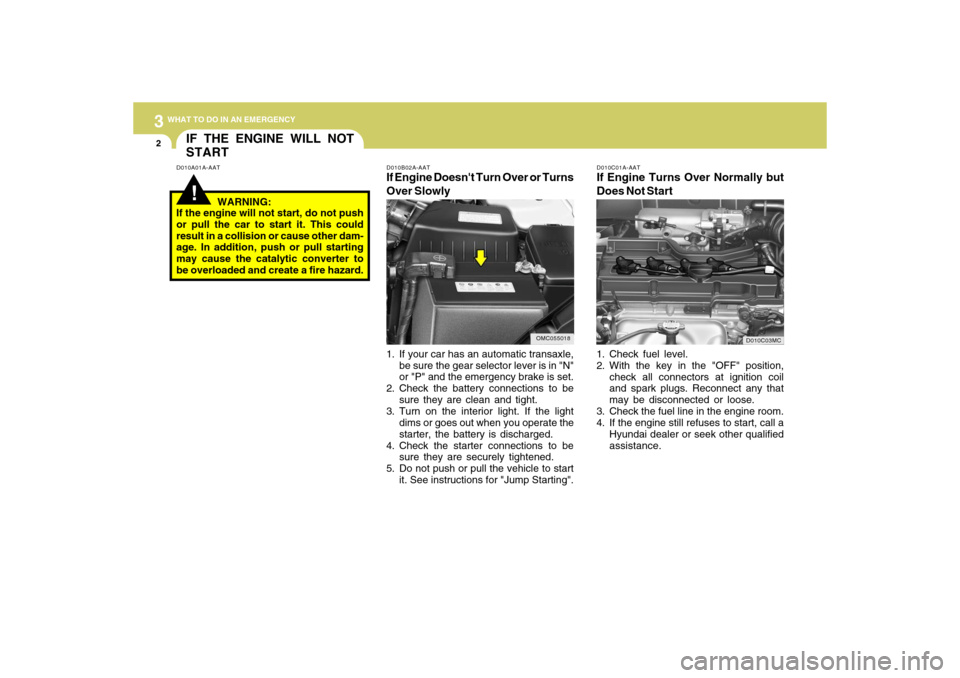
D010B02A-AATIf Engine Doesn't Turn Over or Turns
Over Slowly
D010A01A-AATD010C01A-AAT
If Engine Turns Over Normally but
Does Not Start1. Check fuel level.
2. With the key in the "OFF" position,
check all connectors at ignition coil
and spark plugs. Reconnect any that
may be disconnected or loose.
3. Check the fuel line in the engine room.
4. If the engine still refuses to start, call a
Hyundai dealer or seek other qualified
assistance. WARNING:
If the engine will not start, do not push
or pull the car to start it. This could
result in a collision or cause other dam-
age. In addition, push or pull starting
may cause the catalytic converter to
be overloaded and create a fire hazard.
1. If your car has an automatic transaxle,
be sure the gear selector lever is in "N"
or "P" and the emergency brake is set.
2. Check the battery connections to be
sure they are clean and tight.
3. Turn on the interior light. If the light
dims or goes out when you operate the
starter, the battery is discharged.
4. Check the starter connections to be
sure they are securely tightened.
5. Do not push or pull the vehicle to start
it. See instructions for "Jump Starting".
OMC055018
D010C03MC
Page 171 of 266
3
WHAT TO DO IN AN EMERGENCY
3
JUMP STARTING
D010D01A-AATIf the Engine Stalls While Driving1. Reduce your speed gradually, keep-
ing a straight line. Move cautiously off
the road to a safe place.
2. Turn on your emergency flashers.
3. Try to start the engine again. If your
vehicle will not start, contact a Hyundai
dealer or seek other qualified assis-
tance.
!
D020A02A-AAT
WARNING:
The gas produced by the battery during
the jump-start operation is highly ex-
plosive. If these instructions are not
followed exactly, serious personal in-
jury and damage to the vehicle may
occur! If you are not sure how to follow
this procedure, seek qualified assis-
tance. Automobile batteries contain sul-
furic acid. This is poisonous and highly
corrosive. When jump starting, wear
protective glasses and be careful not to
get acid on yourself, your clothing or on
the car.
D020A02MC
o If you should accidentally get acid on
your skin or in your eyes, immediately
remove any contaminated clothing
and flush the area with clear water for
at least 15 minutes. Then promptly
obtain medical attention. If you must
be transported to an emergency facil-
ity, continue to apply water to the af-
fected area with a sponge or cloth.
o The gas produced by the battery dur-
ing the jump-start operation is highly
explosive. Do not smoke or allow a
spark or open flame in the vicinity.
o The battery being used to provide the
jump start must be 12-volt. If you can-
not determine that it is a 12-volt bat-
tery, do not attempt to use it for the
jump start.
o To jump start a car with a discharged
battery, follow this procedure exactly:
1. If the booster battery is installed in
another vehicle, be sure the two ve-
hicles are not touching.
2. Turn off all unnecessary lights and
accessories in both vehicles.
F020100AUN-EUIf the Engine Stalls at a Crossroad or
CrossingIf the engine stalls at a crossroad or
crossing, set the shift lever in the
N(Neutral) position and then push the
vehicle to a safe place.
Page 172 of 266
34WHAT TO DO IN AN EMERGENCY
IF THE ENGINE OVERHEATSD030A02A-AATIf your temperature gauge indicates over-
heating, you experience a loss of power,
or hear loud pinging or knocking, the
engine is probably too hot. If this hap-
pens, you should:
1. Pull off the road and stop as soon as
it is safe to do so.
2. Place the gear selector lever in "P"
(automatic), or neutral (manual
transaxle) and set the parking brake. If
the air conditioner is on, turn it off.
3. If coolant is running out under the car
or steam is coming out from the hood,
stop the engine. Do not open the hood
until the coolant has stopped running
or the steaming has stopped. If there is
no visible loss of coolant and no steam,
leave the engine running and check to
be sure the engine cooling fan is op-
erating. If the fan is not running, turn
the engine off.
4. Check to see if the water pump drive
belt is missing. If it is not missing,
check to see that it is tight. If the drive
belt seems to be satisfactory, check for
coolant leaking from the radiator, hoses
or under the car. (If the air conditioner
had been in use, it is normal for cold
water to be draining from it when you
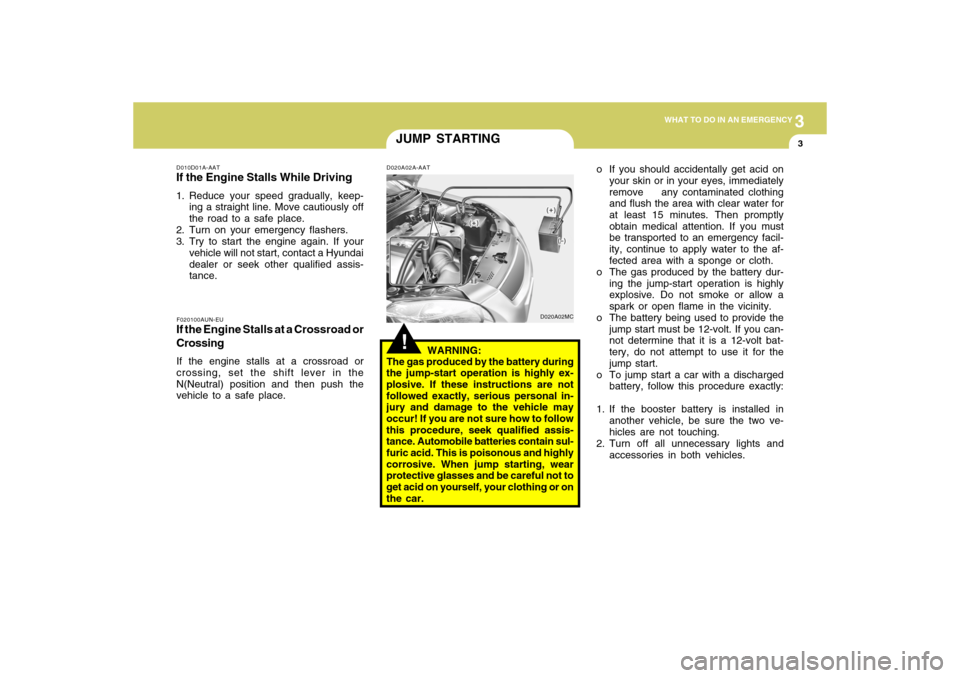
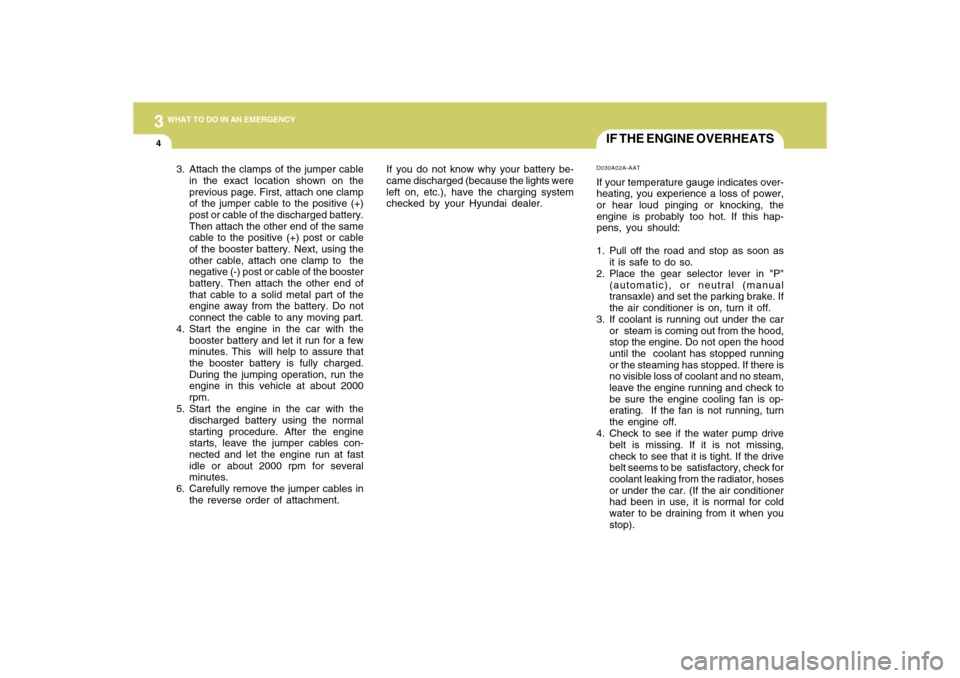
stop). 3. Attach the clamps of the jumper cable
in the exact location shown on the
previous page. First, attach one clamp
of the jumper cable to the positive (+)
post or cable of the discharged battery.
Then attach the other end of the same
cable to the positive (+) post or cable
of the booster battery. Next, using the
other cable, attach one clamp to the
negative (-) post or cable of the booster
battery. Then attach the other end of
that cable to a solid metal part of the
engine away from the battery. Do not
connect the cable to any moving part.
4. Start the engine in the car with the
booster battery and let it run for a few
minutes. This will help to assure that
the booster battery is fully charged.
During the jumping operation, run the
engine in this vehicle at about 2000
rpm.
5. Start the engine in the car with the
discharged battery using the normal
starting procedure. After the engine
starts, leave the jumper cables con-
nected and let the engine run at fast
idle or about 2000 rpm for several
minutes.
6. Carefully remove the jumper cables in
the reverse order of attachment.If you do not know why your battery be-
came discharged (because the lights were
left on, etc.), have the charging system
checked by your Hyundai dealer.
Page 193 of 266
4
CORROSION PREVENTION AND APPEARANCE CARE
4
CORROSION PREVENTION AND APPEARANCE CARE
5
E030B01A-AATSpot CleaningDon't use gasoline, strong solvents or
corrosive cleaning agents. These can
damage the finish of the car. To remove
road tar, use turpentine on a clean, soft
cloth. Be gentle.
To remove dead insects or tree sap, use
warm water and mild soap or car-wash-
ing solution. Soak the spot and rub gen-
tly. If the paint has lost its luster, use a
commercial car-cleaning polish.E030C01A-AATPolishing and WaxingAlways wash and dry the car before pol-
ishing or waxing or using a combination
cleaner and wax. Use a good quality
commercial product and follow the
manufacturer's directions on the con-
tainer. Polish and wax the bright trim
pieces as well as the paint.
E030D01A-AATWhen to Wax AgainYou should polish and wax the car again
when water no longer beads on a clean
surface but spreads out over a larger
area.E030E01A-AATMaintaining BumpersSpecial precautions must be observed to
preserve the appearance of the bumpers
on your Hyundai. They are:
o Be careful not to spill battery electro-
lyte or hydraulic brake fluid on the
bumpers. If you do, wash it off imme-
diately with clean water.
o Be gentle when cleaning the bumper
surfaces. They are made of soft plastic
and the surface can be damaged if
mistreated. Do not use abrasive clean-
ers. Use warm water and mild soap or
carwashing solution.
o Do not expose the bumpers to high
temperatures. For example, if you have
your car repainted, do not leave the
bumpers on the car if the car is going
to be placed in a high-temperature
paint booth.
!
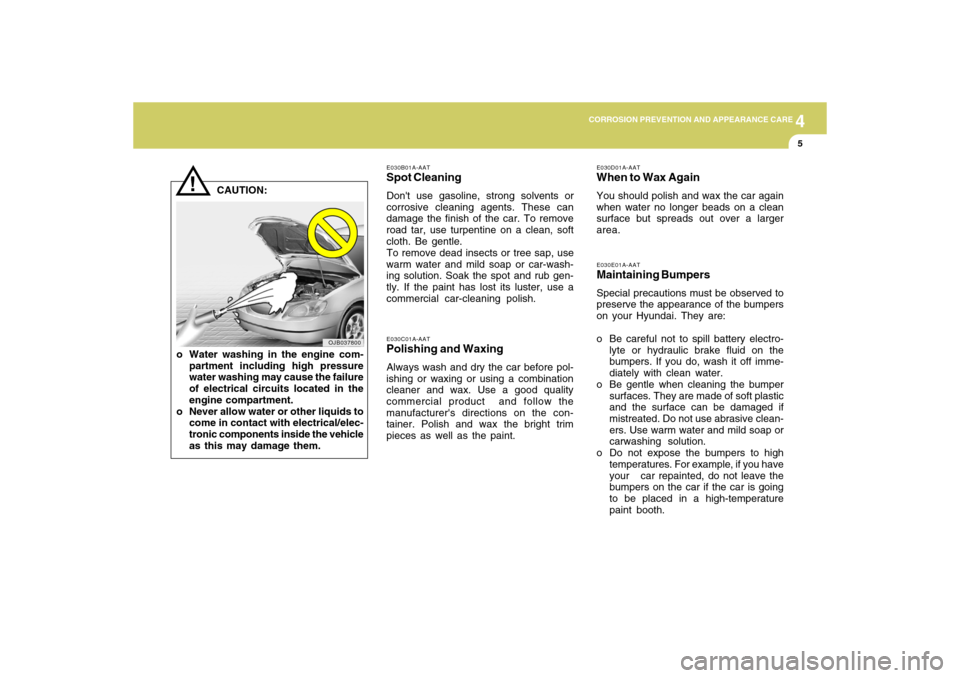
CAUTION:
OJB037800
o Water washing in the engine com-
partment including high pressure
water washing may cause the failure
of electrical circuits located in the
engine compartment.
o Never allow water or other liquids to
come in contact with electrical/elec-
tronic components inside the vehicle
as this may damage them.
Page 206 of 266
Engine Compartment .................................................... 6-2
General Checks ............................................................ 6-3
Maintenance Precautions ............................................. 6-4
Checking the Engine Oil ............................................... 6-4
Checking and Changing the Engine Coolant ................ 6-7
Changing the Air Cleaner Filter ..................................... 6-8
Checking the Transaxle Oil (Manual) .........................6-11
Checking the Transaxle Fluid (Automatic)..................6-11
Checking the Brakes ..................................................6-13
Air Conditioning Care..................................................6-14
Changing the Climate Control Air Filter .......................6-15
Checking and Replacing Fuses..................................6-16
Checking the Battery..................................................6-19
Power Steering Fluid Level .........................................6-21
Replacement of Light Bulbs ........................................6-22
Bulb Wattages.............................................................6-27
Fuse Panel Description...............................................6-28
DO-IT-YOURSELF MAINTENANCE
6
6
Page 207 of 266
6
DO-IT-YOURSELF MAINTENANCE2
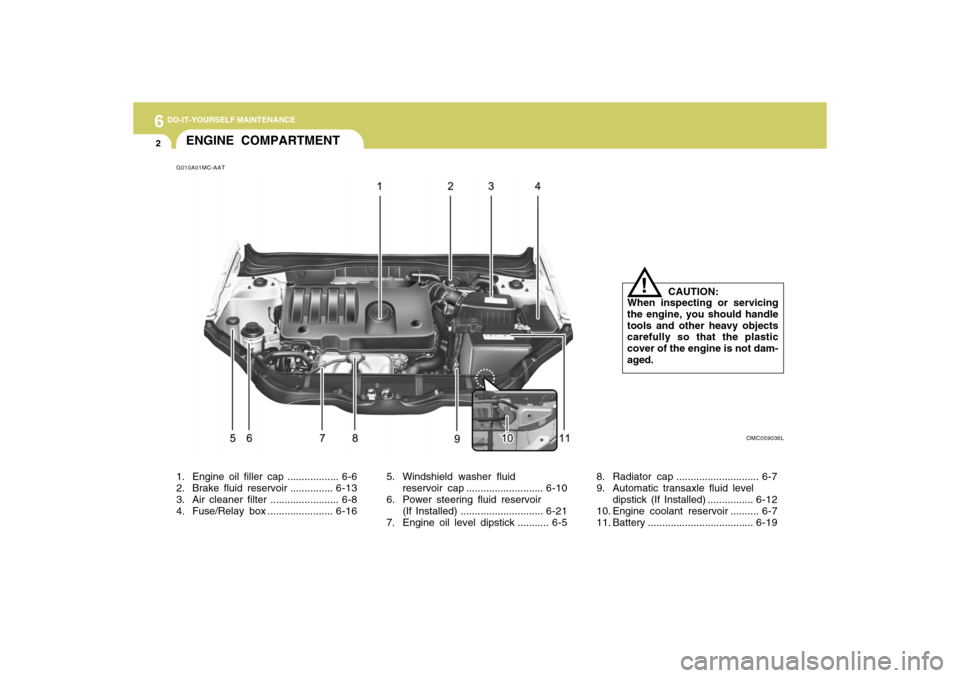
ENGINE COMPARTMENTG010A01MC-AAT1. Engine oil filler cap .................. 6-6
2. Brake fluid reservoir ...............6-13
3. Air cleaner filter ........................ 6-8
4. Fuse/Relay box .......................6-165. Windshield washer fluid
reservoir cap ...........................6-10
6. Power steering fluid reservoir
(If Installed) .............................6-21
7. Engine oil level dipstick ........... 6-58. Radiator cap ............................. 6-7
9. Automatic transaxle fluid level
dipstick (If Installed) ................6-12
10. Engine coolant reservoir .......... 6-7
11. Battery .....................................6-19
OMC059036L
CAUTION:
When inspecting or servicing
the engine, you should handle
tools and other heavy objects
carefully so that the plastic
cover of the engine is not dam-
aged.
!
Page 208 of 266
6
DO-IT-YOURSELF MAINTENANCE
3
GENERAL CHECKS
G020C01A-AATVehicle InteriorThe following should be checked each
time when the vehicle is driven:
o Light operation
o Windshield wiper operation
o Horn operation
o Defroster, heater system operation (and
air conditioning, if installed)
o Steering operation and condition
o Mirror condition and operation
o Turn signal operation
o Accelerator pedal operation
o Brake operation, including parking
brake
o Manual transaxle operation, including
clutchoperation
o Automatic transaxle operation, includ-
ing "Park" mechanism operation
o Seat control condition and operation
o Seat belt condition and operation
o Sun visor operation
If you notice anything that does not oper-
ate correctly or appear to be functioning
correctly, inspect it carefully and seek
assistance from your Hyundai dealer if
service is needed.
G020A01A-AATEngine Compartment
The following should be checked regu-
larly:
o Engine oil level and condition
o Transaxle fluid level and condition
o Brake fluid level
o Clutch fluid level
o Engine coolant level
o Windshield washer fluid level
o Accessory drive belt condition
o Engine coolant hose condition
o Fluid leaks (on or below components)
o Power steering fluid level and condi-
tion
o Battery condition
o Air cleaner filter condition
G020B01A-AATVehicle ExteriorThe following should be checked monthly:
o Overall appearance and condition
o Wheel condition and wheel nut tight-
ness
o Exhaust system condition
o Light condition and operation
o Windshield glass condition
o Wiper blade condition
o Paint condition and body corrosion
o Fluid leaks
o Door and hood lock condition
o Tire pressure and condition
(including spare tire)