check oil Hyundai Accent 2009 User Guide
[x] Cancel search | Manufacturer: HYUNDAI, Model Year: 2009, Model line: Accent, Model: Hyundai Accent 2009Pages: 266, PDF Size: 8.77 MB
Page 202 of 266
5
VEHICLE MAINTENANCE REQUIREMENTS
7
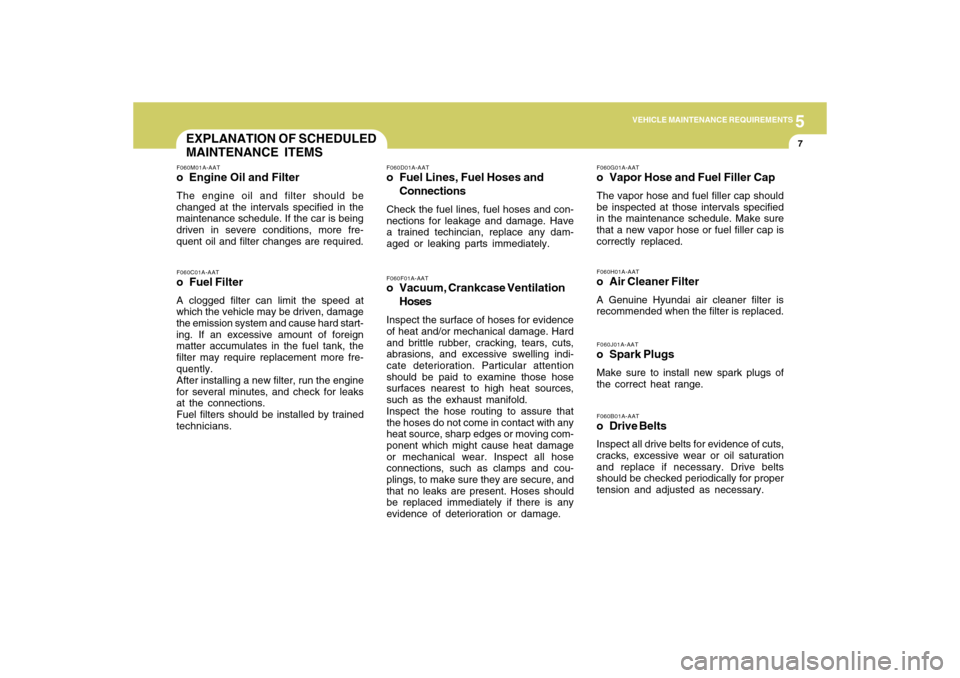
EXPLANATION OF SCHEDULED
MAINTENANCE ITEMS
F060D01A-AATo Fuel Lines, Fuel Hoses and
ConnectionsCheck the fuel lines, fuel hoses and con-
nections for leakage and damage. Have
a trained techincian, replace any dam-
aged or leaking parts immediately.
F060C01A-AATo Fuel FilterA clogged filter can limit the speed at
which the vehicle may be driven, damage
the emission system and cause hard start-
ing. If an excessive amount of foreign
matter accumulates in the fuel tank, the
filter may require replacement more fre-
quently.
After installing a new filter, run the engine
for several minutes, and check for leaks
at the connections.
Fuel filters should be installed by trained
technicians.F060M01A-AATo Engine Oil and FilterThe engine oil and filter should be
changed at the intervals specified in the
maintenance schedule. If the car is being
driven in severe conditions, more fre-
quent oil and filter changes are required.
F060H01A-AATo Air Cleaner FilterA Genuine Hyundai air cleaner filter is
recommended when the filter is replaced.F060G01A-AATo Vapor Hose and Fuel Filler CapThe vapor hose and fuel filler cap should
be inspected at those intervals specified
in the maintenance schedule. Make sure
that a new vapor hose or fuel filler cap is
correctly replaced.
F060F01A-AATo Vacuum, Crankcase Ventilation
HosesInspect the surface of hoses for evidence
of heat and/or mechanical damage. Hard
and brittle rubber, cracking, tears, cuts,
abrasions, and excessive swelling indi-
cate deterioration. Particular attention
should be paid to examine those hose
surfaces nearest to high heat sources,
such as the exhaust manifold.
Inspect the hose routing to assure that
the hoses do not come in contact with any
heat source, sharp edges or moving com-
ponent which might cause heat damage
or mechanical wear. Inspect all hose
connections, such as clamps and cou-
plings, to make sure they are secure, and
that no leaks are present. Hoses should
be replaced immediately if there is any
evidence of deterioration or damage.
F060B01A-AATo Drive BeltsInspect all drive belts for evidence of cuts,
cracks, excessive wear or oil saturation
and replace if necessary. Drive belts
should be checked periodically for proper
tension and adjusted as necessary.F060J01A-AATo Spark PlugsMake sure to install new spark plugs of
the correct heat range.
Page 203 of 266
5
VEHICLE MAINTENANCE REQUIREMENTS8
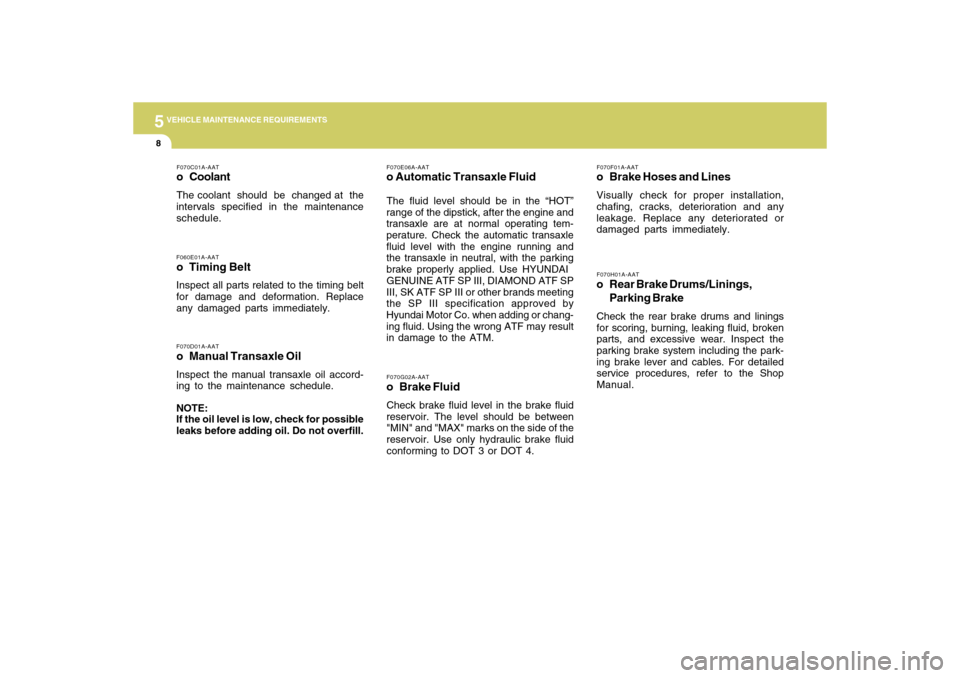
F070H01A-AATo Rear Brake Drums/Linings,
Parking BrakeCheck the rear brake drums and linings
for scoring, burning, leaking fluid, broken
parts, and excessive wear. Inspect the
parking brake system including the park-
ing brake lever and cables. For detailed
service procedures, refer to the Shop
Manual.F070F01A-AATo Brake Hoses and LinesVisually check for proper installation,
chafing, cracks, deterioration and any
leakage. Replace any deteriorated or
damaged parts immediately.
F070G02A-AATo Brake FluidCheck brake fluid level in the brake fluid
reservoir. The level should be between
"MIN" and "MAX" marks on the side of the
reservoir. Use only hydraulic brake fluid
conforming to DOT 3 or DOT 4.F070E06A-AATo Automatic Transaxle FluidThe fluid level should be in the “HOT”
range of the dipstick, after the engine and
transaxle are at normal operating tem-
perature. Check the automatic transaxle
fluid level with the engine running and
the transaxle in neutral, with the parking
brake properly applied. Use HYUNDAI
GENUINE ATF SP III, DIAMOND ATF SP
III, SK ATF SP III or other brands meeting
the SP III specification approved by
Hyundai Motor Co. when adding or chang-
ing fluid. Using the wrong ATF may result
in damage to the ATM.
F070D01A-AATo Manual Transaxle OilInspect the manual transaxle oil accord-
ing to the maintenance schedule.
NOTE:
If the oil level is low, check for possible
leaks before adding oil. Do not overfill.F060E01A-AATo Timing BeltInspect all parts related to the timing belt
for damage and deformation. Replace
any damaged parts immediately.F070C01A-AATo CoolantThe coolant should be changed at the
intervals specified in the maintenance
schedule.
Page 204 of 266

5
VEHICLE MAINTENANCE REQUIREMENTS
9
F070M01A-AATo Steering Gear Box, Linkage &
Boots/Lower Arm Ball JointWith the vehicle stopped and engine off,
check for excessive free-play in the steer-
ing wheel. Check the linkage for bends or
damage. Check the dust boots and ball
joints for deterioration, cracks, or dam-
age. Replace any damaged parts.
F070L01A-AATo Suspension Mounting BoltsCheck the suspension connections for
looseness or damage. Retighten to the
specified torque.F070K01A-AATo Exhaust Pipe and MufflerVisually inspect the exhaust pipes, muf-
fler and hangers for cracks, deterioration,
or damage. Start the engine and listen
carefully for any exhaust gas leakage.
Tighten connections or replace parts as
necessary.F070J01A-AATo Brake Pads, Calipers and RotorsCheck the pads for excessive wear, discs
for run out and wear, and calipers for fluid
leakage.
F070Q01A-AATo Air Conditioning RefrigerantCheck the air conditioning lines and con-
nections for leakage and damage. Check
air conditioning performance according
to the relevant shop manual if necessary.F070P01A-AATo Driveshafts and BootsCheck the drive shafts, boots and clamps
for cracks, deterioration, or damage. Re-
place any damaged parts and, if neces-
sary, repack the grease.
F070N01A-AATo Power Steering Pump, Belt and
HosesCheck the power steering pump and
hoses for leakage and damage. Replace
any damaged or leaking parts immedi-
ately. Inspect the power steering belt for
evidence of cuts, cracks, excessive wear,
oiliness and proper tension. Replace or
adjust it if necessary.
Page 206 of 266
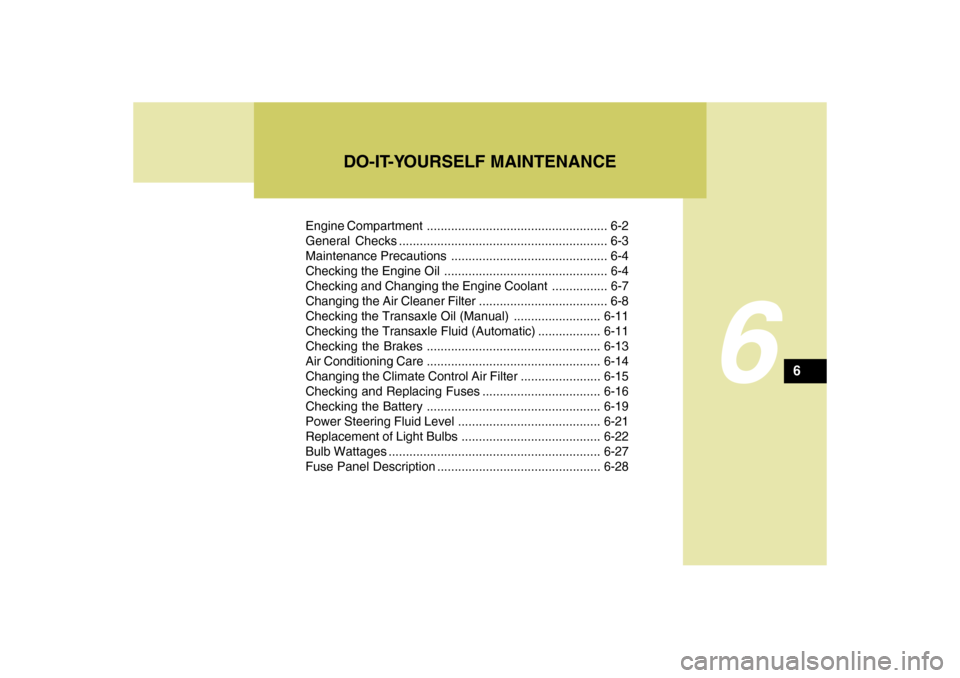
Engine Compartment .................................................... 6-2
General Checks ............................................................ 6-3
Maintenance Precautions ............................................. 6-4
Checking the Engine Oil ............................................... 6-4
Checking and Changing the Engine Coolant ................ 6-7
Changing the Air Cleaner Filter ..................................... 6-8
Checking the Transaxle Oil (Manual) .........................6-11
Checking the Transaxle Fluid (Automatic)..................6-11
Checking the Brakes ..................................................6-13
Air Conditioning Care..................................................6-14
Changing the Climate Control Air Filter .......................6-15
Checking and Replacing Fuses..................................6-16
Checking the Battery..................................................6-19
Power Steering Fluid Level .........................................6-21
Replacement of Light Bulbs ........................................6-22
Bulb Wattages.............................................................6-27
Fuse Panel Description...............................................6-28
DO-IT-YOURSELF MAINTENANCE
6
6
Page 208 of 266
6
DO-IT-YOURSELF MAINTENANCE
3
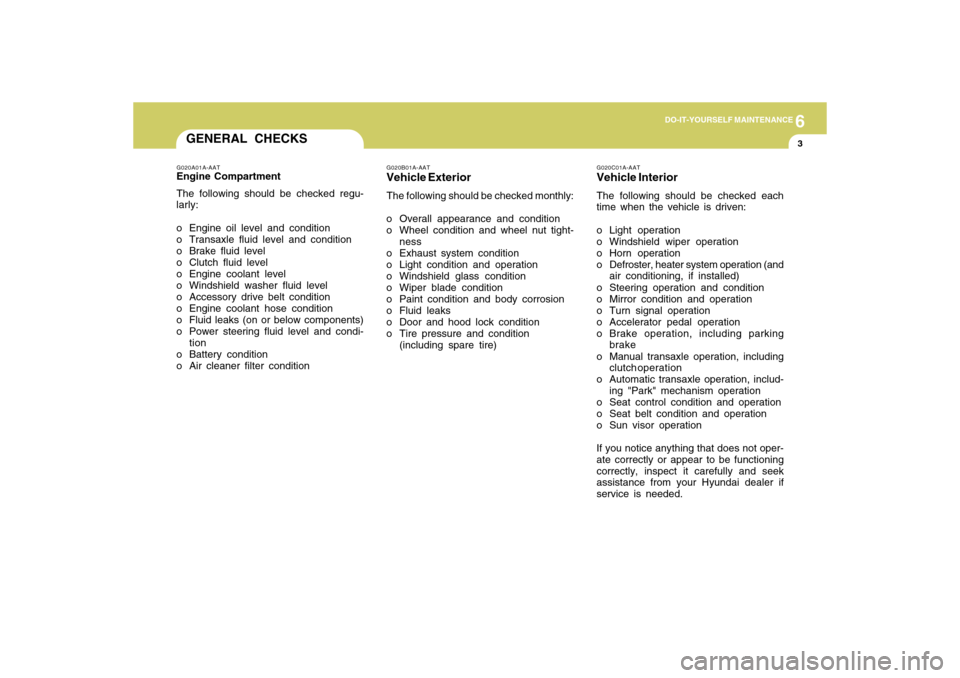
GENERAL CHECKS
G020C01A-AATVehicle InteriorThe following should be checked each
time when the vehicle is driven:
o Light operation
o Windshield wiper operation
o Horn operation
o Defroster, heater system operation (and
air conditioning, if installed)
o Steering operation and condition
o Mirror condition and operation
o Turn signal operation
o Accelerator pedal operation
o Brake operation, including parking
brake
o Manual transaxle operation, including
clutchoperation
o Automatic transaxle operation, includ-
ing "Park" mechanism operation
o Seat control condition and operation
o Seat belt condition and operation
o Sun visor operation
If you notice anything that does not oper-
ate correctly or appear to be functioning
correctly, inspect it carefully and seek
assistance from your Hyundai dealer if
service is needed.
G020A01A-AATEngine Compartment
The following should be checked regu-
larly:
o Engine oil level and condition
o Transaxle fluid level and condition
o Brake fluid level
o Clutch fluid level
o Engine coolant level
o Windshield washer fluid level
o Accessory drive belt condition
o Engine coolant hose condition
o Fluid leaks (on or below components)
o Power steering fluid level and condi-
tion
o Battery condition
o Air cleaner filter condition
G020B01A-AATVehicle ExteriorThe following should be checked monthly:
o Overall appearance and condition
o Wheel condition and wheel nut tight-
ness
o Exhaust system condition
o Light condition and operation
o Windshield glass condition
o Wiper blade condition
o Paint condition and body corrosion
o Fluid leaks
o Door and hood lock condition
o Tire pressure and condition
(including spare tire)
Page 209 of 266
6
DO-IT-YOURSELF MAINTENANCE4
CHECKING THE ENGINE OILG030A01A-AATEngine oil is essential to the performance
and service of the engine. It is suggested
that you check the oil level at least once
a week in normal use and more often if
you are on a trip or driving in severe
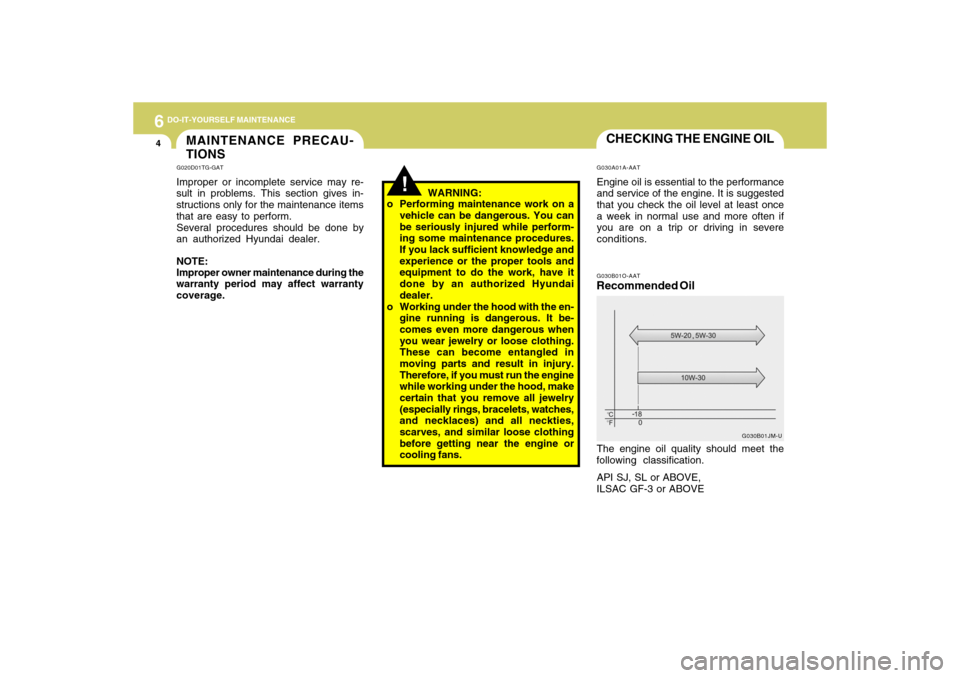
conditions.G030B01O-AATRecommended OilThe engine oil quality should meet the
following classification.
API SJ, SL or ABOVE,
ILSAC GF-3 or ABOVE
G030B01JM-U
MAINTENANCE PRECAU-
TIONS
!
G020D01TG-GATImproper or incomplete service may re-
sult in problems. This section gives in-
structions only for the maintenance items
that are easy to perform.
Several procedures should be done by
an authorized Hyundai dealer.
NOTE:
Improper owner maintenance during the
warranty period may affect warranty
coverage.WARNING:
o Performing maintenance work on a
vehicle can be dangerous. You can
be seriously injured while perform-
ing some maintenance procedures.
If you lack sufficient knowledge and
experience or the proper tools and
equipment to do the work, have it
done by an authorized Hyundai
dealer.
o Working under the hood with the en-
gine running is dangerous. It be-
comes even more dangerous when
you wear jewelry or loose clothing.
These can become entangled in
moving parts and result in injury.
Therefore, if you must run the engine
while working under the hood, make
certain that you remove all jewelry
(especially rings, bracelets, watches,
and necklaces) and all neckties,
scarves, and similar loose clothing
before getting near the engine or
cooling fans.
Page 210 of 266
6
DO-IT-YOURSELF MAINTENANCE
5
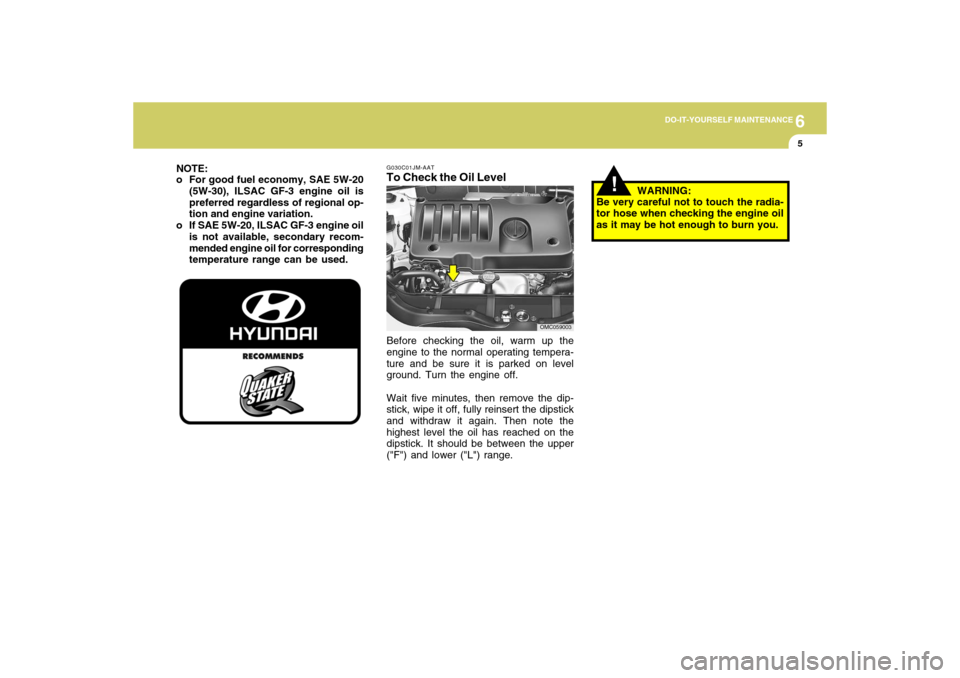
G030C01JM-AATTo Check the Oil LevelBefore checking the oil, warm up the
engine to the normal operating tempera-
ture and be sure it is parked on level
ground. Turn the engine off.
Wait five minutes, then remove the dip-
stick, wipe it off, fully reinsert the dipstick
and withdraw it again. Then note the
highest level the oil has reached on the
dipstick. It should be between the upper
("F") and lower ("L") range.
OMC059003
NOTE:
o For good fuel economy, SAE 5W-20
(5W-30), ILSAC GF-3 engine oil is
preferred regardless of regional op-
tion and engine variation.
o If SAE 5W-20, ILSAC GF-3 engine oil
is not available, secondary recom-
mended engine oil for corresponding
temperature range can be used.
!
WARNING:
Be very careful not to touch the radia-
tor hose when checking the engine oil
as it may be hot enough to burn you.
Page 211 of 266
6
DO-IT-YOURSELF MAINTENANCE6
!
CAUTION:
Slowly pour the recommended oil by
using a funnel. Do not overfill so as not
to damage engine.
!
WARNING:
Be very careful not to touch the radia-
tor hose when adding the engine oil as
it may be hot enough to burn you.
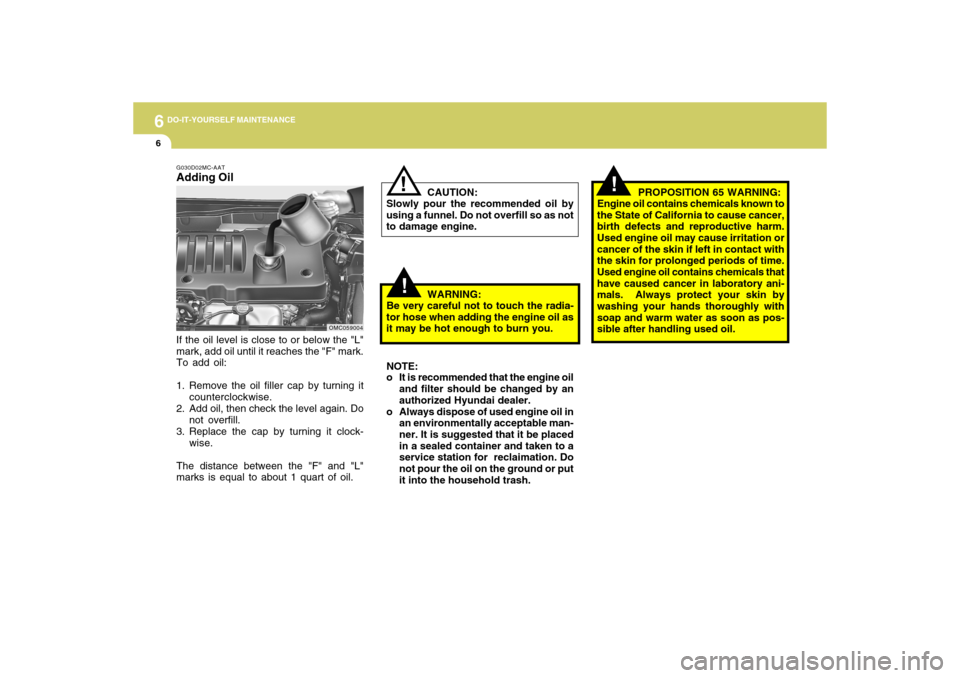
G030D02MC-AATAdding OilIf the oil level is close to or below the "L"
mark, add oil until it reaches the "F" mark.
To add oil:
1. Remove the oil filler cap by turning it
counterclockwise.
2. Add oil, then check the level again. Do
not overfill.
3. Replace the cap by turning it clock-
wise.
The distance between the "F" and "L"
marks is equal to about 1 quart of oil.
OMC059004
NOTE:
o It is recommended that the engine oil
and filter should be changed by an
authorized Hyundai dealer.
o Always dispose of used engine oil in
an environmentally acceptable man-
ner. It is suggested that it be placed
in a sealed container and taken to a
service station for reclaimation. Do
not pour the oil on the ground or put
it into the household trash.
!
PROPOSITION 65 WARNING:
Engine oil contains chemicals known to
the State of California to cause cancer,
birth defects and reproductive harm.
Used engine oil may cause irritation or
cancer of the skin if left in contact with
the skin for prolonged periods of time.
Used engine oil contains chemicals that
have caused cancer in laboratory ani-
mals. Always protect your skin by
washing your hands thoroughly with
soap and warm water as soon as pos-
sible after handling used oil.
Page 216 of 266
6
DO-IT-YOURSELF MAINTENANCE
11
!
G100A01MC-GATTransaxle lubricant in the manual
transaxle should be checked at those
intervals specified in the vehicle mainte-
nance schedule in Section 5.
!CHECKING THE TRANSAXLE
OIL (MANUAL)
!
CAUTION:
o Radiator anti-freeze (engine coolant)
should not be used in the washer
system because it will damage the
car's finish.
o The washer should not be operated
if the washer reservoir is empty.
This can damage the washer fluid
pump.WARNING:
It is always better to check the transaxle
oil level when the engine is cool or cold.
If the engine is hot, you should exercise
great caution to avoid burning yourself
on hot engine or exhaust parts.
WARNING:
o Windshield washer fluid agents con-
tain some amounts of alcohol and
can be flammable under certain cir-
cumstances. Do not allow sparks or
flame to contact the washer fluid or
the washer fluid reservoir. Damage
to the vehicle or its occupants could
occur.
o Windshield washer fluid is poison-
ous to humans and animals. Do not
drink windshield washer fluid. Seri-
ous injury or death could occur.NOTE:
It is recommended that the manual
transaxle fluid should be checked by an
authorized Hyundai dealer.
G110A01MC-AATTransaxle fluid in the automatic transaxle
should be checked at those intervals
specified in the vehicle maintenance
schedule in Section 5.
NOTE:
Automatic transaxle fluid is basically a
red color. As driving distance increases,
the fluid color turns darkish red gradu-
ally. It is a normal condition and you
should not judge the need to replace
based upon the changing color.
You must replace the automatic
transaxle fluid in accordance with inter-
vals specified in the vehicle mainte-
nance schedule in section 5.CHECKING THE TRANSAXLE
FLUID (AUTOMATIC)
Page 224 of 266
6
DO-IT-YOURSELF MAINTENANCE
19
CHECKING THE BATTERY!
G210A01A-AAT
WARNING:
Batteries can be dangerous! When
working with batteries, carefully ob-
serve the following precautions to avoid
serious injuries.o If battery fluid is on your skin, flush the
affected areas with water for at least 15
minutes and then seek medical assis-
tance.
o If battery fluid is in your eyes, rinse out
your eyes with water and get medical
assistance as soon as possible. While
you are being driven to get medical
assistance, continue to rinse your eyes
by using a sponge or soft cloth saturat-
ed with water.
o If you swallow battery fluid, drink a
large quantity of water or milk followed
by milk of magnesia, eat a raw egg or
drink vegetable oil. Get medical assis-
tance as soon as possible.
While batteries are being charged (either
by a battery charger or by the vehicle's
alternator), they produce explosive gases.
Always observe these warnings to pre-
vent injuries from occurring:
o Charge batteries only in a well venti-
lated area.
o Do not permit flames, sparks or smok-
ing in the area.
o Keep children away from the area.
OMC055018
The fluid in the battery contains a strong
solution of sulfuric acid, which is poison-
ous and highly corrosive. Be careful not
to spill it on yourself or the car. If you do
spill battery fluid on yourself, immediately
do the following:
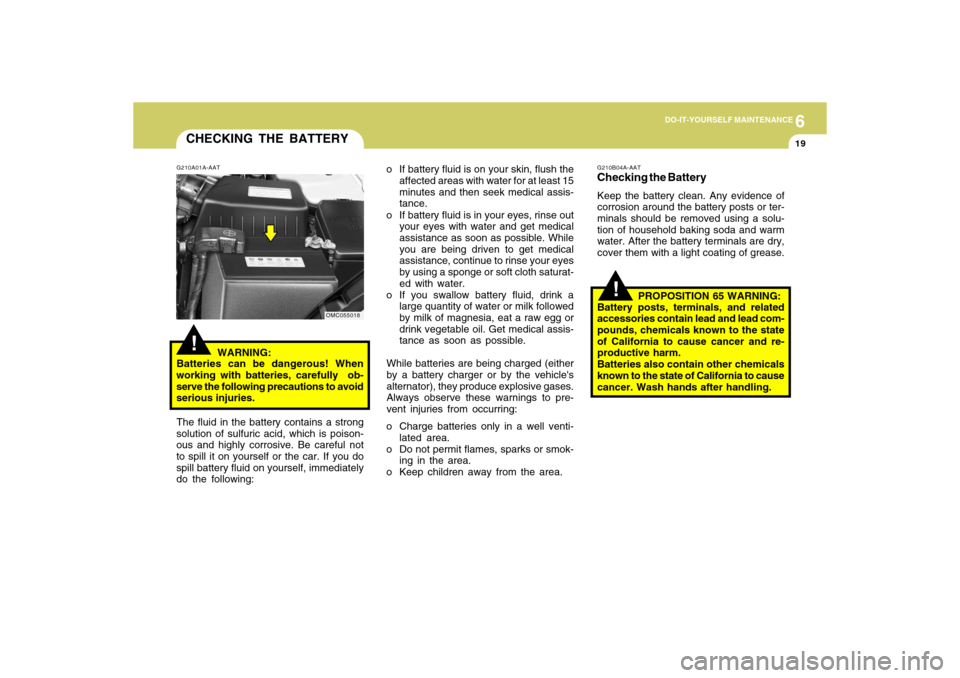
G210B04A-AATChecking the BatteryKeep the battery clean. Any evidence of
corrosion around the battery posts or ter-
minals should be removed using a solu-
tion of household baking soda and warm
water. After the battery terminals are dry,
cover them with a light coating of grease.
!
PROPOSITION 65 WARNING:
Battery posts, terminals, and related
accessories contain lead and lead com-
pounds, chemicals known to the state
of California to cause cancer and re-
productive harm.
Batteries also contain other chemicals
known to the state of California to cause
cancer. Wash hands after handling.