control arm Hyundai Accent 2009 User Guide
[x] Cancel search | Manufacturer: HYUNDAI, Model Year: 2009, Model line: Accent, Model: Hyundai Accent 2009Pages: 266, PDF Size: 8.77 MB
Page 120 of 266
1FEATURES OF YOUR HYUNDAI
110
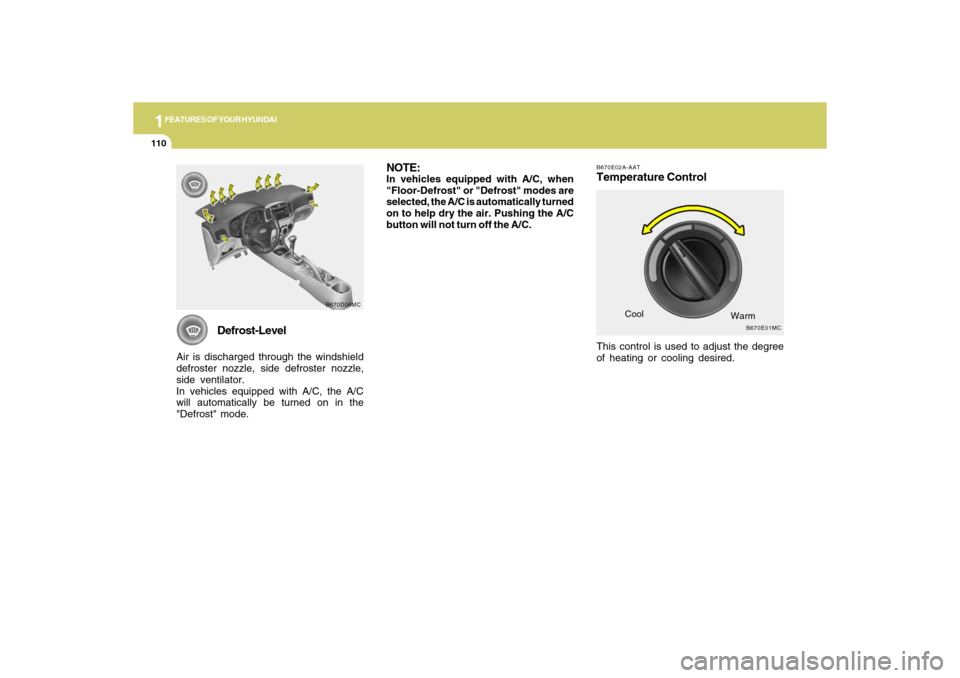
Defrost-Level
Air is discharged through the windshield
defroster nozzle, side defroster nozzle,
side ventilator.
In vehicles equipped with A/C, the A/C
will automatically be turned on in the
"Defrost" mode.
B670D06MC
NOTE:In vehicles equipped with A/C, when
"Floor-Defrost" or "Defrost" modes are
selected, the A/C is automatically turned
on to help dry the air. Pushing the A/C
button will not turn off the A/C.
B670E02A-AATTemperature ControlThis control is used to adjust the degree
of heating or cooling desired.
Cool
Warm
B670E01MC
Page 121 of 266
1
FEATURES OF YOUR HYUNDAI
1111
FEATURES OF YOUR HYUNDAI
111
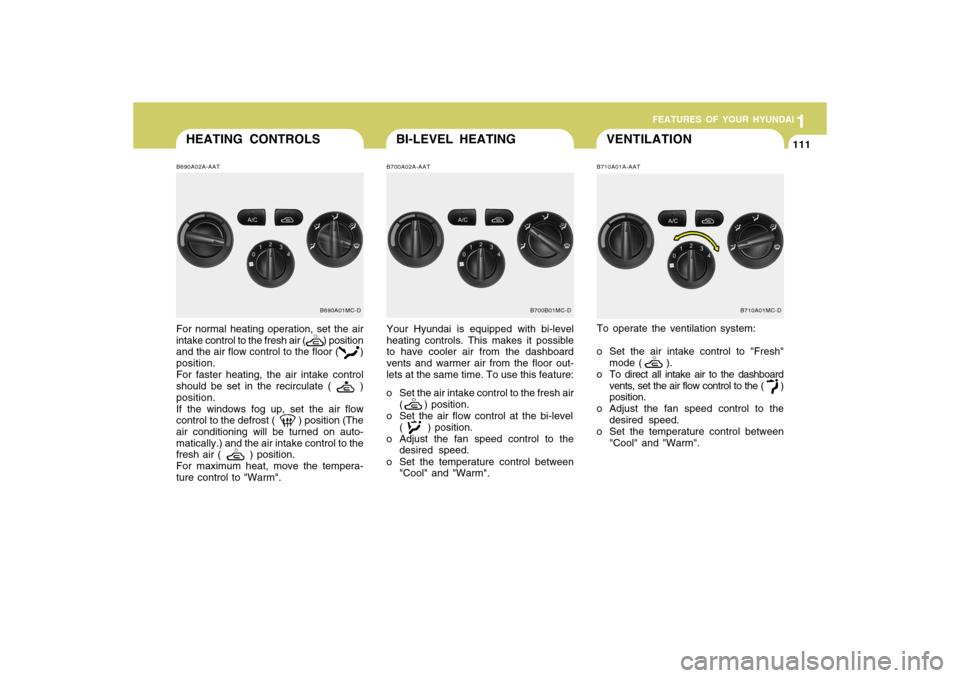
BI-LEVEL HEATINGB700A02A-AATYour Hyundai is equipped with bi-level
heating controls. This makes it possible
to have cooler air from the dashboard
vents and warmer air from the floor out-
lets at the same time. To use this feature:
o Set the air intake control to the fresh air
( ) position.
o Set the air flow control at the bi-level
( ) position.
o Adjust the fan speed control to the
desired speed.
o Set the temperature control between
"Cool" and "Warm".
B700B01MC-D
VENTILATIONB710A01A-AATTo operate the ventilation system:
o Set the air intake control to "Fresh"
mode ( ).
o To direct all intake air to the dashboard
vents, set the air flow control to the (
)
position.
o Adjust the fan speed control to the
desired speed.
o Set the temperature control between
"Cool" and "Warm".
B710A01MC-D
HEATING CONTROLSB690A02A-AATFor normal heating operation, set the air
intake control to the fresh air ( ) position
and the air flow control to the floor ( )
position.
For faster heating, the air intake control
should be set in the recirculate (
)
position.
If the windows fog up, set the air flow
control to the defrost ( ) position (The
air conditioning will be turned on auto-
matically.) and the air intake control to the
fresh air ( ) position.
For maximum heat, move the tempera-
ture control to "Warm".
B690A01MC-D
Page 122 of 266
1FEATURES OF YOUR HYUNDAI
112
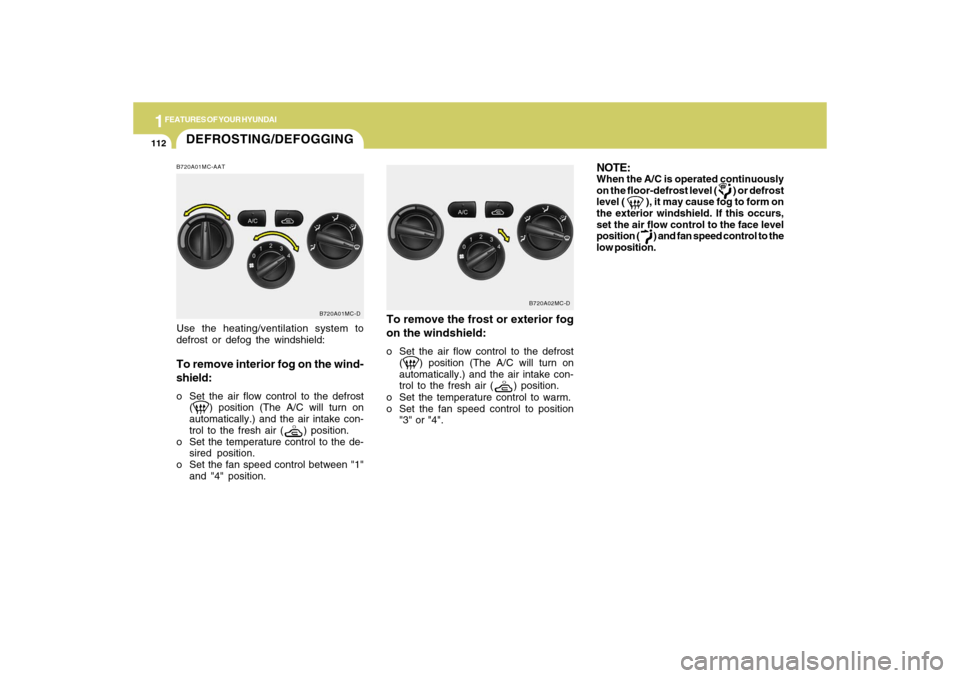
DEFROSTING/DEFOGGINGB720A01MC-AATUse the heating/ventilation system to
defrost or defog the windshield:To remove interior fog on the wind-
shield:o Set the air flow control to the defrost
(
) position (The A/C will turn on
automatically.) and the air intake con-
trol to the fresh air (
) position.
o Set the temperature control to the de-
sired position.
o Set the fan speed control between "1"
and "4" position.
B720A01MC-D
NOTE:When the A/C is operated continuously
on the floor-defrost level (
) or defrost
level (
), it may cause fog to form on
the exterior windshield. If this occurs,
set the air flow control to the face level
position ( ) and fan speed control to the
low position.
To remove the frost or exterior fog
on the windshield:o Set the air flow control to the defrost
(
) position (The A/C will turn on
automatically.) and the air intake con-
trol to the fresh air (
) position.
o Set the temperature control to warm.
o Set the fan speed control to position
"3" or "4".
B720A02MC-D
Page 123 of 266

1
FEATURES OF YOUR HYUNDAI
1131
FEATURES OF YOUR HYUNDAI
113
AIR CONDITIONING SYSTEM
B740A01MC-D B740A01A-AAT
(If Installed)
Air Conditioning SwitchThe air conditioning is turned on by push-
ing the A/C button on the heating/air
conditioning control panel.
B740B02A-AATAir Conditioning Operation
(Cooling)To use the air conditioning to cool the
interior:
o Turn on the fan control switch.
o Turn on the air conditioning switch by
pushing in on the switch.
The air conditioning indicator light
should come on at the same time.
o Set the temperature control to "Cool".
("Cool" provides maximum cooling. The
temperature may be moderated by
moving the control toward "Warm".)
o Adjust the fan control to the desired
speed. For greater cooling, turn the fan
control to one of the higher speeds or
temporarily select the (
)position
on the air intake control.B740B01MC-D B730A01L-AAT
Operation Tipso To keep dust or unpleasant fumes
from entering the car through the ven-
tilation system, temporarily set the air
intake control at the (
) position.
Be sure to return the control to the (
) position when the irritation has
passed to keep fresh air in the vehicle.
This will help keep the driver alert and
comfortable.
o Air for the heating/cooling system is
drawn in through the grilles just ahead
of the windshield. Care should be taken
that these are not blocked by leaves,
snow, ice or other obstructions.
o To prevent interior fog on the wind-
shield, set the air intake control to the
fresh air (
) position, fan speed to
the desired position, turn on the air
conditioning system, and adjust tem-
perature control to desired tempera-
ture.
Page 124 of 266

1FEATURES OF YOUR HYUNDAI
114
B740D01A-AATOperation Tipso If the interior of the car is hot when you
first get in, open the windows for a few
minutes to expel the hot air.
o When you are using the air condition-
ing system, keep all windows closed to
keep hot air out.
o When moving slowly, as in heavy traf-
fic, shift to a lower gear.
This increases engine speed, which in
turn increases the speed of the air
conditioning compressor.
o On steep grades, turn the air condi-
tioning off to avoid the possibility of the
engine overheating.
o During winter months or in periods
when the air conditioning is not used
regularly, run the air conditioning once
every month for a few minutes.
This will help circulate the lubricants
and keep your system in peak operat-
ing condition.
For dehumidified heating:
o Turn on the fan control switch.
o Push the air conditioning switch. The
air conditioning indicator light should
come on at the same time.
o Set the air intake control switch to the
fresh air (
) position.
o Adjust the fan control to the desired
speed.
o For more rapid action, set the fan at
one of the higher speeds.
o Adjust the temperature control to pro-
vide the desired amount of warmth.
B740C01MC-AATDe-Humidified Heating
B740C01MC-D
Page 125 of 266

1
FEATURES OF YOUR HYUNDAI
1151
FEATURES OF YOUR HYUNDAI
115
B720A01MC-AATDEFROSTING/DEFOGGINGUse the heating/ventilation system to defrost or defog the
windshield:
To remove interior fog on the windshield;
o Set the air flow control to the defrost ( ) position (The
A/C will turn on automatically.) and the air intake control
to the fresh air (
) position.
o Set the temperature control to the desired position.
o Set the fan speed control between "1" and "4" position.To remove frost or exterior fog on the windshield;
o Set the air flow control to the defrost ( ) position (The
A/C will turn on automatically.) and the air intake control
to the fresh air (
) position.
o Set the temperature control to warm.
o Set the fan speed control to position "3" or "4".
NOTE:
When the A/C is operated continuously on the floor-defrost level ( ) or defrost level ( ), it may cause fog to form
on the exterior windshield. If this occurs, set the air flow control to the face level position ( ) and fan speed control
to the low position.
OMC029102
OMC029103
Page 175 of 266
3
WHAT TO DO IN AN EMERGENCY
7
!
CAUTION:
In winter or cold weather, the low
tire pressure telltale may be illumi-
nated if the tire pressure was ad-
justed to the recommended tire in-
flation pressure in warm weather. It
does not mean your TPMS is mal-
functioning because the decreased
temperature leads to a proportional
lowering of tire pressure.
When you drive your vehicle from a
warm area to a cold area or from a
cold area to a warm area, or the
outside temperature is greatly
higher or lower, you should check
the tire inflation pressure and ad-
just the tires to the recommended
tire inflation pressure.
WARNING:
Significantly low tire pressure
makes the vehicle unstable and can
contribute to loss of vehicle control
and increased braking distances.
Continued driving on low pressure
tires will cause the tires to overheat
and fail.
TPMS (Tire Pressure Moni-
toring System) Malfunction
Indicator
The TPMS malfunction indicator comes
on and stays on when there is a
problem with the Tire Pressure Moni-
toring System. If the system is able to
correctly detect an under-inflation warn-
ing at the same time as system failure
then it will illuminate both the TPMS
malfunction and the low tire pressure
telltale e.g. if Front Left sensor fails,
the TPMS malfunction indicator turns
on, but if Front Right, Rear Left, or
!
Rear Right tire is under-inflated, the
low tire pressure telltale may turn on at
the same time as the TPMS malfunc-
tion indicator. Have the system
checked by an authorized Hyundai
dealer as soon as possible to deter-
mine the cause of the problem.
NOTE:
o The TPMS malfunction indicator
may be illuminated if the vehicle is
moving around electric power sup-
ply cables or radio transmitters
such as police stations, govern-
ment and public offices, broad-
casting stations, military installa-
tions, airports, or transmitting tow-
ers, etc. which can interfere with
normal operation of the Tire Pres-
sure Monitoring System (TPMS).
o The TPMS malfunction indicator
may be illuminated if snow chains
or some electronic devices, such
as notebook computers, are used
in the vehicle. This can interfere
with normal operation of the Tire
Pressure Monitoring System
(TPMS).
Page 192 of 266
44
CORROSION PREVENTION AND APPEARANCE CARE4
Use a clean sponge or cloth, rinse it
frequently and don't damage the finish by
rubbing too hard. For stubborn spots,
dampen them frequently and remove
them a little at a time.
To clean whitewall tires, use a stiff brush
or soap-impregnated steel-wool scour-
ing pad.
To clean plastic wheel covers, use a
clean sponge or soft cloth and water.
To clean cast aluminum alloy wheels,
use a mild soap or neutral detergent. Do
not use abrasive cleaners. Protect the
bare-metal surfaces by cleaning, polish-
ing and waxing. Because aluminum is
subject to corrosion, be sure to give alu-
minum alloy wheels special attention in
winter. If you drive on salted roads, clean
the wheels thoroughly afterwards.
After washing, be sure to rinse thoroughly.
If soapy water dries on the finish, streak-
ing will result.
When the weather is warm and the hu-
midity low, you may find it necessary to
rinse each section immediately after wash-
ing to avoid streaking.After rinsing, dry the car using a damp
chamois or soft, absorbent cloth. The rea-
son for drying the car is to remove water
from the car so it will dry without water
spots. Don't rub, this can damage the
finish.
If you find any nicks or scratches in the
paint, use touch-up paint to cover them to
prevent corrosion. To protect the
paintwork of the car against corrosion,
you must clean your Hyundai (at least
once a month). Give special attention to
the removal of salt, mud and other sub-
stances on the underside of the
splashboards of the car. Make sure that
the outlets and the underside of the doors
are open. Paint damage can be caused
by small accumulation of tar, industrial
precipitation, tree resin, insects and bird
droppings, when not removed immedi-
ately.
If water alone is not strong enough to
remove the accumulated dirt, use a mild
car washing solution. Be sure to rinse the
surface after washing to remove the solu-
tion. Never allow the solution to dry on the
painted surfaces.
WASHING AND WAXINGE030A02A-AATWashing Your HyundaiNever wash your car when the surface is
hot from being in the sun. Always wash
your car in the shade.
Wash your car frequently. Dirt is abrasive
and can scratch the paint if it is not re-
moved. Air pollution or acid rain may
damage the paint and trim through chemi-
cal action if pollutants are allowed to
remain in contact with the surface. If you
live near the ocean or in an area where
road salts or dust control chemicals are
used, you should pay particular attention
to the underside of the car. Start by rins-
ing the car to remove dust and loose dirt.
In winter, or if you have driven through
mud or muddy water, be sure to thor-
oughly clean the underside as well. Use
a hard direct stream of water to remove
accumulations of mud or corrosive mate-
rials. Use a good quality car-washing
solution and follow the manufacturer's
directions on the package. These are
available at your Hyundai dealer or auto
parts outlet. Don't use strong household
detergents, gasoline, strong solvents or
abrasive cleaning powders as these may
damage the finish.
Page 200 of 266
5
VEHICLE MAINTENANCE REQUIREMENTS
5
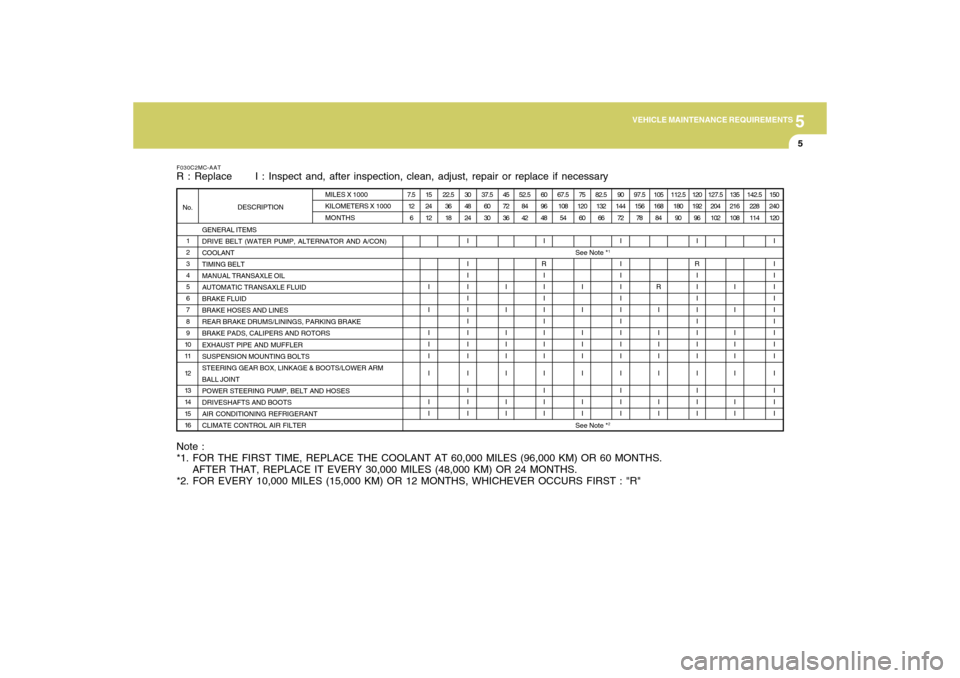
GENERAL ITEMS
DRIVE BELT (WATER PUMP, ALTERNATOR AND A/CON)
COOLANT
TIMING BELT
MANUAL TRANSAXLE OIL
AUTOMATIC TRANSAXLE FLUID
BRAKE FLUID
BRAKE HOSES AND LINES
REAR BRAKE DRUMS/LININGS, PARKING BRAKE
BRAKE PADS, CALIPERS AND ROTORS
EXHAUST PIPE AND MUFFLER
SUSPENSION MOUNTING BOLTS
STEERING GEAR BOX, LINKAGE & BOOTS/LOWER ARM
BALL JOINT
POWER STEERING PUMP, BELT AND HOSES
DRIVESHAFTS AND BOOTS
AIR CONDITIONING REFRIGERANT
CLIMATE CONTROL AIR FILTER 1
2
3
4
5
6
7
8
9
10
11
12
13
14
15
16 No.DESCRIPTIONMILES X 1000
KILOMETERS X 1000
MONTHS7.5
12
615
24
12
I
I
I
I
I
I
I
I22.5
36
1830
48
24
I
I
I
I
I
I
I
I
I
I
I
I
I
I37.5
60
3045
72
36
I
I
I
I
I
I
I
I52.5
84
4260
96
48
I
R
I
I
I
I
I
I
I
I
I
I
I
I67.5
108
5475
120
60
I
I
I
I
I
I
I
I82.5
132
6690
144
72
I
I
I
I
I
I
I
I
I
I
I
I
I
I97.5
156
78105
168
84
R
I
I
I
I
I
I
I112.5
180
90120
192
96
I
R
I
I
I
I
I
I
I
I
I
I
I
I127.5
204
102135
216
108
I
I
I
I
I
I
I
I142.5
228
114150
240
120
I
I
I
I
I
I
I
I
I
I
I
I
I
I
See Note *
2
Note :
*1. FOR THE FIRST TIME, REPLACE THE COOLANT AT 60,000 MILES (96,000 KM) OR 60 MONTHS.
AFTER THAT, REPLACE IT EVERY 30,000 MILES (48,000 KM) OR 24 MONTHS.
*2. FOR EVERY 10,000 MILES (15,000 KM) OR 12 MONTHS, WHICHEVER OCCURS FIRST : "R"F030C2MC-AATR : Replace I : Inspect and, after inspection, clean, adjust, repair or replace if necessary
See Note *
1
Page 201 of 266
5
VEHICLE MAINTENANCE REQUIREMENTS6
DRIVING
CONDITION MAINTENANCE
INTERVALS
ENGINE OIL AND FILTER
AIR CLEANER FILTER
SPARK PLUGS
BRAKE PADS, CALIPERS AND ROTORS
REAR BRAKE DRUMS/LININGS,
PARKING BRAKE
STEERING GEAR BOX, LINKAGE
& BOOTS/LOWER ARM BALL JOINT
DRIVESHAFTS AND BOOTS
TIMING BELT
MANUAL TRANSAXLE OIL
AUTOMATIC TRANSAXLE FLUID
CLIMATE CONTROL AIR FILTER
R
R
R
I
I
I
I
R
R
R
R MAINTENANCE
OPERATION MAINTENANCE ITEM
EVERY 3,000 MILES (4,800 KM) OR 3 MONTHS
MORE FREQUENTLY
MORE FREQUENTLY
MORE FREQUENTLY
MORE FREQUENTLY
MORE FREQUENTLY
EVERY 7,500 MILES (12,000 KM) OR 6 MONTHS
EVERY 37,500 MILES (60,000 KM) OR 48 MONTHS
EVERY 60,000 MILES (96,000 KM)
EVERY 30,000 MILES (48,000 KM)
MORE FREQUENTLY
SEVERE DRIVING CONDITIONSA - Repeatedly driving short distance of less than 5miles (8km) in normal
temperature or less than 10miles (16km) in freezing temperature
B - Extensive engine idling or low speed driving for long distances
C - Driving on rough, dusty, muddy, unpaved, graveled or salt- spread roads
D - Driving in areas using salt or other corrosive materials or in very cold
weatherE - Driving in sandy areas
F - Driving in heavy traffic area over 90°F (32°C)
G - Driving on uphill, downhill, or mountain road
H - Towing a Trailer, or using a camper, or roof rack
I - Driving as a patrol car, taxi, other commercial use or vehicle
towing
J - Driving over 100 MPH (170 Km/h)
K - Frequently driving in stop-and-go conditionsA, B, C, D, E, F, G, H, I, K
C, E
B, H
C, D, G, H
C, D, G, H
C, D, E, F, G, H, I
C, E, F
B, C, D, E, F, G
A, C, D, E, F, G, H, I, J
A, C, E, F, G, H, I
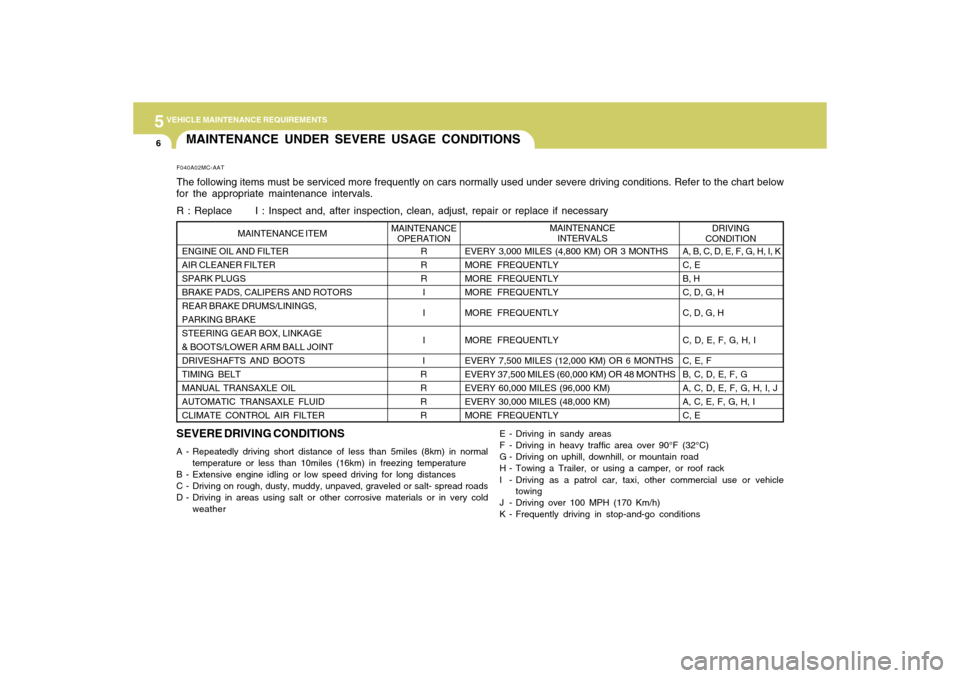
C, EMAINTENANCE UNDER SEVERE USAGE CONDITIONSF040A02MC-AATThe following items must be serviced more frequently on cars normally used under severe driving conditions. Refer to the chart below
for the appropriate maintenance intervals.
R : Replace I : Inspect and, after inspection, clean, adjust, repair or replace if necessary