engine Hyundai Accent 2009 User Guide
[x] Cancel search | Manufacturer: HYUNDAI, Model Year: 2009, Model line: Accent, Model: Hyundai Accent 2009Pages: 266, PDF Size: 8.77 MB
Page 64 of 266
1FEATURES OF YOUR HYUNDAI54
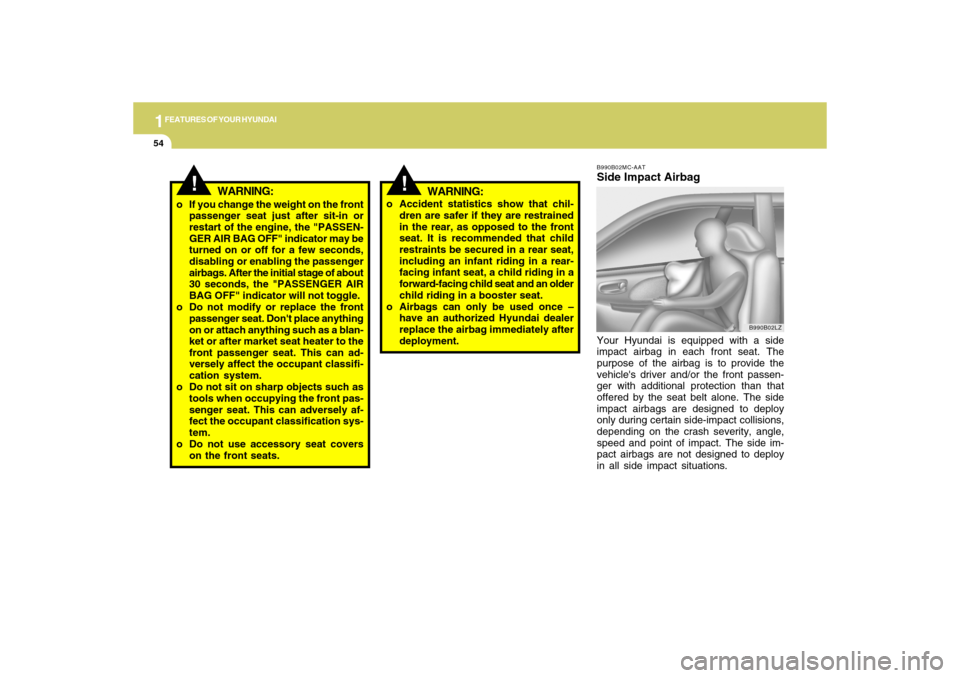
B990B02MC-AATSide Impact AirbagYour Hyundai is equipped with a side
impact airbag in each front seat. The
purpose of the airbag is to provide the
vehicle's driver and/or the front passen-
ger with additional protection than that
offered by the seat belt alone. The side
impact airbags are designed to deploy
only during certain side-impact collisions,
depending on the crash severity, angle,
speed and point of impact. The side im-
pact airbags are not designed to deploy
in all side impact situations.
B990B02LZ
!
WARNING:
o If you change the weight on the front
passenger seat just after sit-in or
restart of the engine, the "PASSEN-
GER AIR BAG OFF" indicator may be
turned on or off for a few seconds,
disabling or enabling the passenger
airbags. After the initial stage of about
30 seconds, the "PASSENGER AIR
BAG OFF" indicator will not toggle.
o Do not modify or replace the front
passenger seat. Don't place anything
on or attach anything such as a blan-
ket or after market seat heater to the
front passenger seat. This can ad-
versely affect the occupant classifi-
cation system.
o Do not sit on sharp objects such as
tools when occupying the front pas-
senger seat. This can adversely af-
fect the occupant classification sys-
tem.
o Do not use accessory seat covers
on the front seats.
!
WARNING:
o Accident statistics show that chil-
dren are safer if they are restrained
in the rear, as opposed to the front
seat. It is recommended that child
restraints be secured in a rear seat,
including an infant riding in a rear-
facing infant seat, a child riding in a
forward-facing child seat and an older
child riding in a booster seat.
o Airbags can only be used once –
have an authorized Hyundai dealer
replace the airbag immediately after
deployment.
Page 66 of 266
1FEATURES OF YOUR HYUNDAI56
!
WARNING:
o The space between the occupant and
the curtain airbag must never be
occupied by children, passengers or
pets. Occupants should never lean
out or have any parts of their body
protruding from the window while the
engine is running.
o Do not move the sun visor out to
cover the side window if there is an
item attached to it such as a garage
door remote control, pens, air fresh-
eners or the like. These objects could
cause injury if the Curtain Airbag is
deployed.
o Do not install sun blinds to the rear
doors, these must not obstruct or
impair the airbag in any way.
o Do not install any accessories or
children’s toys in the Curtain Airbag
deployment zones, as this may im-
pair the operation of the system or
throw parts of them into the vehicle
cabin causing injury to occupants if
the system is deployed.
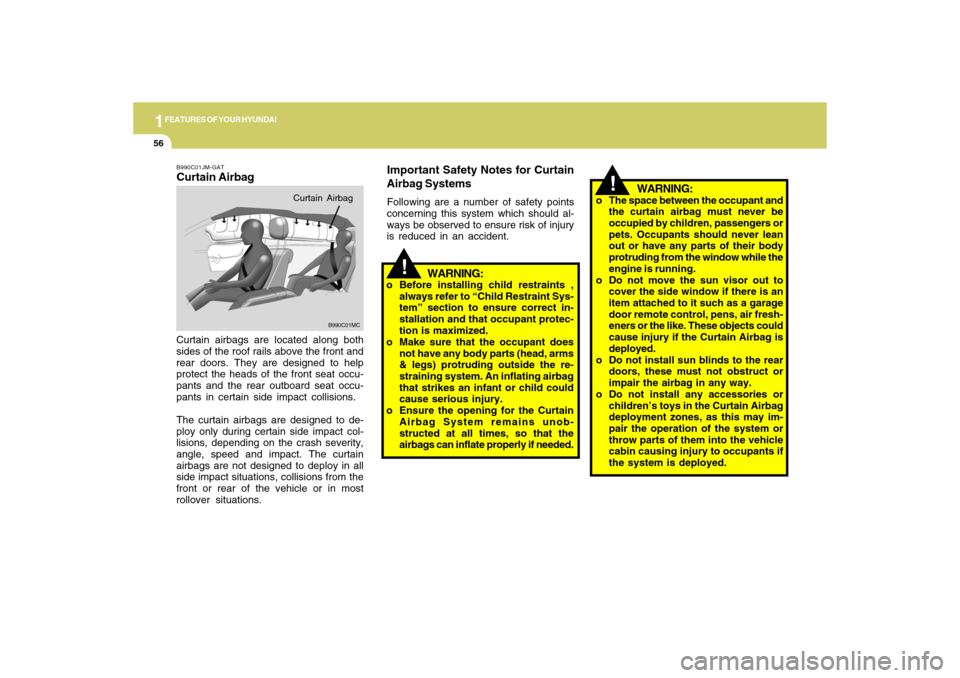
B990C01JM-GATCurtain AirbagCurtain airbags are located along both
sides of the roof rails above the front and
rear doors. They are designed to help
protect the heads of the front seat occu-
pants and the rear outboard seat occu-
pants in certain side impact collisions.
The curtain airbags are designed to de-
ploy only during certain side impact col-
lisions, depending on the crash severity,
angle, speed and impact. The curtain
airbags are not designed to deploy in all
side impact situations, collisions from the
front or rear of the vehicle or in most
rollover situations.
B990C01MC
Curtain Airbag
!
WARNING:
o Before installing child restraints ,
always refer to “Child Restraint Sys-
tem” section to ensure correct in-
stallation and that occupant protec-
tion is maximized.
o Make sure that the occupant does
not have any body parts (head, arms
& legs) protruding outside the re-
straining system. An inflating airbag
that strikes an infant or child could
cause serious injury.
o Ensure the opening for the Curtain
Airbag System remains unob-
structed at all times, so that the
airbags can inflate properly if needed.Important Safety Notes for Curtain
Airbag SystemsFollowing are a number of safety points
concerning this system which should al-
ways be observed to ensure risk of injury
is reduced in an accident.
Page 68 of 266
1FEATURES OF YOUR HYUNDAI58
B240D02NF-AATAdditional Safety PrecautionsoNever let passengers ride in the
cargo area (trunk) or on top of a
folded-down back seat. All occupants
should sit upright, fully back in their
seats with their seat belts on and their
feet on the floor.
oPassengers should not move out of
or change seats while the vehicle is
moving. A passenger who is not wear-
ing a seat belt during a crash or emer-
gency stop can be thrown against the
inside of the vehicle, against other
occupants, or out of the vehicle.
oEach seat belt is designed to re-
strain one occupant. If more than one
person uses the same seat belt, they
could be seriously injured or killed in
a collision.
oDo not use any accessories on seat
belts. Devices claiming to improve oc-
cupant comfort or reposition the seat
belt can reduce the protection pro-
vided by the seat belt and increase the
chance of serious injury in a crash.
oPassengers should not place hard or
sharp objects between themselves
and the airbags. Carrying hard or
sharp objects on your lap or in your
mouth can result in injuries if an airbag
inflates.
!
WARNING:
o No objects should be placed over or
near the airbag modules on the steer-
ing wheel, instrument panel, and the
front passenger's panel above the
glove box, because any such object
could cause harm if the vehicle is in
a crash severe enough to cause the
airbags to inflate.
o If the airbags inflate, they must be
replaced by an authorized Hyundai
dealer.
o Do not tamper with or disconnect
SRS wiring, or other components of
the SRS system. Doing so could re-
sult in injury, due to accidental infla-
tion of the airbags or by rendering
the SRS inoperative.
o If components of the airbag system
must be discarded, or if the vehicle
must be scrapped, certain safety
precautions must be observed. Your
Hyundai dealer knows these precau-
tions and can give you the neces-
sary information. Failure to follow
these precautions and procedures
could increase the risk of personal
injury.
!
WARNING:
o If your car was flooded and has
soaked carpeting or there is water
on the floor, do not start the engine;
have the car towed to an authorized
Hyundai dealer.
Page 71 of 266

1
FEATURES OF YOUR HYUNDAI
611
FEATURES OF YOUR HYUNDAI
61
1. Tachometer
2. Turn Signal Indicator Lights
3. High Beam Indicator Light
4. Automatic Transaxle Position Indicator Light
(If Installed)
5. Odometer/Trip Odometer/Trip Computer (If Installed)
6. Overdrive Off Indicator Light (Automatic transaxle only)
7. Speedometer
8. Check Fuel Cap Warning Light
9. Low Tire Pressure Telltale (If Installed)
10. TPMS (Tire Pressure Monitoring System) Malfunction
Indicator (If Installed)
11. Door Ajar Warning Light12. Charging System Warning Light
13. Parking Brake/Low Brake fluid Level Warning Light
14. SRS (Airbag) Warning Light
15. Seat Belt Warning Light
16. Fuel Gauge
17. Engine Coolant Temperature Warning Light
18. Low Oil Pressure Warning Light
19. Low Fuel Warning Light
20. Trunk Lid/Tail Gate Open Warning Light
21. Malfunction Indicator Light (MIL)
22. ABS Service Reminder Indicator Light (If Installed)
23. Cruise Control Indicator Lights (If Installed)
Page 73 of 266

1
FEATURES OF YOUR HYUNDAI
631
FEATURES OF YOUR HYUNDAI
63
12. Door Ajar Warning Light
13. Charging System Warning Light
14. Parking Brake/Low Brake fluid Level Warning Light
15. Seat Belt Warning Light
16. High Beam Indicator Light
17. Fuel Gauge
18. Engine Coolant Temperature Warning Light
19. Overdrive Off Indicator Light (Automatic transaxle only)
20. Low Fuel Warning Light
21. Trunk Lid/Tail Gate Open Warning Light
22. ABS Service Reminder Indicator Light (If Installed)
23. Cruise Control Indicator Lights (If Installed) 1. Tachometer
2. Turn Signal Indicator Lights
3. Low Oil Pressure Warning Light
4. Automatic Transaxle Position Indicator Light
(If Installed)
5. Odometer/Trip Odometer
6. SRS (Airbag) Warning Light
7. Malfunction Indicator Light (MIL)
8. Speedometer
9. Check Fuel Cap Warning Light
10. Low Tire Pressure Telltale (If Installed)
11. TPMS (Tire Pressure Monitoring System)
Malfunction Indicator (If Installed)
Page 74 of 266
1FEATURES OF YOUR HYUNDAI64
WARNING AND INDICATOR
LIGHTS
!
B260P02Y-GAT
ABS Service Reminder Indi-
cator (SRI) (If Installed)
When the key is turned to the "ON" posi-
tion, the Anti-Lock Brake System SRI will
come on and then go off in a few seconds.
If the ABS SRI remains on, comes on
while driving, or does not come on when
the key is turned to the "ON" position, this
indicates that there may be a problem
with the ABS.
If this occurs, have your vehicle checked
by your Hyundai dealer as soon as pos-
sible. The normal braking system will still
be operational, but without the assis-
tance of the anti-lock brake system.
WARNING:
If both ABS SRI and Parking Brake/Brake
fluid level warning lights remain "ON" or
come on while driving, there may be a
problem with E.B.D. (Electronic Brake
Force Distribution).
If this occurs, avoid sudden stops and
have your vehicle checked by your
Hyundai dealer as soon as possible.
B260C01A-AAT
O/D OFF Indicator
(Automatic Transaxle only)
When the overdrive switch is turned on,
the overdrive off indicator will go out. This
amber indicator will be illuminated when
the overdrive switch is turned off.B260D01A-AAT
Turn Signal Indicator
Lights
The blinking green arrow on the instru-
ment panel shows the direction indicated
by the turn signals. If the arrow comes on
but does not blink, blinks more rapidly
than normal, or does not blink at all, a
malfunction in the turn signal system is
indicated. Your dealer should be con-
sulted for repairs.B260F01A-AAT
High Beam Indicator Light
The high beam indicator light comes on
whenever the headlights are switched to
the high beam or flash position.
B260B01JM-AAT
SRS (Airbag) Warning Light
The SRS warning light comes on for
approximately 6 seconds after the key is
turned to the "ON" position or after the
engine is started, after which it will go out.
This light also comes on when the SRS is
not working properly. If the AIR BAG warn-
ing light does not come on, or continu-
ously remains on after operating for about
6 seconds when you turned the ignition
key to the "ON" position or started the
engine, or if it comes on while driving,
have the SRS inspected by an authorized
Hyundai dealer.
Page 75 of 266
1
FEATURES OF YOUR HYUNDAI
651
FEATURES OF YOUR HYUNDAI
65
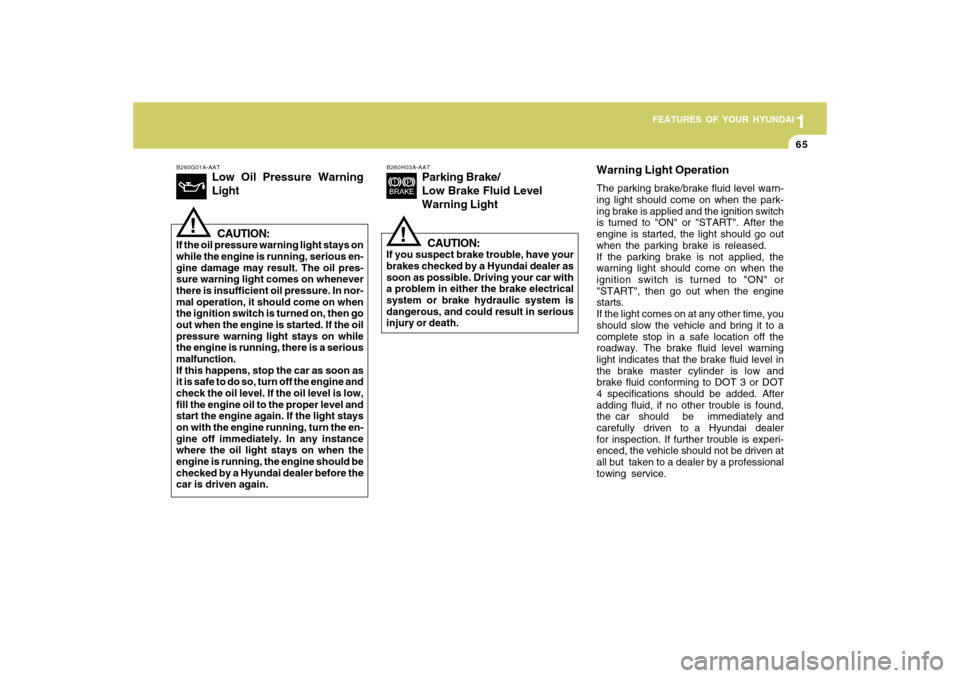
B260G01A-AAT
Low Oil Pressure Warning
LightCAUTION:
If the oil pressure warning light stays on
while the engine is running, serious en-
gine damage may result. The oil pres-
sure warning light comes on whenever
there is insufficient oil pressure. In nor-
mal operation, it should come on when
the ignition switch is turned on, then go
out when the engine is started. If the oil
pressure warning light stays on while
the engine is running, there is a serious
malfunction.
If this happens, stop the car as soon as
it is safe to do so, turn off the engine and
check the oil level. If the oil level is low,
fill the engine oil to the proper level and
start the engine again. If the light stays
on with the engine running, turn the en-
gine off immediately. In any instance
where the oil light stays on when the
engine is running, the engine should be
checked by a Hyundai dealer before the
car is driven again.
!
B260H03A-AAT
Parking Brake/
Low Brake Fluid Level
Warning Light
CAUTION:
If you suspect brake trouble, have your
brakes checked by a Hyundai dealer as
soon as possible. Driving your car with
a problem in either the brake electrical
system or brake hydraulic system is
dangerous, and could result in serious
injury or death.
!
Warning Light OperationThe parking brake/brake fluid level warn-
ing light should come on when the park-
ing brake is applied and the ignition switch
is turned to "ON" or "START". After the
engine is started, the light should go out
when the parking brake is released.
If the parking brake is not applied, the
warning light should come on when the
ignition switch is turned to "ON" or
"START", then go out when the engine
starts.
If the light comes on at any other time, you
should slow the vehicle and bring it to a
complete stop in a safe location off the
roadway. The brake fluid level warning
light indicates that the brake fluid level in
the brake master cylinder is low and
brake fluid conforming to DOT 3 or DOT
4 specifications should be added. After
adding fluid, if no other trouble is found,
the car should be immediately and
carefully driven to a Hyundai dealer
for inspection. If further trouble is experi-
enced, the vehicle should not be driven at
all but taken to a dealer by a professional
towing service.
Page 76 of 266

1FEATURES OF YOUR HYUNDAI66
B260J01MC-AAT
Charging System Warning
Light
The charging system warning light should
come on when the ignition is turned on,
then go out when the engine is running.
If the light stays on while the engine is
running, there is a malfunction in the
electrical charging system. If the light
comes on while you are driving, have the
system checked by your Hyundai dealer
as soon as possble.
B260M01A-AAT
Low Fuel Level Warning Light
The low fuel level warning light comes on
when the fuel tank is approaching empty.
When it comes on, you should add fuel as
soon as possible. Driving with the fuel
level warning light on or with the fuel level
below "E" can cause the engine to misfire
and damage the catalytic converter.
B260L02HP-GAT
Door Ajar Warning Light
and Chime
The door ajar warning light warns you
that a door is not completely closed and
the chime warns you that the key is in the
ignition switch.NOTE :The warning chime only sounds when-
ever the key is in the ignition switch and
the driver's side front door is open simul-
taneously. The chime sounds until the
key is removed from the ignition switch
or the driver's side front door is closed.B260K02A-AAT
Trunk Lid/Tail Gate
Open Warning Light
This light remains on unless the trunk lid/
tail gate is completely closed and latched.
B260O01MC-AAT
Check Fuel Filler Cap Warn-
ing Light
This warning light indicates the fuel filler
cap is not tight securely.
Always make sure that the fuel filler cap
is tight.
Your Hyundai is equipped with dual-di-
agonal braking systems. This means you
still have braking on two wheels even if
one of the dual systems should fail. With
only one of the dual systems working,
more than normal pedal travel and greater
pedal pressure are required to stop the
car. Also, the car will not stop in as short
a distance with only a portion of the brake
system working. If the brakes fail while
you are driving, shift to a lower gear for
additional engine braking and stop the
car as soon as it is safe to do so.
Page 77 of 266
1
FEATURES OF YOUR HYUNDAI
671
FEATURES OF YOUR HYUNDAI
67
B260N01MC-AAT
Malfunction Indicator Light
This light illuminates when there is a
malfunction of an exhaust gas related
component and the system is not func-
tioning properly. This light will also illumi-
nate when the ignition key is turned to the
"ON" position, and will go out in a few
seconds after the engine is started. If it
illuminates while driving, or does not illumi-
nate when the ignition key is turned to the
"ON" position, take your car to your nearest
authorized Hyundai dealer and have the
system checked.
!
CAUTION:
Prolonged driving with the Emission
Control System Malfunction Indicator
Light illuminated may cause damage to
the emission control systems which
could effect drivability or fuel economy.
If the Emission Control System Malfunc-
tion Indicator Light begins to flash ON
and OFF, potential catalytic converter
damage is possible which could result in
loss of engine power. Have the Engine
Control System inspected as soon as
possible by an authorized Hyundai
dealer.The driver's seat belt warning light and
chime will activate to the following table
when the ignition switch is in "ON" posi-
tion.
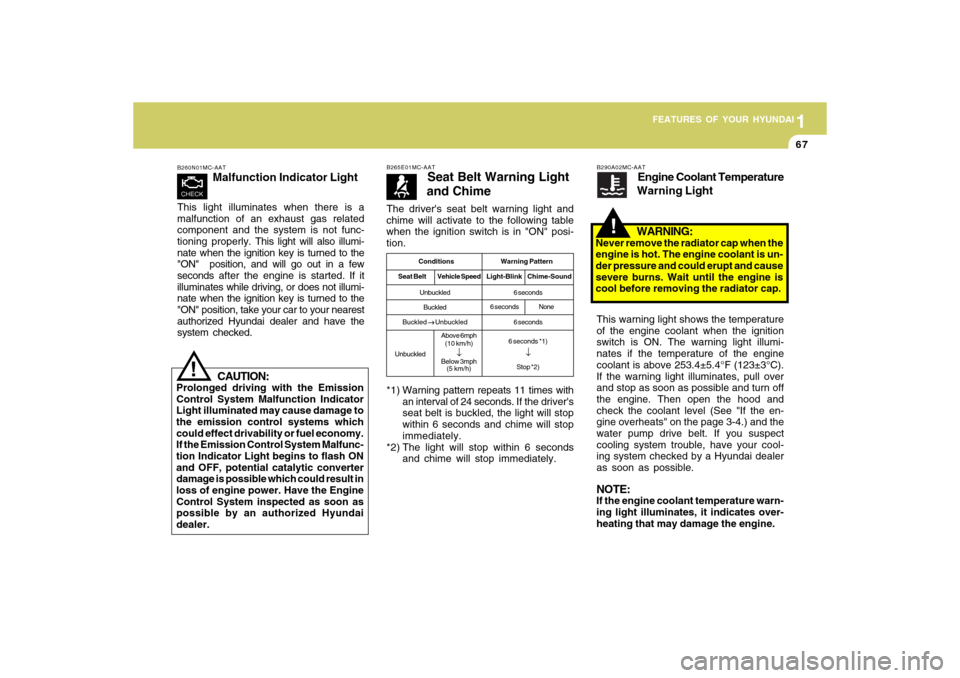
B265E01MC-AAT
Seat Belt Warning Light
and Chime
*1) Warning pattern repeats 11 times with
an interval of 24 seconds. If the driver's
seat belt is buckled, the light will stop
within 6 seconds and chime will stop
immediately.
*2) The light will stop within 6 seconds
and chime will stop immediately.
Conditions Warning Pattern
Seat BeltVehicle SpeedLight-Blink Chime-SoundUnbuckled
Buckled
Buckled
→ →→ →
→ Unbuckled
UnbuckledAbove 6mph
(10 km/h)
↓
Below 3mph
(5 km/h)6 seconds
6 seconds
6 seconds *1)
↓Stop *2)
6 secondsNone
B290A02MC-AAT
Engine Coolant Temperature
Warning Light
WARNING:
Never remove the radiator cap when the
engine is hot. The engine coolant is un-
der pressure and could erupt and cause
severe burns. Wait until the engine is
cool before removing the radiator cap.
!
This warning light shows the temperature
of the engine coolant when the ignition
switch is ON. The warning light illumi-
nates if the temperature of the engine
coolant is above 253.4±5.4°F (123±3°C).
If the warning light illuminates, pull over
and stop as soon as possible and turn off
the engine. Then open the hood and
check the coolant level (See "If the en-
gine overheats" on the page 3-4.) and the
water pump drive belt. If you suspect
cooling system trouble, have your cool-
ing system checked by a Hyundai dealer
as soon as possible.NOTE:If the engine coolant temperature warn-
ing light illuminates, it indicates over-
heating that may damage the engine.
Page 80 of 266
1FEATURES OF YOUR HYUNDAI70
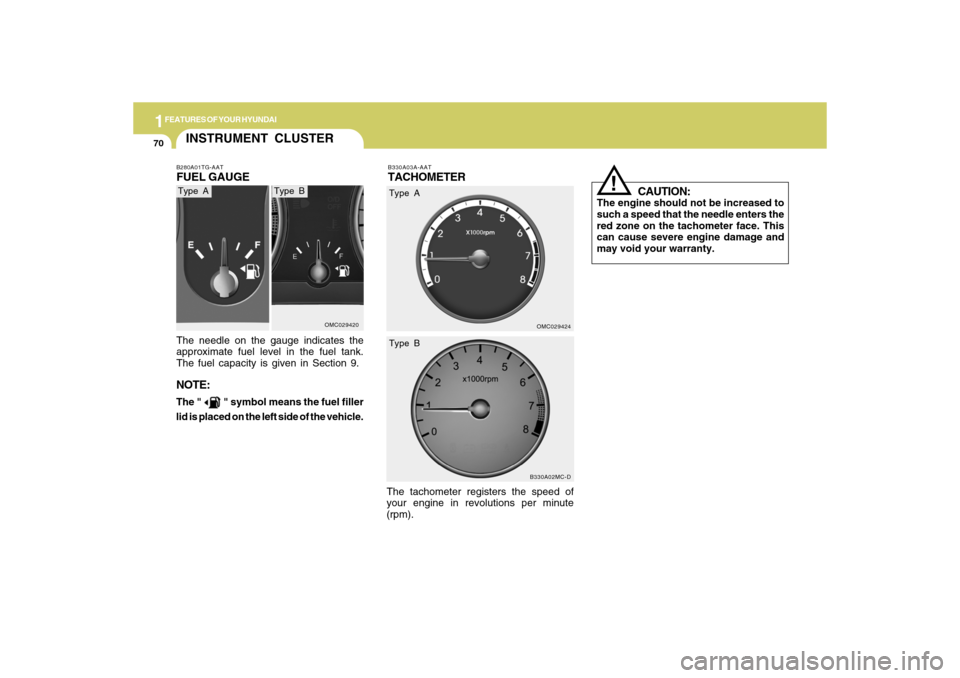
B330A03A-AATTACHOMETERThe tachometer registers the speed of
your engine in revolutions per minute
(rpm).
CAUTION:
The engine should not be increased to
such a speed that the needle enters the
red zone on the tachometer face. This
can cause severe engine damage and
may void your warranty.
!
INSTRUMENT CLUSTERB280A01TG-AATFUEL GAUGEThe needle on the gauge indicates the
approximate fuel level in the fuel tank.
The fuel capacity is given in Section 9.NOTE:The "
" symbol means the fuel filler
lid is placed on the left side of the vehicle.
OMC029420
Type A
Type B
OMC029424B330A02MC-D
Type A
Type B