Lights Hyundai Accent 2009 Owner's Guide
[x] Cancel search | Manufacturer: HYUNDAI, Model Year: 2009, Model line: Accent, Model: Hyundai Accent 2009Pages: 266, PDF Size: 8.77 MB
Page 171 of 266
3
WHAT TO DO IN AN EMERGENCY
3
JUMP STARTING
D010D01A-AATIf the Engine Stalls While Driving1. Reduce your speed gradually, keep-
ing a straight line. Move cautiously off
the road to a safe place.
2. Turn on your emergency flashers.
3. Try to start the engine again. If your
vehicle will not start, contact a Hyundai
dealer or seek other qualified assis-
tance.
!
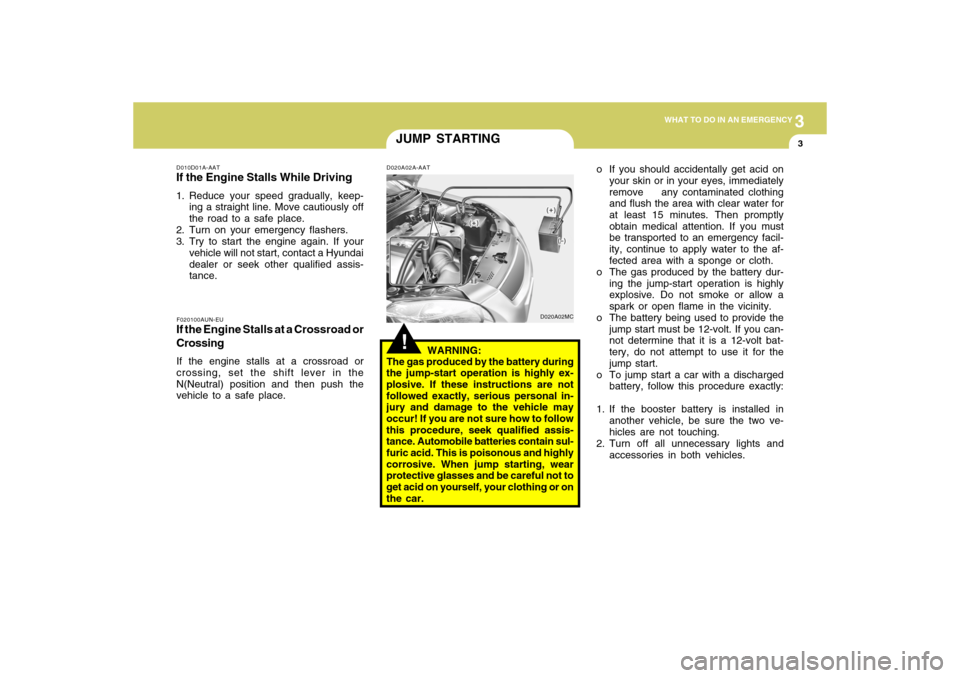
D020A02A-AAT
WARNING:
The gas produced by the battery during
the jump-start operation is highly ex-
plosive. If these instructions are not
followed exactly, serious personal in-
jury and damage to the vehicle may
occur! If you are not sure how to follow
this procedure, seek qualified assis-
tance. Automobile batteries contain sul-
furic acid. This is poisonous and highly
corrosive. When jump starting, wear
protective glasses and be careful not to
get acid on yourself, your clothing or on
the car.
D020A02MC
o If you should accidentally get acid on
your skin or in your eyes, immediately
remove any contaminated clothing
and flush the area with clear water for
at least 15 minutes. Then promptly
obtain medical attention. If you must
be transported to an emergency facil-
ity, continue to apply water to the af-
fected area with a sponge or cloth.
o The gas produced by the battery dur-
ing the jump-start operation is highly
explosive. Do not smoke or allow a
spark or open flame in the vicinity.
o The battery being used to provide the
jump start must be 12-volt. If you can-
not determine that it is a 12-volt bat-
tery, do not attempt to use it for the
jump start.
o To jump start a car with a discharged
battery, follow this procedure exactly:
1. If the booster battery is installed in
another vehicle, be sure the two ve-
hicles are not touching.
2. Turn off all unnecessary lights and
accessories in both vehicles.
F020100AUN-EUIf the Engine Stalls at a Crossroad or
CrossingIf the engine stalls at a crossroad or
crossing, set the shift lever in the
N(Neutral) position and then push the
vehicle to a safe place.
Page 172 of 266
34WHAT TO DO IN AN EMERGENCY
IF THE ENGINE OVERHEATSD030A02A-AATIf your temperature gauge indicates over-
heating, you experience a loss of power,
or hear loud pinging or knocking, the
engine is probably too hot. If this hap-
pens, you should:
1. Pull off the road and stop as soon as
it is safe to do so.
2. Place the gear selector lever in "P"
(automatic), or neutral (manual
transaxle) and set the parking brake. If
the air conditioner is on, turn it off.
3. If coolant is running out under the car
or steam is coming out from the hood,
stop the engine. Do not open the hood
until the coolant has stopped running
or the steaming has stopped. If there is
no visible loss of coolant and no steam,
leave the engine running and check to
be sure the engine cooling fan is op-
erating. If the fan is not running, turn
the engine off.
4. Check to see if the water pump drive
belt is missing. If it is not missing,
check to see that it is tight. If the drive
belt seems to be satisfactory, check for
coolant leaking from the radiator, hoses
or under the car. (If the air conditioner
had been in use, it is normal for cold
water to be draining from it when you
stop). 3. Attach the clamps of the jumper cable
in the exact location shown on the
previous page. First, attach one clamp
of the jumper cable to the positive (+)
post or cable of the discharged battery.
Then attach the other end of the same
cable to the positive (+) post or cable
of the booster battery. Next, using the
other cable, attach one clamp to the
negative (-) post or cable of the booster
battery. Then attach the other end of
that cable to a solid metal part of the
engine away from the battery. Do not
connect the cable to any moving part.
4. Start the engine in the car with the
booster battery and let it run for a few
minutes. This will help to assure that
the booster battery is fully charged.
During the jumping operation, run the
engine in this vehicle at about 2000
rpm.
5. Start the engine in the car with the
discharged battery using the normal
starting procedure. After the engine
starts, leave the jumper cables con-
nected and let the engine run at fast
idle or about 2000 rpm for several
minutes.
6. Carefully remove the jumper cables in
the reverse order of attachment.If you do not know why your battery be-
came discharged (because the lights were
left on, etc.), have the charging system
checked by your Hyundai dealer.
Page 222 of 266
6
DO-IT-YOURSELF MAINTENANCE
17
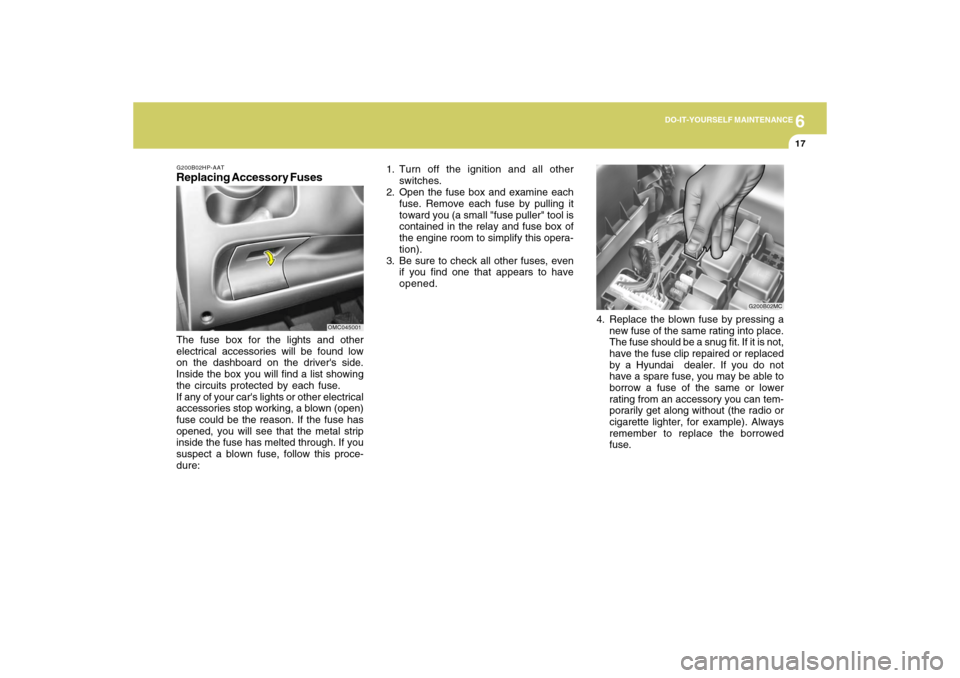
G200B02HP-AATReplacing Accessory FusesThe fuse box for the lights and other
electrical accessories will be found low
on the dashboard on the driver's side.
Inside the box you will find a list showing
the circuits protected by each fuse.
If any of your car's lights or other electrical
accessories stop working, a blown (open)
fuse could be the reason. If the fuse has
opened, you will see that the metal strip
inside the fuse has melted through. If you
suspect a blown fuse, follow this proce-
dure:1. Turn off the ignition and all other
switches.
2. Open the fuse box and examine each
fuse. Remove each fuse by pulling it
toward you (a small "fuse puller" tool is
contained in the relay and fuse box of
the engine room to simplify this opera-
tion).
3. Be sure to check all other fuses, even
if you find one that appears to have
opened.
4. Replace the blown fuse by pressing a
new fuse of the same rating into place.
The fuse should be a snug fit. If it is not,
have the fuse clip repaired or replaced
by a Hyundai dealer. If you do not
have a spare fuse, you may be able to
borrow a fuse of the same or lower
rating from an accessory you can tem-
porarily get along without (the radio or
cigarette lighter, for example). Always
remember to replace the borrowed
fuse.
OMC045001
G200B02MC
Page 223 of 266
6
DO-IT-YOURSELF MAINTENANCE
18
CAUTION:
An open fuse indicates that there is a
problem in the electrical circuit. If you
replace a fuse and it blows as soon as
the accessory is turned on, the prob-
lem is serious and should be referred to
a Hyundai dealer for diagnosis and re-
pair. Never replace a fuse with anything
except a fuse with the same or a lower
amperage rating. A higher capacity fuse
could cause damage and create a fire
hazard.
!
NOTE:
See page 6-28 for the fuse panel de-
scriptions.
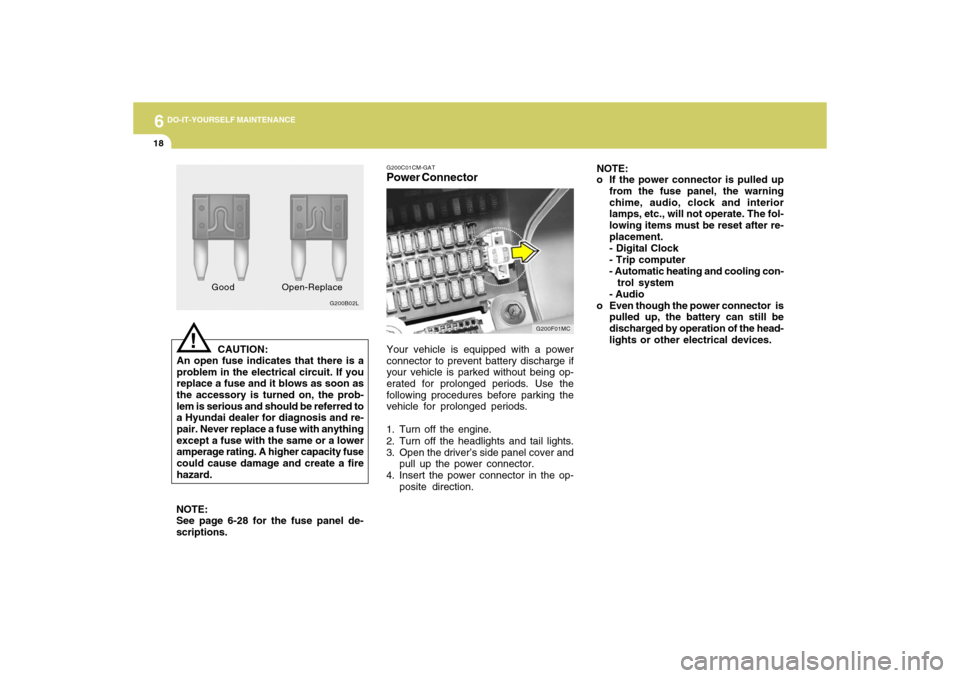
G200C01CM-GATPower Connector
NOTE:
o If the power connector is pulled up
from the fuse panel, the warning
chime, audio, clock and interior
lamps, etc., will not operate. The fol-
lowing items must be reset after re-
placement.
- Digital Clock
- Trip computer
- Automatic heating and cooling con-
trol system
- Audio
o Even though the power connector is
pulled up, the battery can still be
discharged by operation of the head-
lights or other electrical devices.
Your vehicle is equipped with a power
connector to prevent battery discharge if
your vehicle is parked without being op-
erated for prolonged periods. Use the
following procedures before parking the
vehicle for prolonged periods.
1. Turn off the engine.
2. Turn off the headlights and tail lights.
3. Open the driver’s side panel cover and
pull up the power connector.
4. Insert the power connector in the op-
posite direction.
G200F01MC
G200B02L
GoodOpen-Replace
Page 264 of 266

10
INDEX
4
Heating and Cooling Control ..........................................1-106
Air flow control ............................................................. 1-108
Air intake control switch ...............................................1-107
Defrosting/Defogging....................................................1-112
Fan speed control (Blower control) .............................1-107
Temperature control .....................................................1-110
High-Mounted Rear Stop Light .........................................1-92
Hood Release ....................................................................1-93
Horn..................................................................................1-101
I
Ignition Switch ...................................................................... 2-4
Instrument Cluster and Indicator Lights ............................1-60
Instrument Panel Light Control (Rheostat) .......................1-80
Interior Light .......................................................................1-87
J
Jump Starting ....................................................................... 3-3
K
Key ........................................................................................ 1-4
If you lose your keys ......................................................3-20
Positions............................................................................ 2-4L
Light Bulb Wattage .............................................................6-27
Light Bulbs Replacement ..................................................6-22
Lubrication Chart .................................................................. 9-4
Luggage Net ......................................................................1-98
M
Maintenance Intervals .......................................................... 5-2
Explanation of scheduled maintenance items ................ 5-7
Maintenance under severe usage conditions ................. 5-6
Scheduled maintenance .................................................. 5-4
Service requirements ........................................................ 5-2
Maintenance Precautions.................................................... 6-4
Map Light ............................................................................1-87
Mirrors
Day/Night inside rearview mirror ...................................1-91
Outside rearview .............................................................1-89
Multi Box .............................................................................1-89
O
Odometer/Trip Odometer ...................................................1-71
Outside Rearview Mirror ....................................................1-89
P
Parking Brake .....................................................................1-91
Power Outlet .......................................................................1-83
Power Steering Fluid Level ...............................................6-21
Page 266 of 266

10
INDEX
6
Transaxle
Automatic.......................................................................... 2-9
Automatic transaxle fluid checking ................................6-11
Manual.............................................................................. 2-6
Manual transaxle oil checking .......................................6-11
Trip Computer ....................................................................1-73
Trip Odometer ....................................................................1-73
Trunk Lid/Tail Gate .............................................................1-96
Remote trunk lid release ................................................1-97
V
Vehicle Identification Number (VIN) .................................... 8-2
Vehicle Load Limit .............................................................2-20
Vehicle Specifications .......................................................... 9-1
W
Warning and Indicator Lights ............................................1-64
Warranties for Your Hyundai Vehicle ...............................8-15
Windows.............................................................................1-11
Window lock ....................................................................1-11
Windshield Wiper and Washer Switch ..............................1-78
Adjustable Intermittent wiper operation .........................1-80
Mist wiper operation .......................................................1-79
Rear window wiper and washer ....................................1-80
Washer reservoir ............................................................6-10
Windshield washer operation ........................................1-79
Windshield Wiper Blades .................................................... 6-9