coolant Hyundai Accent 2009 Owner's Guide
[x] Cancel search | Manufacturer: HYUNDAI, Model Year: 2009, Model line: Accent, Model: Hyundai Accent 2009Pages: 266, PDF Size: 8.77 MB
Page 237 of 266
7
EMISSION CONTROL SYSTEMS2
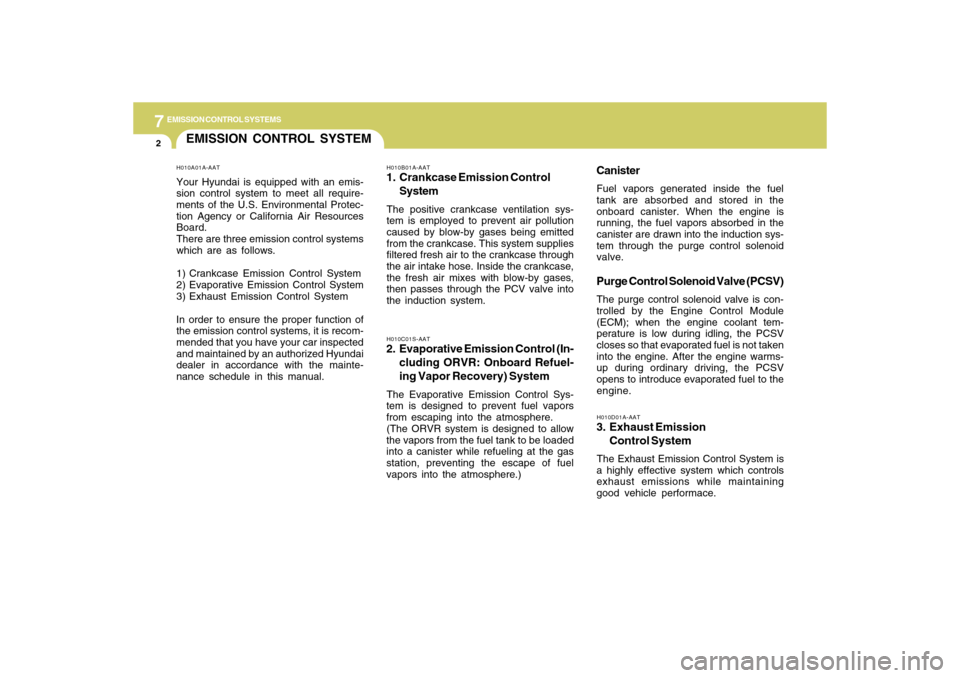
EMISSION CONTROL SYSTEM
CanisterFuel vapors generated inside the fuel
tank are absorbed and stored in the
onboard canister. When the engine is
running, the fuel vapors absorbed in the
canister are drawn into the induction sys-
tem through the purge control solenoid
valve.Purge Control Solenoid Valve (PCSV)The purge control solenoid valve is con-
trolled by the Engine Control Module
(ECM); when the engine coolant tem-
perature is low during idling, the PCSV
closes so that evaporated fuel is not taken
into the engine. After the engine warms-
up during ordinary driving, the PCSV
opens to introduce evaporated fuel to the
engine.
H010B01A-AAT1. Crankcase Emission Control
SystemThe positive crankcase ventilation sys-
tem is employed to prevent air pollution
caused by blow-by gases being emitted
from the crankcase. This system supplies
filtered fresh air to the crankcase through
the air intake hose. Inside the crankcase,
the fresh air mixes with blow-by gases,
then passes through the PCV valve into
the induction system.
H010A01A-AATYour Hyundai is equipped with an emis-
sion control system to meet all require-
ments of the U.S. Environmental Protec-
tion Agency or California Air Resources
Board.
There are three emission control systems
which are as follows.
1) Crankcase Emission Control System
2) Evaporative Emission Control System
3) Exhaust Emission Control System
In order to ensure the proper function of
the emission control systems, it is recom-
mended that you have your car inspected
and maintained by an authorized Hyundai
dealer in accordance with the mainte-
nance schedule in this manual.
H010D01A-AAT3. Exhaust Emission
Control SystemThe Exhaust Emission Control System is
a highly effective system which controls
exhaust emissions while maintaining
good vehicle performace.
H010C01S-AAT2. Evaporative Emission Control (In-
cluding ORVR: Onboard Refuel-
ing Vapor Recovery) SystemThe Evaporative Emission Control Sys-
tem is designed to prevent fuel vapors
from escaping into the atmosphere.
(The ORVR system is designed to allow
the vapors from the fuel tank to be loaded
into a canister while refueling at the gas
station, preventing the escape of fuel
vapors into the atmosphere.)
Page 246 of 266

8
CONSUMER INFORMATION, REPORTING SAFETY DEFECTS & BINDING ARBITRATION OF WARRANTY CLAIMS8
I030D01JM-AATTIRE TERMINOLOGY AND DEFINI-
TIONS
Air Pressure: The amount of air inside
the tire pressing outward on the tire.
Air pressure is expressed in pounds
per square inch (psi) or kilopascal (kPa).
Accessory Weight: This means the
combined weight of optional accesso-
ries. Some examples of optional ac-
cessories are, automatic transmission,
power seats, and air conditioning.
Aspect Ratio: The relationship of a
tire's height to its width.
Belt: A rubber coated layer of cords
that is located between the plies and
the tread. Cords may be made from
steel or other reinforcing materials.
Bead: The tire bead contains steel
wires wrapped by steel cords that hold
the tire onto the rim.
Bias Ply Tire: A pneumatic tire in
which the plies are laid at alternate
angles less than 90 degrees to the
centerline of the tread.Cold Tire Pressure: The amount of
air pressure in a tire, measured in
pounds per square inch (psi) or
kilopascals (kPa) before a tire has
built up heat from driving.
Curb Weight: This means the weight
of a motor vehicle with standard and
optional equipment including the maxi-
mum capacity of fuel, oil and coolant,
but without passengers and cargo.
DOT Markings: A code molded into
the sidewall of a tire signifying that the
tire is in compliance with the U.S.
Department of Transportation motor
vehicle safety standards. The DOT
code includes the Tire Identification
Number (TIN), an alphanumeric desig-
nator which can also identify the tire
manufacturer, production plant, brand
and date of production.
GVWR: Gross Vehicle Weight Rating
GAWR FRT: Gross Axle Weight Rat-
ing for the front Axle.
GAWR RR: Gross Axle Weight Rating
for the rear axle. 6. Maximum load rating
This number indicates the maxi-
mum load in kilograms and pounds
that can be carried by the tire. When
replacing the tires on the vehicle,
always use a tire that has the same
load rating as the factory installed
tire.
7. Uniform Tire Quality Grading
(UTQG):
Tire manufacturers are required to
grade tires based on three perfor-
mance factors: treadwear, traction
and temperature resistance. For
more information, see Uniform Tire
Quality Grading on page 8-15.
Page 260 of 266
9
VEHICLE SPECIFICATIONS4
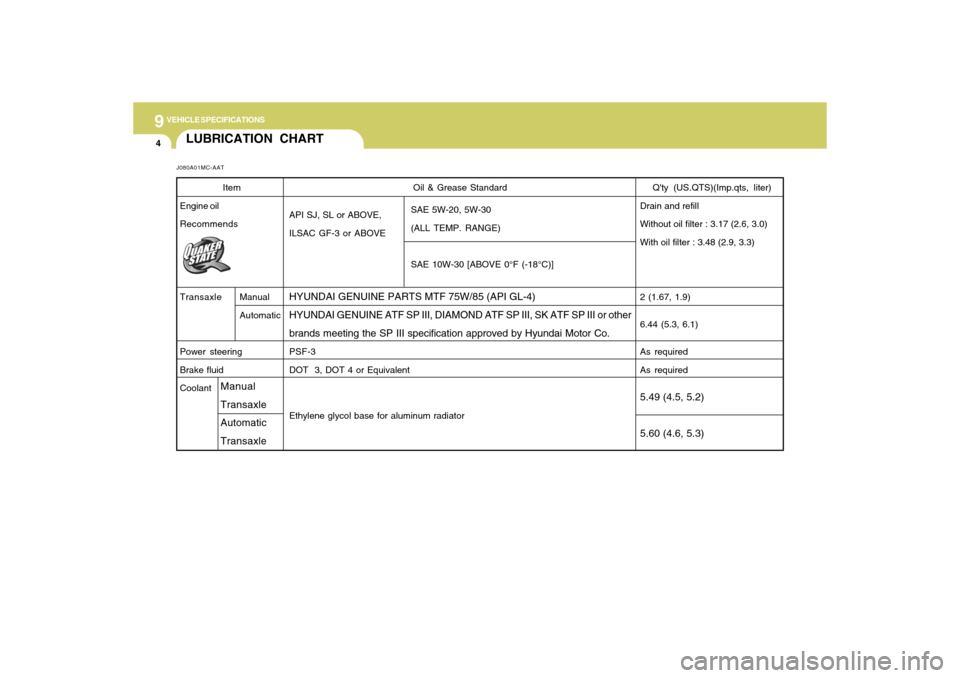
Oil & Grease Standard
API SJ, SL or ABOVE,
ILSAC GF-3 or ABOVE
HYUNDAI GENUINE PARTS MTF 75W/85 (API GL-4)
HYUNDAI GENUINE ATF SP III, DIAMOND ATF SP III, SK ATF SP III or other
brands meeting the SP III specification approved by Hyundai Motor Co.PSF-3
DOT 3, DOT 4 or Equivalent
Ethylene glycol base for aluminum radiatorSAE 5W-20, 5W-30
(ALL TEMP. RANGE)
SAE 10W-30 [ABOVE 0°F (-18°C)]
LUBRICATION CHART
Item
Engine oil
Recommends
TransaxleManual
Automatic
Power steering
Brake fluid
CoolantManual
Transaxle
Automatic
Transaxle
J080A01MC-AAT
Q'ty (US.QTS)(Imp.qts, liter)
Drain and refill
Without oil filter : 3.17 (2.6, 3.0)
With oil filter : 3.48 (2.9, 3.3)
2 (1.67, 1.9)
6.44 (5.3, 6.1)
As required
As required
5.49 (4.5, 5.2)
5.60 (4.6, 5.3)
Page 263 of 266

10
INDEX
3
D
Defrosting/Defogging........................................... 1-112, 1-115
Door
Central door locks ............................................................ 1-7
Door locks ......................................................................... 1-4
Door ajar warning light and chime ................................1-66
Locking and unlocking front door with a key .................. 1-5
Drink Holder .......................................................................1-84
Driving
Economical driving .........................................................2-15
Smooth cornering ...........................................................2-16
Winter driving ..................................................................2-16
E
Emission Control System ..................................................... 7-2
Engine
Before starting the engine ................................................ 2-3
Compartment.................................................................... 6-2
Coolant .............................................................................. 6-7
If the engine overheats ..................................................... 3-4
Number............................................................................. 8-3
Oil ...................................................................................... 6-4
Starting.............................................................................. 2-5
Engine Exhaust Can Be Dangerous! .................................. 2-2F
Fog Light
Front ................................................................................1-82
Front Seats
Adjusting seat forward and rearward ............................1-14
Adjusting seatback angle ...............................................1-15
Headrest..........................................................................1-15
Seat cushion height adjustment ................................... 1-17
Fuel
Capacity............................................................................ 9-2
Gauge..............................................................................1-70
Recommendations............................................................ 1-2
Fuel Filler Lid
Remote release ..............................................................1-94
Fuse Panel Description .....................................................6-28
Fuses..................................................................................6-16
G
General Checks ................................................................... 6-3
Glove Box ...........................................................................1-88
H
Hazard Warning System ....................................................1-81
Headlight
Replacement...................................................................6-22
Switch..............................................................................1-76