wheel Hyundai Accent 2009 Owner's Guide
[x] Cancel search | Manufacturer: HYUNDAI, Model Year: 2009, Model line: Accent, Model: Hyundai Accent 2009Pages: 266, PDF Size: 8.77 MB
Page 176 of 266

38WHAT TO DO IN AN EMERGENCYo If there is a failed tire sensor, it is
possible for the TPMS to tempo-
rarily learn a replacement sensor
if closely driven to another ve-
hicle that is also equipped with
TPMS. In rare cases, this may
temporarily delay the TPMS mal-
function indicator from turning
on.
Changing a tire with TPMS
If you have a flat tire, the Low Tire
Pressure telltale will turn on. Have the
flat tire repaired by an authorized
Hyundai dealer as soon as possible or
replace the flat tire with the temporary
spare tire.
NOTE:
NEVER use a puncture-repairing
agent to repair and/or inflate a low
pressure tire. If used, you will have
to replace the tire pressure sensor.Each wheel is equipped with a tire
pressure sensor mounted inside the
tire behind the valve stem. You must
use TPMS specific wheels. It is rec-
ommended that you always have your
tires serviced by an authorized Hyundai
dealer as soon as possible.
After you replace the low pressure tire
with the spare tire, the TPMS malfunc-
tion indicator or the Low Tire Pressure
telltale may illuminate after restarting
and about 20 minutes of continuous
driving.
Once the low pressure tire is re-in-
flated to the recommended pressure
and installed on the vehicle, the TPMS
malfunction indicator and the low tire
pressure telltale will be extinguished.
If the low pressure and TPMS mal-
function indicators are not extinguished
after about 20 minutes of continuous
driving, please visit an authorized
Hyundai dealer.
You may not be able to identify a low
tire by simply looking at it. Always use
a good quality tire pressure gauge to
measure the tire's inflation pressure.Please note that a tire that is hot (from
being driven) will have a higher pres-
sure measurement than a tire that is
cold (from sitting stationary for at least
3 hours and driven less than 1 mile
during that 3 hour period). Allow the
tire to cool before measuring the infla-
tion pressure.
Always be sure the tire is cold before
inflating to the recommended pres-
sure.
A cold tire means the vehicle has been
sitting for 3 hours and driven for less
than 1 mile in that 3 hour period.
Page 177 of 266
3
WHAT TO DO IN AN EMERGENCY
9
!
!
!
CAUTION:
o Do not use any tire sealant if your
vehicle is equipped with a Tire
Pressure Monitoring System. The
liquid sealant can damage the
tire pressure sensors.
o In order for the system to cor-
rectly monitor tires for under-in-
flation, there should be a total of
exactly 4 sensors fitted to each of
the four driven wheel positions.
There should be no other sen-
sors in the vehicle including spare
tire since this could cause the
system to monitor the wrong sen-
sors.
WARNING:
Tampering with, modifying, or dis-
abling the Tire Pressure Monitoring
System (TPMS) components may
interfere with the system's ability to
warn the driver of low tire pressure
conditions and/or TPMS malfunc-
tions. Tampering with, modifying,
or disabling the Tire Pressure Moni-
toring System (TPMS) components
may void the warranty for that por-
tion of the vehicle.
!
WARNING - TPMS
o The TPMS cannot alert you to
severe and sudden tire damage
caused by external factors such
as nails or road debris.
o If you feel any vehicle instability,
immediately take your foot off the
accelerator, apply the brakes
gradually and with light force,
and slowly move to a safe posi-
tion off the road.This device complies with Part 15
of the FCC rules.
Operation is subject to the following
two conditions:
1. This device may not cause harmful
interference, and
2. This device must accept any inter-
ference received, including interfer-
ence that may cause undesired op-
eration.
WARNING:
Changes or modifications not ex-
pressly approved by the party re-
sponsible for compliance could void
the user’s authority to operate the
equipment.
Page 178 of 266
310
WHAT TO DO IN AN EMERGENCY
!
CAUTION:
o Do not use snow chains with
your temporary spare tire.
o Do not use more than one tempo-
rary spare tire at a time.
!
4. As the temporary spare tire is spe-
cifically designed for your car, it
should not be used on any other
vehicle.
5. The temporary spare tire should not
be used on any other wheels, nor
should standard tires, snow tires,
wheel covers or trim rings be used
with the temporary spare wheel. If
such use is attempted, damage to
these items or other car compo-
nents may occur.
6. The temporary spare tire pressure
should be checked once a month
while the tire is stored.WARNING:
The temporary spare tire is for emer-
gency use only. Do not operate
your vehicle on this temporary spare
at speeds over 50 mph (80 km/h).
The original tire should be repaired
or replaced as soon as is possible
to avoid failure of the spare possi-
bly leading to personal injury or
death.
SPARE TIRESpare Tire PressureD040A02MC-AATTEMPORARY SPARE TIRE
The following instructions for the tem-
porary spare tire should be observed:
1. Check inflation pressure as soon as
is practical after installing the spare
tire, and adjust to the specified
pressure. The tire pressure should
be periodically checked and main-
tained at the specified pressure while
the tire is stored.Tire Size
Inflation Pressure
T115/70D15
60 psi (420 kPa)
2. The spare tire should only be used
temporarily and should be returned
to the luggage compartment as soon
as the original tire can be repaired or
replaced.
3. Continuous use at speeds of over
50 mph (80 km/h) is not recom-
mended.
Page 180 of 266
312
WHAT TO DO IN AN EMERGENCY
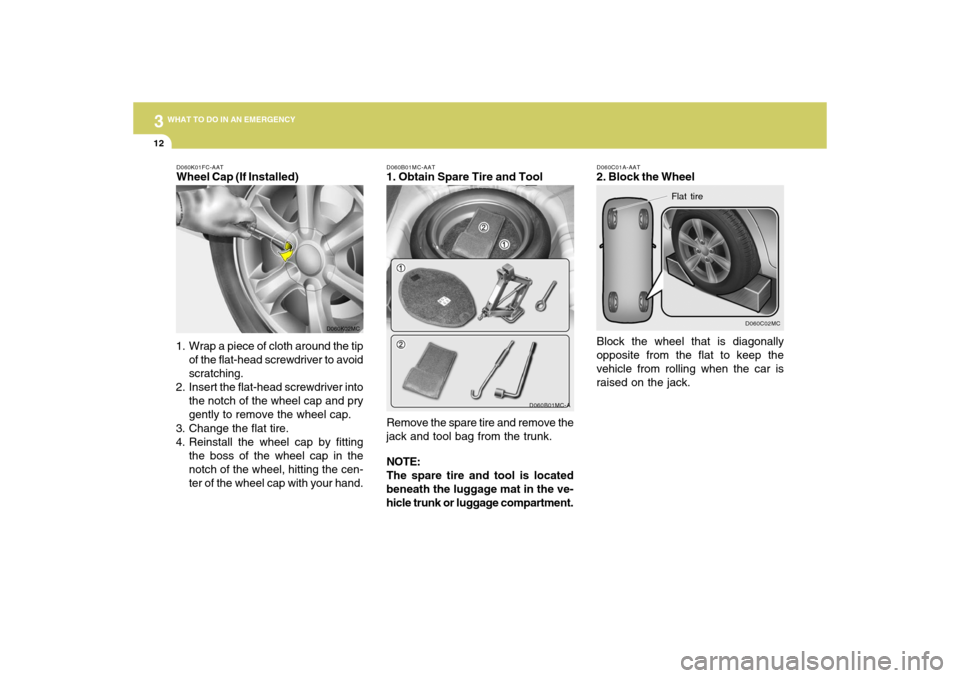
D060C02MC
Flat tire
Block the wheel that is diagonally
opposite from the flat to keep the
vehicle from rolling when the car is
raised on the jack.D060C01A-AAT2. Block the Wheel
Remove the spare tire and remove the
jack and tool bag from the trunk.
NOTE:
The spare tire and tool is located
beneath the luggage mat in the ve-
hicle trunk or luggage compartment.D060B01MC-AAT1. Obtain Spare Tire and Tool
D060B01MC-A
D060K01FC-AATWheel Cap (If Installed)
1. Wrap a piece of cloth around the tip
of the flat-head screwdriver to avoid
scratching.
2. Insert the flat-head screwdriver into
the notch of the wheel cap and pry
gently to remove the wheel cap.
3. Change the flat tire.
4. Reinstall the wheel cap by fitting
the boss of the wheel cap in the
notch of the wheel, hitting the cen-
ter of the wheel cap with your hand.
D060K02MC
Page 181 of 266
3
WHAT TO DO IN AN EMERGENCY
13
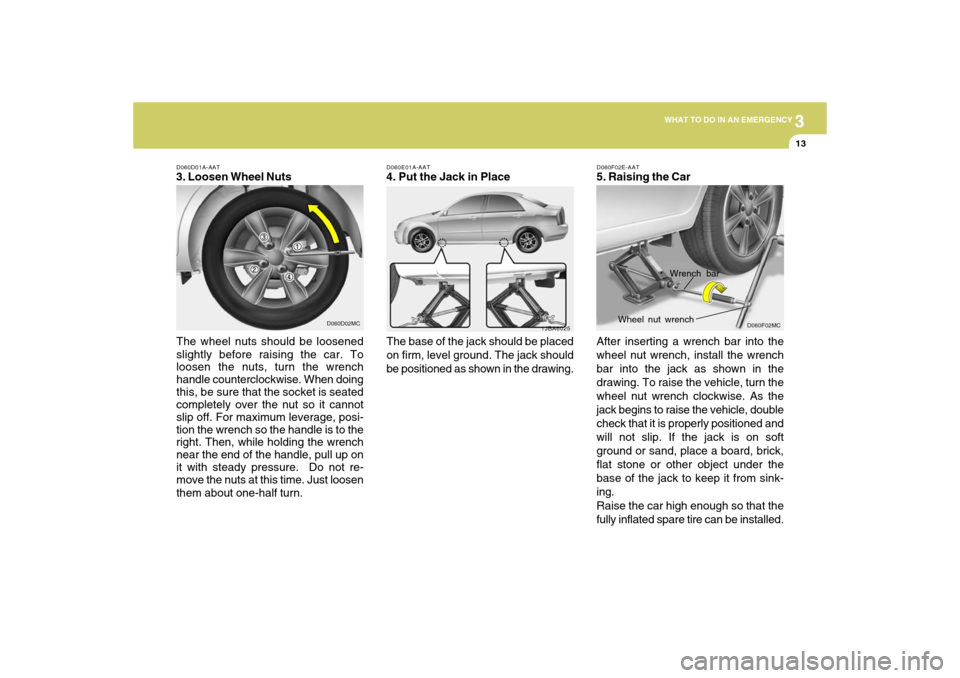
D060E01A-AAT4. Put the Jack in Place
The base of the jack should be placed
on firm, level ground. The jack should
be positioned as shown in the drawing.
1JBA6025
D060D01A-AAT3. Loosen Wheel Nuts
The wheel nuts should be loosened
slightly before raising the car. To
loosen the nuts, turn the wrench
handle counterclockwise. When doing
this, be sure that the socket is seated
completely over the nut so it cannot
slip off. For maximum leverage, posi-
tion the wrench so the handle is to the
right. Then, while holding the wrench
near the end of the handle, pull up on
it with steady pressure. Do not re-
move the nuts at this time. Just loosen
them about one-half turn.
D060D02MC
D060F02E-AAT5. Raising the Car
After inserting a wrench bar into the
wheel nut wrench, install the wrench
bar into the jack as shown in the
drawing. To raise the vehicle, turn the
wheel nut wrench clockwise. As the
jack begins to raise the vehicle, double
check that it is properly positioned and
will not slip. If the jack is on soft
ground or sand, place a board, brick,
flat stone or other object under the
base of the jack to keep it from sink-
ing.
Raise the car high enough so that the
fully inflated spare tire can be installed.
Wrench bar
Wheel nut wrench
D060F02MC
Page 182 of 266
314
WHAT TO DO IN AN EMERGENCY
!
To do this, you will need more ground
clearance than is required to remove
the flat tire.
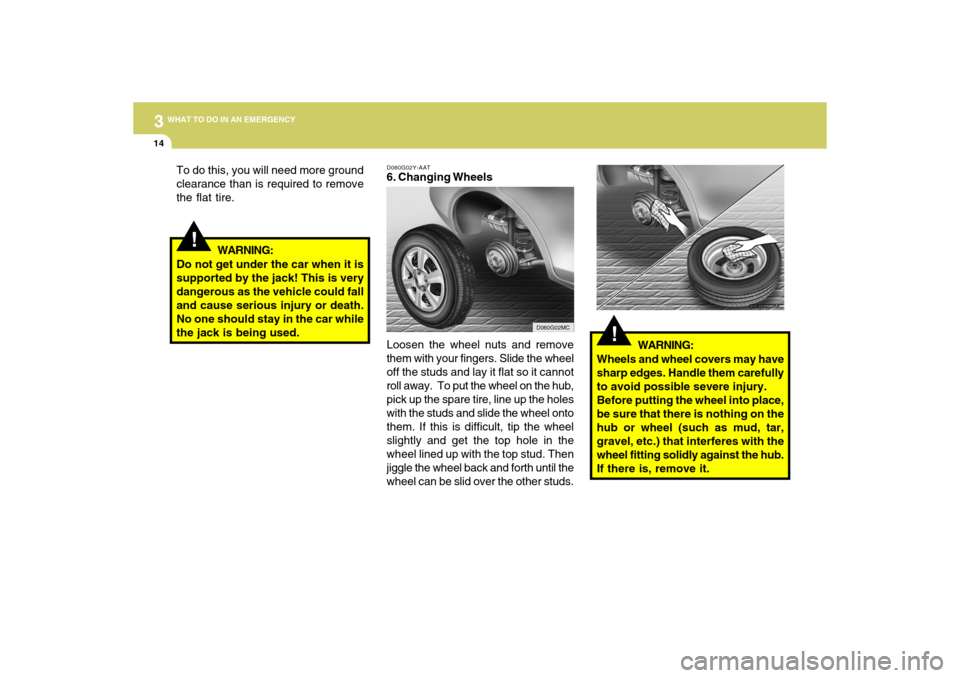
D060G02Y-AAT6. Changing Wheels
Loosen the wheel nuts and remove
them with your fingers. Slide the wheel
off the studs and lay it flat so it cannot
roll away. To put the wheel on the hub,
pick up the spare tire, line up the holes
with the studs and slide the wheel onto
them. If this is difficult, tip the wheel
slightly and get the top hole in the
wheel lined up with the top stud. Then
jiggle the wheel back and forth until the
wheel can be slid over the other studs. WARNING:
Do not get under the car when it is
supported by the jack! This is very
dangerous as the vehicle could fall
and cause serious injury or death.
No one should stay in the car while
the jack is being used.
!
WARNING:
Wheels and wheel covers may have
sharp edges. Handle them carefully
to avoid possible severe injury.
Before putting the wheel into place,
be sure that there is nothing on the
hub or wheel (such as mud, tar,
gravel, etc.) that interferes with the
wheel fitting solidly against the hub.
If there is, remove it.
D060G03MC
D060G02MC
Page 183 of 266
3
WHAT TO DO IN AN EMERGENCY
15
!
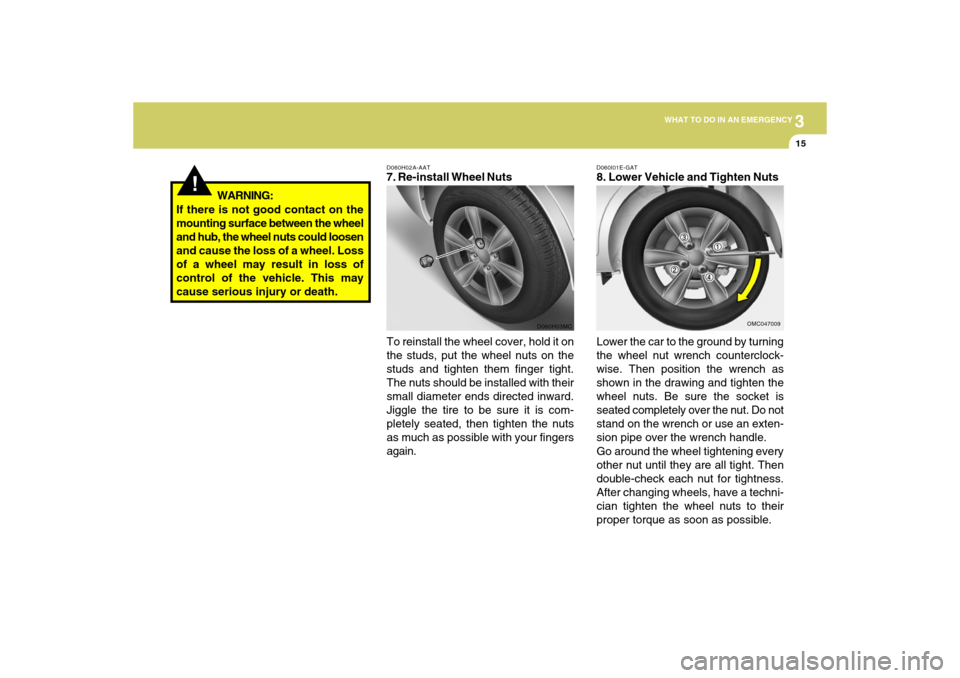
D060H02A-AAT7. Re-install Wheel Nuts
To reinstall the wheel cover, hold it on
the studs, put the wheel nuts on the
studs and tighten them finger tight.
The nuts should be installed with their
small diameter ends directed inward.
Jiggle the tire to be sure it is com-
pletely seated, then tighten the nuts
as much as possible with your fingers
again.
D060H03MC
WARNING:
If there is not good contact on the
mounting surface between the wheel
and hub, the wheel nuts could loosen
and cause the loss of a wheel. Loss
of a wheel may result in loss of
control of the vehicle. This may
cause serious injury or death.
D060I01E-GAT8. Lower Vehicle and Tighten Nuts
Lower the car to the ground by turning
the wheel nut wrench counterclock-
wise. Then position the wrench as
shown in the drawing and tighten the
wheel nuts. Be sure the socket is
seated completely over the nut. Do not
stand on the wrench or use an exten-
sion pipe over the wrench handle.
Go around the wheel tightening every
other nut until they are all tight. Then
double-check each nut for tightness.
After changing wheels, have a techni-
cian tighten the wheel nuts to their
proper torque as soon as possible.
OMC047009
Page 184 of 266
316
WHAT TO DO IN AN EMERGENCY
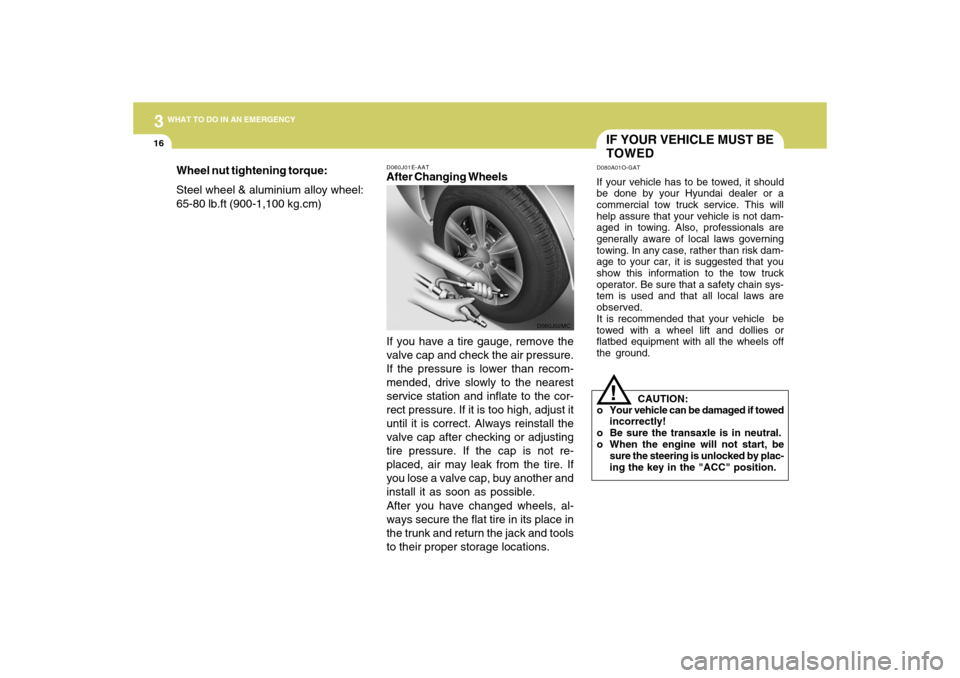
D060J01E-AATAfter Changing Wheels
If you have a tire gauge, remove the
valve cap and check the air pressure.
If the pressure is lower than recom-
mended, drive slowly to the nearest
service station and inflate to the cor-
rect pressure. If it is too high, adjust it
until it is correct. Always reinstall the
valve cap after checking or adjusting
tire pressure. If the cap is not re-
placed, air may leak from the tire. If
you lose a valve cap, buy another and
install it as soon as possible.
After you have changed wheels, al-
ways secure the flat tire in its place in
the trunk and return the jack and tools
to their proper storage locations.
D060J02MC
Wheel nut tightening torque:
Steel wheel & aluminium alloy wheel:
65-80 lb.ft (900-1,100 kg.cm)
IF YOUR VEHICLE MUST BE
TOWEDD080A01O-GATIf your vehicle has to be towed, it should
be done by your Hyundai dealer or a
commercial tow truck service. This will
help assure that your vehicle is not dam-
aged in towing. Also, professionals are
generally aware of local laws governing
towing. In any case, rather than risk dam-
age to your car, it is suggested that you
show this information to the tow truck
operator. Be sure that a safety chain sys-
tem is used and that all local laws are
observed.
It is recommended that your vehicle be
towed with a wheel lift and dollies or
flatbed equipment with all the wheels off
the ground.
!
CAUTION:
o Your vehicle can be damaged if towed
incorrectly!
o Be sure the transaxle is in neutral.
o When the engine will not start, be
sure the steering is unlocked by plac-
ing the key in the "ACC" position.
Page 185 of 266
3
WHAT TO DO IN AN EMERGENCY
17
CAUTION:
o When towing the vehicle, take care
not to cause damage to the bumper
or underbody of the vehicle.
!
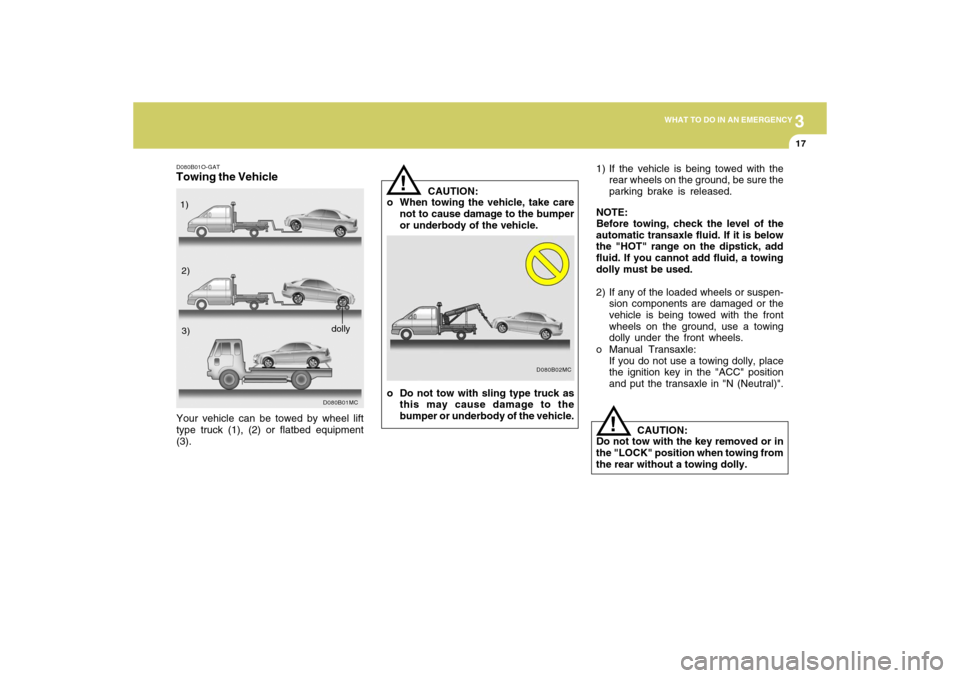
1) If the vehicle is being towed with the
rear wheels on the ground, be sure the
parking brake is released.
NOTE:
Before towing, check the level of the
automatic transaxle fluid. If it is below
the "HOT" range on the dipstick, add
fluid. If you cannot add fluid, a towing
dolly must be used.
2) If any of the loaded wheels or suspen-
sion components are damaged or the
vehicle is being towed with the front
wheels on the ground, use a towing
dolly under the front wheels.
o Manual Transaxle:
If you do not use a towing dolly, place
the ignition key in the "ACC" position
and put the transaxle in "N (Neutral)".
CAUTION:
Do not tow with the key removed or in
the "LOCK" position when towing from
the rear without a towing dolly.
D080B02MC
!
o Do not tow with sling type truck as
this may cause damage to the
bumper or underbody of the vehicle.
D080B01O-GATTowing the Vehicle
D080B01MC
Your vehicle can be towed by wheel lift
type truck (1), (2) or flatbed equipment
(3).1)
2)
3)
dolly
Page 186 of 266
318
WHAT TO DO IN AN EMERGENCY
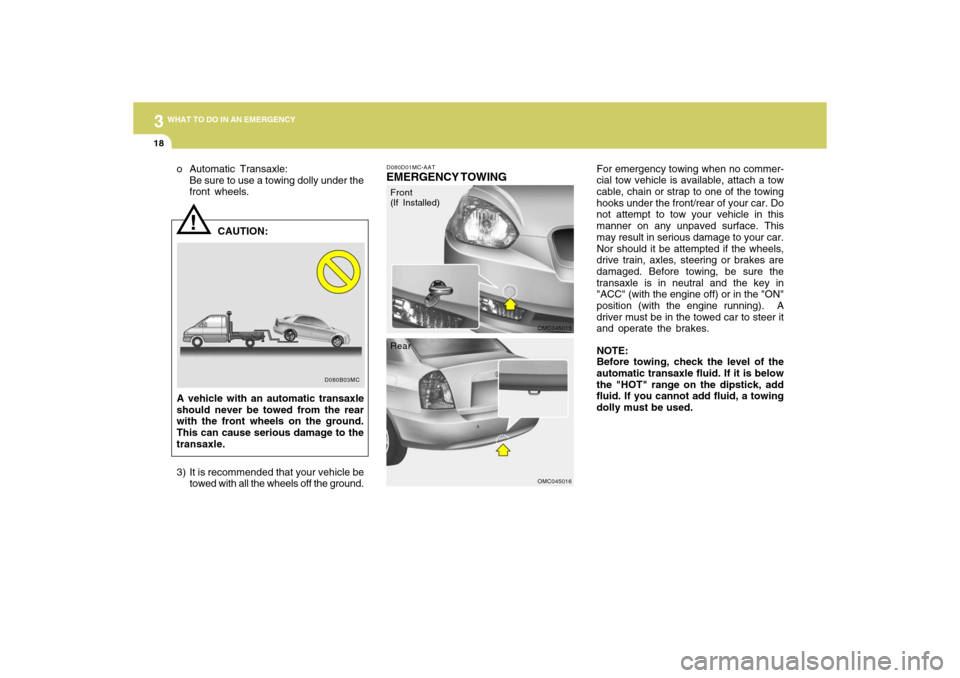
D080D01MC-AATEMERGENCY TOWING
For emergency towing when no commer-
cial tow vehicle is available, attach a tow
cable, chain or strap to one of the towing
hooks under the front/rear of your car. Do
not attempt to tow your vehicle in this
manner on any unpaved surface. This
may result in serious damage to your car.
Nor should it be attempted if the wheels,
drive train, axles, steering or brakes are
damaged. Before towing, be sure the
transaxle is in neutral and the key in
"ACC" (with the engine off) or in the "ON"
position (with the engine running). A
driver must be in the towed car to steer it
and operate the brakes.
NOTE:
Before towing, check the level of the
automatic transaxle fluid. If it is below
the "HOT" range on the dipstick, add
fluid. If you cannot add fluid, a towing
dolly must be used.
OMC045015OMC045016
!
D080B03MC
CAUTION: o Automatic Transaxle:
Be sure to use a towing dolly under the
front wheels.
A vehicle with an automatic transaxle
should never be towed from the rear
with the front wheels on the ground.
This can cause serious damage to the
transaxle.
3) It is recommended that your vehicle be
towed with all the wheels off the ground.
Front
(If Installed)
Rear