flat tire Hyundai Accent 2010 User Guide
[x] Cancel search | Manufacturer: HYUNDAI, Model Year: 2010, Model line: Accent, Model: Hyundai Accent 2010Pages: 284, PDF Size: 10.23 MB
Page 200 of 284
3 WHAT TO DO IN AN EMERGENCY
10
!WARNING:
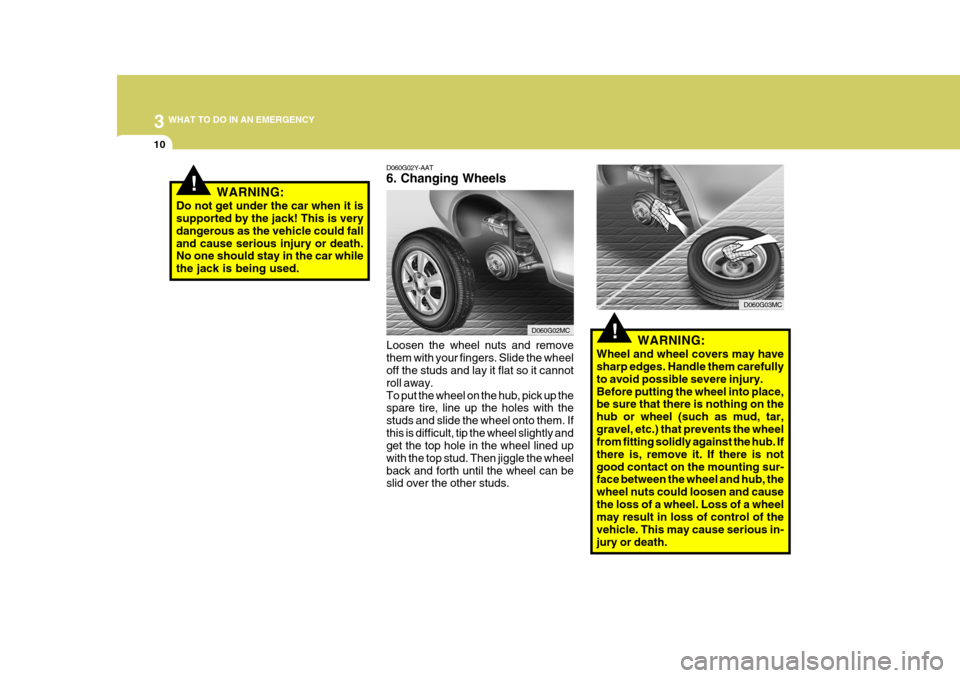
Wheel and wheel covers may have sharp edges. Handle them carefully to avoid possible severe injury.Before putting the wheel into place, be sure that there is nothing on the hub or wheel (such as mud, tar,gravel, etc.) that prevents the wheel from fitting solidly against the hub. If there is, remove it. If there is notgood contact on the mounting sur- face between the wheel and hub, the wheel nuts could loosen and causethe loss of a wheel. Loss of a wheel may result in loss of control of the vehicle. This may cause serious in-jury or death.
D060G02Y-AAT 6. Changing Wheels Loosen the wheel nuts and remove them with your fingers. Slide the wheel off the studs and lay it flat so it cannot roll away.To put the wheel on the hub, pick up the spare tire, line up the holes with the studs and slide the wheel onto them. Ifthis is difficult, tip the wheel slightly and get the top hole in the wheel lined up with the top stud. Then jiggle the wheelback and forth until the wheel can be slid over the other studs.
D060G02MC
D060G03MC
!WARNING:
Do not get under the car when it is supported by the jack! This is very dangerous as the vehicle could falland cause serious injury or death. No one should stay in the car while the jack is being used.
Page 202 of 284
3 WHAT TO DO IN AN EMERGENCY
12
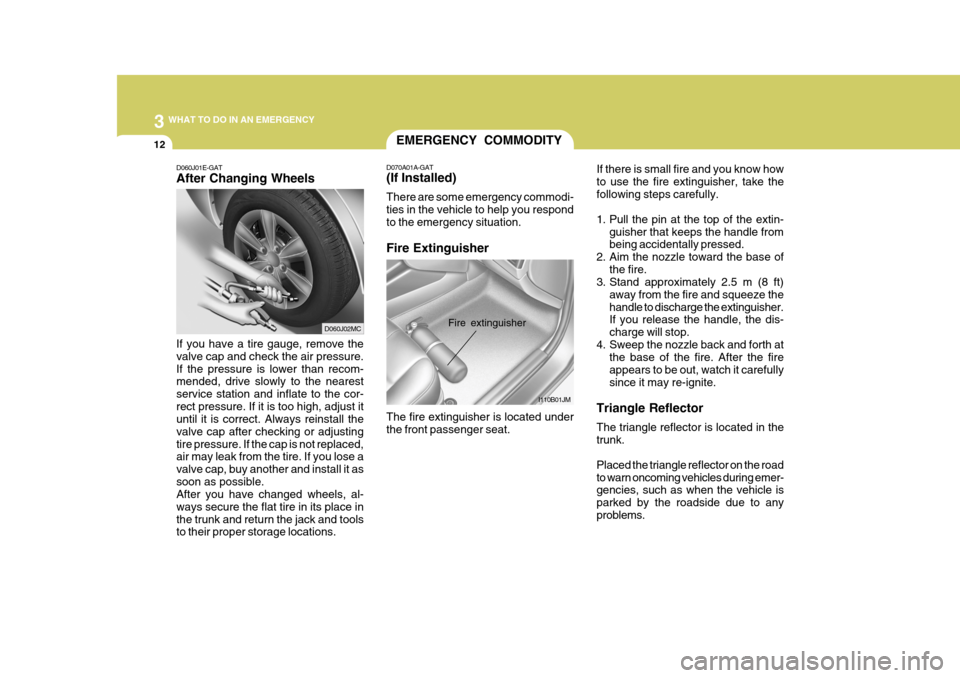
If there is small fire and you know how to use the fire extinguisher, take thefollowing steps carefully.
1. Pull the pin at the top of the extin-guisher that keeps the handle from being accidentally pressed.
2. Aim the nozzle toward the base of
the fire.
3. Stand approximately 2.5 m (8 ft)
away from the fire and squeeze the handle to discharge the extinguisher. If you release the handle, the dis- charge will stop.
4. Sweep the nozzle back and forth at the base of the fire. After the fireappears to be out, watch it carefullysince it may re-ignite.
Triangle Reflector The triangle reflector is located in the trunk. Placed the triangle reflector on the road to warn oncoming vehicles during emer- gencies, such as when the vehicle is parked by the roadside due to anyproblems.
D060J01E-GAT After Changing Wheels If you have a tire gauge, remove the valve cap and check the air pressure.If the pressure is lower than recom- mended, drive slowly to the nearest service station and inflate to the cor-rect pressure. If it is too high, adjust it until it is correct. Always reinstall the valve cap after checking or adjustingtire pressure. If the cap is not replaced, air may leak from the tire. If you lose a valve cap, buy another and install it assoon as possible. After you have changed wheels, al- ways secure the flat tire in its place inthe trunk and return the jack and tools to their proper storage locations.
D060J02MC
EMERGENCY COMMODITY
D070A01A-GAT (If Installed) There are some emergency commodi- ties in the vehicle to help you respond to the emergency situation. Fire Extinguisher The fire extinguisher is located under the front passenger seat. I110B01JM
Fire extinguisher
Page 203 of 284

3
WHAT TO DO IN AN EMERGENCY
13
First Aid Kit The first aid kit is located in the trunk. There are some items such as scis- sors, bandage and adhesive tape and etc. in the kit to give first aid to aninjured person. Tire Pressure Gauge (If Installed) You can easily check the tire pressure with a tire pressure gauge that is found in OVM tool bag. Tires normally lose some air in day-to-day use, and youmay have to add a few pounds of air periodically and it is not usually a sign of a leaking tire, but of normal wear.Always check tire pressure when the tires are cold because tire pressure increases with temperature. To check the tire pressure, take the following steps; 1. Unscrew the inflation valve cap that
is located on the rim of the tire.
2. Press and hold the gauge against the tire valve. Some air will escape asyou begin and more will escape if youdon't press the gauge in firmly.
3. A firm non-leaking push will activate
the gauge.
4. Read the tire pressure on the gauge to know whether the tire pressure islow or high.
5. Adjust the tire pressures to the speci- fied pressure. See page 3-5.
6. Reinstall the inflation valve cap.IF YOUR VEHICLE MUST BE TOWED
D080A01O-GAT If your vehicle has to be towed, it should be done by your Hyundai dealer or a commercial tow truck service. This will help assure that your vehicle is notdamaged in towing. Also, professionals are generally aware of local laws gov- erning towing. In any case, rather thanrisk damage to your car, it is suggested that you show this information to the tow truck operator. Be sure that a safetychain system is used and that all local laws are observed. It is recommended that your vehicle betowed with a wheel lift and dollies or flatbed equipment with all the wheels off the ground.
! CAUTION:
o Your vehicle can be damaged if towed incorrectly!
o Be sure the transaxle is in neutral.
o When the engine will not start, be sure the steering is unlocked byplacing the key in the "ACC" posi-tion.
Page 252 of 284
6 DO-IT-YOURSELF MAINTENANCE
26HEADLIGHT AIMING ADJUSTMENT
5. Open the hood.
6. Draw the vertical line (through the
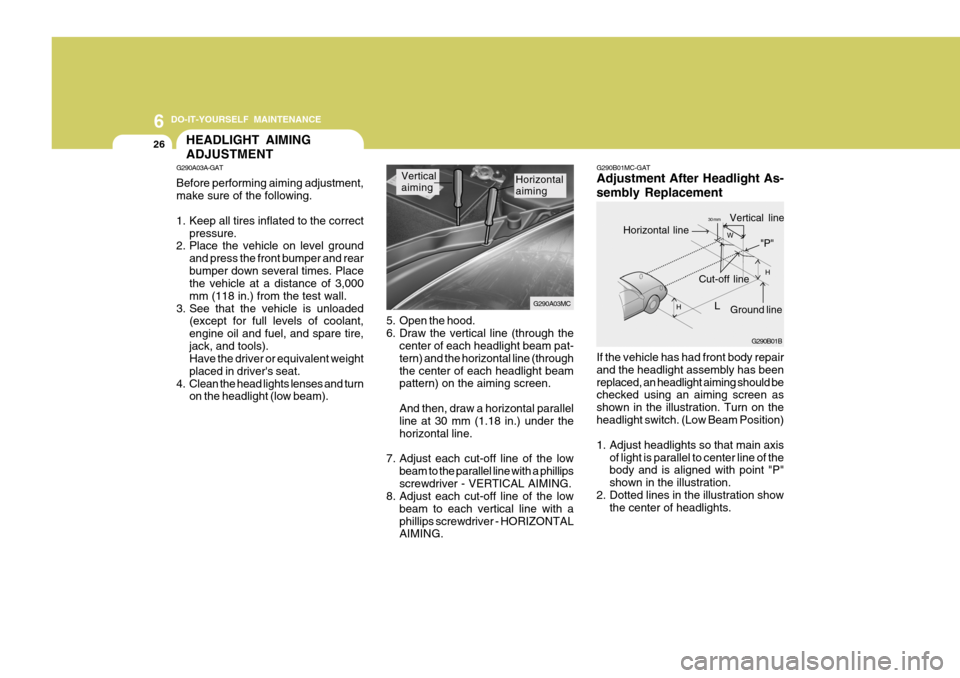
center of each headlight beam pat-tern) and the horizontal line (throughthe center of each headlight beam pattern) on the aiming screen. And then, draw a horizontal parallel line at 30 mm (1.18 in.) under the horizontal line.
7. Adjust each cut-off line of the low beam to the parallel line with a phillipsscrewdriver - VERTICAL AIMING.
8. Adjust each cut-off line of the low
beam to each vertical line with aphillips screwdriver - HORIZONTAL AIMING. Horizontal aiming
Vertical aiming
If the vehicle has had front body repair and the headlight assembly has beenreplaced, an headlight aiming should be checked using an aiming screen as shown in the illustration. Turn on theheadlight switch. (Low Beam Position)
1. Adjust headlights so that main axisof light is parallel to center line of the body and is aligned with point "P" shown in the illustration.
2. Dotted lines in the illustration show the center of headlights.
G290B01MC-GAT Adjustment After Headlight As- sembly Replacement
G290A03A-GAT Before performing aiming adjustment, make sure of the following.
1. Keep all tires inflated to the correct
pressure.
2. Place the vehicle on level ground
and press the front bumper and rear bumper down several times. Place the vehicle at a distance of 3,000 mm (118 in.) from the test wall.
3. See that the vehicle is unloaded (except for full levels of coolant,engine oil and fuel, and spare tire,jack, and tools). Have the driver or equivalent weight placed in driver's seat.
4. Clean the head lights lenses and turn on the headlight (low beam). G290B01B
LW
H
H Cut-off line
Ground line
"P"
Horizontal line
Vertical line30 mm
G290A03MC
Page 269 of 284
Vehicle Identification Number (VIN) .............................. 8-2
Engine Number ............................................................. 8-3
Recommended Inflation Pressures .............................. 8-3
Snow Tires ................................................................... 8-4
Tire Chains ................................................................... 8-5
Tire Rotation ................................................................. 8-5
Tire Balancing ............................................................... 8-6
Tire Traction ................................................................. 8-6
When to Replace Tires ................................................. 8-6
Spare Tire and Tools .................................................... 8-7
8
CONSUMER INFORMATION
8
Page 271 of 284
8
CONSUMER INFORMATION
3ENGINE NUMBERTIRE
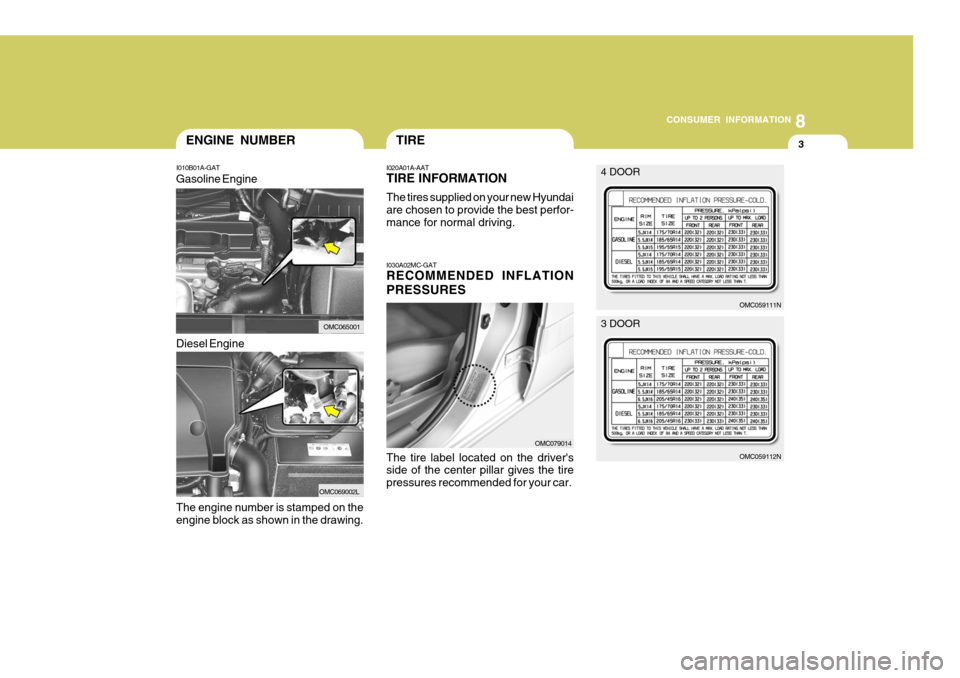
I010B01A-GAT
The engine number is stamped on the engine block as shown in the drawing. I020A01A-AAT TIRE INFORMATION The tires supplied on your new Hyundai are chosen to provide the best perfor-mance for normal driving. I030A02MC-GAT RECOMMENDED INFLATION PRESSURES The tire label located on the driver's side of the center pillar gives the tire pressures recommended for your car.
I030A01MC
Gasoline Engine Diesel Engine
OMC065001
OMC069002L
OMC079014
OMC059112N
3 DOOR
OMC059111N
4 DOOR
Page 272 of 284

8CONSUMER INFORMATION
4
I040A02S-GAT SNOW TIRES If you equip your car with snow tires, they should be the same size and havethe same load capacity as the original tires. Snow tires should be installed on all four wheels; otherwise, poor han-dling may result. Snow tires should carry 28 kPa (4 psi) more air pressure than the pressurerecommended for the standard tires on the tire label on the driver's door edge, or up to the maximum pressure shownon the tire sidewall whichever is less. Do not drive faster than 120 km/h (75 mph) when your car is equipped withsnow tires.
These pressures were chosen to pro-vide the most satisfactory combinationof ride comfort, tire wear and stability under normal conditions. Tire pres- sures should be checked at leastmonthly. Proper tire inflation pressures should be maintained for these rea- sons:
o Lower-than-recommended tire pres-
sures cause uneven tread wear and poor handling.
o Higher-than-recommended tire
pressures increase the chance ofdamage from impacts and cause uneven tread wear. CAUTION:
Always observe the following:
o Check pressures when the tires are cold. That is, after the car has been parked for at least threehours and hasn't been driven more than 1.6 km or one mile since starting up.
o Check the pressure of your spare tire each time you check the pres-sure of other tires.
o Worn, old tires can cause acci-
dents. If your tread is badly worn, or if your tires have been dam-aged, replace them.
!
Page 274 of 284
8CONSUMER INFORMATION
6
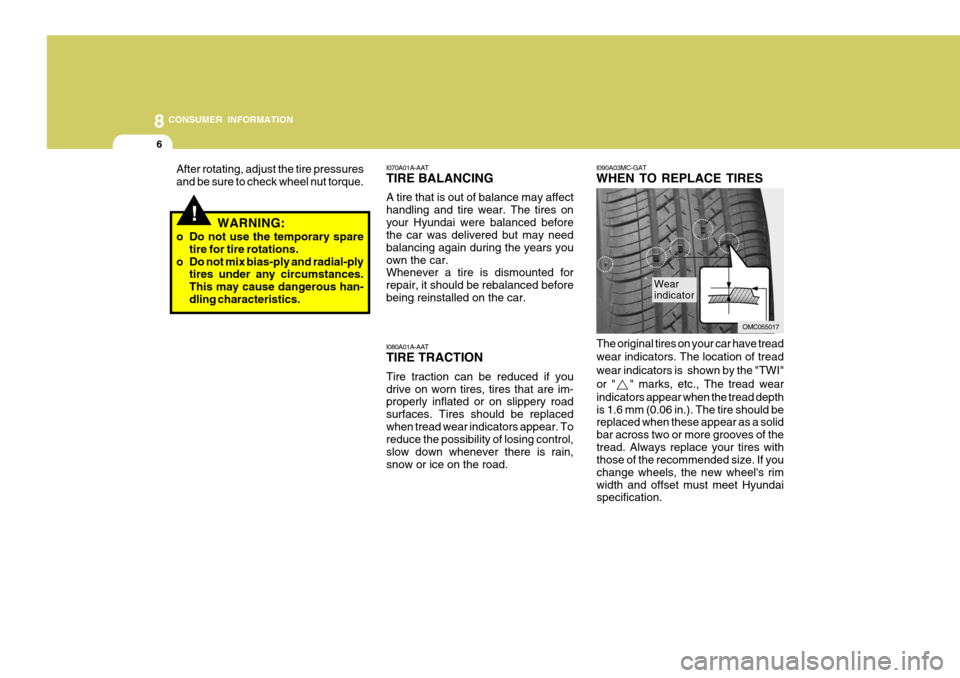
I090A03MC-GAT WHEN TO REPLACE TIRES
The original tires on your car have tread wear indicators. The location of tread wear indicators is shown by the "TWI"or " " marks, etc., The tread wear indicators appear when the tread depth is 1.6 mm (0.06 in.). The tire should be replaced when these appear as a solid bar across two or more grooves of thetread. Always replace your tires with those of the recommended size. If you change wheels, the new wheel's rimwidth and offset must meet Hyundai specification.
OMC055017
Wear indicator
I070A01A-AAT TIRE BALANCING A tire that is out of balance may affect handling and tire wear. The tires onyour Hyundai were balanced before the car was delivered but may need balancing again during the years youown the car. Whenever a tire is dismounted for repair, it should be rebalanced beforebeing reinstalled on the car. I080A01A-AAT TIRE TRACTION Tire traction can be reduced if you drive on worn tires, tires that are im- properly inflated or on slippery road surfaces. Tires should be replacedwhen tread wear indicators appear. To reduce the possibility of losing control, slow down whenever there is rain,snow or ice on the road.
!WARNING:
o Do not use the temporary spare tire for tire rotations.
o Do not mix bias-ply and radial-ply tires under any circumstances. This may cause dangerous han-dling characteristics.
After rotating, adjust the tire pressuresand be sure to check wheel nut torque.
Page 284 of 284

10
INDEX
5
Adjusting your seat belt ................................. 1-30, 1-31
Care of seat belts ................................................... 1-27
Precautions ............................................................. 1-26
Pre-tensioner seat belt ........................................... 1-42
Spectacle Ca se ......................................................... 1-91
Speedometer ............................................................. 1-69
Starting ........................................................................ 2-5
Steering Wheel Tilt Lever ........................................ 1-104
Stereo Sound System ............................................. 1-121
Sun Visor ................................................................. 1-102
Sunroof ...................................................................... 1-87
Sunshade ................................................................... 1-87
T Tachometer ................................................................ 1-70
Theft-Alarm system ................................................... 1-10
Tires
Balancing .................................................................. 8-6
Chains ...................................................................... 8-5
If you have a flat tire ................................................ 3-7
Information ................................................................ 8-3
Pressure ................................................................... 8-3
Replacement ............................................................. 8-6
Rotation .................................................................... 8-5
Snow tires ................................................................ 8-4
Spare tire .................................................................. 3-5
Traction ..................................................................... 8-6
Towing A trailer (or vehicle) ................................................ 2-24
Emergency ............................................................. 3-15If your vehicle must
be towed ................................ 3-13
Trailer or Vehicle towing ............................................ 2-24
Transaxle
Automatic ................................................................. 2-9
Automatic transaxle fluid checking ......................... 6-15
Manual ...................................................................... 2-7
Manual transaxle oil checking ................................ 6-14
Trip Computer ............................................................ 1-73
Trip Odometer ............................................................ 1-71
Trunk Lid/Tail gate ..................................................... 1-99
VVehicle Identifi cation Number ...................................... 8-2
Vehicle Stability Managem ent (VSM) ........................2-15
WWarning and Indicator Lights ..................................... 1-60
Washer Reservoir ...................................................... 6-14
Window Glass ............................................................ 1-14
Power windows ....................................................... 1-14
Windshield Wiper and Washer ...................................1-78
Adjustable intermittent wiper operation ...................1-80
Rear window wiper and washer ...............................1-81
Windshield Wiper Blades ........................................... 6-12
Winter Driving ............................................................ 2-21