steering Hyundai Accent 2010 User Guide
[x] Cancel search | Manufacturer: HYUNDAI, Model Year: 2010, Model line: Accent, Model: Hyundai Accent 2010Pages: 284, PDF Size: 10.23 MB
Page 88 of 284
1FEATURES OF YOUR HYUNDAI
76
Parking Light Auto Cut
o The purpose of this feature is toprevent the battery from being dis- charged. The system automatically turns off the headlights and parking lights whenthe driver removes the ignition key and opens the driver- side door.
o With this feature, the parking light will be turned off automatically if thedriver parks on the side of road at night.If necessary, to keep the lights on when the ignition key is removed, perform the following :
1) Open the driver-side door.
2) Turn the parking lights OFF and ON again using the light switch on the steering column.
B340C04FC-GAT Headlight Switch
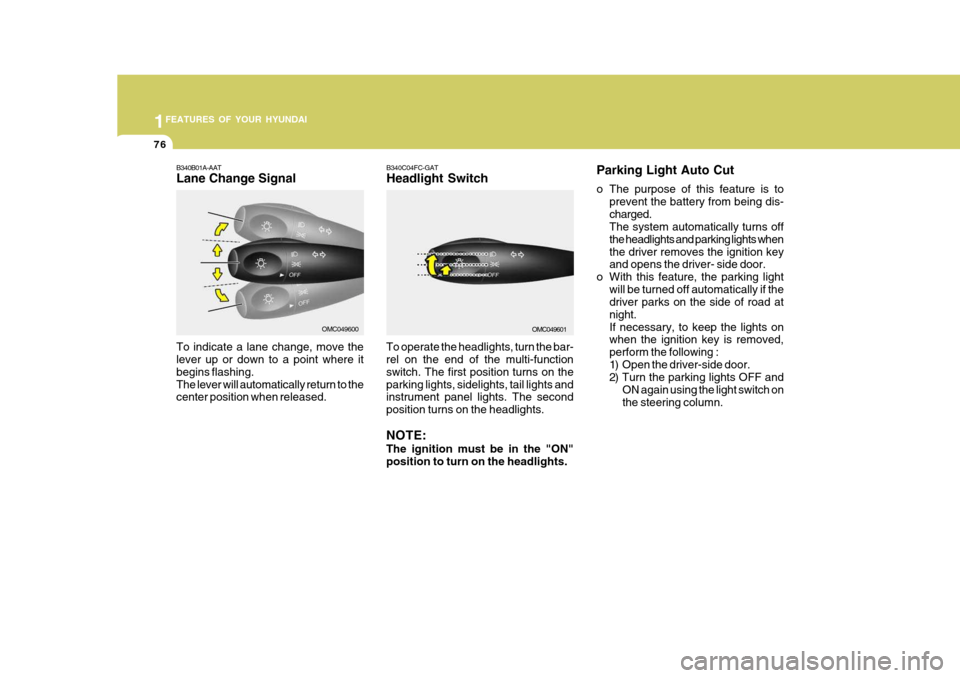
To operate the headlights, turn the bar- rel on the end of the multi-function switch. The first position turns on theparking lights, sidelights, tail lights and instrument panel lights. The second position turns on the headlights. NOTE: The ignition must be in the "ON" position to turn on the headlights.
OMC049601
B340B01A-AAT Lane Change Signal To indicate a lane change, move the lever up or down to a point where it begins flashing.The lever will automatically return to the center position when released.OMC049600
Page 91 of 284
1
FEATURES OF YOUR HYUNDAI
79
B350B01O-GAT Windshield Washer Operation
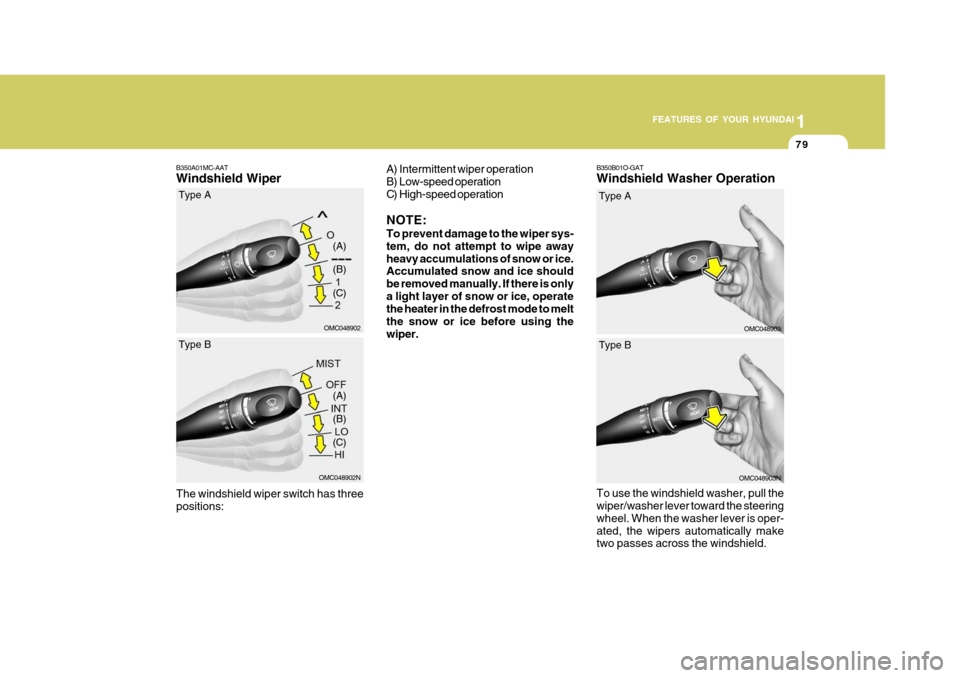
B350A01MC-AATWindshield Wiper
The windshield wiper switch has three positions:
OMC048902 (A) (B) (C)
Type A
OMC048902N
(A) (B) (C)
Type B
OMC048903
Type A
A) Intermittent wiper operation
B) Low-speed operation
C) High-speed operation NOTE: To prevent damage to the wiper sys- tem, do not attempt to wipe awayheavy accumulations of snow or ice. Accumulated snow and ice should be removed manually. If there is onlya light layer of snow or ice, operate the heater in the defrost mode to melt the snow or ice before using thewiper.
OMC048903N
Type B
To use the windshield washer, pull the wiper/washer lever toward the steering wheel. When the washer lever is oper-ated, the wipers automatically make two passes across the windshield.
Page 115 of 284
1
FEATURES OF YOUR HYUNDAI
103STEERING WHEEL
B580C01JM-AAT Sun Visor Extender (If Installed)
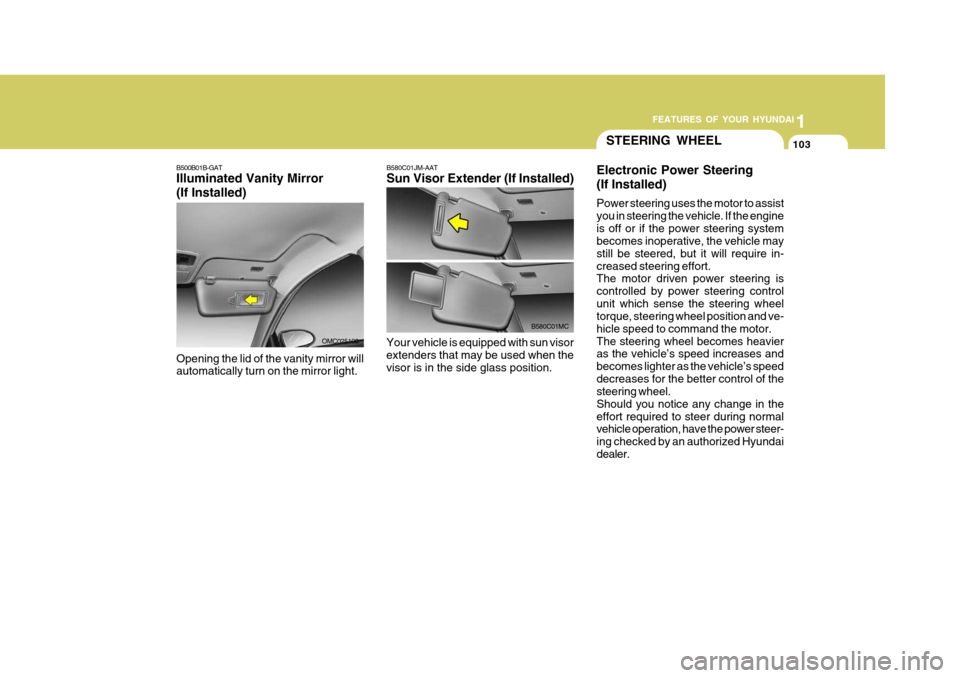
Your vehicle is equipped with sun visor extenders that may be used when the visor is in the side glass position.
B580C01MC
B500B01B-GAT Illuminated Vanity Mirror (If Installed) Opening the lid of the vanity mirror will automatically turn on the mirror light. OMC025100 Electronic Power Steering (If Installed) Power steering uses the motor to assist you in steering the vehicle. If the engineis off or if the power steering system becomes inoperative, the vehicle may still be steered, but it will require in-creased steering effort. The motor driven power steering is controlled by power steering controlunit which sense the steering wheel torque, steering wheel position and ve- hicle speed to command the motor.The steering wheel becomes heavier as the vehicle’s speed increases and becomes lighter as the vehicle’s speeddecreases for the better control of the steering wheel. Should you notice any change in theeffort required to steer during normal vehicle operation, have the power steer- ing checked by an authorized Hyundaidealer.
Page 116 of 284
1FEATURES OF YOUR HYUNDAI
104HORN
B610B01L-GAT
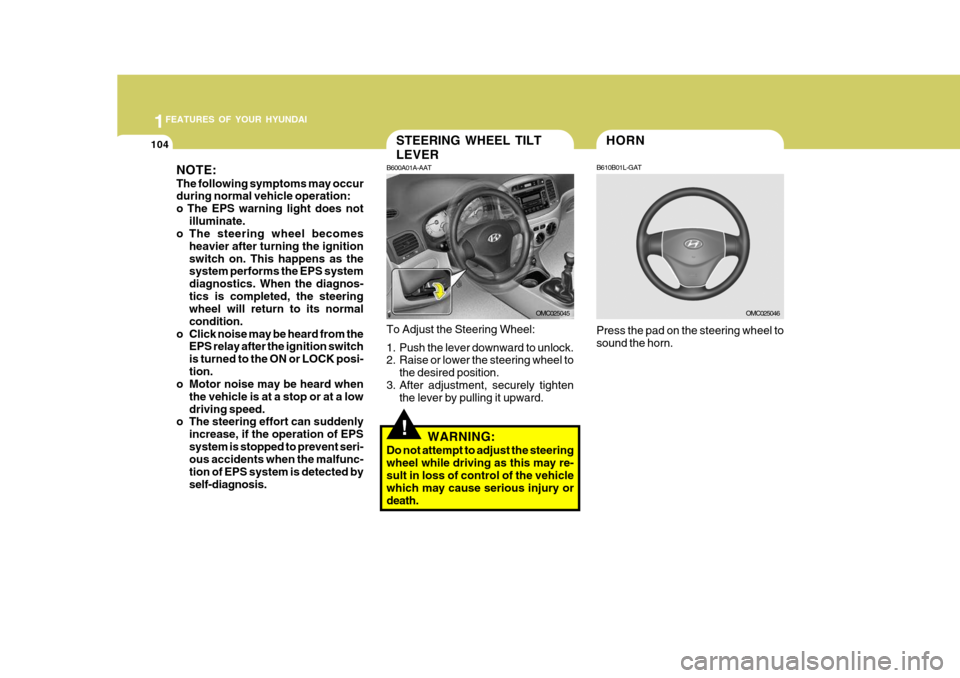
Press the pad on the steering wheel to sound the horn.
OMC025046
!
STEERING WHEEL TILT LEVER
B600A01A-AAT To Adjust the Steering Wheel:
1. Push the lever downward to unlock.
2. Raise or lower the steering wheel to
the desired position.
3. After adjustment, securely tighten the lever by pulling it upward.
WARNING:
Do not attempt to adjust the steering wheel while driving as this may re-sult in loss of control of the vehicle which may cause serious injury or death.
OMC025045
NOTE: The following symptoms may occur during normal vehicle operation:
o The EPS warning light does not
illuminate.
o The steering wheel becomes
heavier after turning the ignitionswitch on. This happens as the system performs the EPS system diagnostics. When the diagnos-tics is completed, the steering wheel will return to its normal condition.
o Click noise may be heard from the EPS relay after the ignition switchis turned to the ON or LOCK posi-tion.
o Motor noise may be heard when
the vehicle is at a stop or at a lowdriving speed.
o The steering effort can suddenly
increase, if the operation of EPSsystem is stopped to prevent seri- ous accidents when the malfunc- tion of EPS system is detected byself-diagnosis.
Page 166 of 284
2 DRIVING YOUR HYUNDAI
4
C070C01A-AAT
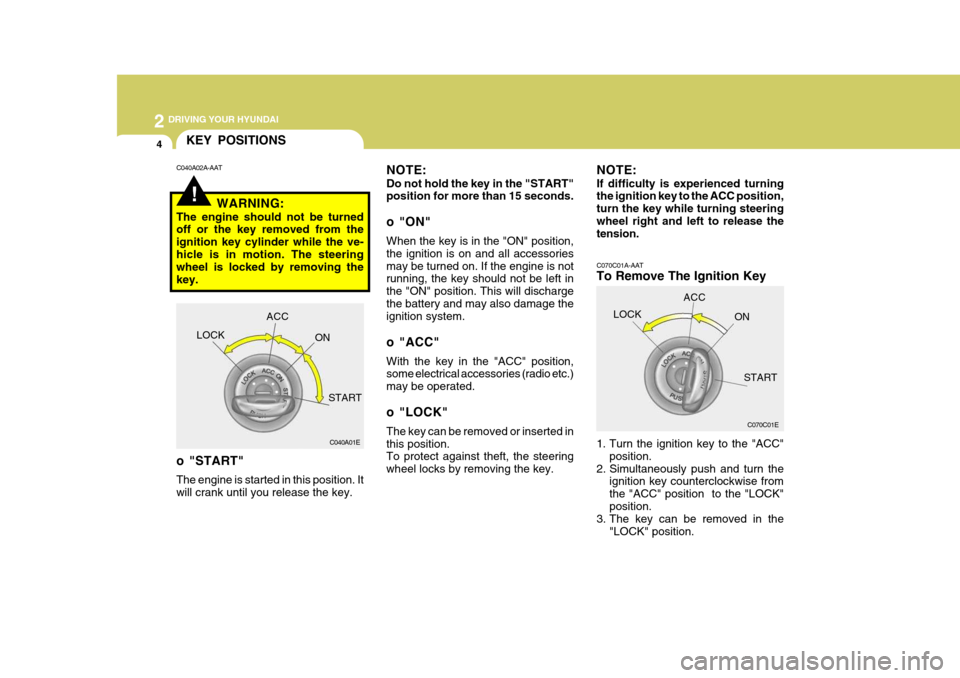
To Remove The Ignition Key
1. Turn the ignition key to the "ACC"position.
2. Simultaneously push and turn the ignition key counterclockwise from the "ACC" position to the "LOCK"position.
3. The key can be removed in the
"LOCK" position.
C070C01E
LOCK
ACC
ON
START
!
KEY POSITIONS
C040A01E
LOCK
ACC
ON
START
o "START" The engine is started in this position. It will crank until you release the key.
C040A02A-AAT
NOTE: Do not hold the key in the "START" position for more than 15 seconds.
o "ON" When the key is in the "ON" position, the ignition is on and all accessoriesmay be turned on. If the engine is not running, the key should not be left in the "ON" position. This will dischargethe battery and may also damage the ignition system.
o "ACC" With the key in the "ACC" position, some electrical accessories (radio etc.) may be operated.
o "LOCK" The key can be removed or inserted in this position. To protect against theft, the steering wheel locks by removing the key.
WARNING:
The engine should not be turned off or the key removed from the ignition key cylinder while the ve-hicle is in motion. The steering wheel is locked by removing the key. NOTE: If difficulty is experienced turning the ignition key to the ACC position, turn the key while turning steeringwheel right and left to release the tension.
Page 171 of 284
2
DRIVING YOUR HYUNDAI
9
2
DRIVING YOUR HYUNDAI
9
!
cially careful when braking, acceler- ating or shifting gears. On a slipperysurface, an abrupt change in ve- hicle speed can cause the drive wheels to lose traction and the ve-hicle to go out of control.
WARNING:
o Avoid high cornering speeds.
o Do not make quick steering wheel movements, such as sharp lanechanges or fast, sharp turns.
o Always wear your seat belts. In a collis ion crash, an unbelted person
is significantly more likely to diethan a person wearing a seatbelt.
o The risk of rollover is greatly in-
creased if you lose control ofyour vehicle at highway speeds.
o Loss of control often occurs if
two or more wheels drop off theroadway and the driver oversteers to reenter the roadway.
o In the event your vehicle leaves the roadway, do not steer sharply.Instead, slow down before pull- ing back into the travel lanes.
o Never exceed posted speed lim- its.
AUTOMATIC TRANSAXLE
OMC035014
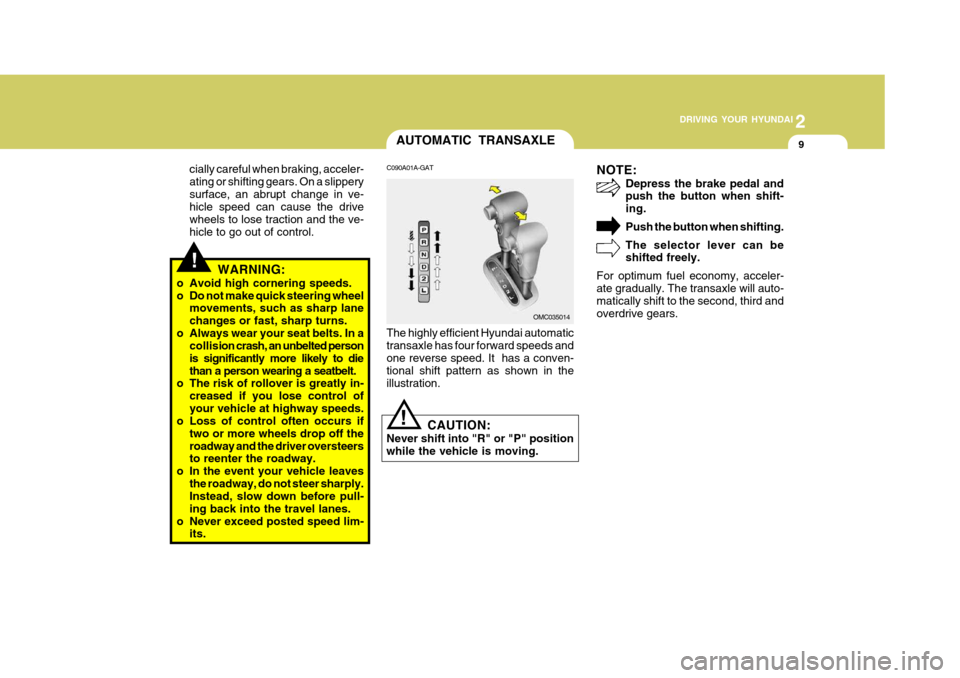
C090A01A-GAT The highly efficient Hyundai automatic transaxle has four forward speeds and one reverse speed. It has a conven- tional shift pattern as shown in theillustration.
CAUTION:
Never shift into "R" or "P" positionwhile the vehicle is moving. NOTE:
Depress the brake pedal and push the button when shift- ing. Push the button when shifting. The selector lever can be shifted freely.
For optimum fuel economy, acceler-ate gradually. The transaxle will auto- matically shift to the second, third andoverdrive gears.
!
Page 174 of 284
2 DRIVING YOUR HYUNDAI
12
!WARNING:
o Avoid high cornering speeds.
o Do not make quick steering wheel movements, such as sharp lanechanges or fast, sharp turns.
o Exercise extreme caution when driv-
ing on a slippery surface. Be espe-cially careful when braking, acceler- ating or shifting gears. On a slippery surface, an abrupt change in ve-hicle speed can cause the drive wheels to lose traction and the ve- hicle to go out of control.
o Optimum vehicle performance and economy is obtained by smoothlydepressing and releasing the accel-erator pedal.
o Turn the overdrive switch on for good
fuel economy and smooth driving. Ifengine braking is needed in the "D" range or if repeated upshifting and downshifting between 3rd and 4thgear is needed when climbing a gentle slope, it is recommended that the overdrive switch be turned off. Turnthe overdrive switch back on imme- diately afterward.
C090N06A-AAT Good Driving Practices
o Never move the gear selector lever
from "P" or "N" to any other position with the accelerator pedal de- pressed.
o Never move the gear selector lever into "P" when the vehicle is in mo-tion.
o Be sure the car is completely stopped before you attempt to shift into "R" or"D".
o Never take the car out of gear and coast down a hill. This may be ex-tremely hazardous. Always leave the car in gear when moving.
o Do not "ride" the brakes. This can cause them to overheat and mal-function. Instead, when you are driv-ing down a long hill, slow down and shift to a lower gear. When you do this, engine braking will help slowthe car.
o Slow down before shifting to a lower
gear. Otherwise, the lower gear maynot be engaged.
o Always use the parking brake. Do
not depend on placing the transaxlein "P" to keep the car from moving. o Always wear your seat belts.
In a collision crash, an unbeltedperson is significantly more likelyto die than a person wearing a seatbelt.
o The risk of rollover is greatly in- creased if you lose control ofyour vehicle at highway speeds.
o Loss of control often occurs if two or more wheels drop off theroadway and the driver oversteers to reenter the roadway.
o In the event your vehicle leaves the roadway, do not steer sharply.Instead, slow down before pull- ing back into the travel lanes.
o Never exceed posted speed limits.
o If your vehicle becomes stuck in snow, mud, sand, etc., then youmay attempt to rock the vehiclefree by moving it forward and back- ward. Do not attempt this proce- dure if people or objects are any-where near the vehicle. During the rocking operation the vehicle may suddenly move forward of back-ward as it becomes unstuck, caus- ing injury or damage to nearby people or objects.
Page 176 of 284
2 DRIVING YOUR HYUNDAI
14
!
CAUTION:
Driving with varying tire or wheel size may cause the ESP system to malfunction. When replacing tires,make sure they are the same size as your original tires.!
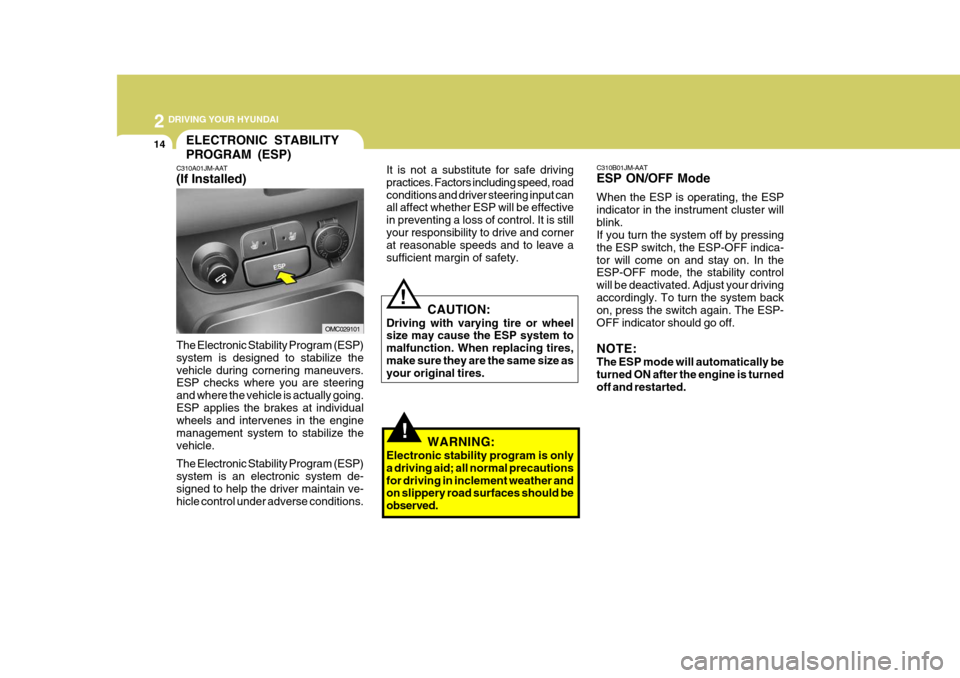
ELECTRONIC STABILITY PROGRAM (ESP)
C310A01JM-AAT (If Installed) It is not a substitute for safe driving practices. Factors including speed, roadconditions and driver steering input can all affect whether ESP will be effective in preventing a loss of control. It is stillyour responsibility to drive and corner at reasonable speeds and to leave a sufficient margin of safety.
OMC029101 C310B01JM-AAT ESP ON/OFF Mode When the ESP is operating, the ESP indicator in the instrument cluster willblink. If you turn the system off by pressing the ESP switch, the ESP-OFF indica-tor will come on and stay on. In the ESP-OFF mode, the stability control will be deactivated. Adjust your drivingaccordingly. To turn the system back on, press the switch again. The ESP- OFF indicator should go off. NOTE: The ESP mode will automatically be turned ON after the engine is turnedoff and restarted.
The Electronic Stability Program (ESP)system is designed to stabilize thevehicle during cornering maneuvers. ESP checks where you are steering and where the vehicle is actually going.ESP applies the brakes at individual wheels and intervenes in the engine management system to stabilize thevehicle. The Electronic Stability Program (ESP) system is an electronic system de- signed to help the driver maintain ve- hicle control under adverse conditions. WARNING:
Electronic stability program is onlya driving aid; all normal precautionsfor driving in inclement weather and on slippery road surfaces should be observed.
Page 177 of 284

2
DRIVING YOUR HYUNDAI
15
2
DRIVING YOUR HYUNDAI
15
C310D01JM-AAT Indicators and Warning The indicators should illuminate when the ignition key is turned to ON orSTART but should go out after three seconds. If the indicators do not illuminate, or theESP or ESP-OFF indicator does not go out after 3 seconds, have the vehicle checked by an authorized dealer. Should there be any unusual conditions in the device while driving, ESP-OFFindicator illuminates as a warning. If ESP-OFF indicator illuminates, pull your car to a safe place and stop theengine. Then, start the engine again to check if the ESP-OFF indicator goes out. If the indicator remains lit even after the engine has been started, have your carchecked by an authorized Hyundai dealer. Take your vehicle to an authorized HYUNDAI dealer and have the systemchecked. NOTE:
o The VSM does not operate when:
- Driving on bank road such asgradient or incline
- Driving rearward - ESP-OFF indicator light remains
on the instrument cluster
- EPS indicator light remains on
the instrument cluster
o The VSM is designed to function above approximately 15 km/h (9mph) on curves.
o The VSM is designed to function above approximately 30 km/h (18mph) when a vehicle is braking ona split-mu road. The split-mu road is made of surfaces which have different friction forces.
o Your vehicle is designed to acti- vate according to the driver’s in-tention, even with installed VSM.Always follow all the normal pre- cautions for driving - including driving at safe speeds for the con-ditions.VEHICLE STABILITY MAN- AGEMENT (VSM)
(If Installed) This system provides further enhance- ments to vehicle stability and steeringresponses when a vehicle is driving on a slippery road or a vehicle detected changes in coefficient of friction be-tween right wheels and left wheels when braking. VSM ON/OFF mode When the VSM is operating, the ESP indicator light on the instrument clusterwill blink and you can feel a slight pulsation of the steering wheel. If you want to cancel the VSM opera-tion, press the ESP-OFF switch. If you press the ESP-OFF switch, the VSM and ESP function will be deactivatedand ESP OFF indicator light will come on and stay on. To turn the system back on, press theESP-OFF switch again. The ESP-OFF indicator light will go out. The VSM can be deactivated even ifyou don’t cancel the VSM operation by pressing the ESP-OFF switch. It indi- cates that a malfunction has been de-tected somewhere in the EPS (Elec- tronic Power Steering) system or VSM system.
Page 178 of 284
2 DRIVING YOUR HYUNDAI
16
!
REAR PARKING ASSIST SYSTEM
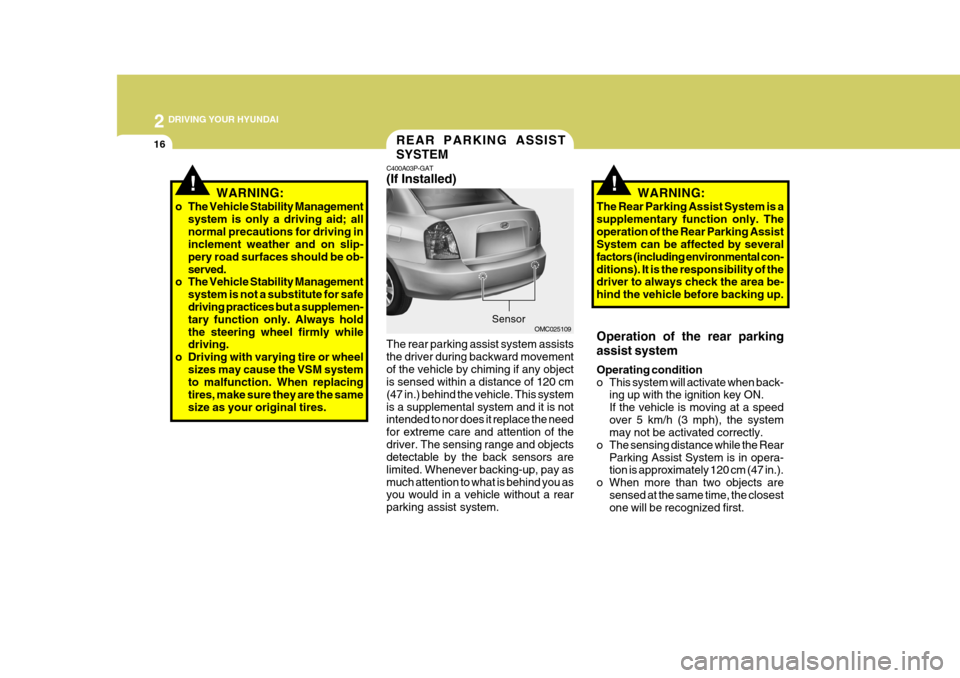
C400A03P-GAT (If Installed) The rear parking assist system assists the driver during backward movementof the vehicle by chiming if any object is sensed within a distance of 120 cm (47 in.) behind the vehicle. This systemis a supplemental system and it is not intended to nor does it replace the need for extreme care and attention of thedriver. The sensing range and objects detectable by the back sensors are limited. Whenever backing-up, pay asmuch attention to what is behind you as you would in a vehicle without a rear parking assist system. OMC025109
WARNING:
The Rear Parking Assist System is asupplementary function only. Theoperation of the Rear Parking Assist System can be affected by several factors (including environmental con-ditions). It is the responsibility of the driver to always check the area be- hind the vehicle before backing up.
Sensor Operation of the rear parking assist system Operating condition
o This system will activate when back-ing up with the ignition key ON.If the vehicle is moving at a speedover 5 km/h (3 mph), the system may not be activated correctly.
o The sensing distance while the Rear
Parking Assist System is in opera-tion is approximately 120 cm (47 in.).
o When more than two objects are
sensed at the same time, the closestone will be recognized first.
!WARNING:
o The Vehicle Stability Management system is only a driving aid; all normal precautions for driving in inclement weather and on slip- pery road surfaces should be ob-served.
o The Vehicle Stability Management
system is not a substitute for safedriving practices but a supplemen- tary function only. Always hold the steering wheel firmly while driving.
o Driving with varying tire or wheel
sizes may cause the VSM systemto malfunction. When replacing tires, make sure they are the samesize as your original tires.