belt Hyundai Accent 2010 Owner's Guide
[x] Cancel search | Manufacturer: HYUNDAI, Model Year: 2010, Model line: Accent, Model: Hyundai Accent 2010Pages: 284, PDF Size: 10.23 MB
Page 53 of 284
1
FEATURES OF YOUR HYUNDAI
41
o When using the vehicle’s "ISOFIX"
system to install a child restraint system in the rear seat, all unusedvehicle rear seat belt metal latch plates or tabs must be latched securely in their seat belt bucklesand the seat belt webbing must be retracted behind the child restraint to prevent the child from reachingand taking hold of unretracted seat
belts. Unlatched metal latch plates or tabs may allow the child toreach the unretracted seat belts which may result in strangulation and a serious injury or death to thechild in the child restraint.
o Do not mount more than one child
restraint to a child restraint loweranchorage point. The improper increased load may cause the an- chorage points or tether anchor tobreak, causing serious injury or death.
o Attach the ISOFIX or ISOFIX-com- patible child restraint seat only tothe appropriate locations shown in the illustration.
o Always follow the installation and use instructions provided by themanufacturer of the child restraint.
WARNING:
o Do not install a child restraint seat at the center of the rear seat using the vehicle's ISOFIX anchors. The ISOFIX anchors are only provided for the left and right outboard rear seating positions. Do not misusethe ISOFIX anchors by attempting to attach a child restraint seat in the middle of the rear seat to theISOFIX anchors. In a crash, the child restraint seat ISOFIX attach- ments may not be strong enoughto secure the child restraint seat properly in the center of the rear seat and may break, causing seri-ous injury or death.
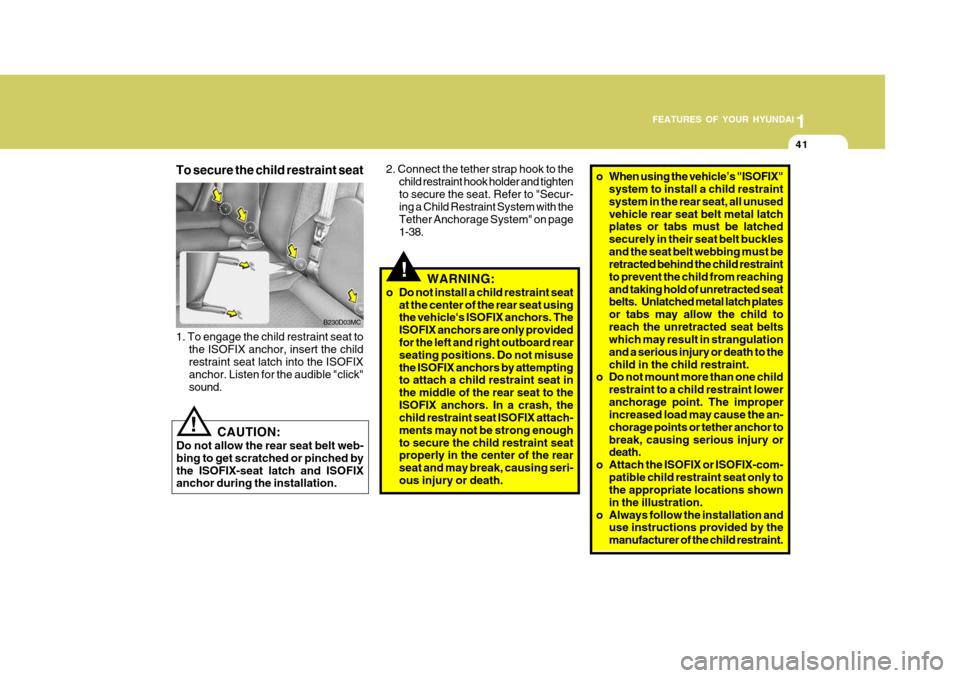
B230D03MC
1. To engage the child restraint seat to the ISOFIX anchor, insert the childrestraint seat latch into the ISOFIX anchor. Listen for the audible "click" sound.
To secure the child restraint seat!
2. Connect the tether strap hook to the
child restraint hook holder and tighten to secure the seat. Refer to "Secur- ing a Child Restraint System with the Tether Anchorage System" on page1-38.
! CAUTION:
Do not allow the rear seat belt web- bing to get scratched or pinched bythe ISOFIX-seat latch and ISOFIX anchor during the installation.
Page 54 of 284
1FEATURES OF YOUR HYUNDAI
42
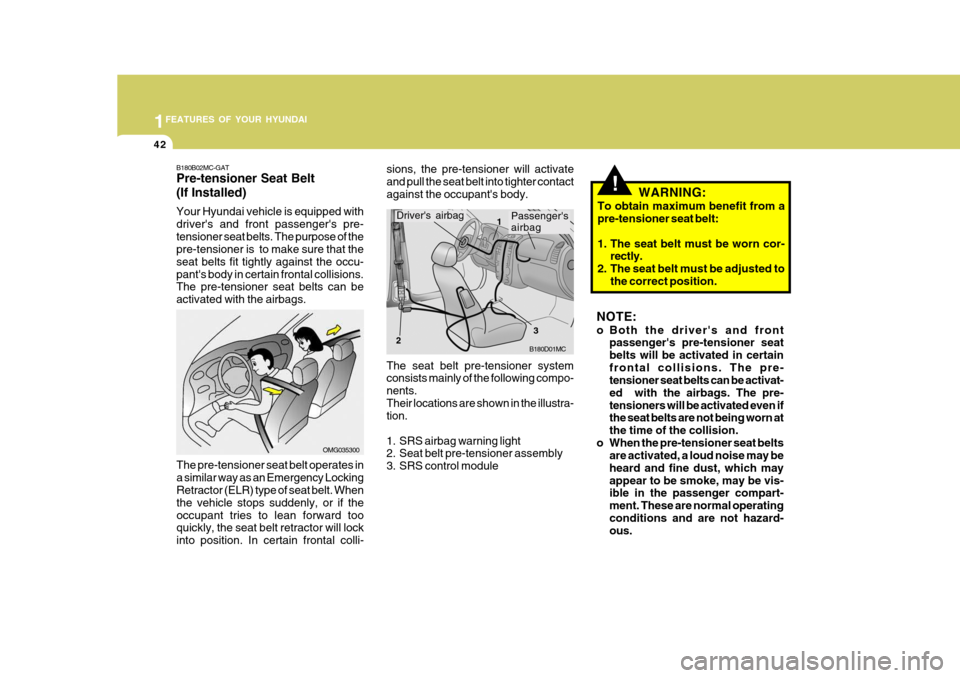
The seat belt pre-tensioner system consists mainly of the following compo- nents.Their locations are shown in the illustra- tion.
1. SRS airbag warning light
2. Seat belt pre-tensioner assembly
3. SRS control module
Passenger's airbag
B180D01MC
Driver's airbag1
2 3
sions, the pre-tensioner will activate and pull the seat belt into tighter contactagainst the occupant's body.
OMG035300
B180B02MC-GAT Pre-tensioner Seat Belt (If Installed) Your Hyundai vehicle is equipped with driver's and front passenger's pre-tensioner seat belts. The purpose of the pre-tensioner is to make sure that the seat belts fit tightly against the occu-pant's body in certain frontal collisions. The pre-tensioner seat belts can be activated with the airbags.
The pre-tensioner seat belt operates ina similar way as an Emergency Locking Retractor (ELR) type of seat belt. When the vehicle stops suddenly, or if theoccupant tries to lean forward too quickly, the seat belt retractor will lock into position. In certain frontal colli-
!WARNING:
To obtain maximum benefit from a pre-tensioner seat belt:
1. The seat belt must be worn cor- rectly.
2. The seat belt must be adjusted to the correct position.
NOTE:
o Both the driver's and front passenger's pre-tensioner seat belts will be activated in certainfrontal collisions. The pre- tensioner seat belts can be activat- ed with the airbags. The pre-tensioners will be activated even if the seat belts are not being worn at the time of the collision.
o When the pre-tensioner seat belts are activated, a loud noise may beheard and fine dust, which mayappear to be smoke, may be vis- ible in the passenger compart- ment. These are normal operatingconditions and are not hazard- ous.
Page 55 of 284
1
FEATURES OF YOUR HYUNDAI
43
!
o Although it is harmless, the fine
dust may cause skin irritation and should not be breathed for pro- longed periods. Wash your hands and face thoroughly after an acci-dent in which the pre-tensioner seat belts were activated.
CAUTION:
o Because the sensor that activates the SRS airbag is connected with pre-tensioner seat belt, the SRS airbag warning light on the instrument panel will illuminatefor approximately 6 seconds after the ignition key has been turned to the "ON" position, and then itshould turn off.
o If pre-tensioner seat belt is not
working properly, this warninglight will illuminate even if there is no malfunction of the SRS airbag.
! If the SRS airbag warning light does not illuminate when the igni-tion key is turned to "ON", or if it blinks for a second and remains illuminated after illuminating forapproximately 6 seconds, or if it illuminates while the vehicle is being driven, please have an au-thorized Hyundai dealer inspect the pre-tensioner seat belt or SRS airbag system as soon as pos-sible.
WARNING:
o Pre-tensioners are designed to operate only one time. After acti-vation, pre-tensioner seat beltsmust be replaced. All seat belts, of any type, should always be re- placed after they have been wornduring a collision.
o The pre-tensioner seat belt assem-
bly mechanisms become hot dur-ing activation. Do not touch the pre-tensioner seat belt assemblies for several minutes after they havebeen activated. o Do not attempt to inspect or re-
place the pre-tensioner seat belts yourself. This must be done by an authorized Hyundai dealer.
o Do not strike the pre-tensioner seat belt assemblies.
o Do not attempt to service or repair
the pre-tensioner seat belt system in any manner.
o Improper handling of the pre-
tensioner seat belt assemblies, andfailure to heed the warnings to not strike, modify, inspect, replace,service or repair the pre-tensioner seat belt assemblies may lead to improper operation or inadvertentactivation and serious injury.
o Always wear seat belts when driv-
ing or riding in a motor vehicle.
o If the vehicle or pre-tensioner seat belt must be discarded, contact anauthorized HYUNDAI dealer.
Page 57 of 284
1
FEATURES OF YOUR HYUNDAI
45
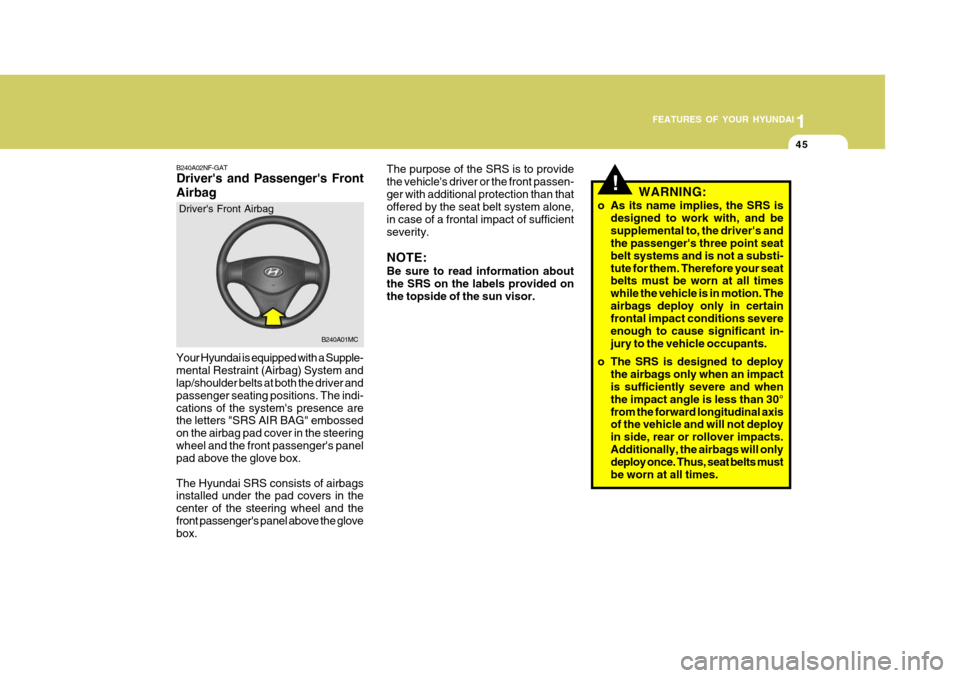
B240A01MC
Driver's Front Airbag
Your Hyundai is equipped with a Supple- mental Restraint (Airbag) System and lap/shoulder belts at both the driver and passenger seating positions. The indi-cations of the system's presence are the letters "SRS AIR BAG" embossed on the airbag pad cover in the steeringwheel and the front passenger's panel pad above the glove box. The Hyundai SRS consists of airbags installed under the pad covers in the center of the steering wheel and thefront passenger's panel above the glove box. B240A02NF-GAT Driver's and Passenger's Front Airbag
!
The purpose of the SRS is to provide the vehicle's driver or the front passen-ger with additional protection than that offered by the seat belt system alone, in case of a frontal impact of sufficientseverity. NOTE: Be sure to read information about the SRS on the labels provided onthe topside of the sun visor.
WARNING:
o As its name implies, the SRS is designed to work with, and besupplemental to, the driver's and the passenger's three point seat belt systems and is not a substi-tute for them. Therefore your seat belts must be worn at all times while the vehicle is in motion. Theairbags deploy only in certain frontal impact conditions severe enough to cause significant in-jury to the vehicle occupants.
o The SRS is designed to deploy the airbags only when an impact is sufficiently severe and when the impact angle is less than 30°from the forward longitudinal axis of the vehicle and will not deploy in side, rear or rollover impacts.Additionally, the airbags will only deploy once. Thus, seat belts must be worn at all times.
Page 58 of 284
1FEATURES OF YOUR HYUNDAI
46
o Do not allow children to ride in the
front passenger seat. If older chil- dren (teenagers and older) must ride in the front seat, make surethey are always properly belted and that the seat is moved back as far as possible.
o For maximum safety protection in all types of crashes, all occupantsincluding the driver should alwayswear their seat belts whether or not an airbag is also provided at their seating position to minimize the risk of severe injury or death in the event of a crash. Do not sit orlean unnecessarily close to the airbag while the vehicle is in mo- tion.
o The SRS airbag system must de- ploy very rapidly to provide pro-tection in a crash. If an occupant isout of position because of not wearing a seat belt, the airbag may forcefully contact the occupantcausing serious or fatal injuries.o No objects should be placed overor near the airbag modules on the steering wheel, instrument panel,and the front passenger's panel above the glove box, because any such object could cause harmif the vehicle is in a crash severe enough to cause the airbags to deploy.
o If the airbags deploy, they must be replaced by an authorized Hyundaidealer.
o Do not tamper with or disconnect SRS wiring, or other componentsof the SRS system. Doing so could result in injury, due to acci- dental firing of the airbags or byrendering the SRS inoperative.
o Do not install a child restraint sys-
tem in the front passenger seatposition. A child restraint system must never be placed in the front seat. The infant or child could beseverely injured or killed by an airbag deployment in case of an accident.
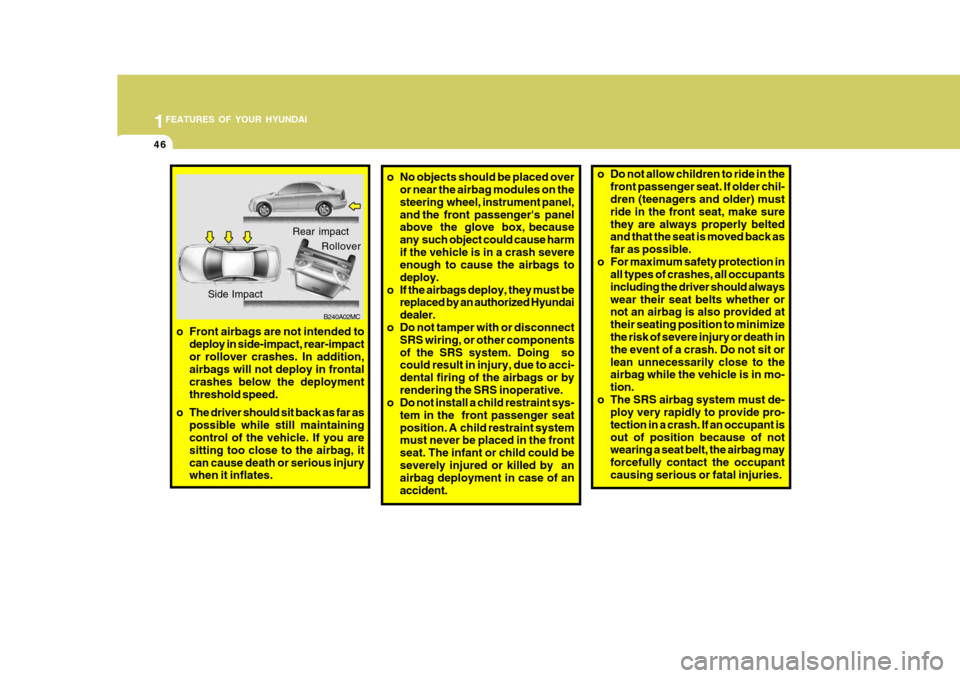
o Front airbags are not intended todeploy in side-impact, rear-impact or rollover crashes. In addition, airbags will not deploy in frontal crashes below the deploymentthreshold speed.
o The driver should sit back as far as possible while still maintaining control of the vehicle. If you are sitting too close to the airbag, itcan cause death or serious injury when it inflates.
B240A02MC
Rear impact
Side Impact Rollover
Page 60 of 284
1FEATURES OF YOUR HYUNDAI
48
!WARNING:
o When the SRS is activated, there may be a loud noise and fine dust will be released throughout the vehicle. These conditions are nor- mal and are not hazardous. How-ever, the fine dust generated dur- ing airbag deployment may cause skin irritation. Wash your handsand face thoroughly with lukewarm water and a mild soap after an accident in which the airbags weredeployed.
Passenger's Front Airbag
B240B05L
!CAUTION:
When installing a container of liquid air freshener inside the vehicle, do not place it near the instrument clus- ter nor on the instrument panel sur-face. If there is any leakage from the air freshener onto these areas (in- strument cluster, instrument panelor air ventilator), it may damage these parts. If the liquid from the air fresh- ener does leak onto these areas,wash them with water immediately.
Passenger's Front Airbag
B240B01MC
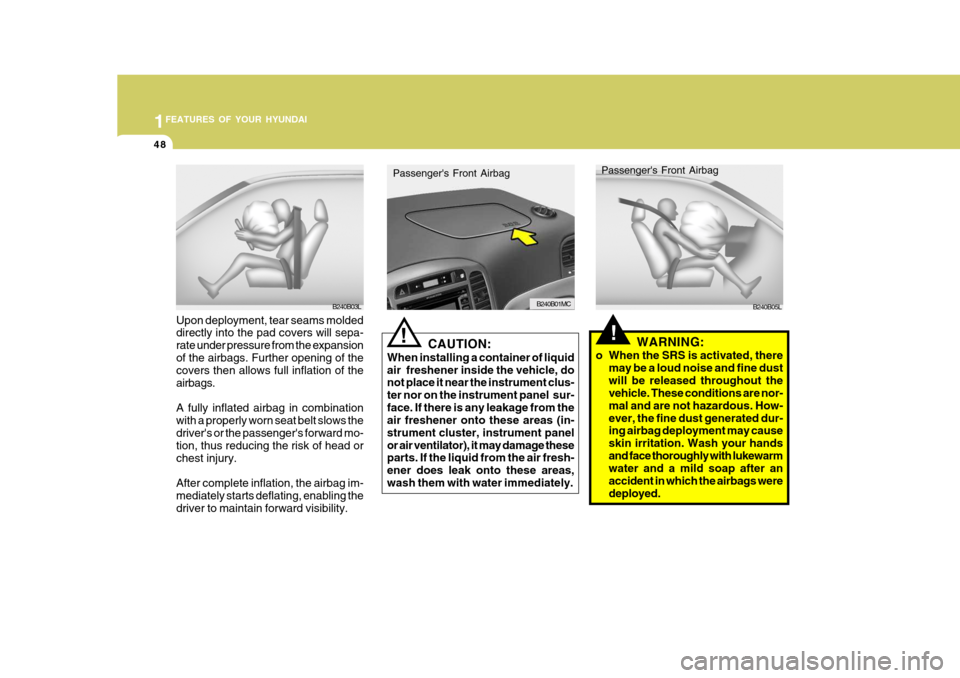
Upon deployment, tear seams molded directly into the pad covers will sepa- rate under pressure from the expansionof the airbags. Further opening of the covers then allows full inflation of the airbags. A fully inflated airbag in combination with a properly worn seat belt slows thedriver's or the passenger's forward mo- tion, thus reducing the risk of head or chest injury. After complete inflation, the airbag im- mediately starts deflating, enabling thedriver to maintain forward visibility.B240B03L
Page 62 of 284

1FEATURES OF YOUR HYUNDAI
50
o If the SRS airbag warning lightdoes not illuminate when the igni- tion key is turned to the "ON" position, or if it illuminates while the vehicle is being driven, havean authorized Hyundai dealer in- spect the passenger's front airbag ON/OFF switch, pre-tensioner seatbelt and the SRS airbag system as soon as possible.
! CAUTION:
o If the passenger's front airbag ON/ OFF switch is not working prop- erly, the SRS warning light on the instrument panel will illuminate.And, the passenger's front airbag OFF indicator will not illuminate, the SRSCM(SRS Control Module)reactivate the passenger's front airbag and the passenger's front airbag will inflate in frontal impactcrashes even if the passenger's front airbag ON/OFF switch is set to "OFF" position.If this occurs, have an authorized Hyundai dealer inspect the passenger's front airbag ON/OFFswitch, the pre-tensioner seat belt system and the SRS airbag sys- tem as soon as possible.
To deactivate or reactivate the passenger's front airbag To deactivate the passenger's front airbag, insert the ignition key into the passenger's front airbag ON/OFF switch on the right side of the crash pad andturn it to the "OFF" position. The passenger's front airbag OFF indicator will illuminate and stay on until thepassenger's front airbag is reactivated. To reactivate the passenger's front airbag, insert the ignition key into the passenger's front airbag ON/OFF switch and turn it to the "ON" position. The passenger's front airbag OFF indicator will go out.
Page 63 of 284
1
FEATURES OF YOUR HYUNDAI
51
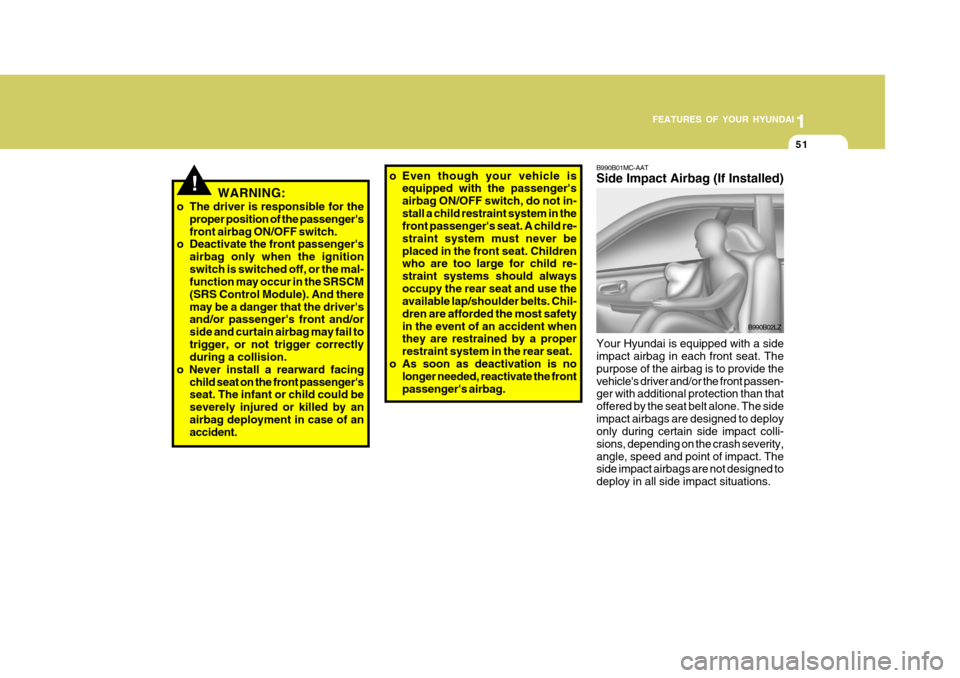
B990B01MC-AAT Side Impact Airbag (If Installed) Your Hyundai is equipped with a side impact airbag in each front seat. The purpose of the airbag is to provide thevehicle's driver and/or the front passen- ger with additional protection than that offered by the seat belt alone. The sideimpact airbags are designed to deploy only during certain side impact colli- sions, depending on the crash severity,angle, speed and point of impact. The side impact airbags are not designed to deploy in all side impact situations.
B990B02LZ
o Even though your vehicle is equipped with the passenger's airbag ON/OFF switch, do not in-stall a child restraint system in the front passenger's seat. A child re- straint system must never beplaced in the front seat. Children who are too large for child re- straint systems should alwaysoccupy the rear seat and use the available lap/shoulder belts. Chil- dren are afforded the most safetyin the event of an accident when they are restrained by a proper restraint system in the rear seat.
o As soon as deactivation is no longer needed, reactivate the frontpassenger's airbag.!WARNING:
o The driver is responsible for the proper position of the passenger's front airbag ON/OFF switch.
o Deactivate the front passenger's
airbag only when the ignitionswitch is switched off, or the mal- function may occur in the SRSCM (SRS Control Module). And theremay be a danger that the driver's and/or passenger's front and/or side and curtain airbag may fail totrigger, or not trigger correctly during a collision.
o Never install a rearward facing
child seat on the front passenger'sseat. The infant or child could be severely injured or killed by anairbag deployment in case of an accident.
Page 64 of 284
1FEATURES OF YOUR HYUNDAI
52
!o Use of seat covers could reduce or
prevent the effectiveness of the system.
o Do not install any accessories on the side or near the side impactairbag.
o Do not use excessive force on the side of the seat.
o Do not place any objects over the
airbag or between the airbag and yourself.
o Do not place any objects (an um-
brella, bag, etc.) between the frontdoor and the front seat. Such ob- jects may become dangerous pro-jectiles and cause injury if the supplemental side impact airbag inflates.
o To prevent unexpected deploy- ment of the side impact air bagthat may result in personal injury,avoid impact to the side impact airbag sensor when the ignition key is on.
WARNING:
o The side impact airbag is supple- mental to the driver's and the passenger's seat belt systems and is not a substitute for them. There-fore your seat belts must be worn at all times while the vehicle is in motion.The airbags deploy only in certain side impact conditions severe enough to cause significant injuryto the vehicle occupants.
o For best protection from the side
impact airbag system and to avoid being injured by the deploying side impact airbag, both front seatoccupants should sit in an upright position with the seat belt proper- ly fastened. The driver's handsshould be placed on the steering wheel at the 9:00 and 3:00 o'clock positions. The passenger's armsand hands should be placed on their laps.
o Do not use any accessory seat covers.
B990B01MC
Side airbag sensor
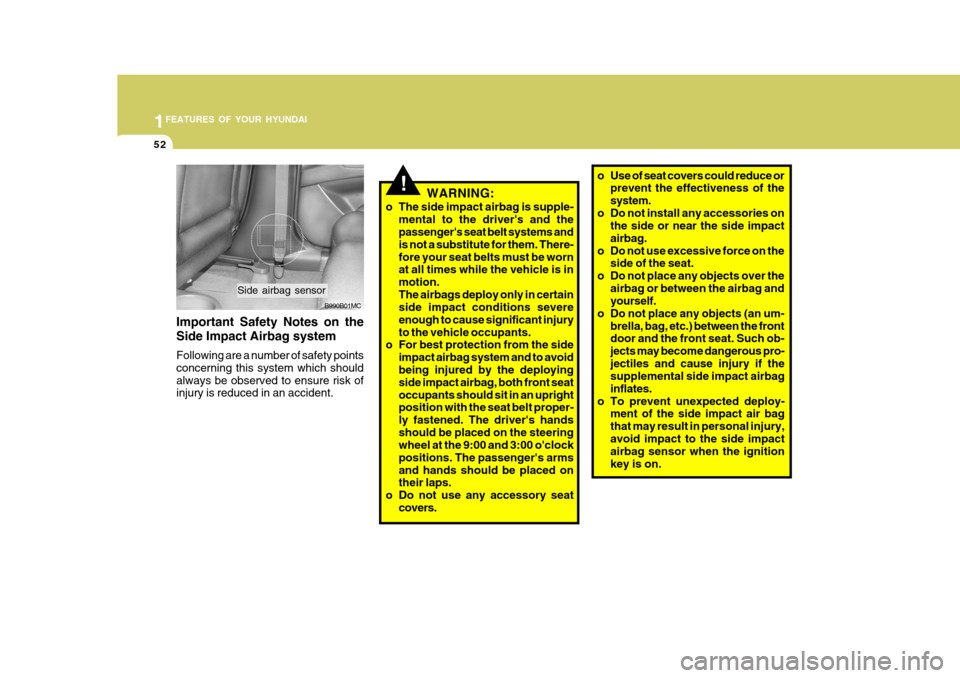
Important Safety Notes on the Side Impact Airbag system Following are a number of safety points concerning this system which shouldalways be observed to ensure risk of injury is reduced in an accident.
Page 69 of 284

1
FEATURES OF YOUR HYUNDAI
57
1. Tachometer
2. Turn Signal Indicator Lights
3. High Beam Indicator Light
4. Automatic Transaxle Position Indicator Light (If Installed)
5. Odometer/Trip Odometer/Trip Computer (If Installed)
6. Overdrive Off Indicator Light (Automatic Transaxle only)
7. Speedometer
8. Fuel Filter Warning Light (Diesel only)
9. Diesel Pre-heat Indicator Light (Diesel only)
10. Passenger's Front Airbag OFF Indicator Light (If Installed)
11. Over Speed Warning Light (If Installed)
12. Door Ajar Warning Light
13. Charging System Warning Light 14. Parking Brake/Low Brake Fluid Level Warning Light
15. SRS (Airbag) Warning Light (If Installed)
16. Seat Belt Warning Light
17. Fuel Gauge
18. Engine Coolant Temperature Warning Light
19. Low Oil Pressure Warning Light
20. Low Fuel Warning Light
21. Immobilizer Warning Light (If Installed)
22. Trunk Lid/Tail Gate Open Warning Light
23. Malfunction Indicator Light (MIL) (If Installed)
24. Electronic Power Steering Warning Light (If Installed)
25. ABS Service Reminder Indicator Light (If Installed)
26. Electronic Stability Program (ESP) Indicator Lights
(If Installed)