ABS Hyundai Accent 2011 Owner's Manual - RHD (UK. Australia)
[x] Cancel search | Manufacturer: HYUNDAI, Model Year: 2011, Model line: Accent, Model: Hyundai Accent 2011Pages: 232, PDF Size: 8.41 MB
Page 10 of 232

YOUR VEHICLE AT A GLANCE
F10B255A03MC-DAT INDICATOR SYMBOLS ON THE INSTRUMENT CLUSTER * More detailed explanations of these items will be found begining on page 1-50.
Turn Signal Indicator Lights
SRS (Airbag) Service Reminder Indicator O/D OFF Indicator Light (Automatic transaxle only) High Beam Indicator Light
Low Oil Pressure Warning Light
ABS Service Reminder Indicator (If Installed)
Door Ajar Warning Light
Hand Brake/Low Brake Fluid Level Warning Light Charging System Warning Light Low Fuel Level Warning Light Malfunction Indicator Light
Immobiliser Warning Light
Boot Lid/Tail Gate Open Warning Light
Engine Coolant Temperature Warning Light Seat Belt Warning Light
Electronic Stability Program Indicator Lights (If Installed)
Automatic Transaxle Position Indicator Light (If Installed)
Page 38 of 232
1
FEATURES OF YOUR HYUNDAI
27
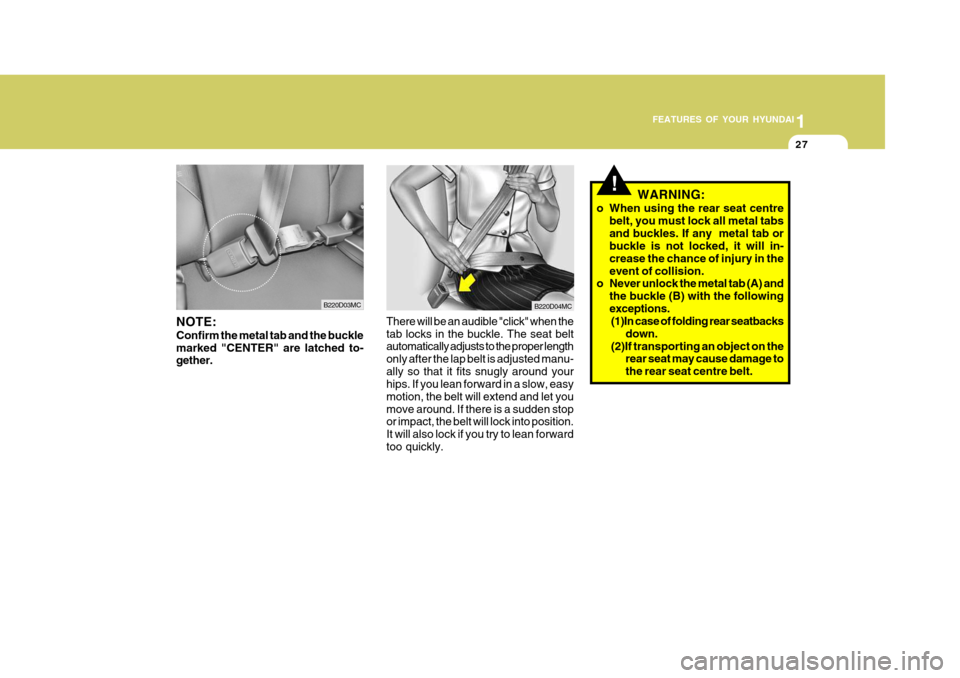
NOTE: Confirm the metal tab and the buckle marked "CENTER" are latched to- gether.
B220D03MC
!
There will be an audible "click" when the tab locks in the buckle. The seat belt automatically adjusts to the proper length only after the lap belt is adjusted manu-ally so that it fits snugly around your hips. If you lean forward in a slow, easy motion, the belt will extend and let youmove around. If there is a sudden stop or impact, the belt will lock into position. It will also lock if you try to lean forwardtoo quickly. WARNING:
o When using the rear seat centre belt, you must lock all metal tabsand buckles. If any metal tab or buckle is not locked, it will in- crease the chance of injury in theevent of collision.
o Never unlock the metal tab (A) and
the buckle (B) with the followingexceptions.(1)In case of folding rear seatbacks
down.
(2)If transporting an object on the rear seat may cause damage tothe rear seat centre belt.
B220D04MC
Page 43 of 232
1FEATURES OF YOUR HYUNDAI
32
!
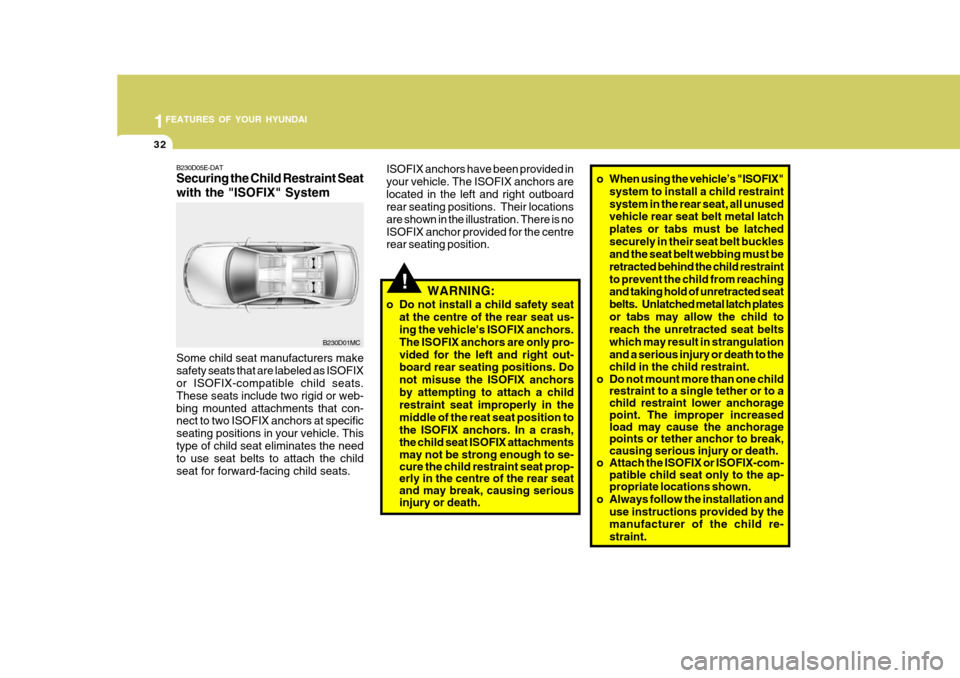
Some child seat manufacturers make safety seats that are labeled as ISOFIX or ISOFIX-compatible child seats. These seats include two rigid or web-bing mounted attachments that con- nect to two ISOFIX anchors at specific seating positions in your vehicle. Thistype of child seat eliminates the need to use seat belts to attach the child seat for forward-facing child seats. WARNING:
o Do not install a child safety seat at the centre of the rear seat us- ing the vehicle's ISOFIX anchors. The ISOFIX anchors are only pro-vided for the left and right out- board rear seating positions. Do not misuse the ISOFIX anchorsby attempting to attach a child restraint seat improperly in the middle of the reat seat position tothe ISOFIX anchors. In a crash,
the child seat ISOFIX attachments may not be strong enough to se- cure the child restraint seat prop- erly in the centre of the rear seat and may break, causing serious injury or death. o When using the vehicle’s "ISOFIX"
system to install a child restraint system in the rear seat, all unused vehicle rear seat belt metal latch plates or tabs must be latchedsecurely in their seat belt buckles and the seat belt webbing must be retracted behind the child restraintto prevent the child from reaching and taking hold of unretracted seat
belts. Unlatched metal latch platesor tabs may allow the child to reach the unretracted seat belts which may result in strangulationand a serious injury or death to the child in the child restraint.
o Do not mount more than one child restraint to a single tether or to a child restraint lower anchorage
point. The improper increased load may cause the anchorage points or tether anchor to break, causing serious injury or death.
o Attach the ISOFIX or ISOFIX-com-
patible child seat only to the ap- propriate locations shown.
o Always follow the installation and
use instructions provided by the manufacturer of the child re- straint.
B230D05E-DAT
Securing the Child Restraint Seat
with the "ISOFIX" System
B230D01MC
ISOFIX anchors have been provided in your vehicle. The ISOFIX anchors arelocated in the left and right outboard rear seating positions. Their locations are shown in the illustration. There is noISOFIX anchor provided for the centre rear seating position.
Page 58 of 232

1
FEATURES OF YOUR HYUNDAI
47
1. Tachometer
2. Turn Signal Indicator Lights
3. High Beam Indicator Light
4. Automatic Transaxle Position Indicator Light (If Installed)
5. Odometer/Trip Odometer/Trip Computer (If Installed)
6. Overdrive Off Indicator Light (Automatic Transaxle only)
7. Speedometer
8. Door Ajar Warning Light
9. Charging System Warning Light
10. Hand Brake/Low Brake Fluid Level Warning Light 11. SRS (Airbag) Warning Light
12. Seat Belt Warning Light
13. Fuel Gauge
14. Engine Coolant Temperature Warning Light
15. Low Oil Pressure Warning Light
16. Low Fuel Warning Light
17. Immobiliser Warning Light
18. Boot Lid/Tail Gate Open Warning Light
19. Malfunction Indicator Light (MIL)
20. ABS Service Reminder Indicator Light (If Installed) 21. Electronic Stability Program (ESP) Indicator Lights
(If Installed)
Page 60 of 232

1
FEATURES OF YOUR HYUNDAI
49
1. Tachometer
2. Turn Signal Indicator Lights
3. Low Oil Pressure Warning Light
4. Automatic Transaxle Position Indicator Light (If Installed)
5. Odometer/Trip Odometer
6. SRS (Airbag) Warning Light
7. Malfunction Indicator Light (MIL)
8. Speedometer
9. Door Ajar Warning Light
10. Charging System Warning Light 11. Hand Brake/Low Brake Fluid Level Warning Light
12. Seat Belt Warning Light
13. High Beam Indicator Light
14. Fuel Gauge
15. Engine Coolant Temperature Warning Light
16. Overdrive Off Indicator Light (Automatic Transaxle only)
17. Low Fuel Warning Light
18. Immobiliser Warning Light
19. Boot Lid/Tail Gate Open Warning Light
20. ABS Service Reminder Indicator Light (If Installed) 21. Electronic Stability Program (ESP) Indicator Lights
(If Installed)
Page 61 of 232
1FEATURES OF YOUR HYUNDAI
50
!
WARNING AND INDICATOR LIGHTS
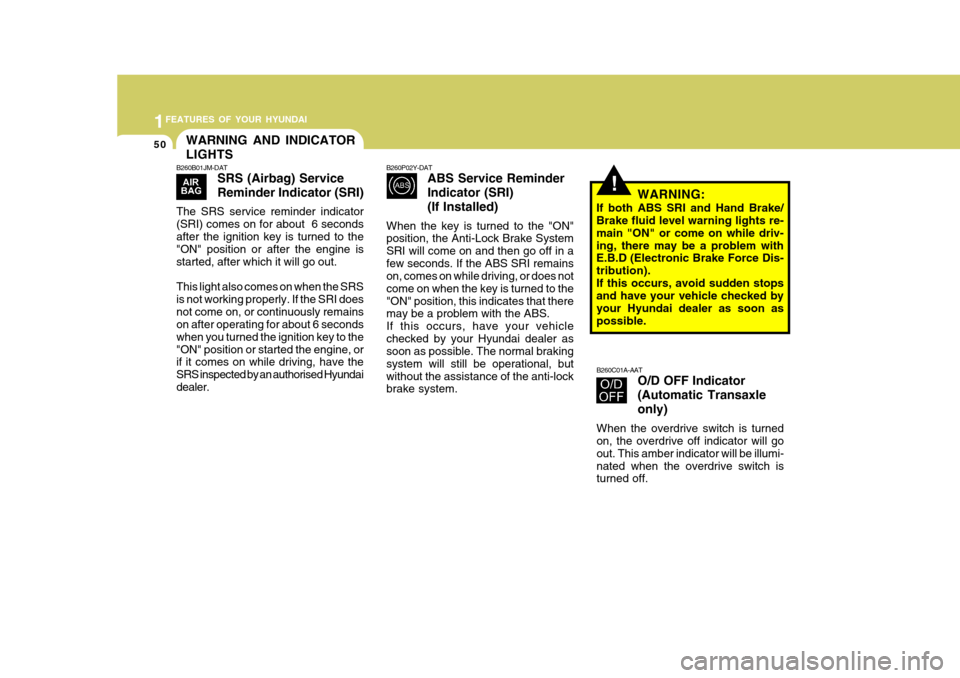
B260C01A-AATO/D OFF Indicator(Automatic Transaxleonly)
When the overdrive switch is turned on, the overdrive off indicator will go out. This amber indicator will be illumi-nated when the overdrive switch is turned off.
B260P02Y-DAT ABS Service Reminder Indicator (SRI)(If Installed)
When the key is turned to the "ON" position, the Anti-Lock Brake System SRI will come on and then go off in afew seconds. If the ABS SRI remains on, comes on while driving, or does not come on when the key is turned to the"ON" position, this indicates that there may be a problem with the ABS. If this occurs, have your vehiclechecked by your Hyundai dealer as soon as possible. The normal braking system will still be operational, butwithout the assistance of the anti-lock brake system. WARNING:
If both ABS SRI and Hand Brake/Brake fluid level warning lights re- main "ON" or come on while driv-ing, there may be a problem with E.B.D (Electronic Brake Force Dis- tribution).If this occurs, avoid sudden stops and have your vehicle checked by your Hyundai dealer as soon aspossible.B260B01JM-DAT SRS (Airbag) Service Reminder Indicator (SRI)
The SRS service reminder indicator (SRI) comes on for about 6 secondsafter the ignition key is turned to the "ON" position or after the engine is started, after which it will go out. This light also comes on when the SRS is not working properly. If the SRI doesnot come on, or continuously remains on after operating for about 6 seconds when you turned the ignition key to the"ON" position or started the engine, or if it comes on while driving, have the SRS inspected by an authorised Hyundaidealer.
Page 128 of 232
2
Engine Exhaust can be Dangerous! ............................. 2-2
Before Starting the Engine ............................................ 2-3
Key Position ................................................................. 2-4Starting ......................................................................... 2-5
Operating the Manual Transaxle .................................. 2-6
Automatic Transaxle ..................................................... 2-8Anti-lock Brake System (ABS) .................................... 2-12
Electronic Stability Program (ESP) ..............................2-12
Rear Parking Assist System ....................................... 2-13
Good Braking Practices .............................................. 2-16
Driving for Economy .................................................... 2-17
Smooth Cornering ........................................................ 2-18
Winter Driving .............................................................. 2-19
Trailer or Vehicle Towing ............................................. 2-21
DRIVING YOUR HYUNDAI
2
Page 139 of 232
2 DRIVING YOUR HYUNDAI
12ANTI-LOCK BRAKE SYSTEMELECTRONIC STABILITY PROGRAM (ESP)
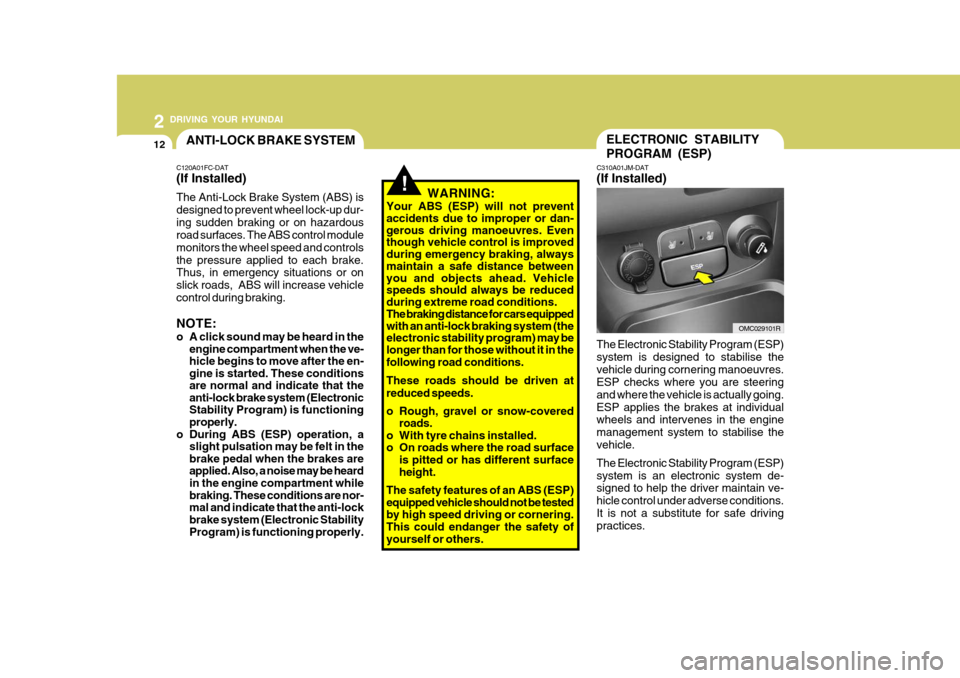
C310A01JM-DAT (If Installed)
OMC029101R
The Electronic Stability Program (ESP) system is designed to stabilise thevehicle during cornering manoeuvres. ESP checks where you are steering and where the vehicle is actually going.ESP applies the brakes at individual wheels and intervenes in the engine management system to stabilise thevehicle. The Electronic Stability Program (ESP) system is an electronic system de- signed to help the driver maintain ve- hicle control under adverse conditions.It is not a substitute for safe driving practices.
!WARNING:
Your ABS (ESP) will not prevent accidents due to improper or dan- gerous driving manoeuvres. Even though vehicle control is improved during emergency braking, always maintain a safe distance between you and objects ahead. Vehicle speeds should always be reduced during extreme road conditions. The braking distance for cars equipped
with an anti-lock braking system (the
electronic stability program) may be
longer than for those without it in the following road conditions. These roads should be driven at reduced speeds.
o Rough, gravel or snow-covered
roads.
o With tyre chains installed.
o On roads where the road surface is pitted or has different surface height.
The safety features of an ABS (ESP) equipped vehicle should not be testedby high speed driving or cornering.This could endanger the safety of yourself or others.
C120A01FC-DAT(If Installed) The Anti-Lock Brake System (ABS) is designed to prevent wheel lock-up dur-ing sudden braking or on hazardous road surfaces. The ABS control module monitors the wheel speed and controlsthe pressure applied to each brake. Thus, in emergency situations or on slick roads, ABS will increase vehiclecontrol during braking. NOTE:
o A click sound may be heard in the
engine compartment when the ve- hicle begins to move after the en-gine is started. These conditionsare normal and indicate that theanti-lock brake system (ElectronicStability Program) is functioning properly.
o During ABS (ESP) operation, a slight pulsation may be felt in the brake pedal when the brakes areapplied. Also, a noise may be heardin the engine compartment while braking. These conditions are nor- mal and indicate that the anti-lockbrake system (Electronic Stability Program) is functioning properly.
Page 142 of 232

2
DRIVING YOUR HYUNDAI
15
2
DRIVING YOUR HYUNDAI
15
CAUTION:
1. The rear parking assist warning may not sound sequentially de- pending on the speed and shapesof the objects detected.
2. The rear parking assist system
may malfunction if the vehiclebumper height or sensor installa- tion has been modified or dam- aged. Any non-factory installedequipment or accessories may also interfere with the sensor per- formance.
3. The sensor may not recognise objects less than 15 in. (40 cm)from the sensor, or it may sensean incorrect distance. Use cau- tion.
4. When the sensor is frozen or stained with snow, dirt, or water,the sensor may be inoperative until the stains are removed using asoft cloth.
5. Do not push, scratch or strike the
sensor. Sensor damage couldoccur.
!
4. Objects generating excessive noise
(vehicle horns, loud motorcycle en- gines, or truck air brakes) are within range of the sensor.
5. Heavy rain or water spray exists.
6. Wireless transmitters or mobile phones are within range of the sen-sor.
7. The sensor is covered with snow. 8. Trailer towing The detecting range may decrease when: 1. The sensor is stained with foreign matter such as snow or water. (The sensing range will return to normal when removed.)
2. Outside air temperature is extremely hot or cold.
The following objects may not be recognised by the sensor: 1. Sharp or slim objects such as ropes, chains or small poles.
2. Objects which tend to absorb the
sensor frequency such as clothes,spongy material or snow.
3. Undetectable objects smaller than 1
m (40 in.) and narrower than 14 cm (6in.) in diameter. CAUTION:
This system can only sense objects within the range and location of the sensors; It can not detect objects inother areas where sensors are not installed. Also, small or slim ob- jects, such as poles or objects lo-cated between sensors may not be detected by the sensors. Always visually check behind thevehicle when backing up. Be sure to inform any drivers of the vehicle that may be unfamiliar withthe system regarding the systems capabilities and limitations. Your new vehicle warranty does notcover any accidents or damage to the vehicle or its occupants due to a rear parking assist system malfunc-tion. Always drive safely and cau- tiously.!
Page 169 of 232
44CORROSION PREVENTION AND APPEARANCE CARE
4WASHING AND WAXING
Don't use strong household detergents, petrol, strong solvents or abrasive clean-ing powders as these may damage the finish. Use a clean lambs wool mitt or a cloth,rinse it frequently and don't damage the finish by rubbing too hard. For stubborn spots, dampen them frequently andremove them a little at a time. To clean whitewall tyres, use a stiff brush or soap-impregnated steel-woolscouring pad. To clean plastic wheel covers, use a clean sponge or soft cloth and water. To clean cast aluminum alloy wheels, use a mild soap or neutral detergent. Do not use abrasive cleaners. Protect the bare-metal surfaces by cleaning,polishing and waxing. Because alumi- num is subject to corrosion, be sure to give aluminum alloy wheels specialattention in winter. If you drive on salted roads, clean the wheels thor- oughly afterwards. After washing, be sure to rinse thor- oughly. If soapy water dries on thefinish, streaking will result. When the weather is warm and thehumidity low, you may find it necessaryto rinse each section immediately after washing to avoid streaking. After rinsing, dry the car using a damp chamois or soft, absorbent cloth. The reason for drying the car is to removewater from the car so it will dry without water spots. Don't rub, this can dam- age the finish. If you find any nicks or scratches in the paint, use touch-up paint to cover themto prevent corrosion. To protect the paintwork of the car against corrosion, you must clean your Hyundai (at leastonce a month). Give special attention to the removal of salt, mud and other substances on the underside of thesplashboards of the car. Make sure that the outlets and the underside of the doors are open. Paint damage canbe caused by small accumulation of tar, industrial precipitation, tree resin, insects and bird droppings, when notremoved immediately. If water alone is not strong enough to remove the accu- mulated dirt, use a mild car washingsolution. Be sure to rinse the surface after washing to remove the solution.
E030A02A-DAT Washing Your Hyundai Never wash your car when the surface is hot from being in the sun. Alwayswash your car in the shade. Wash your car frequently. Dirt is abra- sive and can scratch the paint if it is not removed. Air pollution or acid rain may damage the paint and trim throughchemical action if pollutants are al- lowed to remain in contact with the surface. If you live near the ocean or inan area where road salts or dust control chemicals are used, you should pay particular attention to the underside ofthe car. Start by rinsing the car to remove dust and loose dirt. In winter, or if you have driven through mud or muddywater, be sure to thoroughly clean the underside as well. Use a hard direct stream of water to remove accumula-tions of mud or corrosive materials. Use a good quality car-washing solu- tion and follow the manufacturer's di-rections on the package. These are available at your Hyundai dealer or auto parts outlet.