warning Hyundai Accent 2011 Owners Manual
[x] Cancel search | Manufacturer: HYUNDAI, Model Year: 2011, Model line: Accent, Model: Hyundai Accent 2011Pages: 282, PDF Size: 14.82 MB
Page 169 of 282
13
DRIVING YOUR HYUNDAI
2
!
o If your vehicle becomes stuck in
snow, mud, sand, etc., then you may
attempt to rock the vehicle free by
moving it forward and backward. Do
not attempt this procedure if people
or objects are anywhere near the
vehicle. During the rocking opera-
tion the vehicle may suddenly move
forward or backward as it becomes
unstuck, causing injury to nearby
people or damage to objects.
WARNING:
!
WARNING:
ABS will not prevent accidents due to
improper or dangerous driving maneu-
vers. Even though vehicle control is
improved during emergency braking,
always maintain a safe distance be-
tween you and objects ahead. Vehicle
speeds should always be reduced dur-
ing extreme road conditions.
The braking distance for cars equipped
with an anti-lock braking system may
be longer than for those without it in the
following road conditions.
During these conditions the veicle
should be driven at reduced speeds.
o Rough, gravel or snow-covered
roads.
o With tire chains installed.
o On roads where the road surface is
pitted or has different surface height.
These roads should be driven at re-
duced speeds. The safety features of
an ABS equipped vehicle should not be
tested by high speed driving or corner-
ing. This could endanger the safety of
yourself or others.
ANTI-LOCK BRAKE SYS-
TEMC120A01MC-AAT(If Installed)The Anti-Lock Brake System (ABS) is
designed to prevent wheel lock-up dur-
ing sudden braking or on hazardous road
surfaces. The ABS control module moni-
tors the wheel speed and controls the
pressure applied to each brake. Thus, in
emergency situations or on slick roads,
ABS will increase vehicle control during
braking.NOTE:o A click sound may be heard in the
engine compartment when the ve-
hicle begins to move after the engine
is started. These conditions are nor-
mal and indicate that the anti-lock
brake system is functioning prop-
erly.
o During ABS operation, a slight pulsa-
tion may be felt in the brake pedal
when the brakes are applied. Also, a
noise may be heard in the engine
compartment while braking. These
conditions are normal and indicate
that the anti-lock brake system is
functioning properly.
Page 170 of 282
2
DRIVING YOUR HYUNDAI
14
o After being parked, check to be sure
the parking brake is not engaged and
that the parking brake indicator light is
out before driving away.
o Driving through water may get the
brakes wet. They can also get wet
when the car is washed. Wet brakes
can be dangerous! Your car will not
stop as quickly if the brakes are wet.
Wet brakes may cause the car to pull
to one side. To dry the brakes, apply
the brakes lightly until the braking ac-
tion returns to normal, taking care to
keep the car under control at all times.
If the braking action does not return to
normal, stop as soon as it is safe to do
so and call your Hyundai dealer for
assistance.
o Don't coast down hills with the car out
of gear. This is extremely hazardous.
Keep the car in gear at all times, use
the brakes to slow down, then shift to
a lower gear so that engine braking
will help you maintain a safe speed.
o Don't "ride" the brake pedal. Resting
your foot on the brake pedal while
driving can be dangerous because it
can result in the brakes overheating
and losing their effectiveness. It also
increases the wear of the brake com-
ponents.o If a tire goes flat while you are driving,
apply the brakes gently and keep the
car pointed straight ahead while you
slow down. When you are moving
slowly enough for it to be safe to do so,
pull off the road and stop in a safe
place.
o If your car is equipped with an auto-
matic transaxle, don't let your car creep
forward. To avoid creeping forward,
keep your foot firmly on the brake pedal
when the car is stopped.
o Use caution when parking on a hill.
Firmly engage the parking brake and
place the gear selector lever in "P"
(automatic transaxle) or in first or re-
verse gear (manual transaxle). If your
car is facing downhill, turn the front
wheels into the curb to help keep the
car from rolling. If your car is facing
uphill, turn the front wheels away from
the curb to help keep the car from
rolling. If there is no curb or if it is
required by other conditions to keep
the car from rolling, block the wheels.
GOOD BRAKING PRACTICES!
C130A02A-AAT
WARNING:
o Whenever leaving vehicle or park-
ing, always set the parking brake as
far as possible and fully engage the
vehicle's transaxle into the P (Park)
position (automatic transaxle) or in
first or reverse (manual transaxle).
Vehicles not fully engaged in P (Park)
with the parking brake set are at risk
for moving inadvertently and injuring
yourself or others.
o All vehicles should always have the
parking brake fully engaged when
parking to avoid inadvertent move-
ment of the car which can injure
occupants or pedestrians.
o Nothing should be carried on top of
the shelf panel behind the rear seat.
If there were an accident or a sudden
stop, such objects could move for-
ward and cause damage to the ve-
hicle or injure the occupants.
Page 175 of 282
19
DRIVING YOUR HYUNDAI
2
!
!
USE OF LIGHTSC180A01A-AATCheck your lights regularly for correct
operation and always keep them clean.
When driving during the day in conditions
of poor visibility, it is helpful to drive with
headlights on low beam. This enables
you to be seen, as well as to see.
HIGHER SPEED MOTORINGC170A02A-AATPre-Trip Inspections1. Tires:
Adjust the tire inflation pressures for high-
way driving. Low tire inflation pressures
will result in overheating and possible
failure of the tires.
Avoid using worn or damaged tires which
may result in reduced traction or tire fail-
ure.NOTE:Never exceed the maximum tire infla-
tion pressure shown on the tires.
WARNING:
o Underinflated or overinflated tires
can cause poor handling, loss of ve-
hicle control, and sudden tire failure
leading to accidents, injuries, and
even death. Always check tires are
properly inflated before driving. Refer
to pages 2-20 and 8-3 for proper tire
pressures and further information.2. Fuel, engine coolant and engine oil:
High speed travel consumes more fuel
than urban motoring. Do not forget to
check both engine coolant and engine
oil.
3. Drive belt:
A loose or damaged drive belt may result
in overheating of the engine. o Driving on tires with no or insuffi-
cient tread is dangerous. Worn-out
tires can result in loss of vehicle
control, collisions, injury, and even
death. Worn-out tires should be re-
placed as soon as possible and
should never be used for driving.
Always check tire tread before driv-
ing your car. Refer to 8-12 for further
information and tread limits.
WARNING:
Page 180 of 282
2
DRIVING YOUR HYUNDAI
24
!
WARNING:
o Never exceed the GVWR for your
vehicle, the GAWR for either the
front or rear axle and vehicle ca-
pacity weight. Exceeding these
ratings can cause an accident or
vehicle damage. You can calcu-
late the weight of your load by
weighing the items (or people)
before putting them in the ve-
hicle. Be careful not to overload
your vehicle.
o Do not load your vehicle any
heavier than the GVWR, either the
maximum front or rear GAWR
and vehicle capacity weight. If
you do, parts, including tires on
your vehicle can break, and it can
change the way your vehicle
handles and braking ability. This
could cause you to lose control
and crash. Also, overloading can
shorten the life of your vehicle. This label also tells you the maximum
weights that can be supported by the
front and rear axles, called Gross Axle
Weight Rating (GAWR). To find out the
actual loads on your front and rear
axles, you need to go to a weigh
station and weigh your vehicle. Your
dealer can help you with this. Be sure
to spread out your load equally on the
left and right sides of the centerline.
!
WARNING:
o Overloading your vehicle can
cause heat buildup in your
vehicle's tires and possible tire
failure that could lead to a crash.
o Overloading your vehicle can
cause increased stopping dis-
tances that could lead to a crash.
o A crash resulting from poor han-
dling vehicle damage, tire failure,
or increased stopping dis-
tances could result in serious
injury or death.
Page 181 of 282
25
DRIVING YOUR HYUNDAI
2
NOTE:
o Overloading your vehicle may
cause damage. Repairs would not
be covered by your warranty. Do
not overload your vehicle.
o Using heavier suspension com-
ponents to get added durability
might not change your weight
ratings. Ask your dealer to help
you load your vehicle the right
way.
The label will help you decide how
much cargo and installed equipment
your vehicle can carry.
If you carry items inside your vehicle
– like suitcases, tools, packages, or
anything else – they move as fast as
the vehicle goes. If you have to stop or
turn quickly, or if there is a crash, the
items will keep going and can cause
an injury if they strike the driver or a
passenger.
!
WARNING:
Items you carry inside your vehicle
can strike and injure people in a
sudden stop or turn, or in a crash.
o Put things in the cargo area of
your vehicle. Try to spread the
weight evenly.
o Never stack items, like suitcases,
inside the vehicle above the tops
of the seats.
o Do not leave an unsecured child
restraint in your vehicle.
o When you carry something in-
side the vehicle, secure it.
o Do not drive with a seat folded
down unless necessary.
Page 183 of 282
32WHAT TO DO IN AN EMERGENCY
IF THE ENGINE WILL NOT
START!
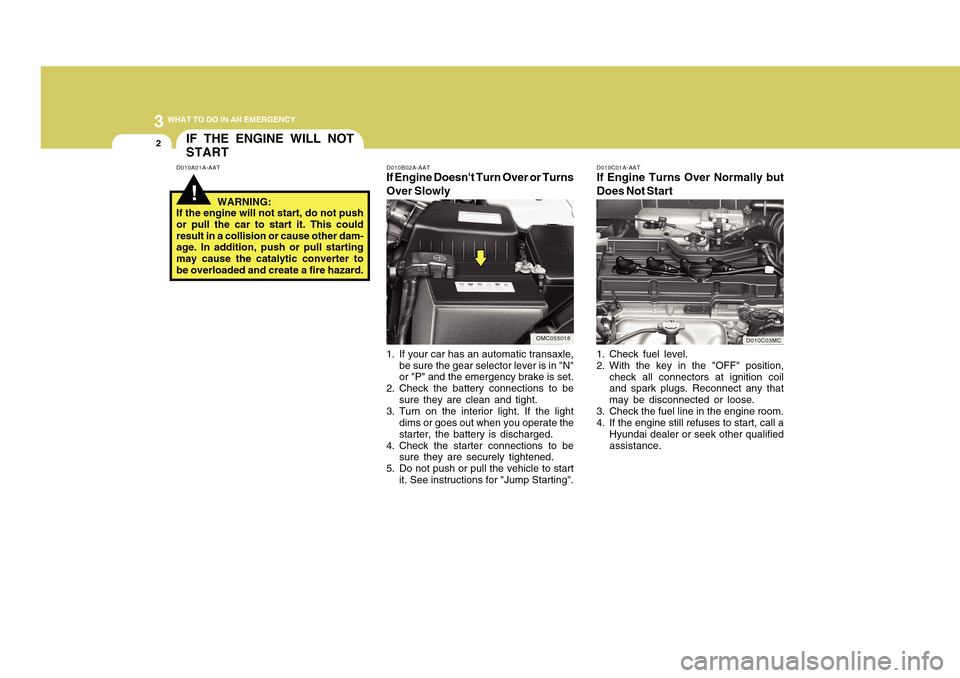
D010B02A-AATIf Engine Doesn't Turn Over or Turns
Over Slowly
D010A01A-AATD010C01A-AAT
If Engine Turns Over Normally but
Does Not Start1. Check fuel level.
2. With the key in the "OFF" position,
check all connectors at ignition coil
and spark plugs. Reconnect any that
may be disconnected or loose.
3. Check the fuel line in the engine room.
4. If the engine still refuses to start, call a
Hyundai dealer or seek other qualified
assistance. WARNING:
If the engine will not start, do not push
or pull the car to start it. This could
result in a collision or cause other dam-
age. In addition, push or pull starting
may cause the catalytic converter to
be overloaded and create a fire hazard.
1. If your car has an automatic transaxle,
be sure the gear selector lever is in "N"
or "P" and the emergency brake is set.
2. Check the battery connections to be
sure they are clean and tight.
3. Turn on the interior light. If the light
dims or goes out when you operate the
starter, the battery is discharged.
4. Check the starter connections to be
sure they are securely tightened.
5. Do not push or pull the vehicle to start
it. See instructions for "Jump Starting".
OMC055018
D010C03MC
Page 184 of 282
3
WHAT TO DO IN AN EMERGENCY
3
JUMP STARTING
D010D01A-AATIf the Engine Stalls While Driving1. Reduce your speed gradually, keep-
ing a straight line. Move cautiously off
the road to a safe place.
2. Turn on your emergency flashers.
3. Try to start the engine again. If your
vehicle will not start, contact a Hyundai
dealer or seek other qualified assis-
tance.
!
D020A02A-AAT
WARNING:
The gas produced by the battery during
the jump-start operation is highly ex-
plosive. If these instructions are not
followed exactly, serious personal in-
jury and damage to the vehicle may
occur! If you are not sure how to follow
this procedure, seek qualified assis-
tance. Automobile batteries contain sul-
furic acid. This is poisonous and highly
corrosive. When jump starting, wear
protective glasses and be careful not to
get acid on yourself, your clothing or on
the car.
D020A02MC
o If you should accidentally get acid on
your skin or in your eyes, immediately
remove any contaminated clothing
and flush the area with clear water for
at least 15 minutes. Then promptly
obtain medical attention. If you must
be transported to an emergency facil-
ity, continue to apply water to the af-
fected area with a sponge or cloth.
o The gas produced by the battery dur-
ing the jump-start operation is highly
explosive. Do not smoke or allow a
spark or open flame in the vicinity.
o The battery being used to provide the
jump start must be 12-volt. If you can-
not determine that it is a 12-volt bat-
tery, do not attempt to use it for the
jump start.
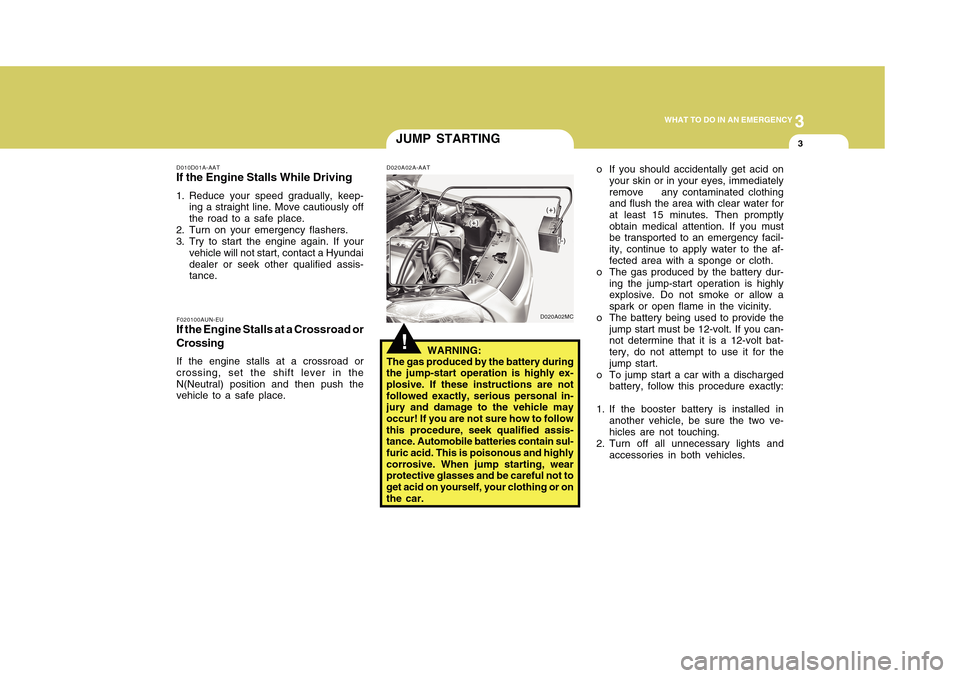
o To jump start a car with a discharged
battery, follow this procedure exactly:
1. If the booster battery is installed in
another vehicle, be sure the two ve-
hicles are not touching.
2. Turn off all unnecessary lights and
accessories in both vehicles.
F020100AUN-EUIf the Engine Stalls at a Crossroad or
CrossingIf the engine stalls at a crossroad or
crossing, set the shift lever in the
N(Neutral) position and then push the
vehicle to a safe place.
Page 186 of 282
3
WHAT TO DO IN AN EMERGENCY
5
!!
WARNING:
While the engine is running, keep hands,
long hair and clothing away from mov-
ing parts such as the fan and drive belts
to prevent injury.
5. If the water pump drive belt is broken
or coolant is leaking out, stop the en-
gine immediately and call the nearest
Hyundai dealer for assistance.
WARNING:
Do not remove the radiator cap when
the engine is hot. This may result in
coolant being blown out of the opening
and cause serious burns.
!
6. If you cannot find the cause of the
overheating, wait until the engine tem-
perature has returned to normal. Then,
if coolant has been lost, carefully add
water to the reservoir (Page 6-8) to
bring the fluid level in the reservoir up
to the halfway mark.
7. Proceed with caution, keeping alert for
further signs of overheating. If over-
heating happens again, call a Hyundai
dealer for assistance.
CAUTION:
Serious loss of coolant indicates there
is a leak in the cooling system and this
should be checked as soon as possible
by a Hyundai dealer.
TIRE PRESSURE MONITOR-
ING SYSTEM (TPMS)
C320A01TG C320A01MC-AAT
(If Installed)
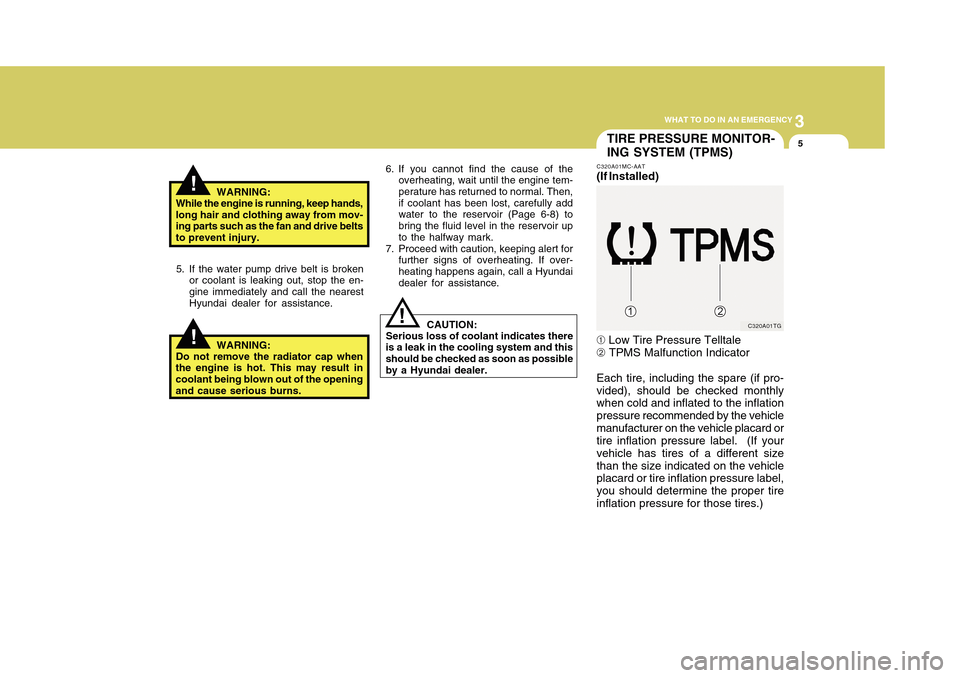
➀ Low Tire Pressure Telltale
➁ TPMS Malfunction Indicator
Each tire, including the spare (if pro-
vided), should be checked monthly
when cold and inflated to the inflation
pressure recommended by the vehicle
manufacturer on the vehicle placard or
tire inflation pressure label. (If your
vehicle has tires of a different size
than the size indicated on the vehicle
placard or tire inflation pressure label,
you should determine the proper tire
inflation pressure for those tires.)
Page 187 of 282
36WHAT TO DO IN AN EMERGENCY
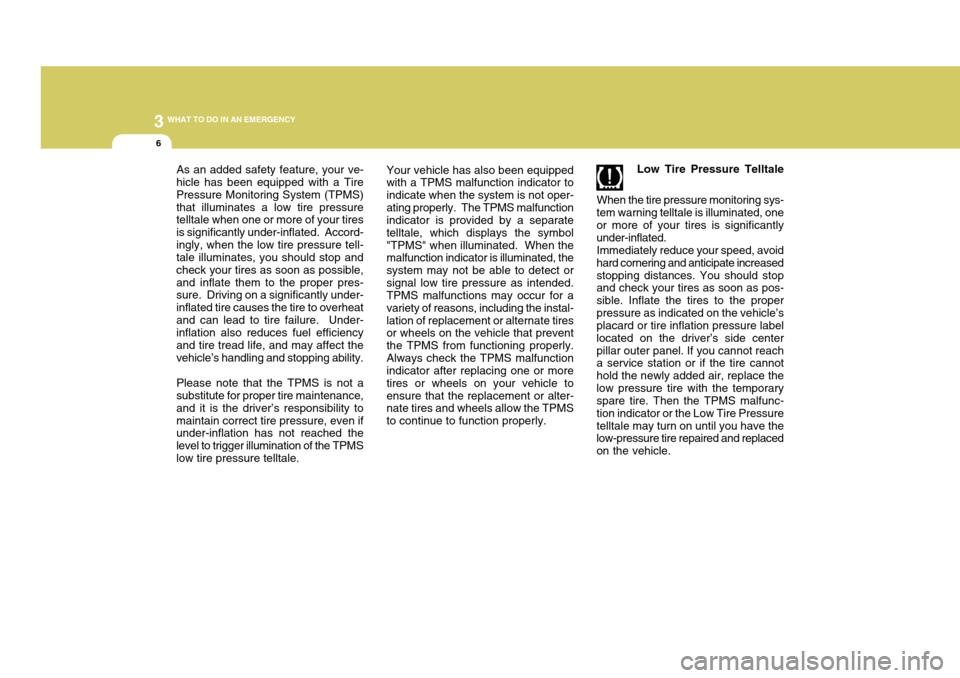
Low Tire Pressure Telltale
When the tire pressure monitoring sys-
tem warning telltale is illuminated, one
or more of your tires is significantly
under-inflated.
Immediately reduce your speed, avoid
hard cornering and anticipate increased
stopping distances. You should stop
and check your tires as soon as pos-
sible. Inflate the tires to the proper
pressure as indicated on the vehicle’s
placard or tire inflation pressure label
located on the driver’s side center
pillar outer panel. If you cannot reach
a service station or if the tire cannot
hold the newly added air, replace the
low pressure tire with the temporary
spare tire. Then the TPMS malfunc-
tion indicator or the Low Tire Pressure
telltale may turn on until you have the
low-pressure tire repaired and replaced
on the vehicle.
As an added safety feature, your ve-
hicle has been equipped with a Tire
Pressure Monitoring System (TPMS)
that illuminates a low tire pressure
telltale when one or more of your tires
is significantly under-inflated. Accord-
ingly, when the low tire pressure tell-
tale illuminates, you should stop and
check your tires as soon as possible,
and inflate them to the proper pres-
sure. Driving on a significantly under-
inflated tire causes the tire to overheat
and can lead to tire failure. Under-
inflation also reduces fuel efficiency
and tire tread life, and may affect the
vehicle’s handling and stopping ability.
Please note that the TPMS is not a
substitute for proper tire maintenance,
and it is the driver’s responsibility to
maintain correct tire pressure, even if
under-inflation has not reached the
level to trigger illumination of the TPMS
low tire pressure telltale.Your vehicle has also been equipped
with a TPMS malfunction indicator to
indicate when the system is not oper-
ating properly. The TPMS malfunction
indicator is provided by a separate
telltale, which displays the symbol
"TPMS" when illuminated. When the
malfunction indicator is illuminated, the
system may not be able to detect or
signal low tire pressure as intended.
TPMS malfunctions may occur for a
variety of reasons, including the instal-
lation of replacement or alternate tires
or wheels on the vehicle that prevent
the TPMS from functioning properly.
Always check the TPMS malfunction
indicator after replacing one or more
tires or wheels on your vehicle to
ensure that the replacement or alter-
nate tires and wheels allow the TPMS
to continue to function properly.
Page 188 of 282
3
WHAT TO DO IN AN EMERGENCY
7
!
CAUTION:
In winter or cold weather, the low
tire pressure telltale may be illumi-
nated if the tire pressure was ad-
justed to the recommended tire in-
flation pressure in warm weather. It
does not mean your TPMS is mal-
functioning because the decreased
temperature leads to a proportional
lowering of tire pressure.
When you drive your vehicle from a
warm area to a cold area or from a
cold area to a warm area, or the
outside temperature is greatly
higher or lower, you should check
the tire inflation pressure and ad-
just the tires to the recommended
tire inflation pressure.
WARNING:
Significantly low tire pressure
makes the vehicle unstable and can
contribute to loss of vehicle control
and increased braking distances.
Continued driving on low pressure
tires will cause the tires to overheat
and fail.
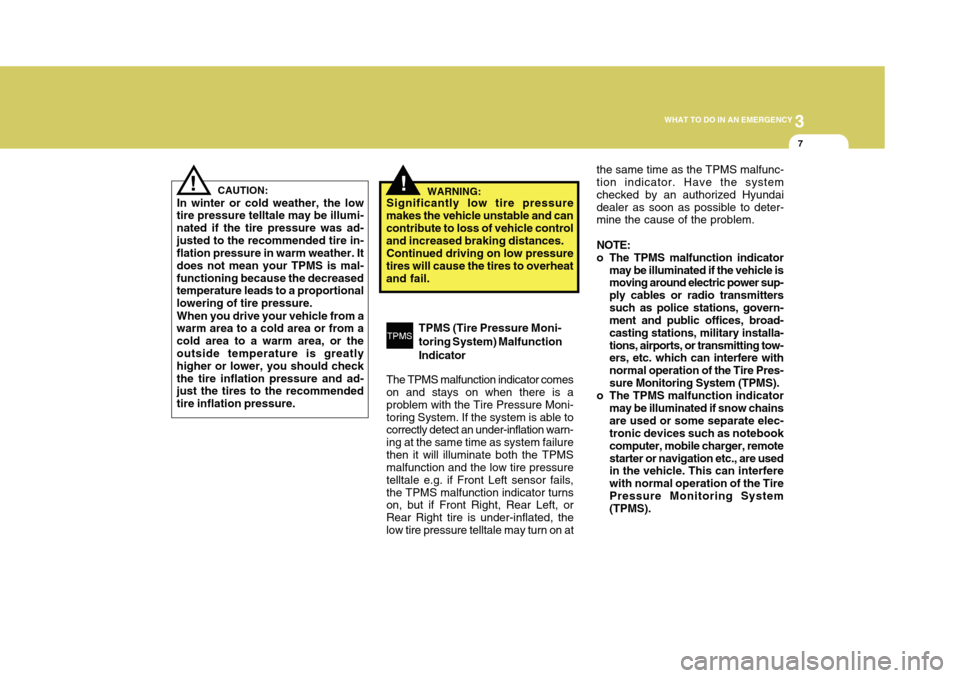
TPMS (Tire Pressure Moni-
toring System) Malfunction
Indicator
The TPMS malfunction indicator comes
on and stays on when there is a
problem with the Tire Pressure Moni-
toring System. If the system is able to
correctly detect an under-inflation warn-
ing at the same time as system failure
then it will illuminate both the TPMS
malfunction and the low tire pressure
telltale e.g. if Front Left sensor fails,
the TPMS malfunction indicator turns
on, but if Front Right, Rear Left, or
Rear Right tire is under-inflated, the
low tire pressure telltale may turn on at
!
the same time as the TPMS malfunc-
tion indicator. Have the system
checked by an authorized Hyundai
dealer as soon as possible to deter-
mine the cause of the problem.
NOTE:
o The TPMS malfunction indicator
may be illuminated if the vehicle is
moving around electric power sup-
ply cables or radio transmitters
such as police stations, govern-
ment and public offices, broad-
casting stations, military installa-
tions, airports, or transmitting tow-
ers, etc. which can interfere with
normal operation of the Tire Pres-
sure Monitoring System (TPMS).
o The TPMS malfunction indicator
may be illuminated if snow chains
are used or some separate elec-
tronic devices such as notebook
computer, mobile charger, remote
starter or navigation etc., are used
in the vehicle. This can interfere
with normal operation of the Tire
Pressure Monitoring System
(TPMS).