brake Hyundai Accent 2011 User Guide
[x] Cancel search | Manufacturer: HYUNDAI, Model Year: 2011, Model line: Accent, Model: Hyundai Accent 2011Pages: 282, PDF Size: 14.82 MB
Page 114 of 282
1
FEATURES OF YOUR HYUNDAI
1031
FEATURES OF YOUR HYUNDAI
103
!
WARNING:
o Pay particular attention to the driv-
ing conditions whenever using the
cruise control system.
o Be careful when driving downhill
using the cruise control system,
which may increase the vehicle
speed.
!
CAUTION:
During cruise-speed driving of a manual
transaxle vehicle, do not shift into neu-
tral without depressing the clutch pedal,
since the engine will be overrevved. If
this happens, depress the clutch pedal
or release the cruise control ON/OFF
switch.NOTE:During normal cruise control operation,
when the -/SET switch is activated or
reactivated after applying the brakes,
the cruise control will energize after ap-
proximately 3 seconds. This delay is
normal.
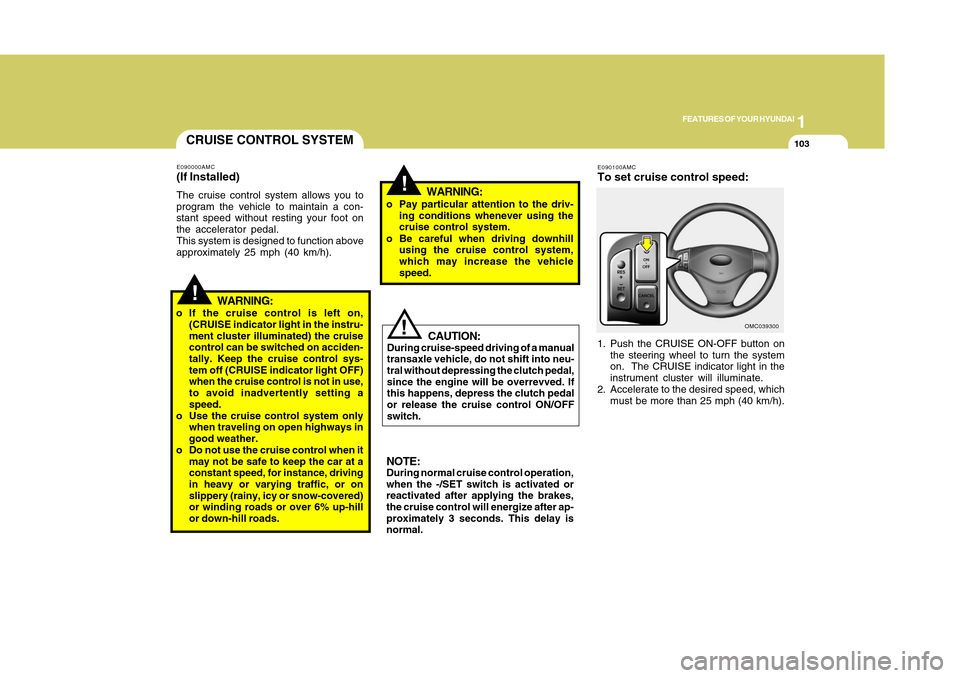
E090100AMCTo set cruise control speed:1. Push the CRUISE ON-OFF button on
the steering wheel to turn the system
on. The CRUISE indicator light in the
instrument cluster will illuminate.
2. Accelerate to the desired speed, which
must be more than 25 mph (40 km/h).
OMC039300
CRUISE CONTROL SYSTEME090000AMC(If Installed)The cruise control system allows you to
program the vehicle to maintain a con-
stant speed without resting your foot on
the accelerator pedal.
This system is designed to function above
approximately 25 mph (40 km/h).
!
WARNING:
o If the cruise control is left on,
(CRUISE indicator light in the instru-
ment cluster illuminated) the cruise
control can be switched on acciden-
tally. Keep the cruise control sys-
tem off (CRUISE indicator light OFF)
when the cruise control is not in use,
to avoid inadvertently setting a
speed.
o Use the cruise control system only
when traveling on open highways in
good weather.
o Do not use the cruise control when it
may not be safe to keep the car at a
constant speed, for instance, driving
in heavy or varying traffic, or on
slippery (rainy, icy or snow-covered)
or winding roads or over 6% up-hill
or down-hill roads.
Page 116 of 282
1
FEATURES OF YOUR HYUNDAI
1051
FEATURES OF YOUR HYUNDAI
105
E090500AMCTo cancel cruise control, do one of
the following:o Press the brake pedal.
o Press the clutch pedal with a manual
transaxle.
o Shift into N (Neutral) with an automatic
transaxle.
o Press the CANCEL switch located on
the steering wheel.
o Decrease the vehicle speed lower than
the memory speed by 9 mph (15 km/h).
o Decrease the vehicle speed to less
than approximately 25 mph (40 km/h).
OMC039303 E090400AUN
To temporarily accelerate with the
cruise control on:If you want to speed up temporarily when
the cruise control is on, depress the ac-
celerator pedal. Increased speed will not
interfere with cruise control operation or
change the set speed.
To return to the set speed, take your foot
off the accelerator.
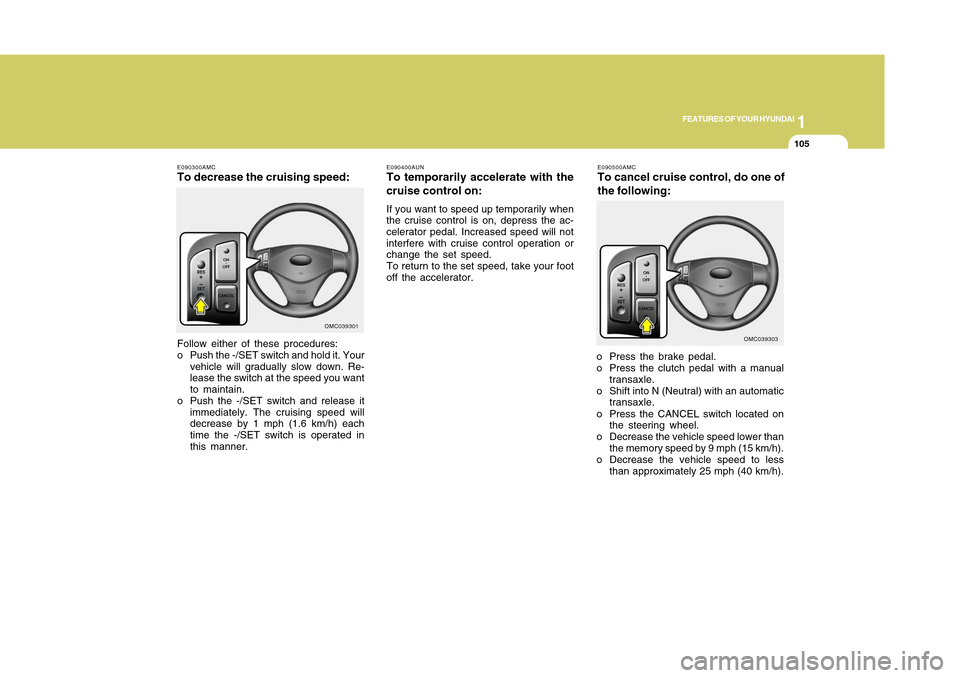
E090300AMCTo decrease the cruising speed:Follow either of these procedures:
o Push the -/SET switch and hold it. Your
vehicle will gradually slow down. Re-
lease the switch at the speed you want
to maintain.
o Push the -/SET switch and release it
immediately. The cruising speed will
decrease by 1 mph (1.6 km/h) each
time the -/SET switch is operated in
this manner.
OMC039301
Page 157 of 282
Engine Exhaust can be Dangerous! ............................. 2-2
Before Starting the Engine ............................................ 2-3
Key Positions ................................................................ 2-4
Starting..........................................................................2-5
Operating the Manual Transaxle ................................... 2-6
Automatic Transaxle ..................................................... 2-9
Anti-Lock Brake System.............................................2-13
Good Braking Practices..............................................2-14
Driving for Economy...................................................2-15
Winter Driving.............................................................2-16
Trailer Towing.............................................................2-20
Vehicle Load Limit.......................................................2-20
DRIVING YOUR HYUNDAI
2
2
Page 159 of 282
3
DRIVING YOUR HYUNDAI
2
!
BEFORE STARTING THE
ENGINEC020A03A-AATBefore you start the engine, you should
always:
1. Look around the vehicle to be sure
there are no flat tires, puddles of oil or
water or other indications of possible
trouble.
2. After entering the car, check to be
sure the parking brake is engaged.
3. Check that all windows, and lights are
clean.
4. Check that the interior and exterior
mirrors are clean and in position.
5. Check your seat, seatback and head-
rest to be sure they are in their proper
positions.
6. Lock all the doors.
7. Fasten your seat belt and be sure that
all other occupants have fastened
theirs.
8. Turn off all lights and accessories that
are not needed.
9. When you turn the ignition switch to
"ON", check that all appropriate warn-
ing lights are operating and that you
have sufficient fuel.
10. Check the operation of warning lights
and all bulbs when key is in the "ON"
position.
CALIFORNIA PROPOSITION
65 WARNING:
Engine exhaust and a wide variety of
automobile components and parts, in-
cluding components found in the inte-
rior furnishings in a vehicle, contain or
emit chemicals known to the State of
California to cause cancer and birth
defects and reproductive harm. In addi-
tion, certain fluids contained in vehicles
and certain products of component
wear contain or emit chemicals known
to the State of California to cause can-
cer and birth defects or other reproduc-
tive harm.
!
WARNING:
o Always wear appropriate shoes
when operating your vehicle. Unsuit-
able shoes (high heels, ski boots,
etc.) may interfere with your ability
to use the brake and accelerator
pedal, and the clutch (if installed).
o All passengers must be properly
belted whenever the vehicle is mov-
ing. Refer to pages: 1-22 through 1-
31 for more information on their
proper use.
o Always check the surrounding ar-
eas near your vehicle for people,
especially children, before putting a
car into 'drive'.
o When you intend to park or stop the
vehicle with the engine on, be careful
not to depress the accelerator pedal
for a long period of time. It may over-
heat the engine or exhaust system
and cause fire.
Page 162 of 282
2
DRIVING YOUR HYUNDAI6
!
NOTE:o To shift into reverse, rest the lever
in neutral for at least 3 seconds after
your car is completely stopped. Then
move the lever into the reverse po-
sition.
o During cold weather, shifting may be
difficult until the transaxle lubricant
has warmed up. This is normal and
not harmful to the transaxle.
o If you've come to a complete stop
and it's hard to shift into 1
st or
R(Reverse), put the shift lever in
N(Neutral) position and release the
clutch. Press the clutch pedal back
down, and then shift into 1st or
R(Reverse) gear position.
o Do not use the shift lever as a
handrest during driving, as this can
result in premature wear of the
transaxle shift forks.
OPERATING THE MANUAL
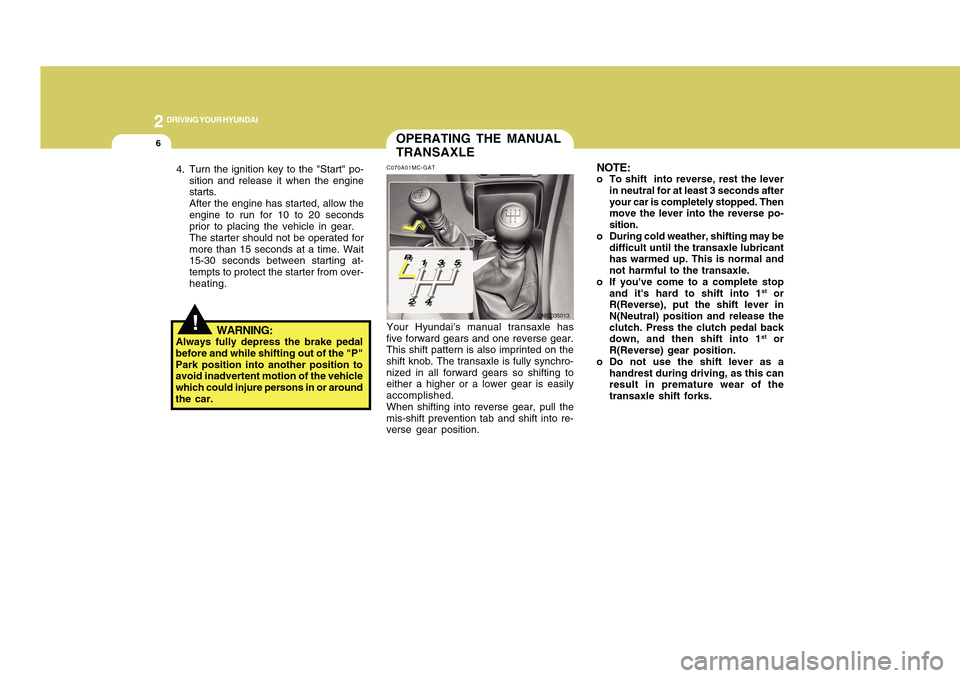
TRANSAXLEC070A01MC-GATYour Hyundai's manual transaxle has
five forward gears and one reverse gear.
This shift pattern is also imprinted on the
shift knob. The transaxle is fully synchro-
nized in all forward gears so shifting to
either a higher or a lower gear is easily
accomplished.
When shifting into reverse gear, pull the
mis-shift prevention tab and shift into re-
verse gear position.
OMC035013
4. Turn the ignition key to the "Start" po-
sition and release it when the engine
starts.
After the engine has started, allow the
engine to run for 10 to 20 seconds
prior to placing the vehicle in gear.
The starter should not be operated for
more than 15 seconds at a time. Wait
15-30 seconds between starting at-
tempts to protect the starter from over-
heating.
WARNING:
Always fully depress the brake pedal
before and while shifting out of the "P"
Park position into another position to
avoid inadvertent motion of the vehicle
which could injure persons in or around
the car.
Page 163 of 282
7
DRIVING YOUR HYUNDAI
2
!
CAUTION:
o Do not downshift more than 2 gears
or downshift the gear when the en-
gine is running at high speed (5,000
RPM or higher). Such downshifting
may damage the engine.
o When downshifting from fifth gear to
fourth gear, caution should be taken
not to inadvertently press the gear
shift lever sideways in such a man-
ner that second gear is engaged.
Such a drastic downshift may cause
the engine speed to increase to the
point that the tachometer will enter
the red zone. Such over revving of
the engine may possibly cause en-
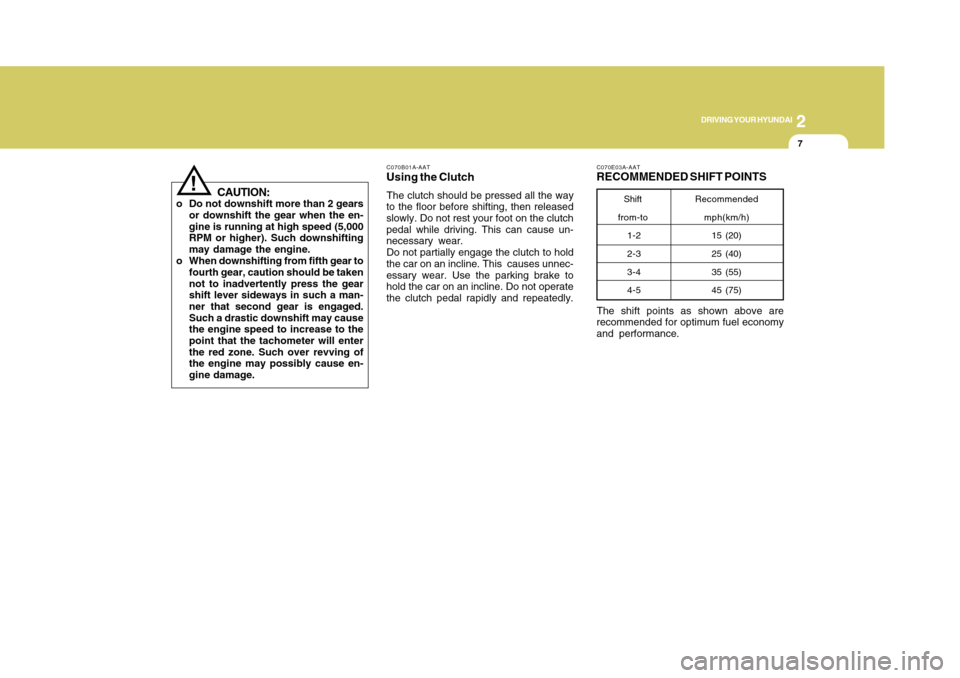
gine damage.The shift points as shown above are
recommended for optimum fuel economy
and performance.
C070E03A-AATRECOMMENDED SHIFT POINTS
C070B01A-AATUsing the ClutchThe clutch should be pressed all the way
to the floor before shifting, then released
slowly. Do not rest your foot on the clutch
pedal while driving. This can cause un-
necessary wear.
Do not partially engage the clutch to hold
the car on an incline. This causes unnec-
essary wear. Use the parking brake to
hold the car on an incline. Do not operate
the clutch pedal rapidly and repeatedly.
Shift
from-toRecommended
mph(km/h)
15 (20)
25 (40)
35 (55)
45 (75) 1-2
2-3
3-4
4-5
Page 164 of 282
2
DRIVING YOUR HYUNDAI8
!
o Exercise extreme caution when driv-
ing on a slippery surface. Be espe-
cially careful when braking, accelerat-
ing or shifting gears. On a slippery
surface, an abrupt change in vehicle
speed can cause the drive wheels to
lose traction and the vehicle to go out
of control.
WARNING:
o Always buckle-up! In a collision, an
unbelted occupant is significantly
more likely to be seriously injured or
killed than a properly belted occu-
pant.
o Avoid high speeds when cornering
or turning.
o Do not make quick steering wheel
movements, such as sharp lane
changes or fast, sharp turns.
o The risk of rollover is greatly in-
creased if you lose control of your
vehicle at highway speeds.
o Loss of control often occurs if two or
more wheels drop off the roadway
and the driver oversteers to reenter
the roadway.
o In the event your vehicle leaves the
roadway, do not steer sharply. In-
stead, slow down before pulling back
into the travel lanes.
o Never exceed posted speed limits.
C070D03O-AATGood Driving Practiceso Never take the car out of gear and
coast down a hill. This is extremely
hazardous. Always leave the car in
gear.
o Don't "ride" the brakes. This can cause
them to overheat and malfunction. In-
stead, when you are driving down a
long hill, slow down and shift to a lower
gear. When you do this, engine brak-
ing will help slow the car.
o Slow down before shifting to a lower
gear. This will help avoid over-revving
the engine, which can cause damage.
o Slow down when you encounter cross
winds. This gives you much better
control of your car.
o Be sure the car is completely stopped
before you attempt to shift into reverse.
The transaxle can be damaged if you
do not. To shift into reverse, depress
the clutch, move the shift lever to neu-
tral, wait three seconds, then shift to
the reverse position.
Page 165 of 282
9
DRIVING YOUR HYUNDAI
2
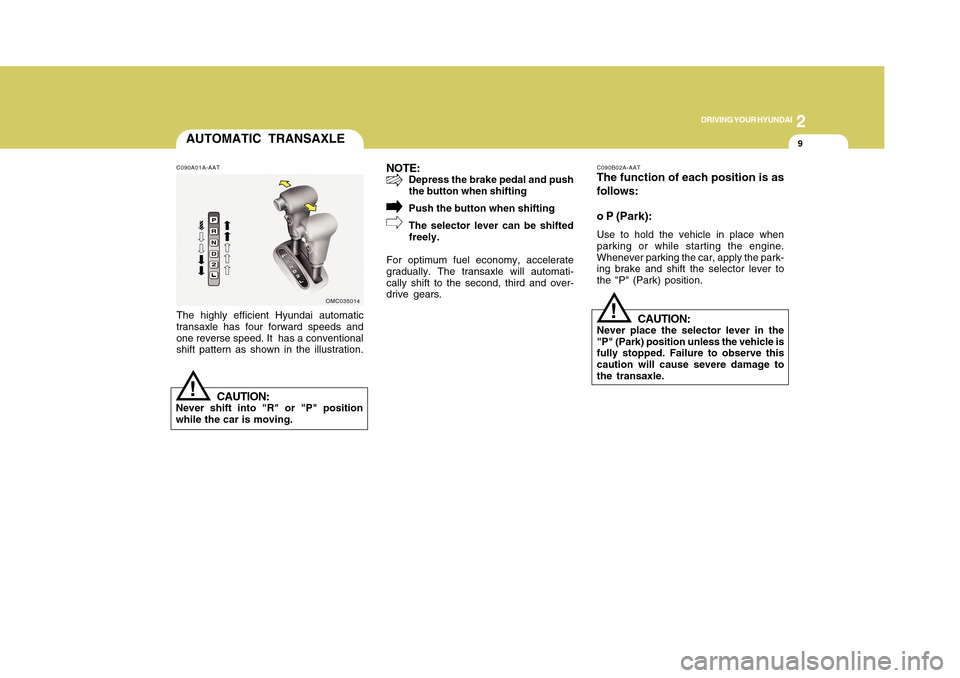
AUTOMATIC TRANSAXLEC090A01A-AATThe highly efficient Hyundai automatic
transaxle has four forward speeds and
one reverse speed. It has a conventional
shift pattern as shown in the illustration.
OMC035014
CAUTION:
Never shift into "R" or "P" position
while the car is moving.
!
NOTE:
Depress the brake pedal and push
the button when shifting
Push the button when shifting
The selector lever can be shifted
freely.
For optimum fuel economy, accelerate
gradually. The transaxle will automati-
cally shift to the second, third and over-
drive gears.
C090B02A-AATThe function of each position is as
follows:
o P (Park):Use to hold the vehicle in place when
parking or while starting the engine.
Whenever parking the car, apply the park-
ing brake and shift the selector lever to
the "P" (Park) position.
CAUTION:
Never place the selector lever in the
"P" (Park) position unless the vehicle is
fully stopped. Failure to observe this
caution will cause severe damage to
the transaxle.
!
Page 166 of 282
2
DRIVING YOUR HYUNDAI
10
C090H01A-AATNOTE:o For smooth and safe operation, de-
press the brake pedal when shifting
from "Neutral" position or "Park"
position to a forward or reverse gear.
o The ignition key must be in the "ON"
position and the brake pedal fully
depressed in order to move the shift
lever from the "P" (Park) position to
any of the other positions.
o It is always possible to shift from
"R", "N", "D", "2", "L" position to "P"
position.
C090G01A-AATo L (Low gear):Use for driving up a very steep grade or
for engine braking when descending
steep hills. When downshifting to "L", the
transaxle will temporarily remain in sec-
ond gear until the vehicle has slowed
enough for low gear to engage. Do not
exceed 31 mph (50 km/h) in low gear.C090F01A-AATo 2 (Second gear):Use for driving on a slippery road, hill
climbing or engine braking downhill. "2"
automatically shifts between first and
second gears.
This means that no shift-up to 3rd gear is
performed. However, the shift-up to third
gear is done when the car speed ex-
ceeds a certain value to prevent the en-
gine from over-revving.
Manually move the selector to "D" return-
ing to normal driving condition.
C090C01A-AATo R(Reverse):Use for backing up the vehicle. Bring the
car to a complete stop before shifting the
selector lever to "R" position.C090D02A-AATo N (Neutral):In the "N" position, the transaxle is in
neutral position, which means that no
gears are engaged. The engine can be
started with the shift lever in "N" position,
although this is not recommended except
if the engine stalls while the car is mov-
ing.C090E02A-AATo D (Drive):Use for normal driving. Bring the car to a
complete stop before shifting the selector
to "D" position. The transaxle will auto-
matically shift through a four-gear se-
quence. Never downshift manually to "2"
position or "L" position when vehicle
speed is more than 60 mph (96 km/h).
Page 167 of 282
11
DRIVING YOUR HYUNDAI
2
C090I05A-AAT
CAUTION:
o Shift into "R", "D" and "P" position
only when the vehicle has completely
stopped.
o Do not accelerate the engine in re-
verse or any of the forward positions
with the brakes applied.
o Always apply the footbrake when
shifting from "P" or "N", to "R", "D",
"2" or "L" position.
o Do not use the "P" (Park) position in
place of the parking brake. Always
set the parking brake, shift the
transaxle into "P" (Park) position and
turn off the ignition when you leave
the vehicle, even momentarily. Never
leave the vehicle unattended while
the engine is running.
o When accelerating from a stop on a
steep hill, the vehicle may have a
tendency to roll backwards. Shifting
the shift lever into 2nd gear will help
prevent the vehicle from rolling back-
wards.
!
o Check the automatic transaxle fluid
level regularly, and add fluid as nec-
essary.
o See the maintenance schedule for
the proper fluid recommendation.
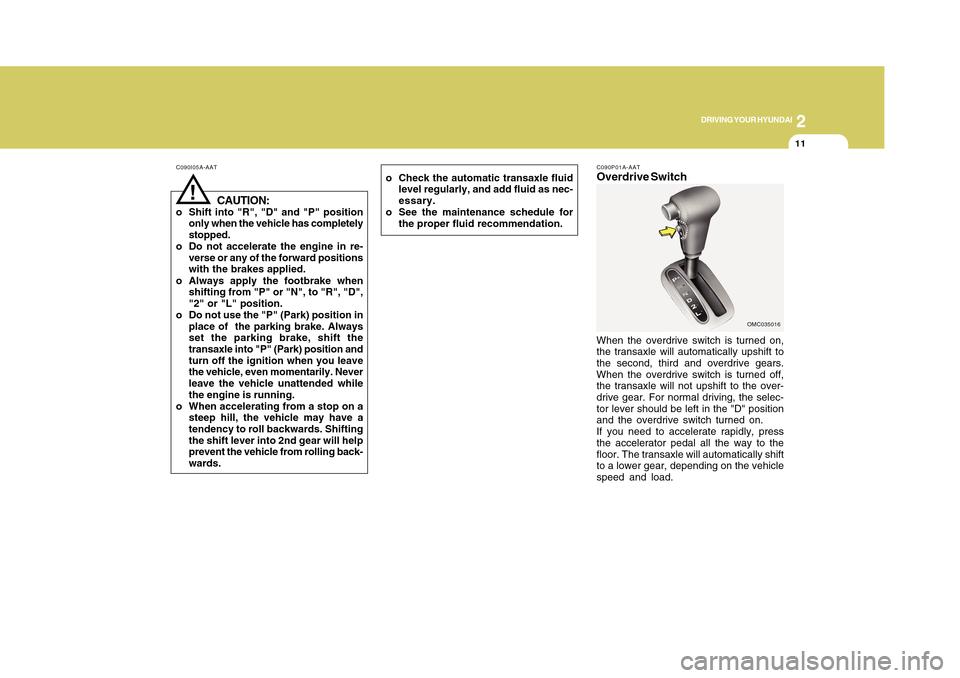
C090P01A-AATOverdrive SwitchWhen the overdrive switch is turned on,
the transaxle will automatically upshift to
the second, third and overdrive gears.
When the overdrive switch is turned off,
the transaxle will not upshift to the over-
drive gear. For normal driving, the selec-
tor lever should be left in the "D" position
and the overdrive switch turned on.
If you need to accelerate rapidly, press
the accelerator pedal all the way to the
floor. The transaxle will automatically shift
to a lower gear, depending on the vehicle
speed and load.
OMC035016