tow Hyundai Accent 2011 Owner's Guide
[x] Cancel search | Manufacturer: HYUNDAI, Model Year: 2011, Model line: Accent, Model: Hyundai Accent 2011Pages: 282, PDF Size: 14.82 MB
Page 177 of 282
21
DRIVING YOUR HYUNDAI
2
Steps For Determining Correct Load
Limit -
1. Locate the statement "The com-
bined weight of occupants and cargo
should never exceed XXX kg or
XXX lbs.'' on your vehicle's placard.
2. Determine the combined weight of
the driver and passengers that will
be riding in your vehicle.
3. Subtract the combined weight of the
driver and passengers from XXX kg
or XXX lbs.
4. The resulting figure equals the avail-
able amount of cargo and luggage
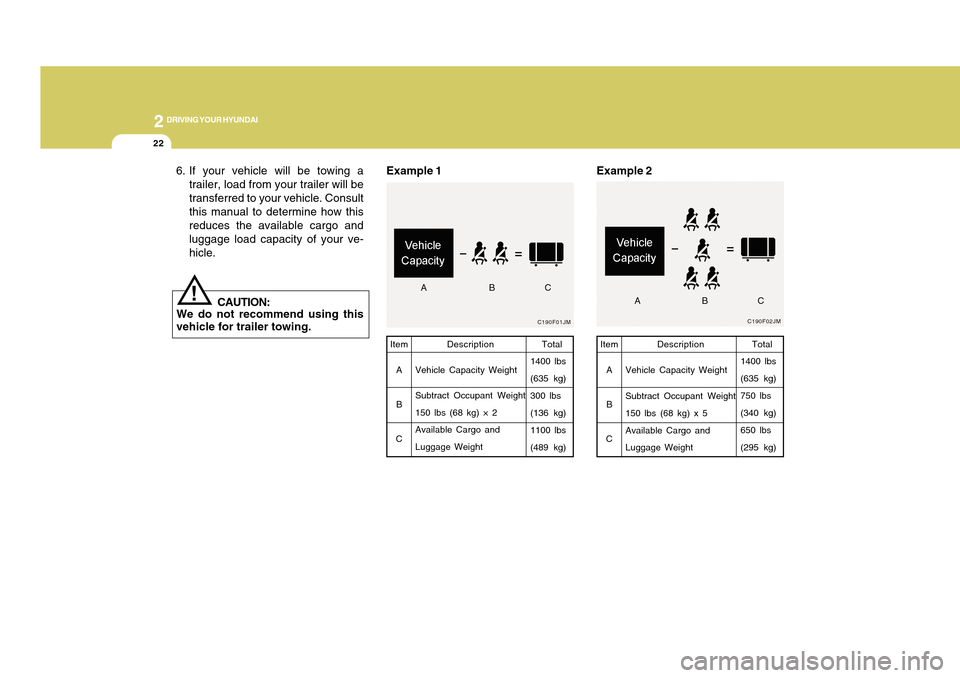
load capacity. For example, if the
"XXX" amount equals 1400 lbs. and
there will be five 150 lb passengers
in your vehicle, the amount of avail-
able cargo and luggage load capac-
ity is 650 lbs.
(1400-750 (5 x 150) = 650 lbs.)
5. Determine the combined weight of
luggage and cargo being loaded on
the vehicle. That weight may not
safely exceed the available cargo
and luggage load capacity calcu-
lated in Step 4. The tire label located on the driver's
side of the center pillar outer panel
gives the original tire size, cold tire
pressures recommended for your ve-
hicle, the number of people that can be
in your vehicle and vehicle capacity
weight.
Vehicle capacity weight:
849 lbs (385 kg)
Vehicle capacity weight is the maxi-
mum combined weight of occupants
and cargo.
Seating capacity:
Total: 5 persons
(Front seat: 2 persons,
Rear seat: 3 persons)
Seating capacity is the maximum num-
ber of occupants including a driver,
your vehicle may carry.However the seating capacity may be
reduced based upon the weight of all
of the occupants, and the weight of the
cargo being carried or towed. Do not
overload the vehicle as there is a limit
to the total weight, or load limit includ-
ing occupants and cargo, the vehicle
can carry.
Towing capacity:
We do not recommend using this ve-
hicle for trailer towing.
Cargo capacity:
The cargo capacity of your vehicle will
increase or decrease depending on the
weight and the number of occupants.
Page 178 of 282
2
DRIVING YOUR HYUNDAI
22
C190F01JMTotal
1400 lbs
(635 kg)
300 lbs
(136 kg)
1100 lbs
(489 kg)
Example 1Item
A
B
CDescription
Vehicle Capacity Weight
Subtract Occupant Weight
150 lbs (68 kg) × 2
Available Cargo and
Luggage Weight
ABC
6. If your vehicle will be towing a
trailer, load from your trailer will be
transferred to your vehicle. Consult
this manual to determine how this
reduces the available cargo and
luggage load capacity of your ve-
hicle.
!
C190F02JM
Example 2
Total
1400 lbs
(635 kg)
750 lbs
(340 kg)
650 lbs
(295 kg) Item
A
B
CDescription
Vehicle Capacity Weight
Subtract Occupant Weight
150 lbs (68 kg) x 5
Available Cargo and
Luggage Weight
AB
C
CAUTION:
We do not recommend using this
vehicle for trailer towing.
Page 182 of 282
If the Engine Will Not Start ........................................... 3-2
Jump Starting ................................................................ 3-3
If the Engine Overheats ............................................... 3-4
Tire Pressure Monitoring System (TPMS) ................... 3-5
Spare Tire...................................................................3-10
If You Have a Flat Tire...............................................3-11
Changing a Flat Tire ...................................................3-11
If Your Vehicle Must Be Towed.................................3-16
Emergency Towing.....................................................3-18
If You Lose Your Keys ...............................................3-20
WHAT TO DO IN AN EMERGENCY
3
3
Page 188 of 282
3
WHAT TO DO IN AN EMERGENCY
7
!
CAUTION:
In winter or cold weather, the low
tire pressure telltale may be illumi-
nated if the tire pressure was ad-
justed to the recommended tire in-
flation pressure in warm weather. It
does not mean your TPMS is mal-
functioning because the decreased
temperature leads to a proportional
lowering of tire pressure.
When you drive your vehicle from a
warm area to a cold area or from a
cold area to a warm area, or the
outside temperature is greatly
higher or lower, you should check
the tire inflation pressure and ad-
just the tires to the recommended
tire inflation pressure.
WARNING:
Significantly low tire pressure
makes the vehicle unstable and can
contribute to loss of vehicle control
and increased braking distances.
Continued driving on low pressure
tires will cause the tires to overheat
and fail.
TPMS (Tire Pressure Moni-
toring System) Malfunction
Indicator
The TPMS malfunction indicator comes
on and stays on when there is a
problem with the Tire Pressure Moni-
toring System. If the system is able to
correctly detect an under-inflation warn-
ing at the same time as system failure
then it will illuminate both the TPMS
malfunction and the low tire pressure
telltale e.g. if Front Left sensor fails,
the TPMS malfunction indicator turns
on, but if Front Right, Rear Left, or
Rear Right tire is under-inflated, the
low tire pressure telltale may turn on at
!
the same time as the TPMS malfunc-
tion indicator. Have the system
checked by an authorized Hyundai
dealer as soon as possible to deter-
mine the cause of the problem.
NOTE:
o The TPMS malfunction indicator
may be illuminated if the vehicle is
moving around electric power sup-
ply cables or radio transmitters
such as police stations, govern-
ment and public offices, broad-
casting stations, military installa-
tions, airports, or transmitting tow-
ers, etc. which can interfere with
normal operation of the Tire Pres-
sure Monitoring System (TPMS).
o The TPMS malfunction indicator
may be illuminated if snow chains
are used or some separate elec-
tronic devices such as notebook
computer, mobile charger, remote
starter or navigation etc., are used
in the vehicle. This can interfere
with normal operation of the Tire
Pressure Monitoring System
(TPMS).
Page 197 of 282
316
WHAT TO DO IN AN EMERGENCY
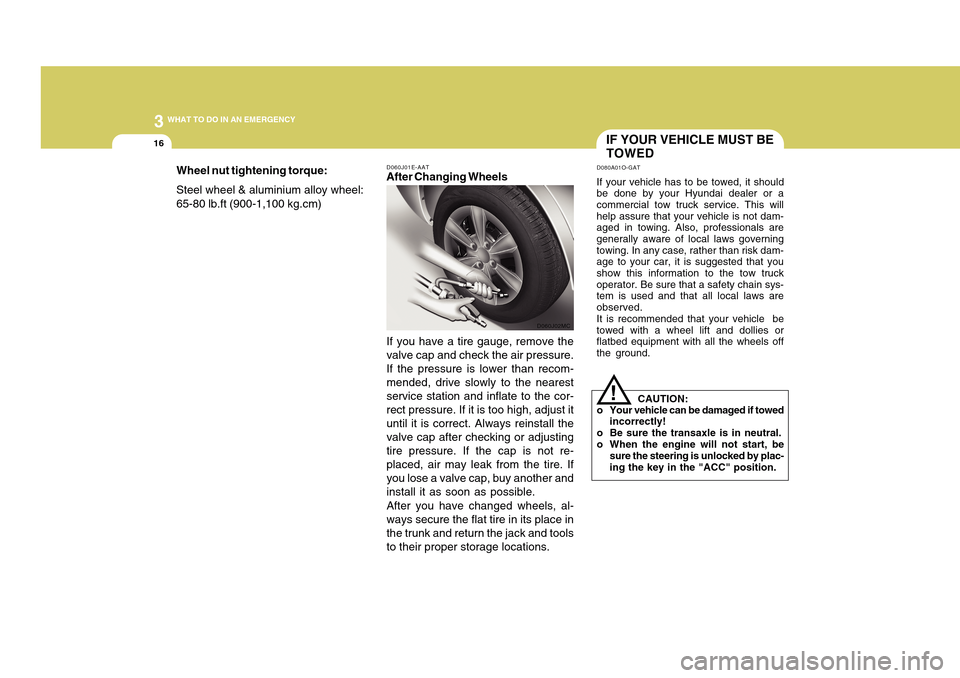
D060J01E-AATAfter Changing Wheels
If you have a tire gauge, remove the
valve cap and check the air pressure.
If the pressure is lower than recom-
mended, drive slowly to the nearest
service station and inflate to the cor-
rect pressure. If it is too high, adjust it
until it is correct. Always reinstall the
valve cap after checking or adjusting
tire pressure. If the cap is not re-
placed, air may leak from the tire. If
you lose a valve cap, buy another and
install it as soon as possible.
After you have changed wheels, al-
ways secure the flat tire in its place in
the trunk and return the jack and tools
to their proper storage locations.
D060J02MC
Wheel nut tightening torque:
Steel wheel & aluminium alloy wheel:
65-80 lb.ft (900-1,100 kg.cm)
IF YOUR VEHICLE MUST BE
TOWEDD080A01O-GATIf your vehicle has to be towed, it should
be done by your Hyundai dealer or a
commercial tow truck service. This will
help assure that your vehicle is not dam-
aged in towing. Also, professionals are
generally aware of local laws governing
towing. In any case, rather than risk dam-
age to your car, it is suggested that you
show this information to the tow truck
operator. Be sure that a safety chain sys-
tem is used and that all local laws are
observed.
It is recommended that your vehicle be
towed with a wheel lift and dollies or
flatbed equipment with all the wheels off
the ground.
!
CAUTION:
o Your vehicle can be damaged if towed
incorrectly!
o Be sure the transaxle is in neutral.
o When the engine will not start, be
sure the steering is unlocked by plac-
ing the key in the "ACC" position.
Page 198 of 282
3
WHAT TO DO IN AN EMERGENCY
17
CAUTION:
o When towing the vehicle, take care
not to cause damage to the bumper
or underbody of the vehicle.
!
1) If the vehicle is being towed with the
rear wheels on the ground, be sure the
parking brake is released.
NOTE:
Before towing, check the level of the
automatic transaxle fluid. If it is below
the "HOT" range on the dipstick, add
fluid. If you cannot add fluid, flatbed
equipment or a towing dolly must be
used.
2) If any of the loaded wheels or suspen-
sion components are damaged or the
vehicle is being towed with the front
wheels on the ground, use a towing
dolly under the front wheels.
o Manual Transaxle:
If you do not use a towing dolly, place
the ignition key in the "ACC" position
and put the transaxle in "N (Neutral)".
CAUTION:
Do not tow with the key removed or in
the "LOCK" position when towing from
the rear without a towing dolly.
D080B02MC
!
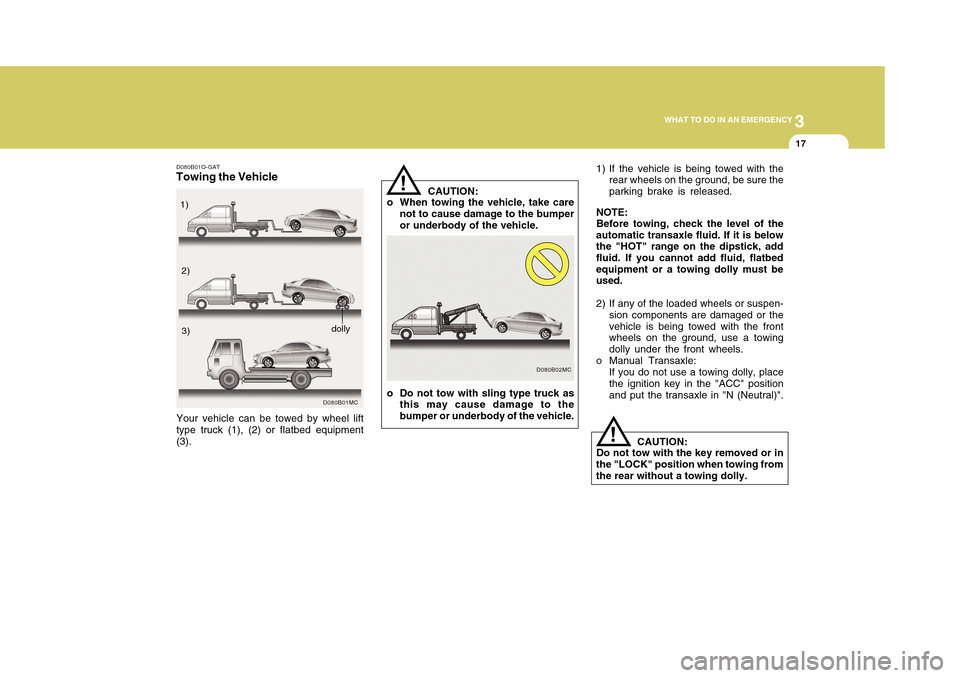
o Do not tow with sling type truck as
this may cause damage to the
bumper or underbody of the vehicle.
D080B01O-GATTowing the Vehicle
D080B01MC
Your vehicle can be towed by wheel lift
type truck (1), (2) or flatbed equipment
(3).1)
2)
3)
dolly
Page 199 of 282
318
WHAT TO DO IN AN EMERGENCY
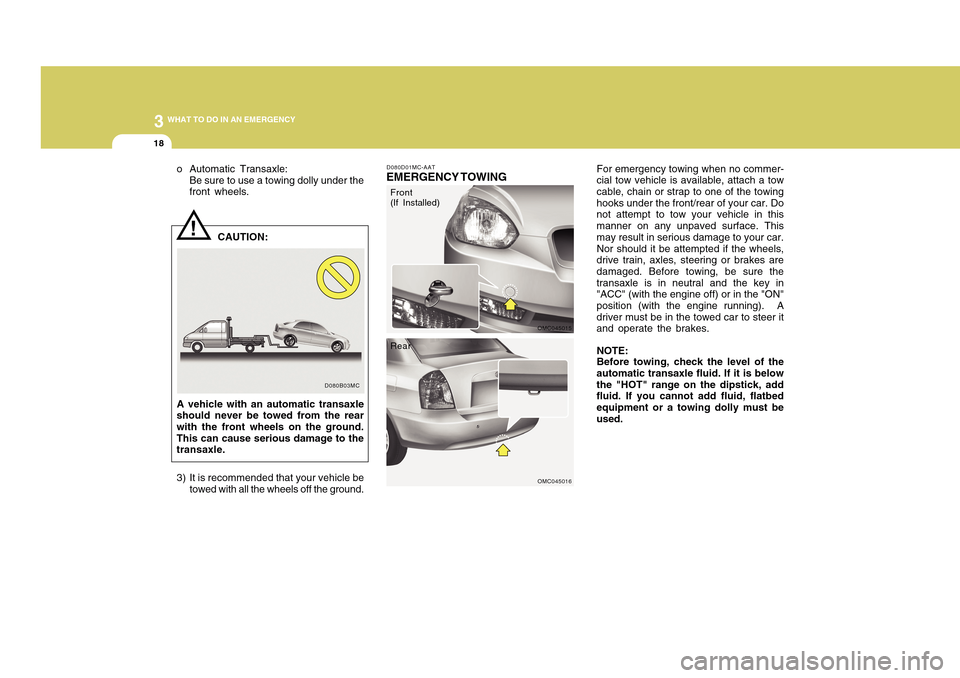
D080D01MC-AATEMERGENCY TOWING
For emergency towing when no commer-
cial tow vehicle is available, attach a tow
cable, chain or strap to one of the towing
hooks under the front/rear of your car. Do
not attempt to tow your vehicle in this
manner on any unpaved surface. This
may result in serious damage to your car.
Nor should it be attempted if the wheels,
drive train, axles, steering or brakes are
damaged. Before towing, be sure the
transaxle is in neutral and the key in
"ACC" (with the engine off) or in the "ON"
position (with the engine running). A
driver must be in the towed car to steer it
and operate the brakes.
NOTE:
Before towing, check the level of the
automatic transaxle fluid. If it is below
the "HOT" range on the dipstick, add
fluid. If you cannot add fluid, flatbed
equipment or a towing dolly must be
used.
OMC045015OMC045016
!
D080B03MC
CAUTION: o Automatic Transaxle:
Be sure to use a towing dolly under the
front wheels.
A vehicle with an automatic transaxle
should never be towed from the rear
with the front wheels on the ground.
This can cause serious damage to the
transaxle.
3) It is recommended that your vehicle be
towed with all the wheels off the ground.
Front
(If Installed)
Rear
Page 200 of 282
3
WHAT TO DO IN AN EMERGENCY
19
CAUTION:
- Automatic Transaxle
o If the car is being towed with all four
wheels on the ground, it can be towed
only from the front. Be sure that the
transaxle is in neutral. Be sure the
steering is unlocked by placing the
ignition switch in the ACC position. A
driver must be in the towed vehicle
to operate the steering and brakes.
o To avoid serious damage to the au-
tomatic transaxle, limit the vehicle
speed to 10 mph (15 km/h) and drive
less than 1 mile (1.5 km) when tow-
ing.
!
OMC045013
OMC045014
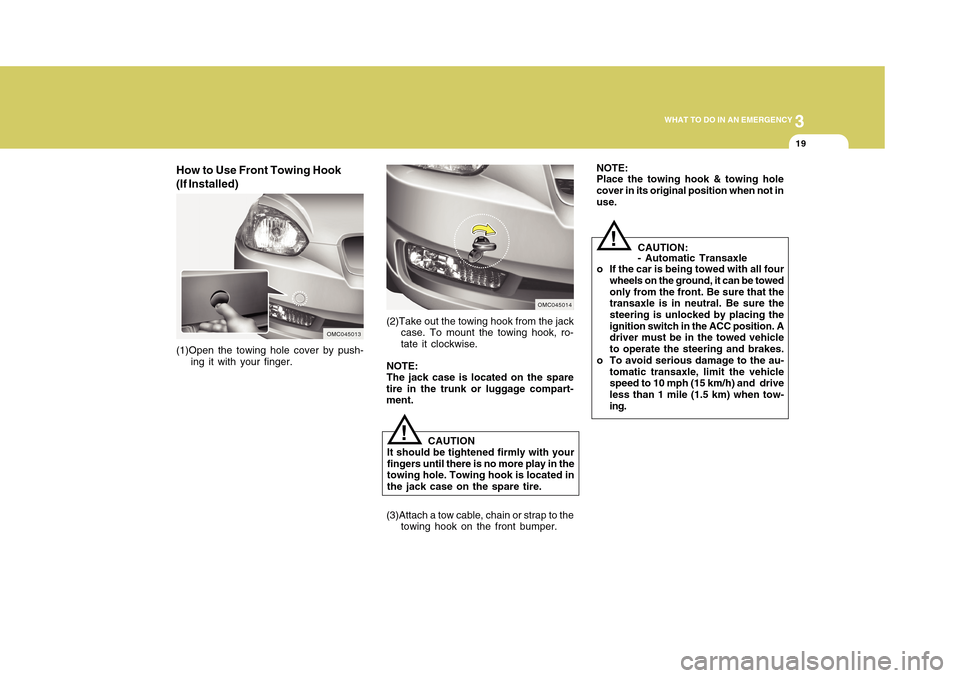
(1)Open the towing hole cover by push-
ing it with your finger.(2)Take out the towing hook from the jack
case. To mount the towing hook, ro-
tate it clockwise.
NOTE:
The jack case is located on the spare
tire in the trunk or luggage compart-
ment.
!
CAUTION
It should be tightened firmly with your
fingers until there is no more play in the
towing hole. Towing hook is located in
the jack case on the spare tire.
How to Use Front Towing Hook
(If Installed)
NOTE:
Place the towing hook & towing hole
cover in its original position when not in
use.
(3)Attach a tow cable, chain or strap to the
towing hook on the front bumper.
Page 214 of 282
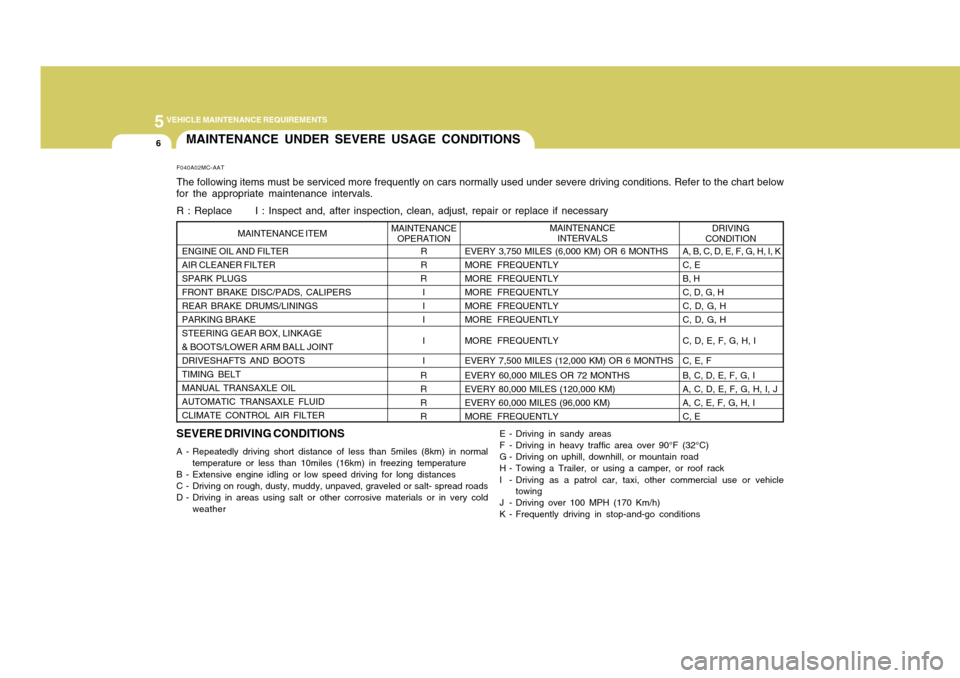
5
VEHICLE MAINTENANCE REQUIREMENTS6
DRIVING
CONDITION MAINTENANCE
INTERVALS
ENGINE OIL AND FILTER
AIR CLEANER FILTER
SPARK PLUGS
FRONT BRAKE DISC/PADS, CALIPERS
REAR BRAKE DRUMS/LININGS
PARKING BRAKE
STEERING GEAR BOX, LINKAGE
& BOOTS/LOWER ARM BALL JOINT
DRIVESHAFTS AND BOOTS
TIMING BELT
MANUAL TRANSAXLE OIL
AUTOMATIC TRANSAXLE FLUID
CLIMATE CONTROL AIR FILTER
R
R
R
I
I
I
I
I
R
R
R
R MAINTENANCE
OPERATION MAINTENANCE ITEM
EVERY 3,750 MILES (6,000 KM) OR 6 MONTHS
MORE FREQUENTLY
MORE FREQUENTLY
MORE FREQUENTLY
MORE FREQUENTLY
MORE FREQUENTLY
MORE FREQUENTLY
EVERY 7,500 MILES (12,000 KM) OR 6 MONTHS
EVERY 60,000 MILES OR 72 MONTHS
EVERY 80,000 MILES (120,000 KM)
EVERY 60,000 MILES (96,000 KM)
MORE FREQUENTLY
SEVERE DRIVING CONDITIONSA - Repeatedly driving short distance of less than 5miles (8km) in normal
temperature or less than 10miles (16km) in freezing temperature
B - Extensive engine idling or low speed driving for long distances
C - Driving on rough, dusty, muddy, unpaved, graveled or salt- spread roads
D - Driving in areas using salt or other corrosive materials or in very cold
weatherE - Driving in sandy areas
F - Driving in heavy traffic area over 90°F (32°C)
G - Driving on uphill, downhill, or mountain road
H - Towing a Trailer, or using a camper, or roof rack
I - Driving as a patrol car, taxi, other commercial use or vehicle
towing
J - Driving over 100 MPH (170 Km/h)
K - Frequently driving in stop-and-go conditionsA, B, C, D, E, F, G, H, I, K
C, E
B, H
C, D, G, H
C, D, G, H
C, D, G, H
C, D, E, F, G, H, I
C, E, F
B, C, D, E, F, G, I
A, C, D, E, F, G, H, I, J
A, C, E, F, G, H, I
C, EMAINTENANCE UNDER SEVERE USAGE CONDITIONSF040A02MC-AATThe following items must be serviced more frequently on cars normally used under severe driving conditions. Refer to the chart below
for the appropriate maintenance intervals.
R : Replace I : Inspect and, after inspection, clean, adjust, repair or replace if necessary
Page 236 of 282
6
DO-IT-YOURSELF MAINTENANCE
18
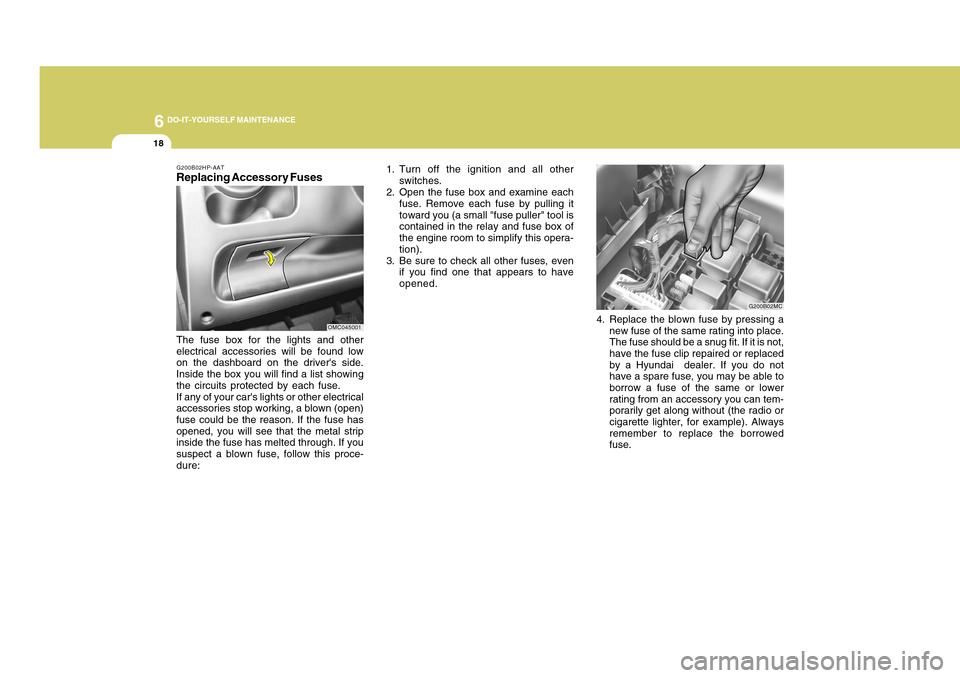
G200B02HP-AATReplacing Accessory FusesThe fuse box for the lights and other
electrical accessories will be found low
on the dashboard on the driver's side.
Inside the box you will find a list showing
the circuits protected by each fuse.
If any of your car's lights or other electrical
accessories stop working, a blown (open)
fuse could be the reason. If the fuse has
opened, you will see that the metal strip
inside the fuse has melted through. If you
suspect a blown fuse, follow this proce-
dure:1. Turn off the ignition and all other
switches.
2. Open the fuse box and examine each
fuse. Remove each fuse by pulling it
toward you (a small "fuse puller" tool is
contained in the relay and fuse box of
the engine room to simplify this opera-
tion).
3. Be sure to check all other fuses, even
if you find one that appears to have
opened.
4. Replace the blown fuse by pressing a
new fuse of the same rating into place.
The fuse should be a snug fit. If it is not,
have the fuse clip repaired or replaced
by a Hyundai dealer. If you do not
have a spare fuse, you may be able to
borrow a fuse of the same or lower
rating from an accessory you can tem-
porarily get along without (the radio or
cigarette lighter, for example). Always
remember to replace the borrowed
fuse.
OMC045001
G200B02MC