key Hyundai Accent 2011 Service Manual
[x] Cancel search | Manufacturer: HYUNDAI, Model Year: 2011, Model line: Accent, Model: Hyundai Accent 2011Pages: 282, PDF Size: 14.82 MB
Page 159 of 282
3
DRIVING YOUR HYUNDAI
2
!
BEFORE STARTING THE
ENGINEC020A03A-AATBefore you start the engine, you should
always:
1. Look around the vehicle to be sure
there are no flat tires, puddles of oil or
water or other indications of possible
trouble.
2. After entering the car, check to be
sure the parking brake is engaged.
3. Check that all windows, and lights are
clean.
4. Check that the interior and exterior
mirrors are clean and in position.
5. Check your seat, seatback and head-
rest to be sure they are in their proper
positions.
6. Lock all the doors.
7. Fasten your seat belt and be sure that
all other occupants have fastened
theirs.
8. Turn off all lights and accessories that
are not needed.
9. When you turn the ignition switch to
"ON", check that all appropriate warn-
ing lights are operating and that you
have sufficient fuel.
10. Check the operation of warning lights
and all bulbs when key is in the "ON"
position.
CALIFORNIA PROPOSITION
65 WARNING:
Engine exhaust and a wide variety of
automobile components and parts, in-
cluding components found in the inte-
rior furnishings in a vehicle, contain or
emit chemicals known to the State of
California to cause cancer and birth
defects and reproductive harm. In addi-
tion, certain fluids contained in vehicles
and certain products of component
wear contain or emit chemicals known
to the State of California to cause can-
cer and birth defects or other reproduc-
tive harm.
!
WARNING:
o Always wear appropriate shoes
when operating your vehicle. Unsuit-
able shoes (high heels, ski boots,
etc.) may interfere with your ability
to use the brake and accelerator
pedal, and the clutch (if installed).
o All passengers must be properly
belted whenever the vehicle is mov-
ing. Refer to pages: 1-22 through 1-
31 for more information on their
proper use.
o Always check the surrounding ar-
eas near your vehicle for people,
especially children, before putting a
car into 'drive'.
o When you intend to park or stop the
vehicle with the engine on, be careful
not to depress the accelerator pedal
for a long period of time. It may over-
heat the engine or exhaust system
and cause fire.
Page 160 of 282
2
DRIVING YOUR HYUNDAI4
C040A02A-AAT
WARNING:
The engine should not be turned off or
the key removed from the ignition key
cylinder while the vehicle is in motion.
The steering wheel is locked by remov-
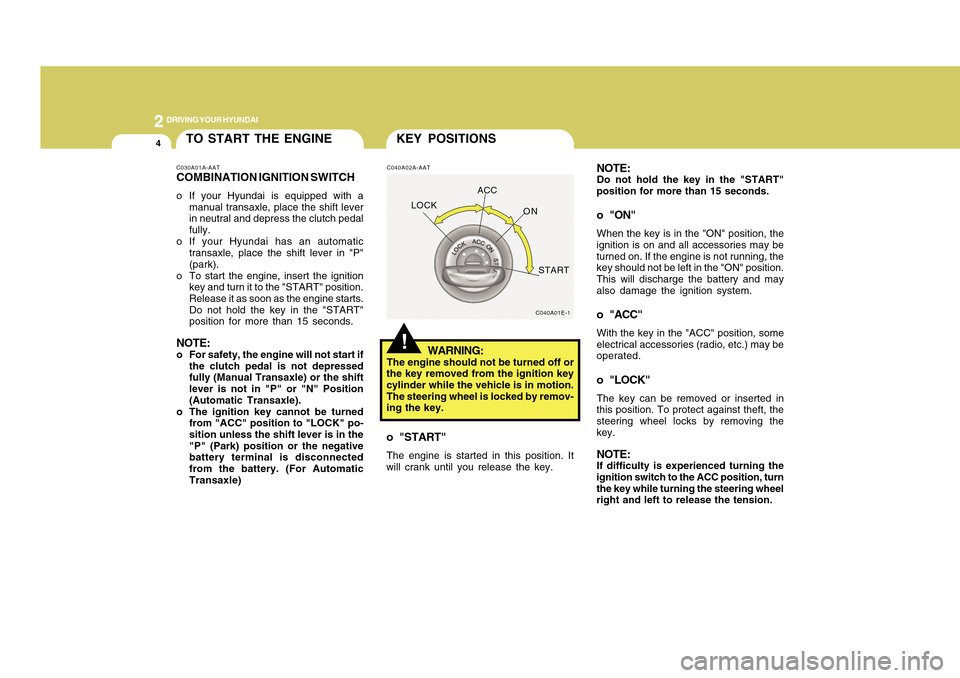
ing the key.o "START"The engine is started in this position. It
will crank until you release the key.
!KEY POSITIONS
C040A01E-1
LOCKACC
ON
START
NOTE:Do not hold the key in the "START"
position for more than 15 seconds.o "ON"When the key is in the "ON" position, the
ignition is on and all accessories may be
turned on. If the engine is not running, the
key should not be left in the "ON" position.
This will discharge the battery and may
also damage the ignition system.o "ACC"With the key in the "ACC" position, some
electrical accessories (radio, etc.) may be
operated.o "LOCK"The key can be removed or inserted in
this position. To protect against theft, the
steering wheel locks by removing the
key.NOTE:If difficulty is experienced turning the
ignition switch to the ACC position, turn
the key while turning the steering wheel
right and left to release the tension.
TO START THE ENGINEC030A01A-AATCOMBINATION IGNITION SWITCHo If your Hyundai is equipped with a
manual transaxle, place the shift lever
in neutral and depress the clutch pedal
fully.
o If your Hyundai has an automatic
transaxle, place the shift lever in "P"
(park).
o To start the engine, insert the ignition
key and turn it to the "START" position.
Release it as soon as the engine starts.
Do not hold the key in the "START"
position for more than 15 seconds.NOTE:o For safety, the engine will not start if
the clutch pedal is not depressed
fully (Manual Transaxle) or the shift
lever is not in "P" or "N" Position
(Automatic Transaxle).
o The ignition key cannot be turned
from "ACC" position to "LOCK" po-
sition unless the shift lever is in the
"P" (Park) position or the negative
battery terminal is disconnected
from the battery. (For Automatic
Transaxle)
Page 161 of 282
5
DRIVING YOUR HYUNDAI
2
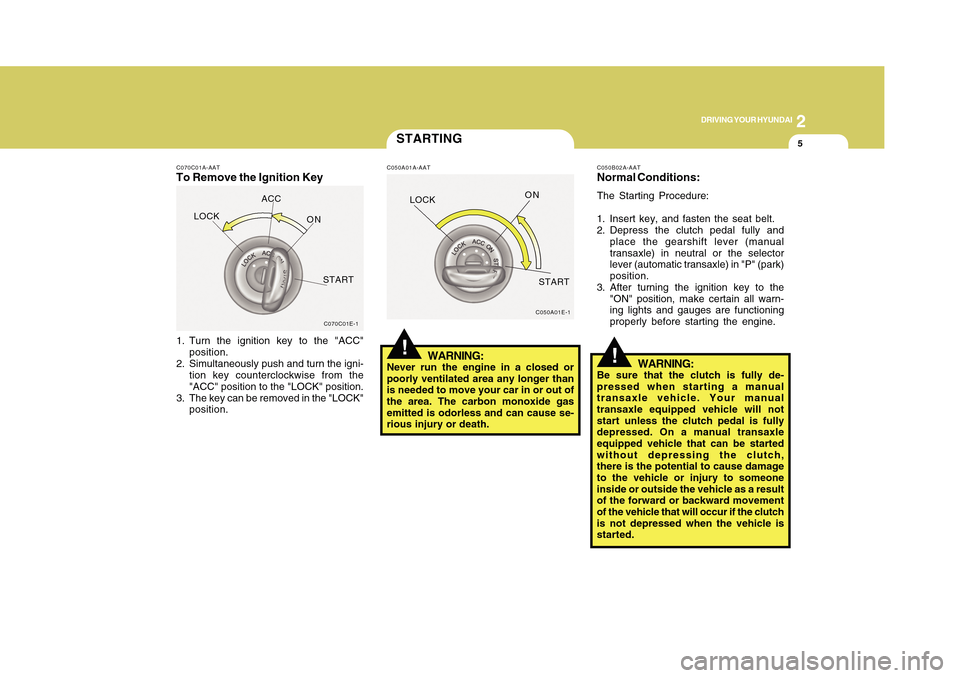
C070C01A-AATTo Remove the Ignition Key1. Turn the ignition key to the "ACC"
position.
2. Simultaneously push and turn the igni-
tion key counterclockwise from the
"ACC" position to the "LOCK" position.
3. The key can be removed in the "LOCK"
position.
C070C01E-1
LOCKACC
ON
START
STARTINGC050A01A-AAT
WARNING:
Never run the engine in a closed or
poorly ventilated area any longer than
is needed to move your car in or out of
the area. The carbon monoxide gas
emitted is odorless and can cause se-
rious injury or death.
C050A01E-1
!LOCKON
START
C050B02A-AATNormal Conditions:The Starting Procedure:
1. Insert key, and fasten the seat belt.
2. Depress the clutch pedal fully and
place the gearshift lever (manual
transaxle) in neutral or the selector
lever (automatic transaxle) in "P" (park)
position.
3. After turning the ignition key to the
"ON" position, make certain all warn-
ing lights and gauges are functioning
properly before starting the engine.
WARNING:
Be sure that the clutch is fully de-
pressed when starting a manual
transaxle vehicle. Your manual
transaxle equipped vehicle will not
start unless the clutch pedal is fully
depressed. On a manual transaxle
equipped vehicle that can be started
without depressing the clutch,
there is the potential to cause damage
to the vehicle or injury to someone
inside or outside the vehicle as a result
of the forward or backward movement
of the vehicle that will occur if the clutch
is not depressed when the vehicle is
started.
!
Page 162 of 282
2
DRIVING YOUR HYUNDAI6
!
NOTE:o To shift into reverse, rest the lever
in neutral for at least 3 seconds after
your car is completely stopped. Then
move the lever into the reverse po-
sition.
o During cold weather, shifting may be
difficult until the transaxle lubricant
has warmed up. This is normal and
not harmful to the transaxle.
o If you've come to a complete stop
and it's hard to shift into 1
st or
R(Reverse), put the shift lever in
N(Neutral) position and release the
clutch. Press the clutch pedal back
down, and then shift into 1st or
R(Reverse) gear position.
o Do not use the shift lever as a
handrest during driving, as this can
result in premature wear of the
transaxle shift forks.
OPERATING THE MANUAL
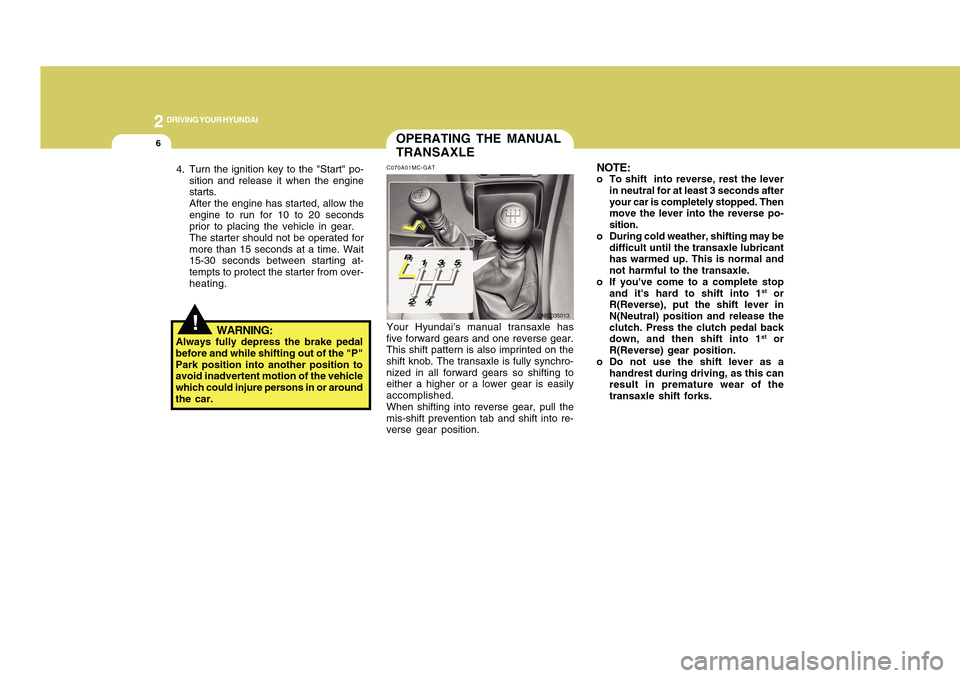
TRANSAXLEC070A01MC-GATYour Hyundai's manual transaxle has
five forward gears and one reverse gear.
This shift pattern is also imprinted on the
shift knob. The transaxle is fully synchro-
nized in all forward gears so shifting to
either a higher or a lower gear is easily
accomplished.
When shifting into reverse gear, pull the
mis-shift prevention tab and shift into re-
verse gear position.
OMC035013
4. Turn the ignition key to the "Start" po-
sition and release it when the engine
starts.
After the engine has started, allow the
engine to run for 10 to 20 seconds
prior to placing the vehicle in gear.
The starter should not be operated for
more than 15 seconds at a time. Wait
15-30 seconds between starting at-
tempts to protect the starter from over-
heating.
WARNING:
Always fully depress the brake pedal
before and while shifting out of the "P"
Park position into another position to
avoid inadvertent motion of the vehicle
which could injure persons in or around
the car.
Page 166 of 282
2
DRIVING YOUR HYUNDAI
10
C090H01A-AATNOTE:o For smooth and safe operation, de-
press the brake pedal when shifting
from "Neutral" position or "Park"
position to a forward or reverse gear.
o The ignition key must be in the "ON"
position and the brake pedal fully
depressed in order to move the shift
lever from the "P" (Park) position to
any of the other positions.
o It is always possible to shift from
"R", "N", "D", "2", "L" position to "P"
position.
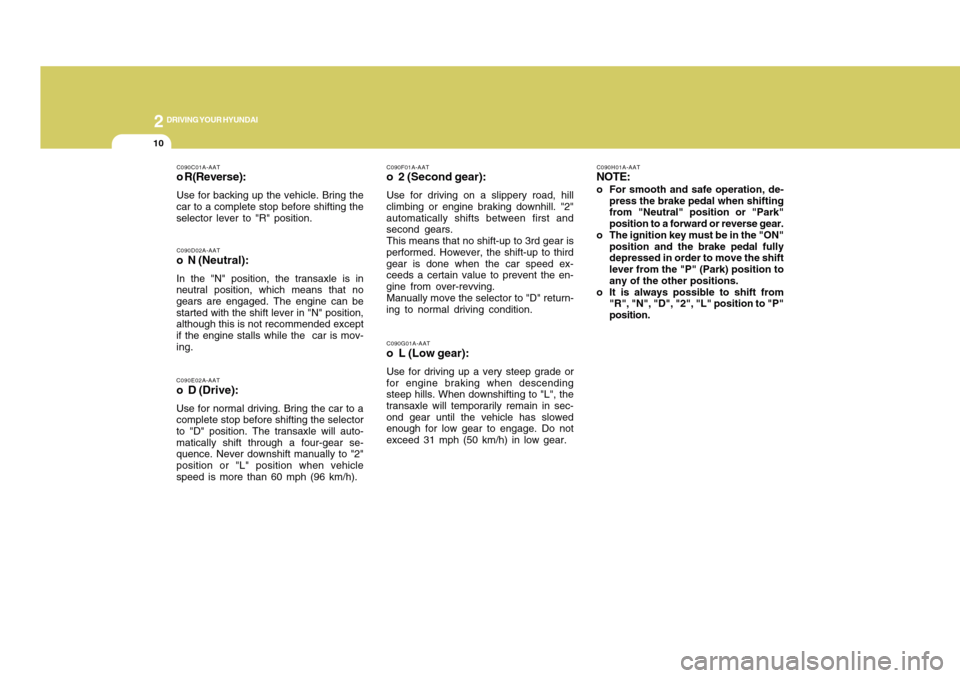
C090G01A-AATo L (Low gear):Use for driving up a very steep grade or
for engine braking when descending
steep hills. When downshifting to "L", the
transaxle will temporarily remain in sec-
ond gear until the vehicle has slowed
enough for low gear to engage. Do not
exceed 31 mph (50 km/h) in low gear.C090F01A-AATo 2 (Second gear):Use for driving on a slippery road, hill
climbing or engine braking downhill. "2"
automatically shifts between first and
second gears.
This means that no shift-up to 3rd gear is
performed. However, the shift-up to third
gear is done when the car speed ex-
ceeds a certain value to prevent the en-
gine from over-revving.
Manually move the selector to "D" return-
ing to normal driving condition.
C090C01A-AATo R(Reverse):Use for backing up the vehicle. Bring the
car to a complete stop before shifting the
selector lever to "R" position.C090D02A-AATo N (Neutral):In the "N" position, the transaxle is in
neutral position, which means that no
gears are engaged. The engine can be
started with the shift lever in "N" position,
although this is not recommended except
if the engine stalls while the car is mov-
ing.C090E02A-AATo D (Drive):Use for normal driving. Bring the car to a
complete stop before shifting the selector
to "D" position. The transaxle will auto-
matically shift through a four-gear se-
quence. Never downshift manually to "2"
position or "L" position when vehicle
speed is more than 60 mph (96 km/h).
Page 174 of 282
2
DRIVING YOUR HYUNDAI
18
C160K01A-AATCarry Emergency EquipmentDepending on the severity of the weather
where you drive your car, you should
carry appropriate emergency equipment.
Some of the items you may want to carry
include tire chains, tow straps or chains,
flashlight, emergency flares, sand, a
shovel, jumper cables, a window scraper,
gloves, ground cloth, coveralls, a blanket,
etc.
C160H01A-AATUse Approved Anti-Freeze in Win-
dow Washer SystemTo keep the water in the window washer
system from freezing, add an approved
anti-freeze solution in accordance with
instructions on the container. Window
washer anti-freeze is available from
Hyundai dealers and most auto parts
outlets. Do not use engine coolant or
other types of anti-freeze as these may
damage the finish.C160G01A-AATTo Keep Locks from FreezingTo keep the locks from freezing, squirt an
approved de-icer fluid or glycerine into
the key opening. If a lock is covered with
ice, squirt it with an approved de-icing
fluid to remove the ice. If the lock is frozen
internally, you may be able to thaw it out
by using a heated key. Handle the heated
key with care to avoid injury.
C160I01A-AATDon't Let Your Parking Brake FreezeUnder some conditions your parking brake
can freeze in the engaged position. This
is most likely to happen when there is an
accumulation of snow or ice around or
near the rear brakes or if the brakes are
wet. If you think the parking brake may
freeze, apply it only temporarily while
you put the gear selector lever in "P"
(automatic) or in first or reverse gear
(manual transaxle) and block the rear
wheels so the car cannot roll. Then re-
lease the parking brake.C160J01A-AATDon't Let Ice and Snow Accumulate
UnderneathUnder some conditions, snow and ice
can build up under the fenders and inter-
fere with the steering. When driving in
severe winter conditions where this may
happen, you should periodically check
underneath the car to be sure the move-
ment of the front wheels and the steering
components is not obstructed.
Page 182 of 282
If the Engine Will Not Start ........................................... 3-2
Jump Starting ................................................................ 3-3
If the Engine Overheats ............................................... 3-4
Tire Pressure Monitoring System (TPMS) ................... 3-5
Spare Tire...................................................................3-10
If You Have a Flat Tire...............................................3-11
Changing a Flat Tire ...................................................3-11
If Your Vehicle Must Be Towed.................................3-16
Emergency Towing.....................................................3-18
If You Lose Your Keys ...............................................3-20
WHAT TO DO IN AN EMERGENCY
3
3
Page 183 of 282
32WHAT TO DO IN AN EMERGENCY
IF THE ENGINE WILL NOT
START!
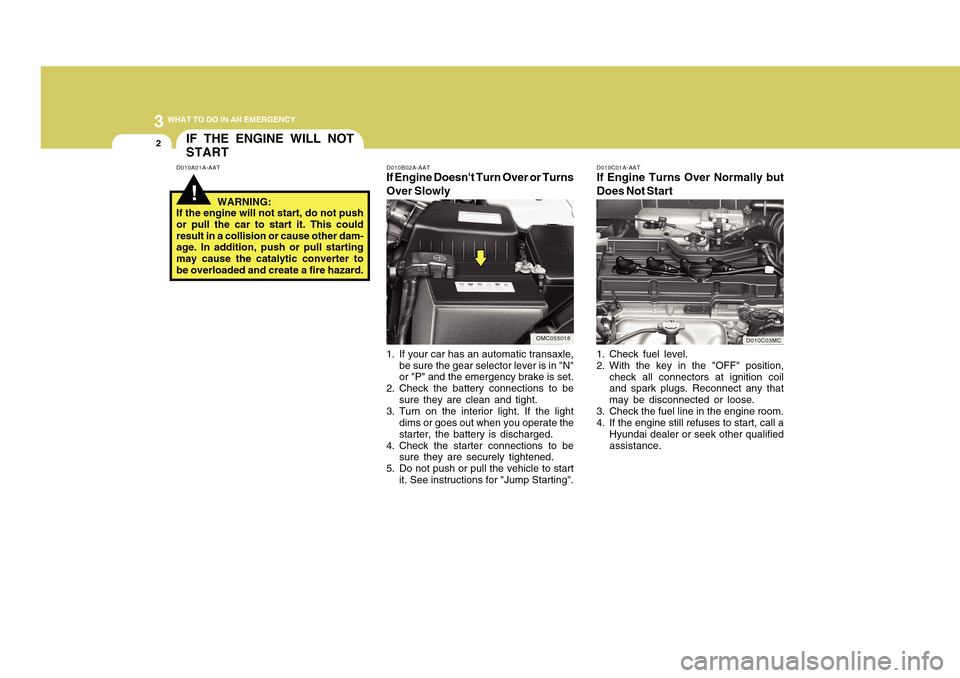
D010B02A-AATIf Engine Doesn't Turn Over or Turns
Over Slowly
D010A01A-AATD010C01A-AAT
If Engine Turns Over Normally but
Does Not Start1. Check fuel level.
2. With the key in the "OFF" position,
check all connectors at ignition coil
and spark plugs. Reconnect any that
may be disconnected or loose.
3. Check the fuel line in the engine room.
4. If the engine still refuses to start, call a
Hyundai dealer or seek other qualified
assistance. WARNING:
If the engine will not start, do not push
or pull the car to start it. This could
result in a collision or cause other dam-
age. In addition, push or pull starting
may cause the catalytic converter to
be overloaded and create a fire hazard.
1. If your car has an automatic transaxle,
be sure the gear selector lever is in "N"
or "P" and the emergency brake is set.
2. Check the battery connections to be
sure they are clean and tight.
3. Turn on the interior light. If the light
dims or goes out when you operate the
starter, the battery is discharged.
4. Check the starter connections to be
sure they are securely tightened.
5. Do not push or pull the vehicle to start
it. See instructions for "Jump Starting".
OMC055018
D010C03MC
Page 197 of 282
316
WHAT TO DO IN AN EMERGENCY
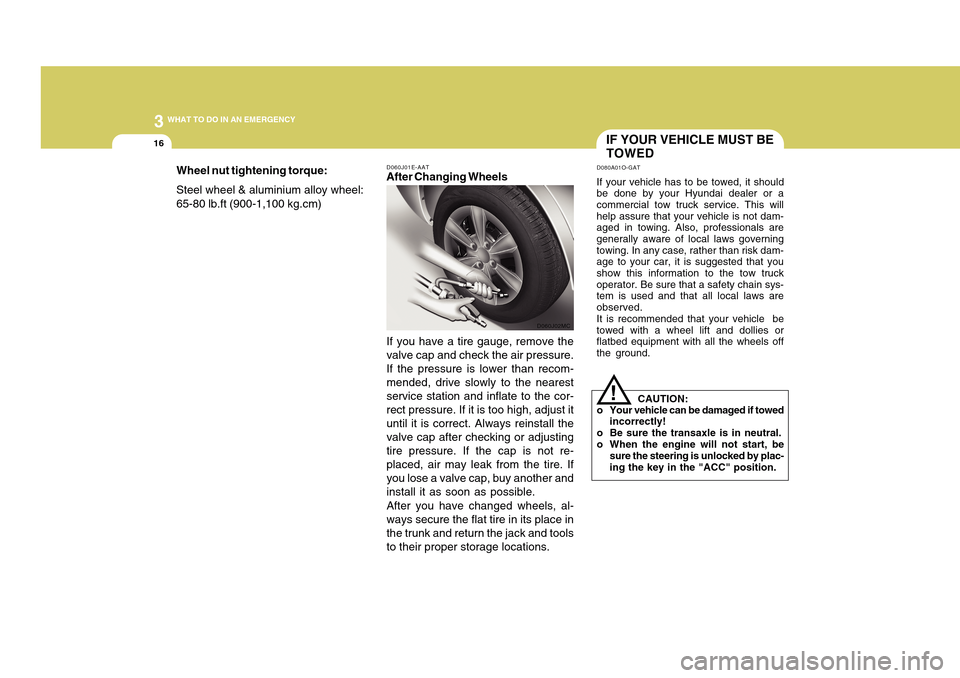
D060J01E-AATAfter Changing Wheels
If you have a tire gauge, remove the
valve cap and check the air pressure.
If the pressure is lower than recom-
mended, drive slowly to the nearest
service station and inflate to the cor-
rect pressure. If it is too high, adjust it
until it is correct. Always reinstall the
valve cap after checking or adjusting
tire pressure. If the cap is not re-
placed, air may leak from the tire. If
you lose a valve cap, buy another and
install it as soon as possible.
After you have changed wheels, al-
ways secure the flat tire in its place in
the trunk and return the jack and tools
to their proper storage locations.
D060J02MC
Wheel nut tightening torque:
Steel wheel & aluminium alloy wheel:
65-80 lb.ft (900-1,100 kg.cm)
IF YOUR VEHICLE MUST BE
TOWEDD080A01O-GATIf your vehicle has to be towed, it should
be done by your Hyundai dealer or a
commercial tow truck service. This will
help assure that your vehicle is not dam-
aged in towing. Also, professionals are
generally aware of local laws governing
towing. In any case, rather than risk dam-
age to your car, it is suggested that you
show this information to the tow truck
operator. Be sure that a safety chain sys-
tem is used and that all local laws are
observed.
It is recommended that your vehicle be
towed with a wheel lift and dollies or
flatbed equipment with all the wheels off
the ground.
!
CAUTION:
o Your vehicle can be damaged if towed
incorrectly!
o Be sure the transaxle is in neutral.
o When the engine will not start, be
sure the steering is unlocked by plac-
ing the key in the "ACC" position.
Page 198 of 282
3
WHAT TO DO IN AN EMERGENCY
17
CAUTION:
o When towing the vehicle, take care
not to cause damage to the bumper
or underbody of the vehicle.
!
1) If the vehicle is being towed with the
rear wheels on the ground, be sure the
parking brake is released.
NOTE:
Before towing, check the level of the
automatic transaxle fluid. If it is below
the "HOT" range on the dipstick, add
fluid. If you cannot add fluid, flatbed
equipment or a towing dolly must be
used.
2) If any of the loaded wheels or suspen-
sion components are damaged or the
vehicle is being towed with the front
wheels on the ground, use a towing
dolly under the front wheels.
o Manual Transaxle:
If you do not use a towing dolly, place
the ignition key in the "ACC" position
and put the transaxle in "N (Neutral)".
CAUTION:
Do not tow with the key removed or in
the "LOCK" position when towing from
the rear without a towing dolly.
D080B02MC
!
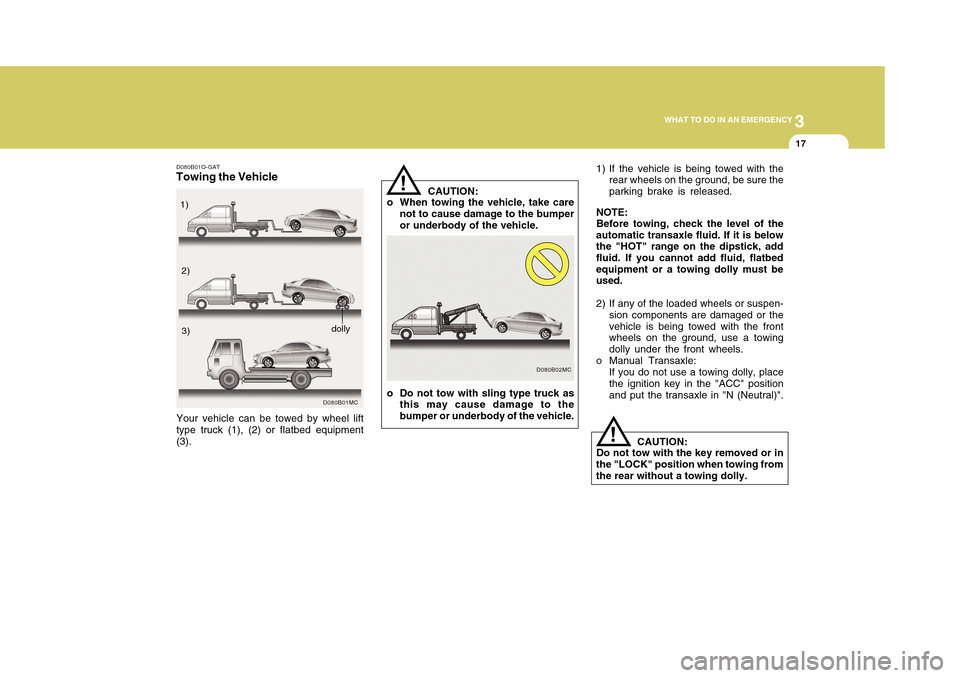
o Do not tow with sling type truck as
this may cause damage to the
bumper or underbody of the vehicle.
D080B01O-GATTowing the Vehicle
D080B01MC
Your vehicle can be towed by wheel lift
type truck (1), (2) or flatbed equipment
(3).1)
2)
3)
dolly