light Hyundai Accent 2011 Manual PDF
[x] Cancel search | Manufacturer: HYUNDAI, Model Year: 2011, Model line: Accent, Model: Hyundai Accent 2011Pages: 282, PDF Size: 14.82 MB
Page 206 of 282

4
CORROSION PREVENTION AND APPEARANCE CARE
4
CORROSION PREVENTION AND APPEARANCE CARE
5
E030B01A-AATSpot CleaningDon't use gasoline, strong solvents or
corrosive cleaning agents. These can
damage the finish of the car. To remove
road tar, use turpentine on a clean, soft
cloth. Be gentle.
To remove dead insects or tree sap, use
warm water and mild soap or car-wash-
ing solution. Soak the spot and rub gen-
tly. If the paint has lost its luster, use a
commercial car-cleaning polish.E030C01A-AATPolishing and WaxingA good coat of wax is a barrier between
your paint and contaminate. Keeping a
good coat of wax on your vehicle will help
protect it.
Always wash and dry the car before pol-
ishing or waxing or using a combination
cleaner and wax. Use a good quality
commercial product and follow the
manufacturer's directions on the con-
tainer. Polish and wax the bright trim
pieces as well as the paint.
!
CAUTION:
OJB037800
o Water washing in the engine com-
partment including high pressure
water washing may cause the failure
of electrical circuits located in the
engine compartment.
o Never allow water or other liquids to
come in contact with electrical/elec-
tronic components inside the vehicle
as this may damage them.
!
CAUTION:
o Do not use strong soap, chemical
detergents or hot water, and do not
wash the vehicle in direct sunlight or
when the body of the vehicle is warm.
o Be careful when washing the side
windows of your vehicle. Especially,
with high-pressure water, water may
leak through the windows and wet
the interior.
o To prevent damage to the plastic
parts, do not clean with chemical
solvents or strong detergents.
Page 207 of 282
44
CORROSION PREVENTION AND APPEARANCE CARE6
E040A01A-AATTo Clean the Vinyl UpholsteryTo clean the vinyl upholstery, first remove
loose dirt and dust with a vacuum cleaner.
Then apply a solution of mild soap or
detergent and water using a clean sponge
or soft cloth. Allow this to stay on the
surface to loosen the dirt, then wipe with
a clean damp sponge or cloth. If all the
dirt stains are not removed, repeat this
procedure until the upholstery is clean.
Do not use gasoline, solvent, paint thin-
ner or other strong cleaners.CLEANING THE INTERIOR
E030D01A-AATWhen to Wax AgainYou should polish and wax the car again
when water no longer beads on a clean
surface but spreads out over a larger
area.E030E01A-AATMaintaining BumpersSpecial precautions must be observed to
preserve the appearance of the bumpers
on your Hyundai. They are:
o Be careful not to spill battery electro-
lyte or hydraulic brake fluid on the
bumpers. If you do, wash it off imme-
diately with clean water.
o Be gentle when cleaning the bumper
surfaces. They are made of soft plastic
and the surface can be damaged if
mistreated. Do not use abrasive clean-
ers. Use warm water and mild soap or
carwashing solution.
o Do not expose the bumpers to high
temperatures. For example, if you have
your car repainted, do not leave the
bumpers on the car if the car is going
to be placed in a high-temperature
paint booth.
E040B01A-AATTo Clean the Leather Upholstery
(If Installed)In the normal course of use, leather up-
holstered surfaces will, like any material,
pick-up dust and dirt. This dust and dirt
must be cleaned off or it may work into the
surface of the leather, causing damage.
Fine leather needs care, and should be
cleaned when necessary. Washing
leather thoroughly with soap and water
will keep your leather lustrous, beautiful
and ensure you have many years of wear.
Take a piece of cheese cloth and using
any mild soap and lukewarm water, work
up a good lather. Thoroughly wash the
leather. Wipe clean with a slightly damp
cloth and dry with soft cloth. Do this as
often as the leather becomes soiled.
During tanning operations, sufficient oils
are incorporated through processing that
none need be applied during the life of
the leather. Oil applied to the finished
surface will in no way help the leather
and may do more harm than good. Var-
nishes and furniture polishes should
never be used under any conditions.
Page 219 of 282
Engine Compartment .................................................... 6-2
General Checks ............................................................ 6-4
Maintenance Precautions ............................................. 6-5
Checking the Engine Oil ............................................... 6-5
Checking and Changing the Engine Coolant ................ 6-8
Changing the Air Cleaner Filter ..................................... 6-9
Checking the Transaxle Oil (Manual) .........................6-12
Checking the Transaxle Fluid (Automatic)..................6-12
Checking the Brakes ..................................................6-14
Air Conditioning Care..................................................6-15
Changing the Climate Control Air Filter .......................6-16
Checking and Replacing Fuses..................................6-17
Checking the Battery..................................................6-20
Power Steering Fluid Level .........................................6-22
Replacement of Light Bulbs ........................................6-23
Bulb Wattage ...............................................................6-29
Fuse Panel Description...............................................6-30
DO-IT-YOURSELF MAINTENANCE
6
6
Page 222 of 282
6
DO-IT-YOURSELF MAINTENANCE4
GENERAL CHECKS
G020C01A-AATVehicle InteriorThe following should be checked each
time when the vehicle is driven:
o Light operation
o Windshield wiper operation
o Horn operation
o Defroster, heater system operation (and
air conditioning, if installed)
o Steering operation and condition
o Mirror condition and operation
o Turn signal operation
o Accelerator pedal operation
o Brake operation, including parking
brake
o Manual transaxle operation, including
clutchoperation
o Automatic transaxle operation, includ-
ing "Park" mechanism operation
o Seat control condition and operation
o Seat belt condition and operation
o Sun visor operation
If you notice anything that does not oper-
ate correctly or appear to be functioning
correctly, inspect it carefully and seek
assistance from your Hyundai dealer if
service is needed.
G020A01A-AATEngine Compartment
The following should be checked regu-
larly:
o Engine oil level and condition
o Transaxle fluid level and condition
o Brake fluid level
o Clutch fluid level
o Engine coolant level
o Windshield washer fluid level
o Accessory drive belt condition
o Engine coolant hose condition
o Fluid leaks (on or below components)
o Power steering fluid level and condi-
tion
o Battery condition
o Air cleaner filter condition
G020B01A-AATVehicle ExteriorThe following should be checked monthly:
o Overall appearance and condition
o Wheel condition and wheel nut tight-
ness
o Exhaust system condition
o Light condition and operation
o Windshield glass condition
o Wiper blade condition
o Paint condition and body corrosion
o Fluid leaks
o Door and hood lock condition
o Tire pressure and condition
(including spare tire)
Page 228 of 282
6
DO-IT-YOURSELF MAINTENANCE
10
WINDSHIELD WIPER
BLADESG080A02A-AATThe wiper blades should be carefully
inspected from time to time and cleaned
to remove accumulations of road film or
other debris. To clean the wiper blades
and arms, use a clean sponge or cloth
with a mild soap or detergent and water.
If the wipers continue to streak or smear
the glass, replace them with genuine
Hyundai replacement parts or their
equivalent.
CAUTION:
o Do not operate the wipers on dry
glass. This can result in more rapid
wear of the wiper blades and may
scratch the glass.
o Keep the blade rubber out of contact
with petroleum products such as
engine oil, gasoline, etc.
!
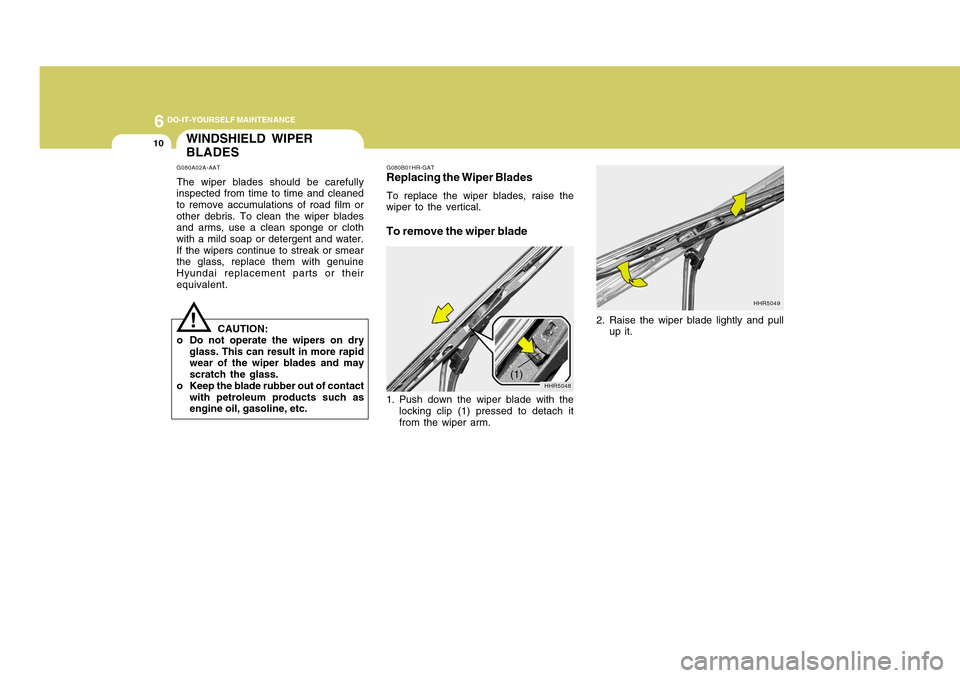
2. Raise the wiper blade lightly and pull
up it.
HHR5049
G080B01HR-GATReplacing the Wiper BladesTo replace the wiper blades, raise the
wiper to the vertical.To remove the wiper blade1. Push down the wiper blade with the
locking clip (1) pressed to detach it
from the wiper arm.
HHR5048
(1)
Page 236 of 282
6
DO-IT-YOURSELF MAINTENANCE
18
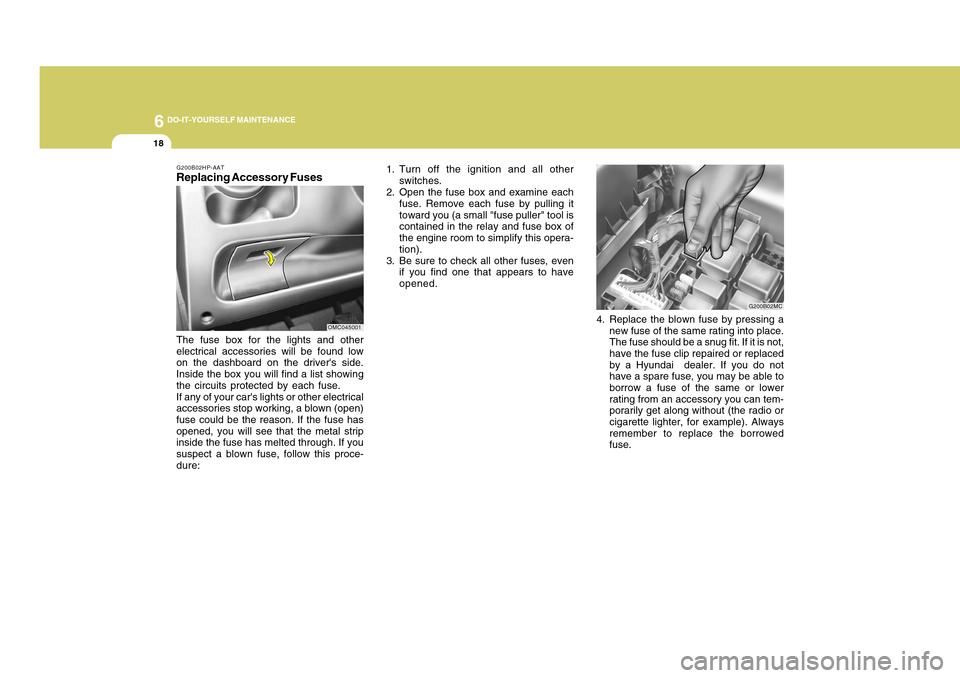
G200B02HP-AATReplacing Accessory FusesThe fuse box for the lights and other
electrical accessories will be found low
on the dashboard on the driver's side.
Inside the box you will find a list showing
the circuits protected by each fuse.
If any of your car's lights or other electrical
accessories stop working, a blown (open)
fuse could be the reason. If the fuse has
opened, you will see that the metal strip
inside the fuse has melted through. If you
suspect a blown fuse, follow this proce-
dure:1. Turn off the ignition and all other
switches.
2. Open the fuse box and examine each
fuse. Remove each fuse by pulling it
toward you (a small "fuse puller" tool is
contained in the relay and fuse box of
the engine room to simplify this opera-
tion).
3. Be sure to check all other fuses, even
if you find one that appears to have
opened.
4. Replace the blown fuse by pressing a
new fuse of the same rating into place.
The fuse should be a snug fit. If it is not,
have the fuse clip repaired or replaced
by a Hyundai dealer. If you do not
have a spare fuse, you may be able to
borrow a fuse of the same or lower
rating from an accessory you can tem-
porarily get along without (the radio or
cigarette lighter, for example). Always
remember to replace the borrowed
fuse.
OMC045001
G200B02MC
Page 237 of 282
6
DO-IT-YOURSELF MAINTENANCE
19
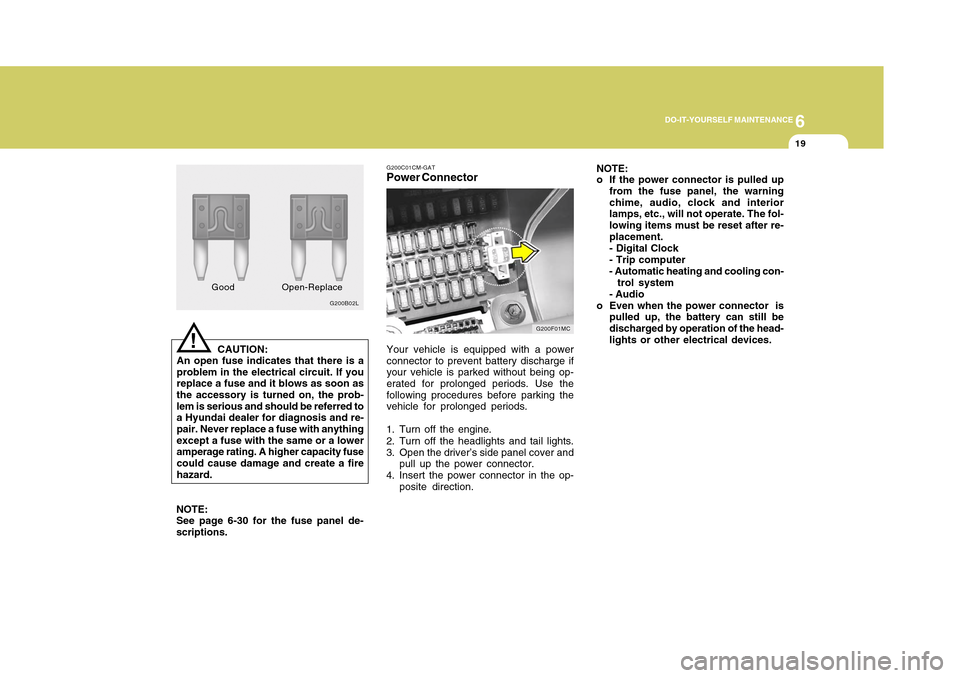
CAUTION:
An open fuse indicates that there is a
problem in the electrical circuit. If you
replace a fuse and it blows as soon as
the accessory is turned on, the prob-
lem is serious and should be referred to
a Hyundai dealer for diagnosis and re-
pair. Never replace a fuse with anything
except a fuse with the same or a lower
amperage rating. A higher capacity fuse
could cause damage and create a fire
hazard.
!
NOTE:
See page 6-30 for the fuse panel de-
scriptions.
G200C01CM-GATPower Connector
NOTE:
o If the power connector is pulled up
from the fuse panel, the warning
chime, audio, clock and interior
lamps, etc., will not operate. The fol-
lowing items must be reset after re-
placement.
- Digital Clock
- Trip computer
- Automatic heating and cooling con-
trol system
- Audio
o Even when the power connector is
pulled up, the battery can still be
discharged by operation of the head-
lights or other electrical devices.
Your vehicle is equipped with a power
connector to prevent battery discharge if
your vehicle is parked without being op-
erated for prolonged periods. Use the
following procedures before parking the
vehicle for prolonged periods.
1. Turn off the engine.
2. Turn off the headlights and tail lights.
3. Open the driver’s side panel cover and
pull up the power connector.
4. Insert the power connector in the op-
posite direction.
G200F01MC
G200B02L
GoodOpen-Replace
Page 238 of 282
6
DO-IT-YOURSELF MAINTENANCE
20
CHECKING THE BATTERY!
G210A01A-AAT
WARNING:
Batteries can be dangerous! When
working with batteries, carefully ob-
serve the following precautions to avoid
serious injuries.o If battery fluid is on your skin, flush the
affected areas with water for at least 15
minutes and then seek medical assis-
tance.
o If battery fluid is in your eyes, rinse out
your eyes with water and get medical
assistance as soon as possible. While
you are being driven to get medical
assistance, continue to rinse your eyes
by using a sponge or soft cloth saturat-
ed with water.
o If you swallow battery fluid, drink a
large quantity of water or milk followed
by milk of magnesia, eat a raw egg or
drink vegetable oil. Get medical assis-
tance as soon as possible.
While batteries are being charged (either
by a battery charger or by the vehicle's
alternator), they produce explosive gases.
Always observe these warnings to pre-
vent injuries from occurring:
o Charge batteries only in a well venti-
lated area.
o Do not permit flames, sparks or smok-
ing in the area.
o Keep children away from the area.
OMC055018
The fluid in the battery contains a strong
solution of sulfuric acid, which is poison-
ous and highly corrosive. Be careful not
to spill it on yourself or the car. If you do
spill battery fluid on yourself, immediately
do the following:
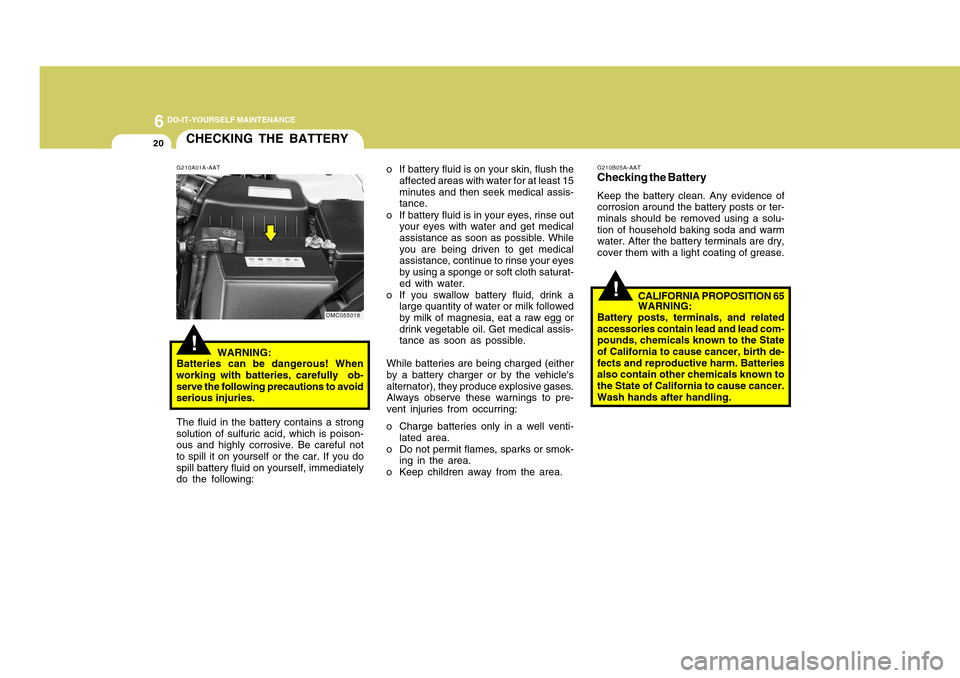
G210B05A-AATChecking the BatteryKeep the battery clean. Any evidence of
corrosion around the battery posts or ter-
minals should be removed using a solu-
tion of household baking soda and warm
water. After the battery terminals are dry,
cover them with a light coating of grease.
!
CALIFORNIA PROPOSITION 65
WARNING:
Battery posts, terminals, and related
accessories contain lead and lead com-
pounds, chemicals known to the State
of California to cause cancer, birth de-
fects and reproductive harm. Batteries
also contain other chemicals known to
the State of California to cause cancer.
Wash hands after handling.
Page 239 of 282
6
DO-IT-YOURSELF MAINTENANCE
21
!
G220A01A-AAT
G220B01A-AATChecking Engine Cooling FanThe engine cooling fan should come on
automatically if the engine coolant tem-
perature is high.WARNING:
The radiator fan is controlled by engine
coolant temperature and may some-
times operate even when the engine is
not running. Use extreme caution when
working near the blades of the cooling
fan, so that you are not injured by a
rotating fan blade. As the coolant tem-
perature decreases the fan will auto-
matically shut off. This is a normal con-
dition.G220C01A-AATChecking Condenser Cooling FanThe condenser cooling fan should come
on automatically whenever the air condi-
tioner is in operation.CHECKING ELECTRIC
COOLING FANS
!
Wear eye protection when
charging or working near a
battery.
Always provide ventilation
when working in an enclosed
space.
An inappropriately disposed
battery can be harmful to the
environment and human
health. Dispose the battery
according to your local law(s)
or regulation.
o When lifting a plastic-cased battery,
excessive pressure on the case may
cause battery acid to leak, resulting
in personal injury. Lift with a battery
carrier or with your hands on oppo-
site corners.
o Never attempt to charge the battery
when the battery cables are con-
nected.
o The electrical ignition system works
with high voltage.
Never touch these components with
the engine running or the ignition
switched on.
WARNING:
Always read the following in-
structions carefully when han-
dling a battery.
Keep lighted cigarettes and
all other flames or sparks
away from the battery.
Hydrogen, which is a highly
combustible gas, is always
present in battery cells and
may explode if ignited.
Keep batteries out of the reach
of children because batteries
contain highly corrosive SUL-
FURIC ACID. Do not allow bat-
tery acid to contact your skin,
eyes, clothing or paint finish.
If any electrolyte gets into
your eyes, flush your eyes
with clean water for at least
15 minutes and get immedi-
ate medical attention. If pos-
sible, continue to apply water
with a sponge or cloth until
medical attention is received.
If electrolyte gets on your skin,
thoroughly wash the con-
tacted area.
If you feel a pain or a burning
sensation, get medical atten-
tion immediately.
!
WARNING:
Page 241 of 282
6
DO-IT-YOURSELF MAINTENANCE
23
Headlight
1. Allow the bulb to cool. Wear eye pro-
tection.
2. Open the engine hood and disconnect
the negative (-) post of the battery.
3. Always grasp the bulb by its plastic
base, avoid touching the glass.
4. Disconnect the power cord from the
back of the headlight.
REPLACEMENT OF LIGHT
BULBS!
G260A01MC-AATBefore attempting to replace a light bulb,
be sure the switch is turned to the "OFF"
position.
The next paragraph shows how to reach
the light bulbs so they may be changed.
Be sure to replace the burned-out bulb
with one of the same number and watt-
age rating.
See page 6-29 for the wattage descrip-
tions.
CAUTION:
o Keep the lamps out of contact with
petroleum products, such as oil,
gasoline, etc.
o If you don't have necessary tools,
the correct bulbs and the expertise,
consult your authorized Hyundai
dealer.
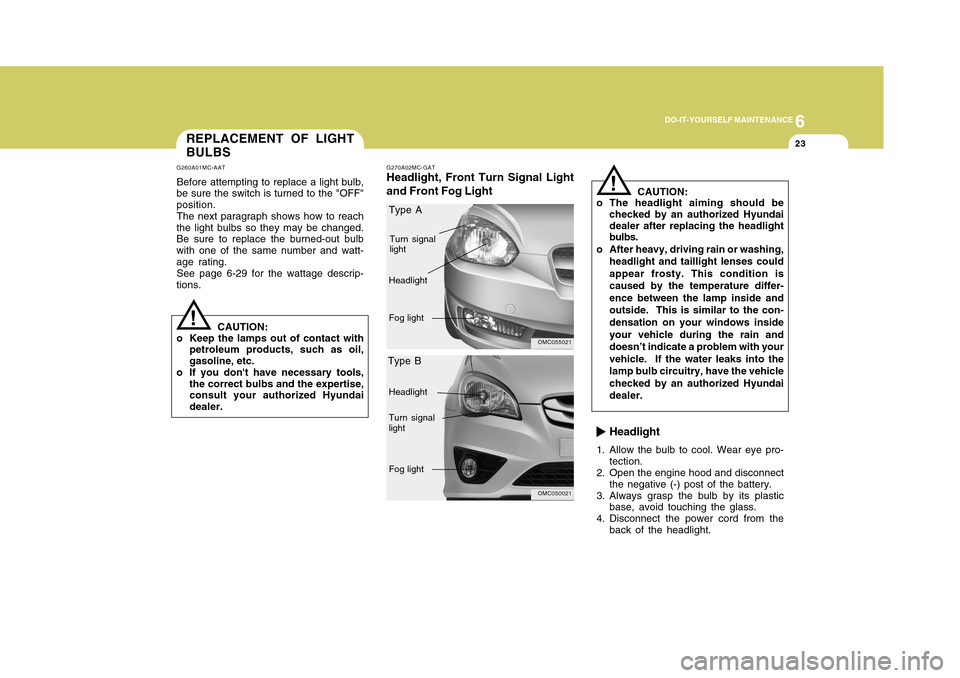
G270A02MC-GATHeadlight, Front Turn Signal Light
and Front Fog Light
CAUTION:
o The headlight aiming should be
checked by an authorized Hyundai
dealer after replacing the headlight
bulbs.
o After heavy, driving rain or washing,
headlight and taillight lenses could
appear frosty. This condition is
caused by the temperature differ-
ence between the lamp inside and
outside. This is similar to the con-
densation on your windows inside
your vehicle during the rain and
doesn’t indicate a problem with your
vehicle. If the water leaks into the
lamp bulb circuitry, have the vehicle
checked by an authorized Hyundai
dealer.
!
OMC055021
Turn signal
light
Headlight
Fog light
OMC050021
Headlight
Turn signal
light
Fog lightType A
Type B