air condition Hyundai Accent 2011 Owner's Manual
[x] Cancel search | Manufacturer: HYUNDAI, Model Year: 2011, Model line: Accent, Model: Hyundai Accent 2011Pages: 282, PDF Size: 14.82 MB
Page 4 of 282
F4
A110A02A-AAT
VEHICLE DATA COLLECTION AND EVENT DATA RECORDERS
This vehicle is equipped with an event data recorder (EDR). The main purpose of an EDR is to
record, in certain crash or near crash-like situations, such as an air bag deployment or hitting
a road obstacle, data that will assist in understanding how a vehicle's systems performed. The
EDR is designed to record data related to vehicle dynamics and safety systems for a short
period of time, typically 30 seconds or less. The EDR in this vehicle is designed to record such
data as:
o How various systems in your vehicle were operating;
o Whether or not the driver and passenger safety belts were buckled/fastened;
These data can help provide a better understanding of the circumstances in which crashes and
injuries occur. NOTE: EDR data are recorded by your vehicle only if a non-trivial crash situation
occurs; no data are recorded by the EDR under normal driving conditions and no personal data
(e.g., name, gender, age, and crash location) are recorded. However, other parties, such as law
enforcement, could combine the EDR data with the type of personally identifying data routinely
acquired during a crash investigation.
To read data recorded by an EDR, special equipment is required, and access to the vehicle or
the EDR is needed. In addition to the vehicle manufacturer, other parties, such as law
enforcement, that have the special equipment, can read the information if they have access to
the vehicle or the EDR.
Page 9 of 282
F9
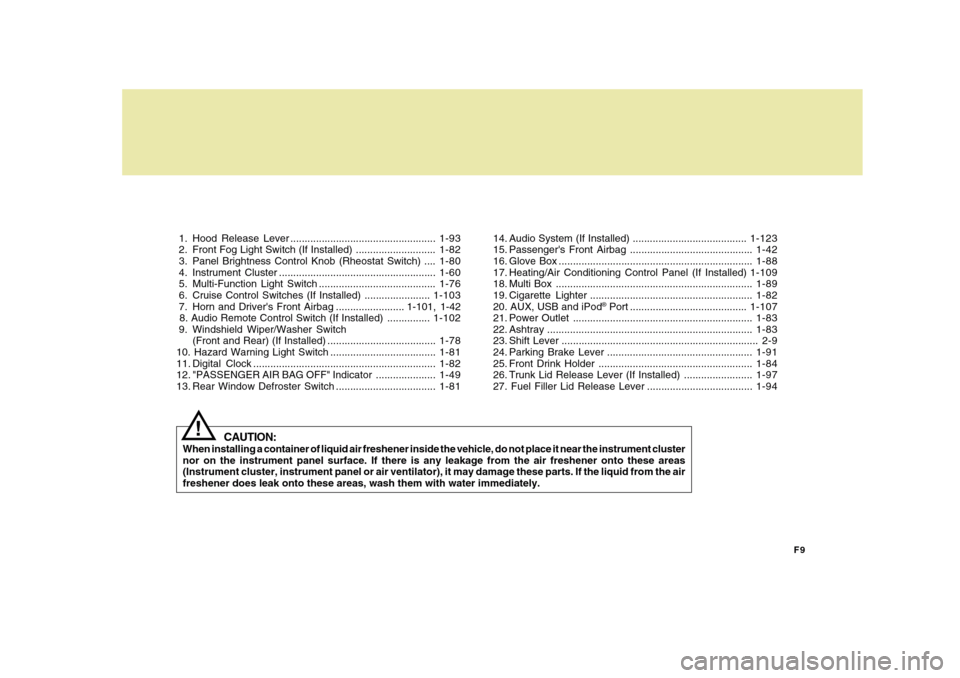
1. Hood Release Lever ...................................................1-93
2. Front Fog Light Switch (If Installed) ............................1-82
3. Panel Brightness Control Knob (Rheostat Switch) ....1-80
4. Instrument Cluster .......................................................1-60
5. Multi-Function Light Switch .........................................1-76
6. Cruise Control Switches (If Installed) .......................1-103
7. Horn and Driver's Front Airbag ........................ 1-101, 1-42
8. Audio Remote Control Switch (If Installed) ...............1-102
9. Windshield Wiper/Washer Switch
(Front and Rear) (If Installed) ......................................1-78
10. Hazard Warning Light Switch .....................................1-81
11. Digital Clock ................................................................1-82
12. "PASSENGER AIR BAG OFF" Indicator .....................1-49
13. Rear Window Defroster Switch ...................................1-8114. Audio System (If Installed) ........................................1-123
15. Passenger's Front Airbag ...........................................1-42
16. Glove Box ....................................................................1-88
17. Heating/Air Conditioning Control Panel (If Installed)1-109
18. Multi Box .....................................................................1-89
19. Cigarette Lighter .........................................................1-82
20. AUX, USB and iPod
® Port .........................................1-107
21. Power Outlet ...............................................................1-83
22. Ashtray........................................................................1-83
23. Shift Lever ..................................................................... 2-9
24. Parking Brake Lever ...................................................1-91
25. Front Drink Holder ......................................................1-84
26. Trunk Lid Release Lever (If Installed) ........................1-97
27. Fuel Filler Lid Release Lever .....................................1-94
CAUTION:
When installing a container of liquid air freshener inside the vehicle, do not place it near the instrument cluster
nor on the instrument panel surface. If there is any leakage from the air freshener onto these areas
(Instrument cluster, instrument panel or air ventilator), it may damage these parts. If the liquid from the air
freshener does leak onto these areas, wash them with water immediately.
!
Page 49 of 282
1FEATURES OF YOUR HYUNDAI38
!
WARNING:
o If the retractor is not in the Auto-
matic Locking mode, the child re-
straint can move when your vehicle
turns or stops suddenly. A child can
be seriously injured or killed if the
child restraint is not properly an-
chored to the car, including setting
the retractor to the Automatic Lock-
ing mode.
o Do not install any child restraint sys-
tem in the front passenger seat.
Should an accident occur and cause
the passenger side airbag to deploy,
it could severely injure or kill an
infant or child seated in an infant or
child seat. Therefore, only use a child
restraint system in the rear seat of
your vehicle.
o Before installing a Child Restraint
System to vehicles fitted with Curtain
Airbags, always refer to safety no-
tices for Curtain Airbag systems in
this manual. Whenever installing child
restraints, use only approved devices
and refer to the "Child Restraint Sys-
tem" section to ensure correct instal-
lation and that occupant protection is
maximized. If the retractor is in the automatic locking
mode, the belt will be locked. After instal-
lation of the child restraint system, try to
move it in all directions to be sure the
child restraint system is securely installed.
If you need to tighten the belt, pull more
webbing toward the retractor. When you
unbuckle the seat belt and allow it to
retract, the retractor will automatically
revert back to its normal seated passen-
ger emergency locking usage condition.
NOTE:o Before installing the child restraint
system, read the instructions sup-
plied by the child restraint system
manufacturer.
o If the seat belt does not operate as
described, have the system checked
immediately by your authorized
Hyundai dealer.
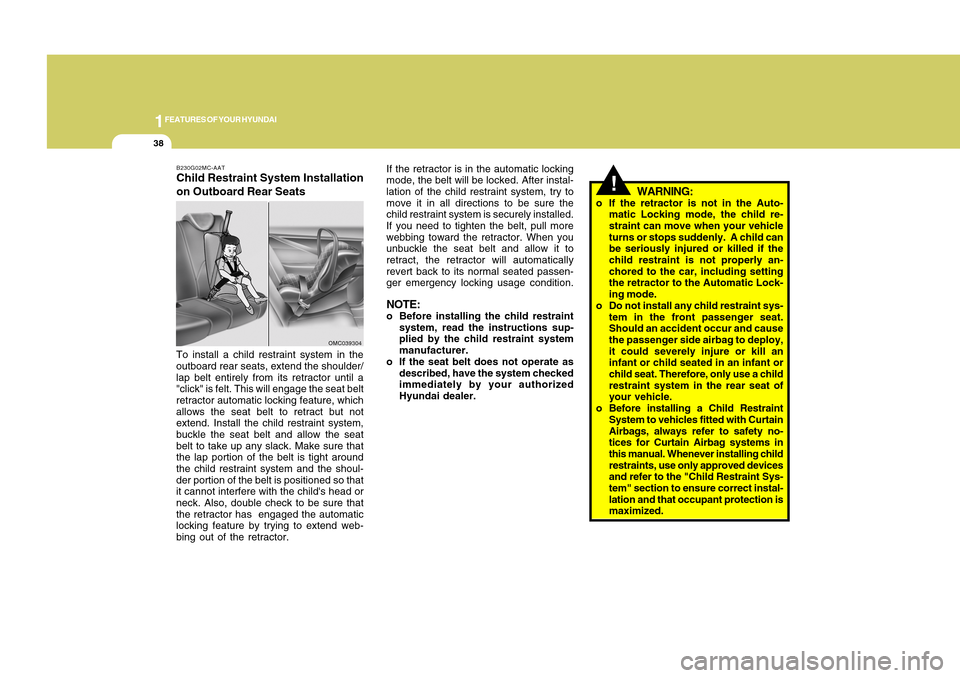
To install a child restraint system in the
outboard rear seats, extend the shoulder/
lap belt entirely from its retractor until a
"click" is felt. This will engage the seat belt
retractor automatic locking feature, which
allows the seat belt to retract but not
extend. Install the child restraint system,
buckle the seat belt and allow the seat
belt to take up any slack. Make sure that
the lap portion of the belt is tight around
the child restraint system and the shoul-
der portion of the belt is positioned so that
it cannot interfere with the child's head or
neck. Also, double check to be sure that
the retractor has engaged the automatic
locking feature by trying to extend web-
bing out of the retractor.B230G02MC-AATChild Restraint System Installation
on Outboard Rear Seats
OMC039304
Page 51 of 282
1FEATURES OF YOUR HYUNDAI40
!
!
WARNING:
o Pre-tensioners are designed to op-
erate only one time. After activation,
pre-tensioner seat belts must be
replaced. All seat belts, of any type,
should always be replaced after they
have been worn during a collision.
o The pre-tensioner seat belt assem-
bly mechanisms become hot during
activation. Do not touch the pre-
tensioner seat belt assemblies for
several minutes after they have been
activated.o Do not attempt to inspect or replace
the pre-tensioner seat belts your-
self. This must be done by an autho-
rized Hyundai dealer.
o Do not strike the pre-tensioner seat
belt assemblies.
o Do not attempt to service or repair
the pre-tensioner seat belt system in
any manner.
o Improper handling of the pre-
tensioner seat belt assemblies, and
failure to heed the warnings to not
strike, modify, inspect, replace, ser-
vice or repair the pre-tensioner seat
belt assemblies may lead to improp-
er operation or inadvertent activa-
tion and serious injury.
o Always wear the seat belts when
driving or riding in a motor vehicle.
o If the vehicle or pre-tensioner seat
belt must be discarded, contact an
authorized HYUNDAI dealer.
WARNING:
CAUTION:
o The sensor that activates the SRS
airbag is connected with the pre-
tensioner seat belt. The SRS airbag
warning light on the instrument
panel will illuminate for approximately
6 seconds after the ignition key has
been turned to the "ON" position,
and then it should turn off.
o If the pre-tensioner seat belt is not
working properly, this warning light
will illuminate even if there is no mal-
function of the SRS airbag.
!
o When the pre-tensioner seat belts
are activated, a loud noise may be
heard and fine dust, which may ap-
pear to be smoke, may be visible in
the passenger compartment. These
are normal operating conditions and
are not hazardous.
o Although it is harmless, the fine dust
may cause skin irritation and should
not be breathed for prolonged peri-
ods. Wash your hands and face thor-
oughly after an accident in which the
pre-tensioner seat belts were acti-
vated.If the SRS airbag warning light does
not illuminate when the ignition key
is turned to the "ON" position, re-
mains illuminated after approxi-
mately 6 seconds when the ignition
key is turned to the "ON" position, or
if it illuminates while the vehicle is
being driven, have an authorized
Hyundai dealer inspect the advanced
SRS airbag system as soon as pos-
sible.
Page 60 of 282
1
FEATURES OF YOUR HYUNDAI
491
FEATURES OF YOUR HYUNDAI
49
!
o Before you replace a fuse or discon-
nect a battery terminal, turn the igni-
tion key to the "LOCK" position and
remove the ignition key. Never re-
move or replace the airbag related
fuse(s) when the ignition key is in the
"ON" position. Failure to heed this
warning will cause the SRS "AIR
BAG" warning light to illuminate.
WARNING:
The occupant classification system cre-
ates a field which is designed to detect
the presence of a properly-seated front
passenger and determine if the
passenger's front air bag should be en-
abled (may inflate) or not. The driver's
front air bag is not affected or controlled
by the occupant classification system.Main components of occupant clas-
sification system• An Electronic Capacity measurement
system in the front passenger seat
which detects major characteristics of
a person or object on the seat.
Electronic system to determine whether
the passenger air bag systems (both
front and side) should be activated or
deactivated.
A warning light located on the instru-
ment panel which illuminates the words
"PASSENGER AIR BAG OFF" indicat-
ing the front passenger air bag system
is deactivated.
The instrument panel air bag warning
light is interconnected with the occu-
pant classification system.
OMC029200N
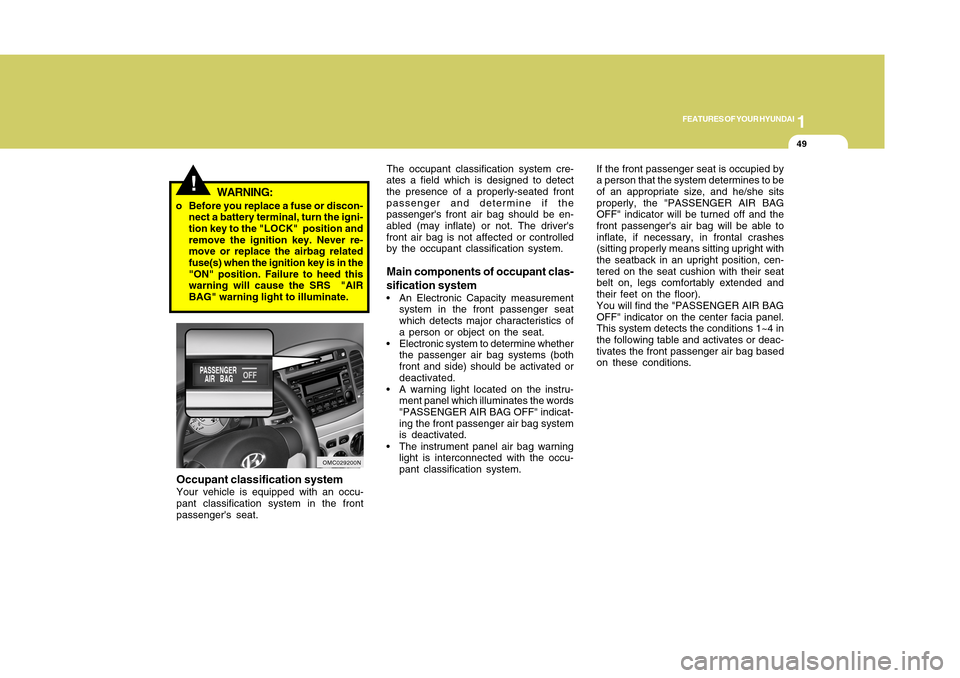
Occupant classification systemYour vehicle is equipped with an occu-
pant classification system in the front
passenger's seat.If the front passenger seat is occupied by
a person that the system determines to be
of an appropriate size, and he/she sits
properly, the "PASSENGER AIR BAG
OFF" indicator will be turned off and the
front passenger's air bag will be able to
inflate, if necessary, in frontal crashes
(sitting properly means sitting upright with
the seatback in an upright position, cen-
tered on the seat cushion with their seat
belt on, legs comfortably extended and
their feet on the floor).
You will find the "PASSENGER AIR BAG
OFF" indicator on the center facia panel.
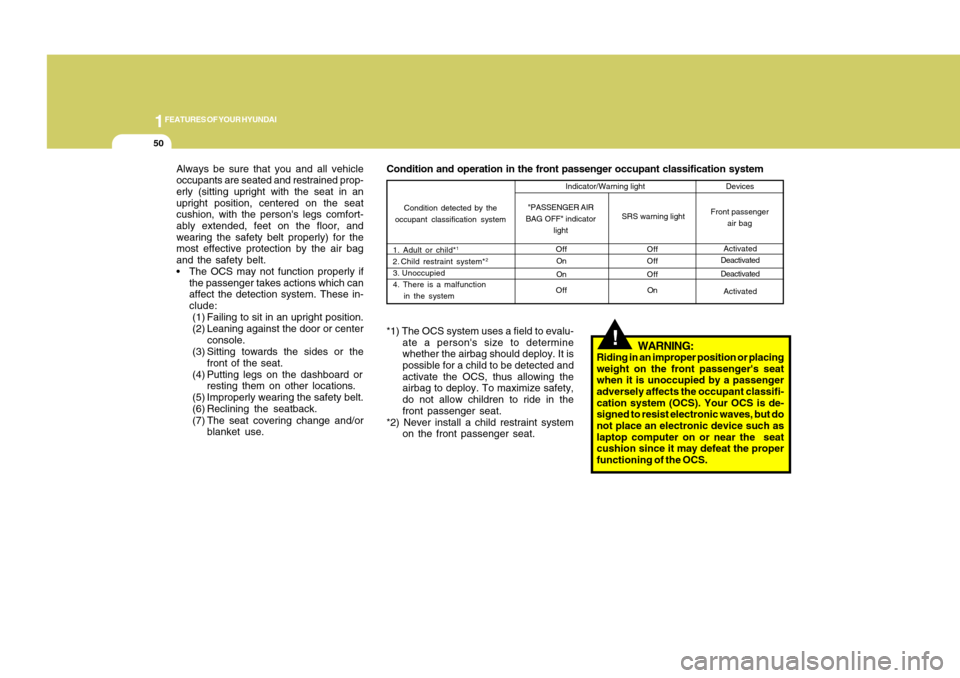
This system detects the conditions 1~4 in
the following table and activates or deac-
tivates the front passenger air bag based
on these conditions.
Page 61 of 282
1FEATURES OF YOUR HYUNDAI50
Condition detected by the
occupant classification system"PASSENGER AIR
BAG OFF" indicator
lightSRS warning lightFront passenger
air bag Indicator/Warning light Devices
1. Adult or child*
1
2. Child restraint system*
2
3. Unoccupied
4. There is a malfunction
in the system
Off
On
On
Off
Activated
Deactivated
Deactivated
Activated
*1) The OCS system uses a field to evalu-
ate a person's size to determine
whether the airbag should deploy. It is
possible for a child to be detected and
activate the OCS, thus allowing the
airbag to deploy. To maximize safety,
do not allow children to ride in the
front passenger seat.
*2) Never install a child restraint system
on the front passenger seat. Condition and operation in the front passenger occupant classification system
!
WARNING:
Riding in an improper position or placing
weight on the front passenger's seat
when it is unoccupied by a passenger
adversely affects the occupant classifi-
cation system (OCS). Your OCS is de-
signed to resist electronic waves, but do
not place an electronic device such as
laptop computer on or near the seat
cushion since it may defeat the proper
functioning of the OCS.
Off
Off
Off
On
Always be sure that you and all vehicle
occupants are seated and restrained prop-
erly (sitting upright with the seat in an
upright position, centered on the seat
cushion, with the person's legs comfort-
ably extended, feet on the floor, and
wearing the safety belt properly) for the
most effective protection by the air bag
and the safety belt.
The OCS may not function properly if
the passenger takes actions which can
affect the detection system. These in-
clude:
(1) Failing to sit in an upright position.
(2) Leaning against the door or center
console.
(3) Sitting towards the sides or the
front of the seat.
(4) Putting legs on the dashboard or
resting them on other locations.
(5) Improperly wearing the safety belt.
(6) Reclining the seatback.
(7) The seat covering change and/or
blanket use.
Page 65 of 282
1FEATURES OF YOUR HYUNDAI54
!
WARNING:
If the occupant classification system is
not working properly, the SRS air bag
warning light on the instrument panel
will illuminate because the passenger's
front air bag is connected with the occu-
pant classification system. If there is a
malfunction of the occupant classifica-
tion system, the "PASSENGER AIR BAG
OFF" indicator will not illuminate and the
passenger's front air bag will inflate in
frontal impact crashes even if there is no
occupant in the front passenger's seat.
If the SRS air bag warning light does not
illuminate when the ignition switch is
turned to the ON position, remains illu-
minated after approximately 6 seconds
when the ignition switch is turned to the
ON position, or if it illuminates while the
vehicle is being driven, have an autho-
rized HYUNDAI dealer inspect the occu-
pant classification system and the SRS
air bag system as soon as possible.
!
WARNING:
o Accident statistics show that chil-
dren are safer if they are restrained
in the rear, as opposed to the front
seat. It is recommended that child
restraints be secured in a rear seat,
including an infant riding in a rear-
facing infant seat, a child riding in a
forward-facing child seat and an older
child riding in a booster seat.
o Air bags can only be used once –
have an authorized HYUNDAI dealer
replace the air bag immediately after
deployment.
o The occupant classification system
may not work properly if water, cof-
fee or any other liquid including rain
gets on the seat. Keep the front seat
dry at all times.
o Do not place an electronic device
such as a laptop computer on the
front passenger seat. Its electronic
field may cause the OCS to switch to
the "on" condition and thus allow the
passenger airbag to deploy need-
lessly in a collision, increasing your
repair costs.
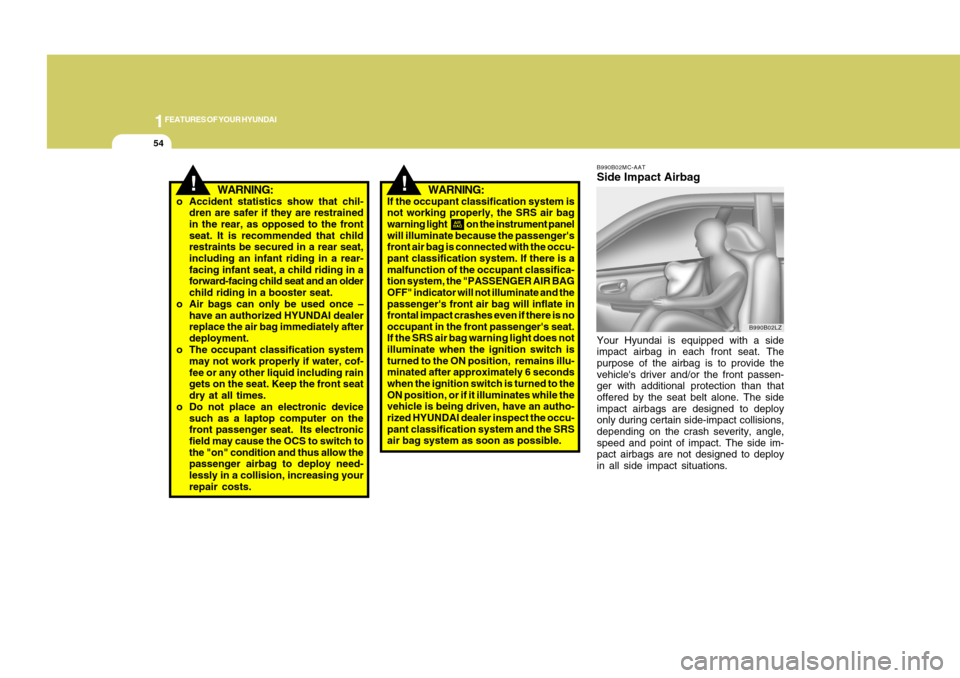
B990B02MC-AATSide Impact AirbagYour Hyundai is equipped with a side
impact airbag in each front seat. The
purpose of the airbag is to provide the
vehicle's driver and/or the front passen-
ger with additional protection than that
offered by the seat belt alone. The side
impact airbags are designed to deploy
only during certain side-impact collisions,
depending on the crash severity, angle,
speed and point of impact. The side im-
pact airbags are not designed to deploy
in all side impact situations.
B990B02LZ
Page 66 of 282
1
FEATURES OF YOUR HYUNDAI
551
FEATURES OF YOUR HYUNDAI
55
WARNING:
o The side impact airbag is supple-
mental to the driver's and the
passenger's seat belt systems and
is not a substitute for them. There-
fore your seat belts must be worn at
all times while the vehicle is in mo-
tion. The airbags deploy only in cer-
tain side impact conditions severe
enough to cause significant injury to
the vehicle occupants.
o For best protection from the side
impact airbag system and to avoid
being injured by the deploying side
impact airbag, both front seat occu-
pants should sit in an upright posi-
tion with the seat belt properly fas-
tened. The driver's hands should be
placed on the steering wheel at the
9:00 and 3:00 positions. The
passenger's arms and hands should
be placed on their laps.
o Do not use any accessory seat cov-
ers.
Use of seat covers could reduce or
prevent the effectiveness of the sys-
tem.
!
B990B01MC
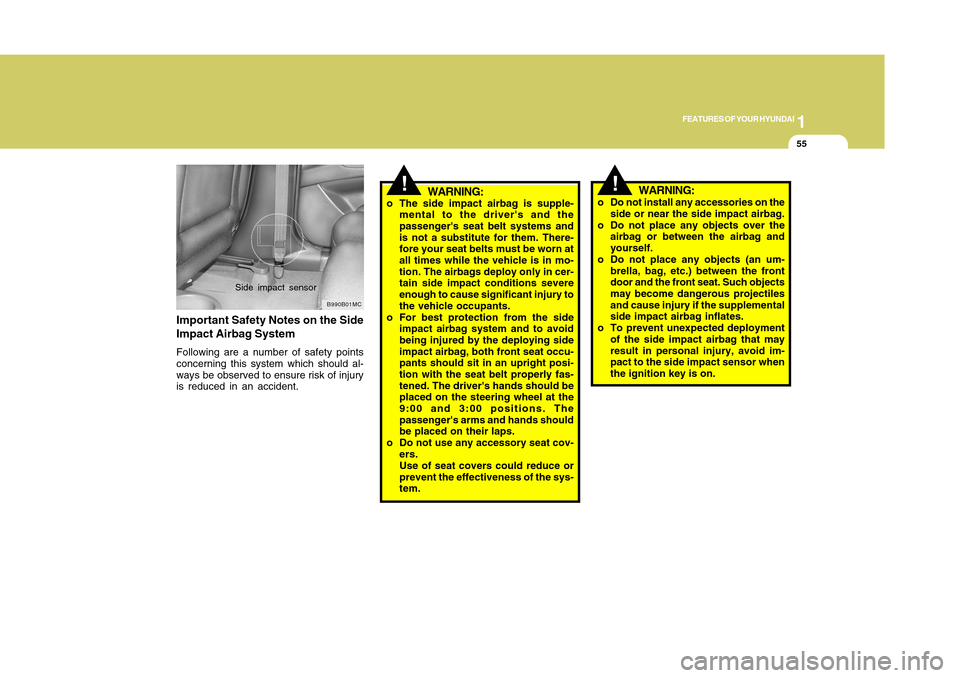
Side impact sensor
Important Safety Notes on the Side
Impact Airbag SystemFollowing are a number of safety points
concerning this system which should al-
ways be observed to ensure risk of injury
is reduced in an accident.
!
o Do not install any accessories on the
side or near the side impact airbag.
o Do not place any objects over the
airbag or between the airbag and
yourself.
o Do not place any objects (an um-
brella, bag, etc.) between the front
door and the front seat. Such objects
may become dangerous projectiles
and cause injury if the supplemental
side impact airbag inflates.
o To prevent unexpected deployment
of the side impact airbag that may
result in personal injury, avoid im-
pact to the side impact sensor when
the ignition key is on.
WARNING:
Page 120 of 282
1
FEATURES OF YOUR HYUNDAI
1091
FEATURES OF YOUR HYUNDAI
109
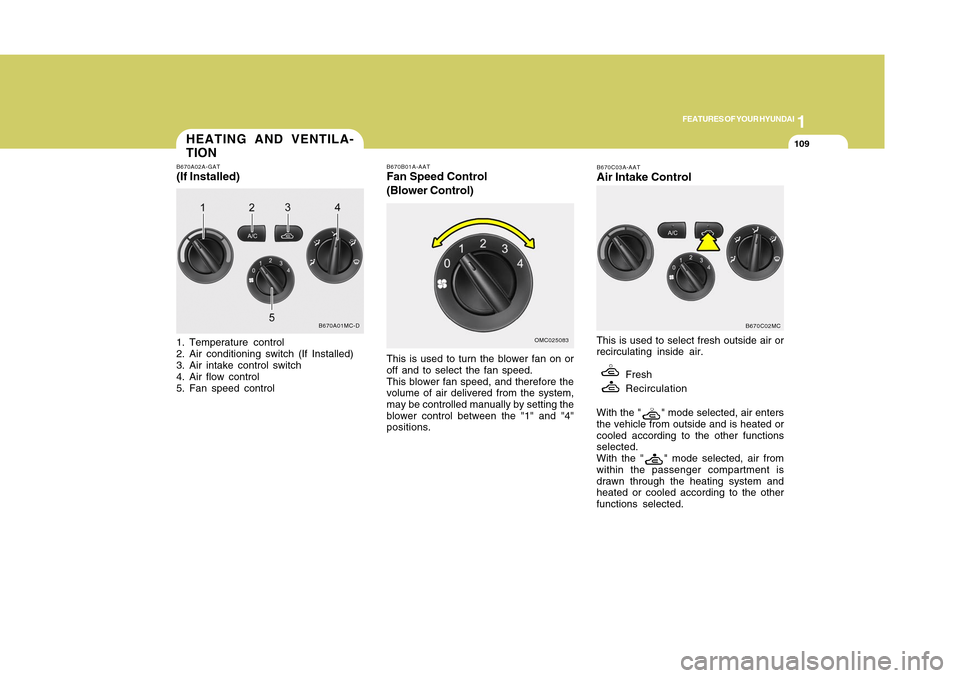
1. Temperature control
2. Air conditioning switch (If Installed)
3. Air intake control switch
4. Air flow control
5. Fan speed control
B670B01A-AATFan Speed Control
(Blower Control)This is used to turn the blower fan on or
off and to select the fan speed.
This blower fan speed, and therefore the
volume of air delivered from the system,
may be controlled manually by setting the
blower control between the "1" and "4"
positions.
B670A01MC-D
OMC025083B670C03A-AAT
Air Intake Control
B670C02MC
This is used to select fresh outside air or
recirculating inside air.
Fresh
Recirculation
With the "
" mode selected, air enters
the vehicle from outside and is heated or
cooled according to the other functions
selected.
With the "" mode selected, air from
within the passenger compartment is
drawn through the heating system and
heated or cooled according to the other
functions selected.
HEATING AND VENTILA-
TIONB670A02A-GAT(If Installed)
Page 121 of 282
1FEATURES OF YOUR HYUNDAI
110
NOTE:It should be noted that prolonged opera-
tion of the intake air system in "
"
mode will give rise to misting of the
windshield and side windows and the air
within the passenger compartment will
become stale. In addition prolonged use
of the air conditioning with the ""
mode selected may result in the air within
the passenger compartment becoming
excessively dry.
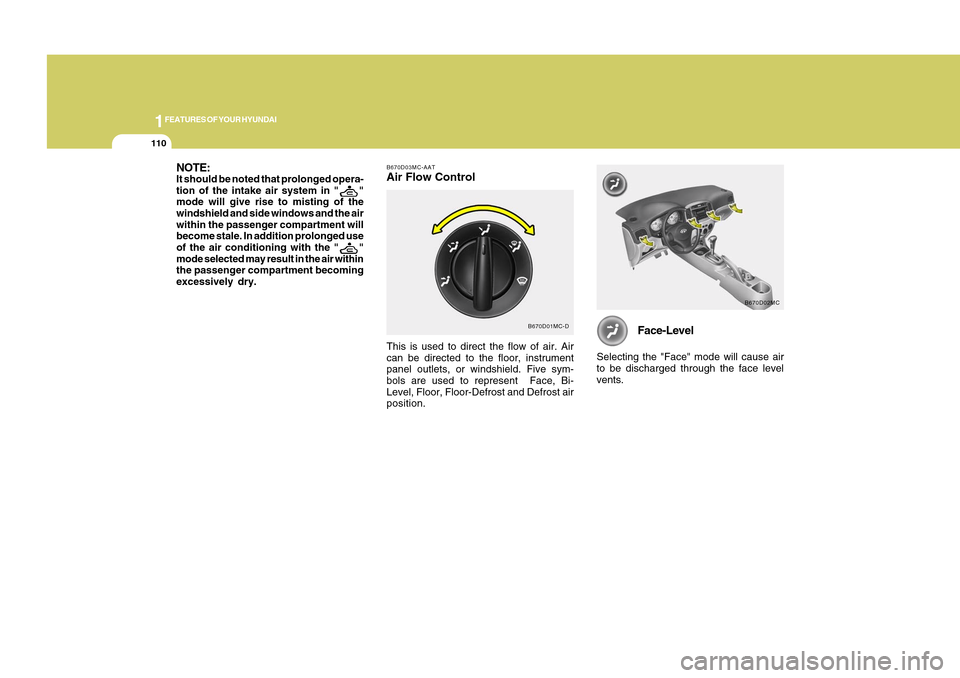
B670D03MC-AATAir Flow ControlThis is used to direct the flow of air. Air
can be directed to the floor, instrument
panel outlets, or windshield. Five sym-
bols are used to represent Face, Bi-
Level, Floor, Floor-Defrost and Defrost air
position.
B670D01MC-D
Face-Level
Selecting the "Face" mode will cause air
to be discharged through the face level
vents.
B670D02MC