fuel cap Hyundai Accent 2011 Owner's Manual
[x] Cancel search | Manufacturer: HYUNDAI, Model Year: 2011, Model line: Accent, Model: Hyundai Accent 2011Pages: 282, PDF Size: 14.82 MB
Page 10 of 282
YOUR VEHICLE AT A GLANCE
F10
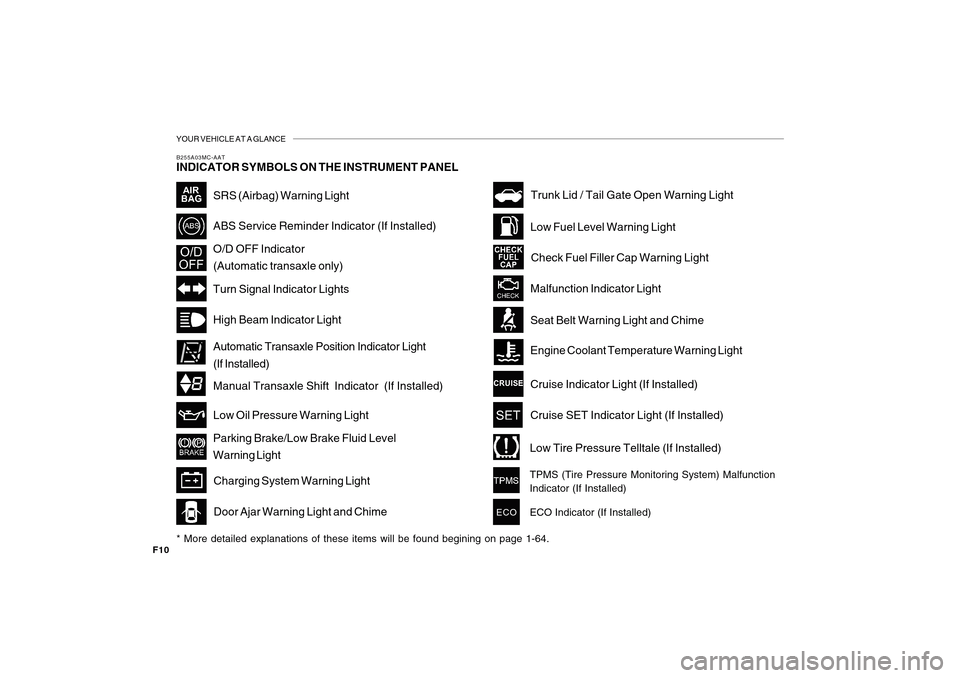
B255A03MC-AATINDICATOR SYMBOLS ON THE INSTRUMENT PANEL* More detailed explanations of these items will be found begining on page 1-64.
SRS (Airbag) Warning LightHigh Beam Indicator LightLow Oil Pressure Warning LightParking Brake/Low Brake Fluid Level
Warning LightCharging System Warning Light
Door Ajar Warning Light and Chime
Trunk Lid / Tail Gate Open Warning LightLow Fuel Level Warning Light
Check Fuel Filler Cap Warning LightMalfunction Indicator LightSeat Belt Warning Light and ChimeEngine Coolant Temperature Warning LightCruise Indicator Light (If Installed)Cruise SET Indicator Light (If Installed)Low Tire Pressure Telltale (If Installed)TPMS (Tire Pressure Monitoring System) Malfunction
Indicator (If Installed)
ECO
ECO Indicator (If Installed)
ABS Service Reminder Indicator (If Installed)O/D OFF Indicator
(Automatic transaxle only)Turn Signal Indicator Lights
Manual Transaxle Shift Indicator (If Installed) Automatic Transaxle Position Indicator Light
(If Installed)
Page 13 of 282
1FEATURES OF YOUR HYUNDAI2
!
B010F01A-AATOperation in Foreign CountriesIf you are going to drive your Hyundai in
another country, be sure to:
o Observe all regulations regarding reg-
istration and insurance.
o Determine that acceptable fuel is avail-
able.B010E01A-AATGasolines for Cleaner AirTo help contribute to cleaner air, Hyundai
recommends you use gasolines treated
with detergent additives, which help pre-
vent deposit formation in the engine.
These gasolines will help the engine run
cleaner and enhance performance of the
Emission Control System.
FUEL RECOMMENDATIONS
UNLEADED
FUEL ONLY
B010A01MC-A B010A02MC-AAT
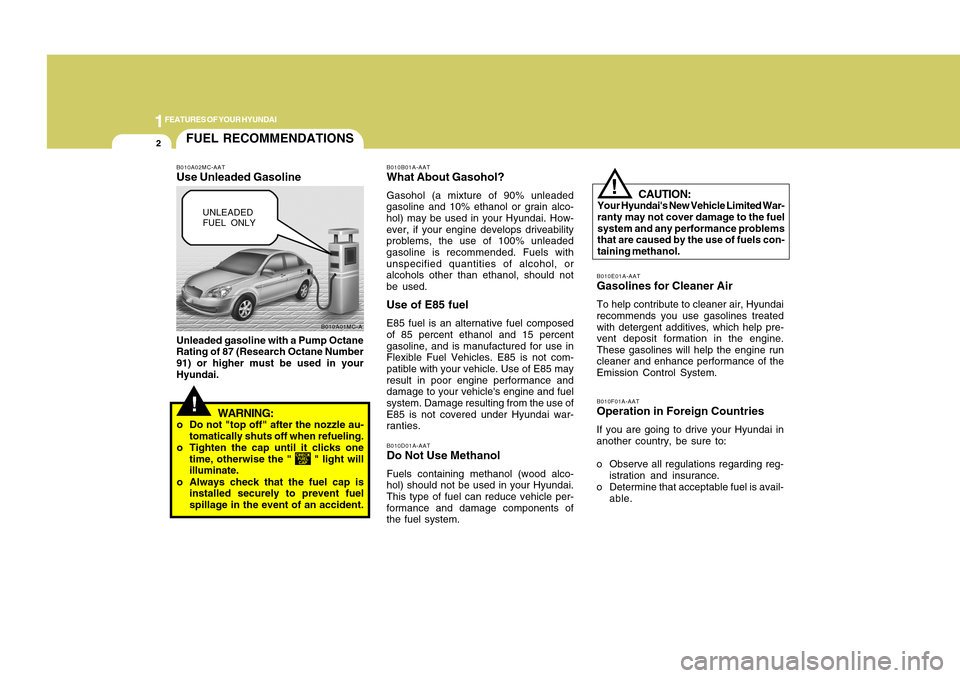
Use Unleaded GasolineUnleaded gasoline with a Pump Octane
Rating of 87 (Research Octane Number
91) or higher must be used in your
Hyundai.
B010B01A-AATWhat About Gasohol?Gasohol (a mixture of 90% unleaded
gasoline and 10% ethanol or grain alco-
hol) may be used in your Hyundai. How-
ever, if your engine develops driveability
problems, the use of 100% unleaded
gasoline is recommended. Fuels with
unspecified quantities of alcohol, or
alcohols other than ethanol, should not
be used.B010D01A-AATDo Not Use MethanolFuels containing methanol (wood alco-
hol) should not be used in your Hyundai.
This type of fuel can reduce vehicle per-
formance and damage components of
the fuel system.
CAUTION:
Your Hyundai's New Vehicle Limited War-
ranty may not cover damage to the fuel
system and any performance problems
that are caused by the use of fuels con-
taining methanol.
!
WARNING:
o Do not "top off" after the nozzle au-
tomatically shuts off when refueling.
o Tighten the cap until it clicks one
time, otherwise the "
" light will
illuminate.
o Always check that the fuel cap is
installed securely to prevent fuel
spillage in the event of an accident.
Use of E85 fuelE85 fuel is an alternative fuel composed
of 85 percent ethanol and 15 percent
gasoline, and is manufactured for use in
Flexible Fuel Vehicles. E85 is not com-
patible with your vehicle. Use of E85 may
result in poor engine performance and
damage to your vehicle's engine and fuel
system. Damage resulting from the use of
E85 is not covered under Hyundai war-
ranties.
Page 72 of 282
1
FEATURES OF YOUR HYUNDAI
611
FEATURES OF YOUR HYUNDAI
61
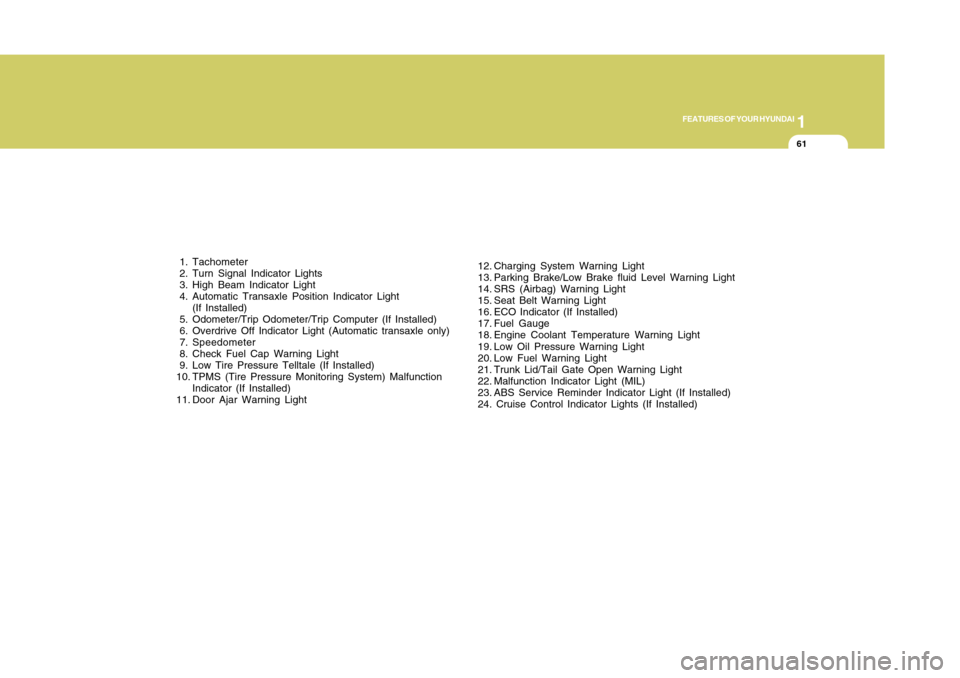
1. Tachometer
2. Turn Signal Indicator Lights
3. High Beam Indicator Light
4. Automatic Transaxle Position Indicator Light
(If Installed)
5. Odometer/Trip Odometer/Trip Computer (If Installed)
6. Overdrive Off Indicator Light (Automatic transaxle only)
7. Speedometer
8. Check Fuel Cap Warning Light
9. Low Tire Pressure Telltale (If Installed)
10. TPMS (Tire Pressure Monitoring System) Malfunction
Indicator (If Installed)
11. Door Ajar Warning Light12. Charging System Warning Light
13. Parking Brake/Low Brake fluid Level Warning Light
14. SRS (Airbag) Warning Light
15. Seat Belt Warning Light
16. ECO Indicator (If Installed)
17. Fuel Gauge
18. Engine Coolant Temperature Warning Light
19. Low Oil Pressure Warning Light
20. Low Fuel Warning Light
21. Trunk Lid/Tail Gate Open Warning Light
22. Malfunction Indicator Light (MIL)
23. ABS Service Reminder Indicator Light (If Installed)
24. Cruise Control Indicator Lights (If Installed)
Page 74 of 282
1
FEATURES OF YOUR HYUNDAI
631
FEATURES OF YOUR HYUNDAI
63
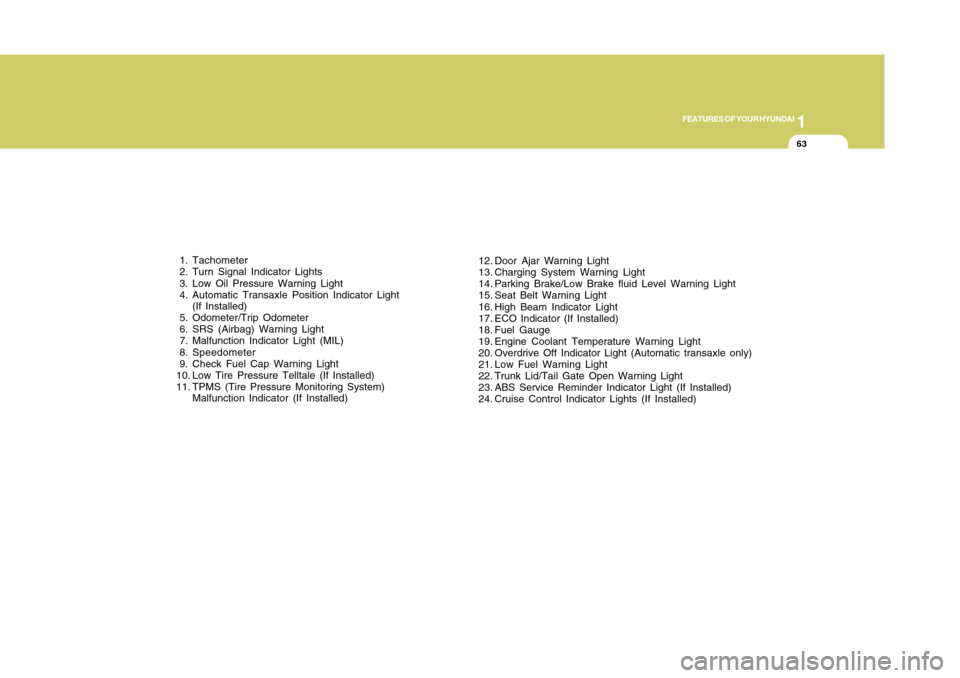
12. Door Ajar Warning Light
13. Charging System Warning Light
14. Parking Brake/Low Brake fluid Level Warning Light
15. Seat Belt Warning Light
16. High Beam Indicator Light
17. ECO Indicator (If Installed)
18. Fuel Gauge
19. Engine Coolant Temperature Warning Light
20. Overdrive Off Indicator Light (Automatic transaxle only)
21. Low Fuel Warning Light
22. Trunk Lid/Tail Gate Open Warning Light
23. ABS Service Reminder Indicator Light (If Installed)
24. Cruise Control Indicator Lights (If Installed) 1. Tachometer
2. Turn Signal Indicator Lights
3. Low Oil Pressure Warning Light
4. Automatic Transaxle Position Indicator Light
(If Installed)
5. Odometer/Trip Odometer
6. SRS (Airbag) Warning Light
7. Malfunction Indicator Light (MIL)
8. Speedometer
9. Check Fuel Cap Warning Light
10. Low Tire Pressure Telltale (If Installed)
11. TPMS (Tire Pressure Monitoring System)
Malfunction Indicator (If Installed)
Page 77 of 282
1FEATURES OF YOUR HYUNDAI66
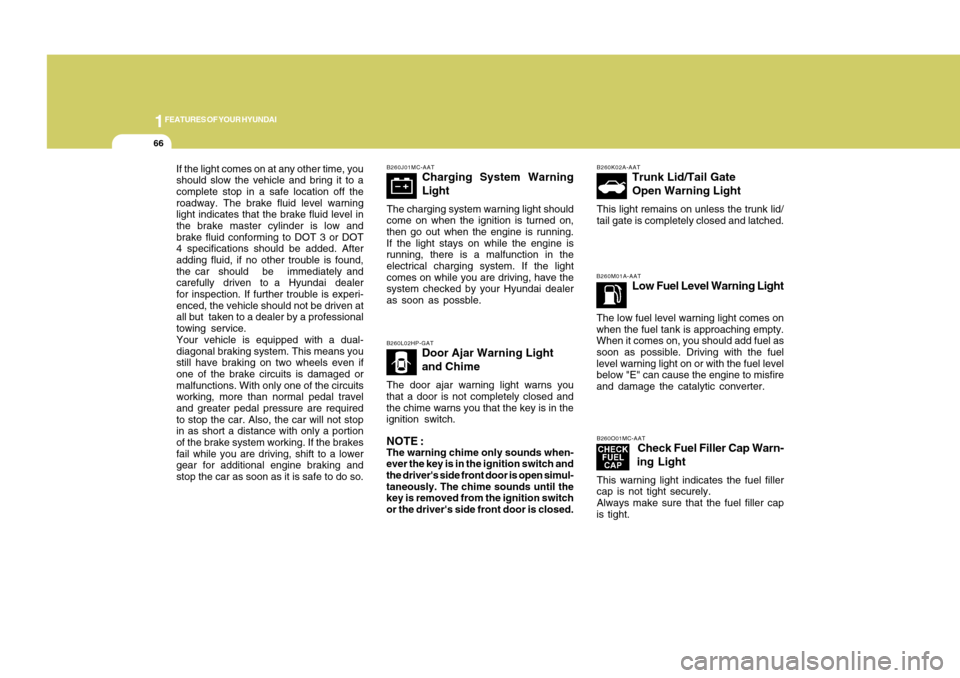
B260J01MC-AAT
Charging System Warning
Light
The charging system warning light should
come on when the ignition is turned on,
then go out when the engine is running.
If the light stays on while the engine is
running, there is a malfunction in the
electrical charging system. If the light
comes on while you are driving, have the
system checked by your Hyundai dealer
as soon as possble.
B260M01A-AAT
Low Fuel Level Warning Light
The low fuel level warning light comes on
when the fuel tank is approaching empty.
When it comes on, you should add fuel as
soon as possible. Driving with the fuel
level warning light on or with the fuel level
below "E" can cause the engine to misfire
and damage the catalytic converter.
B260L02HP-GAT
Door Ajar Warning Light
and Chime
The door ajar warning light warns you
that a door is not completely closed and
the chime warns you that the key is in the
ignition switch.NOTE :The warning chime only sounds when-
ever the key is in the ignition switch and
the driver's side front door is open simul-
taneously. The chime sounds until the
key is removed from the ignition switch
or the driver's side front door is closed.
B260K02A-AAT
Trunk Lid/Tail Gate
Open Warning Light
This light remains on unless the trunk lid/
tail gate is completely closed and latched.B260O01MC-AAT
Check Fuel Filler Cap Warn-
ing Light
This warning light indicates the fuel filler
cap is not tight securely.
Always make sure that the fuel filler cap
is tight.
If the light comes on at any other time, you
should slow the vehicle and bring it to a
complete stop in a safe location off the
roadway. The brake fluid level warning
light indicates that the brake fluid level in
the brake master cylinder is low and
brake fluid conforming to DOT 3 or DOT
4 specifications should be added. After
adding fluid, if no other trouble is found,
the car should be immediately and
carefully driven to a Hyundai dealer
for inspection. If further trouble is experi-
enced, the vehicle should not be driven at
all but taken to a dealer by a professional
towing service.
Your vehicle is equipped with a dual-
diagonal braking system. This means you
still have braking on two wheels even if
one of the brake circuits is damaged or
malfunctions. With only one of the circuits
working, more than normal pedal travel
and greater pedal pressure are required
to stop the car. Also, the car will not stop
in as short a distance with only a portion
of the brake system working. If the brakes
fail while you are driving, shift to a lower
gear for additional engine braking and
stop the car as soon as it is safe to do so.
Page 78 of 282
1
FEATURES OF YOUR HYUNDAI
671
FEATURES OF YOUR HYUNDAI
67
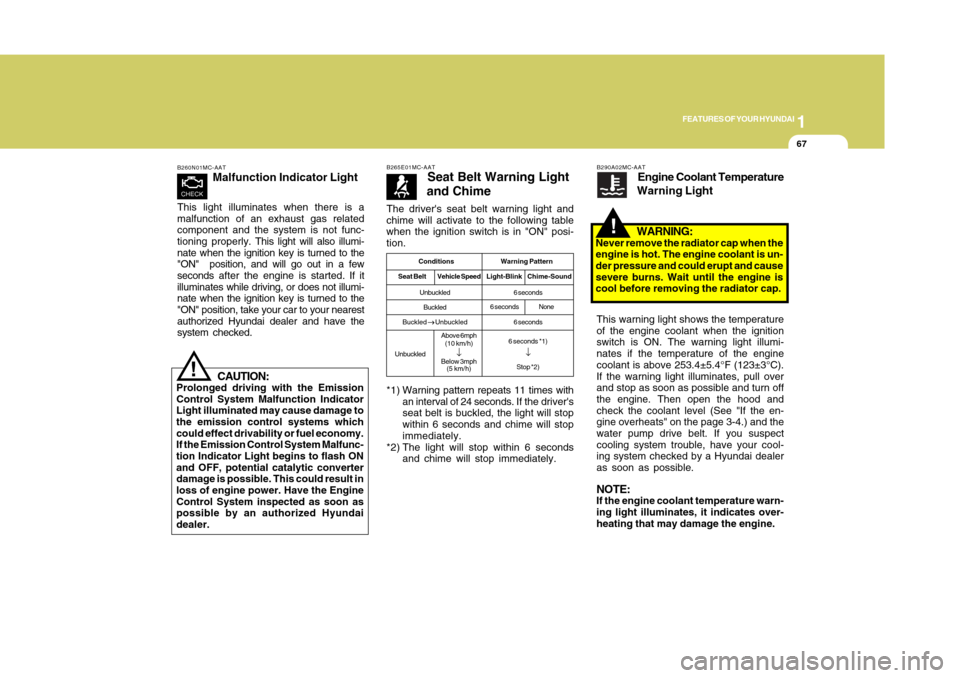
B260N01MC-AAT
Malfunction Indicator Light
This light illuminates when there is a
malfunction of an exhaust gas related
component and the system is not func-
tioning properly. This light will also illumi-
nate when the ignition key is turned to the
"ON" position, and will go out in a few
seconds after the engine is started. If it
illuminates while driving, or does not illumi-
nate when the ignition key is turned to the
"ON" position, take your car to your nearest
authorized Hyundai dealer and have the
system checked.
!
CAUTION:
Prolonged driving with the Emission
Control System Malfunction Indicator
Light illuminated may cause damage to
the emission control systems which
could effect drivability or fuel economy.
If the Emission Control System Malfunc-
tion Indicator Light begins to flash ON
and OFF, potential catalytic converter
damage is possible. This could result in
loss of engine power. Have the Engine
Control System inspected as soon as
possible by an authorized Hyundai
dealer.The driver's seat belt warning light and
chime will activate to the following table
when the ignition switch is in "ON" posi-
tion.
B265E01MC-AAT
Seat Belt Warning Light
and Chime
*1) Warning pattern repeats 11 times with
an interval of 24 seconds. If the driver's
seat belt is buckled, the light will stop
within 6 seconds and chime will stop
immediately.
*2) The light will stop within 6 seconds
and chime will stop immediately.
Conditions Warning Pattern
Seat BeltVehicle SpeedLight-Blink Chime-SoundUnbuckled
Buckled
Buckled
→ →→ →
→ Unbuckled
UnbuckledAbove 6mph
(10 km/h)
↓
Below 3mph
(5 km/h)6 seconds
6 seconds
6 seconds *1)
↓Stop *2)
6 secondsNone
B290A02MC-AAT
Engine Coolant Temperature
Warning Light
WARNING:
Never remove the radiator cap when the
engine is hot. The engine coolant is un-
der pressure and could erupt and cause
severe burns. Wait until the engine is
cool before removing the radiator cap.
!
This warning light shows the temperature
of the engine coolant when the ignition
switch is ON. The warning light illumi-
nates if the temperature of the engine
coolant is above 253.4±5.4°F (123±3°C).
If the warning light illuminates, pull over
and stop as soon as possible and turn off
the engine. Then open the hood and
check the coolant level (See "If the en-
gine overheats" on the page 3-4.) and the
water pump drive belt. If you suspect
cooling system trouble, have your cool-
ing system checked by a Hyundai dealer
as soon as possible.NOTE:If the engine coolant temperature warn-
ing light illuminates, it indicates over-
heating that may damage the engine.
Page 81 of 282
1FEATURES OF YOUR HYUNDAI70
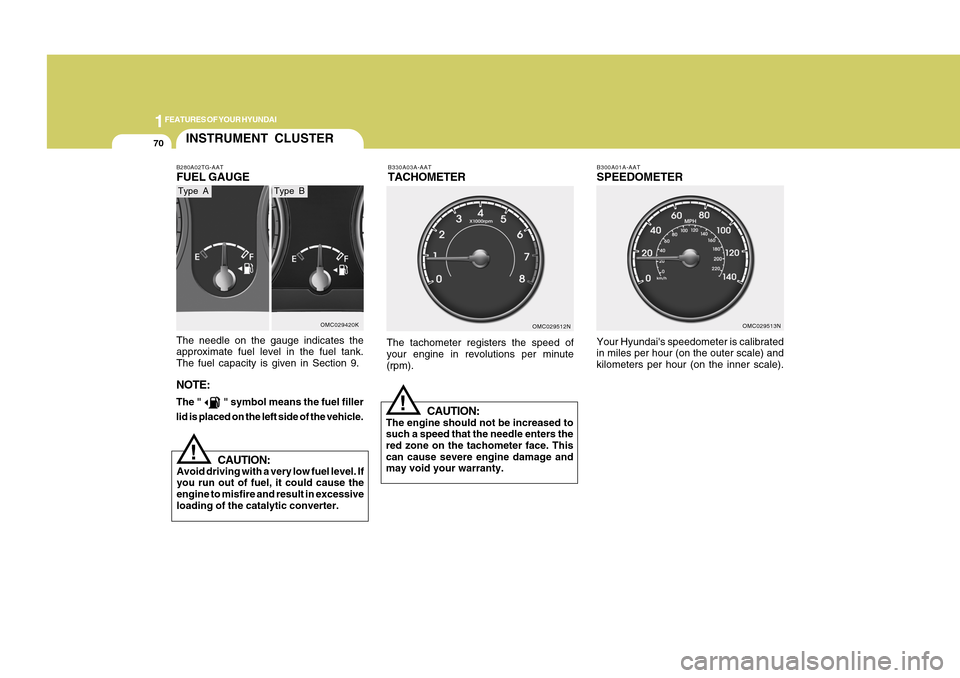
B330A03A-AATTACHOMETERThe tachometer registers the speed of
your engine in revolutions per minute
(rpm).
CAUTION:
The engine should not be increased to
such a speed that the needle enters the
red zone on the tachometer face. This
can cause severe engine damage and
may void your warranty.
!
B300A01A-AATSPEEDOMETERYour Hyundai's speedometer is calibrated
in miles per hour (on the outer scale) and
kilometers per hour (on the inner scale).
OMC029513N
INSTRUMENT CLUSTERB280A02TG-AATFUEL GAUGEThe needle on the gauge indicates the
approximate fuel level in the fuel tank.
The fuel capacity is given in Section 9.NOTE:The "
" symbol means the fuel filler
lid is placed on the left side of the vehicle.
OMC029420K
Type A
Type B
OMC029512N
CAUTION:
Avoid driving with a very low fuel level. If
you run out of fuel, it could cause the
engine to misfire and result in excessive
loading of the catalytic converter.
!
Page 106 of 282
1
FEATURES OF YOUR HYUNDAI
951
FEATURES OF YOUR HYUNDAI
95
!
WARNING:
If you must re-enter the vehicle,
you should once again eliminate
potentially dangerous static elec-
tricity discharge by touching a
metal part of the vehicle, away
from the fuel filler neck, nozzle or
other gasoline source.
- When using a portable fuel con-
tainer be sure to place the con-
tainer on the ground prior to refu-
eling. Static electricity discharge
from the container can ignite fuel
vapors causing a fire. Once refu-
eling has begun, contact with the
vehicle should be maintained until
the filling is complete. Use only
portable fuel containers designed
to carry and store gasoline.
- Do not use cellular phones around
a gas station or while refueling any
vehicle. Electric current and/or
electronic interference from cellu-
lar phones can potentially ignite
fuel vapors causing a fire. If you
must use your cellular phone use
it in a place away from the gas
station.
!
WARNING:
o Gasoline vapors are dangerous.
Before refueling, always stop the
engine and never smoke or allow
sparks and open flames near the
filler area.
o Never operate your vehicle without a
filler cap properly installed, flam-
mable vapors and gasoline could
leak out in dangerous situations such
as a collision or rollover. If the filler
cap must be replaced, only use genu-
ine Hyundai replacement parts.
o After refueling, make sure the fuel
cap is installed securely to prevent
fuel spillage in the event of an acci-
dent.
o Tighten the cap until it clicks one
time, otherwise the "
"light will
illuminate.
o If you open the fuel filler cap during
high ambient temperatures, a slight
"pressure sound" may be heard.
This is normal and not a cause for
concern. Whenever you open the fuel
filler cap, turn it slowly.
o Do not "top off" after the nozzle au-
tomatically shuts off when refueling.
o Automotive fuels are flammable/ex-
plosive materials. When refueling,
please note the following guidelines
carefully. Failure to follow these
guidelines may result in severe per-
sonal injury, severe burns or death
by fire or explosion.
- Read and follow all warnings posted
at the gas station facility.
- Before refueling, note the location
of the Emergency Gasoline Shut-
Off, if available, at the gas station
facility.
- Before touching the fuel nozzle or
fuel filler cap, you should eliminate
potentially dangerous static elec-
tricity discharge by touching an-
other metal part of the front of the
vehicle, a safe distance away from
the fuel filler neck, nozzle, or other
gas source.
- Do not get back into a vehicle once
you have begun refueling. Do not
touch, rub or slide against any item
or fabric (polyester, satin, nylon,
etc.) capable of producing static
electricity. Static electricity dis-
charge can ignite fuel vapors re-
sulting in explosion.
!
WARNING:
Page 107 of 282
1FEATURES OF YOUR HYUNDAI96
!
WARNING:
- When refueling always shut the
engine off. Sparks produced by
electrical components related to
the engine can ignite fuel vapors
causing a fire. Always insure that
the engine is OFF before and dur-
ing refueling. Once refueling is
complete, check to make sure the
fuel filler cap and door are se-
curely closed, before starting the
engine.
- Do not light any fire around a gas
station. DO NOT use matches or a
lighter and DO NOT SMOKE or
leave a lit cigarette in your vehicle
while at a gas station especially
during refueling. Automotive fuel
is highly flammable and can, when
ignited, result in explosion by
flames.
- If a fire breaks out during refueling,
leave the vicinity of the vehicle,
and immediately contact the man-
ager of the gas station or contact
the police and local fire depart-
ment. Follow any safety instruc-
tions they provide.
!TRUNK LID/TAIL GATEB540A01MC-GAT
WARNING:
The trunk lid or the tail gate should al-
ways be kept completely closed while
the vehicle is in motion. If it is left open or
ajar, poisonous exhaust gases may en-
ter the car resulting in serious illiness or
death to the occupants. See additional
warnings concerning exhaust gases on
page 2-2.
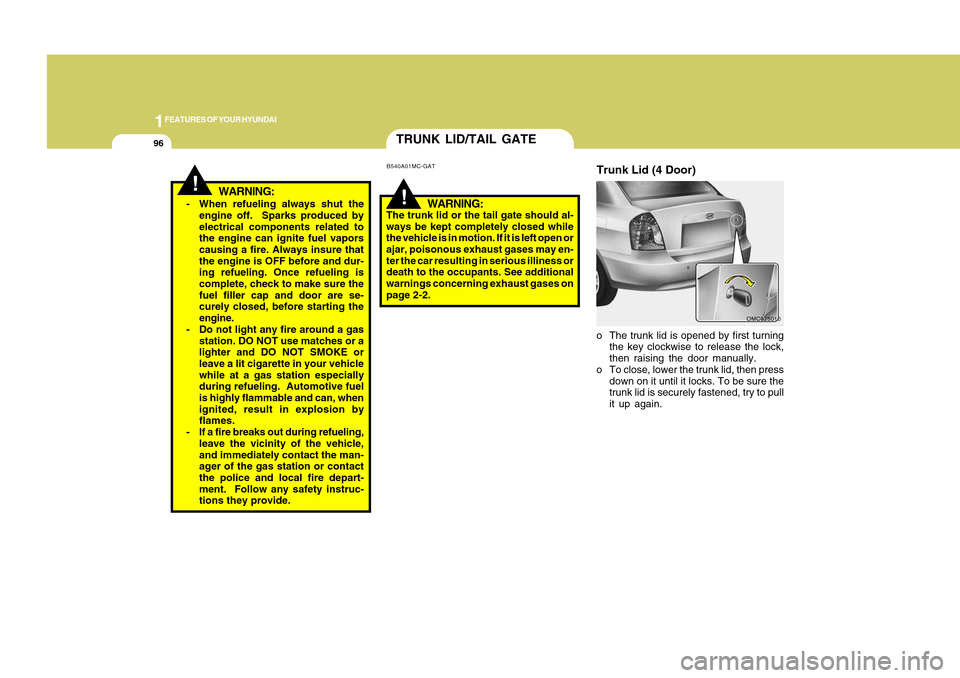
o The trunk lid is opened by first turning
the key clockwise to release the lock,
then raising the door manually.
o To close, lower the trunk lid, then press
down on it until it locks. To be sure the
trunk lid is securely fastened, try to pull
it up again.
OMC025010
Trunk Lid (4 Door)
Page 179 of 282
23
DRIVING YOUR HYUNDAI
2
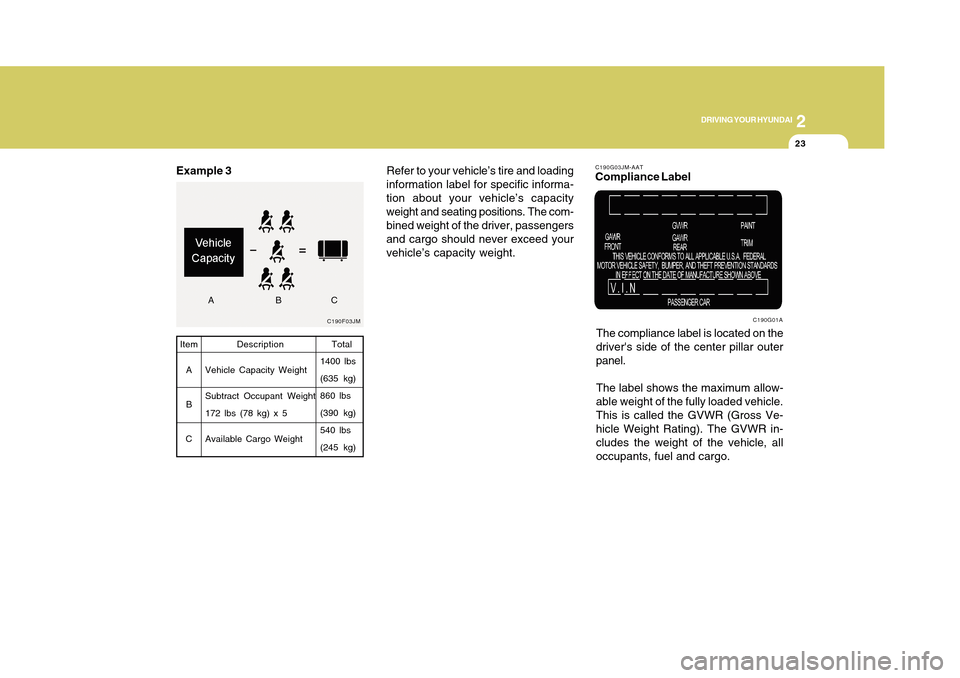
C190G03JM-AATCompliance Label
The compliance label is located on the
driver's side of the center pillar outer
panel.
The label shows the maximum allow-
able weight of the fully loaded vehicle.
This is called the GVWR (Gross Ve-
hicle Weight Rating). The GVWR in-
cludes the weight of the vehicle, all
occupants, fuel and cargo.
C190G01A
Refer to your vehicle’s tire and loading
information label for specific informa-
tion about your vehicle’s capacity
weight and seating positions. The com-
bined weight of the driver, passengers
and cargo should never exceed your
vehicle’s capacity weight.
C190F03JMTotal
1400 lbs
(635 kg)
860 lbs
(390 kg)
540 lbs
(245 kg) Item
A
B
CDescription
Vehicle Capacity Weight
Subtract Occupant Weight
172 lbs (78 kg) x 5
Available Cargo Weight
Example 3
ABC