oil temperature Hyundai Accent 2011 Owner's Manual
[x] Cancel search | Manufacturer: HYUNDAI, Model Year: 2011, Model line: Accent, Model: Hyundai Accent 2011Pages: 282, PDF Size: 14.82 MB
Page 10 of 282
YOUR VEHICLE AT A GLANCE
F10
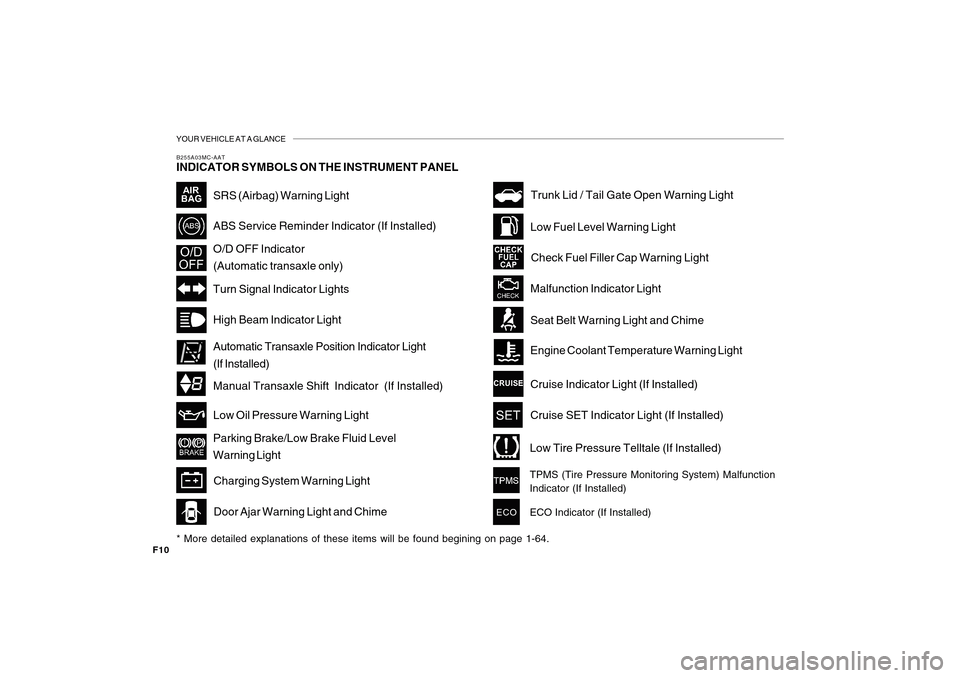
B255A03MC-AATINDICATOR SYMBOLS ON THE INSTRUMENT PANEL* More detailed explanations of these items will be found begining on page 1-64.
SRS (Airbag) Warning LightHigh Beam Indicator LightLow Oil Pressure Warning LightParking Brake/Low Brake Fluid Level
Warning LightCharging System Warning Light
Door Ajar Warning Light and Chime
Trunk Lid / Tail Gate Open Warning LightLow Fuel Level Warning Light
Check Fuel Filler Cap Warning LightMalfunction Indicator LightSeat Belt Warning Light and ChimeEngine Coolant Temperature Warning LightCruise Indicator Light (If Installed)Cruise SET Indicator Light (If Installed)Low Tire Pressure Telltale (If Installed)TPMS (Tire Pressure Monitoring System) Malfunction
Indicator (If Installed)
ECO
ECO Indicator (If Installed)
ABS Service Reminder Indicator (If Installed)O/D OFF Indicator
(Automatic transaxle only)Turn Signal Indicator Lights
Manual Transaxle Shift Indicator (If Installed) Automatic Transaxle Position Indicator Light
(If Installed)
Page 72 of 282
1
FEATURES OF YOUR HYUNDAI
611
FEATURES OF YOUR HYUNDAI
61
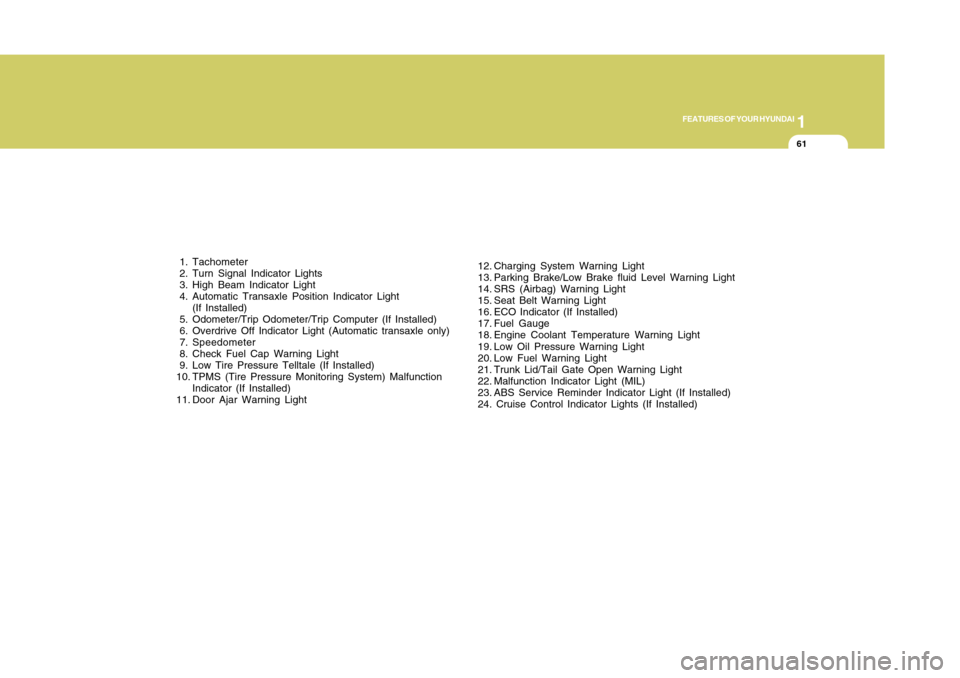
1. Tachometer
2. Turn Signal Indicator Lights
3. High Beam Indicator Light
4. Automatic Transaxle Position Indicator Light
(If Installed)
5. Odometer/Trip Odometer/Trip Computer (If Installed)
6. Overdrive Off Indicator Light (Automatic transaxle only)
7. Speedometer
8. Check Fuel Cap Warning Light
9. Low Tire Pressure Telltale (If Installed)
10. TPMS (Tire Pressure Monitoring System) Malfunction
Indicator (If Installed)
11. Door Ajar Warning Light12. Charging System Warning Light
13. Parking Brake/Low Brake fluid Level Warning Light
14. SRS (Airbag) Warning Light
15. Seat Belt Warning Light
16. ECO Indicator (If Installed)
17. Fuel Gauge
18. Engine Coolant Temperature Warning Light
19. Low Oil Pressure Warning Light
20. Low Fuel Warning Light
21. Trunk Lid/Tail Gate Open Warning Light
22. Malfunction Indicator Light (MIL)
23. ABS Service Reminder Indicator Light (If Installed)
24. Cruise Control Indicator Lights (If Installed)
Page 74 of 282
1
FEATURES OF YOUR HYUNDAI
631
FEATURES OF YOUR HYUNDAI
63
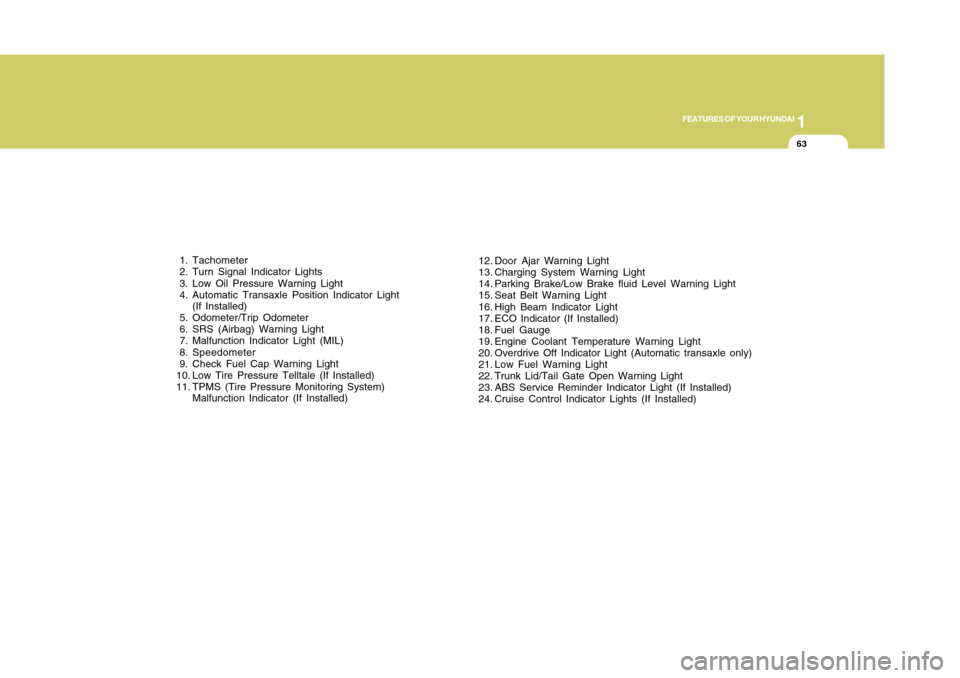
12. Door Ajar Warning Light
13. Charging System Warning Light
14. Parking Brake/Low Brake fluid Level Warning Light
15. Seat Belt Warning Light
16. High Beam Indicator Light
17. ECO Indicator (If Installed)
18. Fuel Gauge
19. Engine Coolant Temperature Warning Light
20. Overdrive Off Indicator Light (Automatic transaxle only)
21. Low Fuel Warning Light
22. Trunk Lid/Tail Gate Open Warning Light
23. ABS Service Reminder Indicator Light (If Installed)
24. Cruise Control Indicator Lights (If Installed) 1. Tachometer
2. Turn Signal Indicator Lights
3. Low Oil Pressure Warning Light
4. Automatic Transaxle Position Indicator Light
(If Installed)
5. Odometer/Trip Odometer
6. SRS (Airbag) Warning Light
7. Malfunction Indicator Light (MIL)
8. Speedometer
9. Check Fuel Cap Warning Light
10. Low Tire Pressure Telltale (If Installed)
11. TPMS (Tire Pressure Monitoring System)
Malfunction Indicator (If Installed)
Page 173 of 282
17
DRIVING YOUR HYUNDAI
2
C160D01A-AATCheck Battery and CablesWinter puts additional burdens on the
battery system. Visually inspect the bat-
tery and cables as described in Section
6. The level of charge in your battery can
be checked by your Hyundai dealer or a
service station.C160C01A-AATUse High Quality Ethylene Glycol
CoolantYour Hyundai is delivered with high qual-
ity ethylene glycol coolant in the cooling
system. It is the only type of coolant that
should be used because it helps prevent
corrosion in the cooling system, lubri-
cates the water pump and prevents freez-
ing. Be sure to replace or replenish your
coolant in accordance with the mainte-
nance schedule in Section 5. Before win-
ter, have your coolant tested to assure
that its freezing point is sufficient for the
temperatures anticipated during the win-
ter.
C160B01A-AATSnowy or Icy ConditionsTo drive your vehicle in deep snow, it may
be necessary to use snow tires or to
install tire chains on your tires. If snow
tires are needed, it is necessary to select
tires equivalent in size and type to the
original equipment tires. Failure to do so
may adversely affect the safety and han-
dling of your car. Furthermore, speeding,
rapid acceleration, sudden brake appli-
cations, and sharp turns are potentially
very hazardous practices.
During deceleration, use engine braking
to the fullest extent. Sudden brake appli-
cations on snowy or icy roads may cause
skids to occur. You need to keep suffi-
cient distance between the vehicle in
operation in front and your vehicle. Also,
apply the brake gently. It should be noted
that installing tire chains on the tire will
provide a greater driving force, but will
not prevent side skids.NOTE:Tire chains are not legal in all states.
Check state laws before fitting tire
chains.
C160E01A-AATChange to "Winter Weight" Oil if
NecessaryIn some climates it is recommended that
a lower viscosity "winter weight" oil be
used during cold weather. See Section 9
for recommendations. If you aren't sure
what weight oil you should use, consult
your Hyundai dealer.C160F02A-AATCheck Spark Plugs and Ignition
SystemInspect your spark plugs and replace
them if necessary. Also check all ignition
wiring and components to be sure they
are not cracked, worn or damaged in any
way.
Page 207 of 282
44
CORROSION PREVENTION AND APPEARANCE CARE6
E040A01A-AATTo Clean the Vinyl UpholsteryTo clean the vinyl upholstery, first remove
loose dirt and dust with a vacuum cleaner.
Then apply a solution of mild soap or
detergent and water using a clean sponge
or soft cloth. Allow this to stay on the
surface to loosen the dirt, then wipe with
a clean damp sponge or cloth. If all the
dirt stains are not removed, repeat this
procedure until the upholstery is clean.
Do not use gasoline, solvent, paint thin-
ner or other strong cleaners.CLEANING THE INTERIOR
E030D01A-AATWhen to Wax AgainYou should polish and wax the car again
when water no longer beads on a clean
surface but spreads out over a larger
area.E030E01A-AATMaintaining BumpersSpecial precautions must be observed to
preserve the appearance of the bumpers
on your Hyundai. They are:
o Be careful not to spill battery electro-
lyte or hydraulic brake fluid on the
bumpers. If you do, wash it off imme-
diately with clean water.
o Be gentle when cleaning the bumper
surfaces. They are made of soft plastic
and the surface can be damaged if
mistreated. Do not use abrasive clean-
ers. Use warm water and mild soap or
carwashing solution.
o Do not expose the bumpers to high
temperatures. For example, if you have
your car repainted, do not leave the
bumpers on the car if the car is going
to be placed in a high-temperature
paint booth.
E040B01A-AATTo Clean the Leather Upholstery
(If Installed)In the normal course of use, leather up-
holstered surfaces will, like any material,
pick-up dust and dirt. This dust and dirt
must be cleaned off or it may work into the
surface of the leather, causing damage.
Fine leather needs care, and should be
cleaned when necessary. Washing
leather thoroughly with soap and water
will keep your leather lustrous, beautiful
and ensure you have many years of wear.
Take a piece of cheese cloth and using
any mild soap and lukewarm water, work
up a good lather. Thoroughly wash the
leather. Wipe clean with a slightly damp
cloth and dry with soft cloth. Do this as
often as the leather becomes soiled.
During tanning operations, sufficient oils
are incorporated through processing that
none need be applied during the life of
the leather. Oil applied to the finished
surface will in no way help the leather
and may do more harm than good. Var-
nishes and furniture polishes should
never be used under any conditions.
Page 214 of 282
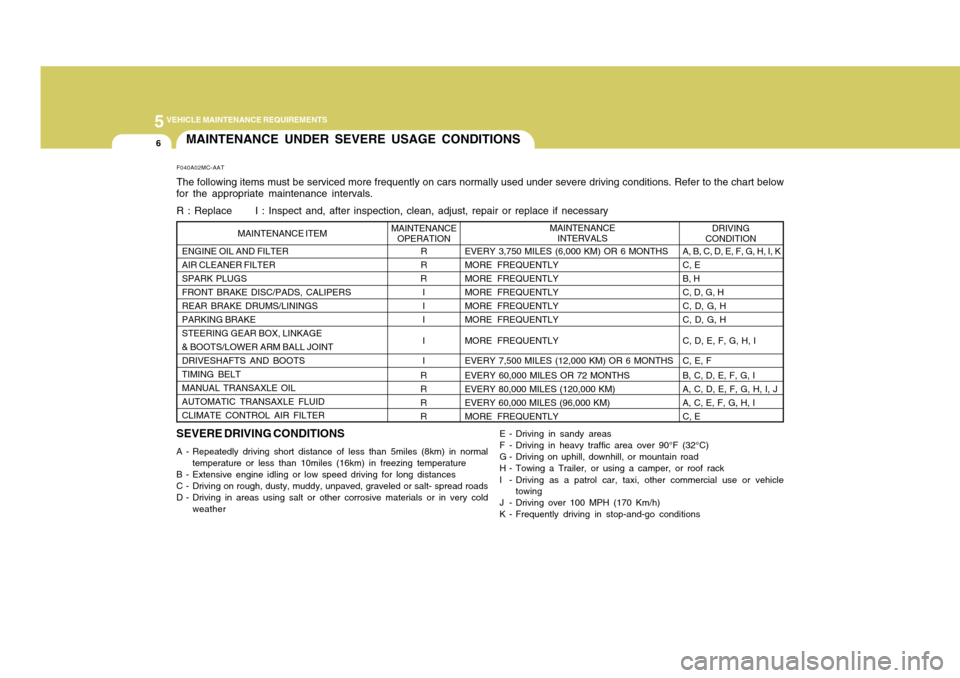
5
VEHICLE MAINTENANCE REQUIREMENTS6
DRIVING
CONDITION MAINTENANCE
INTERVALS
ENGINE OIL AND FILTER
AIR CLEANER FILTER
SPARK PLUGS
FRONT BRAKE DISC/PADS, CALIPERS
REAR BRAKE DRUMS/LININGS
PARKING BRAKE
STEERING GEAR BOX, LINKAGE
& BOOTS/LOWER ARM BALL JOINT
DRIVESHAFTS AND BOOTS
TIMING BELT
MANUAL TRANSAXLE OIL
AUTOMATIC TRANSAXLE FLUID
CLIMATE CONTROL AIR FILTER
R
R
R
I
I
I
I
I
R
R
R
R MAINTENANCE
OPERATION MAINTENANCE ITEM
EVERY 3,750 MILES (6,000 KM) OR 6 MONTHS
MORE FREQUENTLY
MORE FREQUENTLY
MORE FREQUENTLY
MORE FREQUENTLY
MORE FREQUENTLY
MORE FREQUENTLY
EVERY 7,500 MILES (12,000 KM) OR 6 MONTHS
EVERY 60,000 MILES OR 72 MONTHS
EVERY 80,000 MILES (120,000 KM)
EVERY 60,000 MILES (96,000 KM)
MORE FREQUENTLY
SEVERE DRIVING CONDITIONSA - Repeatedly driving short distance of less than 5miles (8km) in normal
temperature or less than 10miles (16km) in freezing temperature
B - Extensive engine idling or low speed driving for long distances
C - Driving on rough, dusty, muddy, unpaved, graveled or salt- spread roads
D - Driving in areas using salt or other corrosive materials or in very cold
weatherE - Driving in sandy areas
F - Driving in heavy traffic area over 90°F (32°C)
G - Driving on uphill, downhill, or mountain road
H - Towing a Trailer, or using a camper, or roof rack
I - Driving as a patrol car, taxi, other commercial use or vehicle
towing
J - Driving over 100 MPH (170 Km/h)
K - Frequently driving in stop-and-go conditionsA, B, C, D, E, F, G, H, I, K
C, E
B, H
C, D, G, H
C, D, G, H
C, D, G, H
C, D, E, F, G, H, I
C, E, F
B, C, D, E, F, G, I
A, C, D, E, F, G, H, I, J
A, C, E, F, G, H, I
C, EMAINTENANCE UNDER SEVERE USAGE CONDITIONSF040A02MC-AATThe following items must be serviced more frequently on cars normally used under severe driving conditions. Refer to the chart below
for the appropriate maintenance intervals.
R : Replace I : Inspect and, after inspection, clean, adjust, repair or replace if necessary
Page 241 of 282
6
DO-IT-YOURSELF MAINTENANCE
23
Headlight
1. Allow the bulb to cool. Wear eye pro-
tection.
2. Open the engine hood and disconnect
the negative (-) post of the battery.
3. Always grasp the bulb by its plastic
base, avoid touching the glass.
4. Disconnect the power cord from the
back of the headlight.
REPLACEMENT OF LIGHT
BULBS!
G260A01MC-AATBefore attempting to replace a light bulb,
be sure the switch is turned to the "OFF"
position.
The next paragraph shows how to reach
the light bulbs so they may be changed.
Be sure to replace the burned-out bulb
with one of the same number and watt-
age rating.
See page 6-29 for the wattage descrip-
tions.
CAUTION:
o Keep the lamps out of contact with
petroleum products, such as oil,
gasoline, etc.
o If you don't have necessary tools,
the correct bulbs and the expertise,
consult your authorized Hyundai
dealer.
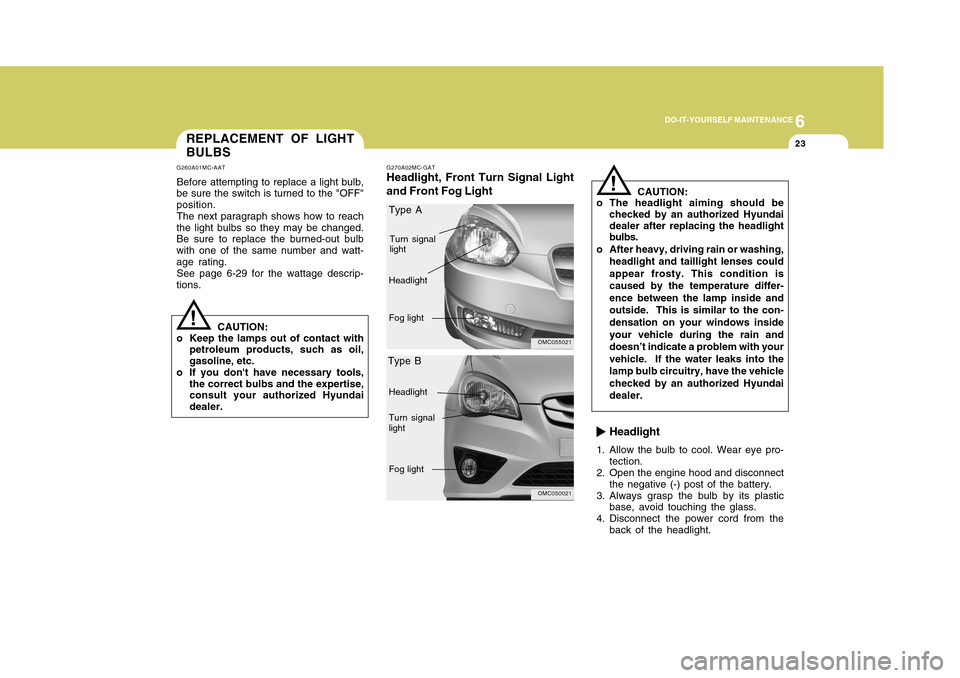
G270A02MC-GATHeadlight, Front Turn Signal Light
and Front Fog Light
CAUTION:
o The headlight aiming should be
checked by an authorized Hyundai
dealer after replacing the headlight
bulbs.
o After heavy, driving rain or washing,
headlight and taillight lenses could
appear frosty. This condition is
caused by the temperature differ-
ence between the lamp inside and
outside. This is similar to the con-
densation on your windows inside
your vehicle during the rain and
doesn’t indicate a problem with your
vehicle. If the water leaks into the
lamp bulb circuitry, have the vehicle
checked by an authorized Hyundai
dealer.
!
OMC055021
Turn signal
light
Headlight
Fog light
OMC050021
Headlight
Turn signal
light
Fog lightType A
Type B
Page 262 of 282
8
CONSUMER INFORMATION, REPORTING SAFETY DEFECTS & BINDING ARBITRATION OF WARRANTY CLAIMS8
I030D01JM-AATTIRE TERMINOLOGY AND DEFINI-
TIONS
Air Pressure: The amount of air inside
the tire pressing outward on the tire.
Air pressure is expressed in pounds
per square inch (psi) or kilopascal (kPa).
Accessory Weight: This means the
combined weight of optional accesso-
ries. Some examples of optional ac-
cessories are, automatic transmission,
power seats, and air conditioning.
Aspect Ratio: The relationship of a
tire's height to its width.
Belt: A rubber coated layer of cords
that is located between the plies and
the tread. Cords may be made from
steel or other reinforcing materials.
Bead: The tire bead contains steel
wires wrapped by steel cords that hold
the tire onto the rim.
Bias Ply Tire: A pneumatic tire in
which the plies are laid at alternate
angles less than 90 degrees to the
centerline of the tread.Cold Tire Pressure: The amount of
air pressure in a tire, measured in
pounds per square inch (psi) or
kilopascals (kPa) before a tire has
built up heat from driving.
Curb Weight: This means the weight
of a motor vehicle with standard and
optional equipment including the maxi-
mum capacity of fuel, oil and coolant,
but without passengers and cargo.
DOT Markings: A code molded into
the sidewall of a tire signifying that the
tire is in compliance with the U.S.
Department of Transportation motor
vehicle safety standards. The DOT
code includes the Tire Identification
Number (TIN), an alphanumeric desig-
nator which can also identify the tire
manufacturer, production plant, brand
and date of production.
GVWR: Gross Vehicle Weight Rating
GAWR FRT: Gross Axle Weight Rat-
ing for the front Axle.
GAWR RR: Gross Axle Weight Rating
for the rear axle. 6. Maximum load rating
This number indicates the maxi-
mum load in kilograms and pounds
that can be carried by the tire. When
replacing the tires on the vehicle,
always use a tire that has the same
load rating as the factory installed
tire.
7. Uniform Tire Quality Grading
(UTQG):
Tire manufacturers are required to
grade tires based on three perfor-
mance factors: treadwear, traction
and temperature resistance. For
more information, see Uniform Tire
Quality Grading on page 8-15.
Page 274 of 282
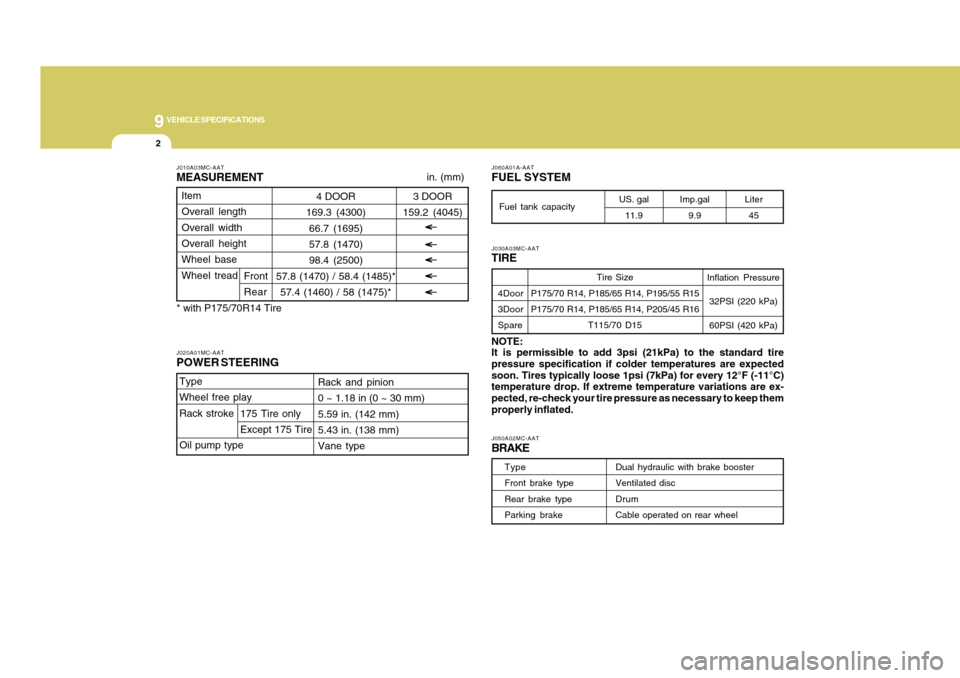
9
VEHICLE SPECIFICATIONS2
Tire Size
P175/70 R14, P185/65 R14, P195/55 R15
P175/70 R14, P185/65 R14, P205/45 R16
T115/70 D15
in. (mm)
Liter
45
4Door
3Door
Spare
US. gal
11.9 Fuel tank capacityImp.gal
9.9
Inflation Pressure
32PSI (220 kPa)
60PSI (420 kPa)
J010A03MC-AATMEASUREMENTJ020A01MC-AATPOWER STEERING
J060A01A-AATFUEL SYSTEMJ030A03MC-AATTIRE
4 DOOR
169.3 (4300)
66.7 (1695)
57.8 (1470)
98.4 (2500)
57.8 (1470) / 58.4 (1485)*
57.4 (1460) / 58 (1475)* Item
Overall length
Overall width
Overall height
Wheel base
Wheel tread
Front
Rear
3 DOOR
159.2 (4045)
Type
Wheel free play
Rack stroke
Oil pump type
Rack and pinion
0 ~ 1.18 in (0 ~ 30 mm)
5.59 in. (142 mm)
5.43 in. (138 mm)
Vane type
175 Tire only
Except 175 Tire
* with P175/70R14 Tire
NOTE:
It is permissible to add 3psi (21kPa) to the standard tire
pressure specification if colder temperatures are expected
soon. Tires typically loose 1psi (7kPa) for every 12°F (-11°C)
temperature drop. If extreme temperature variations are ex-
pected, re-check your tire pressure as necessary to keep them
properly inflated.
Dual hydraulic with brake booster
Ventilated disc
Drum
Cable operated on rear wheel Type
Front brake type
Rear brake type
Parking brake
J050A02MC-AATBRAKE