lock Hyundai Accent 2012 Owner's Manual - RHD (UK. Australia)
[x] Cancel search | Manufacturer: HYUNDAI, Model Year: 2012, Model line: Accent, Model: Hyundai Accent 2012Pages: 367, PDF Size: 25.39 MB
Page 11 of 367
Introduction
4
1
Use of MTBE
HYUNDAI recommends avoiding fuels
containing MTBE (Methyl Tertiary Butyl
Ether) over 15.0% vol. (Oxygen Content
2.7% weight) in your vehicle.
Fuel containing MTBE over 15.0% vol.
(Oxygen Content 2.7% weight) may
reduce vehicle performance and produce
vapour lock or hard starting.
Do not use methanol
Fuels containing methanol (wood alco-
hol) should not be used in your vehicle.
This type of fuel can reduce vehicle per-
formance and damage components ofthe fuel system.
Fuel Additives
HYUNDAI recommends that you use good quality petrol that meets Europe
Fuel standards (EN228) or equivalents.
For customers who do not use good
quality petrol including fuel additives reg-
ularly, and have problems starting or the
engine does not run smoothly, one bottle
of additives should be added to the fuel
tank at every 15,000km. Additives are
available from your authorised HYUNDAI
dealer along with information on how touse them.
Operation in foreign countries
If you are going to drive your vehicle in
another country, be sure to:
Observe all regulations regarding reg-
istration and insurance.
Determine that acceptable fuel is avail- able. Diesel engine
Diesel fuel
Diesel engine must be operated only on
commercially available diesel fuel that
complies with EN 590 or comparable
standard. (EN stands for "European
Norm"). Do not use marine diesel fuel,
heating oils, or non-approved fuel addi-
tives, as this will increase wear andcause damage to the engine and fuel
system. The use of non-approved fuels
and / or fuel additives will result in a limi-
tation of your warranty rights.
Diesel fuel of above cetane 51 is used in
your vehicle. If two types of diesel fuel
are available, use summer or winter fuel
properly according to the following tem-
perature conditions.
Above -5°C (23°F) ... Summer type
diesel fuel.
Below -5°C (23°F) ... Winter type diesel
fuel.
Watch the fuel level in the tank very care-
fully : If the engine stops through fuel fail-
ure, the circuits must be completely
purged to permit restarting.
CAUTION
Your New Vehicle Limited Warranty may not cover damage to the fuelsystem and any performance prob-lems that are caused by the use offuels containing methanol or fuels
containing MTBE (Methyl TertiaryButyl Ether) over 15.0% vol. (Oxygen Content 2.7% weight.)
Page 16 of 367
Your vehicle at a glance
2
2
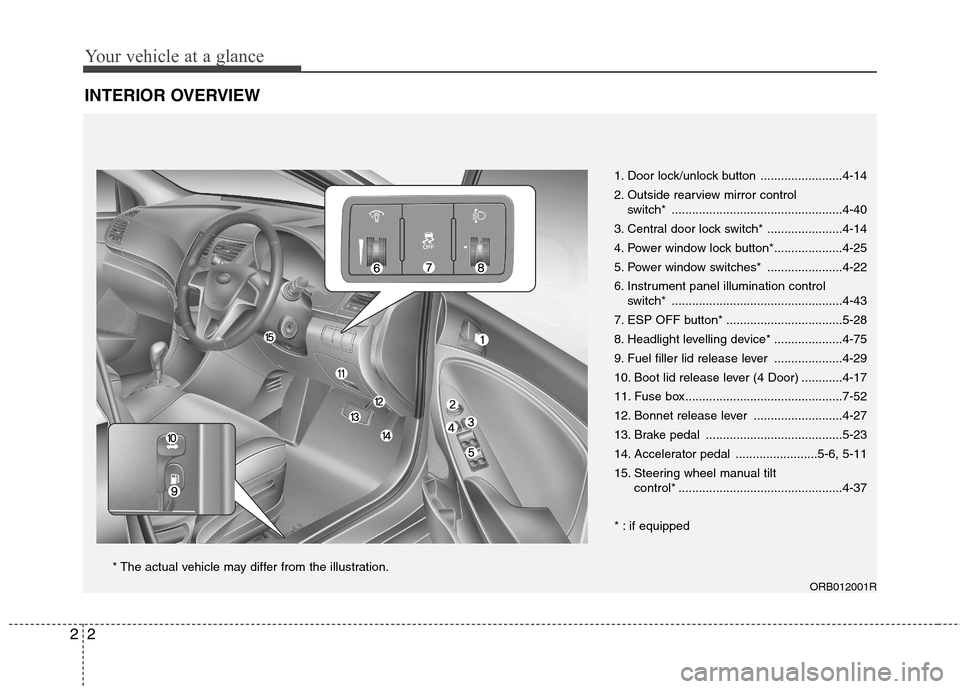
INTERIOR OVERVIEW
1. Door lock/unlock button ........................4-14
2. Outside rearview mirror control
switch* ..................................................4-40
3. Central door lock switch* ......................4-14
4. Power window lock button*....................4-25
5. Power window switches* ......................4-22
6. Instrument panel illumination control switch* ..................................................4-43
7. ESP OFF button* ..................................5-28
8. Headlight levelling device* ....................4-75
9. Fuel filler lid release lever ....................4-29
10. Boot lid release lever (4 Door) ............4-17
11. Fuse box..............................................7-52
12. Bonnet release lever ..........................4-27
13. Brake pedal ........................................5-23
14. Accelerator pedal ........................5-6, 5-11
15. Steering wheel manual tilt control* ................................................4-37
* : if equipped
ORB012001R
* The actual vehicle may differ from the illustration.
Page 17 of 367
23
Your vehicle at a glance
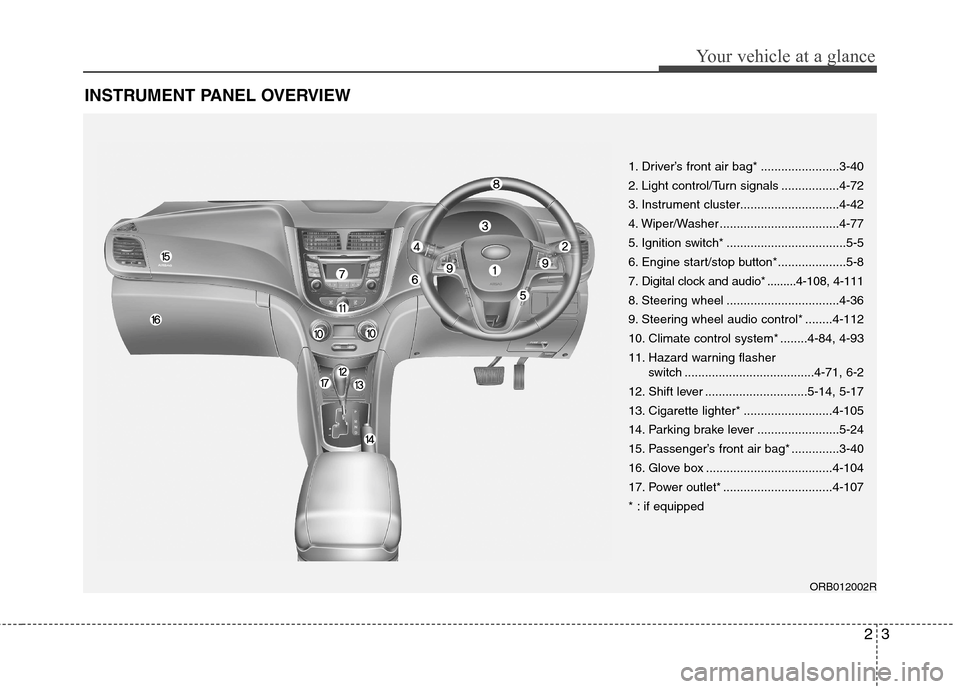
INSTRUMENT PANEL OVERVIEW
1. Driver’s front air bag* .......................3-40
2. Light control/Turn signals .................4-72
3. Instrument cluster.............................4-42
4. Wiper/Washer ...................................4-77
5. Ignition switch* ...................................5-5
6. Engine start/stop button*....................5-8
7. Digital clock and audio* .........4-108, 4-111
8. Steering wheel .................................4-36
9. Steering wheel audio control* ........4-112
10. Climate control system* ........4-84, 4-93
11. Hazard warning flasher switch ......................................4-71, 6-2
12. Shift lever ..............................5-14, 5-17
13. Cigarette lighter* ..........................4-105
14. Parking brake lever ........................5-24
15. Passenger’s front air bag* ..............3-40
16. Glove box .....................................4-104
17. Power outlet* ................................4-107
* : if equipped
ORB012002R
Page 21 of 367
33
Safety features of your vehicle
WARNING- Driver’s seat
Never attempt to adjust the seat whilst the vehicle is moving. This
could result in loss of control,and an accident causing death,
serious injury, or property dam-
age.
Do not allow anything to interfere with the normal position of the
seatback. Storing items against a
seatback or in any other way
interfering with proper locking of
a seatback could result in serious
or fatal injury in a sudden stop orcollision.
seatback upright and the lap por-
tion of the seat belt snug and low
across the hips. This is the best
position to protect you in case ofan accident.
In order to avoid unnecessary and perhaps severe air bag
injuries, always sit as far back as
possible from the steering wheel
whilst maintaining comfortable
control of the vehicle. We recom-
mend that your chest be at least
250 mm (10 inches) away fromthe steering wheel.WARNING - Loose objects
Loose objects in the driver’s foot
area could interfere with the opera-
tion of the foot pedals, possibly
causing an accident. Do not place
anything under the front seats.WARNING - Driver respon-
sibility for passengers
Riding in a vehicle with the seat-
back reclined could lead to serious
or fatal injury in an accident. If a
seat is reclined during an accident,
the occupant’s hips may slide
under the lap portion of the seat
belt applying great force to the
unprotected abdomen. Serious orfatal internal injuries could result.
The driver must advise the passen-
ger to keep the seatback in an
upright position whenever the vehi-
cle is in motion.
WARNING
Do not use a sitting cushion that reduces friction between the seat
and passenger. The passenger's
hips may slide under the lap por-tion of the seat belt during an acci-
dent or a sudden stop. Serious orfatal internal injuries could resultbecause the seat belt can't operate
normally.
WARNING - Seatback adjustment
When you return the seatback to its
upright position, hold the seatback
and return it slowly and be surethere are no other occupants
around the seat. If the seatback isreturned without being held and
controlled, the back of the seat
could spring forward resulting in
accidental injury to a person struck
by the seatback.
Page 22 of 367
Safety features of your vehicle
4
3
Front seat
Manual adjustment
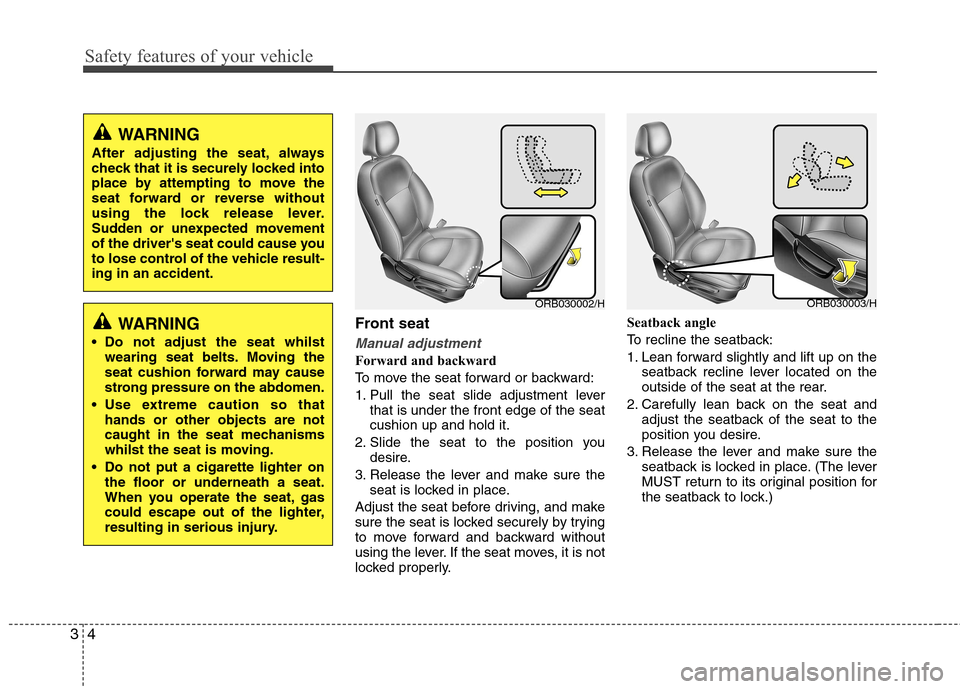
Forward and backward
To move the seat forward or backward:
1. Pull the seat slide adjustment lever
that is under the front edge of the seat cushion up and hold it.
2. Slide the seat to the position you desire.
3. Release the lever and make sure the seat is locked in place.
Adjust the seat before driving, and make
sure the seat is locked securely by trying
to move forward and backward without
using the lever. If the seat moves, it is not
locked properly. Seatback angle
To recline the seatback:
1. Lean forward slightly and lift up on the
seatback recline lever located on the
outside of the seat at the rear.
2. Carefully lean back on the seat and adjust the seatback of the seat to the
position you desire.
3. Release the lever and make sure the seatback is locked in place. (The lever
MUST return to its original position for
the seatback to lock.)
ORB030003/HORB030002/H
WARNING
After adjusting the seat, always
check that it is securely locked into
place by attempting to move the
seat forward or reverse without
using the lock release lever.
Sudden or unexpected movement
of the driver's seat could cause you
to lose control of the vehicle result-ing in an accident.
WARNING
Do not adjust the seat whilst wearing seat belts. Moving the
seat cushion forward may cause
strong pressure on the abdomen.
Use extreme caution so that hands or other objects are not
caught in the seat mechanisms
whilst the seat is moving.
Do not put a cigarette lighter on the floor or underneath a seat.
When you operate the seat, gas
could escape out of the lighter,
resulting in serious injury.
Page 24 of 367
Safety features of your vehicle
6
3
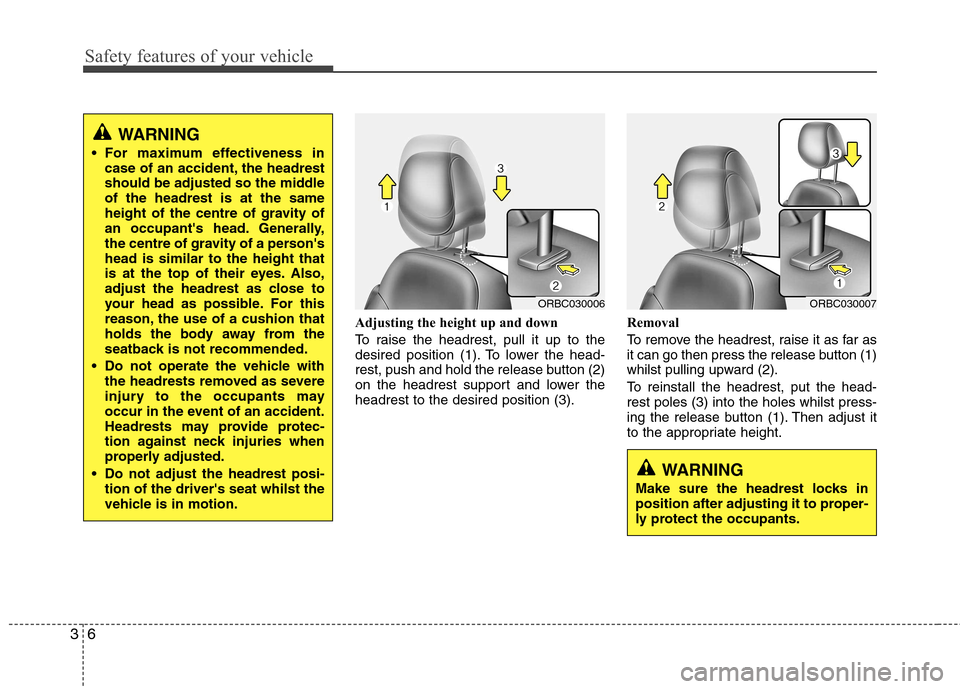
Adjusting the height up and down
To raise the headrest, pull it up to the
desired position (1). To lower the head-
rest, push and hold the release button (2)
on the headrest support and lower theheadrest to the desired position (3). Removal
To remove the headrest, raise it as far as
it can go then press the release button (1)
whilst pulling upward (2).
To reinstall the headrest, put the head- rest poles (3) into the holes whilst press-
ing the release button (1). Then adjust it
to the appropriate height.
WARNING
For maximum effectiveness in case of an accident, the headrest
should be adjusted so the middleof the headrest is at the same
height of the centre of gravity of
an occupant's head. Generally,
the centre of gravity of a person'shead is similar to the height that
is at the top of their eyes. Also,
adjust the headrest as close to
your head as possible. For this
reason, the use of a cushion that
holds the body away from the
seatback is not recommended.
Do not operate the vehicle with the headrests removed as severe
injury to the occupants may
occur in the event of an accident.
Headrests may provide protec-
tion against neck injuries when
properly adjusted.
Do not adjust the headrest posi- tion of the driver's seat whilst the
vehicle is in motion.
ORBC030006ORBC030007
WARNING
Make sure the headrest locks in
position after adjusting it to proper-
ly protect the occupants.
Page 26 of 367
Safety features of your vehicle
8
3
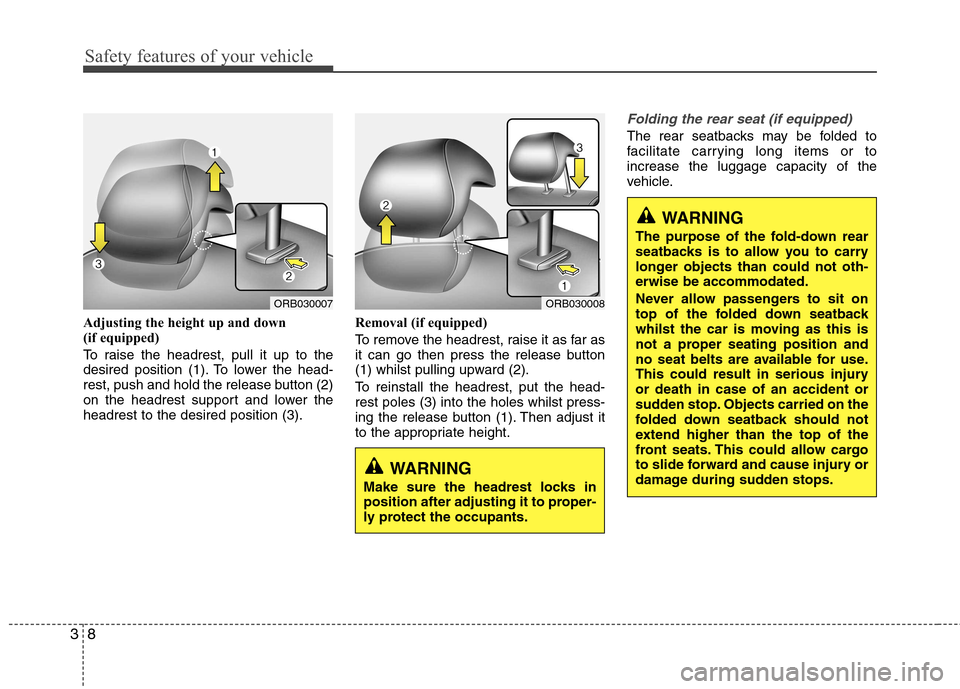
Adjusting the height up and down
(if equipped)
To raise the headrest, pull it up to the
desired position (1). To lower the head-
rest, push and hold the release button (2)
on the headrest support and lower theheadrest to the desired position (3). Removal (if equipped)
To remove the headrest, raise it as far as
it can go then press the release button
(1) whilst pulling upward (2).
To reinstall the headrest, put the head- rest poles (3) into the holes whilst press-
ing the release button (1). Then adjust it
to the appropriate height.
Folding the rear seat (if equipped)
The rear seatbacks may be folded to
facilitate carrying long items or toincrease the luggage capacity of the
vehicle.
ORB030007
WARNING
Make sure the headrest locks in
position after adjusting it to proper-
ly protect the occupants.
ORB030008
WARNING
The purpose of the fold-down rear
seatbacks is to allow you to carry
longer objects than could not oth-erwise be accommodated.
Never allow passengers to sit on
top of the folded down seatback
whilst the car is moving as this is
not a proper seating position and
no seat belts are available for use.
This could result in serious injuryor death in case of an accident or
sudden stop. Objects carried on the
folded down seatback should not
extend higher than the top of the
front seats. This could allow cargo
to slide forward and cause injury or
damage during sudden stops.
Page 27 of 367
39
Safety features of your vehicle
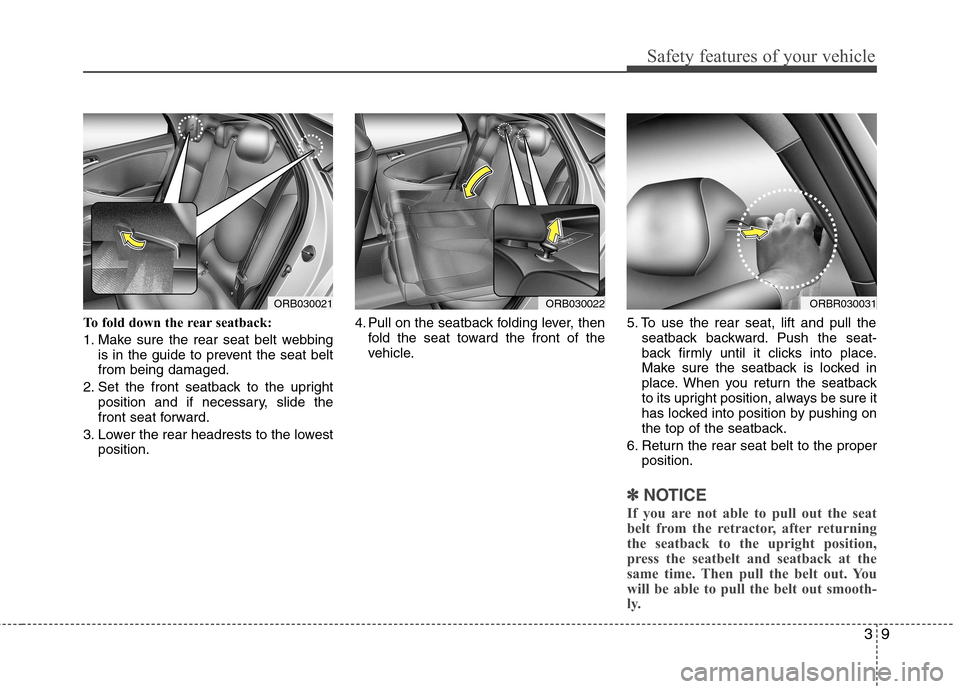
To fold down the rear seatback:
1. Make sure the rear seat belt webbingis in the guide to prevent the seat belt from being damaged.
2. Set the front seatback to the upright position and if necessary, slide the
front seat forward.
3. Lower the rear headrests to the lowest position. 4. Pull on the seatback folding lever, then
fold the seat toward the front of the
vehicle. 5. To use the rear seat, lift and pull the
seatback backward. Push the seat-
back firmly until it clicks into place.
Make sure the seatback is locked in
place. When you return the seatback
to its upright position, always be sure it
has locked into position by pushing on
the top of the seatback.
6. Return the rear seat belt to the proper position.
✽✽ NOTICE
If you are not able to pull out the seat
belt from the retractor, after returning
the seatback to the upright position,
press the seatbelt and seatback at the
same time. Then pull the belt out. You
will be able to pull the belt out smooth-
ly.
ORB030022ORB030021ORBR030031
Page 28 of 367
Safety features of your vehicle
10
3
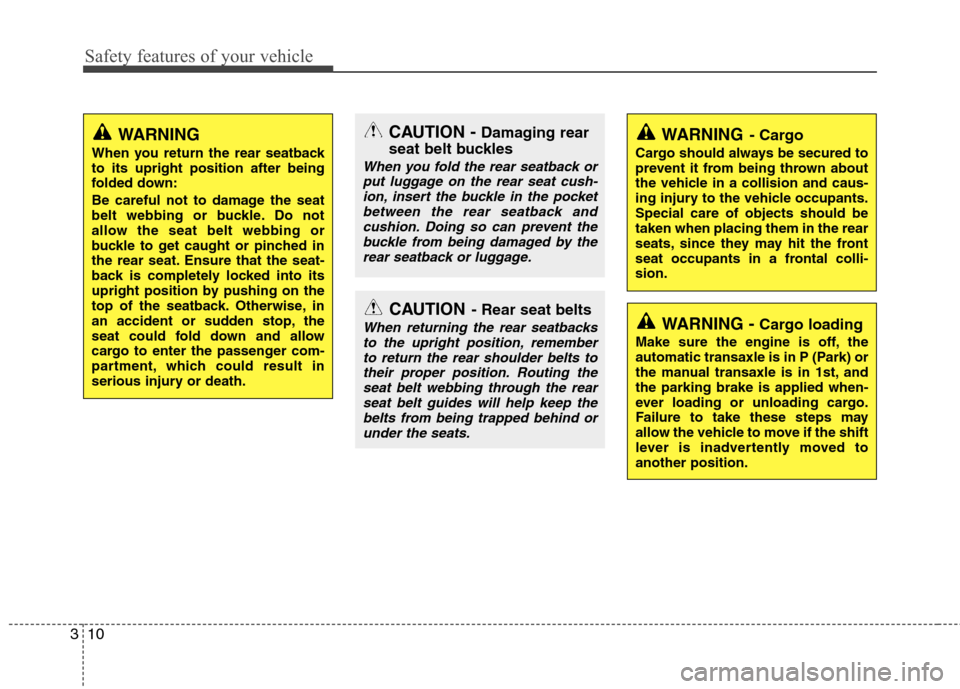
WARNING
When you return the rear seatback to its upright position after being
folded down:
Be careful not to damage the seat
belt webbing or buckle. Do not
allow the seat belt webbing or
buckle to get caught or pinched in
the rear seat. Ensure that the seat-
back is completely locked into its
upright position by pushing on the
top of the seatback. Otherwise, in
an accident or sudden stop, the
seat could fold down and allow
cargo to enter the passenger com-
partment, which could result in
serious injury or death.
CAUTION - Rear seat belts
When returning the rear seatbacks
to the upright position, rememberto return the rear shoulder belts to their proper position. Routing the
seat belt webbing through the rearseat belt guides will help keep thebelts from being trapped behind orunder the seats.
CAUTION - Damaging rear
seat belt buckles
When you fold the rear seatback or put luggage on the rear seat cush-
ion, insert the buckle in the pocketbetween the rear seatback andcushion. Doing so can prevent the buckle from being damaged by the
rear seatback or luggage.
WARNING - Cargo loading
Make sure the engine is off, the
automatic transaxle is in P (Park) or
the manual transaxle is in 1st, andthe parking brake is applied when-
ever loading or unloading cargo.
Failure to take these steps may
allow the vehicle to move if the shift
lever is inadvertently moved toanother position.
WARNING - Cargo
Cargo should always be secured to
prevent it from being thrown about
the vehicle in a collision and caus-
ing injury to the vehicle occupants.Special care of objects should betaken when placing them in the rear
seats, since they may hit the front
seat occupants in a frontal colli-sion.
Page 32 of 367
Safety features of your vehicle
14
3
If the rear seat belt is disconnected when
you drive over 20km/h, the correspon-
ding seat belt warning light will blink for
35 seconds. But, if one of the rear passenger's seat belts are connected and disconnectedtwice within 9 seconds after the belt is
fastened, the corresponding seat belt
warning light will not operate.
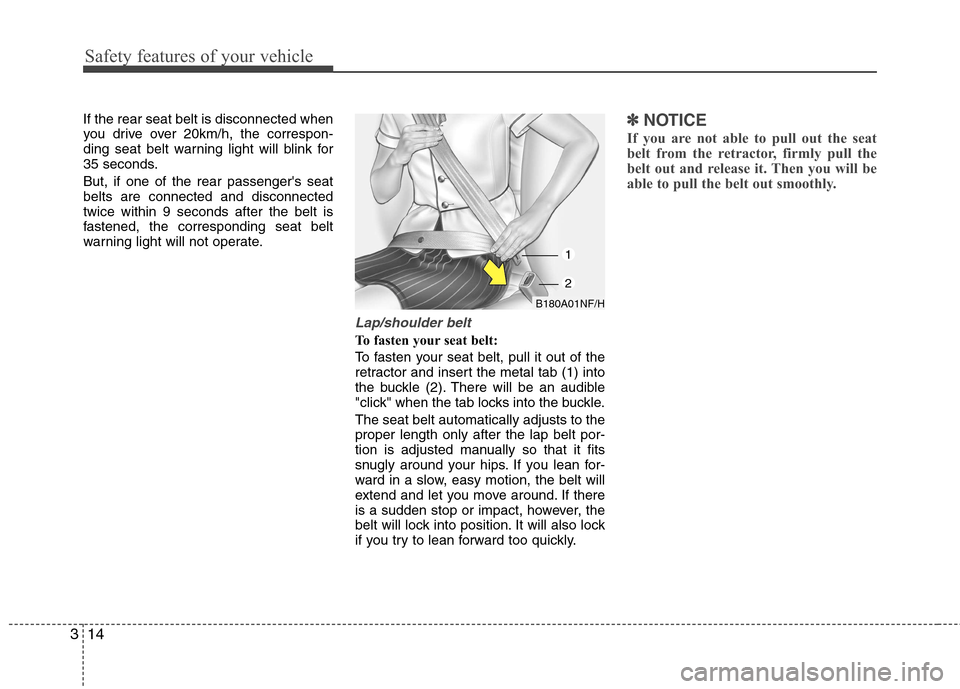
Lap/shoulder belt
To fasten your seat belt:
To fasten your seat belt, pull it out of the
retractor and insert the metal tab (1) into
the buckle (2). There will be an audible
"click" when the tab locks into the buckle. The seat belt automatically adjusts to the proper length only after the lap belt por-
tion is adjusted manually so that it fits
snugly around your hips. If you lean for-
ward in a slow, easy motion, the belt will
extend and let you move around. If there
is a sudden stop or impact, however, the
belt will lock into position. It will also lock
if you try to lean forward too quickly.
✽✽
NOTICE
If you are not able to pull out the seat
belt from the retractor, firmly pull the
belt out and release it. Then you will be
able to pull the belt out smoothly.
B180A01NF/H
1
2