Filter Hyundai Accent 2013 Owner's Guide
[x] Cancel search | Manufacturer: HYUNDAI, Model Year: 2013, Model line: Accent, Model: Hyundai Accent 2013Pages: 402, PDF Size: 8.49 MB
Page 334 of 402
743
Maintenance
FUEL FILTER (FOR DIESEL)
Draining water from the fuel filter
The fuel filter for diesel engine plays an
important role of separating water from
fuel and accumulating the water in its
bottom.
If water accumulates in the fuel filter, the
warning light comes on when the ignition
switch is in the ON position.
If this warning light illuminates,
take your car to an authorized
HYUNDAI dealer and have
drain the water and checked
the system.
Extracting air from the fuel filter
If you drive until you have no fuel left or if
you replace the fuel filter, be sure to
extract air from the fuel system as it
makes it difficult to start the engine.
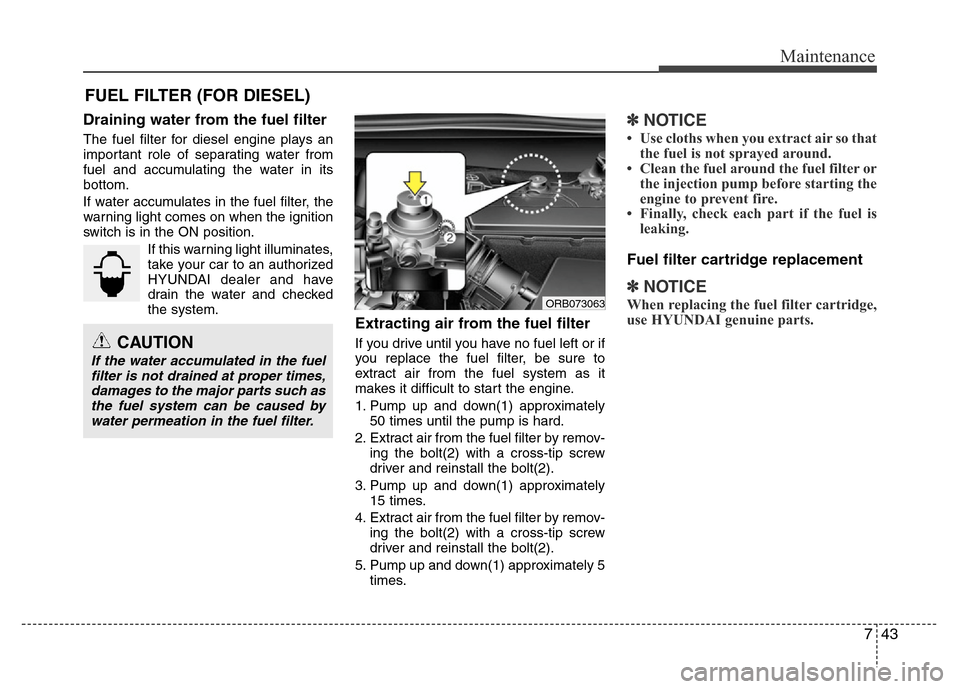
1. Pump up and down(1) approximately
50 times until the pump is hard.
2. Extract air from the fuel filter by remov-
ing the bolt(2) with a cross-tip screw
driver and reinstall the bolt(2).
3. Pump up and down(1) approximately
15 times.
4. Extract air from the fuel filter by remov-
ing the bolt(2) with a cross-tip screw
driver and reinstall the bolt(2).
5. Pump up and down(1) approximately 5
times.
✽NOTICE
• Use cloths when you extract air so that
the fuel is not sprayed around.
• Clean the fuel around the fuel filter or
the injection pump before starting the
engine to prevent fire.
• Finally, check each part if the fuel is
leaking.
Fuel filter cartridge replacement
✽NOTICE
When replacing the fuel filter cartridge,
use HYUNDAI genuine parts.
CAUTION
If the water accumulated in the fuel
filter is not drained at proper times,
damages to the major parts such as
the fuel system can be caused by
water permeation in the fuel filter.
ORB073063
Page 335 of 402
Maintenance
44 7
AIR CLEANER
Filter replacement
It must be replaced when necessary, and
should not be washed.
You can clean the filter when inspecting
the air cleaner element.
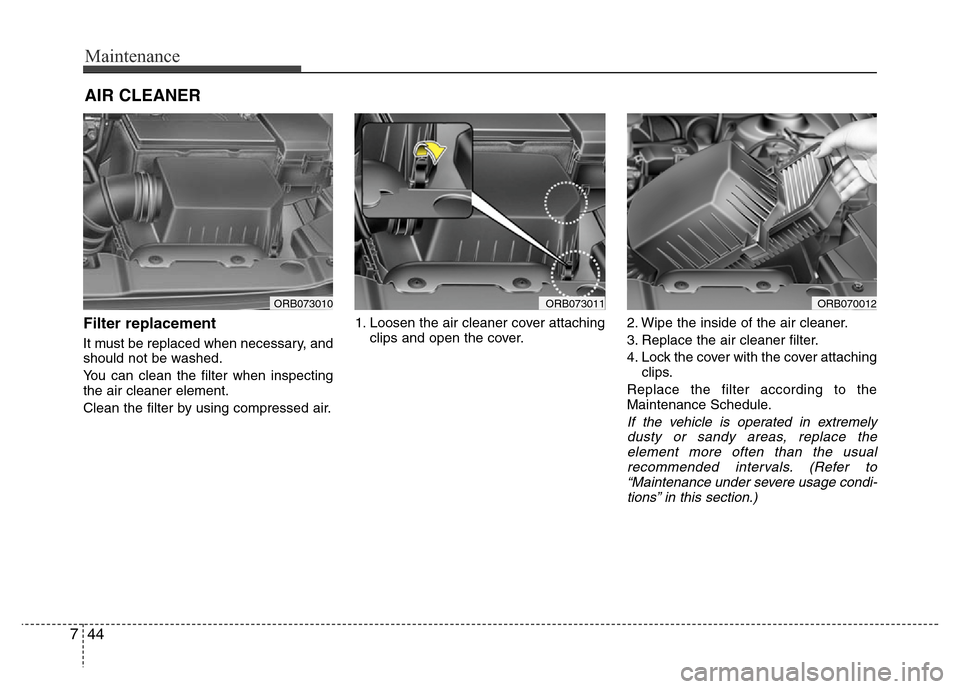
Clean the filter by using compressed air.1. Loosen the air cleaner cover attaching
clips and open the cover.2. Wipe the inside of the air cleaner.
3. Replace the air cleaner filter.
4. Lock the cover with the cover attaching
clips.
Replace the filter according to the
Maintenance Schedule.
If the vehicle is operated in extremely
dusty or sandy areas, replace the
element more often than the usual
recommended intervals. (Refer to
“Maintenance under severe usage condi-
tions” in this section.)
ORB073010ORB073011ORB070012
Page 337 of 402
Maintenance
46 7
CLIMATE CONTROL AIR FILTER (IF EQUIPPED)
Filter inspection
If the vehicle is operated in the severely
air-polluted cities or on dusty rough
roads for a long period, it should be
inspected more frequently and replaced
earlier. When you, the owner, replace the
climate control air filter, replace it per-
forming the following procedure, and be
careful to avoid damaging other compo-
nents.
Replace the filter according to the main-
tenance Schedule.
Filter replacement
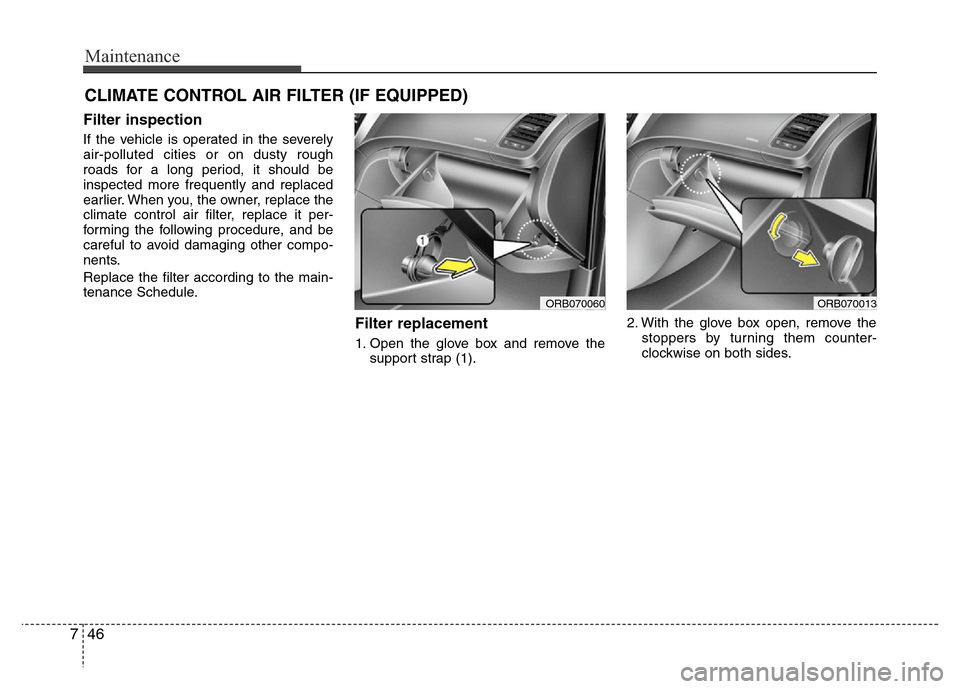
1. Open the glove box and remove the
support strap (1).2. With the glove box open, remove the
stoppers by turning them counter-
clockwise on both sides.
ORB070013ORB070060
Page 338 of 402
747
Maintenance
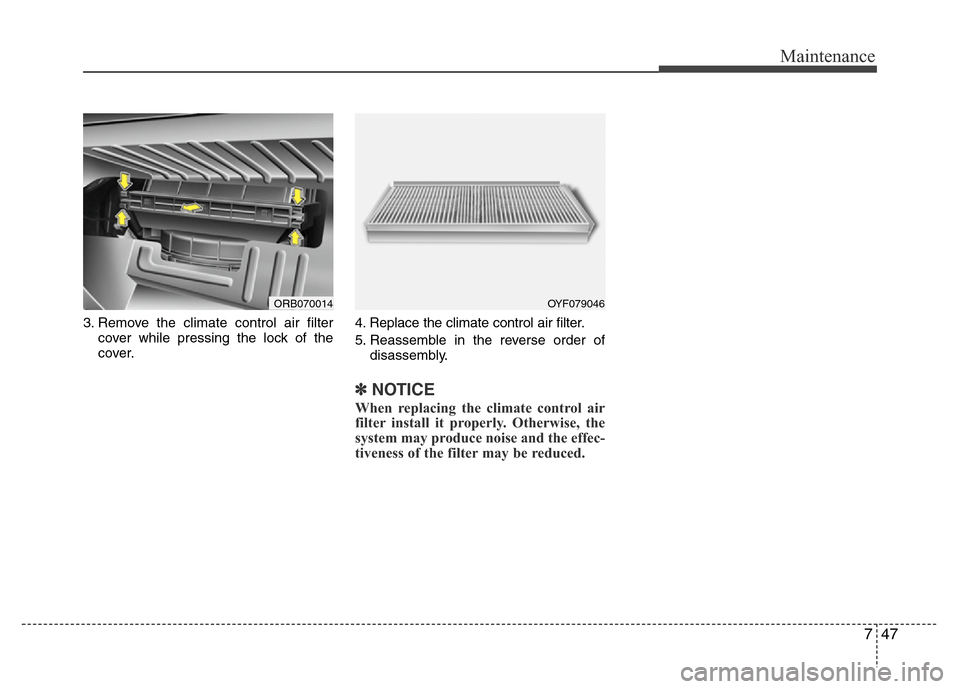
3. Remove the climate control air filter
cover while pressing the lock of the
cover.4. Replace the climate control air filter.
5. Reassemble in the reverse order of
disassembly.
✽NOTICE
When replacing the climate control air
filter install it properly. Otherwise, the
system may produce noise and the effec-
tiveness of the filter may be reduced.
OYF079046ORB070014
Page 365 of 402
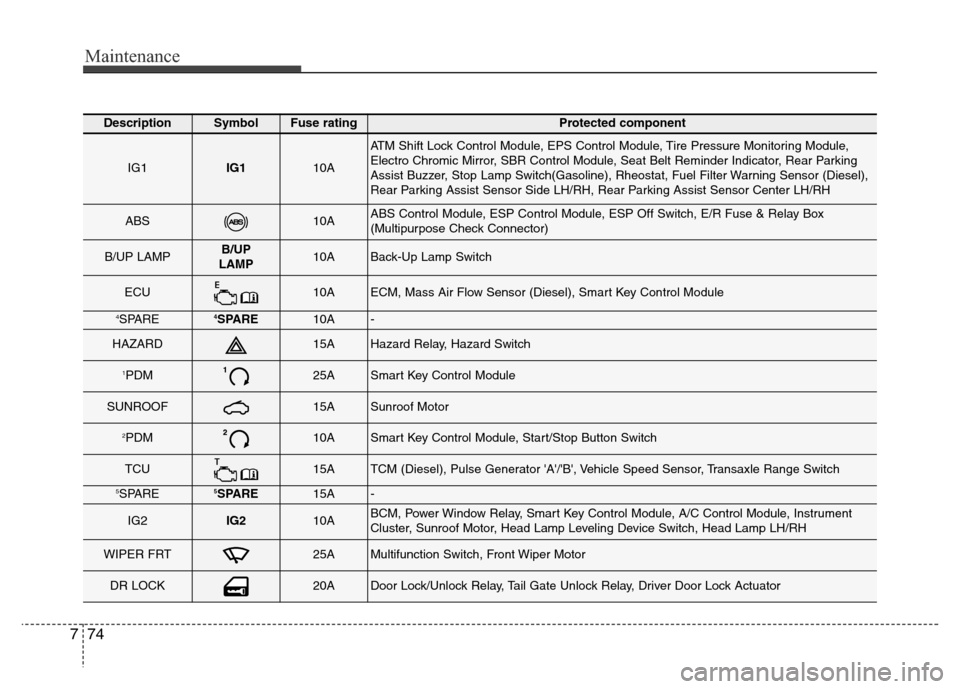
Maintenance
74 7
DescriptionSymbolFuse ratingProtected component
IG1IG110A
ATM Shift Lock Control Module, EPS Control Module, Tire Pressure Monitoring Module,
Electro Chromic Mirror, SBR Control Module, Seat Belt Reminder Indicator, Rear Parking
Assist Buzzer, Stop Lamp Switch(Gasoline), Rheostat, Fuel Filter Warning Sensor (Diesel),
Rear Parking Assist Sensor Side LH/RH, Rear Parking Assist Sensor Center LH/RH
ABS10AABS Control Module, ESP Control Module, ESP Off Switch, E/R Fuse & Relay Box
(Multipurpose Check Connector)
B/UP LAMPB/UP
LAMP10ABack-Up Lamp Switch
ECU10AECM, Mass Air Flow Sensor (Diesel), Smart Key Control Module
4SPARE4SPARE10A-
HAZARD15AHazard Relay, Hazard Switch
1PDM25ASmart Key Control Module
SUNROOF15ASunroof Motor
2PDM10ASmart Key Control Module, Start/Stop Button Switch
TCU15ATCM (Diesel), Pulse Generator 'A'/'B', Vehicle Speed Sensor, Transaxle Range Switch
5SPARE5SPARE15A-
IG2IG210ABCM, Power Window Relay, Smart Key Control Module, A/C Control Module, Instrument
Cluster, Sunroof Motor, Head Lamp Leveling Device Switch, Head Lamp LH/RH
WIPER FRT25AMultifunction Switch, Front Wiper Motor
DR LOCK20ADoor Lock/Unlock Relay, Tail Gate Unlock Relay, Driver Door Lock Actuator
Page 367 of 402
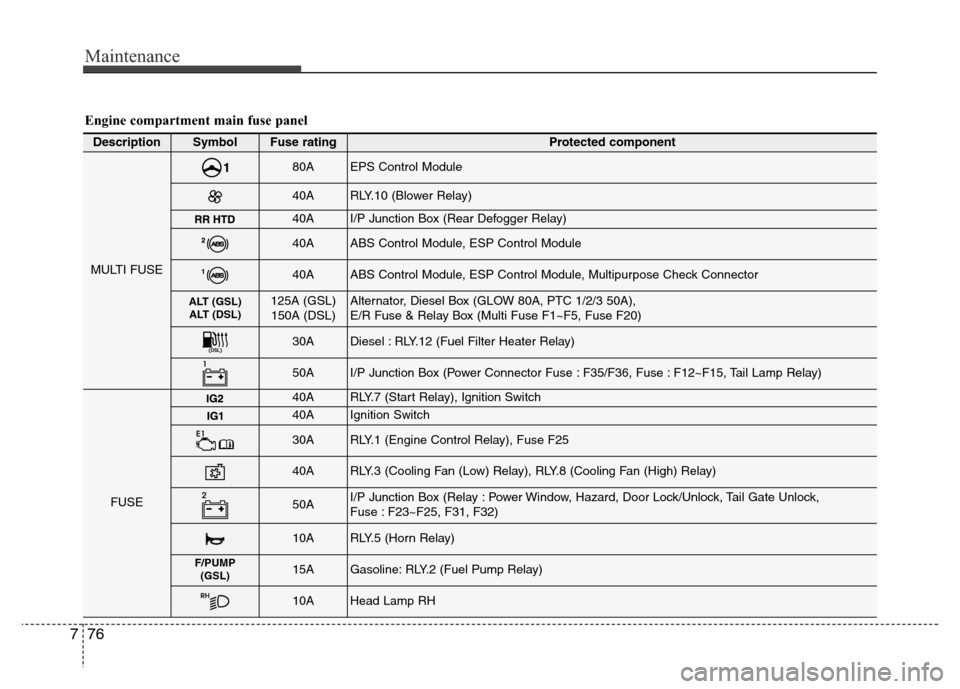
Maintenance
76 7
DescriptionSymbolFuse ratingProtected component
MULTI FUSE
80AEPS Control Module
40ARLY.10 (Blower Relay)
40AI/P Junction Box (Rear Defogger Relay)
40AABS Control Module, ESP Control Module
40AABS Control Module, ESP Control Module, Multipurpose Check Connector
ALT (GSL)
ALT (DSL)125A (GSL)
150A (DSL)Alternator, Diesel Box (GLOW 80A, PTC 1/2/3 50A),
E/R Fuse & Relay Box (Multi Fuse F1~F5, Fuse F20)
30ADiesel : RLY.12 (Fuel Filter Heater Relay)
50AI/P Junction Box (Power Connector Fuse : F35/F36, Fuse : F12~F15, Tail Lamp Relay)
FUSE
40ARLY.7 (Start Relay), Ignition Switch
40AIgnition Switch
30ARLY.1 (Engine Control Relay), Fuse F25
40ARLY.3 (Cooling Fan (Low) Relay), RLY.8 (Cooling Fan (High) Relay)
50AI/P Junction Box (Relay : Power Window, Hazard, Door Lock/Unlock, Tail Gate Unlock,
Fuse : F23~F25, F31, F32)
10ARLY.5 (Horn Relay)
F/PUMP
(GSL)15AGasoline: RLY.2 (Fuel Pump Relay)
10AHead Lamp RH
Engine compartment main fuse panel
Page 390 of 402
799
Maintenance
EMISSION CONTROL SYSTEM (IF EQUIPPED)
The emission control system of your
vehicle is covered by a written limited
warranty. Please see the warranty infor-
mation contained in the Service Passport
in your vehicle.
Your vehicle is equipped with an emis-
sion control system to meet all applicable
emission regulations.
There are three emission control sys-
tems, as follows.
(1) Crankcase emission control system
(2) Evaporative emission control system
(3) Exhaust emission control system
In order to assure the proper function of
the emission control systems, it is rec-
ommended that you have your car
inspected and maintained by an author-
ized HYUNDAI dealer in accordance with
the maintenance schedule in this manu-
al.Caution for the Inspection and
Maintenance Test (With Electronic
Stability Program (ESP) system)
• To prevent the vehicle from misfir-
ing during dynamometer testing,
turn the Electronic Stability
Program (ESP) system off by press-
ing the ESP switch.
• After dynamometer testing is com-
pleted, turn the ESP system back on
by pressing the ESP switch again.1. Crankcase emission control
system
The positive crankcase ventilation sys-
tem is employed to prevent air pollution
caused by blow-by gases being emitted
from the crankcase. This system supplies
fresh filtered air to the crankcase through
the air intake hose. Inside the crankcase,
the fresh air mixes with blow-by gases,
which then pass through the PCV valve
into the induction system.
2. Evaporative emission control
system
The Evaporative Emission Control
System is designed to prevent fuel
vapors from escaping into the atmos-
phere.
Page 393 of 402
Maintenance
102 7
Diesel Particulate Filter (if equipped)
The Diesel Particulate Filter (DPF) sys-
tem removes the soot emitted from the
vehicle.
Unlike a disposable air filter, the DPF
system automatically burns (oxidizes)
and removes the accumulated soot
according to the driving condition. In
other words, the active burning by engine
control system and high exhaust gas
temperature caused by normal/high driv-
ing condition burns and removes the
accumulated soot.
However, if the vehicle continues to be
driven at low speed for long time, the
accumulated soot may not be automati-
cally removed because of low exhaust
gas temperature. In this particular case,
the amount of soot is out of detection
limit, the soot oxidation process by
engine control system may not happen
and the malfunction indicator light may
blink.
When the malfunction indicator light
blinks, it may stop blinking by driving the
vehicle at more than 60km/h (37 mph) or
at more than second gear with 1500 ~
2000 engine rpm for a certain time (for
about 25 minutes).If the malfunction indicator light contin-
ues to be blinked in spite of the proce-
dure, please visit an authorized
HYUNDAI dealer and then check the
DPF system.
If you continue to drive with the malfunc-
tion indicator light blinking for a long
time, the DPF system can be damaged
and fuel consumption can be worsen.
CAUTION - Diesel Fuel
(if equipped with DPF)
It is recommended to use the regu-
lated automotive diesel fuel for
diesel vehicle equipped with the
DPF system.
If you use diesel fuel including high
sulfur (more than 50 ppm sulfur)
and unspecified additives, it can
cause the DPF system to be dam-
aged and white smoke can be emit-
ted.
Page 398 of 402
85
Specifications & Consumer information
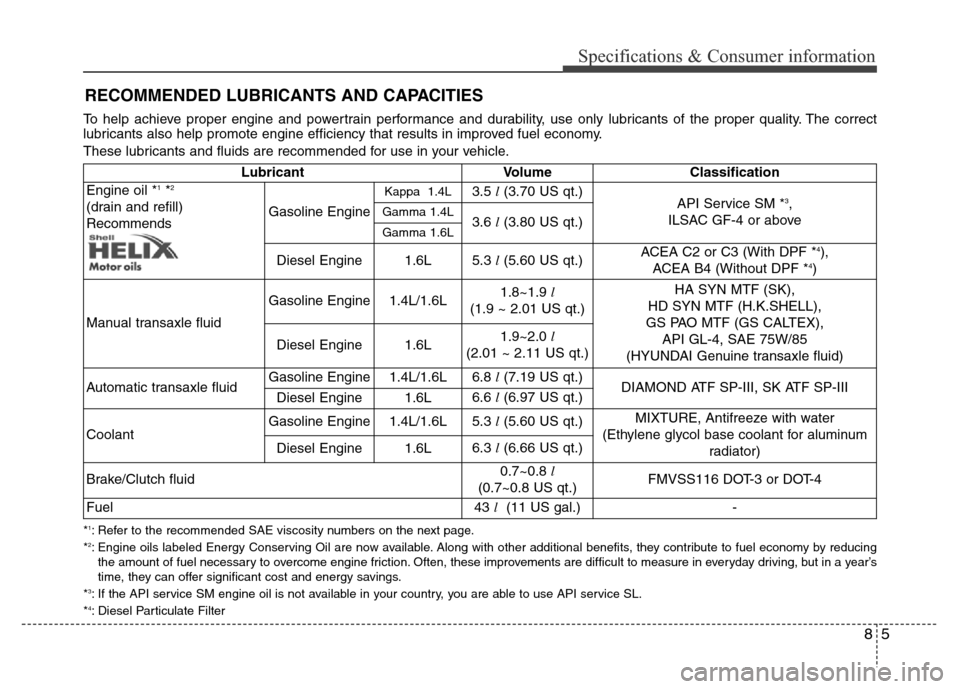
RECOMMENDED LUBRICANTS AND CAPACITIES
Lubricant Volume Classification
Engine oil *1*2
(drain and refill)
RecommendsGasoline Engine
Kappa 1.4L3.5 l(3.70 US qt.)
API Service SM *3,
ILSAC GF-4 or aboveGamma 1.4L3.6 l(3.80 US qt.)Gamma 1.6L
Diesel Engine1.6L5.3 l(5.60 US qt.)ACEA C2 or C3 (With DPF *4),
ACEA B4 (Without DPF *4)
Manual transaxle fluid
Gasoline Engine1.4L/1.6L1.8~1.9 l
(1.9 ~ 2.01 US qt.)HA SYN MTF (SK),
HD SYN MTF (H.K.SHELL),
GS PAO MTF (GS CALTEX),
API GL-4, SAE 75W/85
(HYUNDAI Genuine transaxle fluid)
Diesel Engine1.6L1.9~2.0 l
(2.01 ~ 2.11 US qt.)
Automatic transaxle fluidGasoline Engine 1.4L/1.6L6.8 l(7.19 US qt.)
DIAMOND ATF SP-III, SK ATF SP-III
Diesel Engine1.6L6.6 l(6.97 US qt.)
Coolant Gasoline Engine 1.4L/1.6L5.3 l(5.60 US qt.)MIXTURE, Antifreeze with water
(Ethylene glycol base coolant for aluminum
radiator)
Diesel Engine1.6L6.3 l(6.66 US qt.)
Brake/Clutch fluid0.7~0.8 l
(0.7~0.8 US qt.)FMVSS116 DOT-3 or DOT-4
Fuel43 l(11 US gal.)-
To help achieve proper engine and powertrain performance and durability, use only lubricants of the proper quality. The correct
lubricants also help promote engine efficiency that results in improved fuel economy.
These lubricants and fluids are recommended for use in your vehicle.
*1: Refer to the recommended SAE viscosity numbers on the next page.
*2: Engine oils labeled Energy Conserving Oil are now available. Along with other additional benefits, they contribute to fuel economy by reducing
the amount of fuel necessary to overcome engine friction. Often, these improvements are difficult to measure in everyday driving, but in a year’s
time, they can offer significant cost and energy savings.
*
3: If the API service SM engine oil is not available in your country, you are able to use API service SL.
*4: Diesel Particulate Filter