sae Hyundai Accent 2013 Owner's Manual
[x] Cancel search | Manufacturer: HYUNDAI, Model Year: 2013, Model line: Accent, Model: Hyundai Accent 2013Pages: 402, PDF Size: 8.49 MB
Page 261 of 402
541
Driving your vehicle
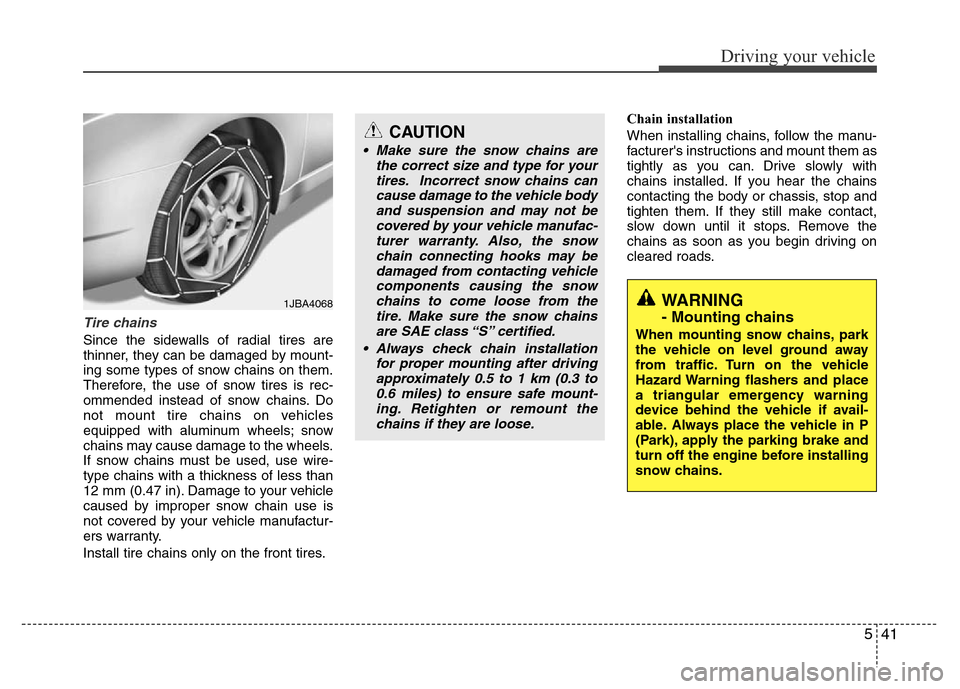
Tire chains
Since the sidewalls of radial tires are
thinner, they can be damaged by mount-
ing some types of snow chains on them.
Therefore, the use of snow tires is rec-
ommended instead of snow chains. Do
not mount tire chains on vehicles
equipped with aluminum wheels; snow
chains may cause damage to the wheels.
If snow chains must be used, use wire-
type chains with a thickness of less than
12 mm (0.47 in). Damage to your vehicle
caused by improper snow chain use is
not covered by your vehicle manufactur-
ers warranty.
Install tire chains only on the front tires.Chain installation
When installing chains, follow the manu-
facturer's instructions and mount them as
tightly as you can. Drive slowly with
chains installed. If you hear the chains
contacting the body or chassis, stop and
tighten them. If they still make contact,
slow down until it stops. Remove the
chains as soon as you begin driving on
cleared roads.
CAUTION
• Make sure the snow chains are
the correct size and type for your
tires. Incorrect snow chains can
cause damage to the vehicle body
and suspension and may not be
covered by your vehicle manufac-
turer warranty. Also, the snow
chain connecting hooks may be
damaged from contacting vehicle
components causing the snow
chains to come loose from the
tire. Make sure the snow chains
are SAE class “S” certified.
• Always check chain installation
for proper mounting after driving
approximately 0.5 to 1 km (0.3 to
0.6 miles) to ensure safe mount-
ing. Retighten or remount the
chains if they are loose.
WARNING
- Mounting chains
When mounting snow chains, park
the vehicle on level ground away
from traffic. Turn on the vehicle
Hazard Warning flashers and place
a triangular emergency warning
device behind the vehicle if avail-
able. Always place the vehicle in P
(Park), apply the parking brake and
turn off the engine before installing
snow chains.
1JBA4068
Page 345 of 402
Maintenance
54 7
❈The actual battery label in the vehicle
may differ from the illustration.
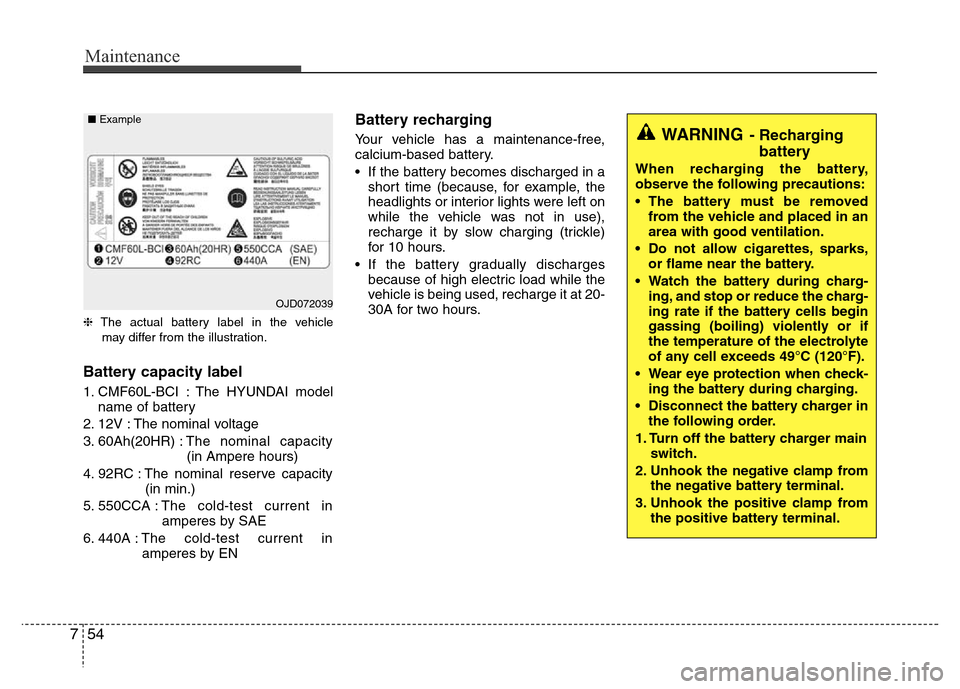
Battery capacity label
1. CMF60L-BCI : The HYUNDAI model
name of battery
2. 12V : The nominal voltage
3. 60Ah(20HR) :The nominal capacity
(in Ampere hours)
4. 92RC : The nominal reserve capacity
(in min.)
5. 550CCA :The cold-test current in
amperes by SAE
6. 440A :The cold-test current in
amperes by EN
Battery recharging
Your vehicle has a maintenance-free,
calcium-based battery.
• If the battery becomes discharged in a
short time (because, for example, the
headlights or interior lights were left on
while the vehicle was not in use),
recharge it by slow charging (trickle)
for 10 hours.
• If the battery gradually discharges
because of high electric load while the
vehicle is being used, recharge it at 20-
30A for two hours.
OJD072039 ■Example
WARNING- Recharging
battery
When recharging the battery,
observe the following precautions:
• The battery must be removed
from the vehicle and placed in an
area with good ventilation.
• Do not allow cigarettes, sparks,
or flame near the battery.
• Watch the battery during charg-
ing, and stop or reduce the charg-
ing rate if the battery cells begin
gassing (boiling) violently or if
the temperature of the electrolyte
of any cell exceeds 49°C (120°F).
• Wear eye protection when check-
ing the battery during charging.
• Disconnect the battery charger in
the following order.
1. Turn off the battery charger main
switch.
2. Unhook the negative clamp from
the negative battery terminal.
3. Unhook the positive clamp from
the positive battery terminal.
Page 398 of 402
85
Specifications & Consumer information
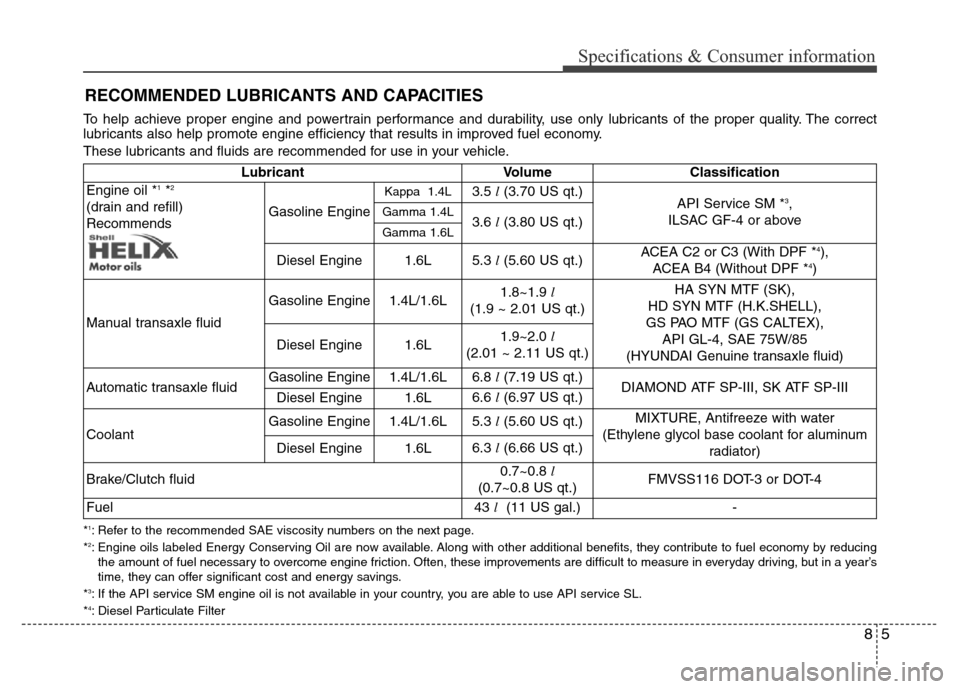
RECOMMENDED LUBRICANTS AND CAPACITIES
Lubricant Volume Classification
Engine oil *1*2
(drain and refill)
RecommendsGasoline Engine
Kappa 1.4L3.5 l(3.70 US qt.)
API Service SM *3,
ILSAC GF-4 or aboveGamma 1.4L3.6 l(3.80 US qt.)Gamma 1.6L
Diesel Engine1.6L5.3 l(5.60 US qt.)ACEA C2 or C3 (With DPF *4),
ACEA B4 (Without DPF *4)
Manual transaxle fluid
Gasoline Engine1.4L/1.6L1.8~1.9 l
(1.9 ~ 2.01 US qt.)HA SYN MTF (SK),
HD SYN MTF (H.K.SHELL),
GS PAO MTF (GS CALTEX),
API GL-4, SAE 75W/85
(HYUNDAI Genuine transaxle fluid)
Diesel Engine1.6L1.9~2.0 l
(2.01 ~ 2.11 US qt.)
Automatic transaxle fluidGasoline Engine 1.4L/1.6L6.8 l(7.19 US qt.)
DIAMOND ATF SP-III, SK ATF SP-III
Diesel Engine1.6L6.6 l(6.97 US qt.)
Coolant Gasoline Engine 1.4L/1.6L5.3 l(5.60 US qt.)MIXTURE, Antifreeze with water
(Ethylene glycol base coolant for aluminum
radiator)
Diesel Engine1.6L6.3 l(6.66 US qt.)
Brake/Clutch fluid0.7~0.8 l
(0.7~0.8 US qt.)FMVSS116 DOT-3 or DOT-4
Fuel43 l(11 US gal.)-
To help achieve proper engine and powertrain performance and durability, use only lubricants of the proper quality. The correct
lubricants also help promote engine efficiency that results in improved fuel economy.
These lubricants and fluids are recommended for use in your vehicle.
*1: Refer to the recommended SAE viscosity numbers on the next page.
*2: Engine oils labeled Energy Conserving Oil are now available. Along with other additional benefits, they contribute to fuel economy by reducing
the amount of fuel necessary to overcome engine friction. Often, these improvements are difficult to measure in everyday driving, but in a year’s
time, they can offer significant cost and energy savings.
*
3: If the API service SM engine oil is not available in your country, you are able to use API service SL.
*4: Diesel Particulate Filter
Page 399 of 402
Specifications & Consumer information
6 8
Recommended SAE viscosity
numberEngine oil viscosity (thickness) has an
effect on fuel economy and cold weather
operating (engine start and engine oil
flowability). Lower viscosity engine oils
can provide better fuel economy and cold
weather performance, however, higher
viscosity engine oils are required for sat-
isfactory lubrication in hot weather.Using oils of any viscosity other than
those recommended could result in
engine damage.
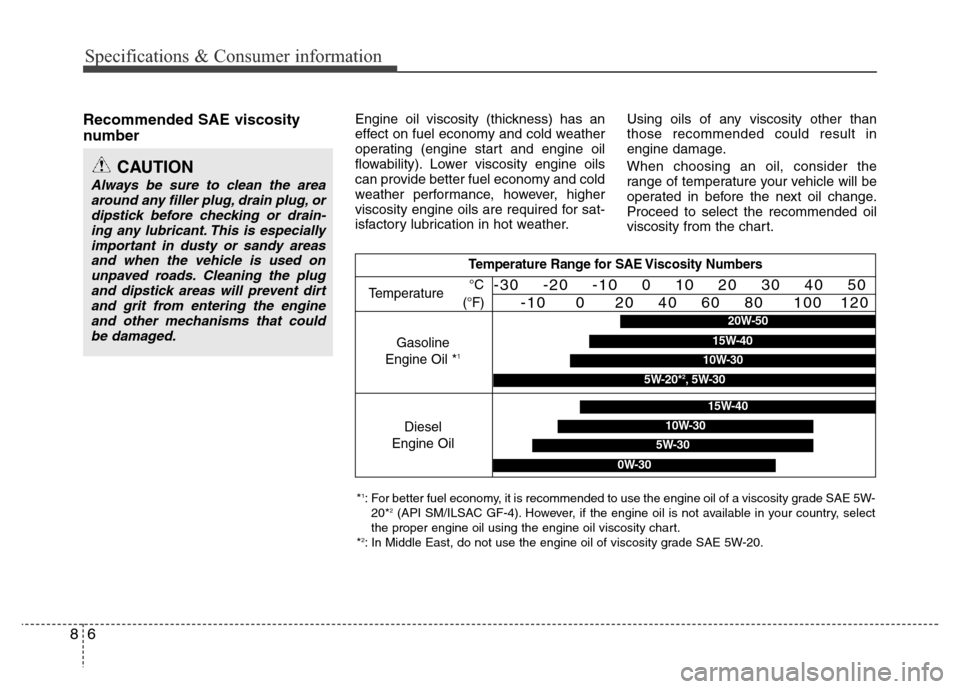
When choosing an oil, consider the
range of temperature your vehicle will be
operated in before the next oil change.
Proceed to select the recommended oil
viscosity from the chart.
CAUTION
Always be sure to clean the area
around any filler plug, drain plug, or
dipstick before checking or drain-
ing any lubricant. This is especially
important in dusty or sandy areas
and when the vehicle is used on
unpaved roads. Cleaning the plug
and dipstick areas will prevent dirt
and grit from entering the engine
and other mechanisms that could
be damaged.
Temperature Range for SAE Viscosity Numbers
Temperature°C
(°F)-30 -20 -10 0 10 20 30 40 50
-10 0 20 40 60 80 100 120
Diesel
Engine Oil
5W-30
15W-40
10W-30
0W-30
*1: For better fuel economy, it is recommended to use the engine oil of a viscosity grade SAE 5W-
20*2(API SM/ILSAC GF-4). However, if the engine oil is not available in your country, select
the proper engine oil using the engine oil viscosity chart.
*
2: In Middle East, do not use the engine oil of viscosity grade SAE 5W-20.
Gasoline
Engine Oil *1
20W-50
10W-30
15W-40
5W-20*2, 5W-30