TPMS Hyundai Accent 2015 User Guide
[x] Cancel search | Manufacturer: HYUNDAI, Model Year: 2015, Model line: Accent, Model: Hyundai Accent 2015Pages: 406, PDF Size: 33.11 MB
Page 289 of 406
615
What to do in an emergency
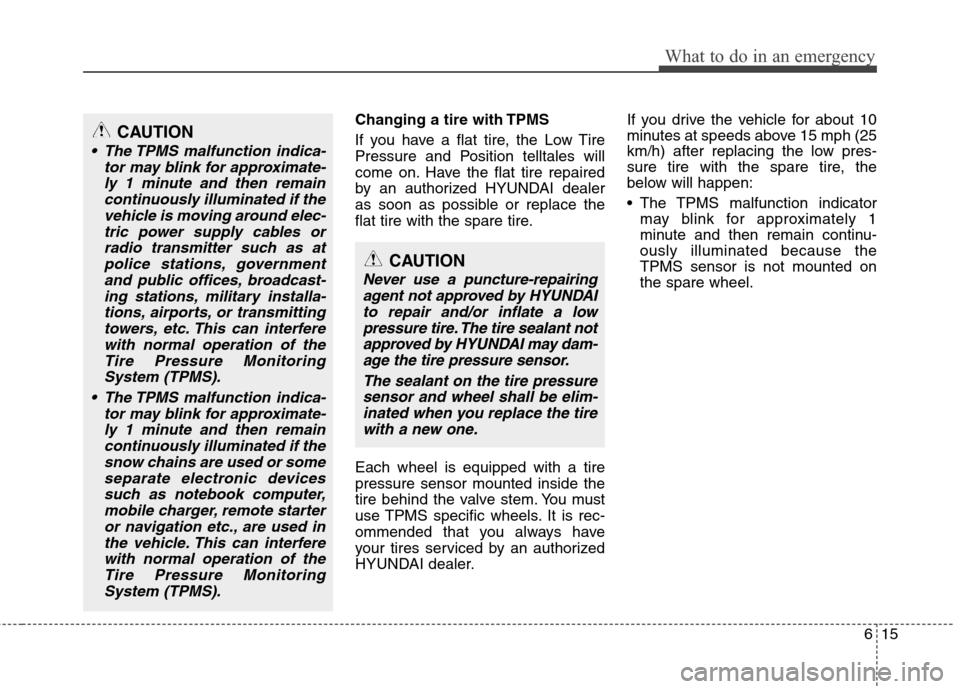
Changing a tire with TPMS
If you have a flat tire, the Low Tire
Pressure and Position telltales will
come on. Have the flat tire repaired
by an authorized HYUNDAI dealer
as soon as possible or replace the
flat tire with the spare tire.
Each wheel is equipped with a tire
pressure sensor mounted inside the
tire behind the valve stem. You must
use TPMS specific wheels. It is rec-
ommended that you always have
your tires serviced by an authorized
HYUNDAI dealer.If you drive the vehicle for about 10
minutes at speeds above 15 mph (25
km/h) after replacing the low pres-
sure tire with the spare tire, the
below will happen:
The TPMS malfunction indicator
may blink for approximately 1
minute and then remain continu-
ously illuminated because the
TPMS sensor is not mounted on
the spare wheel.CAUTION
The TPMS malfunction indica-
tor may blink for approximate-
ly 1 minute and then remain
continuously illuminated if the
vehicle is moving around elec-
tric power supply cables or
radio transmitter such as at
police stations, government
and public offices, broadcast-
ing stations, military installa-
tions, airports, or transmitting
towers, etc. This can interfere
with normal operation of the
Tire Pressure Monitoring
System (TPMS).
The TPMS malfunction indica-
tor may blink for approximate-
ly 1 minute and then remain
continuously illuminated if the
snow chains are used or some
separate electronic devices
such as notebook computer,
mobile charger, remote starter
or navigation etc., are used in
the vehicle. This can interfere
with normal operation of the
Tire Pressure Monitoring
System (TPMS).
CAUTION
Never use a puncture-repairing
agent not approved by HYUNDAI
to repair and/or inflate a low
pressure tire. The tire sealant not
approved by HYUNDAI may dam-
age the tire pressure sensor.
The sealant on the tire pressure
sensor and wheel shall be elim-
inated when you replace the tire
with a new one.
Page 290 of 406
What to do in an emergency
16 6
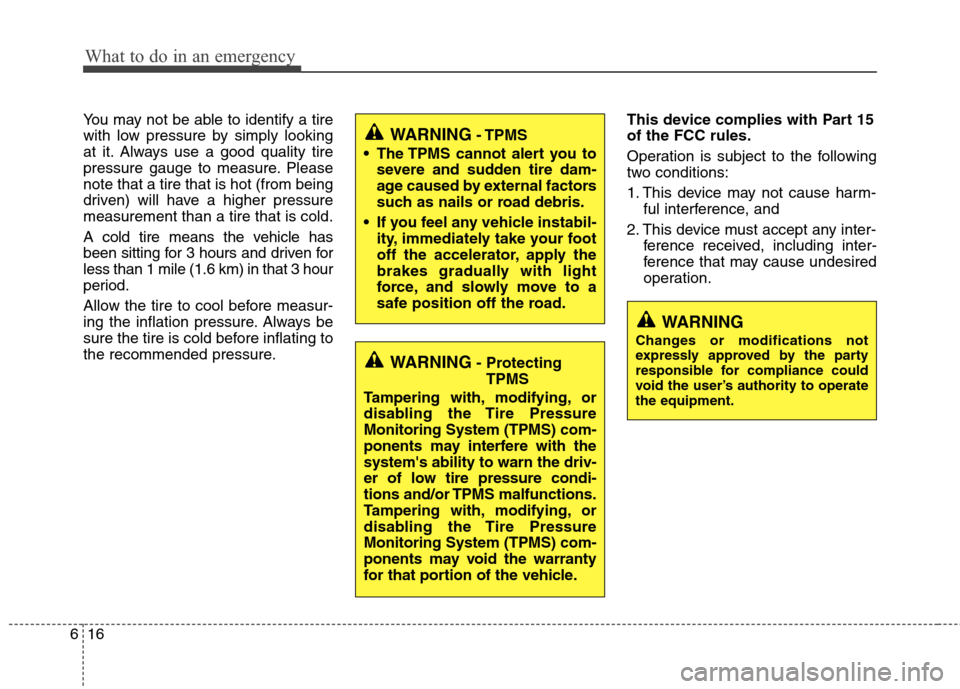
You may not be able to identify a tire
with low pressure by simply looking
at it. Always use a good quality tire
pressure gauge to measure. Please
note that a tire that is hot (from being
driven) will have a higher pressure
measurement than a tire that is cold.
A cold tire means the vehicle has
been sitting for 3 hours and driven for
less than 1 mile (1.6 km) in that 3 hour
period.
Allow the tire to cool before measur-
ing the inflation pressure. Always be
sure the tire is cold before inflating to
the recommended pressure.This device complies with Part 15
of the FCC rules.
Operation is subject to the following
two conditions:
1. This device may not cause harm-
ful interference, and
2. This device must accept any inter-
ference received, including inter-
ference that may cause undesired
operation.
WARNING- Protecting
TPMS
Tampering with, modifying, or
disabling the Tire Pressure
Monitoring System (TPMS) com-
ponents may interfere with the
system's ability to warn the driv-
er of low tire pressure condi-
tions and/or TPMS malfunctions.
Tampering with, modifying, or
disabling the Tire Pressure
Monitoring System (TPMS) com-
ponents may void the warranty
for that portion of the vehicle.
WARNING- TPMS
The TPMS cannot alert you to
severe and sudden tire dam-
age caused by external factors
such as nails or road debris.
If you feel any vehicle instabil-
ity, immediately take your foot
off the accelerator, apply the
brakes gradually with light
force, and slowly move to a
safe position off the road.
WARNING
Changes or modifications not
expressly approved by the party
responsible for compliance could
void the user’s authority to operate
the equipment.
Page 405 of 406
Index
8I
Spare tire
Compact spare tire ····················································6-23
Compact spare tire replacement ································7-42
Removing and storing the spare tire ·························6-18
Special driving conditions ·············································5-34
Driving at night ·························································5-35
Driving in flooded areas············································5-36
Driving in the rain ·····················································5-36
Hazardous driving conditions ···································5-34
Highway driving························································5-37
Rocking the vehicle···················································5-34
Smooth cornering ······················································5-35
Speedometer···································································4-35
Sports mode ···································································5-12
SRS components and functions ·····································3-37
Starting difficulties, see engine will not start ··················6-3
Steering wheel································································4-30
Electric power steering··············································4-30
Horn···········································································4-32
Tilt and telescopic steering········································4-31
Steering wheel audio control ·········································4-95
Steps For Determining Correct Load Limit ··················5-43
Storage compartment ·····················································4-84
Center console storage ··············································4-84
Glove box ··································································4-85
Luggage net ·······························································4-86
Sliding armrest ··························································4-84
Sunglass holder ·························································4-85Sunglass holder ······························································4-85
Sunroof···········································································4-26
Sunvisor ·········································································4-87
Tachometer·····································································4-37
Tailgate···········································································4-14
Tether anchor system ·····················································3-30
Tilt and telescopic steering ···········································4-31
Tire and loading information label ································5-42
Tire chains······································································5-39
Tire mobility kit ·····························································6-25
Tire pressure monitoring system (TPMS) ··············6-7, 6-12
Tire specification and pressure label ·······························8-7
Tires and wheels ····························································7-37
Checking tire inflation pressure ································7-38
Compact spare tire replacement ································7-42
Low aspect ratio tire··················································7-46
Recommended cold tire inflation pressures ··············7-37
Tire care·····································································7-37
Tire maintenance ·······················································7-42
Tire replacement ························································7-41
Tire rotation ·······························································7-39
Tire sidewall labeling ················································7-43
Tire traction ·······························································7-42
Wheel alignment and tire balance ·····························7-40
Wheel replacement ····················································7-42
T