Engine compartment Hyundai Accent 2016 User Guide
[x] Cancel search | Manufacturer: HYUNDAI, Model Year: 2016, Model line: Accent, Model: Hyundai Accent 2016Pages: 456, PDF Size: 16.41 MB
Page 409 of 456
751
Maintenance
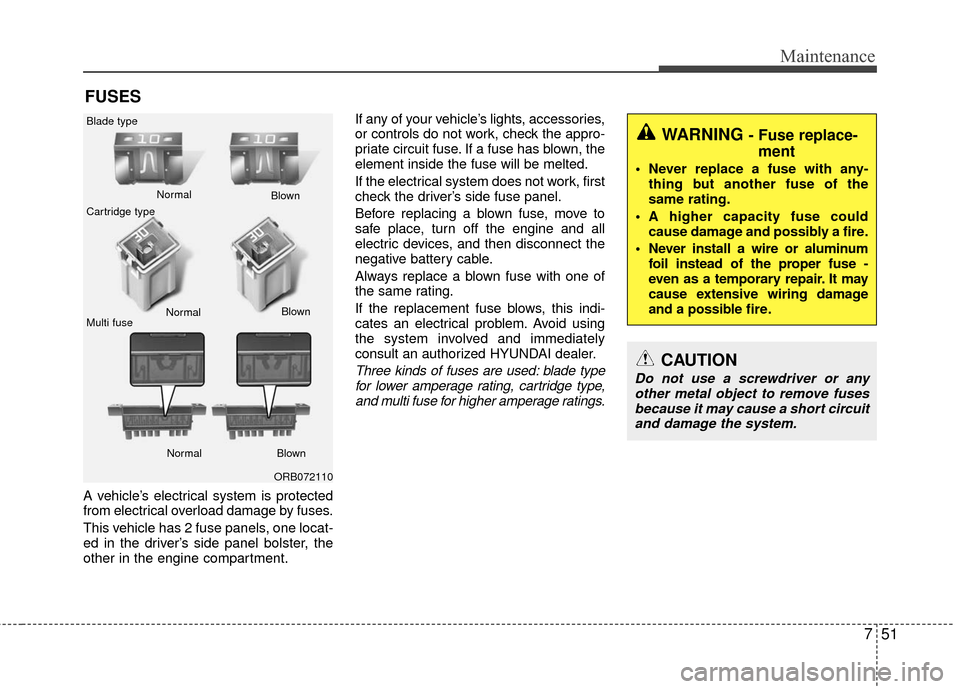
A vehicle’s electrical system is protected
from electrical overload damage by fuses.
This vehicle has 2 fuse panels, one locat-
ed in the driver’s side panel bolster, the
other in the engine compartment.If any of your vehicle’s lights, accessories,
or controls do not work, check the appro-
priate circuit fuse. If a fuse has blown, the
element inside the fuse will be melted.
If the electrical system does not work, first
check the driver’s side fuse panel.
Before replacing a blown fuse, move to
safe place, turn off the engine and all
electric devices, and then disconnect the
negative battery cable.
Always replace a blown fuse with one of
the same rating.
If the replacement fuse blows, this indi-
cates an electrical problem. Avoid using
the system involved and immediately
consult an authorized HYUNDAI dealer.
Three kinds of fuses are used: blade type
for lower amperage rating, cartridge type,and multi fuse for higher amperage ratings.
WARNING - Fuse replace- ment
Never replace a fuse with any-
thing but another fuse of the
same rating.
A higher capacity fuse could cause damage and possibly a fire.
Never install a wire or aluminum foil instead of the proper fuse -
even as a temporary repair. It may
cause extensive wiring damage
and a possible fire.
CAUTION
Do not use a screwdriver or anyother metal object to remove fuses because it may cause a short circuitand damage the system.
ORB072110
Normal
Normal
Blade type
Cartridge type
Multi fuse Blown
Blown
Normal Blown
FUSES
Page 410 of 456
Maintenance
52
7
✽
✽
NOTICE
The actual fuse/relay panel label may
differ from equipped items.
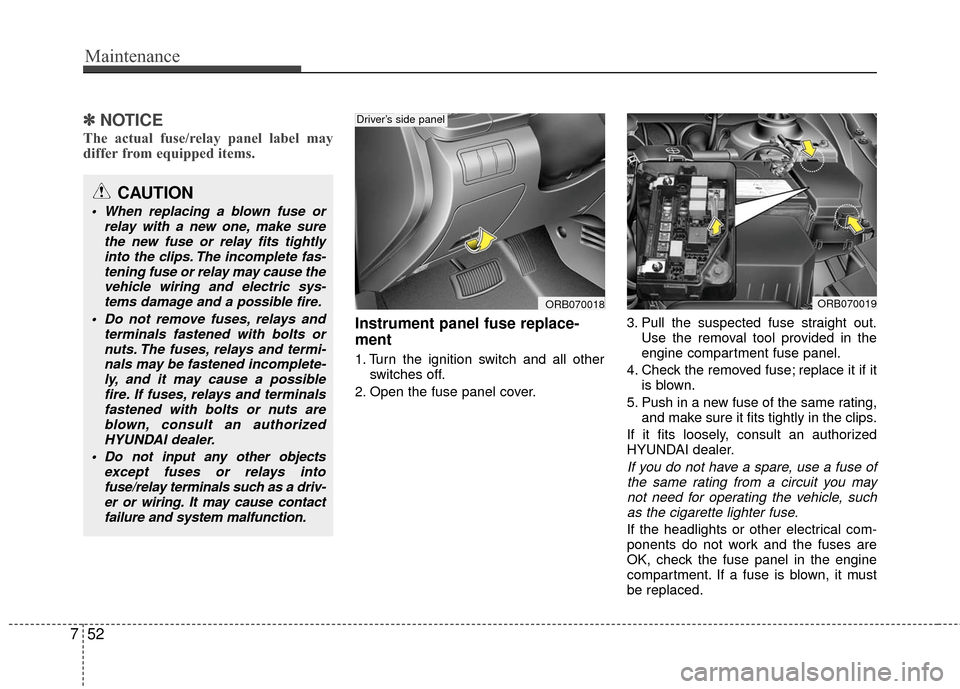
Instrument panel fuse replace-
ment
1. Turn the ignition switch and all other
switches off.
2. Open the fuse panel cover. 3. Pull the suspected fuse straight out.
Use the removal tool provided in the
engine compartment fuse panel.
4. Check the removed fuse; replace it if it is blown.
5. Push in a new fuse of the same rating, and make sure it fits tightly in the clips.
If it fits loosely, consult an authorized
HYUNDAI dealer.
If you do not have a spare, use a fuse of the same rating from a circuit you maynot need for operating the vehicle, suchas the cigarette lighter fuse.
If the headlights or other electrical com-
ponents do not work and the fuses are
OK, check the fuse panel in the engine
compartment. If a fuse is blown, it must
be replaced.
CAUTION
When replacing a blown fuse or relay with a new one, make surethe new fuse or relay fits tightlyinto the clips. The incomplete fas-tening fuse or relay may cause the vehicle wiring and electric sys-tems damage and a possible fire.
Do not remove fuses, relays and terminals fastened with bolts ornuts. The fuses, relays and termi-nals may be fastened incomplete-ly, and it may cause a possiblefire. If fuses, relays and terminalsfastened with bolts or nuts areblown, consult an authorizedHYUNDAI dealer.
Do not input any other objects except fuses or relays intofuse/relay terminals such as a driv-er or wiring. It may cause contactfailure and system malfunction.
ORB070018
Driver’s side panel
ORB070019
Page 412 of 456
Maintenance
54
7
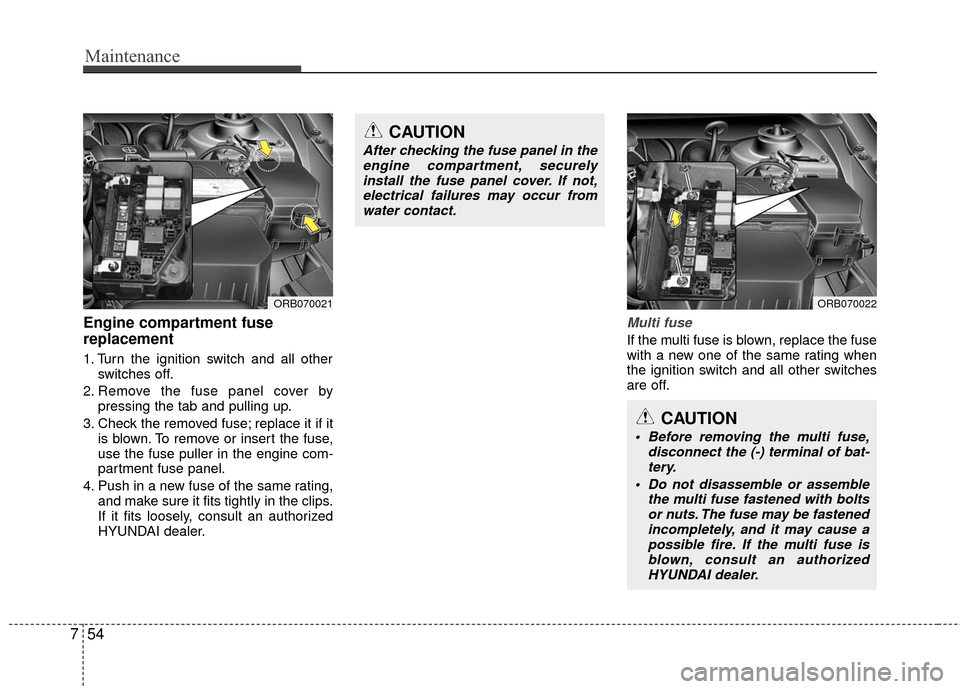
Engine compartment fuse
replacement
1. Turn the ignition switch and all other
switches off.
2. Remove the fuse panel cover by pressing the tab and pulling up.
3. Check the removed fuse; replace it if it is blown. To remove or insert the fuse,
use the fuse puller in the engine com-
partment fuse panel.
4. Push in a new fuse of the same rating, and make sure it fits tightly in the clips.
If it fits loosely, consult an authorized
HYUNDAI dealer.
Multi fuse
If the multi fuse is blown, replace the fuse
with a new one of the same rating when
the ignition switch and all other switches
are off.
CAUTION
After checking the fuse panel in theengine compartment, securelyinstall the fuse panel cover. If not,electrical failures may occur fromwater contact.
ORB070021ORB070022
CAUTION
Before removing the multi fuse, disconnect the (-) terminal of bat-tery.
Do not disassemble or assemble the multi fuse fastened with boltsor nuts. The fuse may be fastenedincompletely, and it may cause apossible fire. If the multi fuse isblown, consult an authorized HYUNDAI dealer.
Page 413 of 456
755
Maintenance
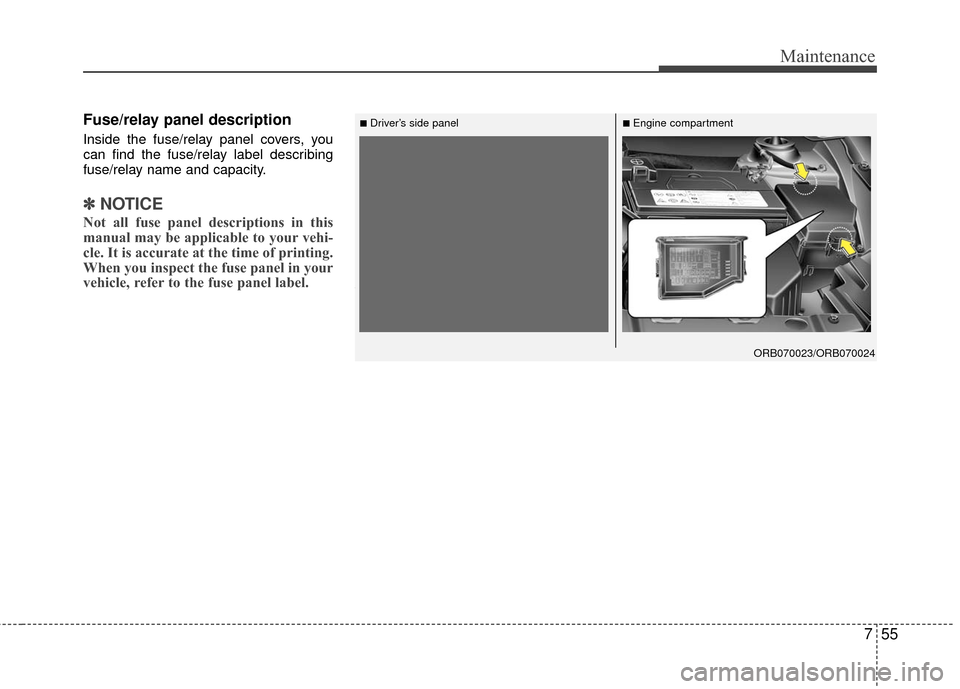
Fuse/relay panel description
Inside the fuse/relay panel covers, you
can find the fuse/relay label describing
fuse/relay name and capacity.
✽ ✽NOTICE
Not all fuse panel descriptions in this
manual may be applicable to your vehi-
cle. It is accurate at the time of printing.
When you inspect the fuse panel in your
vehicle, refer to the fuse panel label.
■Driver’s side panel■Engine compartment
ORB070023/ORB070024
Page 416 of 456
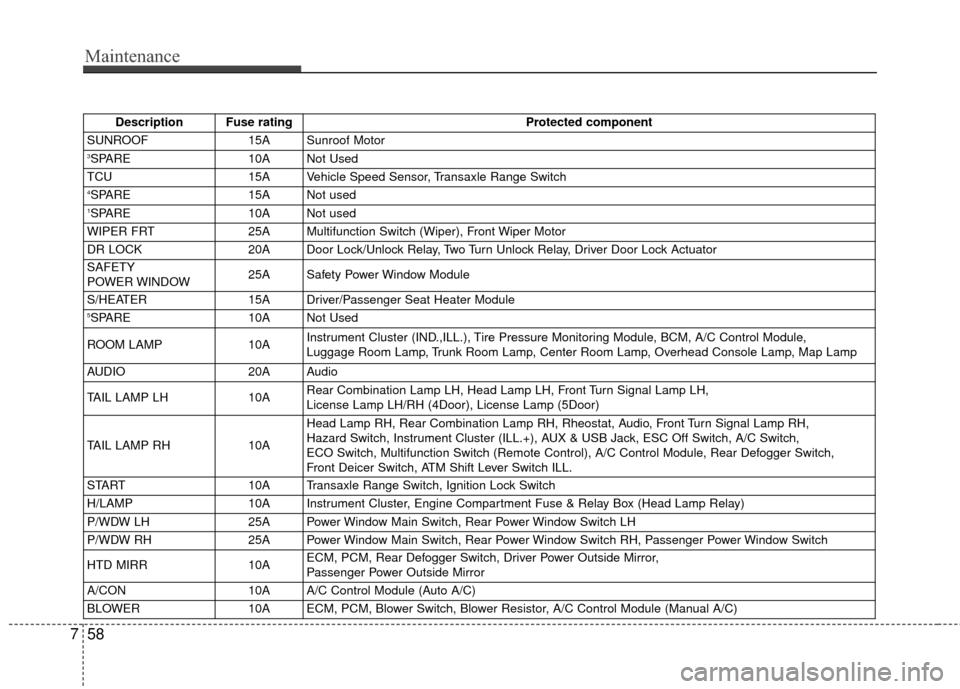
Maintenance
7
Description Fuse ratingProtected component
SUNROOF 15A Sunroof Motor
3SPARE10A Not Used
TCU 15A Vehicle Speed Sensor, Transaxle Range Switch
4SPARE15A Not used1SPARE10A Not used
WIPER FRT 25A Multifunction Switch (Wiper), Front Wiper Motor
DR LOCK 20A Door Lock/Unlock Relay, Two Turn Unlock Relay, Driver Door Lock Actuator
SAFETY
POWER WINDOW 25A Safety Power Window Module
S/HEATER 15A Driver/Passenger Seat Heater Module
5SPARE10A Not Used
ROOM LAMP 10AInstrument Cluster (IND.,ILL.), Tire Pressure Monitoring Module, BCM, A/C Control Module,
Luggage Room Lamp, Trunk Room Lamp, Center Room Lamp, Overhead Console Lamp, Map Lamp
AUDIO 20A Audio
TAIL LAMP LH 10ARear Combination Lamp LH, Head Lamp LH, Front Turn Signal Lamp LH,
License Lamp LH/RH (4Door), License Lamp (5Door)
TAIL LAMP RH 10AHead Lamp RH, Rear Combination Lamp RH, Rheostat, Audio, Front Turn Signal Lamp RH,
Hazard Switch, Instrument Cluster (ILL.+), AUX & USB Jack, ESC Off Switch, A/C Switch,
ECO Switch, Multifunction Switch (Remote Control), A/C Control Module, Rear Defogger Switch,
Front Deicer Switch, ATM Shift Lever Switch ILL.
START 10A Transaxle Range Switch, Ignition Lock Switch
H/LAMP 10A Instrument Cluster, Engine Compartment Fuse & Relay Box (Head Lamp Relay)
P/WDW LH 25A Power Window Main Switch, Rear Power Window Switch LH
P/WDW RH 25A Power Window Main Switch, Rear Power Window Switch RH, Passenger Power Window Switch
HTD MIRR 10AECM, PCM, Rear Defogger Switch, Driver Power Outside Mirror,
Passenger Power Outside Mirror
A/CON 10A A/C Control Module (Auto A/C)
BLOWER 10A ECM, PCM, Blower Switch, Blower Resistor, A/C Control Module (Manual A/C)
58
Page 417 of 456
759
Maintenance
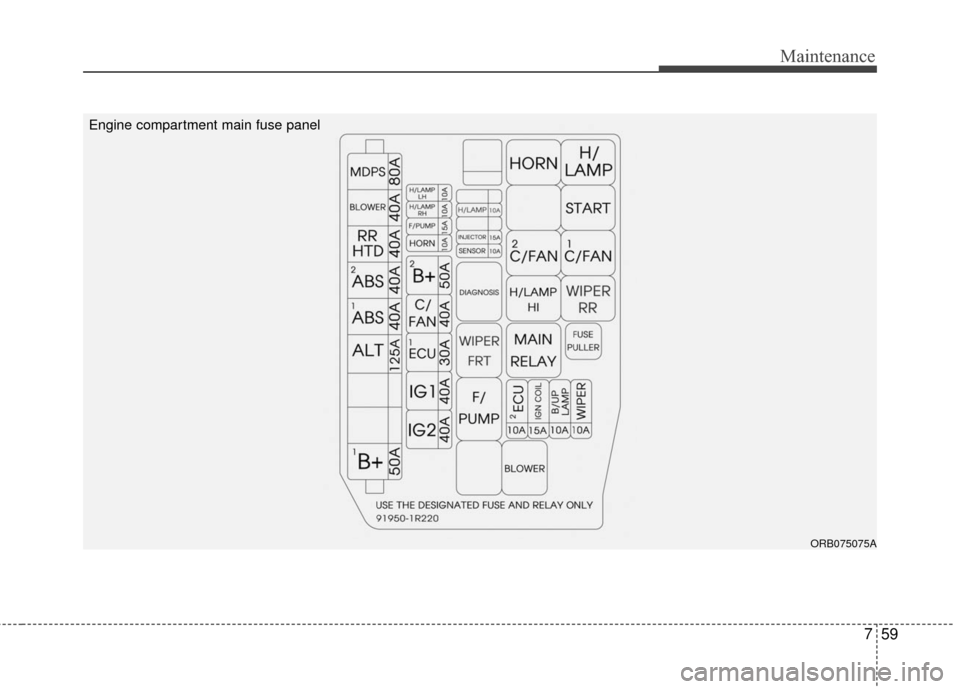
ORB075075A
Engine compartment main fuse panel
Page 418 of 456
Maintenance
7
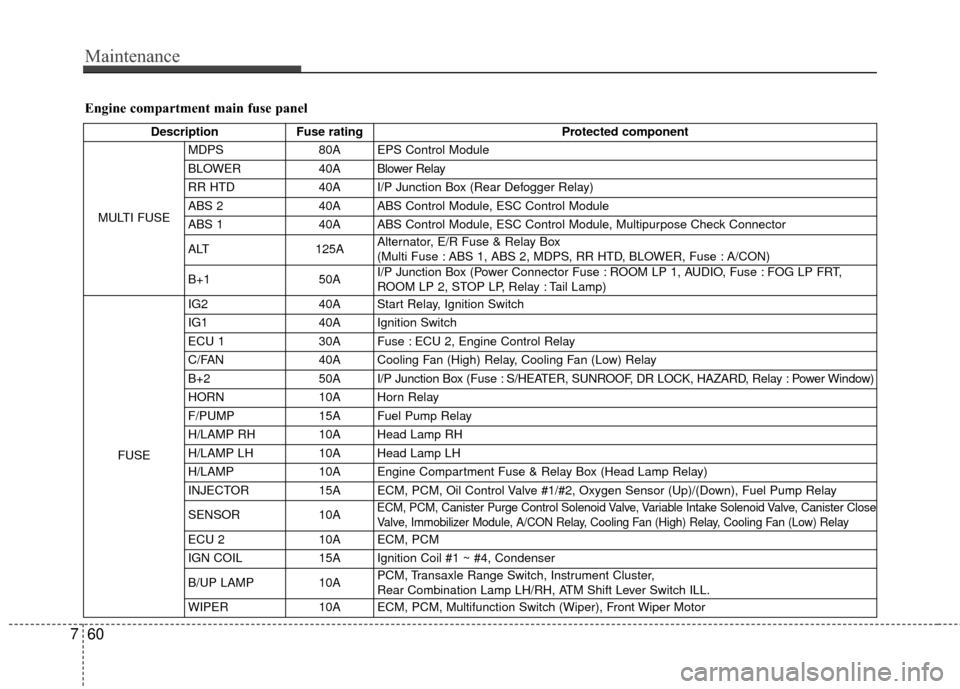
Engine compartment main fuse panel
DescriptionFuse rating Protected component
MULTI FUSE MDPS
80A EPS Control Module
BLOWER 40A Blower Relay
RR HTD 40A I/P Junction Box (Rear Defogger Relay)
ABS 2 40A ABS Control Module, ESC Control Module
ABS 1 40A ABS Control Module, ESC Control Module, Multipurpose Check Connector
ALT 125AAlternator, E/R Fuse & Relay Box
(Multi Fuse : ABS 1, ABS 2, MDPS, RR HTD, BLOWER, Fuse : A/CON)
B+1 50AI/P Junction Box (Power Connector Fuse : ROOM LP 1, AUDIO, Fuse : FOG LP FRT,
ROOM LP 2, STOP LP, Relay : Tail Lamp)
FUSE
IG240AStart Relay, Ignition Switch
IG140AIgnition Switch
ECU 1 30A Fuse : ECU 2, Engine Control Relay
C/FAN 40A Cooling Fan (High) Relay, Cooling Fan (Low) Relay
B+2 50A I/P Junction Box (Fuse : S/HEATER, SUNROOF, DR LOCK, HAZARD, Relay : Power Window)
HORN 10A Horn Relay
F/PUMP 15A Fuel Pump Relay
H/LAMP RH 10A Head Lamp RH
H/LAMP LH 10A Head Lamp LH
H/LAMP 10A Engine Compartment Fuse & Relay Box (Head Lamp Relay)
INJECTOR 15A ECM, PCM, Oil Control Valve #1/#2, Oxygen Sensor (Up)/(Down), Fuel Pump Relay
SENSOR 10A
ECM, PCM, Canister Purge Control Solenoid Valve, Variable Intake Solenoid Valve, Canister Close
Valve, Immobilizer Module, A/CON Relay, Cooling Fan (High) Relay, Cooling Fan (Low) Relay
ECU 210A ECM, PCM
IGN COIL 15A Ignition Coil #1 ~ #4, Condenser
B/UP LAMP 10APCM, Transaxle Range Switch, Instrument Cluster,
Rear Combination Lamp LH/RH, ATM Shift Lever Switch ILL.
WIPER 10A ECM, PCM, Multifunction Switch (Wiper), Front Wiper Motor
60
Page 430 of 456
Maintenance
72
7
Waxing
Wax the vehicle when water will no
longer bead on the paint.
Always wash and dry the vehicle before
waxing. Use a good quality liquid or
paste wax, and follow the manufacturer’s
instructions. Wax all metal trim to protect
it and to maintain its luster.
Removing oil, tar, and similar materials
with a spot remover will usually strip the
wax from the finish. Be sure to re-wax
these areas even if the rest of the vehicle
does not yet need waxing.Finish damage repair
Deep scratches or stone chips in the
painted surface must be repaired
promptly. Exposed metal will quickly rust
and may develop into a major repair
expense.
✽ ✽
NOTICE
If your vehicle is damaged and requires
any metal repair or replacement, be sure
the body shop applies anti-corrosion
materials to the parts repaired or
replaced.
Bright-metal maintenance
To remove road tar and insects, use a
tar remover, not a scraper or other
sharp object.
To protect the surfaces of bright-metal parts from corrosion, apply a coating of
wax or chrome preservative and rub to
a high luster.
During winter weather or in coastal areas, cover the bright metal parts with
a heavier coating of wax or preserva-
tive. If necessary, coat the parts with
non-corrosive petroleum jelly or other
protective compound.CAUTION
Wiping dust or dirt off the body with a dry cloth will scratch thefinish.
Do not use steel wool, abrasive cleaners, or strong detergentscontaining highly alkaline orcaustic agents on chrome-platedor anodized aluminum parts. This may result in damage to the pro-tective coating and cause discol-oration or paint deterioration.
CAUTION
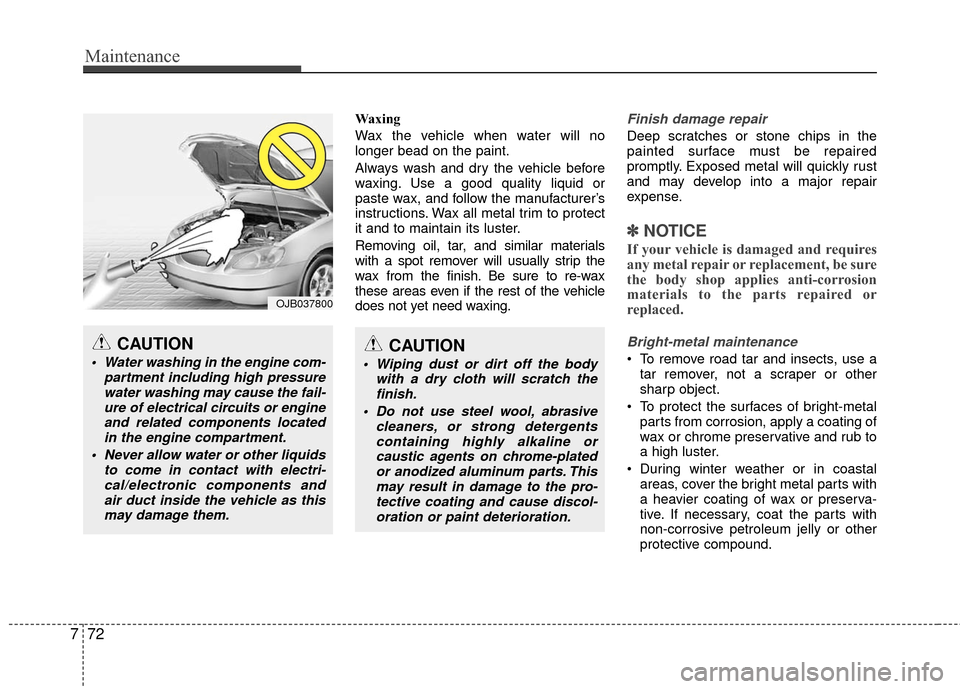
Water washing in the engine com- partment including high pressurewater washing may cause the fail-ure of electrical circuits or engineand related components locatedin the engine compartment.
Never allow water or other liquids to come in contact with electri-cal/electronic components andair duct inside the vehicle as thismay damage them.
OJB037800
Page 451 of 456

Index
4I
Emergency starting··················\
··················\
········6-4
Jump starting ··················\
··················\
···········6-4
Push starting ··················\
··················\
············6-5
Emergency while driving ··················\
··················\
6-2
Emission control system ··················\
················· ·7-76
Crankcase emission control system ··················\
··7-76
Evaporative emission control System ·················7-76
Exhaust emission control system · · · · · · · ···············7-77
Engine ··················\
··················\
··················\
····8-2
Engine compartment ··················\
··················\
······2-4
Engine coolant ··················\
··················\
·········· ·7-23
Engine number ··················\
··················\
············8-7
Engine oil ··················\
··················\
·················7-22
Engine overheats ··················\
··················\
··········6-6
Engine temperature gauge ··················\
··············· ·4-38
Engine will not start ··················\
··················\
······6-3
Evaporative emission control system ··················\
···7-75
Exhaust emission control system ··················\
········7-76
Explanation of scheduled maintenance items ···········7-19
Exterior care ··················\
··················\
··············7-70
Flat tire (with spare tire) ··················\
················· ·6-17
Jack and tools ··················\
··················\
·········6-17
Changing tires ··················\
··················\
······· ·6-18
Compact spare tire ··················\
··················\
·· ·6-23
Removing and storing the spare tire ··················\
·6-18Flat tire (with tire mobility kit)
··················\
··········6-25
Floor mat anchor(s) ··················\
··················\
···· ·4-93
Fluid Brakes/clutch fluid ··················\
··················\
·· ·7-26
Washer fluid ··················\
··················\
·········· ·7-27
Folding the rear seat ··················\
··················\
·····3-11
Front passenger and rear seat belt ··················\
·······3-17
Front seat adjustment ··················\
··················\
···· ·3-5
Fuel filler lid··················\
··················\
··············4-23
Fuel gauge ··················\
··················\
··············· ·4-39
Fuel requirements ··················\
··················\
·········1-3
Fuses ··················\
··················\
··················\
···· ·7-51
Fuse/relay panel description ··················\
··········7-54
Instrument panel fuse ··················\
················· ·7-52
Memory fuse ··················\
··················\
········· ·7-52
Multi fuse ··················\
··················\
··············7-54
Gauge Engine temperature gauge ··················\
············4-38
Fuel gauge ··················\
··················\
············ ·4-39
GA
W (Gross axle weight) ··················\
··············· ·5-48
GAWR (Gross axle weight rating) ··················\
······5-48
Glove box ··················\
··················\
·················4-88
GVW (Gross vehicle weight) ··················\
············5-48
GVWR (Gross vehicle weight rating) ··················\
··5-48
F
G
Page 455 of 456

Index
8I
Spare tireCompact spare tire ··················\
··················\
·· ·6-23
Compact spare tire replacement ··················\
······7-42
Removing and storing the spare tire ··················\
·6-18
Special driving conditions ··················\
··············· ·5-35
Driving at night ··················\
··················\
······ ·5-36
Driving in flooded areas ··················\
···············5-37
Driving in the rain ··················\
··················\
··· ·5-37
Hazardous driving conditions ··················\
········5-35
Highway driving ··················\
··················\
····· ·5-38
Rocking the vehicle ··················\
··················\
· ·5-35
Smooth cornering ··················\
··················\
··· ·5-36
Speedometer ··················\
··················\
··············4-35
SRS components and functions ··················\
··········3-37
Starting difficulties, see engine will not start ·············6-3
Steering wheel ··················\
··················\
··········· ·4-30
Electric power steering ··················\
··············· ·4-30
Horn ··················\
··················\
··················\
· ·4-32
Tilt and telescopic steering ··················\
············4-31
Steering wheel audio control ··················\
·············4-98
Steps For Determining Correct Load Limit ··············5-44
Storage compartment ··················\
··················\
··· ·4-87
Center console storage ··················\
················ ·4-87
Glove box ··················\
··················\
············ ·4-88
Luggage net ··················\
··················\
·········· ·4-89
Sliding armrest ··················\
··················\
······· ·4-87
Sunglass holder ··················\
··················\
······ ·4-88Sunglass holder
··················\
··················\
········· ·4-88
Sunroof ··················\
··················\
··················\
· ·4-26
Sunvisor ··················\
··················\
··················\
·4-90
Tachometer ··················\
··················\
·············· ·4-37
Tailgate ··················\
··················\
··················\
· ·4-14
Tether anchor system ··················\
··················\
··· ·3-30
Tilt and telescopic steering ··················\
··············4-31
Tire and loading information label ··················\
······5-43
Tire chains ··················\
··················\
··············· ·5-40
T
ire mobility kit ··················\
··················\
········· ·6-25
Tire pressure monitoring system (TPMS) ··········6-7, 6-12
Tire specification and pressure label ··················\
·····8-7
Tires and wheels ··················\
··················\
·········7-37
Checking tire inflation pressure ··················\
······7-38
Compact spare tire replacement ··················\
······7-42
Low aspect ratio tire ··················\
··················\
·7-46
Recommended cold tire inflation pressures ··········7-37
Tire care ··················\
··················\
·············· ·7-37
Tire maintenance ··················\
··················\
···· ·7-42
Tire replacement ··················\
··················\
····· ·7-41
Tire rotation ··················\
··················\
·········· ·7-39
Tire sidewall labeling ··················\
················· ·7-43
Tire traction ··················\
··················\
·········· ·7-42
Wheel alignment and tire balance ··················\
···7-40
Wheel replacement ··················\
··················\
·· ·7-42
T